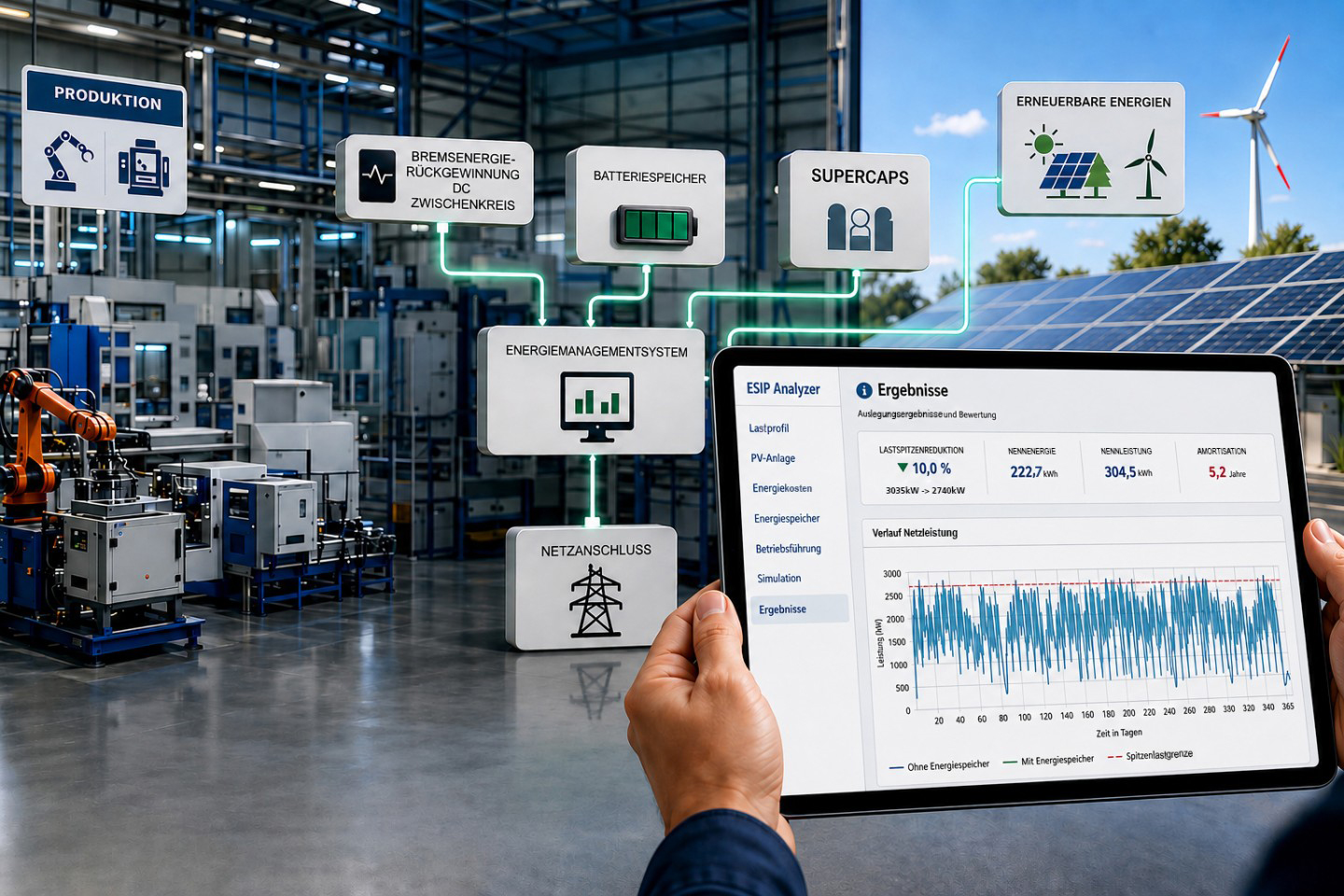
Fraunhofer innovation: How companies can end the expensive energy trap of network charges – Image: Fraunhofer IWU
Up to 15% less electricity consumption: This tool saves factories from gigantic bills
Is your own electricity being wasted? How the new ESiP Analyzer perfectly calculates battery storage capacity
Cutting off expensive peak loads: How factories can massively save on electricity costs with this new tool
The energy transition presents German industry with enormous challenges: While highly dynamic production processes cause extreme and expensive peak loads on the power grid, valuable energy often goes to waste. At the same time, cheaply produced solar power from a company's own rooftops can hardly be used efficiently without suitable batteries. To stop this costly decoupling of generation and consumption, a research consortium led by the Fraunhofer IWU has developed the "ESiP Analyzer." This innovative, technology-neutral simulation tool eliminates the guesswork involved in battery planning. It enables companies to precisely dimension energy storage systems – from individual machines to entire factory halls. Learn how intelligent storage systems can not only drastically reduce grid fees and double self-consumption rates, but also become a decisive competitive advantage on the path to climate-neutral production.
ESiP Analyzer – Intelligent energy storage planning for industry
Factories as energy players: Why the energy transition will fail without storage
The industrial sector accounts for roughly one-third of Germany's total electricity consumption. This structural load is not evenly distributed: Highly dynamic production processes generate extreme power peaks in short intervals, straining the electricity grid, overloading local infrastructure, and incurring significant economic costs in the form of grid fees. At the same time, the increasing share of renewable energies—photovoltaic or wind-based—is fundamentally changing the characteristics of available electricity: Generation and consumption are increasingly less likely to coincide. Companies that invest in a photovoltaic system on their factory roofs but lack suitable storage feed excess electricity into the grid at low feed-in tariffs during sunny midday hours, while drawing expensive grid electricity in the evenings. This decoupling of generation and consumption is not only economically unsatisfactory—it is strategically untenable in light of the declared goal of a climate-neutral industry.
In addition, there is the unique cost structure of industrial grid tariffs in Germany. The grid fee for industrial customers typically consists of an energy charge per kilowatt-hour consumed and a capacity charge for the maximum power used. In the annual capacity pricing system, this capacity charge is calculated based on the highest measured quarter-hourly average of the entire billing year. In other words, a single exceptional peak load—caused, for example, by the simultaneous start-up of several presses or machining centers—determines the capacity charge for the entire year. For industrial customers on the medium-voltage network, capacity charges of over €186 per kilowatt per year can be incurred. The economic rationale behind peak load management is thus obvious.
The research project "Energy Storage in Production" (ESiP), funded by the Federal Ministry for Economic Affairs and Climate Action, addressed precisely this issue. Coordinated by the Fraunhofer Institute for Machine Tools and Forming Technology IWU in Chemnitz, an interdisciplinary consortium was formed between March 2022 and February 2025 with the clear mandate to develop a practical, technology-neutral planning and simulation tool for industrial energy storage systems. The result is called the ESiP Analyzer—a tool designed to enable factories to design energy storage systems not with "generously rounded spreadsheets," but based on robust, production-specific simulations.
How a factory wastes its own electricity — and why previous planning has failed
To understand the conceptual capabilities of the ESiP Analyzer, it is helpful to examine the practical starting point. A typical production plant operating milling and forming machines experiences countless acceleration and deceleration cycles during operation. Highly dynamic drives—such as servo motors on presses or CNC axes—draw power in milliseconds that is many times greater than during steady-state operation. These peaks accumulate at the factory level, resulting in a highly fluctuating load characteristic. To protect against unexpected peaks, companies traditionally oversize their electrical connections—resulting in high fixed costs and poor efficiency under partial load conditions.
At the same time, valuable energy is lost during the braking processes described. Following the principle of recuperation, familiar from electromobility, many industrial drives have so-called DC intermediate circuits in which kinetic energy is converted back into electrical energy during braking. In conventional systems, this braking energy is dissipated as heat via braking resistors—a pure loss. An energy storage system integrated directly into this DC intermediate circuit could capture this energy, store it temporarily, and make it available again during the next acceleration process. This not only reduces power consumption from the grid but also improves the efficiency of the drive itself—a win-win situation.
The real planning challenge lies in the transition from this conceptual understanding to the concrete design decision. Which storage technology is suitable for which machine profile? Does a press-intensive production process require a supercapacitor for fast, short energy pulses or a lithium-ion battery for longer-term intermediate storage? How large must the storage system be to effectively handle the relevant peak load without resorting to economically unviable oversizing? Until now, a standardized, production-oriented methodology for addressing these questions has been lacking. A survey of machine and plant manufacturers explicitly confirmed this need for research. This is precisely where the ESiP Analyzer comes in.
Functionality and simulation architecture of the ESiP Analyzer
The ESiP Analyzer is designed as a design and simulation tool that evaluates energy storage systems across technologies for machines and plants in industrial production. Its methodological core lies in the integration of three knowledge domains: energy storage technology, power electronics, and production technology—reflecting the expert profile of the project consortium, which, in addition to the Fraunhofer IWU, included the Karlsruhe Institute of Technology (KIT) and the companies LioVolt, Skeleton Technologies, EA-Systems Dresden, and Power Innovation Stromversorgungstechnik.
The simulation in the ESiP Analyzer maps various integration levels—from individual machine components to the machine itself and up to the entire factory floor. This multi-level perspective is crucial because optimization measures at the machine level and at the factory level require different storage technologies, different operating strategies, and different economic frameworks. A supercapacitor that absorbs braking energy from a press drive in the millisecond range is fundamentally different, both technologically and economically, from a large-scale stationary lithium-ion battery that stores excess solar power generated at midday for use in the evening.
The operating strategy is a core feature of the simulation. In addition to purely energy-related parameters, the tool also considers production-related factors such as production orders, technological parameters, and load limits, as well as system-related factors such as storage efficiency, thermal behavior, and battery cell aging processes. This integration is crucial because the optimal operating strategy for a storage system cannot be derived solely from the current flow profile: A storage system that must be available for emergency power supply in the evening must not be fully discharged during the day, even if this would maximize the self-consumption rate in the short term. Such boundary conditions can be explicitly modeled in the ESiP Analyzer.
The simulations directly determine relevant key performance indicators: the achievable peak load reduction, the required storage capacity, the expected amortization period, and the potential savings on grid fees. These indicators can be used directly for investment decisions and allow for a transparent cost-benefit analysis even before the first battery unit is purchased.
Handling incomplete data — an underestimated practical advantage
A common obstacle in planning industrial energy storage systems is the availability of data: Meaningful load profiles typically require a complete record of consumption trends over at least one year, ideally in 15-minute intervals. In practice, such data is often lacking—because the energy management system has not yet been implemented, because production fluctuations distort certain periods, or because a company is currently planning a new site for which no historical measurement data yet exists.
The ESiP Analyzer is explicitly designed to handle such data gaps. Missing values in load profiles or yield data are supplemented through appropriate scaling and simulations, ensuring that meaningful analyses remain possible even with incomplete planning information. This robustness against incomplete data is a significant practical advantage, enabling the tool to be used even in early planning phases—before the actual investment decision.
The methodological approach behind this data compensation is based on statistical scaling approaches that recognize type-specific load characteristics for machine categories and production processes. Instead of simply using standard profiles, the existing measured data points are used as anchors to generate synthetic additions that fit the company's specific operating pattern. This approach significantly increases the predictive power of the simulation compared to generic industry averages.
From peak load to the energy market — the diversity of application scenarios
What distinguishes the ESiP Analyzer from simpler peak shaving calculators is the breadth of application scenarios it can model. Classic peak load management—the targeted use of storage to reduce power peaks and thus lower the cost of electricity—is indeed the most economically effective use case, but by no means the only one.
The analyzer also supports the evaluation of scenarios in which the storage system participates in the energy market. Industrial customers with appropriately sized storage systems can offer primary or secondary control reserve and thus generate revenue that goes beyond simply optimizing their own consumption. According to the Federal Network Agency, battery storage systems already provide a significant portion of the primary control reserve in the German electricity grid, with 630 megawatts of prequalified capacity. For industrial companies with sufficient storage capacity, this opens up an attractive additional source of income.
Furthermore, the tool allows for the simulation of integrating an uninterruptible power supply (UPS) for critical production processes. For manufacturing lines where a power outage would cause significant damage—such as in semiconductor production or continuous chemical processes—this application is of high economic relevance. The costs of a conventional diesel generator can then be compared with the costs of a storage system that fulfills this function as a secondary benefit.
Finally, the tool also maps the efficiency gains achieved through regenerated energy at the machine level—the aforementioned recuperation of braking energy in the DC link. This use case is particularly relevant for machine tool-heavy manufacturing environments where highly dynamic axis movements account for a significant portion of total energy consumption.
Innovative photovoltaic solution for cost reduction (up to 30%) and time savings (up to 40%)


Innovative photovoltaic solution for cost reduction and time savings - Image: Xpert.Digital
More information here:
Grid stability as a benefit: How industrial storage can reduce grid expansion and grid fees
Self-consumption rates and profitability — what the figures reveal
The core economic message of the ESiP Analyzer can be substantiated by concrete results: Targeted simulations and optimized operating strategies enable the use of nearly half of the self-generated renewable electricity in some scenarios. This figure—approximately 50 percent self-consumption rate—may initially sound modest, but it must be understood in the context of the typical generation characteristics of photovoltaic systems at industrial sites.
Without storage, the direct self-consumption rate of a PV system on a factory building is often significantly below 30 percent, because peak generation at midday coincides with production times when the load is already well covered, while in the early morning and late afternoon, demand is high but generation is low. A correctly sized and strategically optimized storage system can increase this rate to the described level of nearly 50 percent—and thus dramatically improve the self-consumption advantage.
The economic significance of this increase stems from the price difference between grid electricity and self-generated solar power. For small to medium-sized industrial companies, the average electricity price for new contracts in 2026 is 16.7 cents per kilowatt-hour. Solar power from a self-generated system is available for well under 5 cents per kilowatt-hour for installations that have already been fully depreciated. Every kilowatt-hour of self-generated power consumed instead of being fed into the grid generates a margin of over 10 cents—a sustainable economic advantage that accumulates over the entire lifespan of the system.
According to the Fraunhofer ESiP project, factories that strategically plan their energy storage implementation can realistically achieve savings of up to 15 percent in electricity consumption through intelligent energy storage. This figure is significant for companies with high energy costs: For a medium-sized industrial plant with an annual consumption of 24 gigawatt-hours and standardized grid fees across Germany, annual costs at the grid fee level alone amount to over €750,000—a 15 percent reduction would correspond to annual savings of more than €100,000, in addition to savings on energy procurement.
Grid stability as a collective benefit — the macroeconomic effect of industrial storage
The benefits of the ESiP Analyzer and the storage integration it enables are not limited to individual companies. Industrial storage systems make a measurable contribution to grid stability. The "smoothed" consumption—that is, the stabilization of a previously highly fluctuating load profile—relieves the distribution grid, reduces the need for balancing energy interventions, and mitigates the power quality problems that can arise from impulsive loads.
From an economic perspective, this effect is considerable. The untapped load reduction potential of industrial sites in Germany amounts to 5.2 to 5.6 gigawatts—a capacity that could be activated through appropriate storage integration and would significantly reduce the need for grid expansion. Grid expansion is expensive: the costs are ultimately passed on to all consumers via grid fees. Every kilowatt-hour that doesn't have to be transported through the grid as a peak load thanks to industrial storage therefore lowers costs for everyone in the medium term.
The political framework is increasingly recognizing this connection. In 2026, the German Federal Government provided a state subsidy of €6.5 billion to transmission system operators to stabilize grid fees. At the same time, the Renewable Energy Sources Act (EEG) 2024 clarified the funding guidelines for energy storage and increased the subsidy rate to 30 percent for long-term storage systems with a discharge duration of at least 10 hours. These political signals demonstrate that legislators no longer view energy storage as a niche product, but rather as system-critical infrastructure.
The market is responding to these trends: The German battery storage market kicked off 2026 with a bang—in the first quarter, more than two gigawatt-hours of newly installed storage capacity were installed, representing a 67 percent increase compared to the same period of the previous year. In the industrial segment, revenue rose from €1.3 billion to €1.6 billion in 2024, a growth of 23 percent, and market analyst Blaurock described the industry as a "sleeping giant that everyone is waiting for to spring into action." The global market for industrial energy storage systems is projected to grow at an annual growth rate of 21.2 percent, increasing from approximately US$9.9 billion in 2026 to nearly US$56 billion by 2035.
Licensing model and usage paths — how companies can use the Analyzer
Fraunhofer IWU has designed the ESiP Analyzer for various use cases and offers flexible access options. For companies requiring a one-time, in-depth analysis of their energy status and seeking recommendations for specific investment decisions, individual project agreements are available that incorporate the expertise of Fraunhofer IWU researchers. This approach is particularly recommended for complex sites with multiple production lines, diverse energy sources, and demanding operating profiles.
For companies that want to permanently integrate the analyzer into their energy management system, licensing agreements for continuous use are available. Energy suppliers and industrial companies have already tested the ESiP Analyzer in practice, and according to Fraunhofer IWU, the field test was "passed with flying colors." This practical validation is crucial: simulation tools developed exclusively under laboratory conditions often fail in industrial applications due to the heterogeneity of real-world production environments.
For energy suppliers, the tool offers a unique dimension: they can use it to provide their industrial customers with concrete, data-driven recommendations for storage solutions, thereby expanding their consulting services. Given the competitive pressure in the energy supply market and the growing industrial demand for integrated energy solutions, this is a strategically valuable approach.
The second life of batteries — the dismantling plant as a logical extension
In the context of ESiP research, it is no coincidence that Fraunhofer IWU is simultaneously working on another topic addressing the circular economy of industrial energy storage: the automated dismantling of traction batteries. Together with EDAG Production Solutions, a pilot plant is being built in Chemnitz that can automatically dismantle high-voltage batteries from electric vehicles down to the cell level. Operation is planned for August 2026.
The conceptual link between the ESiP Analyzer and this dismantling facility lies in the resource logic: A growing inventory of stationary industrial energy storage systems requires long-term recycling solutions. At the same time, used traction batteries from electric vehicles, no longer suitable for automotive use, can find a second life as stationary intermediate storage in factories—provided their health and remaining capacity can be reliably assessed. This is precisely what the AI analysis module integrated into the Chemnitz facility does: It evaluates the state of health (SoH) of individual battery cells and automatically decides on their further use, reconditioning, or material recycling.
The plant also operates according to the principles of "Design for Recycling"—a principle that requires new battery systems to be designed from the outset so that they can be economically dismantled at the end of their service life. A battery module that can be disassembled without damage demonstrates such a system. This is economically significant because the profitability of battery recycling depends largely on the complexity of disassembly. Systems constructed with adhesives, permanent connections, or inaccessible modules result in such high disassembly costs that recycling remains uneconomical despite the valuable raw materials they contain.
Supercapacitors, lithium-ion batteries and bipolar batteries — the technology dimension
A key quality feature of the ESiP Analyzer lies in its technology neutrality. The tool considers all common energy storage technologies and evaluates them depending on the specific application scenario. This neutrality is not a given in the market: Many commercial planning tools are developed by providers of a particular storage technology and naturally tend to favor their own product category.
The range of relevant technologies is considerable. Supercapacitors (ultracapacitors) — represented in the project consortium by Skeleton Technologies — are ideal for applications with very high power density and short cycle times: the recuperation of braking energy in the millisecond range, the smoothing of high-frequency power peaks, or short-term bridging during the start-up of large drives. Their weakness lies in their low energy density — they are not suitable for the intermediate storage of solar power for hours at a time.
Lithium-ion batteries in various chemical formulations, on the other hand, offer high energy density with moderate power density. LioVolt, another partner in the ESiP project, specializes in lithium-ion bipolar batteries—a technology that, by eliminating conventional conductive foils, enables a more compact design and reduces the internal resistance of the cell stack. For stationary storage in the hourly to daily range, such batteries are currently the most economically attractive option.
The intelligent combination of different storage technologies in so-called hybrid storage systems—typically a battery for energy storage and a supercapacitor for peak power demands—is another use case that the ESiP Analyzer can model. Such hybrid architectures protect the battery from the extreme stresses of high-frequency charging cycles, significantly extending its lifespan and improving the overall economic efficiency of the storage system.
Design accuracy as a strategic competitive advantage
Perhaps the most underestimated benefit of the ESiP Analyzer lies not in maximizing storage capacity, but in the precision of its design. Oversized energy storage systems are not only expensive to purchase, but they also generate unnecessary ongoing costs through maintenance, operation, and capital appreciation. Undersized systems, on the other hand, cannot meet the set goals—peak load reduction, self-consumption rate, emergency power supply—and disappoint the investment expectations.
The three-stage design process—data analysis for parameter extraction, optimization procedures for determining storage data, and simulation of the resulting load profiles—follows a scientifically sound logic specifically developed to consider the characteristic parameters of the respective load profile, not generic industry averages. With battery sizes of 60 to 100 kilowatt-hours, peak load reductions of ten to 16 percent have already been achieved in pilot plants, with payback periods of less than five years in favorable scenarios.
This level of design accuracy has strategic implications that extend beyond individual storage projects. Companies that plan their energy infrastructure precisely create the foundation for a flexible, long-term energy strategy: They can expand storage gradually, test various business models—balancing power, self-consumption optimization, arbitrage—and respond to changing conditions. The energy transition in industry is not a one-off investment event, but a continuous process of adapting to a changing energy infrastructure. Tools like the ESiP Analyzer provide the analytical basis for this process—and thus a genuine strategic competitive advantage for the companies that use them.
🎯🎯🎯 Data-driven B2B industry hub as a quasi-in-house solution


The quasi-in-house solution: How Xpert.Digital closes operational gaps in B2B marketing and sales – Smart Content-Driven Business - Image: Xpert.Digital
Xpert.Digital is a data-driven B2B industry hub led by Konrad Wolfenstein . The company acts as an external, quasi-in-house solution for industrial partners, closing operational gaps in marketing, content, and sales – without requiring additional resources on the client side.
More information here:
Your global marketing and business development partner
☑️ Our business language is English or German
☑️ NEW: Correspondence in your native language!

Konrad Wolfenstein
I and my team are happy to be available to you as your personal advisor.
You can contact me by filling out the contact form here wolfenstein@xpert.digital:or simply call me at +49 7348 4088 965. My email address is
I'm looking forward to our joint project.