
The US AI Trap: Why the EU AI Act is suddenly becoming Europe's strongest weapon – Image: Xpert.Digital
Gigantism is a thing of the past: Europe is now attacking with this ingenious AI plan
Europe's secret AI revolution: How Mistral and Aleph Alpha are outsmarting the US giants
Europe seems to have long since lost the artificial intelligence race against the US and China – or so the prevailing narrative goes. While US tech giants are pumping hundreds of billions into gigantic data centers and launching increasingly powerful general-purpose language models like ChatGPT, the old continent appears to lack the necessary innovative capacity. But this impression is wildly misleading. Europe hasn't lost the race; it has strategically changed the playing field. With highly specialized industrial solutions, radical efficiency à la Mistral AI, clever realignments like those seen in Aleph Alpha, and a regulatory framework that has suddenly become a global competitive advantage, Europe is building its own sovereign AI future. Why foregoing gigantism is not a defeat, but a brilliant plan – and how the much-maligned EU AI Act is becoming the crucial catalyst.
Europe's AI strategy: Not the biggest, but the most appropriate
No ChatGPT from Frankfurt – and that's not a defeat, but a plan
The global development of AI can be told in numbers, and these numbers are unequivocal: In 2025, companies headquartered in the USA launched 43 new, relevant AI models. Dozens more came from China, including DeepSeek and Alibaba's Qwen series, which, according to experts, have effectively caught up with the United States' technological lead in certain disciplines such as mathematics and programming. Europe? Just a single new model that was classified as globally relevant in 2025. Anyone who concludes from this that Europe has simply failed in the AI race is drawing the wrong conclusion. The correct interpretation is more complex – and more interesting.
Asymmetric competition: What the numbers really say
To understand why Europe cannot and does not want to win this competition, one need only look at the infrastructure. Meta announced plans to invest between 60 and 65 billion US dollars in expanding its AI infrastructure by 2025 and increasing its GPU capacity to around 1.3 million processors. At the same time, Deutsche Telekom opened its new AI factory in Munich's Tucherpark – equipped with 10,000 latest-generation NVIDIA GPUs and a computing power of 0.5 exaflops. This offering is quite remarkable by European standards: the construction of this data center alone increases Germany's total AI computing capacity by around 50 percent. Nevertheless, the direct comparison highlights the extent of the structural asymmetry: on the one hand, a company with over a million GPUs, on the other, a national flagship project with 10,000.
These figures might lead one to conclude that Europe is engaged in the same competition as the US and China, only with far fewer resources. But this narrative falls short. Europe is not competing in the same way. It is competing – increasingly consciously and strategically – in a different way.
Eighty-six percent of all global data center capacity is located in the US and China. Anyone who believes Europe can close this gap in just a few years through government subsidies and national champions is ignoring not only the financial reality but also the political structure of a union of 27 states with divergent budgets and different industrial priorities. The question, therefore, is not whether Europe has lost the race for the largest language model. The question is: Which race can Europe win?
The Aleph Alpha Case: A Lesson in Strategic Reorientation
No case illustrates Europe's AI dilemma more clearly than Aleph Alpha. For years, the Heidelberg-based startup was touted as Europe's answer to OpenAI. With around €500 million in raised capital, the goal was to create a German baseline model that could compete internationally. The ambition was realistic, the vision understandable – and the disillusionment inevitable.
In 2024, CEO Jonas Andrulis made a public strategic shift that was remarkable in its clarity. He explained to Bloomberg that having a European LLM was simply not a sufficient business model and did not justify the investment. The large, general-purpose model generated too little revenue and too many losses. Aleph Alpha realigned itself: away from competing for the largest speech AI, towards an orchestration platform for businesses and government agencies. The product PhariaAI was conceived as an operating system for generative AI, supporting government agencies, defense forces, and regulated industries in the secure and sovereign use of AI.
This realignment is anything but a quiet retreat. In April 2026, the merger with the Canadian AI company Cohere was announced. The new joint venture, with offices in both Canada and Germany, is valued at approximately US$20 billion. Following the transaction, Cohere holds about 90 percent of the shares, while the former Aleph Alpha shareholders retain around ten percent. The Schwarz Group – parent company of Lidl and Kaufland and previously holding a 28 percent stake in Aleph Alpha – is investing a further €500 million in the next financing round. What convinced Cohere about the transaction was not Aleph Alpha's general-purpose model, which had failed to meet market expectations, but rather its specialization: expertise in European languages, regulated markets, and compliance-sensitive government applications.
Whether this should be seen as a consolation prize or a genuine strategy can only be honestly answered as follows: It is both at the same time. The original aim of creating a European competitor to ChatGPT has failed. However, what has emerged has its own intrinsic value – and happens to hit precisely the niche in which Europe can succeed in the long term.
Mistral AI: Efficiency as a core strategy
While Aleph Alpha found its way through defeat, the Paris-based company Mistral AI pursued a different philosophy from the outset. Mistral combines uncompromising technical performance with a radical focus on efficiency and cost structure. Its Large-3 model, released in December 2025, utilizes a mixture-of-experts architecture with 41 billion active parameters and 675 billion total parameters. The price: $0.50 per million input tokens and $1.50 per million output tokens – a significant saving compared to GPT-5 ($1.25 for input, $10 for output), which can be crucial for high-volume industrial applications.
Mistral has thus proven that it is possible to develop competitive language models without having the resources of the US hyperscalers. The model was trained with significantly less GPU capacity than comparable American products – and yet it performs as a serious alternative in market-relevant benchmarks.
In March 2026, Mistral announced that it had raised $830 million in debt financing from a consortium of Bpifrance, BNP Paribas, HSBC, and MUFG. The funds will be used to build its own data center in Bruyères-le-Châtel, south of Paris. Equipped with 13,800 NVIDIA Grace Blackwell GB300 GPUs, the data center will have a capacity of 44 megawatts. It is scheduled to go online in the second quarter of 2026. Simultaneously, another facility with 10 megawatts of capacity is being built in Les Ulis, Sweden. Overall, Mistral plans to provide 200 megawatts of computing capacity across Europe by 2027 and scale up to one gigawatt by 2030. The total long-term investments amount to up to four billion euros.
Particularly noteworthy is the financing structure: Instead of issuing new company shares, Mistral opted for debt financing. This preserves its independence and control over its strategic direction – a deliberate counterpoint to its capital-hungry US competitors, whose independence is effectively curtailed by billions in investments from Microsoft, Amazon, or Google. Mistral has also secured partnerships with Airbus, BMW, and ASML, thereby demonstrating the company's strong industrial roots in the European economy.
SOOFI: Europe's open-source answer for industry
While Aleph Alpha and Mistral operated as private companies, another project is emerging in the state-funded sector that receives little international attention but is strategically important for Europe's industrial AI sovereignty: SOOFI, short for Sovereign Open Source Foundational Models for European Intelligence.
A consortium of leading German research institutions, including TU Darmstadt, the Berlin University of Applied Sciences, and others, is developing a fully open AI base model with approximately 100 billion parameters. Its key features are clearly defined: the model supports 24 European languages, is designed from the outset to meet the requirements of the EU AI Act, and makes the training data sources publicly accessible. The German Federal Ministry for Economic Affairs and Climate Action is funding the project with €20 million. The project runs from October 2025 to the end of June 2026, with a planned release in the third quarter of 2026.
Twenty million euros seems ridiculously small compared to the billions invested by US and Chinese AI companies. But SOOFI's value lies not in its financial size, but in its focus. An open-source model that is transparent, verifiable, multilingual, and compliant by design fulfills precisely the requirements that are essential in regulated sectors such as healthcare, pharmaceuticals, the justice system, and public administration. The major US models often fail to meet these requirements—not because they are technically inferior, but because they were structurally and regulatoryly built for a different market.
The EU AI Act: Burden or structural advantage?
Those who view the European AI regulatory framework solely as a burden overlook its strategic dimension. From August 2, 2025, the regulations of the EU AI Act will apply to General Purpose AI (GPAI) models – that is, to all major language models offered on the European market. These obligations include technical documentation, transparency regarding training data, copyright compliance, and – for models with systemic risk – independent model assessments, reporting obligations for serious incidents, and enhanced cybersecurity requirements.
For US and Chinese models, this means significant retrofitting costs and organizational adjustments. For European models, which were developed with this framework in mind from the outset, it means no additional effort. Compliance is not an add-on, but an integral part of the architecture. Market analysts increasingly consider this structural difference to be a competitive advantage. Companies in regulated industries that use AI systems and must comply with regulations have a strong incentive to choose suppliers whose products already meet European requirements – rather than investing heavily in retrofitting US models.
The full high-risk AI regulations will come into effect in August 2026. The clock is ticking, and the disadvantage of late compliance grows with every week that American providers operate without this compliance burden. Furthermore, the AI Act could eventually become a global standard—much like the GDPR, which was initially ridiculed as a European peculiarity and is now considered the global benchmark for data protection laws. Whoever is the first to fully master this framework will have a real market advantage.
In January 2026, the European Commission clarified that funding should be preferentially allocated to AI architectures that go beyond current Large Language Models. Small Language Models, neuro-symbolic systems, and specialized engineering models are prioritized over consumer-oriented chatbots because they are easier to test, control, and certify for high-risk applications.
A new dimension of digital transformation with 'Managed AI' (Artificial Intelligence) - Platform & B2B solution | Xpert Consulting

A new dimension of digital transformation with 'Managed AI' (Artificial Intelligence) – Platform & B2B solution | Xpert Consulting - Image: Xpert.Digital
Here you will learn how your company can implement customized AI solutions quickly, securely and without high entry barriers.
A managed AI platform is your all-inclusive, worry-free solution for artificial intelligence. Instead of dealing with complex technology, expensive infrastructure, and lengthy development processes, you receive a ready-made solution tailored to your needs from a specialized partner – often within just a few days.
The key advantages at a glance:
⚡ Rapid implementation: From idea to ready-to-use application in days, not months. We deliver practical solutions that create immediate added value.
🔒 Maximum data security: Your sensitive data stays with you. We guarantee secure and compliant processing without sharing data with third parties.
💸 No financial risk: You only pay for results. High upfront investments in hardware, software, or personnel are completely eliminated.
🎯 Focus on your core business: Concentrate on what you do best. We take care of the entire technical implementation, operation, and maintenance of your AI solution.
📈 Future-proof & scalable: Your AI grows with you. We ensure continuous optimization and scalability, and flexibly adapt the models to new requirements.
More information here:
AI sovereignty: Where EU models score points against hyperscalers
Europe's AI Continent Action Plan: Structural Ambitions
Europe's institutional response to the AI challenge is the AI Continent Action Plan, presented by the European Commission in April 2025. The program aims to make the EU the world's leading force in artificial intelligence – a claim that sounds bold given the current state of resources, but is strategically sound.
At least 13 operational AI factories are to be established in Europe by 2026. A budget of €10 billion from EuroHPC funds will be invested in high-performance computing infrastructure until 2027. This will be complemented by so-called AI gigafactories, which are intended to be four times more powerful than regular factories. The investment vehicle InvestAI is mobilizing a further €20 billion for this purpose. By 2030, the EU's data center capacity is to be tripled.
In parallel, France is positioning itself as a European pioneer: At the AI Action Summit in February 2025, the French government announced €109 billion in AI infrastructure investments – the most ambitious sovereign AI program outside the US and China. This announcement must be seen in the context of a geopolitically changing world in which technological dependencies are increasingly considered security risks. Russia's war of aggression against Ukraine and the growing geopolitical tensions between the US and China have sensitized European policymakers to the risks of relying on external technology infrastructure.
The real race: precision over number of parameters
It is helpful not to view global AI development as a one-way street towards ever larger models. The year 2025 demonstrated that China, with limited computing power, was able to develop models that could compete with their US counterparts – DeepSeek being the most prominent example. The realization that sheer scale alone is no guarantee of superiority opens up conceptual space for alternative approaches.
Europe's approach combines three structural advantages: industrial depth, regulatory fit, and linguistic diversity. No other global market boasts a comparable density of highly specialized industrial companies – from German mechanical engineering and Scandinavian pharmaceuticals to Italian manufacturing. These companies don't need omniscient chatbots, but rather precise, verifiable, and secure AI tools for specific use cases. The market for these applications is real and growing.
This is precisely where something is emerging that large-scale US models cannot structurally deliver. A language model specializing in public procurement law, available in 24 EU languages, fully compliant with the AI Act, disclosing its training data, and running on European infrastructure – this is not a feature of an American AI platform. This is a standalone product for a market that hyperscalers cannot or do not want to fully serve for regulatory and economic reasons.
The question of whether Europe's approach is a consolation prize or a genuine strategy is wrongly posed. A consolation prize would be if Europe were to compete in the same way as the US and lose. That is not happening. Europe is choosing – partly out of necessity, partly out of conviction – a different playing field. And on this playing field, the rules are different: compliance, transparency, multilingualism, and data sovereignty are not obstacles, but rather barriers to entry that others cannot so easily overcome.
Open flanks: What Europe has not yet solved
However well-structured the European strategy may appear on paper, its implementation is fraught with considerable risks. The first is speed. Regulatory frameworks and institutional processes operate on different timescales than technological innovation. If the EU AI factories are to be established by 2026, but the applications only reach market maturity in 2027 or 2028, American providers could use the transition period to catch up on their compliance shortfalls.
The second risk lies in fragmentation. Europe is not a unified market when it comes to sensitive data, government procurement, and defense. Developing separate German, French, and Danish language models for government applications may create local sovereignty, but it doesn't create a scalable European market. SOOFI, with its 24 EU languages, addresses this problem—but a research project with €20 million in funding cannot replace an industrial strategy.
The third risk is capital structure. Mistral is currently the most compelling example of a European AI company that combines efficiency and quality. With a valuation of €11.7 billion and a total of $3.9 billion in funding raised, the company is well-capitalized – but this is still a fraction of the resources available to OpenAI, Google DeepMind, or Anthropic. If AI development moves in directions that require significant investment – such as multimodal reasoning or autonomous AI agents – Mistral could find itself in a situation where its structural efficiency is no longer sufficient.
Geopolitics as a catalyst: Europe caught between the camps
Europe's AI strategy is not just technology policy – it is geopolitics. The increasingly palpable uncertainties in transatlantic relations under the Trump administration have heightened European policymakers' awareness of technological dependencies. Cloud services, language models, and data center capacities running on US infrastructure and operating under American law represent potential vulnerabilities in a world of heightened geopolitical tensions.
At the same time, China is not an option. Chinese AI models are becoming increasingly competitive technically – but for European companies and authorities, they are not a real alternative due to data sovereignty, counter-espionage, and compatibility of values. Europe sits between two camps and thus – if used correctly – has a unique positioning advantage: It can be the trusted technological partner for markets that are unwilling or unable to trust either US or Chinese products. These include parts of Africa, Latin America, Southeast Asia, and the Middle East – markets that are increasingly seeking a third way.
83 percent of Chinese companies already use generative AI, compared to 65 percent in the US and 70 percent in Europe. The adoption rate in Europe is therefore higher than often assumed. What's lacking is not demand, but a trustworthy, sovereign supply. And that's precisely what Europe is currently building – fragmented, too slowly, and with too little capital, but moving in the right direction.
A bet on a perfect fit
Europe will not build its own ChatGPT. The necessary infrastructure is lacking, the capital is lacking, and the political will for the required public investment is limited – except in France. Acknowledging this is not defeatism, but a realistic assessment of the situation.
What Europe is building instead is an ecosystem of specialized models, regulatory-compliant infrastructure, and industry-rooted applications that serves a market the American hyperscalers cannot fully address. Mistral AI proves that technological competitiveness is possible without scaling mania. Aleph Alpha shows—albeit by a painful detour—that the shift from general-purpose AI to specialized solutions can be strategic rather than a defeat. SOOFI demonstrates that publicly funded, transparent models for industrial applications can form a distinct class.
The EU AI Act is not a hindrance, but rather a differentiating factor: European suppliers that meet its "Compliance by Design" standard will have a structural advantage in regulated markets worldwide. Companies facing the decision from August 2026 onwards of whether to use expensively retrofitted US models or compliant European solutions from the ground up will take this difference into account in their procurement decisions.
Europe has lost the race for the largest language model – without ever seriously competing in it. The race for the most trustworthy, industry-specific, and regulatory-compliant model for European industry has only just begun. And in this race, the starting conditions are surprisingly favorable.
🎯🎯🎯 Data-driven B2B industry hub as a quasi-in-house solution

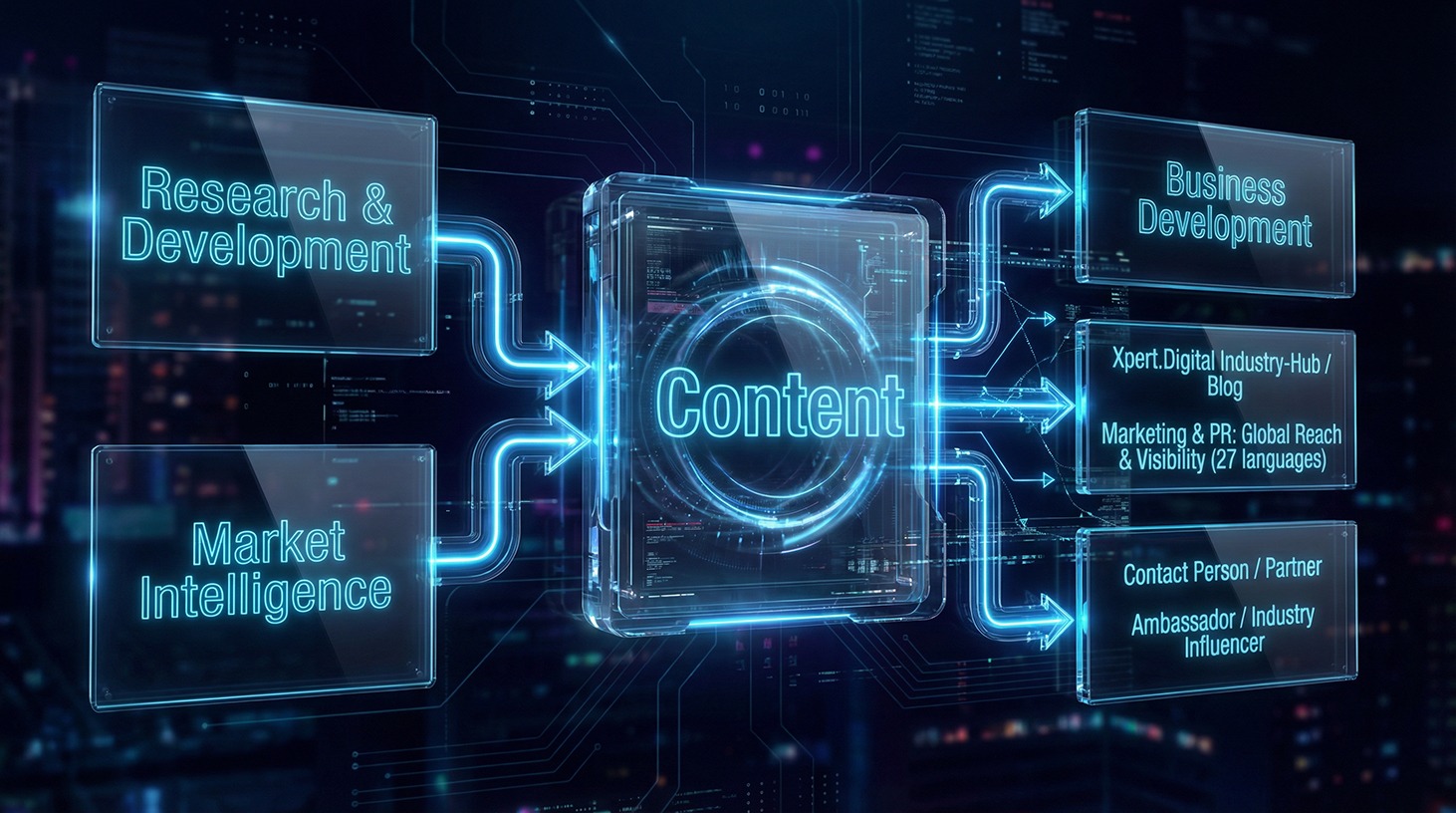
The quasi-in-house solution: How Xpert.Digital closes operational gaps in B2B marketing and sales – Smart Content-Driven Business - Image: Xpert.Digital
Xpert.Digital is a data-driven B2B industry hub led by Konrad Wolfenstein . The company acts as an external, quasi-in-house solution for industrial partners, closing operational gaps in marketing, content, and sales – without requiring additional resources on the client side.
More information here:
Your global marketing and business development partner
☑️ Our business language is English or German
☑️ NEW: Correspondence in your native language!

Konrad Wolfenstein
I and my team are happy to be available to you as your personal advisor.
You can contact me by filling out the contact form here wolfenstein@xpert.digital:or simply call me at +49 7348 4088 965. My email address is
I'm looking forward to our joint project.