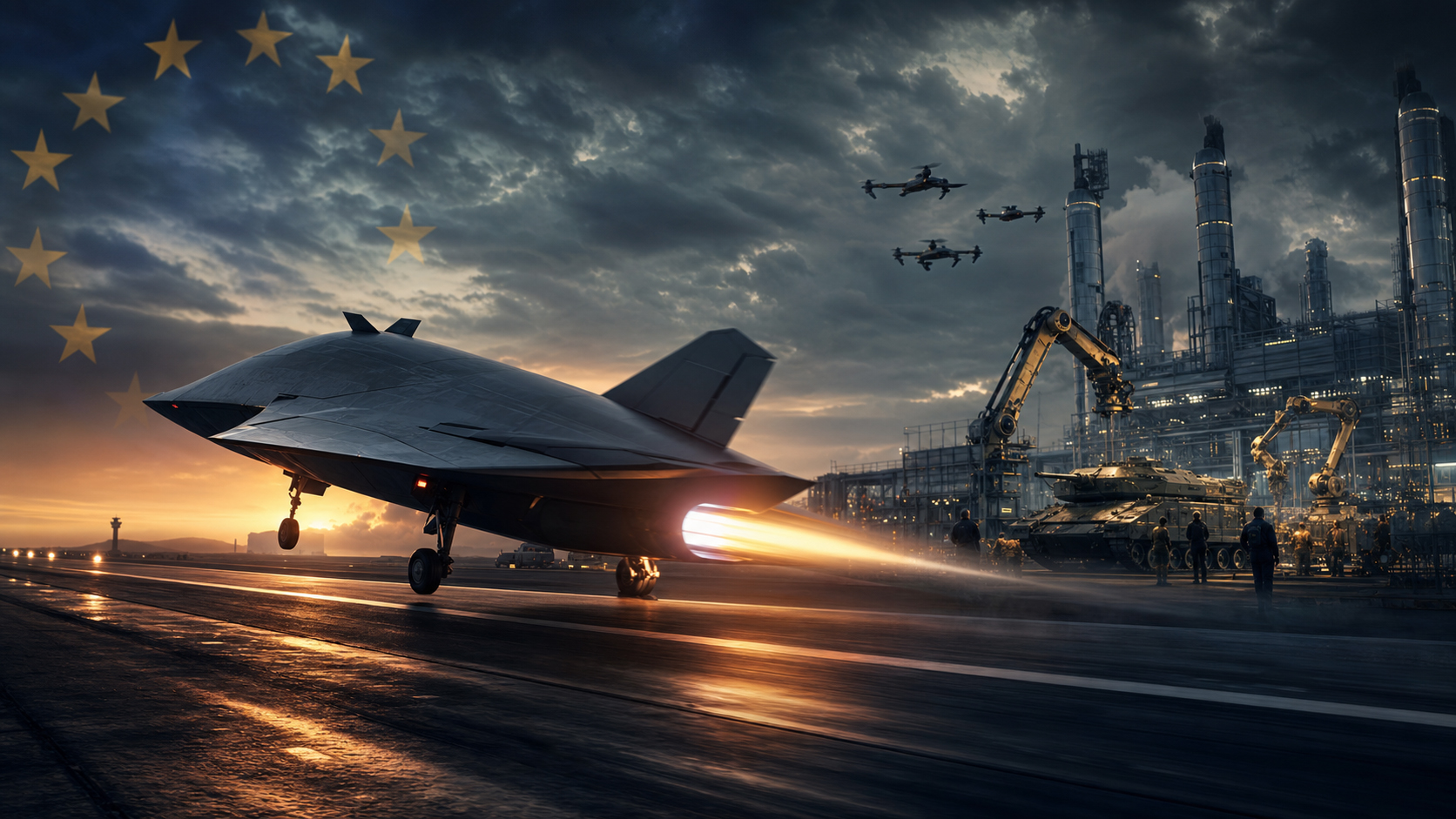
Sparta 2.0 – Europe's defense-industrial rebirth and radical master plan for a new military superpower – Image: Xpert.Digital
The end of the old arms giants? How startups like Helsing are shaking up the arms industry
800 billion for security: How Europe is secretly preparing for a worst-case scenario
For decades, Europe comfortably relied on the US for its security needs. But Russia's war of aggression, geopolitical upheavals, and rapid technological development have triggered a radical wake-up call. The continent's response has a name: "Sparta 2.0"—an ambitious, strategic, and industrial master plan that is fundamentally redefining Europe's defense. At the heart of this revolution are no longer primarily cumbersome arms giants, but agile technology startups like Helsing and Quantum Systems. With artificial intelligence, drone swarms, and hypersonic weapons, they are rewriting the rules of military procurement at breathtaking speed. Fueled by a gigantic €800 billion EU funding package, the continent is currently experiencing a defense industry renaissance. Nothing less than Europe's technological sovereignty in a turbulent world order is at stake. Read on to learn how this radical transformation is working, which players stand to benefit massively, and why the old arms-building logic is obsolete.
Ending US dependence: The 10-year plan for Europe's new defense
For thirty years, Europe outsourced its security. Washington bore the burden, NATO provided the framework, and European governments readily wrote smaller checks to the American defense apparatus. This arrangement is over. The combination of Russia's war of aggression against Ukraine, the Trump administration's strategic withdrawal from the transatlantic guarantee architecture, and the technological rise of non-Western powers has marked a turning point comparable in its historical significance to the end of the Cold War—only in reverse. Europe is rearming, and this time it is doing so with an industrial, technological, and doctrinal seriousness that was previously lacking.
The framework for this transformation has been given a name: Sparta 2.0. What initially circulated as a buzzword has evolved into a serious strategic framework. In May 2026, the Kiel Institute for the World Economy published a paper of the same name, signed by prominent figures from business, technology, and security policy – including former Airbus CEO Thomas Enders, former Deutsche Telekom board member René Obermann, economist and Kiel Institute president Moritz Schularick, security expert Nico Lange, and investor Jeannette zu Fürstenberg. The core thesis is as simple as it is provocative: Europe can close its key strategic capability gaps – and do so within a decade, at an additional cost of around €500 billion, or approximately €50 billion per year.
Sparta 2.0 is not an official EU or NATO program
Sparta 2.0 is a position paper from a private group of experts — but one with considerable weight.
The paper was published on May 6, 2026 by the Kiel Institute for the World Economy and bears the signatures of five prominent figures:
- Thomas Enders (former Airbus CEO, now Chairman of the Board of Directors of the defense company KNDS and President of DGAP)
- Moritz Schularick (Professor of Economics and President of the Kiel Institute)
- Nico Lange (security expert and political advisor)
- René Obermann (former CEO of Deutsche Telekom, Chairman of Airbus)
- Jeannette zu Fürstenberg (investor)
It is a continuation of an earlier paper called SPARTA (Strategic Protection and Advanced Resilience Technology Alliance), which was published in March 2025. Sparta 2.0 is therefore the updated, more in-depth version.
Although it is not a government initiative, it is by no means without political consequences: According to the authors themselves, it largely aligns with calculations by the US think tank CSIS, and the authors operate at the highest levels between industry, politics, and academia. The LinkedIn post from which your source text is taken apparently adopted the paper as a strategic narrative and linked it to specific technology companies (Helsing, Quantum Systems, etc.)—this is a free, thematically expanded interpretation of the original, not a direct quotation from it.
In short: Sparta 2.0 is an influential, high-profile think tank paper with aspirations to have a political impact — but it is not a binding or official program.
The financial framework: 800 billion euros as a starting point
On March 4, 2025, European Commission President Ursula von der Leyen presented the "ReArm Europe" program – a five-part financing instrument designed to mobilize up to €800 billion for European defense. The package is cleverly structured: the largest portion – around €650 billion – is to be released by activating national escape clauses in the EU Stability and Growth Pact. Member states are permitted to increase their defense spending without automatically risking an excessive deficit procedure if they raise their expenditures by an average of 1.5 percent of GDP. In addition, €150 billion will be provided in the form of direct EU loans for joint procurement projects in areas such as artillery, missiles, ammunition, drones, and drone defense.
This figure is impressive, but should also be interpreted with caution. A significant portion of the 800 billion euros is not new money, but rather budgetary leeway that must first be translated into actual investments through political decisions by the individual member states. The fragmentation of European defense spending across 27 national budgets is a structurally complex challenge. Nevertheless, the political message is clear. In December 2025, the European Parliament adopted accompanying legislation that opens up existing EU programs such as Horizon Europe, the European Defence Fund, and the Connecting Europe Facility to dual-use spending and enshrines defense technology as the fourth strategic sector in the STEP platform. The institutional groundwork has thus been laid.
According to the Sparta 2.0 paper, every euro invested in advanced defense technology can generate up to €1.50 in added economic value. This is not a minor aspect: European defense reindustrialization is not only essential from a security policy perspective, but also economically viable. Investments in semiconductors, software architectures, satellite technology, and autonomous systems create spillover effects into the civilian economy, which have historically proven to be one of the most effective drivers of technological innovation.
The doctrine: Five pillars of a new defense philosophy
Sparta 2.0 is not a procurement initiative. It is a doctrine, and as such, it is based on a coherent conceptual foundation. Five principles constitute the strategic thinking behind the initiative.
The first principle is: sovereign technology stacks across all key areas. Europe must be able to design and produce microchips, operate its own communication systems, write its own software for command and control and weapons systems, and achieve kinetic impact using its own resources. Dependence on US or other foreign suppliers in any of these areas is a strategic vulnerability that makes Europe susceptible to political blackmail in crisis situations. The experiences with the Trump administration—especially the temporary suspension of military aid to Ukraine in early 2025—made this lesson bitterly clear.
The second principle is the radical acceleration of procurement cycles. Traditional European arms procurement operates on time horizons of a decade. That is no longer sufficient. Ukraine has shown that war can now be redefined industrially in months. Sparta 2.0 demands procurement cycles that are compressed from years to months – a paradigm shift that necessarily requires closer cooperation between government clients and private technology companies.
The third principle is Dual Use by Design: technologies are designed from the outset to serve both civilian and military applications. The European Commission has already institutionally enshrined this concept – Horizon Europe now explicitly supports civilian applications with potential military benefits. The VDI (Association of German Engineers) identified 14 emerging dual-use technologies, including artificial intelligence, hyperspectral imaging, quantum technologies, and autonomous systems, as strategically relevant development areas in the medium term.
The fourth principle concerns seamless interoperability within NATO and the EU. Scalability can only be achieved if systems from different manufacturers and countries work together smoothly. Software-defined defense—the ability to modernize defense platforms through software updates instead of expensive hardware replacements—is the technological foundation of this approach. This strengthens competition, reduces costs, and increases responsiveness.
The fifth principle is cultural in nature: Founder-led companies are replacing established defense corporations as drivers of innovation. This shift is more profound than it might initially appear. It doesn't mean the end of industrial giants like Rheinmetall, Airbus, or Leonardo. But it does mean that these corporations will increasingly serve as production and integration bases, while technological leadership lies in the hands of smaller, agile startups—companies like Helsing, Quantum Systems, Hypersonica, or ARX Robotics.
Helsing: The flagship of a new paradigm
No company embodies the Sparta 2.0 narrative as precisely as Helsing. Founded in Munich in 2021 by Torsten Reil, Gundbert Scherf, and Niklas Köhler, this defense technology company, which originated from an AI software focus, has become the most valuable German start-up in less than five years – with a valuation of around twelve billion dollars and total funding of over 1.37 billion euros.
Helsing's technology portfolio is broader today than that of some mid-sized defense companies. Altra is an AI-powered reconnaissance and attack system – the nervous system for network operations. Cirra analyzes electronic warfare threats in real time. Centaur is the AI pilot system that has already flown in the Saab Gripen fighter jet and is intended to form the software basis for the CA-1 Europa unmanned combat aircraft. The HX-2 is an attack drone with a range of up to 100 kilometers, of which the German Federal Government has ordered 4,000 for Ukraine. In the area of maritime defense, Helsing presented the Lura system and the autonomous underwater glider SG-1 Fathom in May 2025: Lura, an AI software platform based on large acoustic neural networks, can detect acoustic signatures ten times quieter than competing systems and perform classifications forty times faster than human operators.
The company's flagship is the CA-1 Europa, an autonomous unmanned combat aircraft, which Helsing presented in full scale in Tussenhausen in September 2025. The aircraft weighs between three and five tons, measures eleven meters in length, and was unveiled to the public in the presence of Bavarian Minister-President Söder. The first flight is planned for 2027, with series production targeted for 2031. The underlying rationale is simple, yet economically compelling: a CA-1 is intended to cost a fraction of the 80 to 100 million euros that conventional fighter jets currently command. The CA-1 is designed as a swarm – many cost-effective, highly autonomous units replace a few extremely expensive manned systems.
To pursue this path, Helsing acquired the Swabian light aircraft manufacturer Grob Aircraft in 2025 – a strategically astute move that combines the company's software expertise with physical manufacturing capabilities in lightweight construction. Since its founding, more than €1.37 billion has been invested in the company, including a €600 million funding round in which Spotify founder Daniel Ek acted as the lead investor through his investment vehicle Prima Materia. Ek also chairs Helsing's supervisory board – a sign that Europe's technology founders are increasingly willing to invest in defense technology, which was previously considered morally questionable.
Hub for Security and Defense - Advice and Information

Hub for Security and Defense - Image: Xpert.Digital
The Security and Defence Hub offers expert advice and up-to-date information to effectively support companies and organizations in strengthening their role in European security and defence policy. Working closely with the SME Connect Defence Working Group, it particularly promotes small and medium-sized enterprises (SMEs) that wish to further develop their innovative capacity and competitiveness in the defence sector. As a central point of contact, the Hub thus creates a crucial bridge between SMEs and European defence strategy.
Related to this:
Ten gaps, ten priorities: The strategic recipe for Europe's defense reform
The broader ecosystem: A new arms landscape
Helsing is the outstanding individual case, but not an isolated one. The European defense technology sector has undergone a radical transformation since 2022. According to an analysis by the market research platform Tracxn, startups in this segment have raised over $3.2 billion in equity funding since their inception, with $1.3 billion flowing into the sector in 2025 alone – an increase of more than 550 times compared to 2016. The ecosystem now comprises around 384 startups, a third of which were founded in the last ten years.
Quantum Systems, based in Gilching near Munich, has transformed itself at a remarkable pace from a simple drone manufacturer into a budding European defense conglomerate. In 2025, the company raised a total of €340 million in several funding rounds, exceeding a valuation of €3 billion. Unlike many highly valued technology companies, Quantum Systems is already profitable. CEO Florian Seibel pursues a four-pillar strategy with divisions for air, land, sea, and software under the umbrella of the Quantum Systems Group. Revenue is projected to reach around €300 million in 2025 and grow to over €500 million in 2026. The model is reminiscent of Palantir and Anduril – but with a European focus and a strong hardware component.
ARX Robotics, based in Oberding near Munich, develops modular, unmanned ground systems that are already in use by several European armed forces and are being tested in Ukraine. In January 2026, the company received a visit from Bavarian State Minister Florian Herrmann – a sign of political backing that is becoming standard practice in the new defense landscape. ARX exemplifies the approach of building software-defined ground vehicles equipped with sensors for AI-supported drone detection, tracking, and classification, thus functioning as nodes in a larger reconnaissance network.
Hypersonica, a German-British start-up based in Feldkirchen near Munich, is pursuing perhaps the most ambitious single goal in the entire ecosystem: the first sovereign European hypersonic capability. In February 2026, Hypersonica achieved the first successful test flight of its HS1 hypersonic rocket from the Norwegian spaceport Andøya – the prototype reached Mach 6, more than 7,400 kilometers per hour, and flew a distance of 300 kilometers. To date, only a few countries, such as China, Russia, and the USA, possess operational hypersonic systems. Hypersonica aims to close this gap by 2029. What is remarkable is not only the technological achievement but also the speed: from concept to working prototype in just nine months – proof of the procurement and development speed demanded by Sparta 2.0.
In the space sector, Isar Aerospace from Ottobrunn received its first contracts from the EU and ESA in 2025 and plans to begin commercial launches with its Spectrum launch vehicle from Andøya, Norway, in 2026. Europe's dramatic weakness in independent access to space—in 2024 the continent launched only four rockets compared to more than 110 from SpaceX alone—is a strategic deficiency of the first order, directly impacting its reconnaissance and communication capabilities in a crisis. Tekever from Lisbon has also achieved unicorn status and received €70 million in funding from Baillie Gifford and the NATO Innovation Fund.
Preligens, Comand AI, and similar companies in the field of AI-powered command and control systems are addressing the software side of the command and control infrastructure problem—the European equivalent of Palantir's Gotham system or Ukraine's Delta system. The Sparta 2.0 paper identifies the development of sovereign, resilient command and control software as one of Europe's ten key capability gaps.
The economic logic: SaaS margins in the defense industry
The valuation dynamics of the European defense technology sector follow a logic well-known to those familiar with the software industry: companies capable of combining hardware with proprietary software achieve structurally higher margins than pure hardware manufacturers. A tank is a tank. But a tank with proprietary AI reconnaissance software, its own command and control system, and an ongoing software subscription is a customer retention tool – with margins that are significantly closer to a SaaS model than to traditional arms production.
Helsing was recently valued at around twelve billion dollars, without generating significant revenue commensurate with that valuation. Quantum Systems, valued at over three billion euros, is profitable. European defense stocks as a whole have risen by over 150 percent since 2022, with individual companies like Rheinmetall more than tripling in value in just a few years. Exail Technologies – a provider of maritime drone systems – even saw its share price increase by over 300 percent in 2025.
The investment logic behind these figures is compelling: There is a scarcity price for European defense companies with purely European ownership structures, as geopolitically conscious investors want to avoid exposure to US systems or systemic NATO dependencies. There is a structurally stronger defense base that will not fall back to its pre-2022 level in virtually any peacetime scenario. And there is the prospect of SaaS-like margins in a sector historically dominated by production-based, low-margin heavy equipment suppliers. These three factors combine to create an attractive medium- to long-term investment profile that is appealing to institutional investors on an ever-increasing scale.
Ten capability gaps, ten strategic priorities
The Sparta 2.0 paper from the Kiel Institute structures European action needs along ten strategic capability gaps. Command and control systems are ranked first – Europe lacks a sovereign, resilient command and control software ecosystem comparable to the Ukrainian Delta system. Second on the list is the scaled autonomous systems industry: drones, loitering munitions, and unmanned ground vehicles must be capable of being produced in the millions per year – an industrial challenge, not primarily a technological one.
Added to this are shortcomings in space reconnaissance, independent launch vehicle capability, electromagnetic spectrum control, cyber-sovereign communication, and key components of materials research. The paper makes it clear that the decisive bottleneck is neither money nor technology. Implementation depends on political prioritization and leadership, industrial coordination, and the willingness to overcome the inefficient and costly fragmentation of European defense. Former Airbus CEO Thomas Enders put it this way: The Bundeswehr's new military strategy sets the right priorities – information superiority, multi-domain operations, and long-range capabilities. Sparta 2.0 provides the industrial and technological framework to achieve these goals.
Particularly noteworthy is the paper's call for implementation through resilient coalitions rather than a European superstructure. Instead of waiting for a monolithic European defense state, which remains a distant prospect both democratically and institutionally, Sparta 2.0 relies on flexible multi-national cooperation in specific capability domains. This pragmatic approach is more politically realistic and can be implemented more quickly from an industrial perspective.
Structural risks: Don't ignore them, but don't overestimate them either
Any serious analysis must identify the risks of the Sparta 2.0 project. The most serious structural problem is fragmentation: 27 procurement systems with 27 national priorities, 27 export control regimes, and 27 industrial policy agendas represent a fundamental obstacle to efficiency. The German government's Council of Economic Experts notes that national procurement regulations, transfer guidelines, and export controls systematically hinder cross-border cooperation. The EU has taken initial steps toward harmonization through EDIRPA and similar instruments, but the starting point remains structurally challenging.
The second risk is the competition for talent. The European defense technology sector is growing faster than the pool of qualified engineers in the fields of AI, drone technology, software architecture, and materials science. Helsing alone already employs over 900 people and is expanding aggressively. At the same time, companies like Alphabet, Microsoft, and ASML are competing for the same talent. The shortage of skilled workers is not an abstract risk—for many of these companies, it is already an operational bottleneck.
The third risk comes from west of the Atlantic. In March 2026, Anduril Industries was awarded a ten-year, $20 billion contract by the US Department of Defense to develop its Lattice software ecosystem into the US Army's central AI platform. Palantir and Anduril are jointly developing the software for the $185 billion Golden Dome project—a space-based defense system against ballistic and hypersonic missiles. These dimensions far exceed anything Europe currently has to offer. Furthermore, US defense tech companies like Anduril and Shield AI are actively entering the European market, thereby encountering European sovereignty aspirations, creating an interesting strategic tension.
The fourth, and perhaps most difficult, risk is the leap from technological excellence to industrial mass production. A convincing drone prototype or a successful test flight of a hypersonic missile is one thing. Building thousands of them per month is a completely different challenge—one that requires different supply chains, different factory floors, and different organizational structures. The war in Ukraine has strikingly demonstrated that in modern conflict, it is not the most technologically advanced manufacturer, but the one that scales most rapidly that wins.
Europe as a technology continent: The broader implications
What is being discussed under the label Sparta 2.0 is, in its deepest dimension, more than a defense program. It is the question of whether Europe in the 21st century is capable of achieving the technological sovereignty that was tacitly delegated to the USA in the 20th century. Semiconductors, communication infrastructure, operating systems, satellite networks – in all these areas there is a strategic dependency that will become critical in a crisis.
The war in Ukraine, as an unintended laboratory experiment, demonstrated what is possible with rapid innovation. The Ukrainian Delta system for command and control and reconnaissance was developed in months, not decades. Drone programs that would have taken years using conventional procurement methods were scaled up in weeks. This is the model that Sparta 2.0 is following.
The economic rationale behind this realignment is robust. Even in a peacetime scenario, Europe's defense spending will not fall back to the levels of the early 2020s. The geopolitical risk premium has risen permanently. This translates into a structurally higher flow of investment into a sector that has historically been characterized by government inefficiencies and industrial legacies, but is now being challenged and redefined by a new generation of agile, technology-driven companies.
Sparta 2.0 is not a slogan. It is a program, a capital movement, and an industrial reinvention all taking place simultaneously. The companies, investors, and policymakers who internalize this today will shape the European security and technology landscape for the next twenty years. The fact that Europe must undertake this transformation from a position of historical weakness—after three decades of strategic self-disengagement—makes the task more difficult. But the ingredients for genuine change are there: the capital, the technology, the talent, and, for the first time in decades, the political will.
Consulting - Planning - Implementation

Markus Becker
I would be happy to serve as your personal advisor.
Head of Business Development
Chairman SME Connect Defense Working Group
Consulting - Planning - Implementation
Konrad Wolfenstein
I would be happy to serve as your personal advisor.
You can contact me at wolfenstein∂xpert.digital or
Just call me on +49 7348 4088 965 .