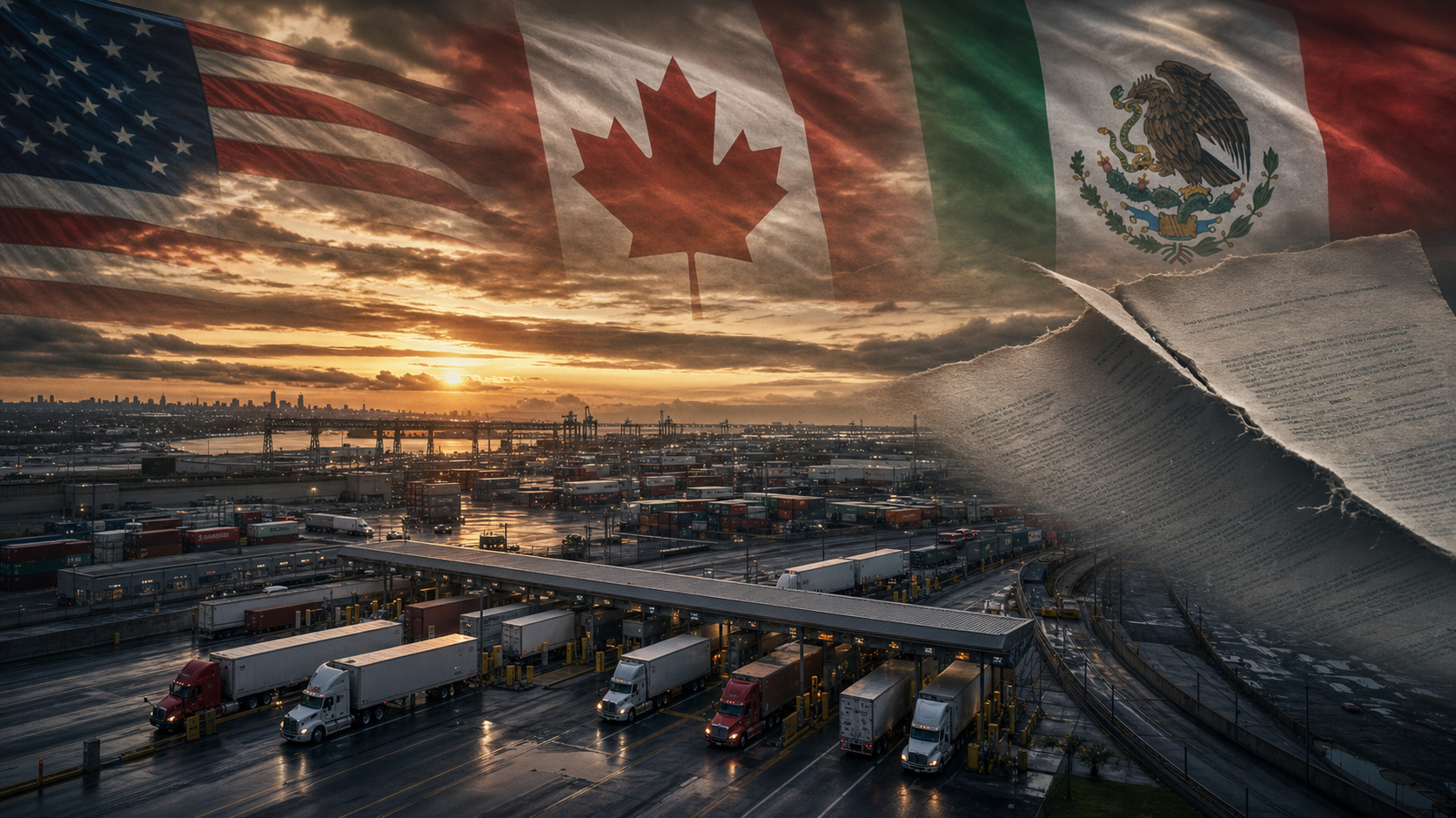
The end of North American trade security: How Washington is turning USMCA into a political weapon – Image: Xpert.Digital
Mexico's "back door" for China: Why the US is jeopardizing the most important free trade agreement
Trade as a political weapon: Donald Trump's risky plan for the USMCA agreement
The USMCA was intended to secure North America's economic stability for decades and usher the controversial NAFTA agreement into a modern era. However, by triggering the so-called "sunset clause" in July 2026, Washington has effectively placed the most important free trade agreement between the US, Canada, and Mexico in a precarious state of limbo. The US government is not using the contractually built-in review mechanism for routine monitoring, but rather as a geopolitical weapon: Calculated uncertainty is intended to force a reduction in trade deficits, attract massive numbers of production facilities back to the US, and curb growing Chinese investment influence in Mexico. While the highly integrated automotive and agricultural industries fear for their complex supply chains, hundreds of billions of dollars are at stake for neighboring Canada and Mexico. This is an in-depth analysis of how a rules-based economic pact has become a political instrument of discipline – and what massive consequences this paradigm shift has for global trade.
Free trade on demand – Washington's calculated destabilization strategy
From NAFTA to USMCA: How an agreement overturned its own creator
The history of North American free trade is also the history of a political contradiction. The North American Free Trade Agreement (NAFTA), which came into force in 1994, was long considered the foundation of economic integration between the US, Canada, and Mexico – and for over three decades created one of the world's most closely intertwined trading regions. However, even during his first presidency, Donald Trump had nothing good to say about the agreement, repeatedly calling it the "worst deal ever" that had outsourced US jobs and hollowed out the American manufacturing industry. This criticism was rhetorically exaggerated, but it contained a kernel of truth: NAFTA had created strong incentives, particularly in the automotive sector, to shift production to low-wage countries.
The result of the renegotiations initiated by Trump was the United States-Mexico-Canada Agreement (USMCA), which came into effect on July 1, 2020, replacing NAFTA. Trump hailed the new agreement as a historic triumph, "the best deal we have ever made." While the USMCA was essentially a continuation of NAFTA, it included important innovations: stricter rules of origin in the automotive and steel sectors, improved labor standards in Mexico, better access for US farmers to Canadian and Mexican markets, and updated provisions for intellectual property protection and digital trade.
Particularly significant was the increase in the regional value content (RVC) in the automotive sector from 62.5 percent under NAFTA to 75 percent under USMCA – combined with the requirement that 40 to 45 percent of vehicle components must originate from factories with an hourly wage of at least US$16. These regulations were specifically designed to bring manufacturing jobs back to North America – and especially to the USA.
A forfeiture clause with explosive potential: The built-in mechanism of instability
What received little attention during the celebrations for the introduction of the USMCA is one of the most unusual provisions of the agreement: the so-called Sunset Clause in Article 34.7. This clause stipulates that although the agreement has a total duration of 16 years – i.e., until 2036 – a joint review by the Free Trade Commission of all three countries must take place after six years.
The decision made during this review has far-reaching consequences: If all three parties agree to an extension, the agreement will run for another 16 years, until 2042. However, if such an agreement fails – and that is precisely what has now happened – the agreement will enter a phase of annual reviews, which could continue until 2036, unless a consensus on an extension is reached. At any time, each of the three parties can withdraw from the agreement with six months' notice.
This structure was originally conceived as a safety net: it was meant to ensure the flexibility to adapt the agreement to changing economic conditions. The fact that this same clause can now be used as leverage to create persistent uncertainty and exert political pressure was not intended – or perhaps it was deliberately included, depending on one's interpretation. Canada's Minister for US Relations, Dominic LeBlanc, put it succinctly: if uncertainty is the goal of one of the USMCA parties, then the scenarios that emerge from annual reviews are easily conceivable.
Failure on July 1, 2026: Setting the course for a decade of uncertainty
On July 1, 2026, the first anniversary of the review period, what many analysts had expected came to pass: The US announced in a brief statement that it would not extend the agreement in its current form. US Trade Representative Jamieson Greer stated after a virtual meeting with his counterparts from Mexico and Canada that Washington intended to address the shortcomings of the agreement – particularly the growing trade deficits and, from the US perspective, the insufficient consideration given to American farmers, manufacturers, and businesses.
The decision was no surprise. In the preceding weeks, Trump had already made it clear how undecided he was about the agreement. In June 2026, he said he didn't know if he would extend it, leaving open the question of whether he was willing to negotiate. A week later, he was even more explicit: He would prefer not to have the agreement, but might still be able to sign it. This kind of calculated ambiguity is characteristic of Trump's negotiating style – it creates pressure without committing.
The result: The USMCA formally remains in force and will initially be reviewed annually. The new mechanism stipulates a maximum term of ten years for this phase, during which the three countries can agree to a 16-year extension at any time. If this does not occur, the agreement will expire in 2036. A third round of negotiations between the participating countries was scheduled for the week of July 20.
The economic dimension: Trillions of dollars in limbo
To understand the scale of the potential economic consequences, one must consider the sheer size of North American trade. The USMCA regulates the exchange of goods and services worth nearly two trillion US dollars annually – making it one of the world's most important free trade zones.
In 2024, trade in goods between the US and Mexico alone amounted to approximately US$935 billion, while bilateral trade with Canada totaled around US$909 billion. Mexico surpassed Canada for the first time as the US's largest trading partner in 2025: Total trade in goods reached US$873 billion, with US exports to Mexico, at US$338 billion, even slightly exceeding exports to Canada.
From a US perspective, however, one of these impressive figures is overshadowed by considerable concern: the trade deficits. The US goods trade deficit with Mexico grew to nearly $197 billion in 2025, an increase of almost 15 percent compared to the previous year. The deficit with Canada was around $46 billion, although this figure had fallen by about 25 percent compared to 2024. Remarkably, the combined US trade deficit with its two USMCA partners exceeded the deficit with China for the first time in 2025.
These figures are the real driving force behind US criticism. For the Trump administration, the trade deficit is the primary indicator of economic fairness – even though economists rightly criticize this as too narrow a perspective because it ignores the deep integration of value chains and the comparative advantages of each country. Nevertheless, as a political narrative, the deficit argument wields enormous power.
The leverage of uncertainty: The economic impact of annual reviews
What distinguishes the annual review from a normal trade policy review is its systemic impact on business decisions. Tony Stillo, director of Canadian economics at the research firm Oxford Economics, succinctly described the effect: annual reviews create a “massive headwind” for investment decisions. Companies planning long-term capital allocations, building supply chains, or choosing locations for new production facilities need planning certainty over periods of five, ten, or twenty years.
Canada's Trade Minister LeBlanc confirmed that the uncertainty is already having a measurable impact: Net business investment in Canada has declined. This finding aligns with what economists know from research on trade policy uncertainty: Even the mere possibility of a change in trade policy is enough to delay or completely prevent investment projects.
Germany Trade and Invest (GTAI), the German economic development agency, analyzed the new mechanism and sees it as a clearly defined lever for the US: Washington could strategically use the annual review to exert political pressure on Mexico and Canada – for example, on issues such as drug trafficking, energy policy, or migration policy. This assessment precisely describes what a purely trade agreement has become: a geopolitical instrument of discipline.
The consulting firm Control Risks offered a similarly sober assessment: The USMCA is increasingly transforming from a rules-based trading framework into a politicized, security-oriented economic pact. For companies, this means not only a new level of regulatory complexity, but also the need to continuously monitor political risks and factor them into strategic decisions.
The automotive industry: A showcase system of an interconnected economy under pressure
No industry symbolizes the depth of North American economic integration better than the automotive industry, and none faces greater challenges from the USMCA review. A modern vehicle manufactured in North America crosses the borders between the US, Canada, and Mexico an average of seven to eight times before it rolls off the assembly line as a finished product. These highly interconnected supply chains have developed over decades and cannot be restructured without significant cost and time.
The USMCA had already exerted considerable pressure on the industry to adapt with its 75 percent RVC requirement for vehicles and the wage value clause (40 to 45 percent from factories paying a minimum wage of $16). Now, the US demands go even further: In the negotiations, Washington demanded that 50 percent of all vehicle components must originate specifically from US sources – no longer just from the NAFTA/USMCA region as a whole. Furthermore, the regional value-added share should be increased from 75 to over 80 percent.
Behind these technical regulations lies a concrete geopolitical agenda: the displacement of Chinese components from North American vehicles. US negotiators want to classify electronic components, currently sourced predominantly from Asia, as "core parts," for which strict regional manufacturing requirements apply. US exports of automotive parts and accessories worth more than $10 billion went to Canada and Mexico in 2025 – this industry is therefore existentially dependent on the USMCA not only for imports but also for exports.
Our US expertise in business development, sales and marketing


Our US expertise in business development, sales and marketing - Image: Xpert.Digital
Industry focus areas: B2B, digitalization (from AI to XR), mechanical engineering, logistics, renewable energies and industry
More information here:
A thematic hub offering insights and expertise:
- Knowledge platform covering global and regional economies, innovation and industry-specific trends
- A collection of analyses, insights, and background information from our key areas of focus
- A place for expertise and information on current developments in business and technology
- A hub for companies seeking information on markets, digitalization, and industry innovations
How Chinese investments are turning Mexico into a "back door" to US markets
The China Problem: Mexico's Industrial Rise as a Trojan Horse?
A significant, though often overlooked in public debate, factor in the USMCA tensions is the Chinese investment presence in Mexico. Since the start of the US-China trade war in 2017, and increasingly since the COVID-19 pandemic, Chinese companies have invested heavily in Mexican manufacturing facilities to supply the US market and take advantage of USMCA preferential tariffs. Official data shows net Chinese direct investment in Mexico of approximately $2.3 billion between 2017 and 2024 – but private estimates are considerably higher, as a large portion of the investment is channeled through offshore vehicles and greenfield projects.
The most prominent single example is the announcement by the Chinese construction equipment manufacturer Lingong Machinery Group that it will build a $5 billion factory in Monterrey. However, smaller and medium-sized Chinese suppliers have also significantly relocated production capacity to Mexico, sometimes using the same contacts as before in China, but now operating under Mexican company names.
For US negotiators, this is a sensitive issue. They see this development as a systematic circumvention of American tariffs on Chinese goods – Mexico acting as a "backdoor" into the US market. The Mexican side and many economists take a more nuanced view: If Chinese companies actually produce in Mexico, employ local workers, and generate added value in the country, this is structurally no different from what Japanese or Korean companies have been doing for decades. The line between legitimate nearshoring strategy and regulatory arbitrage is blurred.
The practical consequence: The tightening of the rules of origin as part of the USMCA renegotiation aims, not least, to push back this Chinese presence – especially in the EV sector (electric vehicles), where Chinese battery and electronics manufacturers are particularly active.
Different negotiating dynamics: Mexico as a constructive partner, Canada facing headwinds
A notable asymmetry in the current phase of the USMCA review concerns the very different ways in which Washington deals with its two neighbors. Mexico is explicitly praised by US officials as a "constructive partner": the Sheinbaum administration has made concrete proposals for reducing the trade deficit, and formal bilateral negotiations are progressing productively. Mexico's Economy Minister Marcelo Ebrard made it clear that, despite the failed 16-year extension, Mexico sees room to maintain the North American trade relationship.
Canada, on the other hand, is under much heavier fire. From the US government's perspective, Ottawa was one of the few countries in the world to respond to Trump's trade measures with retaliatory tariffs, thereby squandering political capital. Added to this are long-standing US complaints about non-tariff trade barriers and market distortions caused by Canadian agricultural policy, particularly in the dairy sector, which is protected by a government quota system.
Canada's Trade Minister LeBlanc, however, emphasized that his country was entering the negotiations from a position of strength: Canada was a stable, reliable partner with the energy resources and natural raw materials the world needed, and a predictable investment environment. Nevertheless, the realities of the negotiations are clear: if Washington increasingly favors bilateral approaches with each of the two countries, Canada will lose the protection of a joint negotiating bloc.
Agriculture: Export success and growing deficit debate
For US agriculture, the USMCA is a mixed bag. On the positive side: US agricultural exports to Canada and Mexico have increased by around 45 percent since 2020, reaching a combined $59.6 billion in 2024. Mexico is the largest buyer of US corn – about 40 percent of US corn exports go there – while Canada is the largest US export market for ethanol.
The picture is less rosy on the deficit side: The total US agricultural trade deficit amounted to approximately $37.6 billion in 2024, with Canada and Mexico together accounting for $30.2 billion of that. Canada's agricultural trade balance with the US has grown from a surplus of $2.5 billion in 2019 to a surplus of $11.5 billion in 2024 – a doubling of the shift in favor of Canada. Mexico's agricultural balance with the US climbed from $11 billion to $18.7 billion over the same period.
US agricultural associations are divided: The National Corn Growers and Soybean Associations are calling for an immediate 16-year extension of the USMCA to secure stable export markets. Dairy associations, on the other hand, are using the review as leverage to challenge Canadian quota regulations. Fruit and vegetable growers, particularly in California, are complaining about the influx of cheap Mexican imports, which is putting pressure on their farms.
Geopolitical Architecture: The USMCA as a Tool of Economic Security Policy
What is heralded by the end of the simple USMCA extension is more than a trade dispute—it is a paradigm shift in how Washington shapes its economic relationship with its neighbors. The agreement is increasingly viewed through an “economic security” lens, in which trade issues are inextricably linked to security, immigration, and drug policy.
The US has already demonstrated its willingness to employ trade policy instruments beyond the USMCA: Tariffs were imposed under Section 232 (National Security) on Canadian and Mexican steel and aluminum – 50 percent on Canadian steel – even though the USMCA was supposed to guarantee tariff-free trade. This practice shows that in the Trump era, the agreement is not seen as a protective shield, but rather as a supplementary legal framework that can be superseded by other instruments at any time.
From a strategic perspective, creating permanent uncertainty is perfectly rational: it compels trading partners to make continuous concessions, as they fear losing market access. At the same time, it generates a kind of bonus for US investments – those who produce in the US do not need USMCA compliance and are unaffected by trade policy shifts. The senior US government official who spoke after the July 1, 2026 meeting openly expressed this logic: for companies seeking to eliminate uncertainty, the solution was to invest in the US.
Six scenarios for North America's economic future
The Center for Strategic and International Studies (CSIS) has outlined six possible scenarios for the future development of the USMCA, ranging from a smooth extension to complete collapse. Given the current situation, the following scenarios appear realistic:
In the most likely scenario, the three countries remain in a mode of annual reviews for several years, but gradually agree on sector-specific adjustments—initially in the automotive industry and regarding the control of Chinese investments—before finally achieving a modified extension. This scenario maintains uncertainty as a permanent means of exerting pressure without sacrificing the agreement itself.
In the medium scenario, bilateral negotiations with Mexico lead to a separate agreement, effectively splitting the trilateral framework into two bilateral treaties. Canada would remain in a legal limbo, which is not unrealistic given the significantly more complex US-Canadian relationship.
In the pessimistic scenario, one of the parties – likely the US – withdraws from the agreement after the six-month deadline and establishes a purely tariff-based trade relationship that would de facto comply with WTO rules. This would cause massive disruptions in the integrated North American value chains and would be equally painful for the US automotive industry and the agricultural sector.
What's at stake: Systemic risks to value chains
Hufbauer and Zhang of the Peterson Institute for International Economics quantified how dependent individual US states are on the USMCA. In 2025, approximately 89.9 percent of North Dakota's goods exports went to Canada and Mexico. Michigan's figure was 64.9 percent, Iowa's 50 percent, and Arizona's 39 percent – all states that voted for Trump in 2024.
75.6 percent of all US exports of tractor parts, public transportation components, and automotive accessories went to the two neighboring countries that same year. These figures illustrate that the consequences of a USMCA failure would by no means be abstract—they would fall directly back on those economic regions most politically connected to the Trump electorate.
For Canada, the ongoing uncertainty is likely to accelerate the economic diversification strategy initiated at the beginning of Trump's second term. Canada will not cease trading with the US, but it will strategically expand trade relations with Europe, the Asia-Pacific region, and other partners – a development that could lead to an erosion of the US market position in the long term.
The economic-theoretical classification: Where is the path leading?
From a fundamental economic perspective, the contradictions in the US position are obvious. The trade deficit that Washington so vehemently laments is not primarily attributable to the USMCA – it is the result of macroeconomic fundamentals: high US consumer demand, the savings rate, capital flows, and the strength of the dollar. Trade agreements can distribute comparative advantage, but an economy's overall trade deficit is determined by its domestic economy, not its trade policy. The US total trade deficit reached a new record of $1.24 trillion in 2025 – despite its extensive tariff policy.
At the same time, the political logic of the Trump administration is internally consistent: if the real goal is not to optimize comparative advantage, but to reindustrialize certain US regions and push back Chinese economic influence, then creating uncertainty and maintaining constant negotiating pressure are rational instruments – even if they are inefficient from a macroeconomic perspective.
The question ultimately is whether the three North American countries are collectively capable of maintaining the strength of their integrated economies in the face of growing global competition from China and a resurgent Asia-Pacific economic region. Mexican President Sheinbaum clearly expressed this idea: as North America, the three countries together are more competitive compared to other regions of the world. This integrative logic remains economically compelling – whether it will prevail over short-term domestic politics is another matter.
The coming months will show whether the USMCA renegotiation will be a coordinated modernization project that prepares North America for the economic challenges of the 21st century – or whether it will mark the beginning of a slow erosion of one of the world's most successful regional trade frameworks.
Your global marketing and business development partner
☑️ Our business language is English or German
☑️ NEW: Correspondence in your native language!

Konrad Wolfenstein
I and my team are happy to be available to you as your personal advisor.
You can contact me by filling out the contact form here wolfenstein@xpert.digital:or simply call me at +49 7348 4088 965. My email address is
I'm looking forward to our joint project.
☑️ SME support in strategy, consulting, planning and implementation
☑️ Creation or realignment of the digital strategy and digitization
☑️ Expansion and optimization of international sales processes
☑️ Global & Digital B2B trading platforms
☑️ Pioneer Business Development / Marketing / PR / Trade Fairs
🎯🎯🎯 Data-driven B2B industry hub as a quasi-in-house solution


The quasi-in-house solution: How Xpert.Digital closes operational gaps in B2B marketing and sales – Smart Content-Driven Business - Image: Xpert.Digital
Xpert.Digital is a data-driven B2B industry hub led by Konrad Wolfenstein . The company acts as an external, quasi-in-house solution for industrial partners, closing operational gaps in marketing, content, and sales – without requiring additional resources on the client side.
More information here: