EDIRPA: Missiles, tanks, ammunition: The trick behind why 20 EU countries are now suddenly buying weapons together – Image: Xpert.Digital
The new “Buy European” strategy, with which the EU protects its own arms industry
EDIRPA: Analysis of a European instrument to strengthen the defence industry
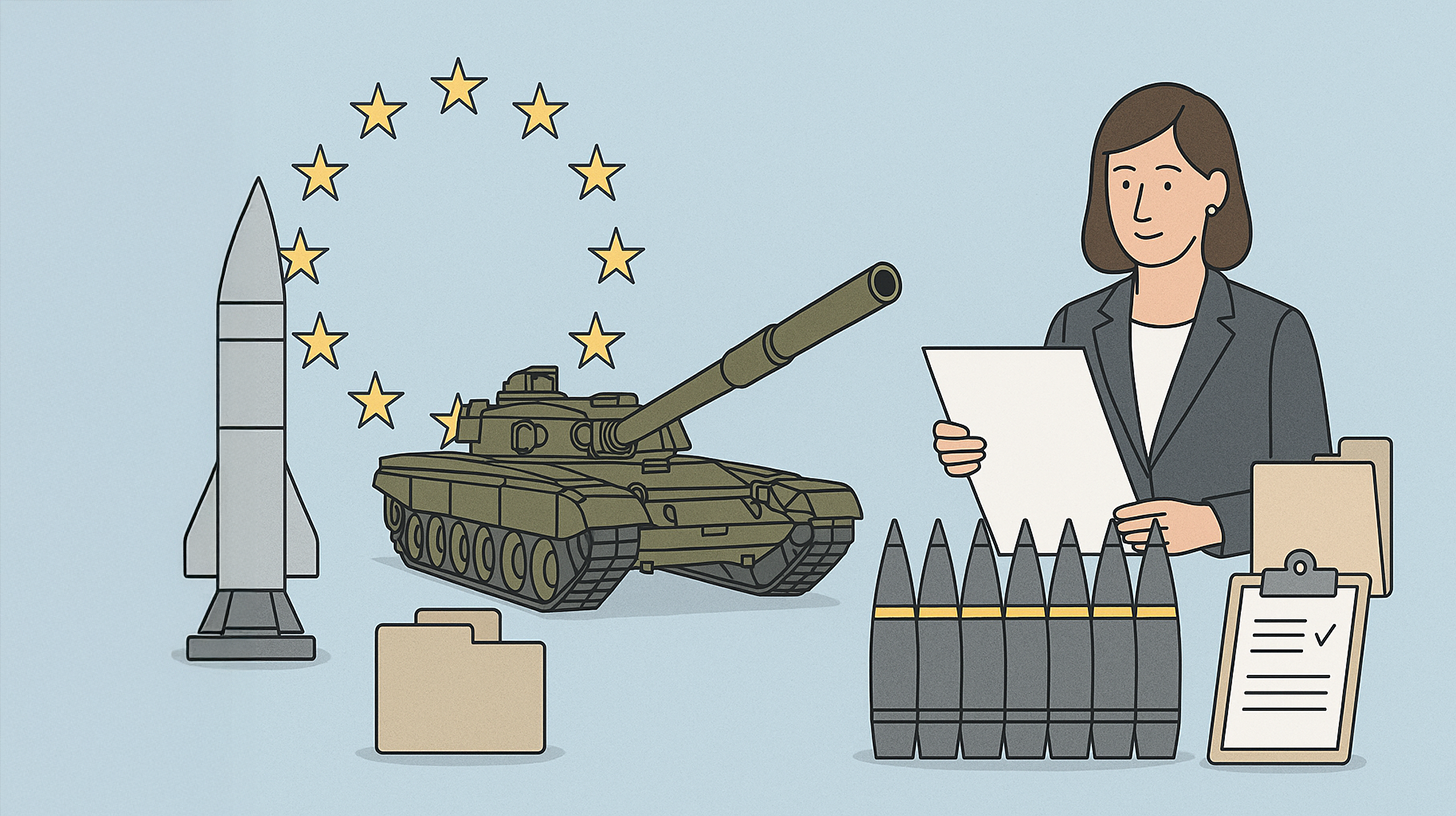
With the EDIRPA program, the European Union is using a clever financial incentive to address a long-standing weakness: the fragmented procurement of defense equipment. Instead of acting as individual buyers, this short-term program encourages member states to form groups and jointly purchase defense equipment such as missile defense systems or ammunition. The rationale is clear: joint bulk orders save money, improve military cooperation through compatible systems, and strengthen European industry. EDIRPA is not the marketplace itself, but rather the reward for joint purchasing – the EU reimburses participating countries for a portion of the costly administrative expenses as a bonus.
EDIRPA is a short-term incentive program that promotes precisely this: cooperation in the purchase of ammunition or missile defense systems. The key is that the countries—currently 20 are participating in five projects—continue to purchase and pay for the weapons themselves. However, the EU rewards their cooperation by reimbursing a portion of the administrative costs. EDIRPA is therefore not a joint arms shop, but rather a bonus program that rewards the additional effort required for coordination and thus aims to make Europe's defense more effective.
Strategic context and historical classification
What is the geopolitical trigger for the creation of EDIRPA and how has the war in Ukraine changed European defense policy?
The creation of the law to strengthen the European defence industry through joint procurement (EDIRPA) is a direct and immediate consequence of the profound change in the European security architecture triggered by Russia's large-scale invasion of Ukraine on February 24, 2022. This event acted as a geopolitical shock and a "turning point," forcing the European Union to fundamentally rethink its decades-long approach to defence policy. The European Council immediately called for concrete measures to respond to the new threat landscape, prompting the European Commission to propose a series of contingency instruments, including EDIRPA, to specifically strengthen the European defence industry.
The key lesson learned from the first months of the war was the “return of industrial warfare.” The nature and scale of the conflict, characterized by high intensity, massive material attrition, and enormous ammunition consumption, ruthlessly exposed the unpreparedness of most European armed forces and their industrial base. For decades, the European defense industry had been geared toward peacetime “artisanal manufacturing,” specializing in the production of highly complex systems in small batches, rather than the industrial mass production required for a major conflict. This structural weakness led to an acute crisis as member states attempted to support Ukraine while simultaneously replenishing their own rapidly dwindling stockpiles.
Against this backdrop, the main objective of EDIRPA and related initiatives was clearly defined: to address the “most urgent and critical defence needs” of the EU member states. The focus was on closing capability gaps that had become particularly evident due to the massive support for Ukraine and the new threat situation on the EU's eastern flank.
This process marks a fundamental shift in the EU's strategic thinking. Policy has moved from a primary focus on crisis management and expeditionary operations to the requirements of territorial defense and the capability to conduct a high-intensity conflict. Strategic documents such as the European Defence Industrial Strategy (EDIS) explicitly articulate this paradigm shift and aim to structurally rebuild European defence and place support for Ukraine on a sustainable footing.
Although the war in Ukraine was the immediate trigger for EDIRPA, the instrument must be understood as a response to a deep-rooted, chronic ailment of the European defense sector. Its weaknesses—fragmentation, underfunding, and a lack of cooperation—had been known and well-documented for decades. The war did not create these problems; rather, it brutally and undeniably exposed them, thereby forcing the political will to act. The design of EDIRPA as a short-term emergency instrument underscores this character: it is a reactive measure to treat the acute symptoms of a long-standing structural illness.
What structural weaknesses in the European defence industry and cooperation already existed before 2022 that EDIRPA is trying to address?
The creation of EDIRPA was not only a response to the war in Ukraine, but also an attempt to address deep-seated and long-standing structural deficiencies in the European defence sector. These weaknesses have undermined the EU's ability to act as a coherent security actor for decades.
- Chronic underinvestment: After the end of the Cold War, European states benefited from a “peace dividend,” which led to drastic cuts in defense budgets. This period of underinvestment was long and profound. The European Commission estimates that between 2006 and 2020, member states would have spent an additional €1.1 trillion on defense if they had consistently adhered to the NATO target of 2% of gross domestic product (GDP). This deficit led to the atrophy of key military capabilities, outdated equipment, and dangerously low stockpiles of ammunition and spare parts.
- Pervasive fragmentation: The European defense market is not a single market, but a mosaic of 27 national markets, often isolated from one another by regulatory and protectionist barriers. This fragmentation leads to massive inefficiencies: unnecessary duplication in research, development, and production; a multitude of competing weapon systems for the same tasks; and a resulting lack of interoperability between the armed forces of the member states. Although EU directives on the awarding of defense contracts exist, these are frequently circumvented by invoking national security interests (Article 346 TFEU) to protect domestic industry.
- The “Cost of Non-Europe”: The economic consequences of this lack of cooperation are immense. A 2013 study by the European Parliament estimated the annual costs of duplication of effort and inefficiency at around €26 billion. More recent analyses suggest even higher potential savings, ranging from €24.5 billion to €75.5 billion per year, with some estimates reaching as high as €120 billion. A 2025 report estimates the “Cost of Non-Europe” in the defense sector at between €17 billion and €58 billion annually. This money is effectively wasted due to a lack of coordination.
- Failure of joint procurement: Despite clear political objectives set within the framework of the European Defence Agency (EDA) and Permanent Structured Cooperation (PESCO), joint procurement of armaments has remained the exception. The target of jointly conducting 35% of procurement projects has been far from being met; the share has recently fallen to 18%. This is a clear indication of a persistent “defense-industrial nationalism,” in which national interests and the safeguarding of domestic jobs take precedence over collective efficiency and military effectiveness.
The history of European defense integration is characterized by this tension. Initiatives such as the failed European Defence Community (EDC) in 1954, but also the gradual establishment of the Common Security and Defence Policy (CSDP), the EDA (2004) and PESCO (2017) created important foundations, but could never overcome the core problem of fragmentation.
EDIRPA embodies the fundamental tension between the economic logic of integration and the political primacy of national sovereignty in defence. The economic arguments for closer cooperation are overwhelming and supported by numerous studies. It promises efficiency, interoperability, and better value for money. However, the political reality is that defence remains a core attribute of national sovereignty. Member States are reluctant to relinquish control over their armed forces and defence industries. EDIRPA was designed as a compromise to navigate this tension. The instrument does not mandate joint procurement or create a supranational procurement agency. Instead, it uses the EU budget to provide a financial incentive—the reimbursement of administrative costs—to encourage voluntary cooperation between sovereign states. This approach, which aims to align national behavior with a common European objective through financial incentives without infringing on national competences, is a classic EU method. It seeks to make the economically rational choice (cooperation) politically palatable.
EDIRPA – The Instrument in Detail
What are the core objectives, budget, and duration of EDIRPA?
EDIRPA was designed as a targeted, short-term instrument to respond to the challenges exacerbated by the war in Ukraine. Its architecture reflects the urgency of the situation and the need to achieve rapid, tangible results.
Key objectives
EDIRPA's objectives are fourfold and address both the demand and supply sides of the European defence market:
- Promoting cooperation: The primary objective is to encourage Member States to cooperate in the joint procurement of defence equipment in order to meet the most urgent and critical needs.
- Strengthening the industrial base (EDTIB): By pooling demand, the European defense technology and industrial base (EDTIB) is to be strengthened. Large, bundled orders provide industry with the necessary planning security to invest in expanding its production capacities.
- Increased interoperability: The joint procurement of identical systems by multiple armed forces automatically leads to higher military interoperability, which improves the ability to conduct joint operations.
- Efficiency improvement: By utilizing economies of scale in large orders, a better price-performance ratio should be achieved for national defense budgets.
Budget and its reduction
EDIRPA's final budget amounts to €300 million from the EU budget. This sum is supplemented by a contribution of approximately €10 million from Norway, which participates in the program as an associated country.
The instrument was originally allocated a significantly larger budget of €500 million. The reduction to €300 million occurred because funds were reallocated to the Law on Supporting Munitions Production (ASAP). This reallocation is telling: it reveals a real-time political prioritization in which the immediate supply-side crisis—the acute shortage of munitions production capacity—was deemed even more urgent than the structural problem of demand-side coordination. While EDIRPA addresses the pooling of demand, ASAP aims directly at increasing production. Given the dramatic situation on the Ukrainian front, where the shortage of artillery shells became a critical factor, the EU chose to address the most immediate bottleneck in production lines first.
Duration
EDIRPA is explicitly designed as a short-term and temporary instrument. It entered into force on October 27, 2023, and its duration is limited to December 31, 2025. This short duration underscores its character as an emergency measure intended to serve as a bridge to a more permanent solution.
How exactly does EDIRPA's funding mechanism work, and what are reimbursable "administrative costs"?
EDIRPA's financing mechanism is the core of its operation and was deliberately designed to circumvent political obstacles while creating maximum incentives for cooperation.
Reimbursement mechanism
Crucially, EDIRPA does not finance the defense equipment itself. The costs for tanks, missiles, or ammunition remain entirely borne by the national budgets of the procuring member states. Instead, the EU reimburses the participating states for a portion of the costs arising from the complexity of joint procurement. This instrument compensates for the "additional administrative costs" incurred when three or more countries negotiate a complex multinational contract rather than simply procuring nationally.
Reimbursement rates
The amount of the reimbursement is tiered to promote specific policy objectives:
- The standard reimbursement rate is up to 15% of the estimated value of the joint procurement contract.
- A bonus incentive increases this rate to up to 20% if the procurement demonstrably benefits small and medium-sized enterprises (SMEs) or mid-cap companies. This is intended to ensure that not only the large defense contractors profit from the contracts.
Definition of "administrative costs"
Although the EDIRPA regulation does not contain an exhaustive list, the definition is based on general EU practice. Administrative costs include expenditure for "general management, oversight, coordination, evaluation, and reporting." In the context of multinational defense procurement, this could specifically include:
- Personnel costs for project managers and coordinators who manage cooperation between ministries.
- Costs for legal advice on drafting complex international contracts.
- Travel expenses for coordination meetings between the participating nations.
- Costs for developing common technical specifications and requirements.
- Costs for the joint evaluation of offers and contract monitoring.
These costs are either not incurred or are significantly lower in a simple national procurement. EDIRPA therefore specifically subsidizes the additional expenses that arise through cooperation.
The leverage effect
The instrument's true strength lies in its enormous economic leverage. The €300 million from the EU budget has enabled the five selected projects to undertake procurements totaling over €11 billion. This equates to a leverage of more than 36:1. It demonstrates that a relatively small financial incentive from Brussels is sufficient to mobilize many times that amount of national investment by lowering the barriers to cooperation.
This funding mechanism is a politically astute compromise. It is designed to subsidize the process of cooperation, not the product of defense. Directly financing national arms purchases from the EU budget would be extremely politically sensitive and would likely face resistance from some member states. However, one of the biggest obstacles to voluntary cooperation is the high cost of transactions—the additional administrative, legal, and political effort required to synchronize the procurement processes of several countries. EDIRPA cleverly targets precisely this hurdle. By offering to absorb some of these “costs of complexity,” the EU reduces friction and makes the decision to cooperate easier for national defense ministries to justify. This allows the EU to achieve its strategic objective—promoting a common defense market—by acting as a facilitator and promoter, rather than a direct buyer. It is a subsidy for the “how” (the cooperation), not the “what” (the weapon)—a subtle but crucial distinction that makes the instrument politically viable.
What are the participation requirements, and what is the particular significance of the 65% component origin rule?
To access EDIRPA funds, procurement projects must meet strict criteria designed to ensure the EU's strategic objectives. These conditions relate to both the composition of the buyers and the origin of the suppliers and products.
Participation requirements for funding
- Consortium of Member States: A joint procurement must be carried out by a consortium of at least three EU Member States. Norway can also participate as an associated country.
- Location of contractors: The main contractors and their main subcontractors must be based in the EU or an associated country (Norway) and have their management structures there.
- Control clause: A crucial criterion is that these companies must not be controlled by a non-associated third country or entity. This clause is intended to ensure that the financial and strategic benefits of the program remain within the European defence base and do not flow to companies in, for example, the USA, the UK or China.
The 65% component origin rule
This rule is the industrial and security policy core of EDIRPA and has far-reaching implications.
- Requirement: In order for a defence product to be procured under an EDIRPA-funded project, at least 65% of the components of the final product, measured by value, must originate from the EU or associated countries (Norway).
- Purpose: The rule is a clear commitment to the "Buy European" principle. It aims to ensure that increased European defense spending directly contributes to strengthening the EDTIB. This promotes the EU's strategic autonomy by reducing dependence on external supply chains and consolidating Europe's technological and industrial sovereignty.
- Context: This regulation is a direct response to the long-observed trend of European countries spending a significant portion of their defense budgets on arms from non-EU countries, particularly the US. The rule aims to redirect this flow of funds and invest it in European industry.
The 65% origin rule is thus far more than a technical regulation; it is a deliberate act of industrial policy that crystallizes the tension between the EU's goal of strategic autonomy and its traditionally close transatlantic defense cooperation. The EU's strategic objective is to build a self-sufficient and competitive defense industry (EDTIB) to reduce dependencies. A key risk identified is that an increase in European defense spending would primarily benefit the already dominant US defense industry, thereby undermining the EU's objective. The 65% rule is the primary policy instrument within EDIRPA to prevent this outflow and keep resources in-house. It acts as a protective barrier for the EDTIB.
However, this creates a potential area of conflict. The rule could exclude top-of-the-line or more readily available systems from key NATO allies such as the US or the UK from procurement. It may be perceived as protectionist in Washington and London and makes procurement more difficult for European prime contractors who rely on global supply chains. This rule is therefore a policy statement that prioritizes the long-term industrial goal of European autonomy, even at the risk of short-term procurement friction and political tensions with strategic partners.
Hub for Security and Defense - Advice and Information

Hub for Security and Defense - Image: Xpert.Digital
The Security and Defence Hub offers expert advice and up-to-date information to effectively support companies and organizations in strengthening their role in European security and defence policy. Working closely with the SME Connect Defence Working Group, it particularly promotes small and medium-sized enterprises (SMEs) that wish to further develop their innovative capacity and competitiveness in the defence sector. As a central point of contact, the Hub thus creates a crucial bridge between SMEs and European defence strategy.
Related to this:
The secret plan for the European defense strategy - missiles, tanks, ammunition: The European Union's great arms build-up
The EDIRPA projects – Concrete implementation
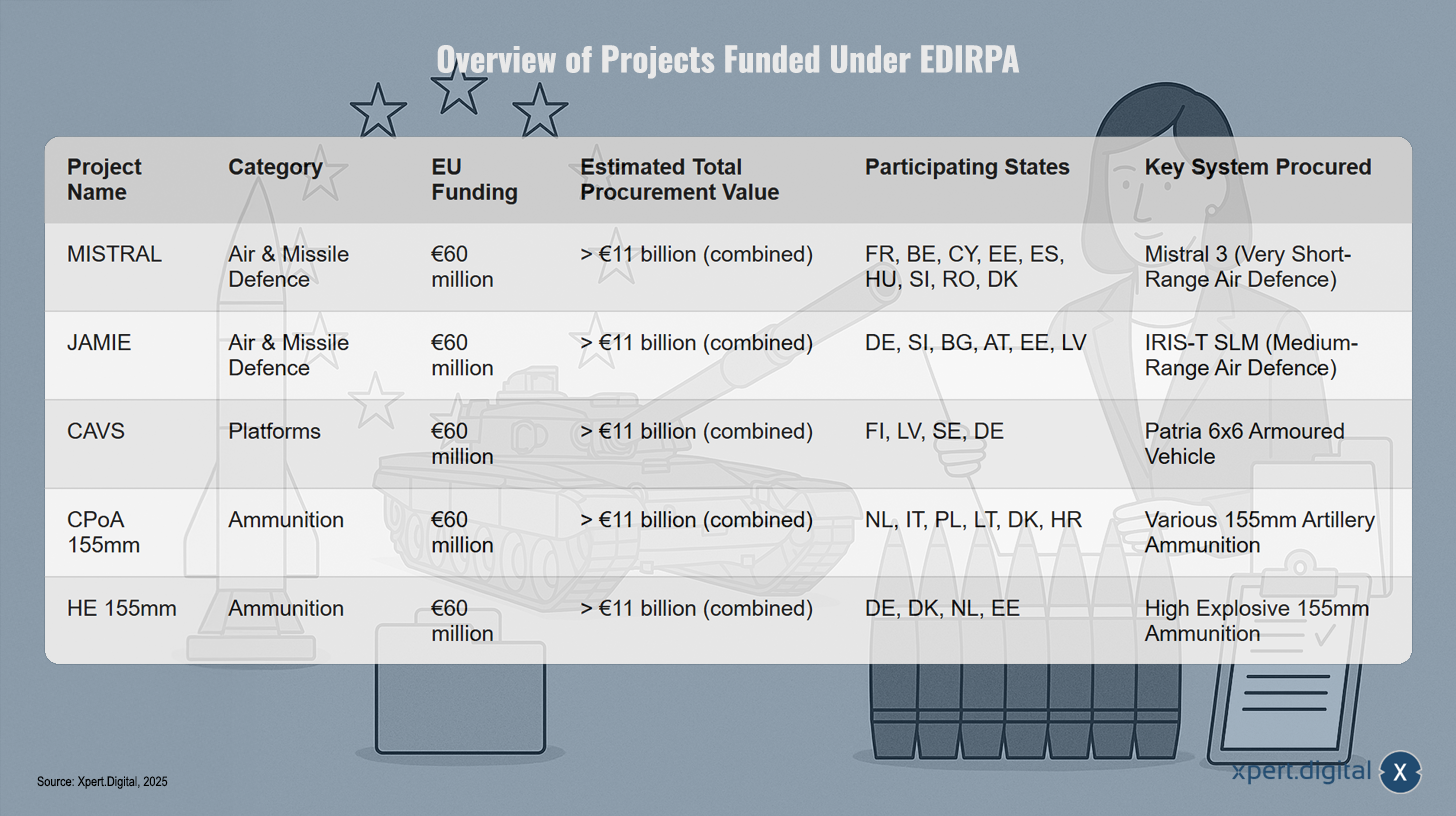
On November 14, 2024, the European Commission approved funding for five cross-border projects, utilizing the entire EDIRPA budget of €300 million. Each project will receive €60 million in funding. These projects represent the concrete implementation of EDIRPA's objectives and cover the capability areas identified as most urgent: air and missile defense, armored platforms, and munitions. The table below provides an overview of the selected projects.
Overview of projects funded under EDIRPA
Overview of projects funded under EDIRPA – Image: Xpert.Digital
The EDIRPA program is funding five major defense projects that will strengthen military cooperation between various European states. These projects include two air and missile defense systems, two munitions projects, and a platform for armored vehicles. Each project will receive €60 million in EU funding, with the total estimated value of the procurement exceeding €11 billion.
The MISTRAL project focuses on very short-range air defense and unites nine countries, including France, Belgium, and Denmark. The JAMIE project complements this with medium-range air defense and includes six countries, such as Germany and Austria. Ground-based mobility is addressed by the CAVS project with the Patria 6×6 armored vehicle, in which Finland, Latvia, Sweden, and Germany are participating.
The CPoA 155mm and HE 155mm ammunition projects complete the initiative with the procurement of various high-explosive 155mm artillery ammunition, involving countries such as the Netherlands, Italy, Denmark, and Estonia. These coordinated procurement initiatives underscore the growing military cooperation within Europe.
Source: Compilation based on data from the European Commission. The estimated total value refers to the combined value of all five projects.
Which five projects were approved under EDIRPA and which Member States are involved?
The selection of the five projects reflects the most pressing capability gaps exposed by the war in Ukraine. A total of 20 Member States are involved in these projects, underscoring the broad acceptance of the instrument. For some countries, this is their first participation in a joint European procurement project, highlighting EDIRPA's role as a catalyst for deeper cooperation.
The projects in detail:
Air and missile defense
- MISTRAL Project: This project supports the joint procurement of Mistral 3 very short-range air defense systems. Nine member states are participating: France, Belgium, Cyprus, Estonia, Spain, Hungary, Slovenia, Romania, and Denmark.
- JAMIE Project (Joint Initiative for Air and Missile Defense in Europe): This project involves the joint procurement of IRIS-T-SLM medium-range air defense systems. The six participating states are Germany, Slovenia, Bulgaria, Austria, Estonia, and Latvia.
Armored vehicles
CAVS Project: This project promotes the procurement of the Joint Armored Vehicle System (CAVS), a modern protected 6×6 troop carrier based on the platform of the Finnish manufacturer Patria. The four participating nations are Finland, Latvia, Sweden, and Germany.
ammunition
- CPoA 155mm Project (Joint Procurement of Munitions): This involves the joint procurement of various types of 155mm artillery ammunition. Six countries are cooperating in this project: the Netherlands, Italy, Poland, Lithuania, Denmark, and Croatia.
- HE 155mm Project: This project focuses specifically on the procurement of high-explosive 155mm artillery ammunition. The four participants are Germany, Denmark, the Netherlands, and Estonia.
The EDIRPA project portfolio is a direct and pragmatic response to the military lessons learned from the high-intensity conflict in Ukraine. The war is dominated by artillery duels and the constant threat from the air by missiles, drones, and aircraft. Consequently, the most urgent needs identified by military planners are multi-layered air defense and a sustainable supply of artillery ammunition. The EDIRPA projects precisely reflect these priorities: two ammunition projects, two air defense projects, and one to replenish the stocks of armored vehicles depleted by donations to Ukraine. This demonstrates that EDIRPA is not a theoretical, top-down industrial policy exercise, but a threat-driven initiative where project selection is dictated by the immediate and tangible realities of modern warfare on Europe's eastern flank.
What are the technical specifications of the MISTRAL 3 and IRIS-T SLM air and missile defense systems procured under EDIRPA?
The two air defense projects funded under EDIRPA procure systems that play different but complementary roles in a modern, multi-layered air defense architecture. MISTRAL 3 is a system for close-range protection, while IRIS-T SLM covers the medium-range range.
Technical comparison of the air defense systems MISTRAL 3 and IRIS-T SLM
Technical comparison of the MISTRAL 3 and IRIS-T SLM air defense systems – Image: Xpert.Digital
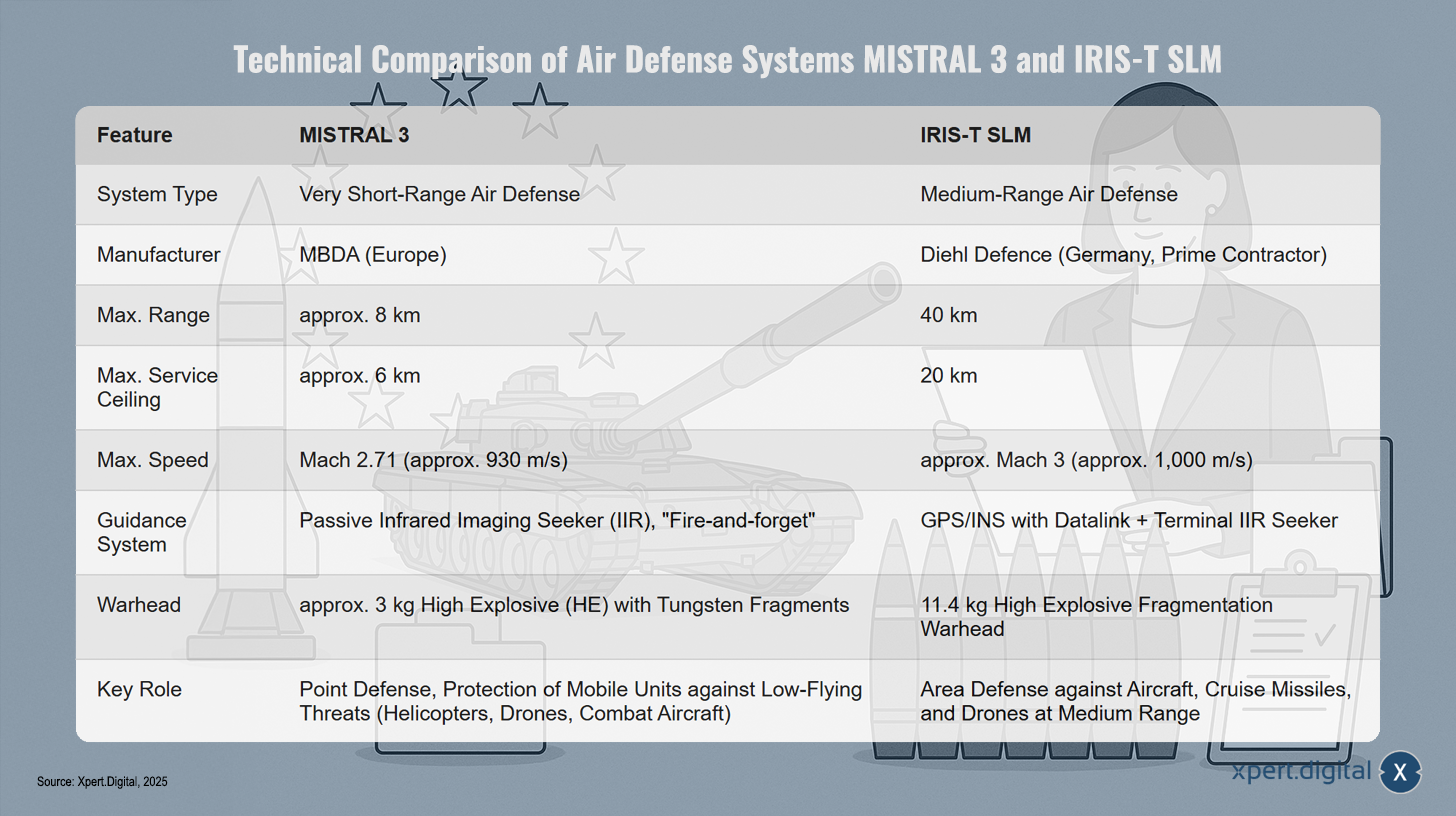
A technical comparison between the MISTRAL 3 and IRIS-T SLM air defense systems reveals interesting differences in their performance characteristics. The MISTRAL 3, manufactured by MBDA in Europe, is a very short-range air defense system with a maximum range of approximately 8 km and a service ceiling of about 6 km. It reaches a top speed of Mach 2.71 and features a passive infrared seeker in "fire-and-forget" mode. Its warhead weighs approximately 3 kg and contains high-explosive tungsten fragments.
In comparison, the IRIS-T SLM from Diehl Defence is a medium-range air defense system with significantly greater capabilities. It can engage targets at a range of up to 40 km and an altitude of 20 km, reaching speeds of approximately Mach 3. The system utilizes a GPS/INS guidance system with a data link and a terminal IIR seeker. Its warhead is considerably heavier at 11.4 kg and is also high-explosive.
While MISTRAL 3 is primarily designed for object protection and the defense of mobile units against low-flying threats such as helicopters, drones and fighter jets, IRIS-T SLM is suitable for area defense against aircraft, cruise missiles and drones at medium range.
Source: Compilation based on manufacturer specifications and expert analyses.
The MISTRAL-3 system, manufactured by the European consortium MBDA, is designed for the immediate protection of troops and critical infrastructure. As a "fire-and-forget" system, the gunner can immediately change position after firing, increasing survivability in combat. Its advanced infrared seeker head enables it to detect targets with low thermal signatures, such as small drones or incoming missiles, and is highly resistant to known countermeasures.
The IRIS-T-SLM system from Diehl Defence offers protection over a significantly larger area. It can defend an entire region or a strategic location such as a city or an airbase. Unlike the purely passive MISTRAL 3, the IRIS-T-SL guided missile uses a combination of GPS navigation and data link updates from ground radar during the approach phase, before its own IIR seeker autonomously acquires the target during the final approach. This enables attacks on targets far beyond the launcher's line of sight and ensures high accuracy even against fast and agile targets.
The joint procurement of both systems by different groups of countries under EDIRPA is strategically beneficial, as it promotes the development of a robust, multi-layered air defense, which is essential for countering the wide range of modern air threats.
What are the technical characteristics of the Common Armored Vehicle System (CAVS) and what role does it play in European defense?
The Joint Armored Vehicle System (CAVS) is a prime example of successful European cooperation in the field of land systems and one of five projects funded by EDIRPA. The program is based on the 6×6 platform of the Finnish company Patria.
Technical specifications of the Patria 6×6 (CAVS)
Technical specifications of the Patria 6×6 (CAVS) – Image: Xpert.Digital
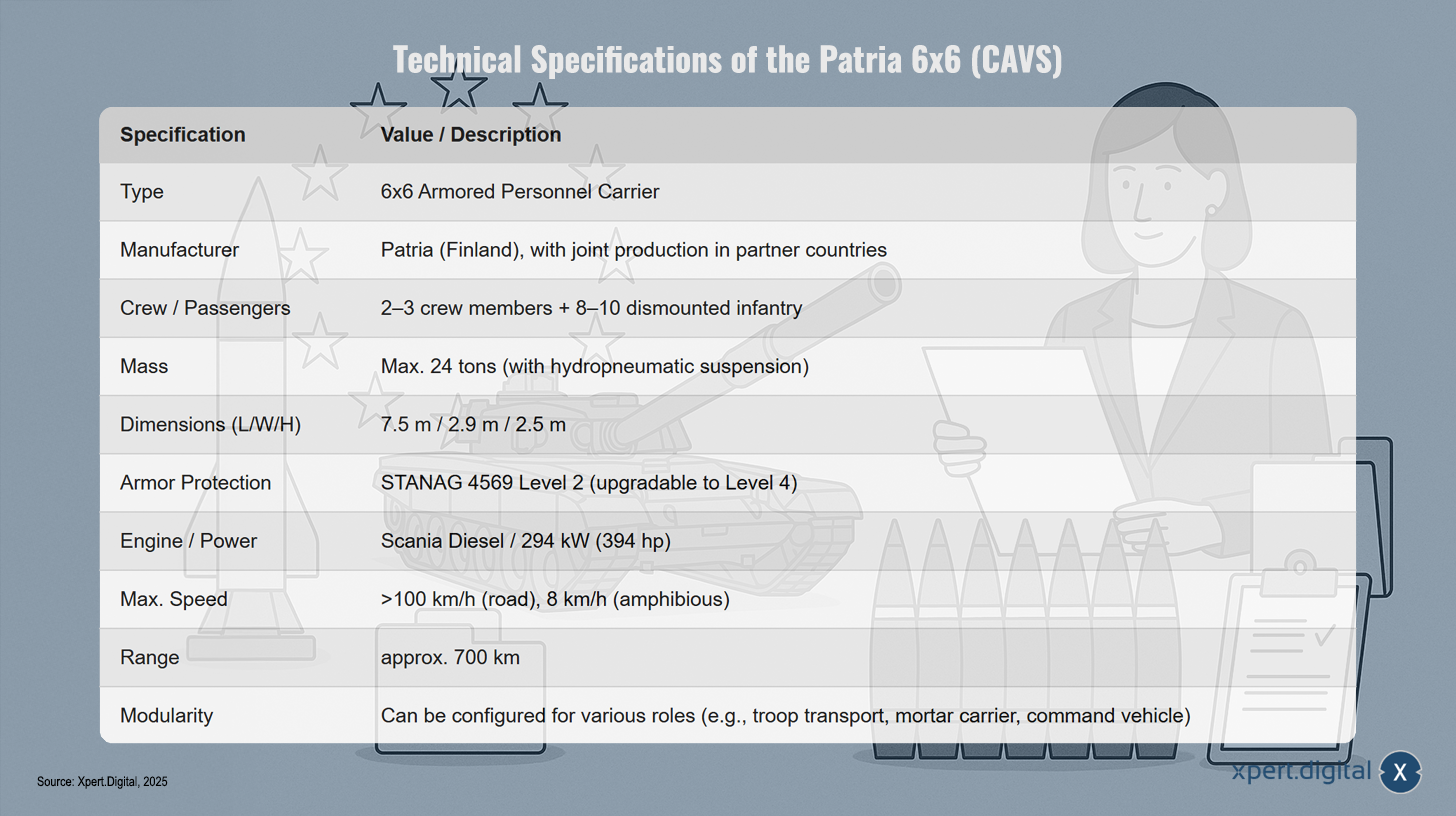
The Patria 6x6 is a modern, Finnish-made wheeled armored personnel carrier designed for versatile military operations. Manufactured by Patria, it can also be jointly produced in partner countries. It accommodates a crew of two to three and eight to ten mounted infantry. With a maximum weight of 24 tons and hydropneumatic suspension, the vehicle measures 7.5 meters in length, 2.9 meters in width, and 2.5 meters in height.
The tank features STANAG 4569 Level 2 armor protection, which can be upgraded to Level 4 if required. It is powered by a 294 kW (394 hp) Scania diesel engine, enabling the vehicle to reach a top speed of over 100 km/h on roads and 8 km/h in water. Its range is approximately 700 kilometers.
A key feature of the Patria 6x6 is its high degree of modularity. The vehicle can be flexibly configured for various roles, including troop transport, mortar carrier, and command vehicle. This versatility makes it a valuable asset for modern armed forces.
Source: Compilation based on manufacturer specifications and expert analyses.
The strategic role of the CAVS program extends beyond the vehicle's technical specifications. Initiated by Finland and Latvia and later expanded to include Sweden and Germany, it serves as a prime example of progressively growing, needs-based European defense cooperation. The goal is the development and procurement of a joint, modern, and highly mobile armored vehicle system capable of replacing various outdated systems within national armed forces, such as the German TPz Fuchs.
The advantages of such a joint program are numerous:
- Cost efficiency: Larger order quantities lead to lower unit costs.
- Interoperability: The participating nations use the same platform, which greatly simplifies joint training, maintenance and logistics, as well as deployment in the event of an alliance conflict.
- Industrial cooperation: The program includes the establishment of production and maintenance capacities in partner countries (e.g., Latvia), which promotes technology transfer and the strengthening of national defense industries.
The funding provided by EDIRPA underlines the political importance of this cooperation model as a blueprint for future European land-based armaments projects.
What types of 155mm artillery ammunition are being procured in the CPoA and HE 155mm projects, and why is this ammunition so critical?
The 155mm artillery has proven to be the decisive weapon system on the battlefield in the Ukraine war. The conflict is characterized by intense artillery duels, resulting in an unprecedented level of ammunition consumption. It is estimated that both sides fire tens of thousands of shells per day. This immense consumption has rapidly depleted stockpiles across Europe and the USA, revealing a massive gap between demand and production capacity. Replenishing these stockpiles and ramping up production are therefore top priorities for all NATO and EU member states. EDIRPA is addressing this critical need with two separate projects.
The two projects are designed to be complementary, in order to comprehensively meet the need:
CPoA 155mm (Joint Procurement of Ammunition): This project, involving the Netherlands, Italy, Poland, Lithuania, Denmark, and Croatia, aims at the "joint procurement of various types of 155mm artillery ammunition." This broad approach suggests that a whole portfolio of ammunition types will be procured. These likely include:
- Standard high-explosive (HE) bullets: The most commonly used type of ammunition for general purposes.
- Extended Range projectiles: Variants with a special base (Boat Tail, BT) or a gas generator (Base Bleed, BB) that reduces air resistance and increases the range from approximately 25-30 km to over 40 km.
- Smoke and illuminating shells: For camouflaging friendly troop movements or for nighttime battlefield illumination.
HE 155mm: This project, led by Germany with the participation of Denmark, the Netherlands, and Estonia, has a more specific focus. It concentrates on procuring "high-explosive 155mm artillery ammunition." This addresses the greatest and most urgent need: replenishing stocks of standard high-explosive shells, which constitute the majority of consumption.
Both projects pursue a dual objective. Firstly, they aim to meet the immediate needs of the armed forces by procuring large quantities of grenades. Secondly, and this is strategically equally important, pooling demand is intended to send a strong and long-term signal to the European defense industry. Companies such as Rheinmetall, BAE Systems, and the Czechoslovakian group (CSG) will thus gain the necessary planning certainty to invest in expanding existing and constructing new production facilities, thereby permanently increasing manufacturing capacity.
🎯🎯🎯 Benefit from Xpert.Digital's extensive, five-fold expertise in one comprehensive service package | BD, R&D, XR, PR & Digital Visibility Optimization

Benefit from Xpert.Digital's extensive, five-fold expertise in a comprehensive service package | R&D, XR, PR & Digital Visibility Optimization - Image: Xpert.Digital
Xpert.Digital possesses in-depth knowledge across various industries. This allows us to develop tailored strategies precisely aligned with the requirements and challenges of your specific market segment. By continuously analyzing market trends and monitoring industry developments, we can act proactively and offer innovative solutions. The combination of experience and expertise generates added value and provides our clients with a decisive competitive advantage.
More information here:
Resilient supply networks: The strategy behind innovative logistics hubs
Evaluation, critique and future prospects
How is the effectiveness of EDIRPA assessed by experts, politicians, and think tanks? What are the main criticisms?
Experts have a mixed opinion of EDIRPA. On the one hand, the instrument is praised for its design and conceptual success, while on the other hand, its actual impact is considered marginal due to its limited scope.
Positive aspects
Undeniably, the program has a remarkable leverage effect. With an investment of €300 million from the EU budget, joint procurement worth over €11 billion has been initiated. Furthermore, EDIRPA has successfully motivated 20 Member States to cooperate, some of whom are participating in such a project for the first time. In this respect, EDIRPA has fulfilled its purpose as an incentive and coordination instrument and as a proof of concept.
Main criticisms
However, the general consensus among experts is that EDIRPA is not a "game-changer" for European defense capabilities. Criticism focuses on several key points:
- A mismatch of scales: The main criticism is the inadequate budget. €300 million in incentives are considered "meager" or "symbolic" when compared to annual national defense spending of over €300 billion and the estimated investment backlog of over €1 trillion. Such a small amount is insufficient to fundamentally change the procurement behavior of the major member states or to solve the massive structural problems.
- Lack of political will among member states: Critics like Green MEP Hannah Neumann see the problem less in the design of EU instruments than in the member states' "lack of commitment" to genuine cooperation. Defense policy often remains a domain of "national narcissism," with member states continuing to compete with each other on the arms market instead of procuring jointly.
- Persistent structural fragmentation: Leading think tanks such as the Centre for European Reform (CER) and Bruegel point out that initiatives like EDIRPA do not solve the fundamental problems. The European defense market remains fragmented, national protectionism is rampant, and there is still no genuine single market for defense equipment. EDIRPA provides incentives but does not change the underlying structures.
In summary, EDIRPA is a well-designed instrument in principle, but its effectiveness is severely limited by its short-term nature and, above all, by its minuscule budget relative to the scale of the problem. It is a successful pilot project, but not a structural solution.
The primary value of EDIRPA may therefore lie not in its direct material contribution to European defence capability, but rather in its political and symbolic role as a successful proof of concept. The material impact of €300 million in incentives on a market of over €300 billion per year is, as critics rightly point out, marginal. However, EDIRPA has successfully demonstrated that the EU is capable of action in this area, that Member States are willing to use such an instrument (as evidenced by the participation of 20 countries), and that the leverage mechanism works (with a multiplier of over 36). This success creates political momentum. It provides the European Commission with a concrete, positive case study to justify a much larger and more permanent follow-up program. EDIRPA can thus be seen as a strategic springboard. Its most important achievement is to demystify and validate the concept of EU-funded joint procurement politically, making it politically easier to argue for the far larger and structurally driven European Defence Industry Programme (EDIP).
How does EDIRPA fit into the landscape of other EU defence initiatives such as the European Defence Fund (EDF) and ASAP?
To fully understand EDIRPA's role, it must be considered in the context of the EU's other key defence policy instruments: the European Defence Fund (EDF) and the Law on Supporting Munitions Production (ASAP). These three instruments are complementary and cover different stages of the defence-industrial value chain.
Comparison of EU defense instruments: EDF, ASAP and EDIRPA
Comparison of EU defense instruments: EDF, ASAP and EDIRPA – Image: Xpert.Digital
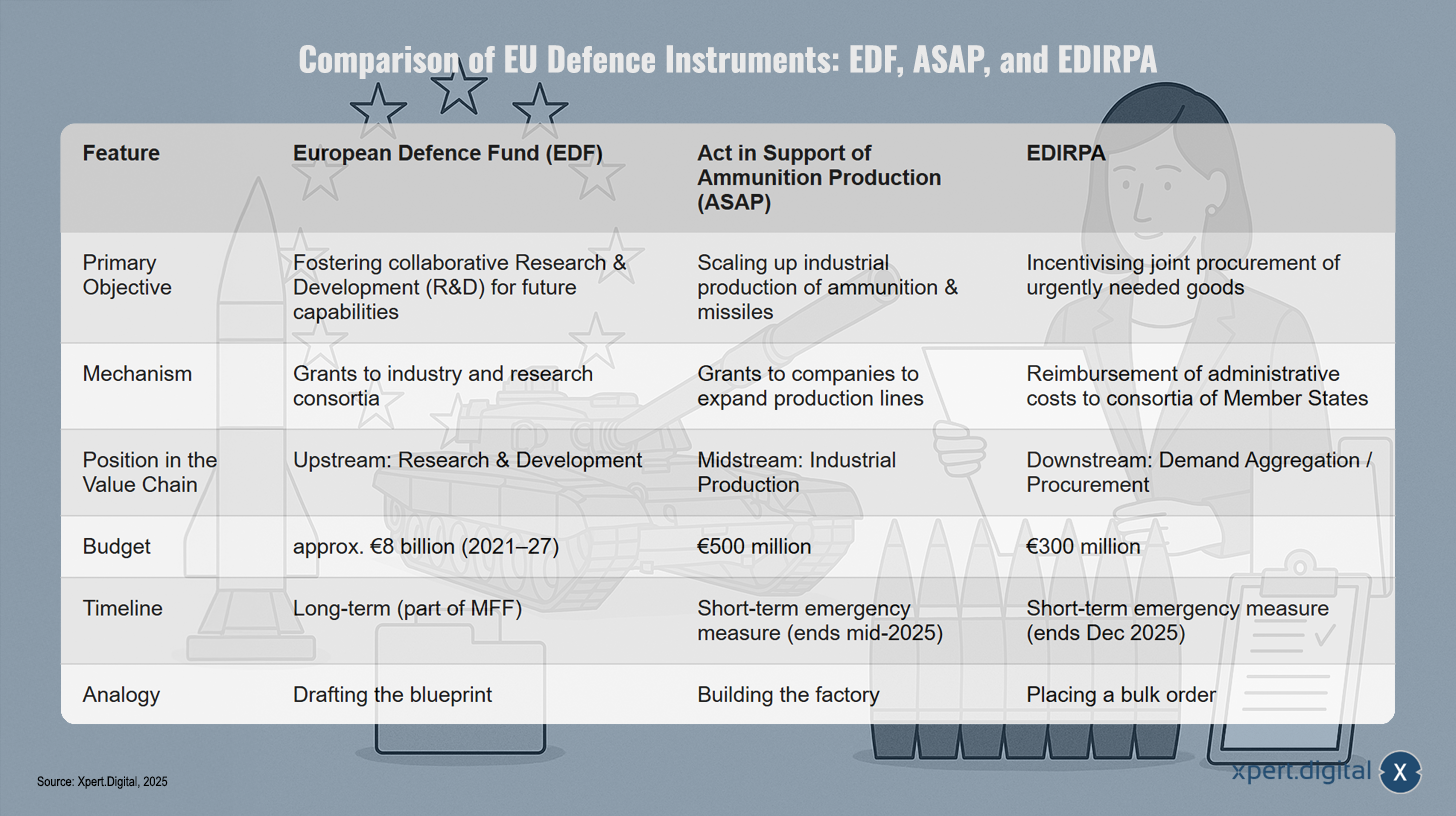
The European Defence Fund (EDF), the Law on Supporting Munitions Production (ASAP), and EDIRPA are three significant initiatives in the European defence industry, each pursuing different but complementary objectives. The EDF focuses primarily on promoting collaborative research and development for future capabilities, positioning itself in the upstream sector. With a budget of approximately €8 billion for the period 2021-2027, it is part of the multiannual financial framework and can be compared to the drafting of a blueprint.
The ASAP law, on the other hand, aims to ramp up the industrial production of munitions and missiles. With a budget of €500 million, it focuses on the midstream part of the value chain and can be metaphorically understood as the construction of a factory. As a short-term emergency measure, it is limited to the period ending in mid-2025.
EDIRPA, in turn, focuses on downstream activities and creates incentives for the joint procurement of urgently needed goods. With a budget of €300 million and a duration until December 2025, it is similar to a bulk order. The mechanism provides for the reimbursement of administrative costs to consortia of member states.
Taken together, these three initiatives form a comprehensive strategy to strengthen European defence capabilities, from research and production to targeted procurement.
Source: Compilation based on documents from the European Commission and analyses.
European Defence Fund (EDF)
The EDF is the EU's long-term, strategic instrument for promoting innovation. Launched in 2021, before the escalation of the war in Ukraine, it aims to develop the next generation of defense technologies by funding joint research and development projects. It is anchored in the EU's Multiannual Financial Framework (MFF) and has a duration of seven years.
Law to Support Munitions Production (ASAP)
ASAP, like EDIRPA, is a direct response to the war. It is a short-term emergency instrument that addresses a specific supply-side problem: the lack of production capacity for munitions and missiles. ASAP provides manufacturers with direct financial assistance to expand their production lines and eliminate bottlenecks in critical components such as explosives and propellant powder.
EDIRPA
EDIRPA complements ASAP by addressing the problem on the demand side. While ASAP boosts production, EDIRPA ensures that member states pool their orders. This not only creates efficiency but also provides industry with the planning certainty necessary for investment through large, predictable orders.
The trio of EDF, ASAP, and EDIRPA represents an evolutionary learning process for the EU. It illustrates the transition from a pre-war focus on long-term research and development (EDF) to a wartime logic that addresses the entire defense value chain: developing (EDF), producing (ASAP), and procuring (EDIRPA). The EDF was launched in 2021 with the long-term goal of developing the next generation of defense technology. However, the war created an immediate need for existing technology in vast quantities, for which the EDF was not designed. The EU then rapidly developed two new, targeted emergency instruments: ASAP to address the industrial bottleneck on the supply side, and EDIRPA to resolve the issue of fragmented demand. This sequence demonstrates how the EU adapts its policy toolkit in real time, moving from a peacetime-oriented, R&D-focused approach to a crisis-driven, holistic approach that covers the entire industrial cycle. This development laid the foundation for a single, integrated program like EDIP.
What is the European Defence Industry Programme (EDIP) and how is it intended to continue and expand upon the logic of EDIRPA after 2025?
The European Defence Industry Programme (EDIP) is the proposed long-term successor to the short-term contingency instruments EDIRPA and ASAP. It was presented by the European Commission in March 2024 as part of the broader European Defence Industry Strategy (EDIS) and is intended to fill the gap that will arise when the contingency measures expire in 2025.
A structural approach for the future
Unlike reactive emergency instruments, EDIP aims to permanently anchor support for the European defence industry within the EU framework. It seeks to combine and expand the logic of supply-side support (as with ASAP) and demand-side incentives (as with EDIRPA) under a single, more coherent umbrella. The goal is to move from crisis response to a structural, forward-looking policy.
Budget and timeframe
The original proposal for EDIP envisages a budget of €1.5 billion from the EU budget for the period 2025 to 2027. This is seen as bridge financing until the start of the next Multiannual Financial Framework (MFF) in 2028, in which a significantly larger defense budget is expected.
Key objectives of EDIP
EDIP builds on the experience gained with its predecessors and expands their goals:
- Strengthening the competitiveness and responsiveness of EDTIB.
- Ensuring the availability and supply of defense goods through the development of production capacities.
- Continuation of the promotion of cooperation and joint procurement between the Member States.
- A new and important element is the targeted promotion of cooperation with Ukraine to support the reconstruction and modernization of its own defense industry.
EDIP represents the EU's attempt to institutionalize its newly established role in defence industrial policy. It aims to transform the ad hoc emergency measures of 2023 into a permanent feature of the Union's institutional and budgetary architecture. While EDIRPA and ASAP were created as temporary responses to an unforeseen crisis, the proposal for EDIP signals the Commission's recognition that the security environment has changed permanently and that the problems of industrial capacity and procurement fragmentation require a permanent, structural solution, not just temporary fixes. By proposing a separate multiannual program with its own budget line, the Commission is attempting to move EU defence industrial policy from the realm of "crisis management" to the realm of "core EU business." This transition from EDIRPA/ASAP to EDIP is therefore of great significance: it marks the intended shift from a reactive to a proactive and strategic long-term role for the EU in shaping the European defence landscape.
Consulting - Planning - Implementation

Markus Becker
I would be happy to serve as your personal advisor.
Head of Business Development
Chairman SME Connect Defense Working Group
Consulting - Planning - Implementation
Konrad Wolfenstein
I would be happy to serve as your personal advisor.
You can contact me at wolfenstein∂xpert.digital or
Just call me on +49 7348 4088 965 .