Germany's economy in international comparison: Recession, challenges and global perspectives in 2025 – Image: Xpert.Digital
Emerging markets on the rise, Germany at a standstill: A global economic outlook
Energy prices, trade and structural change: Why Germany will lag behind in 2025
Germany will experience a period of economic difficulties in 2025. Growth has stagnated for two years, following two consecutive years of declining gross domestic product. Forecasts for 2025 are within a very narrow range, fluctuating between minimal and moderate growth. The reasons for this are manifold: structural weaknesses in key industries, increased energy prices, weakening global trade, and uncertainty surrounding international supply chains. While emerging economies such as India and China continue to expect higher growth rates, Germany, along with several other European economies, remains in a comparatively weaker position. The following section presents a comprehensive picture of the economic situation in various countries, highlighting the most significant challenges and opportunities, and outlining how these different economies are attempting to meet or even exceed their economic targets for 2025.
"It is a time of great upheaval"—this aptly describes the overall situation in many parts of the global economy. Technological innovations, geopolitical tensions, and profound transformations toward digitalization and sustainability are influencing economic activity. In this context, it becomes clear how individual countries are attempting to respond with fiscal and monetary policy measures as well as structural reforms to support and modernize their economies in the long term.
1. The initial situation in Germany
Germany, long Europe's growth engine, is in recession by 2025, after GDP had already shrunk in previous years. Forecasts from various institutes and bodies range from extremely low growth of 0.1% to 0.9%. The following challenges and causes are frequently discussed:
“Structural problems in German industry”
The German economy is struggling with, among other things, a heavy dependence on the automotive industry. Added to this is the sluggish expansion of future-oriented technologies such as artificial intelligence and renewable energies. While significant investments have been made in research and development in recent years, there are sometimes delays in implementation.
“High energy prices”
The global energy crisis has hit Germany hard because the country is traditionally heavily dependent on energy imports. At the same time, political upheavals, increased CO2 prices, and the accelerated phase-out of fossil fuels have driven up energy costs. As a result, German industry is suffering competitive disadvantages, especially compared to locations with lower energy prices.
Related to this:
"Weak export demand"
Germany's export strength was long a guarantee of growth and prosperity. However, with increased global trade tensions and protectionist tendencies in US economic policy—and also in China—the German foreign trade model is suffering. The export engine is sputtering and can no longer stimulate the domestic economy as effectively as in the past.
“Demographic development and skills shortage”
Another frequently highlighted factor is the rapidly aging population. Demographic change is exacerbating the skills shortage in almost all sectors. Despite immigration, it is not easy to find enough qualified personnel to maintain a high level of innovation.
Related to this:
“ECB’s restrictive monetary policy”
To get inflation in the eurozone under control, monetary policy was tightened. This makes loans more expensive for businesses and consumers. The propensity to invest decreases, which has a negative impact on growth and employment.
All these factors lead to Germany being projected to be among the weakest-growing industrialized nations in 2025, based on current projections. While other European countries face similar challenges, the international picture is quite heterogeneous.
2. USA: Solid growth and technology focus
The United States has successfully generated a surge in technological innovation. "We are banking on artificial intelligence as a growth driver" is a common motto in industry and government circles. This supports national productivity and creates new business opportunities. At the same time, fiscal policy measures, such as tax cuts, are easing the burden on businesses and investors. Although the US has also faced inflation, it has largely succeeded in keeping the economy on an expansionary path. Various economic stimulus programs have contributed to this, stabilizing the labor market and boosting the purchasing power of many consumers.
However, the risk of trade conflicts remains. Protectionist tendencies and tariffs, especially on Chinese goods, are causing tension. The US government's stance of restricting certain technology transfers is also impacting global supply chains. Nevertheless, economic growth is projected for the US to be significantly higher than that of Germany. Furthermore, the US continues to benefit from its role as the leading currency country, which affords it considerable fiscal flexibility.
Related to this:
3. China: Between hunger for growth and challenges
China, which for decades was among the fastest-growing economies, will remain a major global player in 2025. While growth rates have slowed somewhat compared to previous years, solid figures are still projected, significantly higher than those of Germany. A strong service sector and government guarantees, particularly in high technology, are driving the economy. Investments in artificial intelligence, infrastructure, and production capacity will remain high.
"The real estate crisis is dampening consumer confidence" – this phrase is frequently heard when discussing the temporarily cooled real estate prices in China. While previous speculative bubbles led to rapid price increases, government measures and slower economic growth are now causing buyers to be more cautious. Furthermore, there is a risk that continued US tariffs will dampen Chinese exports. A sustainable growth strategy therefore relies even more heavily than before on domestic demand and the expansion of innovation-driven industries.
Related to this:
4. Japan: Old and new economic stimulus programs
Japan will remain in a transitional phase in 2025. After years of efforts to combat deflation and revive economic growth, new stimulus programs are showing initial success. For example, a policy of negative interest rates was pursued for a period, which was ended once an inflation target was reached. Nevertheless, domestic demand remains rather subdued. The service sector, which contributes around 70% to GDP, is a key pillar of the economy, but is suffering from a shortage of skilled workers and rising wages.
Furthermore, the strength of the US dollar is hindering Japanese exports, even though the yen has been relatively weak compared to other international currencies. Uncertainty surrounding potential trade barriers between the US and China, two of Japan's key trading partners, is also prompting caution in the investment planning of Japanese companies. "We need more quality than quantity" – this is a common refrain in Japan, reflecting the country's increased focus on high-tech developments, robotics, and future-oriented sectors to remain competitive in the long term.
5. South Korea: Major exporter under pressure
South Korea's economy has traditionally relied heavily on exports, particularly in the semiconductor industry. Demand for semiconductors remains high in 2025, but global competition has intensified. Protectionist tendencies in the US and China are disrupting international trade flows and could negatively impact South Korean companies. At the same time, South Korea is facing an aging population, which is clouding its long-term growth prospects.
The government is responding with investments in research and development to maintain the innovative strength of the South Korean economy. At the same time, new markets are being developed and existing trade agreements expanded. "We cannot rely solely on our traditional strengths," leading politicians in Seoul emphasize. While domestic demand is growing, it is doing so rather moderately, so export orientation remains a key focus of economic policy. Structural reforms aim to relieve pressure on the private sector while simultaneously ensuring social balance.
6. Singapore: A trading hub with a liberal orientation
Singapore, one of Asia's most important financial and trading centers, continues to prioritize open markets, an investment-friendly climate, and macroeconomic stability. The government is strategically investing in education and innovation to secure the city-state's competitive edge. At the same time, geopolitical tensions pose a challenge. The trade conflict between the US and China, the world's two largest economies, could negatively impact Singapore's role as an intermediary.
Nevertheless, the outlook for Singapore remains positive. "Our diversification strategy is paying off," government officials often say. This means that Singapore is not relying on a single industry or major trading partner, but is striving to diversify. Service sectors such as finance, logistics, and tourism are recovering as the global economy begins to pick up again. Rising real wages are supporting consumption and keeping growth forecasts in the solid middle range.
7. India: A growth giant with potential and problems
India is projected to experience exceptionally high growth rates in 2025. Economic growth is estimated to be significantly above the global average. The reasons for this are manifold: a rapidly growing population, large-scale infrastructure investments, a young and dynamic IT and service sector, and a government strategy that combines deregulation with state support programs.
“Digitalization as the key to success” – this phrase is often heard in India. With affordable smartphones and rapidly expanding internet access, millions of people have gone online, opening up new markets for e-commerce, fintech, and other digital business models. At the same time, inflation remains a challenge, as rising food prices can dampen consumption for some segments of the population. Sustainable integration of all social classes into the economic upswing and the modernization of agriculture remain high on the agenda. However, the momentum for reform and innovation in India is unbroken, allowing the country to look to the future with optimism.
Related to this:
8. Pakistan: Fragile stabilization and a long road ahead
Pakistan is moving towards economic stabilization but remains vulnerable to external shocks. Projected growth is higher than in recessionary countries but significantly lower than in growth leaders. "We need to adjust several levers," is a common assessment. The public finances remain under pressure despite the country receiving financial aid and debt relief agreements.
While reform measures and the easing of currency and import restrictions are leading to some economic recovery, Pakistan still needs to attract investors and create the conditions for sustainable growth. More free trade agreements, improved infrastructure, and incentives for the private sector have been announced. Agriculture remains an important sector, but it needs modernization to become more productive. A young population presents both an opportunity and a challenge: integrating them into the labor market requires more investment in education and training.
9. The EU in general: Coordination and differences
In 2025, the European Union is grappling with the need for growth and cohesion. While many member states boast robust labor markets, average growth rates are expected to lag behind those of many international competitors. Economic stimulus programs have, in some cases, boosted labor markets in southern and eastern European countries. However, inflation remains a concern in parts of the EU, prompting the European Central Bank to maintain its relatively tight monetary policy.
“We are focusing on joint structural reforms,” is how the European direction is often described. The expansion of digital infrastructure, the green transformation, and the removal of trade barriers within the single market play a central role in this. For some member states, the national debt burden remains high. The EU is attempting to address this through coordinated fiscal policy. Furthermore, the service sector continues to be a strong engine of growth, while industry in some regions is struggling with competitiveness issues. Strong exporting countries benefit from global trade but must adapt to increasing conflicts in the global economy.
Economic Outlook 2025: Forecasts for global GDP growth by region and country
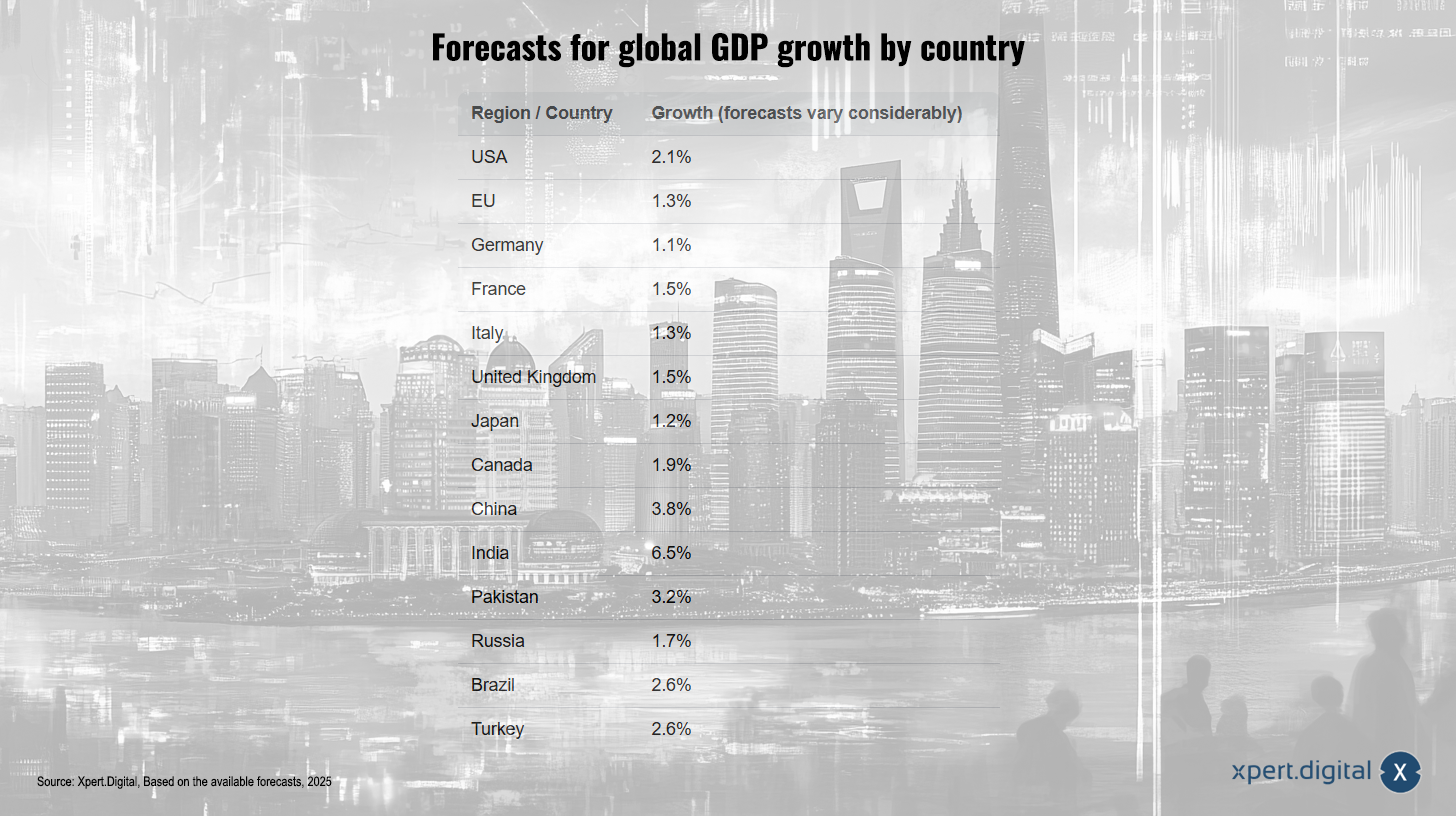
Global GDP growth forecasts by country – Image: Xpert.Digital
Based on the available forecasts for global GDP growth by country, the following picture can be drawn for 2025:
Global Forecast
Global GDP growth is estimated at around 3.2% for 2025. The Council of Economic Experts expects global growth of 2.6% for 2025.
Forecasts by region and country
Forecasts for individual countries sometimes differ considerably. Nevertheless, an overall trend towards economic recovery is discernible for 2025, the extent of which will be significantly influenced by various factors and the successful implementation of economic policy measures.
- USA: 2.1% growth
- Eurozone: 1.3% growth
- Germany: 1.1% growth
- France: 1.5% growth
- Italy: 1.3% growth
- United Kingdom: 1.5% growth
- Japan: 1.2% growth
- Canada: 1.9% growth
- China: 3.8% growth
- India: 6.5% growth
- Pakistan: 3.2% growth
- Russia: 1.7% growth
- Brazil: 2.6% growth
- Türkiye: 2.6% growth
Regional differences
Africa and Asia are expected to experience the fastest growth, with rates exceeding 4%. Experts predict that Europe will experience growth below the global average of the last ten years.
Factors influencing the forecasts
The forecasts take into account various factors such as the expected recovery of the global economy, inflation trends, monetary policy decisions, and geopolitical tensions. It should be noted that these forecasts are subject to uncertainties and may change due to unforeseen events.
Our recommendation: 🌍 Limitless reach 🔗 Connected 🌐 Multilingual 💪 Sales power: 💡 Authentic with strategy 🚀 Innovation meets 🧠 Intuition


From local to global: SMEs conquer the world market with a clever strategy - Image: Xpert.Digital
In an era where a company's digital presence determines its success, the challenge lies in creating an authentic, personalized, and far-reaching presence. Xpert.Digital offers an innovative solution that positions itself as the intersection of an industry hub, a blog, and a brand ambassador. It combines the advantages of communication and sales channels in a single platform and enables publication in 18 different languages. Cooperation with partner portals and the ability to publish articles on Google News and a press distribution list with approximately 8,000 journalists and readers maximize the reach and visibility of the content. This represents a crucial factor in external sales and marketing (SMarketing).
More information here:
Overview of key economic sectors and export goods
International comparisons show that different leading industries, sectors and export goods exist depending on the country:
"USA"
Traditionally, services, real estate, finance, and healthcare play a major role. At the same time, oil, aircraft parts, and fuels are exported. The US is also a leader in the technology sector, particularly in software, internet services, and artificial intelligence.
"China"
As a major manufacturing hub, the country is one of the largest exporters of electronics, machinery, and industrial intermediate products. Alongside manufacturing, the service sector is also gaining enormous importance.
"Japan"
As is well known, the automotive, electronics, and mechanical engineering sectors dominate the Japanese economy. The chemical industry is also gaining in importance. Japanese exports focus on high-tech products, while the country is also developing more services in the healthcare and nursing sectors due to its aging population.
"South Korea"
Electronics, and especially semiconductors, are prominent industries here. The country also has a strong presence in shipbuilding, the automotive industry, and the steel industry. The production of consumer electronics and digital devices plays a crucial role.
"Singapore"
The city-state combines financial services, chemicals, electronics, and dynamic high-tech manufacturing with its established status as a global trade hub. Numerous multinational corporations maintain their Asian headquarters there.
"India"
A large part of the added value comes from agriculture, while industry and services are growing strongly. Besides IT and software services, textiles, petroleum products, diamonds, pharmaceuticals, machinery, and steel are among the most significant exports.
"Pakistan"
Agriculture and the textile industry are key pillars of the economy. In addition, the country has industries such as cement, steel, automobiles, and food processing. Exports often focus on textiles, leather goods, and sporting goods.
“EU”
Europe's economy is highly diversified. Germany, France, and other countries export machinery, vehicles, and chemical products. At the same time, the service sector continues to grow, particularly in tourism, finance, consulting, and trade.
Economic policy measures in comparison
Faced with these challenges, governments have developed different strategies:
"Germany"
In addition to economic stimulus packages and infrastructure investments, a key focus is on promoting innovation and providing tax relief for businesses and citizens. However, it has been criticized that some funding programs are implemented too hesitantly and that bureaucratic hurdles deter potential investors.
"USA"
A mix of tax cuts, deregulation, and infrastructure investments dominates here. Technological development, particularly in the field of artificial intelligence, is being further accelerated by government programs and private investors.
"China"
The state steers the economy through targeted investments in key industries, while striving to avoid excessive debt. Structural change means, in particular, reducing dependence on simple exports and increasing innovation in the high-tech sector.
"Japan"
Monetary and fiscal stimulus is combined with structural reforms to stimulate the stagnant economy. For years, "Abenomics" was a buzzword for this three-pronged approach. However, its success remains limited by demographic trends.
"South Korea"
Seoul is focusing on economic stimulus packages, promoting innovation in the high-tech sector, and trade agreements. The government is also concentrating on solving structural problems in the labor market and strengthening the private sector.
"Singapore"
Openness to trade and capital is traditionally a cornerstone of economic policy. This is complemented by investments in education, technology, and innovation programs, which ensure the city-state's high competitiveness.
"India"
Deregulation and a push towards digitalization are key elements. These are complemented by major infrastructure projects, such as improvements to the road network and energy supply, to better connect the vast country. Financial incentives are being created for certain sectors to enable increased production and exports.
"Pakistan"
The country is focusing on privatizing state-owned enterprises and deregulating to attract investors. Strict fiscal management aims to improve the budget situation. Long-term programs are intended to increase export volume and further diversify the economy.
“EU”
The European Union pursues a coordinated policy that employs common monetary and fiscal policies. Structural reforms in member states aim to increase competitiveness, and green and digital agendas also play a central role. The EU often relies on compromises, as it must reconcile the interests of many different countries.
Additional aspects in 2025: sustainability, digitalization and global supply chains
Three megatrends will be particularly influential in 2025, affecting virtually all economies:
1) “Sustainability and climate protection”
Climate change is being discussed more intensively in numerous countries. Environmental standards are being tightened, and decarbonization is in full swing. "We need a green transformation," is a common refrain worldwide. To achieve the Paris climate goals, many countries are accelerating the expansion of renewable energies. Industry, too, must adapt, which is resulting in high investment costs in some sectors.
2) “Digitalization and Artificial Intelligence”
Whether in industrial manufacturing, the service sector, or medicine – AI is finding its way into more and more sectors of the economy. Countries like the USA, China, and India are well-positioned, as they already boast large digital companies and significant investments. Europe is also intensifying its efforts but is falling behind in some areas. At the same time, opportunities are opening up for smaller economies, especially if they can respond flexibly to innovation processes.
3) “Global supply chains and geopolitical tensions”
The pandemic years and the resulting focus on resilience have taught companies and governments that they cannot rely too heavily on individual suppliers or supply regions. While the motto previously was "just in time," the emphasis is now more on "just in case," meaning inventory management and diversifying sources of supply. Geopolitical crises, such as potential conflicts in the South China Sea, in Eastern Europe, or tensions between major powers, can lead to the closure of individual markets.
Comparison of economic development
A comparison of economic development in Germany, the USA, China, Japan, South Korea, Singapore, India, Pakistan and the EU yields several fundamental insights:
- Firstly, a clear divergence can be observed between the growth rates of some industrialized countries and the dynamic development in certain emerging economies. While India, parts of Southeast Asia, and China are showing some growth despite a slowdown, some established economies are struggling with stagnation or even recession.
- Secondly, the continuing threat of trade conflicts, protectionism, and geopolitical tensions leads to uncertainty. Export-oriented countries such as Germany, South Korea, and China are particularly affected. Trade between the US and China remains strained. At the same time, some countries will try to become less dependent on global risks and promote more local value creation.
- Third, technological innovation remains a key driver of economic development. Countries that invest in digitalization, research and development, and the expansion of their technological infrastructure have a better long-term chance of increasing their productivity and remaining competitive in the global market. This applies not only to high-tech nations like the USA, Japan, or South Korea, but increasingly also to emerging economies like India, which are rapidly expanding their technology-intensive sectors.
- Fourth, many countries, including Germany, Japan, and South Korea, face a demographic problem. The aging of society and the decline in the working-age population are hindering economic growth. Migration policies, targeted skilled worker programs, and long-term family and education policies could be important building blocks to counteract this.
- Fifth, attention is turning to the structural transformation towards a more sustainable, climate-friendly economy. While investment programs in many countries – including those in the EU – are aligned with climate targets, this can lead to upheavals in individual sectors. A successful transformation requires long-term planning, political stability, and a strategic allocation of capital and research.
"Germany must be courageous" – this is a frequently heard demand in panel discussions and business associations when it comes to overcoming the recession and regaining its leading position globally. This refers to the consistent expansion of digital infrastructure, the accelerated development of green technologies, and more intensive cooperation with innovative partner countries. Furthermore, Germany needs a modernized administration, less bureaucracy, faster approval processes, and a culture that more strongly supports entrepreneurial risk. Only in this way can it succeed in overcoming its structural weaknesses and returning to a path of growth.
At the same time, closer cooperation is needed within the EU. The introduction and strengthening of green industrial support, a coordinated foreign and security policy, a common approach to digitalization, and cooperation on migration issues could all contribute to making Europe more competitive. The creation of a truly interconnected single market for digital services and renewable energies can also provide a crucial impetus.
A look at global markets
A look at global markets reveals that the world economy in 2025 is far from homogeneous. Some countries are experiencing strong growth, others are mired in recession, and still others are struggling to recover. Almost all, however, face the challenge of reconciling technology, sustainability, and social stability. Tensions between major powers, protectionist tendencies, and regional conflicts contribute to an overall uncertain environment. The continued high importance of energy prices and raw materials, coupled with the trend toward diversifying supply chains, will also shape the global economy.
Whether Germany can overcome its current period of weakness will depend largely on how quickly and effectively political and economic actors respond. Investments in future technologies, education and research efforts, and a proactive industrial and energy policy could turn the tide. At the same time, a forward-looking, globally integrated policy could open up new markets and encourage domestic companies to take more risks.
“Change is inevitable, but it can be shaped, not merely endured” – this thought aptly summarizes the coming years in the global economy. Many countries, including the USA, India, South Korea, and Singapore, have adapted their economic strategies and are increasingly focusing on innovation and opening up new markets. In China, too, there is a strong awareness that after a period of breathtaking growth, a differentiated policy is now needed that reduces debt, promotes technology, and strengthens domestic demand. Japan, which has been battling economic stagnation for decades, is also taking steps to maintain its competitiveness through new technologies and reforms. Pakistan is at the beginning of a long road in which stabilization and liberalization must go hand in hand, while the EU is seeking stronger coordination and the implementation of joint projects.
Ultimately, the situation in 2025 is characterized by both challenges and opportunities. Innovations such as AI, quantum computing, green technologies, and biotechnology could not only help to modernize existing structures but also create new business areas, generate jobs, and improve people's quality of life. The decisive factor will be how policymakers, businesses, and societies respond. Going it alone nationally may bring short-term advantages, but there is a risk that overly isolated policies will hinder global exchange and potentially dampen growth. Finding a balance between openness and protection, between competition and cooperation, is the major challenge.
From today's perspective, every country has its own path, its own history, its own strengths and weaknesses. But in a globalized world, the development of each country has an impact on the whole. If Germany overcomes its crisis and once again sets innovative impulses, this could, for example, boost suppliers in Poland, the Czech Republic, or Italy. If the US and China de-escalate their trade conflicts, third countries will also benefit from smoother supply chains. If India continues its trajectory to become a growth champion, it could attract foreign companies and thus trigger new global dynamics.
Related to this:
The global economy in 2025 does not present a homogeneous picture
The global economy in 2025 will not present a homogenous picture, but rather a patchwork of different situations and strategies. Germany is in a recession that must be overcome with smart, forward-looking economic policies and structural reforms. Other countries are in a better position, although they too are grappling with their own problems. "One world, many paths"—this could be a concise summary of the global economic reality. Ultimately, it is clear that adaptability, innovation, and a long-term vision will be crucial for mastering the economic challenges. The path to lasting prosperity leads through investments in education, research, digitalization, sustainable energy, and social stability. If these tasks are tackled decisively, the prospects for Germany and the other affected countries can brighten considerably.
We are here for you - Consulting - Planning - Implementation - Project Management
☑️ SME support in strategy, consulting, planning and implementation
☑️ Creation or realignment of the digital strategy and digitization
☑️ Expansion and optimization of international sales processes
☑️ Global & Digital B2B trading platforms
☑️ Pioneer Business Development

Konrad Wolfenstein
I would be happy to serve as your personal advisor.
You can contact me by filling out the contact form below or simply call me on +49 7348 4088 965 .
I'm looking forward to our joint project.
Write to me


Xpert.Digital - Konrad Wolfenstein
Xpert.Digital is a hub for industry focusing on digitalization, mechanical engineering, logistics/intralogistics and photovoltaics.
With our 360° Business Development solution, we support renowned companies from new business to after-sales.
Market intelligence, smarketing, marketing automation, content development, PR, mail campaigns, personalized social media and lead nurturing are part of our digital tools.
You can find more information at: www.xpert.digital - www.xpert.solar - www.xpert.plus
Keep in touch