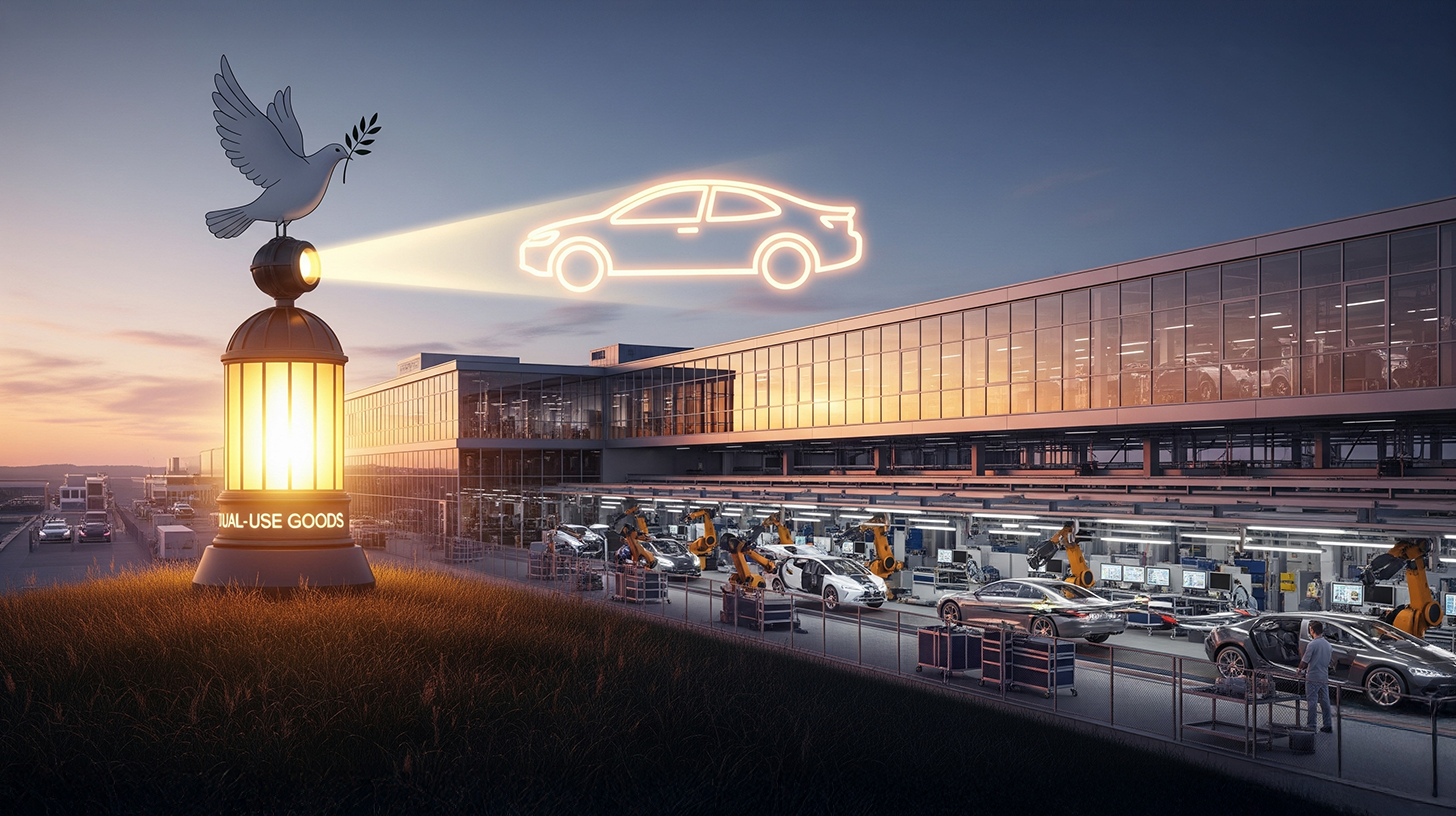
Dual-use goods as a beacon of hope for the beleaguered German automotive industry – Image: Xpert.Digital
'Dual-use' as a lifeline? What's really behind automakers' flirtation with the arms industry?
### Tanks instead of Passats? Why the German auto industry is now focusing on armaments ### Tens of thousands of jobs at risk: Can the arms boom stop the German auto crisis? ### The unexpected turnaround: How VW, Mercedes & Co. are fighting their crisis with military technology ### From electric cars to combat robots: The secret plan of the German industrial giants
Billions for armaments, crisis in the automotive industry: A surprising way out for thousands of skilled workers?
Alarm bells are ringing in German industry, but they sound very different: While profits are plummeting at automotive giants like Volkswagen, Mercedes-Benz, and BMW, putting tens of thousands of jobs at risk, the arms industry is experiencing a historic boom. Fueled by the geopolitical shift and exploding defense spending, the arms sector appears to be an oasis of growth in an uncertain economic world. It is precisely at this intersection that a question arises that is as pressing as it is obvious: Can tanks, military vehicles, and unmanned systems be the salvation for Germany's beleaguered key industry?
The figures paint a bleak picture for automakers and their suppliers. Massive profit slumps, shrinking sales, and large-scale job cuts at industry giants like ZF, Continental, and Bosch illustrate the depth of the crisis. At the same time, Germany is pumping billions into defense and, for the first time in decades, leads the list of Western European countries in military spending. In this context, so-called "dual-use goods"—technologies that can be used for both civilian and military purposes—are coming into focus.
But the path from passenger car assembly lines to the production of military technology is arduous and complex. Completely different safety standards, lengthy certification processes, and fundamentally different development cycles present enormous hurdles. This article examines the opportunities and risks of this potential transformation, highlights companies like Daimler Truck that are already taking initial steps, and explains why the commercial vehicle sector is considered a promising gateway. It is an analysis of a strategic realignment that could determine the future of thousands of jobs and the competitiveness of Germany as a manufacturing location.
Can the arms boom solve the automotive crisis?
Why is the German automotive industry suddenly focusing so intensely on armaments and dual-use technologies? The answer lies in the dramatic deterioration of the industry's economic situation and the simultaneous boom in the defense sector. While car manufacturers and suppliers are suffering from massive profit slumps and job cuts, the defense sector is experiencing historic growth due to the geopolitical shift. But how realistic is a transition from the struggling automotive industry to the flourishing defense sector?
What are the dimensions of the current automotive crisis? The figures speak for themselves: BMW's profit plummeted by more than a quarter in the first half of 2025, Volkswagen's by more than a third, and Mercedes-Benz's by more than half. The German automotive industry's revenue shrank by five percent in 2024 to €536 billion. The situation is particularly dramatic for suppliers: their revenue fell by eight percent, and almost 19,000 jobs were lost across the entire German automotive industry in 2024.
Which companies are affected by the job cuts? ZF plans to eliminate up to 18,000 of its current 50,000 jobs in Germany by the end of the decade. Continental has already announced the elimination of over 10,000 jobs, including 3,000 more in research and development by the end of 2026. Bosch intends to cut several thousand jobs, and tens of thousands of jobs are also at risk at Mercedes, Porsche, and Audi.
The historic surge in defense spending
How much have defense spendings increased in Germany and Europe? The figures show unprecedented growth: Germany's defense spending is projected to reach €86.4 billion in 2025 – an increase of €14.74 billion compared to 2024. With growth of 28 percent, Germany leads the list of Western European countries in absolute defense spending for the first time since reunification. Military procurement is expected to rise from €15.2 billion in 2024 to €21.64 billion in 2025.
How are NATO spending developing overall? For the first time, all 32 NATO member states are meeting the two percent target for their defense spending. Total NATO expenditures amounted to approximately US$1.185 trillion in 2024. In Europe, military spending increased by 17 percent to US$693 billion. NATO even plans to increase this to five percent of GDP by 2032.
The challenges of technology transfer
What are the fundamental differences between the automotive and defense industries? The requirements for a realignment are highly complex, and a simple capacity shift is not feasible. Production safety requirements differ significantly. Certification, testing, and standardization procedures in defense technology are entirely different from those in the passenger car and civilian commercial vehicle sectors.
What specific certification requirements exist in the defense sector? Companies in the defense industry must hold a number of ISO certifications, including ISO 9001 for quality management, ISO 14001 for environmental management, and ISO 27001 for information security. Additionally, NATO AQAP (Allied Quality Assurance Publications) certifications are required. These standards ensure consistency, efficiency, and effectiveness in the procurement and supply of NATO forces.
How long are the development cycles in the defense sector? In the defense sector, it can easily take two years from the initial application for a project to its launch. In the civilian sector, a project is often nearly complete by then. Furthermore, there are extremely high requirements for all kinds of components, and companies must guarantee long service and repair times as well as maintain long-term spare parts inventories.
Hub for Security and Defense - Advice and Information

Hub for Security and Defense - Image: Xpert.Digital
The Security and Defence Hub offers expert advice and up-to-date information to effectively support companies and organizations in strengthening their role in European security and defence policy. Working closely with the SME Connect Defence Working Group, it particularly promotes small and medium-sized enterprises (SMEs) that wish to further develop their innovative capacity and competitiveness in the defence sector. As a central point of contact, the Hub thus creates a crucial bridge between SMEs and European defence strategy.
Related to this:
Complex Mobility: Opportunities of Dual-Use Development
Commercial vehicles as a promising transitional area
Which vehicle categories are better suited for military use? Martin Thul from the Commercial Vehicle Cluster Southwest in Kaiserslautern sees a significantly shorter path to dual-use or military equipment for companies in the commercial vehicle sector than in the passenger car segment. Passenger cars are consumer goods and sit idle most of the time. Commercial vehicles are in intensive use and subjected to heavy wear and tear – qualities that make them suitable for military applications. A truck serves to transport, be it people or goods – the latter could be food or grenades.
Which companies are already active in the dual-use sector? Daimler Truck already has concrete plans: Defense-based revenue is to be doubled by 2030, after accounting for around one percent of total revenue in 2024. The company is increasingly focusing on partnerships, for example with ARX Robotics for the integration of robotics and AI technologies into vehicle platforms, and with the French military vehicle manufacturer Arquus for the joint development of military wheeled vehicles.
Innovative collaborations and technology alliances
What new partnerships are emerging between the automotive and defense industries? German automakers are exploring cooperation opportunities with defense companies in the field of automated driving. A high-ranking manager at a major German defense corporation confirmed initial talks with all German automakers regarding a potential technology transfer. The discussions focus primarily on how the automakers' development departments could enable the creation of unmanned systems for logistical or support purposes in the military sector.
What is the automotive industry's stance on dual-use goods? Several VW managers generally confirm the transferability of civilian automation technology to military applications. However, weapons technology, ammunition, and the construction of offensive battle tanks are considered a red line within the company. VW primarily produces for the civilian market, and dual-use goods play only a minor role. The Volkswagen Group has been involved in the production of tanks and warships since the beginning of the year through its subsidiary Renk.
Regional competence centers and research sites
What regional advantages does Germany have in the dual-use sector? Germany has a locational advantage because of its large number of specialized companies. "Project collaborations are an opportunity for the automotive industry," emphasizes Martin Thul. Suppliers, the chemical industry, IT and software solutions are needed – a comprehensive package. "That's where we have a locational advantage in Germany.".
Which companies and research institutions are located in Rhineland-Palatinate? Rhineland-Palatinate is home to important players such as Daimler Truck with its plant in Wörth, John Deere in Kaiserslautern, the construction machinery manufacturer Volvo in Konz, and General Dynamics European Land Systems-Bridge Systems GmbH in Kaiserslautern, which manufactures military bridge systems. The German Research Center for Artificial Intelligence (DFKI) and the Fraunhofer Institute for Experimental Software Engineering (IESE) are also located nearby.
What makes General Dynamics Bridge Systems a key player? Founded in 1864 as Eisenwerke Kaiserslautern, the company is today the world market leader for mobile bridge systems. As a specialist in the development, welded assembly, and repair of complex aluminum structures, it employs approximately 400 people at its Kaiserslautern location. The company has been recognized as one of the 100 most innovative medium-sized companies in Germany and, with its Leading Employer 2025 award, ranks among the top 1 percent of all employers in Germany.
The limits of transformation
How do industry associations assess the opportunities of the dual-use approach? The German Association of the Automotive Industry (VDA) is rather skeptical. While the growing demand from the dual-use and defense sectors is certainly an option for companies with their expertise, "at the same time, the publicly debated expectations regarding the creation of alternative jobs will most likely prove to be exaggerated.".
What structural obstacles exist? The German Association of the Automotive Industry (VDA) is certain: "The potential new jobs will by no means be able to replace the jobs threatened by the transformation and the lack of competitiveness of the location." Karsten Tacke of the Rhineland-Palatinate State Association of Employers' Associations emphasizes that while dual-use and defense-related technologies could open up additional markets for the automotive and supplier industries, they are not a panacea and do not fit every business model.
Strategic considerations for the future
What role does robotics play as a key technology? The dual-use nature of robotics is obvious: industrial service robotics and military robotics both benefit from AI, robust sensors, and ever-increasing computing power. China is already investing heavily in humanoid robotics with the stated goal of modernizing its own industry, addressing demographic change, and developing robots for military use.
How does modern warfare function in the context of the automotive industry? "War works differently today than it did in the past," says Martin Thul. To be prepared for this and to develop suitable innovations, a cross-industry approach is needed, focusing on systems, not individual components. Autonomous systems are playing an increasingly important role in modern warfare, as demonstrated by Russia's war of aggression against Ukraine, where both sides are using, among other things, semi-autonomous drones.
What long-term trends are emerging? A key approach for future industrial and defense policy is a dual-use approach, which, from an industrial policy perspective, is less technological than strategic. Modern dual-use strategies aim to systematically leverage synergies to achieve both economic advantages and defense capabilities. With dual-use, Europe intends to strengthen its industrial base without launching purely military stimulus programs – a classic win-win situation.
Realistic assessment of the possibilities
Can the arms boom actually solve the automotive crisis? The analysis paints a nuanced picture: While the growth in defense spending opens up significant new market opportunities and some companies are already successfully making the transition, a complete compensation for losses in the automotive industry is unrealistic. The structural differences between the two sectors—from certification requirements and development cycles to completely different production standards—make a simple switch impossible.
The commercial vehicle sector appears particularly promising, where technical requirements are more closely aligned and companies like Daimler Truck are already achieving concrete successes. Collaborations with technology companies like ARX Robotics demonstrate how modern dual-use strategies can work: combining basic civilian research with military applications leads to innovative solutions that benefit both sectors.
The future lies not in a complete shift from the automotive to the defense industry, but in intelligent dual-use strategies that can serve both markets. Germany, with its broad industrial base, research landscape, and geographical location, is well-positioned to assume a leading role in this field. However, the transformation will require time, significant investment, and, above all, realistic expectations.
Consulting - Planning - Implementation

Markus Becker
I would be happy to serve as your personal advisor.
Head of Business Development
Chairman SME Connect Defense Working Group
Consulting - Planning - Implementation
Konrad Wolfenstein
I would be happy to serve as your personal advisor.
You can contact me at wolfenstein∂xpert.digital or
Just call me on +49 7348 4088 965 .