
Digital catch-up for SMEs: With us, you'll beat the big players in your industry – in visibility (GEO/SEO), trust, and expertise – Image: Xpert.Digital
Leverage the evolution of search engines to your advantage: With our tailored visibility strategies for SMEs, we match the budgets of large corporations through precision and relevance
Our own industry hub as a trade magazine and our data-driven research & development for marketing, sales and business development
The global economy is facing enormous changes. While large corporations are investing heavily in their digital presence, a significant portion of Germany's small and medium-sized enterprises (SMEs) risk becoming invisible in the new age of AI. This is no longer just about traditional search engine optimization or simply having a website. With the rapid rise of generative AI like ChatGPT and the increase in so-called "zero-click searches," the rules of customer acquisition are fundamentally changing: Those not cited as trustworthy sources by the new AI systems simply cease to exist for purchasing decision-makers in both the B2B and B2C sectors. But instead of succumbing to shock, this historic shift offers a tremendous opportunity, especially for specialized companies. This article examines why visibility has become the new currency of power, which strategic gaps are currently holding SMEs back, and what concrete steps companies can take now to catch up and secure their future market viability.
Visibility as the new currency of power: Why invisible companies are disappearing economically
Why German SMEs are falling behind in the digital race – and how they can catch up
The German economy is at a crossroads that, at first glance, appears unspectacular, but in its depths is triggering structural shifts of historic proportions. Digital visibility, long considered an optional marketing tool, has evolved into a hard business necessity that determines market share, revenue growth, and ultimately, the survival of companies. While large corporations have their own marketing departments, specialized agencies, and multi-million-euro budgets to continuously professionalize their digital presence, a significant portion of Germany's small and medium-sized enterprises (SMEs) are still struggling with the basics of online presence. This gap is not a marginal phenomenon, but rather affects the backbone of the German economy, as over 99 percent of all companies in Germany are SMEs, which provide more than half of all jobs and generate a substantial share of economic output.
The starting point is ambivalent. On the one hand, digital maturity has noticeably improved in recent years; on the other hand, the total number of digitally lagging businesses remains alarmingly large. Current surveys show that around six out of ten small and medium-sized enterprises (SMEs) in Germany have their own website, which represents an increase of eight percentage points compared to the previous year. However, this also means that around 40 percent still operate without a digital presence. This gap is particularly pronounced among micro-enterprises with fewer than ten employees, of which, according to various surveys, only about half have an online presence, while companies with 50 to 249 employees have almost universal online visibility. These figures reveal a deep divide within the SME sector itself, one that is not along traditional industry boundaries but rather along company size and the available internal resources for digital initiatives.
From website lag to structural investment gap: Where SMEs really stand
A quantitative analysis of digitalization spending provides an even more nuanced picture of the economic reality. The KfW banking group documents in its latest digitalization report that digitalization activities among small and medium-sized enterprises (SMEs) have lost considerable momentum, and the proportion of companies with completed digitalization projects has fallen back to pre-pandemic levels, after having temporarily risen to 35 percent. At the same time, digitalization spending has also declined, most recently reaching €23.8 billion, after having been significantly higher in previous survey years. Particularly noteworthy is the finding that the digital divide between large and small SMEs is not shrinking, but rather widening. This means that the inequality described at the outset is intensifying over time instead of disappearing on its own.
In a European comparison, Germany performs only moderately well in the use of advanced digital technologies. Around one in four small and medium-sized enterprises (SMEs) in Germany used artificial intelligence (AI) methods in 2025, which, while above the European average, lags far behind the adoption rate of large companies, which is over half. The Scandinavian countries continue to lead the European rankings by a considerable margin, demonstrating that despite its industrial reputation, the German economy is by no means at the forefront of digital transformation. This finding contradicts the widespread self-image of many German entrepreneurs, who often overestimate their technological competitiveness because they measure it by the quality of their physical products rather than their digital market penetration.
Bureaucracy as a new brake on growth: When rules become more important than costs
A remarkable shift is evident in the obstacles that companies themselves perceive as the biggest barriers to digitalization. For the first time since systematic surveys began, cost is no longer cited as the biggest obstacle, but rather bureaucracy, identified as the primary impediment by 55 percent of the surveyed companies, while costs fall to second place at 52 percent. This change is economically significant because it demonstrates that while the willingness to invest financially is fundamentally present, administrative and regulatory hurdles structurally slow down the pace of implementation. Lack of time in day-to-day operations remains the third most frequent barrier, cited by 47 percent of respondents, and points to a core problem for small and medium-sized enterprises (SMEs): the chronic scarcity of resources in areas that do not promise immediate operational returns.
At the same time, a positive shift in investment can be observed. Among the companies that are actually investing, IT security and data protection top the list of priorities at 38 percent, while online visibility, including website optimization, and the use of artificial intelligence (AI) follow closely behind at 35 percent each. The willingness to invest in AI has increased by ten percentage points compared to the previous year, and for almost a third of the companies surveyed, AI now accounts for more than ten percent of the total digital budget. These figures demonstrate that AI is no longer a fringe phenomenon, but has become an integral part of strategic budget planning in medium-sized businesses.
The strategy gap in the engine room: Why enthusiasm doesn't translate into implementation
A key paradox of the current situation lies in the discrepancy between perceived importance and actual implementation competence. A study by the digital association Bitkom on the digital transformation of industry shows that 78 percent of the surveyed companies attribute very high or rather high importance to artificial intelligence for their competitiveness, while at the same time 46 percent consider themselves to be lagging behind or even completely out of touch with the technology. This gap between aspiration and reality can be described as a strategic gap and is characteristic of a phase in which technological availability has clearly outpaced organizational implementation capability.
Further analyses show that 43 percent of German SMEs lack a concrete strategy for the use of artificial intelligence (AI), while 91 percent of large companies already consider this technology business-critical. Even where AI is implemented, industry experts estimate that more than half of the projects fail due to management issues, as pilot projects are not systematically scaled or integrated into existing business processes. This observation is crucial for understanding the current situation, as it demonstrates that technological access alone does not create a competitive advantage. The decisive factor is the organizational ability to translate new tools into viable, repeatable processes, which is particularly difficult for smaller companies with limited personnel resources and a lack of internal digital expertise.
The silent revolution of search: How AI systems decide who gets found
While small and medium-sized enterprises (SMEs) are still grappling with the basics of traditional search engine optimization (SEO), the foundation of digital visibility has already fundamentally changed. The introduction of AI-generated summaries in the search results of major search engines has fundamentally reshaped user behavior. Studies show that the click-through rate for traditional organic search results drops by between 34 and 46 percent as soon as an AI-generated summary appears in the results. The proportion of so-called zero-click searches, where users don't visit any external website at all, rose from 56 to 69 percent within a year. For companies whose entire digital marketing is based on traditional search engine ranking, this represents a fundamental loss of value on their previous investments.
In parallel, the research behavior of business customers is changing radically. Current surveys show that half of all purchasing decision-makers in the B2B sector now begin their research in an AI chat system like ChatGPT instead of a traditional search engine, with this share increasing by over 70 percent within just a few months. According to market research data, ninety percent of B2B buyers now use generative AI tools in their procurement process. Traffic generated via AI systems demonstrably converts into actual business contacts much more effectively than traditional search engine traffic because users are already at a more advanced stage of their purchasing decision. This development represents a structural shift that goes far beyond a mere trend change in marketing.
🎯🎯🎯 Data-driven B2B industry hub as a quasi-in-house solution

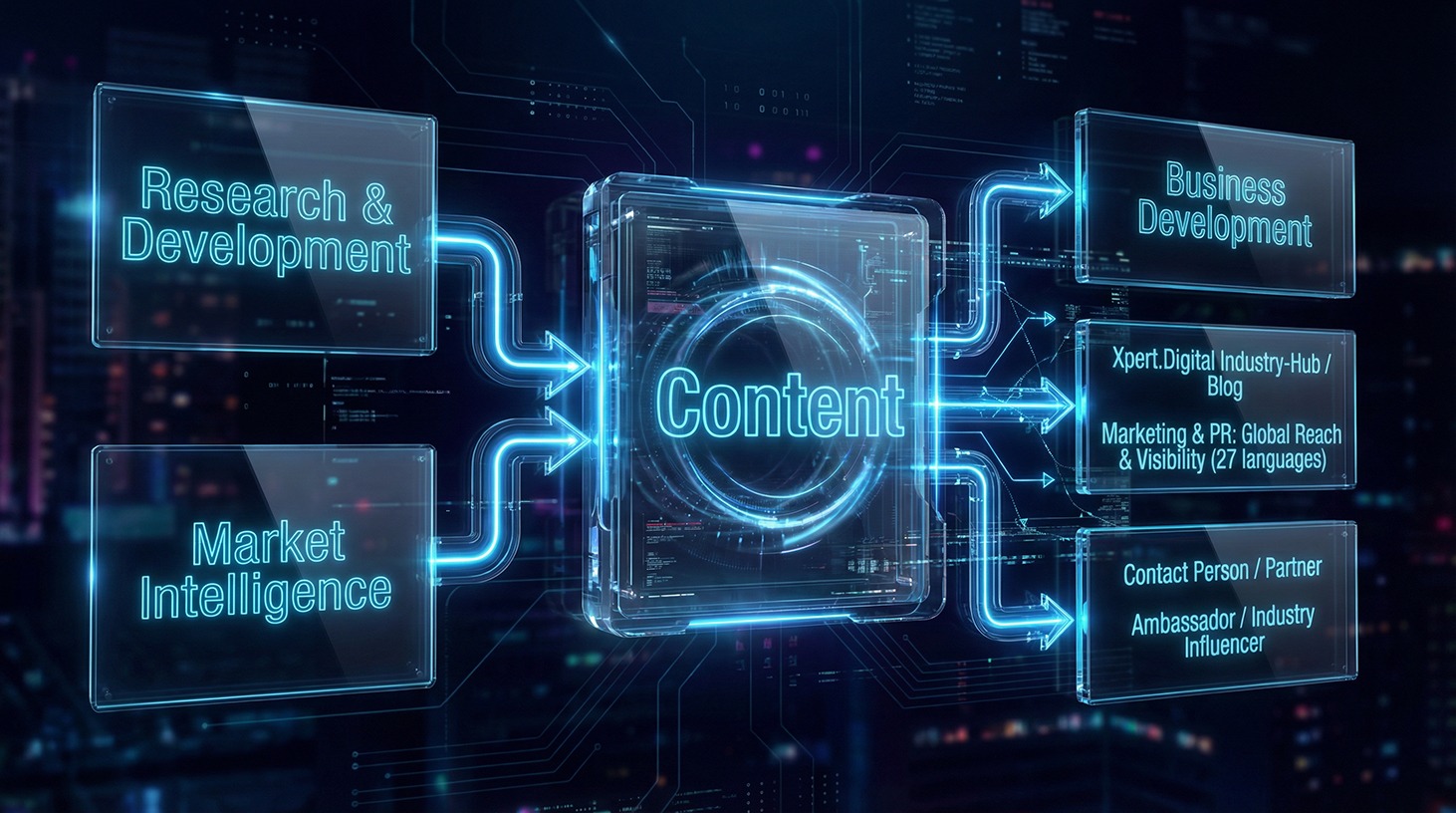
The quasi-in-house solution: How Xpert.Digital closes operational gaps in B2B marketing and sales – Smart Content-Driven Business - Image: Xpert.Digital
Xpert.Digital is a data-driven B2B industry hub led by Konrad Wolfenstein . The company acts as an external, quasi-in-house solution for industrial partners, closing operational gaps in marketing, content, and sales – without requiring additional resources on the client side.
More information here:
AI strategy for SMEs: Out of digital invisibility
From search engine optimization to the mention economy: New rules of the game for visibility
The crucial economic consequence of this shift is that traditional rankings are losing their significance as a measure of success, while the frequency of mentions within AI-generated responses is becoming the new key metric. A company that doesn't appear as a trusted source in the responses of systems like ChatGPT, Perplexity, or Google Gemini simply ceases to exist for a growing segment of potential customers, regardless of its former high visibility in traditional search results. Experts are referring to a new success metric called "Share of Citations," which measures the proportion of mentions as a source in AI-generated responses, and the "Share of Mentions," which tracks the frequency of brand mentions across all relevant platforms.
These new requirements demand a fundamentally different approach from companies than traditional search engine optimization. Citable content must be clearly structured, provide concise summaries in prominent positions, and be supported by concrete, verifiable facts and proven expert authorship. AI systems demonstrably cite content with named, verified authors almost twice as often as anonymous contributions. Furthermore, external validation through third-party sources such as specialist portals, industry directories, and professional networks like LinkedIn is gaining considerable importance because AI systems compile their answers from a multitude of trustworthy sources and do not rely solely on the company's own website. For small and medium-sized enterprises (SMEs), this means that simply having a website is no longer sufficient. What is needed is a consistent, professionally sound digital presence distributed across multiple channels, going far beyond what many smaller companies can currently achieve with their limited resources.
Economies of scale for corporations: Why economies of scale distort competition
The structural disadvantage of smaller companies in this new environment is easily explained economically. Large corporations have specialized teams that continuously produce content, maintain technical infrastructures for machine-readable data structures, and systematically build relationships with trade media and influencers, while in medium-sized businesses, a single person often has to handle these tasks alongside numerous other responsibilities. This resource asymmetry leads to a self-reinforcing cycle: Those who are already digitally visible are preferentially cited by algorithms and AI systems, thereby gaining further inquiries and mentions and continuously expanding their lead, while digitally invisible companies, even with objectively comparable technical quality of their products or services, increasingly disappear from the view of potential customers.
Interestingly, market observations suggest that AI systems don't necessarily recommend the largest providers, but rather those with the most relevant expertise, provided they possess sufficiently specific, verifiable, and thematically focused content. This presents specialized medium-sized businesses with a real opportunity to position themselves as digital authorities in clearly defined niches without having to compete with the global marketing budgets of multinational corporations. However, this requires a strategic realignment of their own communication strategies, which many companies cannot manage on their own due to a lack of both time and expertise. Therefore, external support from specialized service providers is increasingly becoming an economically rational way to bridge this gap.
Regional and sectoral fault lines: Where the digitalization gap is deepest
The digital divide among small and medium-sized enterprises (SMEs) is not uniform across the German economy, but rather concentrated in specific sectors and regions. Particularly affected are the skilled trades, the construction industry, the transport sector, and local service providers, which have traditionally relied more heavily on personal customer relationships and word-of-mouth marketing than on digital marketing. Significant regional differences are also evident: In economically strong regions of southern Germany and in metropolitan areas, the digital presence of SMEs is, on average, considerably stronger than in rural areas, especially in parts of eastern Germany. There, lower broadband coverage and less IT affinity, combined with limited personnel resources, lead to noticeably lower scores for websites and online marketing.
A comparison with direct competitors within the same industry and region is often sobering. Digitally engaged companies sometimes show ten to twenty times higher scores in key metrics such as visibility index, ranking positions for relevant search terms, and total web traffic than their digitally passive competitors in the same location. This enormous range illustrates that digital visibility is no longer just a competitive advantage in the sense of an add-on, but rather determines a company's fundamental market viability. Those who remain near zero in these statistics gradually lose market share to more digitally active competitors, even if their own product quality is objectively equivalent or even superior.
Funding policy as a bridge builder: What the state has achieved so far
In light of the challenges described, German economic policy has launched various funding programs to specifically support digitalization in small and medium-sized enterprises (SMEs). An evaluation of the "SME Digital" funding priority, published in spring 2025 by the Federal Ministry for Economic Affairs and Climate Action, confirms that these programs have a generally positive impact on the supported companies. As a concrete example, the "Digital Now" investment grant program is cited, which, between September 2020 and December 2022, reportedly generated a revenue increase of approximately €447 million for the supported companies with funding of around €134 million – a multiplier of more than three times the amount of public funds invested.
The evaluation also notes, however, that micro-enterprises tend to be underrepresented in the recipient structure of funding programs. This means that precisely those businesses with the greatest need for improvement have the most difficulty accessing government support. This finding is economically significant because it shows that funding programs alone are insufficient to close the structural gap. Often, the smallest businesses lack the time and personnel resources to submit complex funding applications or to translate the funds into concrete digitalization projects, which in turn underscores the need to provide low-threshold, practical consulting and implementation services as a complement to traditional funding policies.
Escaping the visibility trap: Strategic options for SMEs
A clear economic conclusion can be drawn from the overall picture of the developments described. German SMEs are not facing a temporary technological trend, but rather a structural reorganization of how business contacts are established, trust is built, and purchasing decisions are prepared. Those who ignore this reality risk not only missed growth but also a gradual displacement from the relevant perception space of their target group, even if their product or service offering is technically convincing. At the same time, the analysis shows that the mere availability of technology is not a guarantee of success. Crucial is the ability to systematically integrate strategy, content, technical infrastructure, and external reach, which, given limited internal resources, is realistically only achievable for most SMEs with external expert support.
The central entrepreneurial task for the coming years is therefore to no longer view digital visibility as a cost item, but rather as a strategic investment in one's own marketability. This includes the systematic development of citable, technically sound content, the technical preparation of one's own digital infrastructure for machine-readable analysis by AI systems, and the targeted expansion of one's own presence on specialist portals, in industry directories, and in professional networks. Only through this multidimensional approach can SMEs compensate for the economies of scale that have historically given large corporations a structural advantage and assert themselves as a relevant, visible, and trustworthy choice for their customers in a market environment increasingly mediated by artificial intelligence.
Your global marketing and business development partner
☑️ Our business language is English or German
☑️ NEW: Correspondence in your native language!

Konrad Wolfenstein
I and my team are happy to be available to you as your personal advisor.
You can contact me by filling out the contact form here wolfenstein@xpert.digital:or simply call me at +49 7348 4088 965. My email address is
I'm looking forward to our joint project.
☑️ SME support in strategy, consulting, planning and implementation
☑️ Creation or realignment of the digital strategy and digitization
☑️ Expansion and optimization of international sales processes
☑️ Global & Digital B2B trading platforms
☑️ Pioneer Business Development / Marketing / PR / Trade Fairs
📈🚀 From visibility to trust 👀🤝 Your scalable path with Xpert.Digital

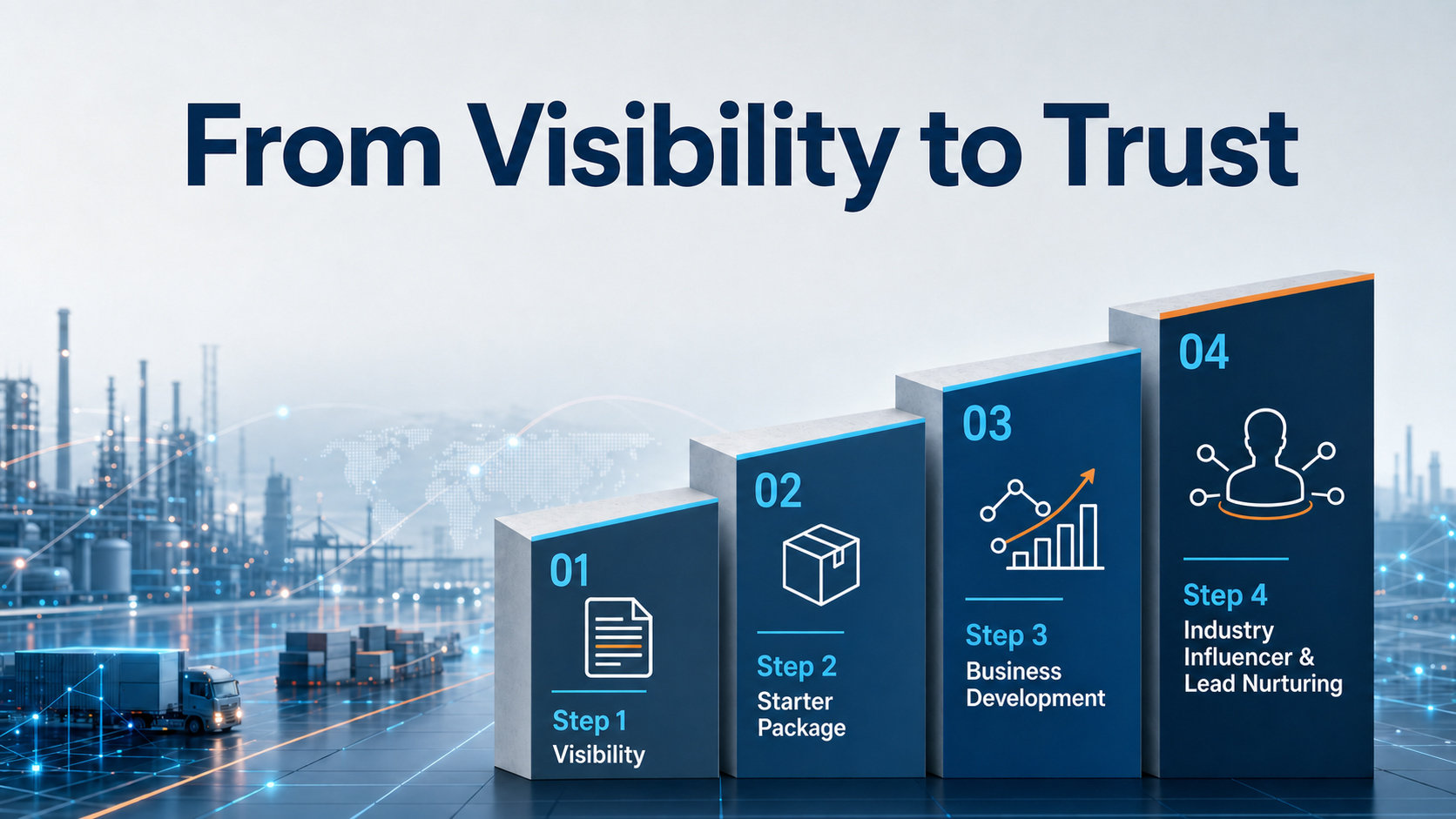
From visibility to trust: Your scalable path with Xpert.Digital - Image: Xpert.Digital
In industrial B2B, sustainable business relationships rarely emerge overnight. They develop step by step – through visibility, professional relevance, recurring touchpoints, and growing trust. Xpert.Digital's 4-stage model addresses precisely this: It offers a structured path that begins with a manageable entry point and can evolve into deeper collaboration in business development if needed.
Instead of relying on loud marketing promises, this model puts the relationship at the forefront. Companies start with clearly defined, easily calculable measures and then decide, based on their own experience, how far they want to expand the collaboration. A key factor for this undisturbed trust-building process: The platform completely avoids annoying advertising ads, so the editorial focus remains solely on the companies' expertise.
More information here: