
Development of the global construction machinery market: A comprehensive analysis

Available in 27 languages 📢
Prefer Xpert.Digital on GoogleⓘPublished on: May 5, 2025 / Updated on: May 23, 2025 – Author: Konrad Wolfenstein
Development of the global construction machinery market: A comprehensive analysis – Image: Xpert.Digital
Global Construction Equipment Market: Growth, Challenges and Trends in Focus until 2030
Strategies and market potential in the global construction machinery sector examined
This article provides an in-depth analysis of the global construction machinery market, examining its size, growth trajectory, segmentation, key drivers (infrastructure investment, urbanization, technological innovation), significant challenges (regulations, supply chain volatility, costs), regional dynamics, and competitive landscape. The market is substantial and growing, undergoing significant transformation driven by sustainability pressures and digitalization.
Synthesis of Market Size & Growth
The global market value was estimated to be between USD 150 billion and USD 250 billion for the period 2023-2024, with variations due to differing methodologies and market definitions across different sources. Forecasts indicate growth at a compound annual growth rate (CAGR) generally ranging from 3.5% to 8.5% through the early 2030s. This suggests steady expansion despite potential regional economic headwinds.
Dominant Trends & Regional Leadership
Global infrastructure development and rapid urbanization, particularly in Asia, remain the primary drivers of demand. Asia-Pacific, led by China and India, represents the largest regional market. Technological advancements toward electrification and automation/digitalization are reshaping machine design and operation.
Key Challenges & Strategic Imperatives
Stringent emissions regulations, ongoing supply chain disruptions affecting costs and delivery times, high initial investment costs, and technological hurdles pose significant challenges. Success depends on technological innovation, supply chain resilience, regional adaptation, and evolving business models that integrate services and leasing.
Related to this:

Global Construction Equipment Market Overview
Construction machinery encompasses a wide range of specialized, heavy machines designed for specific tasks in construction, demolition, infrastructure development, mining, and material handling. These include excavators, loaders (front loaders, backhoe loaders, skid steer loaders), bulldozers, graders, cranes, dump trucks, compactors, pavers, and concrete mixers. These machines enable an efficiency and scale that far surpasses manual labor or standard tools.
Market boundaries
This analysis focuses primarily on the global market value generated from the sale of new equipment. However, it acknowledges the interconnectedness and significant size of the rental market, as well as the growing importance of the service segment (repair, maintenance, spare parts, training, telematics data), since these influence overall demand and manufacturers' strategies. The market serves as a critical indicator of broader economic activity and the level of infrastructure investment.
Segmentation as an analytical tool
Market segmentation involves dividing the overall market into smaller, more homogeneous groups based on shared characteristics. This enables targeted analysis and strategy development by understanding the diverse needs and trends within different customer groups, product categories, applications, or regions. Segmentation is therefore a fundamental tool for managing the complexity of the global market and defining effective market strategies.
Current market size and historical growth trajectory
Market Quantification: Recent estimates for the size of the global construction equipment market show significant fluctuations, ranging from approximately USD 150 billion to USD 250 billion for the period 2023-2024. Examples include estimates for 2023 such as USD 151.6 billion, USD 152.7 billion, USD 155.9 billion, USD 156 billion, USD 171.1 billion, USD 200.3 billion, USD 206.4 billion, USD 207.1 billion, and USD 208.5 billion. For 2024, estimates range from USD 148.0 billion through USD 161.5 billion, USD 161.8 billion, USD 175.1 billion, USD 183.6 billion, USD 202.8 billion, and USD 212.9 billion, up to USD 250.0 billion. This range underscores the critical need to understand the methodology, scope (e.g., inclusion of services, rentals), and base year of each figure cited.
Historical context: The market has shown significant growth over the past decade, albeit with cyclical fluctuations. Historical data points (e.g., USD 119.0 billion in 2022, USD 195.8 billion in 2021) indicate an upward trend. The COVID-19 pandemic caused initial disruptions and slowdowns, but the subsequent recovery, coupled with economic stimulus measures, led to pent-up demand and may have accelerated the trend toward leasing due to uncertainty.
Recent performance: Despite the general growth forecasts, some recent reports indicate a market cooling or declines in certain regions (particularly Europe) or globally for sales in 2024 compared to record highs in 2023, suggesting sensitivity to economic conditions and interest rates.
The significant discrepancy in reported market sizes (in some cases exceeding USD 100 billion for estimates from 2023/2024) underscores the lack of a standardized market definition and reporting methodology in industry analysis. Contributing factors include the inclusion or exclusion of services and rental income, differing compilations of equipment types, varying geographic coverage, differing currency conversion rates, and the timeliness of report updates. A direct comparison of absolute values is problematic without normalizing the scope. This report must therefore establish its own clear definition (e.g., value of new equipment sales) and utilize the range of reported figures to illustrate market size, while highlighting the methodological ambiguity. The trend (growth) is more consistent across sources than the absolute value.
Market forecast and projected growth (CAGR analysis)
Growth projections: Forecasts generally indicate continued market expansion, with projected CAGRs ranging significantly between approximately 3.0% and 8.5% for the period up to 2030-2034. This means that market values could potentially reach USD 280-350 billion by the early 2030s, with some optimistic forecasts exceeding USD 400 billion.
Interpretation of the range: The variance in CAGR forecasts reflects differing perspectives on the balance of power between growth drivers (infrastructure spending, technological adoption, emerging market potential) and headwinds (economic slowdowns, regulatory costs, supply chain risks, high interest rates). Optimistic forecasts (e.g., in the range of 6–8.5%) likely place a strong emphasis on technological transitions (electrification) and sustained infrastructure demand, particularly in APAC. More conservative forecasts (e.g., in the range of 3–5%) may place greater weight on the recent market slowdown, economic uncertainties, and the challenges of widespread technology adoption.
The divergence of projected CAGRs (3.0% to 8.4%) is a key indicator of market uncertainty and the varying impacts of major trends. It suggests disagreement among analysts regarding the speed and extent of technological transformation (electrification/automation) and its ability to offset economic headwinds or saturation in mature markets. High CAGRs assume that technology and emerging markets will overcome challenges, while low CAGRs imply a more constrained growth trajectory influenced by costs, regulations, and economic cycles. Actual market performance could fall anywhere within this range and depend heavily on policy decisions, technological breakthroughs (particularly battery technology), and global economic health. This report aims to provide a baseline forecast but also discuss the factors that could drive growth to either end of the spectrum.
Global Construction Equipment Market Size and Forecast (USD billion, CAGR)
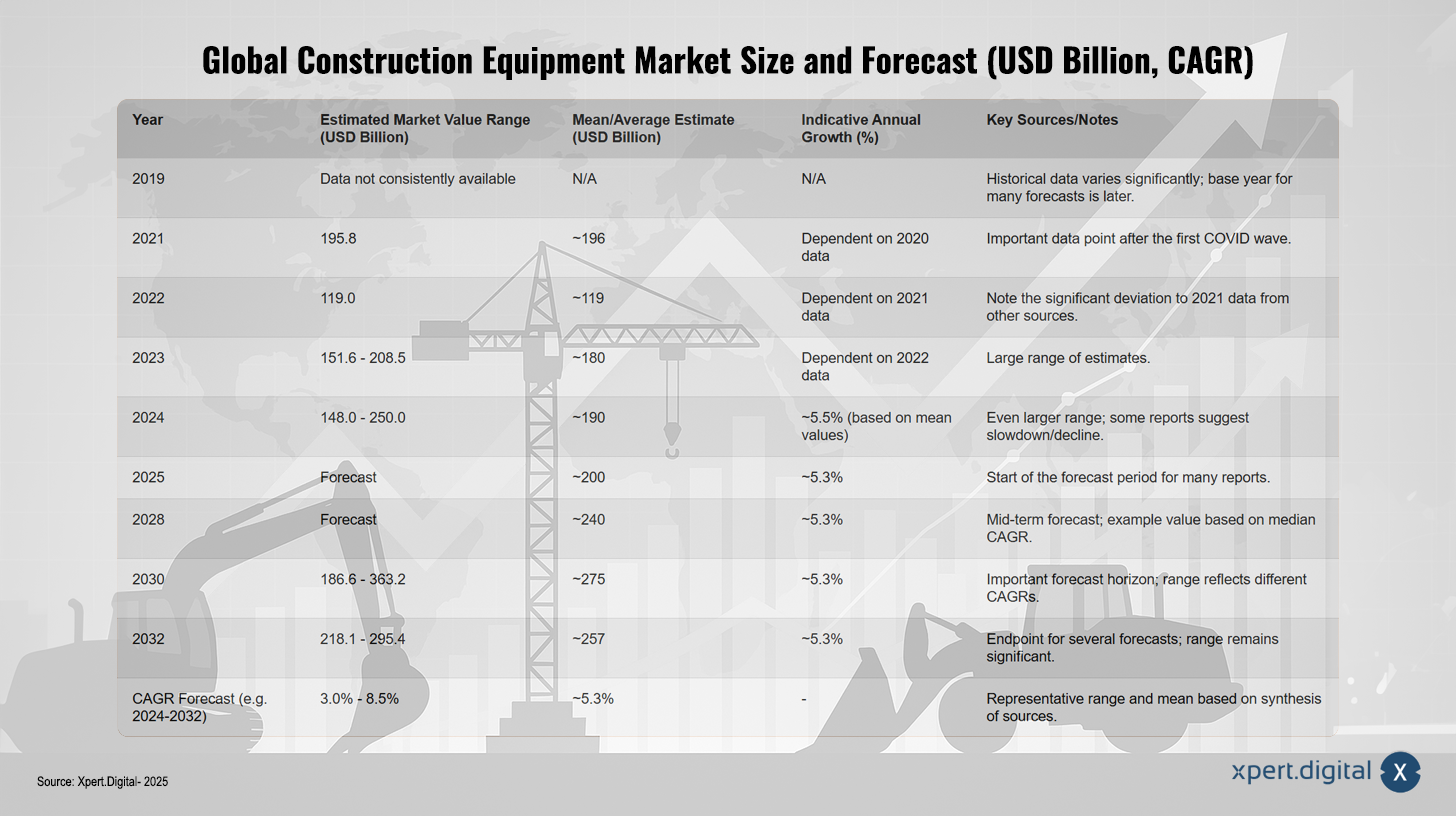
Global Construction Equipment Market Size and Forecast (USD billion, CAGR) – Image: Xpert.Digital
The global market size for construction equipment has grown significantly in recent years, though it has also been subject to considerable fluctuations. In 2021, the market value reached approximately USD 196 billion, followed by a significant decline to USD 119 billion in 2022. Estimates for 2023 ranged from USD 151.6 billion to USD 208.5 billion, with an average of around USD 180 billion. Forecasts for the coming years indicate steady growth: a value of approximately USD 190 billion is expected for 2024, followed by USD 200 billion in 2025 and approximately USD 240 billion by 2028. Revenues are projected to increase to an average of USD 275 billion by 2030, before leveling off at around USD 257 billion in 2032. The average annual growth rate (CAGR) for the period 2024–2032 is estimated at approximately 5.3%, with estimates ranging from 3.0% to 8.5%. This data reflects both the uncertainties of market development and the long-term growth dynamics.
Note: The values in the table are synthesized and rounded for illustrative purposes. The actual figures vary considerably depending on the source and methodology.
Related to this:

Market analysis by segment
By equipment type
Main categories: The market is typically divided into the following main categories: Earthmoving machinery (the foundation of the market: excavators, loaders, bulldozers, graders), material handling machinery (crucial for logistics and building construction: cranes, forklifts, telehandlers), concrete and road construction machinery (essential for infrastructure: mixers, pavers, compactors, rollers), heavy construction vehicles (transport on the construction site: dump trucks) and other specialized categories such as civil engineering machinery, crushing and screening plants.
Segment dominance: Earthmoving equipment consistently represents the largest segment by value, often accounting for approximately 50-60% of the market. Excavators and loaders are frequently highlighted as the dominant subcategories within earthmoving. One source even cites the share of earthmoving equipment as 63% in 2022, while other estimates for 2023 are 53.3% or 52%.
Growth dynamics: Although earthmoving equipment accounts for the largest share, material handling equipment is often projected to have the highest CAGR. This growth is attributed to increasing industrialization, the rise of e-commerce, which requires sophisticated logistics and warehousing, automation trends, and the demand for lifting solutions in large infrastructure projects. Concrete and road construction equipment also show strong growth potential, directly linked to infrastructure spending.
Heavy vs. Compact: The distinction between heavy and compact/light equipment is crucial. Compact equipment (mini excavators, skid steer loaders, compact wheel loaders <100 hp) is experiencing rapid growth, particularly in developed markets (North America/Europe) and urban environments. This is driven by versatility, maneuverability, lower costs, and suitability for electrification.
The market exhibits a pattern where the largest segment (earthmoving) may not necessarily be the fastest growing. The scale of earthmoving is tied to large, often cyclical projects (infrastructure, mining). In contrast, the high growth of material handling appears to be linked to more persistent structural trends (logistics, automation, industrial expansion). Similarly, the rapid growth of compact equipment suggests the influence of urbanization, smaller/specialized job requirements, and the initial focus of electrification efforts. This implies that different segments are driven by different economic and technological forces. While large projects determine the overall volume (earthmoving), secular trends such as e-commerce and automation fuel growth rates in material handling, and urbanization/electrification favors compact equipment. Market strategy must therefore differentiate between volume leadership and growth leadership. Opportunities exist in high-growth niches, even if they do not represent the largest share of the current market.
After application
Key applications: The primary applications driving demand include infrastructure development (roads, bridges, airports, utility lines, energy – often cited as the largest or fastest growing), residential construction (housing demand – also often cited as the largest), commercial construction (offices, retail), industrial construction (factories, warehouses), mining & excavation, lifting & material handling, transportation and others such as oil & gas, forestry, agriculture.
Dominant applications: Sources disagree on whether infrastructure or housing holds the largest share. This likely depends on the region and the economic conditions of the year (e.g., government stimulus programs vs. housing market cycles). Earthmoving and excavation & mining are also fundamentally large application areas that often overlap with the end-user segments of infrastructure and mining.
Growth drivers by application: Infrastructure growth is directly linked to government spending and major projects. Housing growth is related to urbanization, population growth, and housing affordability/demand. Industrial applications are expected to grow strongly, possibly in connection with the expansion of manufacturing and logistics. Lifting and material handling applications show high growth potential.
Conflicting reports regarding whether infrastructure or housing is the dominant application segment highlight the market's sensitivity to both long-term government planning (infrastructure) and shorter-term economic cycles (housing). Infrastructure spending often provides a baseline demand, particularly in developing regions (APAC), while housing activity can fluctuate more with interest rates and consumer confidence, especially in developed markets (NA/Europe). Neither segment is universally dominant at all times and in all places. Both are crucial, and their relative size can shift depending on geography and economic context.
By drive type
Powertrain landscape: The market is overwhelmingly dominated by internal combustion engines (ICE), primarily diesel. This is due to their power density, torque characteristics suitable for heavy loads, established refueling infrastructure, and maturity. However, alternative drive systems are gaining importance: battery-electric, hybrid (diesel-electric), and compressed/liquefied natural gas (CNG/LNG) or renewable natural gas (RNG).
Market Share & Growth: Diesel/ICE currently holds the largest share. Electric propulsion is projected to have the highest CAGR, driven by environmental regulations, sustainability initiatives, and the potential for lower operating costs. CNG/LNG/RNG is also identified as a significant growth area, potentially even the fastest in some analyses, and offers a cleaner-burning alternative to diesel, particularly for larger equipment where electrification faces challenges. Hybrid technology serves as an intermediate step, offering fuel savings compared to pure ICE propulsion.
The transition away from diesel is unlikely to be a monolithic shift solely to battery-electric powertrains. Alternative fuels such as CNG/LNG/RNG and hybrid systems represent important parallel pathways, particularly for heavy-duty work cycles and applications where battery range, charging infrastructure, or power density remain constraints. This points to a future market with a more diverse mix of powertrain technologies tailored to specific equipment sizes and use cases. Market decarbonization will likely involve multiple technological solutions concurrently, rather than a single replacement for diesel. OEM strategies must reflect this multi-pronged development.
Other key segments
By performance class: Detailed segments such as <100 hp, 101-200 hp, 201-400 hp, >400 hp. The dominance of the lower horsepower segments (<100 hp or 101-200 hp) reflects the volume of compact and mid-size car equipment.
By end user/industry: Construction & Infrastructure (dominant), Mining, Oil & Gas, Manufacturing, Forestry & Agriculture, Public Works, Military, Rental Companies, Contractors, Government. The relative importance varies, with Construction & Infrastructure and Mining often being the largest consumers.
By solution type: Products vs. services. Products (machine sales) dominate revenue, but services (maintenance, repair, training, rental) are growing, potentially with higher margins or CAGR.
By drive type (mechanical): Hydraulic vs. Electric/Hybrid. Hydraulic is traditional, while electric/hybrid drives are associated with newer drive systems.
Based on engine displacement: <5L, 5L-10L, >10L. Often correlates with power class and equipment size.
By equipment category: Heavy vs. Compact/Light. This reinforces the importance of this distinction.
The explicit mention of a 'services' segment, which is potentially growing faster than 'products', indicates a shift towards lifecycle value. OEMs and dealers could find increasing revenue opportunities in maintenance, repair, telematics data services, and operator training, especially as equipment becomes more complex and technologically advanced (digitalization, electrification). This is also related to the growth of rental markets, where service and maintenance are bundled. The business model is potentially evolving beyond simply selling machines to providing complete solutions and creating value across the entire equipment lifecycle. Service revenue streams are becoming strategically more important and potentially offer more stable income compared to cyclical equipment sales.
Market Segmentation Overview (Estimated Share/Growth by Type, Application, Region – 2023/2024)
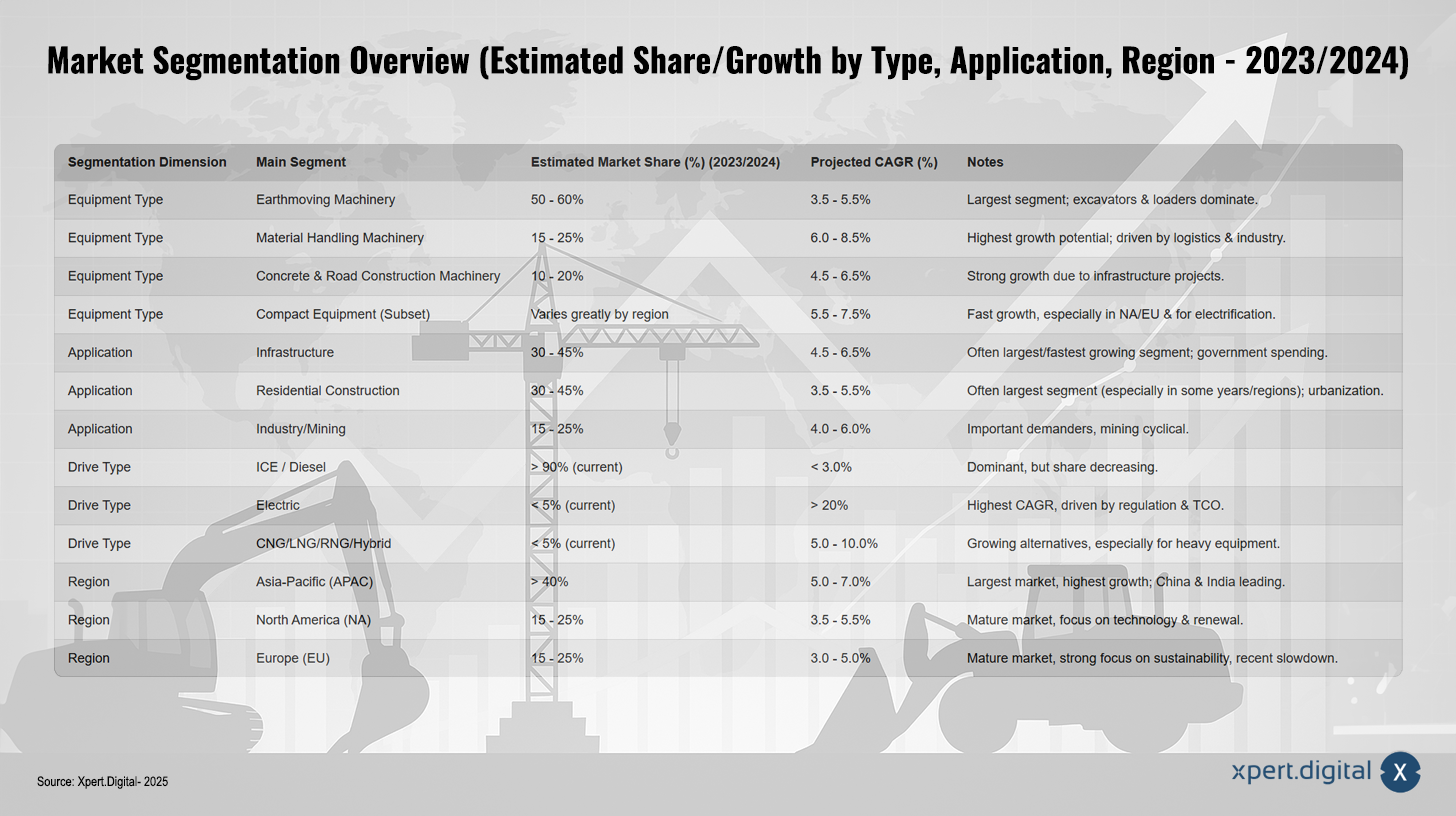
Market segmentation overview (Estimated share/growth by type, application, region – 2023/2024) – Image: Xpert.Digital
The market segmentation overview for 2023/2024 shows that earthmoving equipment, with a market share of 50–60%, represents the dominant equipment segment. This segment, led by excavators and loaders, is growing at an annual rate of 3.5–5.5%. Material handling equipment accounts for 15–25% and exhibits the highest potential with a growth rate of 6.0–8.5%, driven by demand from the logistics and industrial sectors. Concrete and road construction equipment reaches a 10–20% market share, favored by infrastructure projects, and is growing at 4.5–6.5%. Compact equipment, particularly in North America and Europe, is experiencing rapid growth (5.5–7.5%).
Between 30 and 45% of applications are in infrastructure and housing projects, driven by government investment and urbanization. Industry and mining account for 15–25%, with mining being cyclical. Diesel-powered machines continue to dominate with over 90%, although their share is declining in favor of electric drives (with an annual growth rate of over 20%). Alternative drives such as CNG, LNG, RNG, and hybrid are also growing (5.0–10.0%).
Regionally, the Asia-Pacific region (APAC) leads with a market share of over 40%, driven in particular by strong markets such as China and India, with annual growth of 5.0–7.0%. North America and Europe follow with 15–25% each. While North America focuses on technological innovation, Europe's focus is on sustainability, although a slowdown has recently been observed there.
Note: The percentages and CAGRs are estimates based on the synthesis of various sources and are for illustrative purposes only. They may vary depending on the specific definition and reporting year.
🎯🎯🎯 Benefit from Xpert.Digital's extensive, five-fold expertise in one comprehensive service package | BD, R&D, XR, PR & Digital Visibility Optimization

Benefit from Xpert.Digital's extensive, five-fold expertise in a comprehensive service package | R&D, XR, PR & Digital Visibility Optimization - Image: Xpert.Digital
Xpert.Digital possesses in-depth knowledge across various industries. This allows us to develop tailored strategies precisely aligned with the requirements and challenges of your specific market segment. By continuously analyzing market trends and monitoring industry developments, we can act proactively and offer innovative solutions. The combination of experience and expertise generates added value and provides our clients with a decisive competitive advantage.
More information here:
Urbanization drives demand: Construction machinery in transition
Key market drivers and opportunities
Infrastructure development and government spending
This is widely identified as the primary global driver for the construction equipment market. Governments worldwide are investing heavily in new and the modernization of existing infrastructure to stimulate economic growth, manage urbanization, and improve quality of life.
Concrete examples illustrate the scale of these investments:
- USA: The Infrastructure Bill allocates approximately $1 trillion for the renewal of roads, bridges, railways and other transportation systems.
- China: State-led infrastructure projects total approximately USD 1 trillion, including urban roads, water supply networks, and large reservoirs. The Belt and Road Initiative (BRI) is further stimulating projects both domestically and internationally. By 2035, China plans to construct 70,000 km of high-speed rail lines.
- India: Significant investments are being made in national motorway construction (target: 200,000 km by 2025), airport expansions (target: 220 airports), logistics parks, and railway corridors. Specific projects such as the Bengaluru-Chennai Expressway, the Western Dedicated Freight Corridor, and the Mumbai Trans Harbour Link are examples. Recent approvals include funding for the construction and upgrade of rural roads in Telangana (approximately INR 13.8 billion for 1,324 km) and a new four-lane road in Goa.
- Europe: The EU has allocated significant funds for transport infrastructure projects (e.g., over USD 5.4 billion in 2022 for 135 projects). Germany is investing heavily in green infrastructure and building renovation (USD 62.3 billion in 2024).
- Middle East: Megaprojects such as NEOM and Saudi Arabia's Vision 2030, as well as the new Istanbul Airport (a $6 billion project), are driving demand.
These projects require a wide range of construction machinery, particularly earthmoving, road construction, and material handling equipment, for tasks such as excavation, grading, material transport, and structure construction. Investments in renewable energy (solar and wind farms) also necessitate heavy machinery for land development and installation. Public-private partnerships (PPPs) also play a significant role in financing and executing large infrastructure projects.
Urbanization and population growth
The global shift of the population to urban areas is another fundamental driver. This phenomenon leads to increased demand for residential and commercial real estate (apartments, offices, retail space) as well as for the necessary supporting urban infrastructure such as transportation systems, water and wastewater systems, and energy supply.
Urbanization is particularly pronounced in emerging Asian economies, especially China and India. For example, China's urbanization rate reached approximately 66.2% in 2023, compared to less than 20% in 1980. By 2050, China is expected to have 255 million additional urban residents and India 416 million. India's urban population grew from 27.7% in 2000 to 35.8% in 2024.
This development is driving demand for a wide variety of construction machinery. Compact machines are often needed for work on confined urban construction sites, while cranes, loaders, and concrete pumps are required for the construction of high-rise buildings and other vertical infrastructure. Initiatives such as the Smart Cities Mission in India, or similar programs worldwide, are reinforcing this trend, as they involve the construction of sustainable buildings, smart roads, and integrated infrastructure systems, which often require sophisticated construction equipment.
Technological advances
Technological progress is a crucial factor driving the demand for modern construction machinery and improving efficiency, productivity, safety and sustainability on construction sites.
Key technology trends include:
- Electrification and alternative fuels: As detailed in section 7.1, this is a major trend driven by regulations and sustainability goals.
- Automation & Autonomy: This ranges from assistance systems such as 3D planning for dozers and automated bucket/shield control to fully autonomous machines like dump trucks in mining and increasingly in construction. These technologies promise higher productivity (in some cases +30% for autonomous trucks), precision, and safety, especially for repetitive or hazardous tasks.
- Digitalization (IoT, telematics, GPS): The networking of machines via the Internet of Things (IoT) enables real-time monitoring of location, condition, fuel consumption, and performance. Telematics systems provide data for predictive maintenance, reducing downtime. GPS and Building Information Modeling (BIM) integration improve planning and execution accuracy. Hitachi's ConSite Mine platform is one example.
The advantages of these technologies are manifold: reduced operating costs (fuel, maintenance), improved safety, increased performance and precision, and the possibility of counteracting the shortage of skilled workers.
Replacement needs and fleet modernization
The market is also driven by the natural replacement cycle of construction equipment. Machines have a limited lifespan, often between 10 and 15 years, after which maintenance costs increase and efficiency decreases. This creates a continuous demand for replacement equipment.
Furthermore, there are factors that encourage early replacement or modernization:
- Productivity increase: Newer models often offer higher performance and efficiency.
- Regulatory pressure: Stricter emission regulations (e.g. EU Stage V, US EPA Tier 4) make older machines obsolete or less competitive in certain markets or applications.
- Technology adoption: The desire for newer technologies such as improved fuel efficiency, advanced hydraulics, or telematics systems for predictive maintenance motivates companies to update their fleets.
- Maintenance costs: The rising costs of maintaining older machines make purchasing a new one economically attractive.
Manufacturers (OEMs) are supporting this trend by regularly launching updated models with improved features, thus incentivizing construction companies to modernize their fleets. One example is the introduction of Kobelco's SK80 excavator in India under the 'Make in India' initiative, which highlights improved fuel efficiency and modern features.
Growth of the rental market
A growing trend is the preference for renting construction equipment over purchasing it, particularly among small and medium-sized construction companies. The global construction equipment rental market is itself a significant market, exceeding USD 120 billion in size in 2023 and projected to grow at a CAGR of 6.0%.
The drivers for this trend are:
- Avoiding high investment costs: Renting eliminates the need for large capital expenditures to purchase expensive machinery.
- Flexibility: Companies can rent machines according to project needs, thus avoiding unused capacity.
- Access to modern technology: Renting provides access to the latest and most technologically advanced equipment without the burden of ownership.
- Uncertainty management: In economically uncertain times or with fluctuating project utilization, renting reduces financial risk.
This trend is driving overall demand for construction equipment, as rental companies need to continuously purchase new equipment to expand and modernize their fleets.
The aforementioned key drivers are closely intertwined and mutually reinforcing. Infrastructure projects often take place in or connect urbanizing areas. Both developments require not only more equipment, but also better equipment – technologically advanced and compliant with stricter regulations, particularly in urban or environmentally sensitive areas. This pressure, along with aging fleets, drives replacement demand. The high costs of new, advanced equipment and the need for flexibility, in turn, stimulate the rental market. This creates a cycle in which government policy, demographic shifts, and technological innovation collectively shape demand patterns and business models (ownership vs. rental).
Related to this:

Market challenges and obstacles
Regulatory pressure and emission standards
Strict regulations regarding emissions (e.g., EU Stage V, US EPA Tier 4, China VI) and environmental impacts (noise, greenhouse gases) pose a significant challenge for the industry. These standards aim to improve air quality and reduce the construction sector's contribution to climate change.
The effects are manifold:
- Increased complexity and costs: Compliance with regulations requires investment in research and development as well as the use of complex exhaust aftertreatment systems such as selective catalytic reduction (SCR) and diesel particulate filters (DPF). This increases manufacturing costs and potentially the end-customer prices of the machines.
- Technological change: Regulatory pressure is a major driver for the development and introduction of clean technologies such as electric drives and alternative fuels. At the same time, however, it also creates compliance burdens for manufacturers and operators.
- Market access: Non-compliant machines may be excluded from the market in certain regions.
Supply chain disruptions and cost volatility
Global supply chains for construction machinery and its components are vulnerable to disruption, as recent experiences with the COVID-19 pandemic and geopolitical tensions have shown.
The consequences are far-reaching:
- Production disruptions: Lockdowns and social distancing measures forced many manufacturers to temporarily halt or significantly reduce production. This affected both final assembly and component suppliers.
- Component and material shortages: There were significant shortages of critical components such as semiconductor chips and raw materials such as steel, which further hampered production.
- Logistics bottlenecks: Overburdened ports, a shortage of containers, and a lack of drivers in road freight transport led to significant delays in the transport of raw materials, components, and finished machinery. The driver shortage in the USA, for example, was estimated at 80,000.
- Labor shortage: The labor shortage exacerbated the situation not only in logistics, but also in manufacturing and on the construction sites themselves.
The disruptions led to a sharp increase in costs and unpredictably long delivery times:
- Cost increases: Prices for raw materials (steel, copper, cement), energy, and transport (sea freight, diesel) rose dramatically. This was reflected in higher prices for construction machinery, with reported increases of around 10% per year. Overall construction costs increased considerably.
- Extended delivery times: The time from order placement to delivery of new machines and spare parts increased dramatically, in some cases doubling or more. Lead times of eight months or more for new machines and up to a year for certain components such as electrical switchgear became the norm.
This situation had serious consequences for construction companies: Project planning and calculation became more difficult, budget overruns occurred, project delays were caused, and in extreme cases, projects even had to be postponed or cancelled altogether.
Although triggered by recent events, supply chain challenges could represent a longer-term structural shift. Increased volatility, pressure to regionalize, and the need for greater resilience are becoming firmly entrenched concerns. This is forcing OEMs and construction companies to rethink procurement strategies and inventory management (moving away from pure just-in-time) and potentially prioritize local suppliers, which could permanently impact global trade patterns and cost structures. The industry is likely undergoing a fundamental recalibration toward resilience and risk minimization, possibly at the expense of the pure cost optimization that characterized the pre-pandemic era.
High initial investment costs
Acquiring heavy construction equipment requires significant capital investment. This presents a barrier to entry, particularly for small and medium-sized construction companies. The high costs can slow the adoption of new, expensive technologies such as large electric machines and are a major reason for the growth of the rental market, which offers a more cost-effective alternative to ownership.
Technological hurdles
Despite the progress, technological challenges remain, particularly regarding electrification:
- Battery technology: Limited battery capacity and therefore range/operating time, long charging times, concerns about performance under heavy loads and demanding tasks, high battery costs and questions about lifespan are key hurdles.
- Charging infrastructure: The availability and standardization of high-performance charging stations on construction sites is not yet widespread.
- Cybersecurity: With increasing digitalization and networking of machines, the risk of cyberattacks that could disrupt operations or compromise sensitive data increases.
Skilled worker shortage
A widespread problem is the shortage of skilled machine operators and maintenance technicians. This is exacerbated by an aging workforce (approximately 20% of US construction workers are 55+) and difficulties in recruiting younger talent. The lack of skilled workers can limit the effective use of equipment, increase operating costs (higher wages), and slow down projects. However, this shortage can also drive demand for automation solutions as a compensatory mechanism.
Related to this:

Regional market analysis
Asia-Pacific (APAC)
Market position: APAC is by far the largest regional market for construction equipment and consistently holds the highest market share, often estimated at over 40% (e.g., 41.65% in 2023, 43.8% in 2023, 44.3% in 2023, ~45% by 2030, 45% in 2023). The region is also expected to exhibit the highest CAGR.
Key countries: China is by far the largest single market in the region and globally. India is showing rapid growth, driven by extensive infrastructure and construction projects. Other important markets include Japan, South Korea, and the countries of Southeast Asia.
Drivers: Growth is driven by rapid urbanization and industrialization, massive public and private investment in infrastructure (transport networks, energy, smart cities, BRI), strong population growth and significant mining activities.
OEM activity: In addition to the strong presence of global manufacturers, there are high-performing domestic companies (e.g., XCMG, SANY, Zoomlion from China) that are increasingly operating globally. China is a major exporter of construction machinery.
North America
Market position: A mature, but very large and significant market. Market share estimates vary; historically often around 17-20%, but one source claimed dominance of 45.77% for 2022, which may indicate a specific methodology or an outlier. A share in the range of 15-25% seems more plausible.
Key countries: The USA clearly dominates the region (approx. 80% share in 2023). Canada is also an important market.
Drivers: The renewal of aging infrastructure, supported by government programs such as the US infrastructure package, is driving demand. Residential and commercial construction, the increasing prevalence of compact machinery, and the adoption of new technologies such as automation and electrification are other important factors. Mining and the energy sector (including renewables) also play a role.
Challenges: Potential slowdowns due to interest rate hikes and the need for extensive repairs to existing infrastructure could dampen growth.
Europe
Market position: Another mature, but high-revenue market. Market share is typically in the range of 15-25%.
Key countries: Germany, Great Britain, France, Italy and Spain are the main markets.
Drivers: Infrastructure investments, a strong focus on sustainability, and strict emissions regulations are driving demand for electric and cleaner machinery. Renovation and maintenance work is also significant. Demand for compact machines is high.
Challenges: Recent reports indicate a significant market contraction in 2023/2024 (-21% real in Germany in 2024, -19% in Europe in 2024, -2.4% construction activity in the Eurozone in 2024). Economic headwinds, high interest rates, a shortage of skilled workers, and the effects of geopolitical tensions are weighing on the market. According to CECE, sentiment in the sector was pessimistic at the end of 2023/beginning of 2024. A decline in construction output is expected for 2024, with a recovery not anticipated until 2025.
Latin America (LATAM)
Market position: An emerging market with significant growth potential, albeit starting from a smaller base.
Key countries: Brazil and Mexico (named in one report as the fastest growing country) are the largest markets.
Drivers: Infrastructure development, urbanization and mining activities are the main growth engines.
Middle East & Africa (MEA)
Market position: Growth is strongly driven by specific large-scale projects and efforts toward economic diversification. One source predicts that MEA will dominate the market, which contradicts the general assessment of APAC as the leading region and may be due to a specific segmentation or forecast period.
Key areas: The GCC states (especially Saudi Arabia and the UAE) are of central importance due to megaprojects (NEOM, Vision 2030) and investments in infrastructure, tourism and energy.
Drivers: High government infrastructure spending, activities in the oil and gas sector and mining are driving demand.
The global market is not a homogeneous bloc, but rather comprises regions with very different dynamics. APAC leads the growth, driven by large-scale development. North America focuses on innovation and technology adoption. Europe prioritizes sustainability and faces economic headwinds. Latin America and MEA offer growth spurts, often tied to specific projects or commodity sectors. Global trends such as electrification or supply chain issues manifest themselves differently depending on regional priorities, economic conditions, and regulatory environments. A global strategy therefore requires nuanced regional approaches that tailor product offerings, marketing, and investments to the specific conditions of each major market.
Regional market highlights (size/share, CAGR, key drivers)
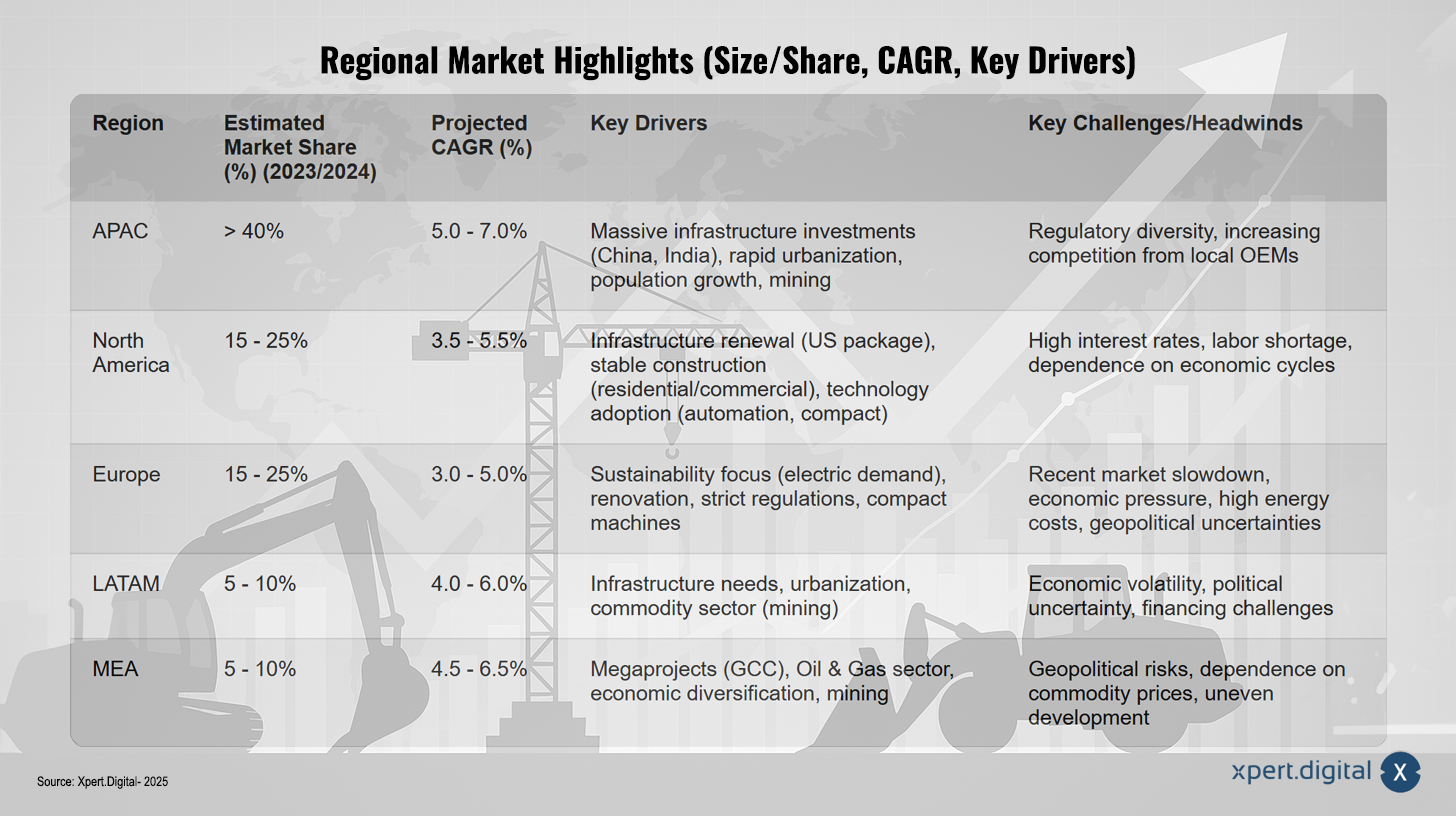
Regional market highlights (size/share, CAGR, key drivers) – Image: Xpert.Digital
Regional market highlights reveal significant differences in terms of size, growth rate (CAGR), and driving factors. In the APAC region, which leads with a market share exceeding 40%, massive infrastructure investment, urbanization, and population growth are driving development, despite challenges such as regulatory diversity and increasing competition from local OEMs. North America holds a market share of 15–25%, supported by infrastructure renewal, stable construction, and technology adoption, but is hampered by high interest rates, a shortage of skilled workers, and cyclical dependence. Europe shares a similar market size and growth rate (CAGR: 3.0–5.0%) with a particular focus on sustainability, renovation, and compact machinery, but faces economic pressures, high energy costs, and geopolitical uncertainties. LATAM, with a market share of 5–10%, benefits from infrastructure demand and resource sectors but faces challenges such as economic volatility and financing issues. The MEA region, also at 5–10%, is driven by megaprojects, the oil and gas sector and economic diversification, but struggles with geopolitical risks, commodity price dependency and uneven development.
Note: The percentages and CAGRs are estimates based on the synthesis of various sources and are for illustrative purposes.
Our recommendation: 🌍 Limitless reach 🔗 Connected 🌐 Multilingual 💪 Sales power: 💡 Authentic with strategy 🚀 Innovation meets 🧠 Intuition

From local to global: SMEs conquer the world market with a clever strategy - Image: Xpert.Digital
In an era where a company's digital presence determines its success, the challenge lies in creating an authentic, personalized, and far-reaching presence. Xpert.Digital offers an innovative solution that positions itself as the intersection of an industry hub, a blog, and a brand ambassador. It combines the advantages of communication and sales channels in a single platform and enables publication in 18 different languages. Cooperation with partner portals and the ability to publish articles on Google News and a press distribution list with approximately 8,000 journalists and readers maximize the reach and visibility of the content. This represents a crucial factor in external sales and marketing (SMarketing).
More information here:
Automation & Electrification: The Construction Machines of Tomorrow
Technological development: Electrification and automation
The Rise of Electric Construction Machines
Context: The trend toward electrification is driven primarily by stricter emissions regulations, sustainability goals set by companies and governments, the potential for lower total cost of ownership (TCO) through savings in fuel and maintenance, and noise reduction benefits (important in urban areas). Government incentives and subsidies also play a supporting role in market adoption.
Current status: Although it is a rapidly growing segment, electric construction equipment currently only makes up a small fraction of the total market. The technology is most widespread in compact machines, such as mini-excavators and compact loaders. This is due to its technical feasibility (lower energy consumption) and suitability for typical applications such as urban construction sites or indoor spaces, where emission-free and noise-free operation is particularly advantageous.
Key players & models: Leading OEMs are investing heavily in the development and marketing of electric motors. Examples of pioneers and their models include:
- Volvo CE, considered a pioneer in electric powertrains, has announced the discontinuation of diesel engines for its compact machines. It offers models such as the ECR25 Electric mini excavator and the L25 Electric wheel loader. With the 23-tonne EC230 Electric excavator, it has ventured into the medium-sized machine segment. Pilot projects have demonstrated comparable performance to diesel models while offering significant savings in emissions (64% less CO2/hour) and operating costs (74% lower cost/hour).
- Caterpillar: Was an early adopter of hybrid technology with the D7E diesel-electric dozer. Now also bringing fully electric models to market, such as a prototype of the 950 GC wheel loader and an electric compact excavator. Leveraging its expertise in autonomous mining.
- Komatsu: Introduced the first hybrid hydraulic excavator back in 2008. Offers a range of electric mini-excavators (PC20E, PC26E, PC33E) and has partnerships for micro-excavators (with Honda). Also develops larger models such as the 13-ton electric excavator PC138E-11. The "Electric Dumper" (eDumper), a 45-ton mining truck with a regenerative braking system, is an example of innovation in the heavy-duty sector.
- JCB: With the 19C-1E, they were one of the first suppliers of a series-produced electric mini excavator.
- Liebherr: Developed the first battery-powered crawler crane, the LR 1200.1.
- Others: Case Construction Equipment introduced the 580 EV, the first fully electric backhoe loader. Chinese manufacturers such as XCMG, LiuGong, and SANY are also active in the electric vehicle segment.
Challenges: Wider adoption, especially of larger machines, is hampered by technological hurdles: Limited battery capacity leads to shorter operating times than diesel machines (often 4-5 hours per charge), long charging times, the need for a high-performance charging infrastructure on construction sites, high purchase costs of the batteries, and concerns regarding their lifespan and performance under heavy load conditions.
Outlook: The electric construction machinery segment is expected to continue its strong growth, led by compact machines. Expansion into larger classes depends crucially on advances in battery technology (energy density, cost, durability) and the development of the charging infrastructure. Hybrid solutions could serve as an important bridging technology.
Automation and digitalization trends
Drivers: The increasing automation and digitalization in the construction machinery sector is driven by the pursuit of higher productivity, efficiency, precision and safety, as well as by the ongoing shortage of skilled workers.
Key technologies:
- Automation/Autonomy: This encompasses driver assistance systems such as grade control, which automatically adjusts the blade or bucket to follow construction plans, up to fully autonomous machines that can operate without a human driver. Autonomous dump trucks are established in mining and are now also being used in construction. Autonomous excavators and dozers are under development or in testing. Examples include Caterpillar's autonomous truck fleet and Komatsu's "intelligent machine control" (iMC).
- Connectivity & Data (IoT/Telematics): Machines are increasingly being equipped with sensors and networked via the Internet of Things (IoT). This enables real-time monitoring of machine data such as location, operating hours, fuel consumption, engine condition, and error messages. This data forms the basis for fleet management, optimization of machine utilization, and predictive maintenance, which minimizes unplanned downtime. Hitachi's ConSite Mine is one example of such a platform.
- Digital integration: The integration of machine data with higher-level systems such as Building Information Modeling (BIM), fleet management software and digital twins enables better project planning, control and documentation.
Advantages: Optimized workflows, reduced downtime, increased safety through fewer human errors or the removal of people from dangerous areas, improved planning and execution quality.
Challenges: High implementation costs for hardware and software, the need for qualified personnel for data analysis and system administration, concerns regarding data security and cyber risks, the complexity of integrating different systems, and regulatory frameworks for autonomous operation that still need to be developed.
Electrification and automation/digitalization are not isolated trends, but are increasingly converging. Electric drives offer better and more precise controllability, which facilitates automated functions. Digital platforms (telematics, IoT) are essential for managing electric fleets (charge status, battery condition) and optimizing the performance of both electric and autonomous machines. Autonomous operations, in turn, rely heavily on sensors, data processing, and connectivity – core components of digitalization. These technological flows reinforce each other. Advances in one area often enable or enhance progress in the other. The "future" construction machine will therefore likely be increasingly electric, connected, and automated, representing a holistic technological transformation. OEMs that develop integrated solutions will likely have a competitive advantage.
Related to this:

competitive landscape
Key Global Manufacturers
The global construction machinery market is dominated by a number of established, multinational corporations, but also features strong regional players and niche specialists. The key players consistently mentioned include:
- Caterpillar Inc. (USA) – World market leader with a broad portfolio in construction and mining, strong in North America, focus on technology (autonomy, digitalization).
- Komatsu Ltd. (Japan) – Second largest global player, strong in Asia, pioneer in hybrid and smart construction technologies.
- Volvo Construction Equipment (Volvo CE) (Sweden) – part of the Volvo Group, strong focus on sustainability and electrification, especially in compact machines, strong in Europe.
- Hitachi Construction Machinery Co., Ltd. (Japan) – Known for excavators, strong global presence.
- Liebherr Group (Switzerland/Germany) – Broad portfolio, strong in cranes and mining equipment, family business with a focus on technology.
- Deere & Company (John Deere) (USA) – Strong in North America, expanding globally, known for agricultural machinery, but also significant in construction.
- CNH Industrial NV (UK/Italy) (Brands: Case, New Holland) – Broad portfolio, global presence.
- SANY Group (China) – One of the largest Chinese manufacturers with a rapidly growing global presence.
- XCMG Group (China) – Leading Chinese manufacturer, strong position in APAC and expanding globally.
- HD Hyundai Infracore / Develon (formerly Doosan) (South Korea) – A major global player.
- JC Bamford Excavators Ltd. (JCB) (UK) – Known for backhoe loaders, telescopic handlers and increasingly also electric models.
- Kubota Corporation (Japan) – Leader in compact machinery.
- Zoomlion Heavy Industry Science & Technology Co., Ltd. (China) – Another large Chinese manufacturer with global ambitions.
- Terex Corporation (USA) – Focuses on material handling and high-altitude access technology.
- Manitou BF SA (France) – Specialist for material handling, especially telescopic loaders.
- Wacker Neuson SE (Germany) – Strong in compact machines and light construction equipment.
Competition is driven by product innovation (especially in efficiency, sustainability and digitalization), geographic expansion, strategic partnerships and a strong focus on customer needs and aftermarket services.
Market share analysis
Accurately determining global market shares is difficult because the data is inconsistent and often not published in detail by report providers. However, available data points and estimates suggest the following trends:
- Caterpillar and Komatsu are generally regarded as the two largest players worldwide.
- One source states that Komatsu, XCMG and Caterpillar together held over 28% market share in 2023.
- In the rental market, the top players (number not specified) are said to account for approximately 45-50% of the total market.
- Case India achieved a market share of 7% for backhoe loaders in India by 2022.
- Some market reports (e.g., from MarketsandMarkets) contain more detailed market share analyses for specific years.
Factors influencing market share include the breadth and depth of the product portfolio, technological leadership (e.g., in electrification or autonomy), the strength of the global sales and service network, regional presence and market penetration, as well as pricing and financing offers.
Although Caterpillar and Komatsu are often considered the top global players, the competitive landscape is dynamic. The rise of Chinese manufacturers like SANY, XCMG, and Zoomlion, which are particularly strong in volume segments and emerging markets, is challenging the established order. Strategic initiatives by other players, such as Volvo's consistent push toward electrification or the automation efforts of Komatsu and Caterpillar, indicate that market shares are not static. Regional strengths (e.g., Chinese players in APAC) and technological shifts could lead to future realignments. Market share analysis must therefore consider regional differences and the potential impact of ongoing technological and strategic changes, rather than assuming a fixed hierarchy.
Recent developments
Competitors are very active in strengthening their market position and responding to changing market demands. Key strategic activities include:
- Product launches: A strong focus is on the introduction of new models, particularly those with electric or alternative drive systems and advanced digital and autonomous features. Examples include new electric excavators from Volvo and Komatsu, and Caterpillar's autonomous technologies.
- Partnerships & Acquisitions: Companies enter into strategic alliances or acquire competitors to gain access to technologies, expand portfolios, or gain market share. An example is the Ammann Group's acquisition of Volvo CE's ABG manufacturing business. Partnerships with dealers to strengthen regional presence are also common.
- Geographical expansion: Opening up new markets or strengthening the presence in existing regions through investments in sales and service networks.
- Focus on digital services: development and marketing of telematics platforms, software solutions for fleet management and predictive maintenance, and integration with BIM.
Major Global Construction Equipment Manufacturers
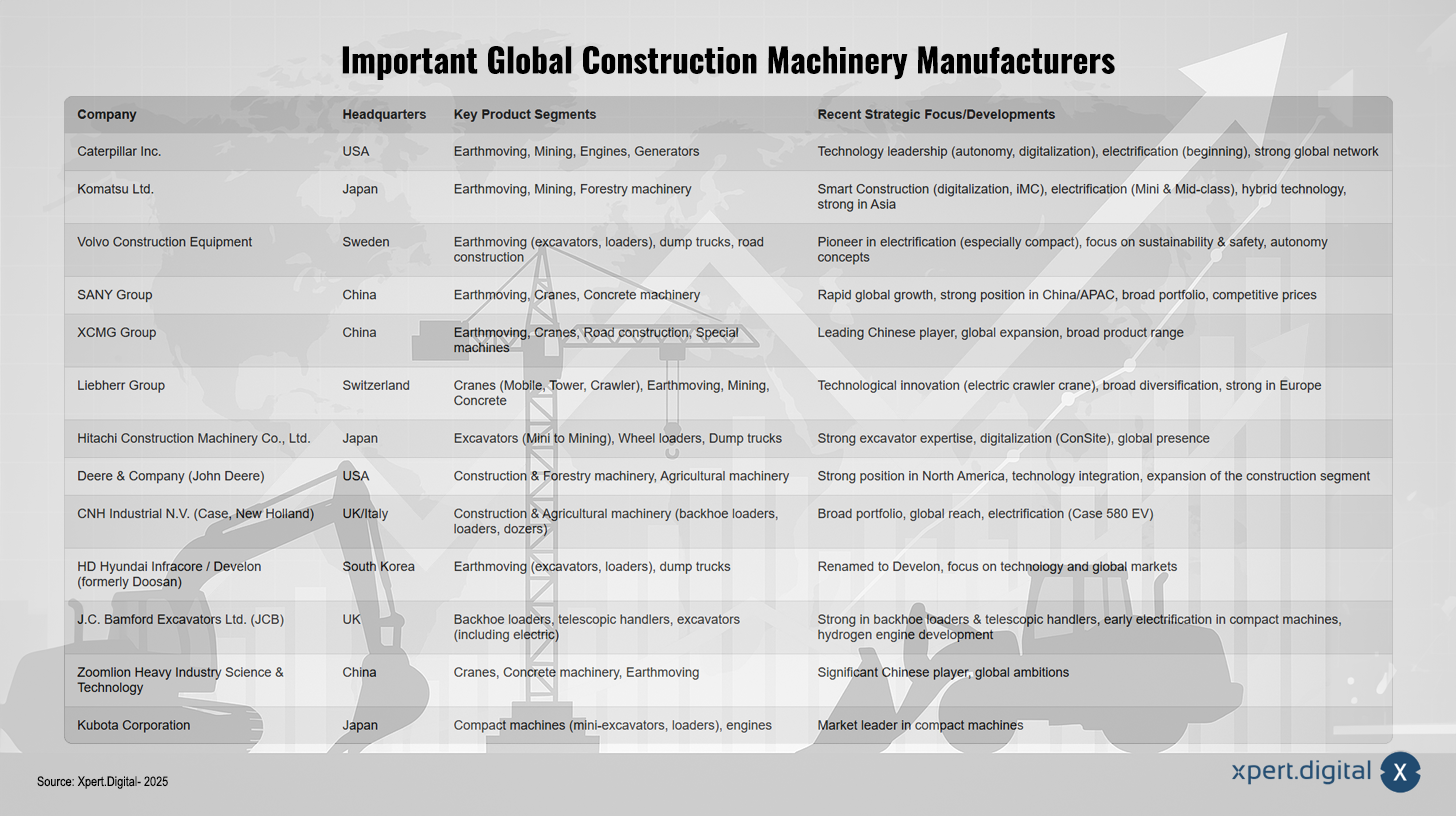
Key global construction equipment manufacturers – Image: Xpert.Digital
Major global construction equipment manufacturers play a central role in the construction and mining industries. Caterpillar Inc., based in the USA, is a leader in earthmoving, mining, engines, and generators, focusing on technological leadership, electrification, and a strong global network. Komatsu Ltd., based in Japan, concentrates on earthmoving, mining, and forestry equipment, with initiatives such as "Smart Construction," the electrification of mini and mid-size machines, hybrid technology, and a strong market presence in Asia. Volvo Construction Equipment, based in Sweden, is a pioneer in electrification, particularly in compact machines, and places great emphasis on sustainability, safety, and autonomous concepts. The SANY Group, based in China, is characterized by rapid global growth, a strong position in China, and a broad, price-competitive product portfolio. The XCMG Group, also based in China, is expanding internationally and offers a wide range of products while being considered a leading player in the Chinese market.
The Liebherr Group, headquartered in Switzerland, focuses on cranes, earthmoving, mining, and concrete, characterized by technical innovation, broad diversification, and a strong presence in Europe. Hitachi Construction Machinery Co., Ltd. from Japan is known for its expertise in excavators, digitalization, and global reach, particularly through systems like ConSite. Deere & Company (John Deere) from the USA has a strong market position in North America, focuses on technology integration, and is actively expanding into the construction sector. CNH Industrial NV, which includes brands such as Case and New Holland, offers construction and agricultural machinery with a broad portfolio, electrification initiatives, and global reach. HD Hyundai Infracore, formerly Doosan and now operating under the Develon brand, focuses on technology and global markets. JC Bamford Excavators Ltd. (JCB) from the UK is a leader in backhoe loaders and telehandlers and is developing innovative machines with electric and hydrogen powertrains.
Zoomlion Heavy Industry Science & Technology from China pursues global ambitions with a focus on cranes, concrete machinery, and earthmoving equipment. Kubota Corporation from Japan is a market leader in its segment of compact machines and mini-excavators, renowned for its high-quality engines. This broad spectrum of leading companies illustrates the key trends in the industry: digitalization, electrification, sustainability, and global expansion.
Supply chain considerations
Impact of recent disturbances
Global supply chains for construction machinery have been significantly disrupted in recent years by a number of events, particularly the COVID-19 pandemic and geopolitical conflicts. These disruptions have had far-reaching consequences:
- Production disruptions: Lockdowns and social distancing measures forced many manufacturers to temporarily halt or significantly reduce production. This affected both final assembly and component suppliers.
- Component and material shortages: There were significant shortages of critical components such as semiconductor chips and raw materials such as steel, which further hampered production.
- Logistics bottlenecks: Overburdened ports, a shortage of containers, and a lack of drivers in road freight transport led to significant delays in the transport of raw materials, components, and finished machinery. The driver shortage in the USA, for example, was estimated at 80,000.
- Labor shortage: The labor shortage exacerbated the situation not only in logistics, but also in manufacturing and on the construction sites themselves.
Cost inflation and challenges with delivery times
The disruptions led to a sharp increase in costs and unpredictably long delivery times:
- Cost increases: Prices for raw materials (steel, copper, cement), energy, and transport (sea freight, diesel) rose dramatically. This was reflected in higher prices for construction machinery, with reported increases of around 10% per year. Overall construction costs increased considerably.
- Extended delivery times: The time from order placement to delivery of new machines and spare parts increased dramatically, in some cases doubling or more. Lead times of eight months or more for new machines and up to a year for certain components such as electrical switchgear became the norm.
This situation had serious consequences for construction companies: Project planning and calculation became more difficult, budget overruns occurred, project delays were caused, and in extreme cases, projects even had to be postponed or cancelled altogether.
Strategies for increasing resilience
In response to these challenges, companies are developing and implementing strategies to increase the resilience of their supply chains:
- Improved planning and forecasting: More accurate predictions of demand to enable earlier order placement.
- Focus on maintenance: Intensified maintenance and servicing of existing fleets to extend their lifespan and reduce the need for new machines.
- Use of rental options: Increased use of rental equipment as a flexible alternative or to bridge supply gaps.
- Supplier diversification: Building a broader network of suppliers to reduce dependence on individual sources or regions.
- Regional/Local Procurement: Considerations regarding relocating procurement sources closer to production or deployment locations in order to minimize transport risks.
- Inventory management: Review of just-in-time strategies and possibly building up higher safety stocks for critical parts.
- Supply Chain Visibility: Investments in technologies and systems for better monitoring and control of the supply chain.
Supply chain disruptions have directly increased the importance of maintenance and the rental market. When new equipment is unavailable or significantly delayed, maintaining existing machinery becomes critical (increasing demand for spare parts and services), and rental becomes a necessary bridging measure or alternative strategy. This underscores the growing strategic importance of the aftermarket and rental business for OEMs and dealers, not only during disruptions but potentially as a long-term shift in customer behavior.
Related to this:

Strategic insights and future prospects
Synthesis of key trends and market developments
Analysis of the global construction equipment market reveals a complex picture shaped by several powerful forces. Sustained demand, driven by worldwide infrastructure projects and ongoing urbanization, forms the basis for growth. At the same time, the industry is undergoing a profound technological transformation toward electrification, automation, and digitalization, which opens up new opportunities but also requires significant investment and adaptation. However, persistent volatility in global supply chains, increasing regulatory pressure regarding emissions and sustainability, and significant regional disparities in market maturity and growth prospects pose ongoing challenges. The overall outlook remains positive but suggests potentially more moderate growth than some more optimistic forecasts anticipate, as the industry must balance these complex and often conflicting forces.
Emerging opportunities
Despite the challenges, the market offers significant growth opportunities:
- Electric and autonomous equipment: These segments promise high growth rates, driven by regulatory pressure and the pursuit of efficiency and sustainability. Electrification is already a reality, particularly for compact machines.
- Digital services: Telematics, predictive maintenance, fleet management software and data-driven optimization offer new revenue streams and customer retention opportunities beyond simply selling machinery.
- Growth of the rental market: The trend towards renting offers opportunities for specialized rental companies as well as for OEMs and dealers who operate or support rental fleets.
- Sustainable building solutions: Beyond electrification, there is potential for machines that use alternative fuels, manage resources more efficiently, or support the use of recycled materials.
- High-growth emerging markets: Regions such as India, Southeast Asia and parts of Latin America and MEA offer above-average growth potential due to the need to catch up in infrastructure and construction activities.
- Specialized niches: Certain types of equipment, such as material handling machines or specialized equipment for tunneling or recycling, could experience above-average growth.
Recommendations for stakeholders
Based on the analysis, the following strategic recommendations can be derived:
For manufacturers (OEMs):
- Technology investments: Prioritizing R&D in electrification, automation, and digitalization across relevant product segments. Development of a diversified powertrain portfolio (diesel, electric, hybrid, alternative fuels).
- Supply chain resilience: Building more robust supply chains through diversification, regionalization and improved transparency.
- Service orientation: Strengthening the aftermarket business (spare parts, maintenance, training) and developing data-based services.
- Strategic partnerships: Cooperations for technology development, market development or strengthening of the sales and rental business.
- Regional adaptation: Developing tailored strategies for the different requirements and dynamics of key regions.
For construction companies/end consumers:
- TCO assessment: Careful examination of the total cost of ownership of new technologies such as electric drives to assess long-term economic viability.
- Explore rental options: Utilize rental offers to increase flexibility, access modern technology, and minimize risk.
- Training: Investment in the training of operators and maintenance personnel for new, technologically advanced machines.
- Maintenance focus: Prioritizing preventive maintenance of existing fleets to maximize service life and minimize breakdowns, especially given long delivery times for replacements.
- Proactive supplier communication: Close exchange with suppliers regarding delivery times and prices for better project planning.
For rental companies:
- Fleet modernization: Expansion of rental fleets to include electric and technologically advanced equipment in order to meet growing demand.
- Service expertise: Building strong maintenance and repair capacities to ensure high availability.
- Leveraging digitalization: Using digital tools for efficient fleet management, booking processes and customer interaction.
For investors:
- OEM rating: Assessment of manufacturers based on their technological maturity (electric, autonomy, digital), regional presence, supply chain stability and service capabilities.
- Technology opportunities: Identification of investment opportunities in supporting technologies (batteries, charging systems, software) and components.
- Segment/region focus: Analysis of opportunities in high-growth segments (e.g., material handling, compact) and regions (e.g., APAC).
- Monitor framework conditions: Actively track regulatory developments (emission standards) and government infrastructure investment plans.
The global construction machinery market is facing a period of significant change. Companies that proactively adapt to the technological, environmental, and economic challenges and seize the opportunities that arise will be successful in this dynamic environment.
We are here for you - Consulting - Planning - Implementation - Project Management
☑️ SME support in strategy, consulting, planning and implementation
☑️ Creation or realignment of the digital strategy and digitization
☑️ Expansion and optimization of international sales processes
☑️ Global & Digital B2B trading platforms
☑️ Pioneer Business Development

Konrad Wolfenstein
I would be happy to serve as your personal advisor.
You can contact me by filling out the contact form below or simply call me on +49 7348 4088 965 .
I'm looking forward to our joint project.
Write to me

Xpert.Digital - Konrad Wolfenstein
Xpert.Digital is a hub for industry focusing on digitalization, mechanical engineering, logistics/intralogistics and photovoltaics.
With our 360° Business Development solution, we support renowned companies from new business to after-sales.
Market intelligence, smarketing, marketing automation, content development, PR, mail campaigns, personalized social media and lead nurturing are part of our digital tools.
You can find more information at: www.xpert.digital - www.xpert.solar - www.xpert.plus
Keep in touch










