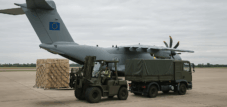
Decentralized, automated dual-use hubs: Key to European defense resilience and the EU circular economy – Image: Xpert.Digital
Europe's dangerous gap: How "dual-use hubs" are supposed to save our economy and security
From crisis situations to the circular economy: The underestimated trillion-dollar logistics market
Europe is at a historic turning point: The changed geopolitical threat landscape demands unprecedented military mobility, while at the same time the rapid transition to a circular economy and the trend toward nearshoring are completely upending global supply chains. What at first glance appear to be entirely separate challenges in defense, ecology, and the economy, in reality, are all failing due to precisely the same infrastructural bottleneck. The solution lies in a concept that has long been underestimated: decentralized, highly automated dual-use logistics hubs. This in-depth analysis reveals why intelligent mega-warehouses have suddenly become central to European sovereignty, how they combine civilian efficiency with military resilience, and why they currently represent arguably the most strategic—and lucrative—infrastructure project on the continent.
Related to this:
- EU regulatory package CBAM, PPWR, ESPR and CRMA: The major logistics and supply chain transformation


When warehouses decide war and peace – why Europe now needs to reinvent its logistics
The new geopolitical logic: infrastructure as a weapon and as an economic engine
Europe is facing a historic turning point. Decades of the peace dividend have fostered the illusion that logistics infrastructure is a purely economic matter – optimizable according to cost considerations, outsourced to Asia, and optimized for just-in-time delivery. The Russian war of aggression against Ukraine and the gradual erosion of American security guarantees have shattered this certainty abruptly. What was long considered a bureaucratic side issue of defense policy has become a core issue of European sovereignty: the ability to move troops, materiel, and supplies across Europe with sufficient speed and volume.
At the same time, a second, structurally equally profound transformation is driving the European economy: the circular economy. The European Action Plan for the Circular Economy calls for a fundamental restructuring of production and consumption patterns, which is simply not feasible without an efficient reverse logistics infrastructure. Returns, refurbishment, recycling, and the reuse of components—all of this requires physical hubs where goods flows are recorded, sorted, processed, and reintroduced into circulation.
The central thesis of this analysis is that both requirements – military-strategic resilience and the economic-ecological transformation towards a circular economy – converge on precisely the same infrastructural solution. Decentralized, automated dual-use logistics hubs, embedded in an EU-wide intermodal network, are not just the answer to one challenge, but to both simultaneously. This is not a coincidence, but a structural logic that, upon closer examination, appears almost inevitable.
Related to this:

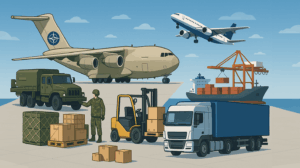
The initial problem: Europe's dangerous logistics gap
Bureaucratic blinders instead of a quick response
Anyone in Europe today wishing to move heavy military equipment from western Germany to the eastern flank encounters a labyrinth of national regulations. Different permitting procedures, differing bridge classification standards, varying route approvals for heavy transport, and incompatible digital reporting requirements apply to cross-border military transports. In December 2025, the European Parliament unequivocally stated that, despite significant progress, major administrative and financial hurdles to military mobility persist. Members of Parliament explicitly demanded the ability to deploy troops and military equipment within 24 hours in crisis situations – something inconceivable under the current regulations.
The physical reality of Europe's transport infrastructure exacerbates the problem. Thousands of bridges and tunnels are simply not designed to bear the loads of modern military vehicles. Railways that function efficiently in daily freight traffic reach their limits as soon as tank transports have to be prioritized on certain sections of track. The European Parliament estimates that modernizing some 500 infrastructure hotspots, such as bridges and tunnels, would require at least €100 billion. This figure illustrates the structural investment deficit that has accumulated over decades under the guise of budgetary discipline.
The billion-dollar paradox of European defense
Europe's defense spending has risen dramatically in recent years. Between 2021 and 2024, EU member states increased their defense spending by more than 30 percent to an estimated €326 billion. By 2025, it had reached €381 billion, equivalent to 2.1 percent of the EU's GDP. With the ReArm Europe program, Commission President Ursula von der Leyen further increased spending in March 2025: up to €800 billion is to be mobilized for Europe's defense capabilities over the next four years. The SAFE instrument provides €150 billion in direct loans for defense investments.
The bitter paradox of this arms buildup is that billions are flowing into weapons systems, ammunition, and artillery, while the logistical backbone that makes these systems operational in the first place continues to suffer from critical capacity shortages. Weapons without access to the front lines are tactically worthless. The European Commission has recognized this and set a target in its military mobility package presented in November 2025: a military Schengen Area is to be established by 2027 – an area in which troops and equipment can circulate as freely as goods in the EU single market. For the next multiannual financial framework starting in 2028, €17.65 billion is earmarked for military mobility within the framework of the Connecting Europe Facility.
The PESCO LogHub network: The emerging backbone
From warehouse to strategic infrastructure
The PESCO project "Network of LogHubs in Europe and Support to Operations" is perhaps the most impressive example of what European defense cooperation can look like in practice. Far more than a collection of warehouses, this network forms the emerging logistical backbone for the defense and operational capability of the European Union. The core idea is as simple as it is powerful: instead of each member state maintaining its own costly logistics chains for multinational operations, existing national military bases are linked to form a Europe-wide, intelligent network.
Coordinated by a central coordination center in Wilhelmshaven and supported by 15 EU nations, the project aims to strengthen Europe's strategic autonomy, maximize the efficiency of military operations, and achieve significant cost savings through resource sharing. The network currently comprises 25 logistics hubs across Europe. Each hub offers core functionalities such as warehousing, transport, transshipment, and maintenance, though not every hub is required to provide every service.
Related to this:
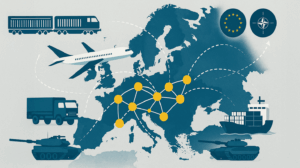
Smart warehouses as a driver of modernization
With investments totaling billions, the participating logistics centers are being gradually transformed into highly automated smart warehouses, where robots, artificial intelligence, and digital systems optimize material flow. The 2025 PESCO progress report confirms that the Network of Logistic Hubs is actively facilitating cross-border military transport through a network of logistics hubs across Europe. Of the current 74 PESCO projects, almost half have reached the implementation phase.
Automation solutions in these hubs reduce picking times by up to 30 percent and ensure guaranteed availability for time-critical deliveries. This metric is particularly relevant in the military context: In defense logistics, where supply disruptions have direct operational consequences, the reliability of the systems is just as crucial as their capacity. The integration of automated high-bay warehouses into trimodal dual-use logistics networks represents a key component for improving European infrastructure.
Dual-use as a system concept: Civil efficiency and military speed
The Connecting Europe Facility as a financing architecture
The European Union has created the Connecting Europe Facility (CEF), an instrument that directly incorporates the dual-use principle into its funding structure. One of the explicit goals of the CEF in the transport sector is to adapt the trans-European transport network to dual use for civilian and military mobility. The EU contributes up to 50 percent of the total costs of eligible projects.
Specifically, between 2021 and 2023, the CEF allocated a budget of €1.74 billion for dual-use transport infrastructure projects. A total of 95 projects were selected, covering all modes of transport – rail, road, sea, inland waterways, and air. The breakdown by mode is revealing: at €874 million (50 percent of the CEF's funds for military mobility), the largest share went to rail – clearly reflecting the strategic prioritization of rail-based heavy transport. Germany alone secured more than €296 million in CEF funding for dual-use projects over three years.
Ports, railways, terminals: The trimodal backbone
The practical examples illustrate how the dual-use logic works in practice. In Szczecin, Poland, a multimodal rail transshipment hub is being built on the Ostrów Grabowski peninsula – the MULTIRAILHUB project, co-financed by the CEF – with a total volume of €8.7 million. The project is explicitly designed to serve both intermodal freight transport and military purposes. In Finland, CEF funds were used to upgrade the electrified Oritkari rail junction so that larger military equipment can be transported directly from the Oulu-Luleå rail network to the Port of Oulu and the intermodal freight terminal.
Strategic ports like Rostock, Split, and Rijeka act as force multipliers for NATO and the EU, combining economic interests with military requirements. They are not isolated examples, but prototypes of a model that must be scaled: infrastructure that maximizes trade efficiency in peaceful times, but can be seamlessly and without delay used for emergency and troop transport in a crisis. The vision behind the dual-use rapid deployment concept is an infrastructure that no longer distinguishes between economics and security, but rather combines both through intelligent multi-use.
Four core military corridors as a framework for order
In March 2025, the EU Council established four priority corridors for military mobility: the Northern Corridor, the Central-Northern Corridor, the Central-Southern Corridor, and the Eastern Corridor. These corridors form the geographical framework within which dual-use infrastructure investments are prioritized and coordinated. Along these routes, the intermodal transshipment points, bridges, tunnels, railway lines, and ports that represent critical capacity bottlenecks must be identified. The European Commission's package from November 2025 provides for an enhanced European Response System (EMERS), a solidarity pool for logistics capacities, and a digital information system for military mobility.
Reverse logistics and the circular economy: The underestimated economic imperative
A trillion-dollar market with structural growth
While the defense dimension of dual-use hubs attracts considerable public attention, the economic significance of their civilian function as circular economy nodes is often underestimated. The global reverse logistics market was valued between US$665 billion and US$982 billion in 2025 – estimates from various market research institutes vary considerably due to methodological differences, but all point in the same direction. By 2034 or 2035, most forecasts anticipate a volume between US$1.0 trillion and US$1.75 trillion, with annual growth rates between 4.6 and 7.3 percent.
For the European market specifically, the reverse logistics industry recorded sales of approximately US$136 billion in 2024, representing a share of about 16.6 percent of the global market. This figure is projected to rise to US$452 billion by 2033, corresponding to an annual growth rate of 15.4 percent. Even after adjusting the most optimistic forecasts with a realistic discount, a structurally consistent double-digit growth rate remains evident – driven by EU regulations, rising e-commerce return rates, and the increasing pressure to create a circular economy for products and materials.
EU regulation as a growth driver
With its Circular Economy Action Plan, the European Commission has created a comprehensive framework that obligates companies across all sectors to take back, repair, and recycle products, or at least provides incentives for doing so. Ecodesign regulations aim to ensure that products are designed from the outset to be more easily repaired, retrofitted, recycled, and reused. The right to repair, new packaging rules, and targets for reducing packaging waste—all these measures systematically increase the volume of reverse logistics flows.
The implications for infrastructure are immediately obvious. Reverse logistics is not simply a matter of reversing logistics processes. Returned goods are heterogeneous, their condition is unknown, and their onward route must be determined on a case-by-case basis. They require physical hubs with sorting, inspection, and processing capacities – precisely those decentralized, multifunctional hubs whose necessity is also emphasized by defense logistics. Reverse logistics is a crucial lever for a functioning circular economy, and this lever requires infrastructure as a stable base.
Closed-loop supply chains as a strategic imperative
The transformation to a circular economy necessitates the development of so-called closed-loop supply chains, where reverse logistics is no longer seen as a burdensome cost factor, but rather as an integral part of value creation. In this model, the reverse logistics hub is not the end of the supply chain, but a central point where materials begin their next life cycle. Electric vehicle batteries are diagnosed and either refurbished or prepared for recycling. Industrial components are inspected and approved for reuse. Packaging materials are consolidated and fed into the recycling loop.
For this function, the hubs need not only storage space, but also testing and diagnostic technology, sorting robots, quality management systems, and a digital database that records and assesses the condition of every incoming item. This is highly automated logistics at the cutting edge of technology – and it is the same infrastructure required for military maintenance, i.e., the upkeep and repair of defense equipment.
Hub for Security and Defense - Advice and Information


Hub for Security and Defense - Image: Xpert.Digital
The Security and Defence Hub offers expert advice and up-to-date information to effectively support companies and organizations in strengthening their role in European security and defence policy. Working closely with the SME Connect Defence Working Group, it particularly promotes small and medium-sized enterprises (SMEs) that wish to further develop their innovative capacity and competitiveness in the defence sector. As a central point of contact, the Hub thus creates a crucial bridge between SMEs and European defence strategy.
Related to this:
How nearshoring is making Europe a logistics superpower
Nearshoring as a third line of force: Why Europe is restructuring its supply chains
The reshoring boom and its logistics requirements
The supply chain disruptions of the COVID-19 pandemic, the energy shock of the Ukraine war, and the uncertainty surrounding Taiwan have collectively forced a realization that many business leaders had long ignored: maximum cost efficiency through global outsourcing and resilience are mutually exclusive. The answer lies in nearshoring and reshoring. According to a 2025 ABB study, 86 percent of the German companies surveyed plan to reshore or nearshore to make their supply chains more resilient. At the same time, 84 percent intend to invest in robotics and automation to compensate for higher labor costs in Europe.
The investment volumes are impressive. A Capgemini study estimates that European and US companies plan to invest $4.7 trillion in reindustrialization over the next three years. Between 2021 and 2024, approximately $2.4 trillion already flowed into reshoring or nearshoring initiatives. Forty-seven percent of large companies have already made concrete investments in reshoring, and 72 percent are developing a reindustrialization strategy. Flagship projects such as the TSMC ESMC chip factory in Dresden, with an investment volume of over €10 billion, and the VW PowerCo battery factory in Salzgitter demonstrate that this trend goes far beyond mere declarations of intent.
Related to this:

The logistical consequences of relocation
Nearshoring not only changes where production takes place – it also fundamentally alters how logistics between producers, suppliers, and customers must be organized. When production sites are relocated from Asia to Central and Eastern Europe, new, shorter supply chains emerge, requiring different transshipment points. The ifo Institute has calculated that complete reshoring would reduce German GDP by 9.7 percent, while targeted nearshoring within the EU limits the loss to 4.2 percent – a strong argument for the European dimension of reshoring rather than a purely national approach.
Central and Eastern Europe is gaining strategic importance. German companies increasingly view the region as an integrated production, procurement, and sales area. 39 percent of the companies surveyed by KPMG consider the region one of their most important procurement locations in the long term. In such a scenario, Europe needs efficient intermodal logistics hubs along the emerging nearshoring corridors: for the fast, flexible distribution of goods within the EU single market, but also for the return and recycling of products and materials.
Structural parallels to military requirements
The structural requirements that nearshoring places on logistics infrastructure and the requirements of military mobility are essentially identical. Both require decentralized hubs with sufficient buffer capacity to absorb fluctuations in transport volumes. Both need trimodal connections – rail, road, and water – to ensure flexibility in route selection. Both benefit from digital transparency and real-time tracking to know the status of goods and transport vehicles at all times. And both require a high degree of automation and scalability to respond to sudden increases in demand.
Anyone in Europe planning a dual-use defense hub today is automatically also planning a node in the circular economy and an anchor point in the nearshoring network. This triple functional overlap is the true economic and strategic potential of the concept.
The intermodal transport network: Technical requirements for multiple use
TEN-T as a digital and physical platform
The Trans-European Transport Network (TEN-T) forms the infrastructural basis on which dual-use hubs operate. The TEN-T core network is scheduled for completion by 2030, the extended core network by 2040, and the entire network by 2050. It encompasses railways, inland waterways, maritime routes, roads, ports, airports, and terminals. In close cooperation with the Member States, the Commission ensures that the TEN-T network is coherent and meets the requirements of both civilian and military use.
The requirements for dual-use TEN-T infrastructure are specifically defined: All TEN-T infrastructure upgrades must include dual-use parameters, including road and rail loading standards, tunnel and bridge capacities, and requirements for intermodal transshipment points. Digital systems such as e-CMR and eFTI for paperless transport not only offer efficiency gains for commercial traffic but also enable the rapid processing of military transports through simplified and harmonized reporting requirements.
Related to this:

Automation, AI and digital operations management
The technological maturity of the automation solutions to be deployed is a critical success factor. Modern dual-use hubs must be able to achieve maximum picking speeds for e-commerce returns and industrial deliveries in civilian operations, while simultaneously switching to military operation within a very short time in a crisis. This requires modular system architectures in which warehouse management systems (WMS), autonomous mobile robots (AMRs), and automated high-bay warehouses are configured to allow for operational changeover without lengthy modifications.
AI-supported planning and inventory optimization play a key role in this process. In civilian operations, they maximize warehouse throughput and minimize idle capacity. In a military context, they enable the prioritization of critical supplies and dynamic route planning under variable transport conditions. Integrating these systems into overarching digital platforms for military mobility—such as the European Commission's planned digital information system for military mobility—creates the necessary data transparency for coordinated, multinational logistics management.
Economic analysis: Costs, synergies and financing framework
The dual-use principle as a lever for cost reduction
The core economic logic of the dual-use concept lies in the shared capital commitment for two usage profiles that typically do not simultaneously experience their respective peak demands. A military logistics infrastructure built solely for crisis situations represents a continuous waste of capital during peacetime operations. Conversely, a purely civilian logistics infrastructure fails to meet the military's capacity and security requirements in a crisis. Dual-use addresses both problems at once: civilian utilization finances operating costs and enables state-of-the-art technological equipment, while military crisis capability is provided as a subsidized added benefit.
This principle is already being practiced in the PESCO LogHub network. Instead of 15 nations each building their own logistics infrastructure for multinational operations, they share resources, thereby achieving significant cost savings. The EU, through the CEF, contributes up to 50 percent of the total costs of eligible dual-use infrastructure projects – a clear political signal that the European funding mechanism actively rewards the multiple-use approach.
Investment volumes and return logic
The financing architecture for dual-use hubs is complex, but robust in its basic structure. At the European level, in addition to the CEF, funds from the European Defence Fund are also available for the development of interoperable logistics and digital systems. At the national level, the SAFE instrument provides low-interest loans of up to €150 billion, which can also be used for infrastructure investments with defence relevance. Cohesion funds can also be used for defence spending under the ReArm-Europe plans, opening up additional opportunities for structurally weak regions located along military corridors.
Dual-use hubs offer a particular appeal for private investors: the public funding component significantly reduces investment risk, while the stable demand from two independent sectors – civilian logistics and defense – creates an unusually broad revenue base. This combination of public risk mitigation and private return expectations is the real lever that enables the European Investment Bank to mobilize private capital for this infrastructure.
Geopolitical framework and strategic risks
The eastern flank as a stress test laboratory
The PESCO LogHub network's military suitability has already been impressively demonstrated in supporting NATO missions on the eastern flank. These experiences not only prove the concept's operational functionality but also provide important insights into the limitations of current infrastructure. Bridge classes sufficient for passenger car traffic become bottlenecks for tank transporters. Rail lines that function smoothly in regular freight traffic reach their limits when massive additional volumes of military equipment need to be prioritized.
Four priority corridors for military mobility now structure the geographical focus of investments. Along these corridors, critical capacity bottlenecks must be systematically identified and addressed. The connection between rail expansion for military mobility and the TEN-T program for civilian freight transport is not a contradiction, but rather a productive overlap: railway lines upgraded for heavy military transport simultaneously increase capacity for heavy freight wagons and containers in commercial freight transport.
Dependencies, vulnerabilities, and resilience requirements
The decentralized structure of dual-use hubs is not merely an organizational preference, but a strategic necessity. Centralized logistics systems create single points of failure—individual nodes whose failure cripples the entire system. In a civilian context, this leads to supply chain disruptions; in a military context, it can determine the outcome of operations. Decentralization increases resilience by distributing the vulnerability of the overall system across many subsystems.
At the same time, decentralization creates new coordination challenges. A network of 25 or more LogHubs, operated under national command but according to common standards, requires significant efforts toward interoperability: technical in terms of storage systems and handling equipment, regulatory in terms of access rules and authorization procedures, and digital in terms of data exchange and communication systems. The planned digital information system for military mobility is a step in this direction, but no substitute for the political coordination effort required to integrate dozens of national responsibilities into a coherent operational architecture.
Perspectives: What consistent implementation would mean
Europe as a logistical superpower
A consistently implemented network of decentralized, automated dual-use hubs would have transformative effects far beyond the immediate functions of defense and the circular economy. It would make Europe one of the world's most efficient logistics regions, with an infrastructure designed not only for the status quo but for the coming decades. Integrating nearshoring requirements into this infrastructure would systematically strengthen the competitiveness of European production sites compared to non-European alternatives – not through subsidies for specific companies, but through a structurally superior infrastructure base.
Combining reverse logistics and the circular economy in the same hubs would give Europe's industrial sector a sustainable resource utilization advantage. Efficiently recovering rare metals, valuable industrial components, and critical materials from reverse flows and reintegrating them into the production cycle reduces dependence on imports from politically unstable regions – a parallel to the nearshoring motive that completes the overall geostrategic picture.
The Achilles heel: Governance and political coordination
The technological and economic prerequisites for the outlined concept are in place or emerging. The financing instruments are established in their basic structure. What is lacking is political coordination discipline across national jurisdictional boundaries. The structural problem of EU defense integration—too much national sovereignty at critical interfaces, too little supranational decision-making authority—threatens to slow down the dual-use hub concept as well.
The goal of a military Schengen Area by 2027 is ambitious, perhaps too ambitious given the current regulatory landscape. A maximum processing time of three days for cross-border military transports sends a clear political signal, but it requires the harmonization of approval procedures across 27 member states – a bureaucratic undertaking that should not be underestimated. Similarly, the issue of cybersecurity for digital logistics platforms is far from trivial: a network critical for military supply in a crisis is an attractive target for state-sponsored cyber attackers.
Time horizon and recommendations for action
The timeframes for the most strategically important decisions are narrow. The next multiannual financial framework from 2028 onwards, with €17.65 billion for military mobility, offers the opportunity to finance the dual-use hub architecture systematically and coherently – or to once again fragment it into a patchwork of national investments. The CEF tender cycles structure the timeframes in which projects must be submitted and evaluated.
For companies and investors, this means specifically: Opportunities for attractive funding conditions are foreseeable, demand development through ReArm Europe, the Circular Economy Regulation, and nearshoring dynamics is structurally secure, and the technological solutions – from automated high-bay warehouses and AMR to WMS platforms – are available on the market. What remains is the complexity of navigating the political landscape in a system where defense interests, environmental policy, and economic development must be served simultaneously within a single project.
The most strategic infrastructure project in Europe
Decentralized, automated dual-use logistics hubs are not just a clever infrastructure planning concept. They are the structural node where three of Europe's most significant strategic transformations converge: defense autonomy in a post-Atlantic security architecture, the circular economy as the foundation of a resource-sovereign industry, and nearshoring reindustrialization as a response to two decades of global supply chain overstretch.
Neither defense, nor the circular economy, nor nearshoring can be implemented with maximum efficiency on their own if the other transformations are ignored. The integrated infrastructure solution that unites all three functions in a network of physically bundled nodes is not the lowest common multiple of these requirements, but rather their synergistic overlap. Europe has the financing instruments, the technological building blocks, and—after years of strategic naiveté—finally the political will. What is lacking is the coordinated determination to implement the concept faster than geopolitical and economic crises force it to.
Consulting - Planning - Implementation

Markus Becker
I would be happy to serve as your personal advisor.
Head of Business Development
Chairman SME Connect Defense Working Group
Consulting - Planning - Implementation
Konrad Wolfenstein
I would be happy to serve as your personal advisor.
You can contact me at wolfenstein∂xpert.digital or
Just call me on +49 7348 4088 965 .