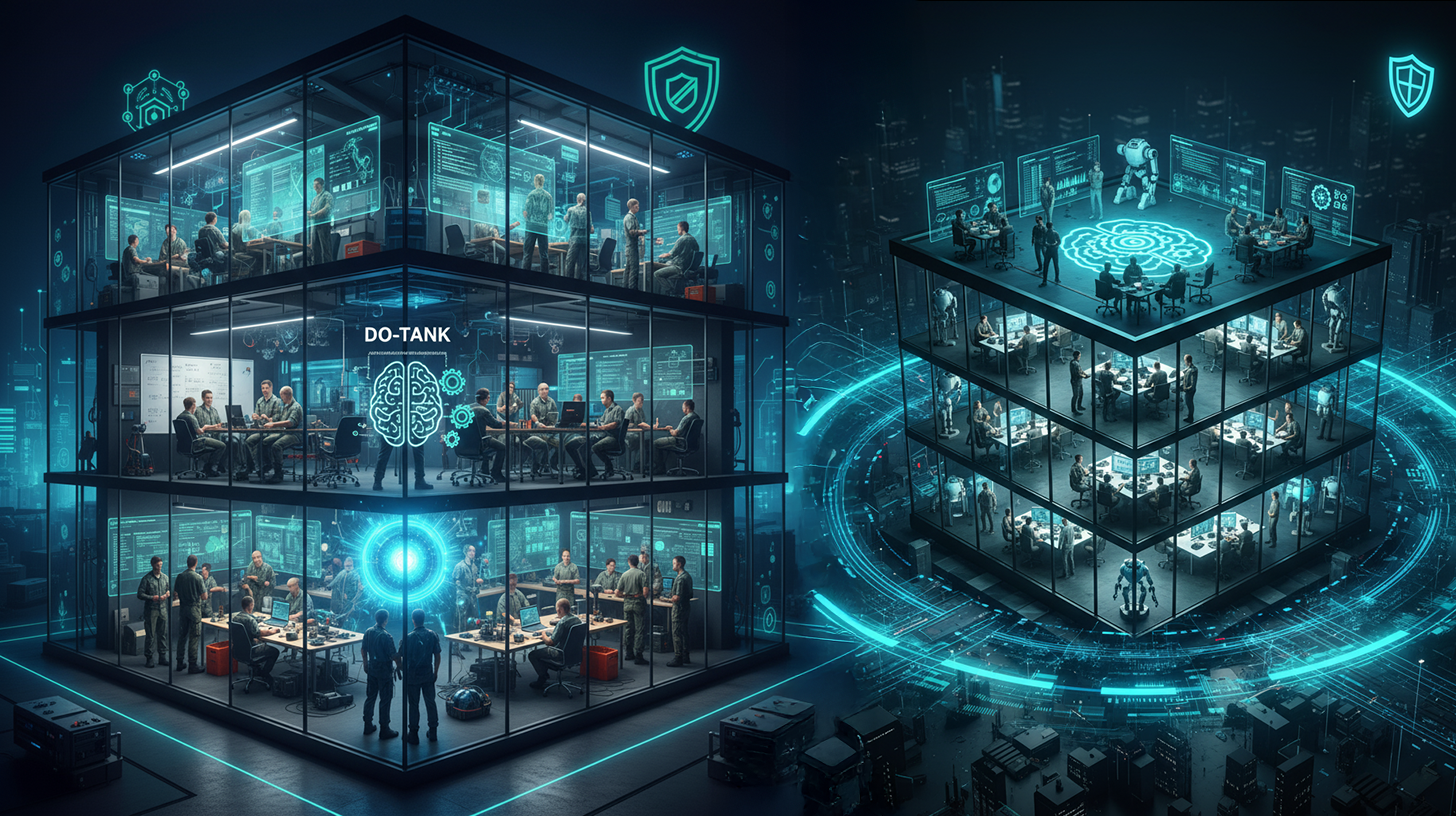
The German Armed Forces' Cyber Innovation Hub (CIHBw) acts as a "do-tank" – The secret to the success of the German Armed Forces' innovators – Image: Xpert.Digital
Innovations in the German Armed Forces: How high technology reaches the troops in record time
### The German Armed Forces' "Valley of Death": Why brilliant inventions often fail – and what's changing now ### 180-Day Revolution: How a special unit is digitizing the German Armed Forces at record speed ### Software instead of steel: The radical plan that aims to change Germany's defense forever ### Germany's new weapons manufacturers? Why tech startups are suddenly loving the German Armed Forces ### From idea to drone in 6 months: The secret to success of the German Armed Forces' innovators ###
A top mark from the soldiers: This “Do-Tank” is truly making the Bundeswehr fit for the future
While the public perception of the German Armed Forces is often characterized by slow bureaucracy and outdated equipment, a unit is working behind the scenes to turn these perceptions on their head. The German Armed Forces' Cyber Innovation Hub (CIHBw) acts as a "do-tank" and promises what sounds like science fiction in the public sector: bringing innovative high technology from concept to the hands of soldiers within just 180 days. Led by Sven Weizenegger, this hub serves as an agile bridge between the dynamic civilian tech and startup world and the specific needs of the armed forces.
Success is measurable: projects like AI-supported disinformation detection and life-saving mine-detection drones are already in use and achieve top marks in soldier satisfaction. Yet despite this impressive speed, the revolution is hitting a familiar German wall: procurement law. After the successful testing of a prototype, many promising projects fall into the so-called "valley of death," where scaling for widespread use fails due to rigid procurement processes. This struggle between the speed of innovation and bureaucratic inertia is taking place against the backdrop of a new era in which concepts like "Software Defined Defence" and a burgeoning German DefenseTech scene are fundamentally redefining the future of national defense.
What is the German Armed Forces' Cyber Innovation Hub and what is its mission?
The German Armed Forces' Cyber Innovation Hub, or CIHBw for short, sees itself as a change agent for the German Armed Forces and is considered the first military digital innovation unit in Europe. Since 2020, this "do-tank" has been headed by Sven Weizenegger, who pursues the vision of enabling the German Armed Forces to fulfill their mission of national and collective defense through digital excellence and technological sovereignty.
The hub acts as a crucial interface between the civilian tech world and the military system. Soldiers directly contribute their specific requirements and challenges, whereupon the CIHBw systematically searches for market-ready, mostly civilian technologies and transfers them into practical application within the German Armed Forces. The goal is clearly defined: to develop solutions that simplify everyday military operations and strengthen the troops' operational readiness.
Strategic management is exercised directly by the Federal Ministry of Defence, while technical leadership lies with the Cyber and Information Technology Department. Legally, the CIHBw is part of BWI GmbH. This structure enables the innovation unit to respond agilely to increasingly shorter development cycles and to advance both dual-use and purely military developments.
How does the rapid implementation of innovations work in practice?
The Cyber Innovation Hub's impressive speed in implementing innovations is demonstrated by concrete figures: "We can deliver something to the soldiers within 180 days," explains director Sven Weizenegger. This timeframe is considered the speed of light in the public sector and represents a fundamental difference to conventional procurement processes.
Since its inception, the hub has launched over 200 projects, 40 of which are actively deployed within the armed forces. This success rate of approximately 20 percent reflects its pragmatic approach, which doesn't require every idea to be fully realized. A well-known example is a system for detecting disinformation on platforms like Telegram. Another project saves lives during mine clearance operations using drones.
The CIHBw team is intentionally interdisciplinary, comprising both civilians and military personnel. Approximately half of the staff are reservists completing time-limited military training exercises. This rotation continuously brings new expertise to the organization and ensures ongoing skills development. IT, AI, communications, and startup experts round out the team, contributing the necessary specialist knowledge for rapid project development.
What role does feedback from soldiers play, and how is user satisfaction measured?
A key success factor of the Cyber Innovation Hub lies in the direct involvement of end users. "Our user satisfaction is 9.5 – in school grades, that would be an A+," emphasizes Sven Weizenegger. This exceptionally high level of satisfaction is based on a systematic feedback system that utilizes various channels.
The feedback comes directly from the soldiers themselves. They write via LinkedIn, email, or contact the hub directly. This direct communication creates a foundation of trust and ensures that the developed solutions truly meet the needs of the troops. The principle "Whoever reports the problem is part of the solution" is consistently implemented and is considered the CIHBw's recipe for success.
The development and implementation of projects focuses exclusively on the needs of the users within the armed forces. All developed projects and prototypes are tested on-site with the troops to ensure that they actually provide added value in everyday service and enable the completion of daily tasks more quickly and easily.
The soldiers bring a unique quality to the evaluation. Weizenegger observes: "In tests and discussions, the soldiers are incredibly precise. They can accurately discern whether a solution truly relies on AI or is merely marketing." This objective and precise approach helps to differentiate genuine innovations from mere marketing promises.
What is the "valley of death" and why does scaling often fail due to procurement law?
The term "valley of death" describes a critical phase between the successful testing of a prototype and its scaling for widespread use. Weizenegger vividly explains the problem: "We are able to get something to the soldiers' barracks within 180 days. That's light speed in the public sector. But after that, we often run into the 'valley of death' – we've tested something, we know it works, but scaling fails due to procurement regulations.".
In the military and defense sector, the valley of death describes the gap between a promising concept or prototype and its transition into a formal program or operational use. The challenges include securing funding, demonstrating operational benefits, and aligning with existing military procurement processes.
German procurement law, which is actually intended to ensure transparency and competition, often becomes an obstacle to rapid innovation in practice. While the CIHBw can operate very flexibly during the experimental phase, larger procurements must follow the regular tendering processes. These are traditionally geared towards established suppliers and lengthy procedures, which contradicts the nature of rapid, iterative technology development.
The problem is exacerbated by the fact that over 20 percent of all public contracts in 2018 received only a single bid, despite being advertised Europe-wide. The average number of bids fell from nine to four between 2009 and 2018, representing a decline of 54 percent.
What procurement reforms are planned or have already been implemented?
The German Federal Government has recognized that the existing procurement system must be reformed to keep pace with the demands of this new era. In July 2025, the Cabinet adopted a draft law for accelerated planning and procurement for the German Armed Forces. This Federal Armed Forces Planning and Procurement Acceleration Act (BwPBBG) represents a logical continuation of the first Federal Armed Forces Procurement Acceleration Act.
The new law expands its scope to include all "contracts to meet the needs of the German Armed Forces," not just military equipment. This is important because "civilian" products can often be crucial for a high-performing German Armed Forces. In addition, all construction projects and planning services for the German Armed Forces fall under the law, regardless of whether they are defense- or security-related.
The law has been expanded to include important new aspects: In addition to the already promoted rapid procurement of commercially available products, it now also addresses the procurement of innovative solutions with a view to ensuring the medium- to long-term operational capability of the German Armed Forces. Specific instruments such as innovation partnerships as a procurement procedure and the prioritization of functional performance specifications have been enshrined in law.
The possibility of setting specific requirements for value creation in Europe has also been expanded – with the aim of safeguarding European and national sovereignty. Experts emphasize, however, that legal regulations alone cannot achieve these goals – implementation and execution in concrete procurement processes are crucial.
What does "Software Defined Defence" mean for the future of the German Armed Forces?
Software Defined Defense (SDD) represents a fundamental paradigm shift in military thinking. Instead of primarily focusing on hardware, software becomes the decisive factor for military superiority. In November 2023, a group of experts from the Ministry of Defense, industry, and Bitkom published a joint position paper on this topic.
The core of SDD lies in the decoupling of sensors and effectors, software and hardware, and data and applications. These are then flexibly integrated into data-centric, networked systems. Adaptations to new threats should be possible via software updates, without requiring physical hardware modifications.
Modern weapon systems are already over 80 percent software-defined, yet the focus in armaments and procurement remains heavily on hardware. SDD aims to change this and create the conditions for a rapid response to evolving threats through purely software-based adjustments.
The concept was divided into six key areas of investigation: Foundation@SDDBw for the basic IT infrastructure, Rapid Development & Deployment@SDDBw for agile software development, AI methods as enablers, information security, and other aspects that together form a holistic overall construct. For Weizenegger, the vision is clear: "I dream of technological sovereignty that operates via interfaces. Software-defined defense by default.".
Hub for Security and Defense - Advice and Information

Hub for Security and Defense - Image: Xpert.Digital
The Security and Defence Hub offers expert advice and up-to-date information to effectively support companies and organizations in strengthening their role in European security and defence policy. Working closely with the SME Connect Defence Working Group, it particularly promotes small and medium-sized enterprises (SMEs) that wish to further develop their innovative capacity and competitiveness in the defence sector. As a central point of contact, the Hub thus creates a crucial bridge between SMEs and European defence strategy.
Related to this:
Rethinking procurement: How to successfully scale military innovations
How has the startup scene in the defense sector developed?
For decades, Germany's startup and investor scene ignored military innovations out of conviction, convenience, or fear of bad press. This stance, however, is increasingly crumbling. The war in Ukraine, the resurgence of great power politics, and Europe's open dependence on US defense technology have forced a change of thinking.
“We’re seeing a surge in investment. Partly out of a sense of responsibility, and partly because there are valid business cases,” observes Weizenegger. This trend is reflected in the investment figures: Startups like Alpine Eagle received €10.25 million for drone defense technology, while Arx Robotics raised over €50 million for autonomous unmanned ground vehicles.
A Bitkom survey of 44 DefTech and dual-use startup founders also revealed the challenges: 71 percent consider Germany's current defense capabilities to be low, and 25 percent even consider them very low. All respondents called for a streamlining and acceleration of procurement processes.
84 percent of startups consider real-world laboratories necessary for testing innovations. An equal number, 84 percent, advocate for increased public investment in defense startups. The most important German DefenseTech startup is now Helsing, which has become the most valuable startup in Germany.
Weizenegger remains realistic: “Of course, 70 drone startups won’t survive. Consolidation is inevitable – but that’s precisely what fuels innovation.” He draws a clear line: “We’re not the traditional arms industry. Our focus is on digitalization; anything that provides an advantage on the battlefield.”.
Which specific innovation projects are already in use?
The Cyber Innovation Hub boasts an impressive track record of successful innovation projects. Of the more than 200 projects launched, 40 are already actively deployed within the armed forces. These projects cover a wide range of applications that tangibly improve everyday military operations.
A prominent example is a system for detecting disinformation on platforms like Telegram. This tool helps the German Armed Forces distinguish facts from deliberately disseminated misinformation in the information overload of the digital age. Given the increasing importance of information warfare, this represents a critical capability.
Another life-saving project uses drones for mine detection. This technology makes it possible to explore dangerous areas from a safe distance, thereby protecting the lives of soldiers. The use of unmanned systems for such tasks exemplifies how civilian technologies can be adapted for military purposes.
In October 2024, Defense Minister Boris Pistorius, head of the CIHBw (Center for High-Performance Weapons and Information Technology of the German Armed Forces), presented the latest developments in drone defense. The highlight was a successful field exercise with an interceptor drone from a Munich-based startup. The interceptor drones proved to be significantly faster than expected and were able to successfully neutralize attacking drones at long range and altitude.
In cooperation with the army's reconnaissance units, further innovation projects are being pursued under the motto "Explore the Unexplored". Ten prototypes in the field of software-defined defense have already been presented, all of which were developed by Bundeswehr soldiers themselves.
How is a balance between innovation and military security ensured?
The challenge of reconciling innovation with the high security requirements of the military sector demands a well-thought-out approach. The CIHBw has developed special procedures and structures for this purpose, which can guarantee both speed and security.
A key component is the System Soldier Innovation Lab in Erding, where technical concepts meet military reality. In simulated operational scenarios, solutions can be tested, adapted, and optimized for later use. This approach makes it possible not only to develop technologies but also to test their suitability under real-world conditions.
The projects are divided into two parallel formats: The practical track is aimed at teams that can develop near-deployable prototypes within a few months. The moonshot track offers space for visionary early-stage ideas that pursue new approaches. Both tracks are supported by coaching and direct feedback from stakeholders.
Information security plays a central role in Software Defined Defense and has been defined as a separate research focus area, "InfoSec@SDDBw". This demonstrates that cybersecurity is considered from the outset, rather than being added later.
Proximity to the troops is a crucial safety factor. Directly involving soldiers in the development processes ensures that only solutions that function under real-world operational conditions are pursued. The soldiers' precise evaluation helps to distinguish genuine innovations from superficial promises.
What role does international cooperation and NATO compatibility play?
The international dimension plays an increasingly important role in the German Armed Forces' innovation efforts. Software-defined defense explicitly aims to expand interoperability within the armed forces and with alliance partners. This "networked operations" is essential for modern multi-domain operations.
The concept stipulates that only compatible systems will enable Germany to react quickly in an emergency. Weizenegger emphasizes: "For me, it's not just about military strength, but about a cultural shift: away from simply avoiding mistakes, towards a culture of learning.".
NATO sees digitalization as a way to network its armed forces across all domains – land, air, sea, cyber, and space. This enables faster decision-making based on better data and makes its own forces more resilient against enemy surprises.
Practical examples of international cooperation can be seen in joint innovation formats. The SPECTRA Challenge, conducted by the Cyber Agency, the CIHBw, and the Innovation Lab System Soldat, seeks solutions for electronic threats against unmanned systems. Such cross-cutting formats create new avenues for collaboration between various German institutions.
The NATO Innovation Fund is already investing in German startups like Arx Robotics, demonstrating that the importance of innovation is recognized at the alliance level as well. These financial connections not only generate capital but also foster strategic partnerships that can contribute to interoperability.
What is the future vision for a digitized German Armed Forces?
Weizenegger's vision of a technologically sovereign, interface-based German Armed Forces based on the principle of "Software Defined Defence by default" points the way to the future. This transformation goes far beyond pure technology and requires a fundamental cultural shift within the armed forces.
The focus is on creating modular, reusable software components that can be quickly replaced and updated. This makes it possible to respond to new threats through software updates without having to make physical hardware modifications. Improvements in capabilities and performance are achieved situationally through rapid software adjustments.
The digitalization of the battlefield and the command and control capabilities of the armed forces are central to the special fund for the German Armed Forces. The "Command and Control Capabilities and Digitalization" component is intended to create an adaptive, secure, and interoperable information and communication network and significantly improve the command and control capabilities of Germany's NATO contribution.
Multi-domain operations between equally matched adversaries will be the norm on the battlefield of the future. The German Armed Forces must therefore prepare for operations that take place simultaneously in the land, air, sea, space, and cyberspace domains. Software will become a crucial component for the successful coordination and execution of such complex operations.
Weizenegger remains optimistic: “Many have already woken up. It’s important to speak honestly about concerns and hopes. Something can grow from that.” His vision is a German Armed Forces that is more digital than many currently believe – an armed force that can fulfill its mission of national and alliance defense through innovation and technological excellence.
What challenges remain and how can they be overcome?
Despite the impressive successes of the Cyber Innovation Hub, structural challenges remain that hinder sustainable transformation. Public procurement law remains the major obstacle that needs to be overcome. While the Hub can work very agilely during the prototyping phase, scaling often fails due to rigid procurement processes.
Weizenegger calls for "more speed, more courage, and more pragmatism." For him, innovation means not only developing new things but also knowing when to stop. "Far more important than the final result are the insights gained. Government structures could learn a thing or two from startups about the courage to sometimes abandon projects." This learning culture stands in contrast to the traditional error-avoidance mentality of public administration.
Procurement markets are showing worrying trends: The number of bidders fell by 54 percent between 2009 and 2018. It is essential to increase incentives to bid for Bundeswehr contracts in order to make the instrument of economically sound competitive bidding effective.
Bitkom is calling for at least 30 flagship collaborations between the German Armed Forces and startups in the defense and dual-use sectors by 2030. The CIHBw (Center for Innovation and High Performance Competence in the German Armed Forces) should be provided with a substantial budget, earmarked as a financial corridor at the BAAINBw (Federal Office of Bundeswehr Equipment, Information Technology and In-Service Support), and should be granted the authority to largely independently introduce innovations into the armed forces.
The solution lies in a holistic approach: experimental formats and framework agreement structures for faster procurement of digital solutions, agile methods involving providers and users for the joint development of solutions. Innovation budgets can contribute to dynamism and flexibility, while new tendering and contract models enable different providers to effectively pool their capabilities.
The transformation has already begun, but it still requires political will, structural reforms, and cultural change. Only in this way can the vision of a digital, innovative, and deployable German Armed Forces become a reality.
Consulting - Planning - Implementation

Markus Becker
I would be happy to serve as your personal advisor.
Head of Business Development
Chairman SME Connect Defense Working Group
Consulting - Planning - Implementation
Konrad Wolfenstein
I would be happy to serve as your personal advisor.
You can contact me at wolfenstein∂xpert.digital or
Just call me on +49 7348 4088 965 .
Your dual-use logistics experts
Dual-use logistics experts - Image: Xpert.Digital
The global economy is currently undergoing a fundamental transformation, a watershed moment that is shaking the foundations of global logistics. The era of hyper-globalization, characterized by the relentless pursuit of maximum efficiency and the "just-in-time" principle, is giving way to a new reality. This new reality is marked by profound structural breaks, geopolitical power shifts, and increasing fragmentation of economic policy. The once taken-for-granted predictability of international markets and supply chains is dissolving and being replaced by a period of growing uncertainty.
Related to this: