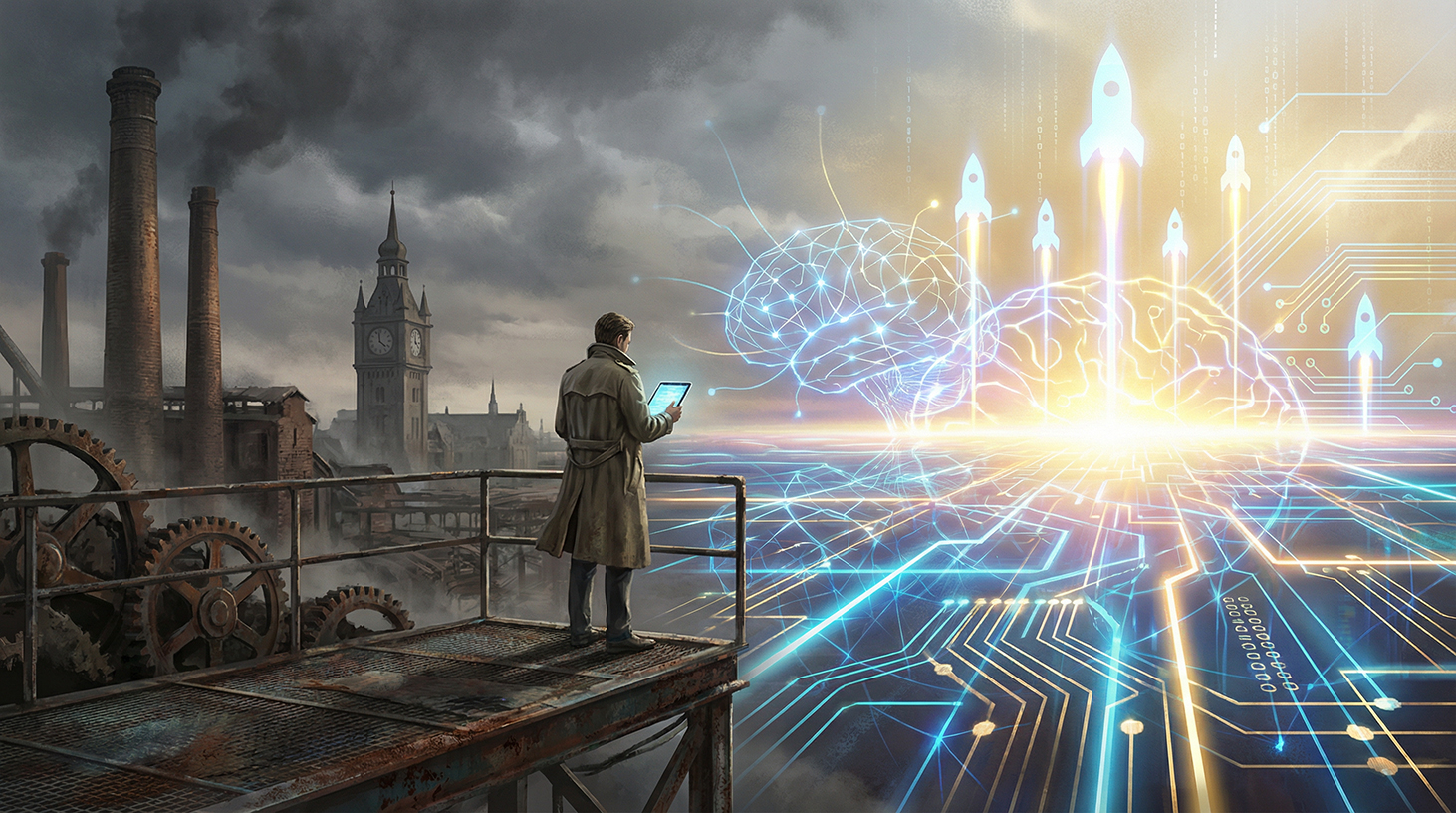
Curiosity as an economic force – Why Germany needs a renewed appetite for the new – Image: Xpert.Digital
The prosperity trap: How “German Angst” and bureaucracy are paralyzing our economy
Breaking free from stagnation: Why courage and curiosity are our most important resources
The Silicon Valley Misconception: What Germany as a business location really lacks right now
Germany was once considered the undisputed engine of growth in Europe – a guarantor of stability, technological precision, and unwavering prosperity. But this very deep-seated need for maximum security is proving to be a fatal trap in the 21st century. While the global economy is being reshaped by artificial intelligence and ever-shorter technology cycles, Germany is losing significant innovative strength and stagnating. Trapped in bureaucratic overregulation, a chronic shortage of venture capital, and the deeply ingrained "German Angst" about failure, the country is blocking the urgently needed economic renewal. This text examines the creeping decline of the German entrepreneurial spirit, analyzes the structural obstacles from digitalization to demographics, and shows why we don't need to copy Silicon Valley, but simply cultivate a new culture of curiosity and entrepreneurial courage.
Related to this:

When security becomes a risk: The paradox of the German prosperity trap
Germany is afraid. Not the kind of fear that drives people to existential crisis, but a more subtle, paralyzing kind: the fear of losing what it has achieved. It is deeply ingrained in the collective psyche of a nation that has built prosperity for decades through consistency, reliability, and technical precision. And yet, it is precisely this attitude that is now proving to be the greatest structural risk to the country's economic future. Because in a world where technology cycles are shortening, where artificial intelligence is redefining industries, and where emerging economies are no longer just copying but inventing, consistency is no longer a virtue, but stagnation in slow motion.
Germany's economic situation in the 2020s is soberingly concrete: After growth of just 1.4 percent in 2022, the economy stagnated in 2023 and 2024, and was the only major economy in the EU to contract in 2024. Over the past five years, inflation-adjusted gross domestic product (GDP) has grown by a mere 0.02 percent. Leading economic institutes now forecast growth of only 0.6 to a maximum of 1.0 percent for 2026. Germany, which for decades was considered the engine of growth in Europe, has become the problem child of the Eurozone. This diagnosis is not the result of a temporary economic headwind. It reflects a deeper structural failure whose roots reach far back into the history of German economic culture.
The silent drift: How Germany is squandering its innovation lead
At the heart of this structural crisis lies a dramatic loss of innovation momentum. Germany fell to eleventh place in the Global Innovation Index 2025, down from eighth in 2023. In the Innovation Indicator 2024, compiled by Roland Berger and the Federation of German Industries (BDI) in cooperation with the Fraunhofer Institute, Germany ranks only twelfth out of 35 economies. The indicator value dropped from 45 to 43 out of a possible 100 points, while other countries have significantly increased their efforts. Particularly painful is the fact that Germany's decline is not due to its own weakness, but primarily to the rise of others. Switzerland, Singapore, Denmark, Sweden, and Ireland now occupy the top spots. China made it into the global top ten for the first time. What was once considered a stable leadership role is now just one position among many.
Even more worrying is the finding of a recent study by the Bertelsmann Foundation from spring 2026: More than 1,100 companies were surveyed for their research. The result is alarming: Only 13 percent of German companies now belong to the innovation leaders. In 2019, this figure was still around a quarter. At the same time, the proportion of companies with weak innovation has risen to almost 40 percent. This shift is occurring precisely during a period of intensified global competition, geopolitical tensions, and accelerated technological developments. Innovation is thus losing its strategic anchoring across the German economy – at a time when the opposite is urgently needed.
The causes of this gradual decline are multifaceted, yet they can be reduced to a common denominator: Germany systematically avoids the kind of uncertainty from which innovation emerges. Companies operate in an environment of increasing complexity, where bureaucratic requirements and regulatory uncertainty tie up resources that are then lacking for genuine innovation. It is economically rational to act more cautiously under these conditions. But rational conservatism at the company level, when applied across an entire economy, leads to collective stagnation.
Schumpeter was right: On the art of letting go of the old
Joseph Alois Schumpeter, the Austrian economist and pioneer of growth theory, coined the term "creative destruction" as a central concept of capitalist dynamics: the constant renewal of production processes and goods through innovation, which displaces the old, is the true engine of economic progress. Not the preservation of structures, but their active overcoming with something better is the foundation of growth and prosperity. Schumpeter's insight has an almost disconcerting relevance for Germany today, more than a century after its formulation. For Germany is systematically blocking this process.
The winners of the 2025 Nobel Prize in Economics took up precisely this idea. The chairman of the selection committee, John Hassler, put it succinctly: The mechanisms underlying creative destruction must be maintained to avoid falling back into stagnation. Germany has arrived exactly there. Instead of allowing transformation, policymakers prop up companies structurally trapped in outdated business models through industrial electricity prices, subsidy programs, and protective measures. The attempt to stabilize VW, BASF, and other industrial giants through state intervention, instead of embracing structural change as an opportunity, is the economic policy equivalent of trying to defend the typewriter industry against the personal computer. No country in the world could have succeeded – yet Germany is attempting it, and it is costing time, money, and momentum.
The problem isn't a lack of awareness about the necessity of change. Countless location analyses, consulting reports, and political declarations of intent accurately diagnose the situation. What's missing is the courage to accept the consequences: that creative destruction also means destruction—the loss of jobs, the demise of established companies, the devaluation of expertise built up over decades. A society that shies away from the pain of transition ultimately loses both: the old structures and the new future.
The bureaucracy trap: When administration stifles innovation
Among the most tangible obstacles is bureaucratic overload. A recent study by the Cologne Institute for Economic Research (IW), commissioned by the Initiative for a New Social Market Economy (INSM), found that the number of business start-ups has fallen by more than 40 percent in the past ten years, representing a veritable collapse. A turnaround is not in sight. Founders in Germany continue to face significantly greater administrative hurdles than those in other European countries or the USA. The findings of the IAB/ZEW Start-up Panel 2025 are even more specific: Young companies spend an average of nine hours per week on legally mandated administrative tasks. That's almost a full workday every week that is unavailable for product development, customer contact, or strategic planning.
The consequences are immediately measurable: More than half of the young companies surveyed stated that bureaucratic requirements leave less time for processing orders. Innovation activities are postponed. Skilled workers cannot be recruited due to hiring hurdles, even though demand exists. Those companies experiencing the greatest difficulties are the ones most focused on growth – precisely those that the economy needs most urgently. According to entrepreneurship researcher Sandra Gottschalk from the ZEW (Centre for European Economic Research), the burden of bureaucracy leads to a vicious cycle: Less time for innovation means reduced competitiveness, which in turn stifles growth, exacerbating the skills shortage.
The "Location Radar Germany 2025," conducted by the strategy consultancy Advyce & Company in cooperation with the German Association for the Protection of Securities Holders (DSW), identifies wage and structural costs as by far the biggest crisis factor, accounting for 31 percent of the pressure for transformation. This is followed by regulation at 24 percent, increased international competition at 21 percent, and the shortage of skilled workers at 20 percent. Contrary to public perception, the much-discussed energy costs play a subordinate role in the majority of sectors, accounting for only four percent. The real enemies of German entrepreneurship are therefore less the energy markets than structural rigidities in the regulatory and tax framework that stifle entrepreneurial dynamism in its infancy.
Related to this:


German Angst: The Psychology of the Non-Daring
Behind these structural obstacles lies a deeply rooted cultural pattern that economists have been describing for decades as "German Angst." It is the institutionally shaped, collectively reinforced, and socially sanctioned fear of the unknown. In Germany, failure is still considered a stigma, not a learning process. Anyone who starts a business and fails in Germany finds it difficult to get back on their feet, explains Hamburg-based business consultant Marie-Dorothee Burandt. The image of being worthless, of not having made it, clings to them like a stain. In the USA, on the other hand, the land of pioneers, getting back up after failure is part of the process. Falling down isn't so bad there—in Germany, it's tantamount to a catastrophe.
The available data confirms this cultural diagnosis with disturbing consistency. According to a KfW study, the fear of failure deters 42 percent of the German working population from starting a business. In comparable industrialized nations like France, this figure is 39 percent, and in Great Britain it is even lower. In the USA, the fear of failure only inhibits around one-fifth of the population. The DIW Institute found that if Germans acted with the same optimism, self-confidence, and willingness to take risks as Americans, a higher proportion of people in Germany would actually start a business than in the USA. The potential is therefore there. It is the internal permission to fail that is lacking.
This mentality has concrete economic consequences. Currently, only four percent of the working-age population in Germany ventures into self-employment, compared to seven percent in the USA. Since the 1950s – when the proportion of self-employed individuals among the workforce was still around 30 percent – this figure has steadily declined to its current level of ten to eleven percent. In a ranking of 20 comparable countries based on entrepreneurial spirit, Germany barely occupies 15th place. This is no coincidence, but rather the result of a system that prioritizes security over dynamism – with the consequence that neither security nor dynamism is adequately guaranteed.
Our EU and German expertise in business development, sales and marketing

Our EU and German expertise in business development, sales and marketing - Image: Xpert.Digital
Industry focus areas: B2B, digitalization (from AI to XR), mechanical engineering, logistics, renewable energies and industry
More information here:
A thematic hub offering insights and expertise:
- Knowledge platform covering global and regional economies, innovation and industry-specific trends
- A collection of analyses, insights, and background information from our key areas of focus
- A place for expertise and information on current developments in business and technology
- A hub for companies seeking information on markets, digitalization, and industry innovations
Why Germany needs to let go of the Silicon Valley myth — and what helps instead
The Silicon Valley Misconception: What Germany Really Needs
When the culture of innovation is discussed, comparisons with Silicon Valley inevitably arise. However, these comparisons are often both unproductive and misleading. The Silicon Valley ecosystem is the result of a specific set of factors that have developed over decades: a deregulated labor market, a deep capital market, close ties to universities, cultural optimism, and geographic concentration – none of which can be transferred to Germany by government decree. Venture capital firms in the Valley make quick decisions, invest large sums, and accept that nine out of ten bets will fail, as long as the tenth produces a billion-dollar company. This is a completely different logic than the risk-averse culture prevalent in the German financial landscape.
What Germany can and must learn, however, is not to copy Silicon Valley, but to combine its own strengths with a greater willingness to take risks and agility. Germany possesses world-renowned engineering expertise, an outstanding education system, a broad industrial base in its small and medium-sized enterprises (SMEs), and excellent research institutions such as Fraunhofer, Max Planck, and Leibniz. This substance is there. What is lacking is a cultural framework that allows for faster action, testing ideas, failing, and starting anew—instead of slowing down every decision with years of studies, approval processes, and risk assessments.
Specifically: While Silicon Valley startups often bring ideas to market within a few months, German companies sometimes struggle for years with approval processes and safety requirements. This slowness is a structural handicap in a global competitive environment that thrives on speed and iteration. In many technology fields, from artificial intelligence and biotechnology to electromobility, success is determined not by the quality of the first version, but by the speed of the second, third, and fourth.
Related to this:


Digital backwardness: When 19 percent is not enough
The German digitalization agenda exemplifies the pattern described. On the one hand, the ICT market is projected to grow by 4.6 percent to €232.8 billion in 2025, with particularly strong growth in software (up 9.8 percent). On the other hand, the more than 4,000 companies surveyed by the DIHK (Association of German Chambers of Industry and Commerce) continue to rate their own level of digitalization with an average grade of only 2.8 (on a scale where 1 is the best and 6 is the worst). Only 10 percent see themselves as pioneers, while around 58 percent are in the middle or lagging behind. And the real warning sign: only 31 percent report digital innovations in the form of new products or business models – digitalization remains, for the most part, a tool for optimizing efficiency, not for creative renewal.
The picture is even clearer when it comes to the use of artificial intelligence in industry. The Industry 4.0 Barometer 2025, conducted by Ludwig Maximilian University of Munich and the management consultancy MHP, reveals that only 19 percent of the German industrial companies surveyed are using AI productively. In contrast, China and the USA are actively driving digital transformation with proactive data strategies, modern IT infrastructure, and targeted talent development. Particularly worrying is the fact that long-serving managers without sufficient AI expertise are often entrusted with the implementation of digital projects – a structural problem in skills development that is further exacerbated by demographic change. A survey by the digital association Bitkom confirms this finding from another perspective: only 10 percent of the IT decision-makers surveyed believe Germany is well prepared for future AI developments. And 72 percent rate the state of digitalization in Germany as poor or very poor.
The obstacles are well-known and extensively documented: a lack of knowledge about specific areas of application (27 percent), legal uncertainties (21 percent), a shortage of skilled workers (14 percent), and insufficient continuing education opportunities (12 percent). These are solvable problems—not immutable natural laws. However, they require political will, entrepreneurial courage, and an educational reform that recognizes technological competence as the foundation for economic participation.
Related to this:

The demographic tipping point: labor market in structural change
Among the structural challenges that have an impact independent of economic cycles is demographic change. According to the German Economic Institute (IW), there was a shortage of over 391,000 skilled workers in June 2025. The Federal Ministry of Labor expects continued shortages in the IT, healthcare, technology, and education sectors until at least 2028. The age structure of the working population is even more dramatic: Of the 34.2 million employees subject to social security contributions, around 7.8 million were recently between 55 and 65 years old – that's 23 percent. Nearly a quarter of the total workforce is expected to leave the labor market in the next ten years. Ten years ago, this figure was only 17 percent.
The paradox of this transformation is evident: On the one hand, many companies are cutting jobs due to the economic downturn – in September 2025, almost three million people were unemployed. On the other hand, there is a shortage of skilled workers in precisely those sectors relevant to the future. The simultaneous occurrence of job cuts and a skills shortage is not a contradiction, but rather a symptom of a structural break: Outdated skill profiles are being replaced by new requirements. Someone who loses their job in the automotive industry cannot simply start working in wind energy or healthcare. This dynamic of structural mismatch presents labor market policy, the education system, and companies with challenges for which conventional instruments such as short-time work or training programs alone are insufficient.
According to the DIHK Skilled Workers Report 2025/2026, 83 percent of companies expect negative consequences from the shortage of labor and skilled workers in the coming years. Even with a temporary economic recovery, demographic pressure will remain a long-term structural problem that will worsen without active countermeasures. Without qualified personnel, new technologies cannot be developed, processes cannot be modernized, and businesses cannot grow.
The venture capital problem: Why good ideas starve in Germany
Even if a German startup can overcome bureaucratic hurdles and societal reservations, it encounters another structural obstacle: the chronic undersupply of venture capital. In 2025, German startups raised just under €8.4 billion in venture capital – a 19 percent increase compared to the previous year and the third-highest figure in the history of the German startup ecosystem. This number sounds impressive until you put it into perspective: In the US, an average of around $169.4 billion flowed into the startup ecosystem annually during the same period. The ratio is therefore roughly 1:20, and this despite a significantly smaller difference in economic output.
At the same time, the number of funding rounds is steadily declining – in 2025, it was the fourth consecutive year of decrease, from 755 to 716 rounds. This means that fewer companies are receiving capital, even though the total investment volume is increasing. The money is concentrated on a few, already well-known candidates and is not reaching the vast majority of innovative startups. Particularly problematic is the fact that 28.5 percent of potential founders are now considering establishing their companies abroad. This is not a sign of a thirst for adventure, but rather a structurally driven exodus that will ultimately harm Germany's position as a hub for innovation.
The German Startup Monitor confirms this ambivalence: On the one hand, 40 percent of the founders surveyed now rate Germany as more attractive than the USA – an increase of six percentage points – and 61 percent see Germany in a leading position compared to other European countries. On the other hand, the willingness to start another company has fallen from almost 90 percent two years ago to 78.3 percent. The improved perception of Germany compared to the USA seems to be based less on a strengthening of the German location than on a weakening of the American one – a fragile foundation for a genuine innovation revolution.
Investment backlog and lack of confidence: The double brake
In addition to a shortage of venture capital for startups, Germany is suffering from a systemic investment backlog in the corporate sector. Gross fixed capital formation fell by 6.3 percent between 2019 and 2024 – the lowest figure of all EU member states. Many companies are postponing projects or relocating them abroad. The reasons are rational: With persistent uncertainty and high costs for energy, labor, and capital, companies are delaying their investment decisions. Domestic demand has still not recovered five years after the start of the pandemic, and corporate spending remains below 2019 levels.
This creates a self-reinforcing downward dynamic: when consumers and businesses become more cautious simultaneously, aggregate demand falls, which in turn further reduces the willingness to invest. The result is a gradual economic slowdown that neither ends in a dramatic collapse nor allows for a noticeable recovery. German companies are thus failing to generate new economic momentum; the export sector has stagnated since the end of 2022, and domestic industrial orders were recently at their lowest level since 2010. This weakness in investment is not only a symptom of the stagnation but also one of its causes – it prevents the technological innovation that would be necessary to reopen growth pathways.
The ifo Institute recently lowered its growth forecast to 0.8 percent for 2026. Head of Economic Research Timo Wollmershäuser summarized the situation in one sentence: The German economy is adapting to structural change through innovation and new business models only slowly and costly. In addition, companies and startups in particular are hampered by bureaucratic hurdles and outdated infrastructure. The planned government investments from special funds for infrastructure and defense will only have a delayed effect – a growth impact of just 0.3 percentage points is expected for 2026.
Reform approaches: What politicians need to tackle – and what they haven't done so far
The German government has understood the diagnosis, even if the treatment remains half-hearted. In its 2026 Annual Economic Report, it commits to comprehensive reforms: improved framework conditions for innovation through the Real-World Laboratories Act, the review of experimental clauses for new laws, and the mobilization of private capital via the Germany Fund launched in December 2025. The Location Promotion Act, passed the previous year, is intended to facilitate access to capital for young companies. New records were set in the number of new start-up formations in 2025 – a positive sign. And while the EU Commission, in its 2025 country report, acknowledged key challenges facing Germany, it also recognized the fiscal policy turnaround of March 2025 as a potentially transformative step.
Nevertheless, the reform efforts remain insufficient in depth. Individual measures such as depreciation allowances, subsidies for specific technologies, or an industrial electricity price will hardly be enough to trigger a significant growth spurt. This is evident in the fact that, despite high-profile investment summits and countless announcements, the economic situation has changed little in terms of fundamental indicators. What Germany needs is not another subsidy program, but a systematic reduction of the burden on entrepreneurs: radical deregulation, a competitive tax structure, faster approval processes, improved insolvency law that allows for failure and restarts, and targeted strengthening of the venture capital market.
International recommendations from the ifo Institute and the EU Commission point in a clear direction: Efficiency potential in social security systems needs to be unlocked, a growth-friendly tax and contribution structure is required, and consistent deregulation is needed in those areas where regulation hinders rather than promotes innovation. Despite everything, Germany still possesses considerable strengths: its qualified infrastructure, political stability, favorable geographical location, and the industrial depth of its small and medium-sized enterprises (SMEs). However, these strengths are increasingly being neutralized by weaknesses in the institutional framework.
Curiosity as an economic principle: What Germany really lacks
At the end of all economic analyses, data, and political reform proposals, one fundamental question remains: What is the deepest cause of one of the world's most productive, best-educated, and historically most innovative economies sliding into structural stagnation? The answer does not lie in the statistics. It lies in an attitude.
Over decades of economic success, Germany has cultivated a mentality that prioritizes achievement over aspiration, security over risk, and preservation over exploration. This is precisely the antithesis of curiosity. Curiosity—understood in an economic sense—is not merely a cognitive disposition, but an economic principle. It is the willingness to invest resources in the unknown, in things that might fail but could also revolutionize. It is the cultural foundation of any innovation culture worthy of the name. Without curiosity, there are no experiments. Without experiments, there are no breakthroughs. Without breakthroughs, there is no progress.
Silicon Valley doesn't have better engineers than Germany. It has a culture of "yes," of "now," of "again." Germany has a culture of "but," of "wait a minute," of "this needs to be examined very carefully." Both cultures have their place. But in a world where the rate of technological change is growing exponentially, the second culture is a competitive disadvantage that is reflected in the level of prosperity. At the beginning of 2025, 63 percent of Germans looked to the economic future with anxiety. This is no coincidence. It is the emotional assessment of a country that senses it is losing something but doesn't know how to regain it.
The solution is not to transform Germany into a European Silicon Valley. The solution is to awaken the dormant entrepreneurial spirit that the country has always possessed throughout its history – from the inventors of industrialization to the pioneers of the German economic miracle, to the medium-sized companies that became global market leaders in niche markets in the 1990s, markets that no one else knew existed. Germany has not lost this entrepreneurial spirit. It has been bureaucratized, overregulated, taxed unfairly, and socially stigmatized. What is lost can be regained. But for that to happen, failure must cease to be a disgrace. It must become a mark of distinction.
Interim conclusion: Use strengths, break free from constraints
Germany is at a historic crossroads. The resources are there – the engineering culture, the research institutions, the adaptable small and medium-sized enterprises, the geographical and infrastructural location in the heart of Europe. But these resources are hampered by a system of incentives, norms, and institutions that rewards risk aversion and penalizes risk-taking. The challenge is not technological, but cultural and institutional in nature.
What's needed is not another strategy, another commission, another funding program. What's needed is a national decision: Germany wants to be hungry again. Hungry for the new. Curious about what's possible. Ready to give up the securities of yesterday for the opportunities of tomorrow. This is not a call for recklessness or the abolition of social safety nets. It is a call for what Joseph Schumpeter described over a century ago as the essence of dynamic capitalism: the courage of dynamic entrepreneurs to relentlessly drive innovation forward in the face of reservations and resistance, thereby enabling economic change.
Germany has this capability. It just needs to want it again.
Your global marketing and business development partner
☑️ Our business language is English or German
☑️ NEW: Correspondence in your native language!

Konrad Wolfenstein
I and my team are happy to be available to you as your personal advisor.
You can contact me by filling out the contact form here wolfenstein@xpert.digital:or simply call me at +49 7348 4088 965. My email address is
I'm looking forward to our joint project.
☑️ SME support in strategy, consulting, planning and implementation
☑️ Creation or realignment of the digital strategy and digitization
☑️ Expansion and optimization of international sales processes
☑️ Global & Digital B2B trading platforms
☑️ Pioneer Business Development / Marketing / PR / Trade Fairs
🎯🎯🎯 Data-driven B2B industry hub as a quasi-in-house solution
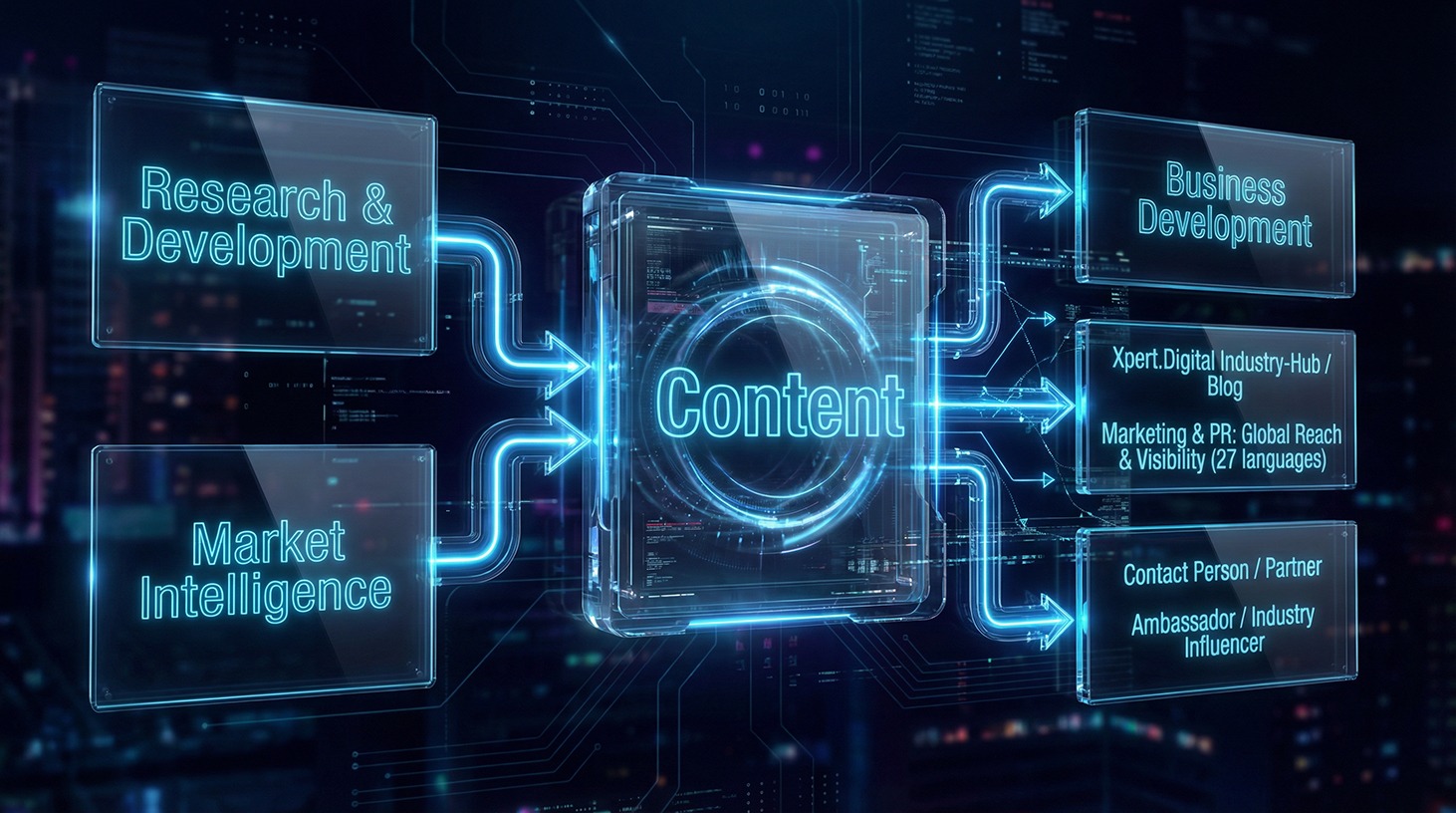
The quasi-in-house solution: How Xpert.Digital closes operational gaps in B2B marketing and sales – Smart Content-Driven Business - Image: Xpert.Digital
Xpert.Digital is a data-driven B2B industry hub led by Konrad Wolfenstein . The company acts as an external, quasi-in-house solution for industrial partners, closing operational gaps in marketing, content, and sales – without requiring additional resources on the client side.
More information here: