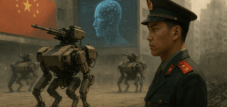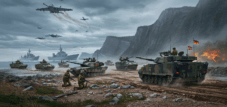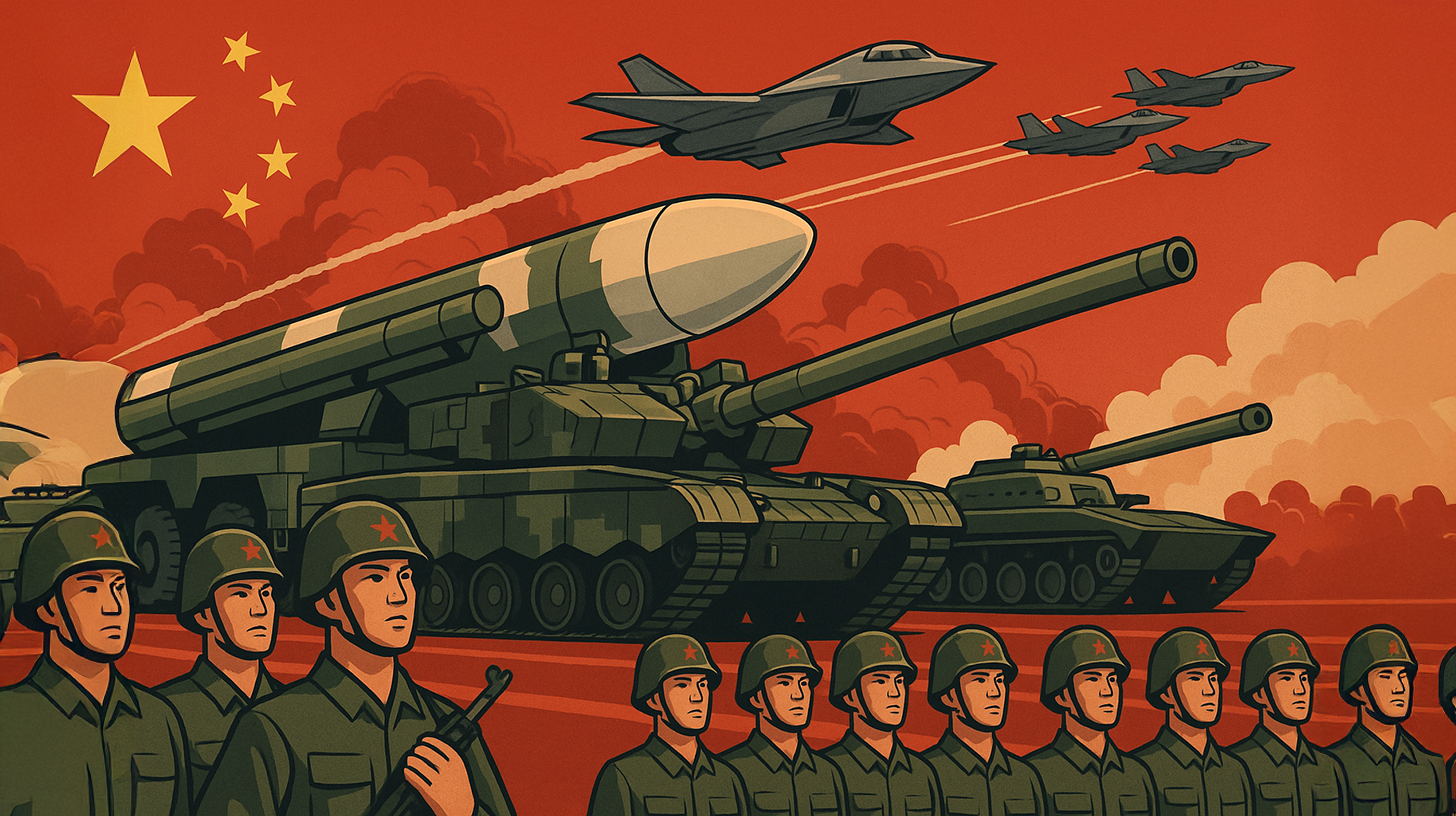
China's military parade: Weapons designed to impress – What did China showcase at its grand military parade in 2025? – Image: Xpert.Digital
China's show of force: Why experts warn of a new arms race after the parade
### Hypersonic missiles & underwater drones: China showcased these superweapons at its mega-parade ### “Virtually uninterceptable”: How dangerous are China’s new missiles really? ### Nuclear weapons, lasers, AI jets: China’s military reveals its plans – and its weaknesses ###
More than just a show: What China's military parade means for Taiwan and global security
On September 3, 2025, the world held its breath as China staged one of the largest military parades in its history in Beijing's Tiananmen Square. The occasion was the 80th anniversary of the end of World War II, but the message was unmistakably forward-looking. Before the eyes of Russian President Vladimir Putin and North Korean leader Kim Jong Un—an unprecedented meeting that demonstrated a new "axis of autocracies"—President Xi Jinping presented an army that emphatically underscored its claim to global superpower status. The parade was a perfectly orchestrated propaganda spectacle designed not only to demonstrate strength but also to deliberately intimidate the West.
At the heart of this show of force was an arsenal of highly advanced weapons systems that threatens to shift the strategic balance worldwide. From hypersonic missiles like the DF-17 and DF-27, which render existing defense systems virtually ineffective, to enormous, nuclear-powered underwater drones, mobile laser weapons, and unmanned "loyal wingman" fighter jets – China unveiled technological leaps that are setting off alarm bells for NATO and its allies. At the same time, Beijing is accelerating the expansion of its nuclear arsenal at a pace that definitively abandons the previous doctrine of minimal deterrence and heralds a dangerous trilateral arms race with the US and Russia.
This article analyzes in detail the weapons systems displayed at the parade and their military capabilities. It examines the strategic goals China is pursuing with its rapid modernization and investigates the reactions of its concerned neighbors in the Pacific region, from Taiwan to Japan. Furthermore, it discusses how NATO and Europe assess the growing threat, what critical dependencies—for example, in munitions production—exist for Germany, and what structural weaknesses China's military still exhibits despite its impressive facade. Ultimately, it poses the question: What does China's rise mean for the global security architecture, and how must the West respond to this new reality?
Xi, Putin and Kim united: This image of the military parade is a direct warning to the West
On September 3, 2025, China staged one of the largest military parades in its history to mark the 80th anniversary of the end of World War II. Over 10,000 soldiers marched in Tiananmen Square in Beijing, showcasing state-of-the-art weapons systems. The parade was not only a demonstration of military might but also a meticulously orchestrated propaganda spectacle. Security measures were so stringent that residents were even forbidden from cooking on the morning of the parade to keep the skies over the capital clear of smoke. Instead, they received breakfast packages containing hard-boiled eggs and pickles.
The parade took place before prominent guests, including Russian President Vladimir Putin and North Korean leader Kim Jong Un. It was the first time the three leaders Xi Jinping, Putin, and Kim had appeared together in public. This unprecedented demonstration of the Chinese-Russian-North Korean alliance sent a clear signal to the West.
What new weapon systems were presented?
Next-generation hypersonic missiles
China displayed an impressive array of hypersonic missiles that pose a serious challenge to Western defense systems. The YJ-17 hypersonic anti-ship missiles can be launched from bombers beyond the reach of enemy air defenses and can penetrate virtually any known defense. These missiles reach speeds exceeding Mach 5 and are extremely difficult to intercept due to their maneuverability in flight.
Particularly threatening is the DF-17, which has been in service with the Chinese army since 2020. This ballistic missile is distinguished by its ability to support hypersonic flight maneuvers during the intermediate and terminal phases, making interception by existing missile defense systems such as THAAD, SM3, and Patriot virtually impossible. With a range of 1,500 kilometers for the missile itself and an additional 1,000 kilometers for the detached glider, the combined system achieves a maximum range of 2,500 kilometers.
The even more advanced DF-27, which may have entered service before 2019, has a range of 5,000 to 8,000 kilometers and can therefore attack Hawaii from the Chinese coast. This missile is designed to carry multiple warhead types and attack several targets simultaneously.
Underwater drones as a new threat
One of the most spectacular new displays was torpedo-shaped underwater drones, which were rolled along the Eternal Peace Road on trucks. These colossal-looking systems, possibly the AJX002, measuring approximately 20 meters in length, could be used as stealth submarines. Experts speculate that these drones are modeled after the Russian Poseidon torpedo and could be powered by a tiny nuclear reactor, giving them virtually unlimited range.
These autonomous underwater vehicles could theoretically patrol the world's oceans undetected for months and strike on command, opening up a completely new dimension of naval warfare.
Revolutionary laser weapons
China unveiled the LY-1 mobile laser weapon, a high-energy laser system capable of intercepting swarms of small drones or guided missiles. This vehicle-mounted system represents a significant development in air defense and could be particularly effective against the increasingly common drone swarms in modern conflicts.
Unmanned combat jets and loyal wingman systems
The unmanned combat jets and the so-called Loyal Wingman drones attracted particular attention. These systems can support manned fighter jets like the J-20 stealth fighter or fly reconnaissance missions independently. The J-20, China's first domestically developed stealth fighter, has also existed since 2021 in a two-seat variant specifically designed to command drone swarms.
The FH-97A, a supersonic combat drone, is said to be capable of matching the performance of the J-20 stealth fighter, potentially giving China an advantage over its competitors. These Collaborative Combat Aircraft are considered by experts to be the future of aerial warfare.
How threatening is China's nuclear arsenal really?
Massive expansion of nuclear weapons
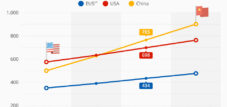
China's nuclear arsenal has undergone a dramatic expansion in recent years. According to the Stockholm International Peace Research Institute, the arsenal has grown by approximately 100 warheads annually since 2023 and now comprises at least 600. By 2035, the number could reach 1,500, at which point China is abandoning its previous strategy of minimal nuclear deterrence.
The country is currently building approximately 350 new silos for intercontinental ballistic missiles in desert and mountainous regions. Once fully equipped, these silos would allow China to deploy over 1,200 warheads on ICBMs alone, many with multiple independently guided reentry vehicles. These figures illustrate the scale of China's nuclear buildup.
New carrier systems
Besides increasing the sheer number of warheads, China is also modernizing its delivery systems. New submarines, such as the O96-type, and strategic H-20 bombers are under development. The Dongfeng intercontinental ballistic missiles displayed at the parade, which can reach Europe or the US mainland, have been part of China's arsenal for some time.
Some nuclear weapons, previously stored separately from their missiles, are now presumably ready for immediate use, significantly reducing reaction time. This development marks a clear shift from a defensive to a more offensive nuclear strategy.
How are China's neighbors reacting to the military buildup?
Growing tensions in the Pacific region
China's military modernization and aggressive rhetoric are putting increasing pressure on its neighbors in the Pacific. The People's Republic claims almost the entire South China Sea and regularly conducts military exercises around Taiwan. These activities have led to a spiral of arms buildup in the region.
Taiwan perceives itself as particularly threatened and is preparing intensively for a potential Chinese attack. The country has extended its annual Han Kuang military exercise from five to ten days in 2025 and mobilized 22,000 reservists. For the first time, civilians are also being included in the exercises to test the resilience of cities and communities.
Philippines and other ASEAN states under pressure
The Philippine Navy and Coast Guard are facing increasing military pressure from China. The People's Republic is asserting its claims in the South China Sea with increasingly aggressive coast guard and naval vessels. This development has prompted the United States to increase its military support for the Philippines.
Other states in the region, such as Vietnam, Malaysia, and Brunei, also lay claim to parts of the South China Sea, but feel intimidated by China's aggressive stance. The more these countries feel threatened by Beijing, the more they align themselves with Washington and intensify their cooperation with the United States.
Japan is rearming
Japan views China as a direct threat in the region and has accelerated its military buildup in recent years. The country is preparing to develop long-range missile strike capabilities and is reinterpreting its pacifist post-war constitution to allow for military engagement abroad.
Post-war pacifism is increasingly being sacrificed for a more robust defense policy, and the defense budget is growing steadily. This development is a direct response to China's maritime self-confidence in the East China Sea and concerns about a potential blockade of Taiwan.
Hub for Security and Defense - Advice and Information


Hub for Security and Defense - Image: Xpert.Digital
The Security and Defence Hub offers expert advice and up-to-date information to effectively support companies and organizations in strengthening their role in European security and defence policy. Working closely with the SME Connect Defence Working Group, it particularly promotes small and medium-sized enterprises (SMEs) that wish to further develop their innovative capacity and competitiveness in the defence sector. As a central point of contact, the Hub thus creates a crucial bridge between SMEs and European defence strategy.
Related to this:
Hypersonic waves and drone swarms: How the West must rethink its defense
What weaknesses does China's military have despite modernization?
Lack of combat experience
Despite its impressive weapons systems and numerical superiority, China's military has significant weaknesses. A major problem is its lack of combat experience. The People's Liberation Army has not conducted any major military operations since the brief border war with Vietnam in 1979. This lack of practical experience in modern conflicts is a considerable disadvantage compared to armies like the American one, which have decades of combat experience.
Xi Jinping's distrust of the generals
Another structural problem is Xi Jinping's apparent distrust of his own generals. The Chinese president has dismissed or demoted several high-ranking military leaders in recent years due to alleged corruption. This climate of distrust can significantly affect the efficiency and morale of the armed forces.
Corruption in the military
Corruption remains a persistent problem in the Chinese army. Despite Xi Jinping's anti-corruption campaign, cases of bribery and nepotism continue to surface, undermining the combat readiness and professionalism of the troops.
Logistical challenges
An invasion of Taiwan would require China to conduct one of the most complex amphibious operations in military history. The logistical challenges of such an operation are immense, and it is questionable whether the Chinese army possesses the necessary experience and equipment to successfully undertake such a task.
How do NATO and Europe assess China's military threat?
NATO concerns about Chinese-Russian cooperation
NATO views the growing military cooperation between China and Russia with great concern. NATO Secretary General Mark Rutte warned of a coordinated scenario in which China could attack Taiwan while simultaneously urging Russia to keep NATO militarily occupied in Europe. This fear stems from the close partnership between Xi Jinping and Putin, who have met in person 40 times.
NATO accuses China of providing crucial support for Russia's war of aggression in Ukraine. According to the alliance, China supplies both civilian and military goods to Moscow and supports the Russian defense industry. An analysis by the Center for European Policy Analysis concludes that China has become a key enabler of Russia's war effort.
European reactions
Germany and other European countries are increasingly concerned about China's aggressive stance. German Foreign Minister Johann Wadephul sharply criticized China's behavior in the Pacific region and warned of the consequences for Europe. He emphasized that China's increasingly aggressive activities in the Taiwan Strait and the South and East China Seas also threaten fundamental principles of the global order.
Concerns are growing about an escalation of the Taiwan conflict, as this area is considered a sensitive crossroads of global trade and could have serious consequences for global security and the economy. Germany has already signaled that German Navy ships might transit the Taiwan Strait to demonstrate freedom of navigation in international waters.
Specific incidents
These tensions are also manifesting themselves in concrete incidents. In early July 2025, a German reconnaissance aircraft was attacked with a laser by a Chinese warship in the Red Sea. This incident illustrates how far China is willing to go to assert its interests, even if this endangers the safety of soldiers from allied nations.
What strategic goals is China pursuing with its military modernization?
Vision of a world-class army by 2050
Xi Jinping has set the ambitious goal of building a world-class army by 2050, capable of waging wars and conducting successful operations anywhere in the globe. This vision is part of a comprehensive strategy to make China a dominant global power. Mechanization is to be completed by 2020, modernization by 2035, and by 2050 the People's Liberation Army is to be among the world's leading armies.
Power projection beyond the first island chain
China aims to extend its military reach far beyond the traditional boundaries of its immediate neighborhood. It plans to overcome the so-called First Island Chain, stretching from Japan through Taiwan to the Philippines, in order to gain direct access to the Pacific Ocean. This strategy is intended to challenge American dominance in the Pacific and establish its own spheres of influence.
Deterrence and intimidation
The military parade and the display of state-of-the-art weapons technology also serve as a form of psychological warfare. China aims to intimidate potential adversaries while simultaneously bolstering its own allies. The message is clear: China is ready and able to enforce its interests, if necessary by military force.
How dependent is Germany on China in defense matters?
Critical dependency in munitions production
Germany is in a precarious position of dependence on China, particularly regarding ammunition production. A critical raw material called linters, a byproduct of cotton production, is required for every cartridge and bullet and comes almost exclusively from China. All European arms manufacturers rely on these Chinese supplies.
The German armed forces currently only possess enough ammunition for a few hours, or at most a few days, of intense fighting. This dramatic shortage is exacerbated by China's sluggish exports of the necessary raw materials. Experts see this as a deliberate sabotage of Western defense capabilities in retaliation for support of Ukraine.
Structural weaknesses of the German Armed Forces
The German armed forces have suffered from decades of underfunding and neglect. Despite the €100 billion special fund, the structural problems are so deep-seated that a rapid improvement is unlikely. Defense companies have reduced their production for years because the Bundeswehr had purchased very little ammunition.
Arms deliveries to Ukraine have further exacerbated gaps in Germany's defense capabilities. Main battle tanks, air defense systems, and self-propelled howitzers were withdrawn from active Bundeswehr units and have not been replaced to this day. Germany possesses no reserves of military equipment, which significantly limits its operational capability.
What does China's rise mean for the global security architecture?
The emergence of a multipolar world order
China's military modernization is part of a larger geopolitical shift toward a multipolar world order. The close cooperation between China, Russia, and North Korea, as demonstrated at the military parade, illustrates the emergence of an anti-Western bloc. This axis of autocracies fundamentally challenges the US-dominated world order that has existed since 1945.
Arms race between three nuclear powers
The traditional bipolar nuclear arms race between the US and Russia is evolving into a dangerous triangle with China as a third player. This constellation carries significant risks of miscalculations and unintended escalations. Unlike during the Cold War, there are no established channels of communication or arms control agreements between all three parties today.
Challenge for international institutions
China's rise also poses significant challenges to existing international institutions and norms. The country is using its growing power to strengthen alternative structures such as the Shanghai Cooperation Organisation and to undermine the Western-dominated liberal world order. This development could lead to a fragmentation of the international community in the long term.
What role does Taiwan play in China's military strategy?
Taiwan as a test case for Chinese ambitions
Taiwan plays a central role in China's military-strategic considerations. The democratic island is viewed by Beijing as a renegade province that it intends to reunite by force if necessary. US Defense Secretary Pete Hegseth warned that Xi Jinping has ordered his military to be ready to invade Taiwan by 2027.
Military preparations are intensifying
China regularly conducts large-scale military exercises around Taiwan, continuously increasing the intensity and scale of these drills. In December 2024, China carried out its largest naval exercise in three decades, involving 90 ships, two-thirds of which were warships. These activities are interpreted as a dress rehearsal for a possible invasion.
Geopolitical significance beyond the region
A conflict over Taiwan would have far-reaching consequences for global security and the economy. The Taiwan Strait is one of the world's most important shipping lanes, and Taiwan is a key hub in global semiconductor supply chains. A military conflict would not only shake the region but the entire global economy.
How effective are Western defense strategies against China's new weapons?
Challenges for existing defense systems
China's new hypersonic weapons pose significant problems for Western defense systems. The DF-17 and other hypersonic missiles are virtually uninterceptable to currently available systems like the THAAD, Patriot, or SM-3 due to their speed and maneuverability. These weapons could render existing missile defense concepts practically ineffective.
Adaptation of NATO strategies
NATO must fundamentally rethink its defense strategies to respond to new threats. NATO Secretary General Rutte emphasizes that the alliance can only maintain its credibility through faster responses and increased defense spending. Member states' defense expenditures must be significantly increased to keep pace with China's military buildup.
Technological race
The West is engaged in an intense technological race with China, particularly in areas such as artificial intelligence, quantum technology, and autonomous weapons systems. China's advances in drone swarms and loyal wingman systems indicate that the country may already be a technological leader in some areas. This development necessitates massive investments in research and development from Western nations.
The Chinese military parade of 2025 marks a turning point in global security architecture. As China demonstrates its military might and showcases new weapons technologies, NATO and Europe must fundamentally rethink their strategies. The challenge lies in responding to a rising military power that is both technologically advanced and strategically ambitious. The question is no longer whether China poses a global military threat, but how the West will respond to this new reality.
Consulting - Planning - Implementation

Markus Becker
I would be happy to serve as your personal advisor.
Head of Business Development
Chairman SME Connect Defense Working Group
Consulting - Planning - Implementation
Konrad Wolfenstein
I would be happy to serve as your personal advisor.
You can contact me at wolfenstein∂xpert.digital or
Just call me on +49 7348 4088 965 .