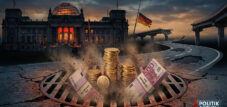
Cash Cow Bundestag: The tax-free expense allowance as an institutionalized privilege – Image: Xpert.Digital
Allowances, pensions, BahnCard 100: The lucrative system of quiet self-enrichment in parliament
While we have to account for every cent: The truth about politicians' allowances
Factor 53: Why politicians are drastically favored over employees when it comes to taxes
While ordinary employees in Germany must meticulously document every cent exceeding the standard deduction for work-related expenses of €1,230 to the tax office, the 630 members of the German Bundestag enjoy a privilege unparalleled in the working world. In addition to their already generous salaries – soon to exceed €12,000 – they receive over €65,000 annually as a tax-free expense allowance. The catch: not a single receipt needs to be submitted. Add to that a BahnCard 100 (a German rail pass), enormous staff budgets, and lucrative pension entitlements without any personal contributions, and a system of institutionalized self-enrichment is revealed. This massive inequality not only raises legal questions but, in times of growing political disillusionment, also significantly fuels the erosion of trust in democracy. A deep dive into a compensation model where parliament writes its own rules – at the expense of taxpayers.
Those who pay themselves pay well: On the quiet self-enrichment in parliamentary operations
The expense allowance for members of the German Bundestag is a tax construct whose generosity is unparalleled in German employment. While around 46 million employed people in Germany receive an annual employee allowance of €1,230, all 630 members of the German Bundestag receive, in addition to their parliamentary salaries, a tax-free expense allowance amounting to €65,607 per year. This is a ratio of more than 53 to 1 – and no political ideology is needed to recognize that fundamentally different standards are being applied here.
The remuneration model: per diems, flat rates and the addition of privileges
Basic salary and tax-free expense allowance: A dual system
The compensation for members of parliament, commonly referred to simply as "allowances," has been €11,833.47 gross per month since July 1, 2025, and is fully taxable. From July 1, 2026, this compensation will increase by approximately 4.2 percent to around €12,330 per month, as the adjustment is automatically linked to the nominal wage index of the Federal Statistical Office without the need for a parliamentary resolution. This increase corresponds to a rise of approximately €497 per month and thus exceeds the symbolic €12,000 mark for the first time.
In addition, there is a tax-free expense allowance, currently €5,467.27 per month, totaling €65,607 per year. According to the German Bundestag, this allowance is intended to cover expenses related to the mandate, including setting up and maintaining a constituency office, travel within the constituency, renting a second residence near the parliament building, and constituency support costs. The allowance is adjusted annually on January 1st to reflect the cost of living, thus increasing reliably and automatically.
Assuming an effective tax rate of 36 percent – which is realistic for an annual income of this magnitude – the net remuneration of parliamentary allowances results in a monthly payment of approximately €7,573. Together with the tax-free expense allowance of €5,467, a member of parliament receives at least €13,040 per month, without having to submit a single receipt, at least as far as the allowance is concerned.
The symbolic counter-calculation: 1,230 euros for everyone else
Different rules apply to the rest of the working population. The standard employee allowance, also known as the standard deduction for work-related expenses, has remained unchanged at €1,230 per year for all employees since 2023. This sum is automatically deducted from taxable income to cover work-related expenses. Employees who actually incur higher work-related expenses can itemize them and claim the additional amounts. This means that the average working person in Germany bears the burden of proof, while members of parliament receive a flat-rate allowance – and this allowance is 53 times higher.
The tax effect for the average taxpayer from the standard deduction for work-related expenses of €1,230 is modest: at a medium tax rate of approximately 30 to 35 percent, this results in tax savings of around €370 to €430 per year. In contrast, the standard deduction for members of parliament saves them between €19,000 and €23,000 in taxes at the same tax rate, which they would otherwise have to pay on this amount.
The office, the employees, the ticket: The invisible complete package
Personnel budget and benefits in kind: What else follows the lump sum?
The tax-free expense allowance is by no means the end of the list. Each member of the Bundestag also has €26,650 per month available for employing staff (as of April 1, 2025). This budget does not go to the member of parliament themselves, but is paid directly to the employees by the Bundestag administration. Any unused funds expire at the end of the year and remain in the federal budget. This brings the total personnel budget per member of parliament to €319,800 per year. According to the Bundestag, the 630 members of parliament employ a total of up to 5,000 staff members – an average of approximately eight employees per parliamentarian.
In addition, each member of parliament receives €12,000 annually for office supplies, software, technical equipment, mobile phones, and similar expenses, which are reimbursed upon presentation of individual receipts. The member's Berlin office, with an area of approximately 54 square meters, is fully furnished and maintained by the Bundestag. The 2026 budget allocates a total of €127.9 million for compensation, allowances, and expense reimbursements under the Members of Parliament Act, and a further €280.6 million for staff salaries.
Mobility without personal costs: BahnCard 100, flights and ride service
The mobility package completes the picture. All members of the Bundestag receive a Deutsche Bahn network ticket equivalent to a BahnCard 100, allowing them to travel on all domestic trains free of charge. The annual value of a first-class BahnCard 100 is €7,999. Domestic flights undertaken in connection with parliamentary business are also reimbursed. For longer international flights, the business class rule was relaxed again in September 2025 by the Council of Elders: Flights of two hours or more in the more expensive cabin are now permitted and reimbursable. This rule had previously been tightened to a minimum duration of four hours in April 2024 to reduce costs, but was relaxed again after less than a year and a half.
Furthermore, Members of Parliament have access to the German Bundestag's chauffeur service for journeys within Berlin. Federal ministers and other officeholders also receive personal official cars, in which case the allowance is reduced by a quarter.
The legal debate: Unequal or constitutional?
Lawsuits before the Federal Fiscal Court and the decision of the Federal Constitutional Court
The flat-rate expense allowance is not without controversy. For years, taxpayers have been attempting to challenge the unequal treatment through legal means. Several appeals have been brought before the Federal Fiscal Court (BFH), in which plaintiffs from various professional groups – including managing directors, lawyers, and judges – argued that they were being unfairly disadvantaged compared to members of parliament. In this context, the BFH even requested a statement from the Federal Ministry of Finance on constitutional issues, in particular whether the legislature assumed actual annual business expenses in the amount of the flat rate and on what empirical basis the amount was determined.
The Federal Constitutional Court ultimately declined to accept the constitutional complaints for review. In a ruling published in August 2010, the First Chamber of the Second Senate determined that the tax-free, lump-sum expense allowance for members of parliament was not, in principle, unconstitutional. The reasoning was that the special status of members of parliament justified this unequal treatment, as they are fundamentally free to decide how they exercise their mandate and bear sole responsibility to the electorate. Thus, those who are politically accountable may be privileged under tax law – a logic that holds up legally, but politically empowers a distinct class of elected officials.
The structural dilemma: Parliament regulates itself
The real problem lies not only in the amount of the allowance, but in the structure of the system. The allowance is regulated by the Members of Parliament Act, which is passed and amended by the German Bundestag itself. Furthermore, in 2014, the adjustment of parliamentary allowances was deliberately linked to an automatic mechanism – the nominal wage index – in order to circumvent the politically uncomfortable debates about salary increases. Since then, the allowances have increased automatically every year without requiring a vote by the members of parliament in plenary session. The result is an institutional architecture in which the controllers decide on the conditions under which their own remuneration is controlled – a classic conflict of interest.
It is permissible under constitutional law; from a democratic theory perspective, it remains unsatisfactory. The justification that individual verification for 630 members of parliament is too administratively burdensome sounds hollow in light of the fact that the same state administration routinely performs precisely this task for 46 million taxpayers – and for significantly smaller amounts involving far more complex circumstances.
Our EU and German expertise in business development, sales and marketing


Our EU and German expertise in business development, sales and marketing - Image: Xpert.Digital
Industry focus areas: B2B, digitalization (from AI to XR), mechanical engineering, logistics, renewable energies and industry
More information here:
A thematic hub offering insights and expertise:
- Knowledge platform covering global and regional economies, innovation and industry-specific trends
- A collection of analyses, insights, and background information from our key areas of focus
- A place for expertise and information on current developments in business and technology
- A hub for companies seeking information on markets, digitalization, and industry innovations
What a member of parliament really costs: The hidden items in the Bundestag budget
The fiscal dimension: What the taxpayer bears
Total costs per member of parliament: A calculation
If one adds up the various performance components, a cost framework per member of the Bundestag emerges, which is rarely considered in its entirety in public debate:
| Performance component | Amount per year (rounded) |
|---|---|
| Member of Parliament's compensation (gross allowances) | approximately 141,989 euros |
| Tax-free lump sum allowance | 65,607 euros |
| Employee budget | 319,800 euros |
| Office expenses flat rate | 12,000 euros |
| BahnCard 100 (1st class) | approximately 7,999 euros |
| Flight costs and shuttle service | variable, reimbursed by the Bundestag |
| Health insurance subsidy | approximately 4,900 euros |
Each member of parliament receives approximately €141,989 in gross parliamentary allowance (salary), a tax-free expense allowance of €65,607, a staff budget of €319,800, an office expense allowance of €12,000, a first-class rail pass (BahnCard 100) worth around €7,999, variable reimbursement of airfare and transportation costs, and a health insurance subsidy of approximately €4,900. The direct public costs per member of parliament thus amount to over €550,000 annually – excluding the proportional costs for the Bundestag as an institution, for parliamentary group financing, and for administrative expenses. The 2026 federal budget allocates a total of approximately €1.3 billion to the German Bundestag; in addition, the parliamentary groups receive €123 million from this budget to finance their political infrastructure and communications.
Retirement provision: Another silent privilege
Retirement provision deserves special attention. Members of the Bundestag do not pay contributions to the statutory pension insurance scheme, but they do acquire pension-like entitlements. For each year of membership in the Bundestag, a pension entitlement of 2.5 percent of their parliamentary allowance accrues, up to a maximum of 65 percent after 26 years of service. With current allowances of around €11,833, this corresponds to a pension entitlement of €295 per year of service. Someone who has served as a member of parliament for four years already has a monthly pension entitlement of around €1,183 – without having paid a single cent into the pension fund.
In contrast, the reality for average earners is quite different: The standard pension after 45 years of contributions with average earnings is currently around €1,620 gross per month in Germany. A member of parliament with four years of experience receives almost three-quarters of that amount without making any contributions to social security – and that's in addition to any private pension plans. The AfD and The Left Party have both submitted motions in the Bundestag to reform politicians' pensions, demanding their full integration into the statutory pension insurance system – with so far, limited prospects for implementation.
The problem of justice: Equal rules for unequal actors
Orwell's Axiom in Parliamentary Practice
In George Orwell's allegory "Animal Farm," the principle is: "All animals are equal, but some animals are more equal than others." This principle has a striking parallel in German tax and social security law. For employees, work-related expenses exceeding €1,230 must be itemized and documented down to the cent. For members of parliament, however, a tax-free lump sum of €65,607 is paid without any documentation because the administrative burden would be too high.
This asymmetry is not only quantitatively remarkable, but also structurally illuminating. It shows that German tax law does not adhere to the ability-to-pay principle in all areas, but rather gives leeway to institutional interests in certain areas. The Federation of Taxpayers has been pointing out for years that members of parliament whose constituency is in or around Berlin do not need a second residence and therefore have correspondingly lower expenses related to their mandate – yet they still receive the full allowance. What is not actually spent remains as tax-free income.
The transparency problem: Control without control
A key criticism of the flat-rate expense allowance is not only its amount, but its structural lack of transparency. Since no receipts are required, it is not publicly verifiable to what extent the allowance actually corresponds to expenses incurred in carrying out their mandate. Some members of parliament practice voluntary transparency and publish detailed statements of their income and expenses, but a systematic and mandatory accountability requirement does not exist. In an era where digitalization enables tax offices to process millions of tax assessments with complex issues automatically, the argument of administrative overhead appears anachronistic.
The social context: Trust as a scarce commodity
Political disaffection as an economic variable
The financial structures described do not exist in a vacuum. They coincide with a period of massive erosion of trust in the political system. According to a survey from March 2026, 56 percent of Germans have lost faith in politics – an increase of 14 percentage points compared to 2021. A survey by the Körber Foundation from 2025 shows that only 45 percent of Germans express great or very great trust in democracy, while 53 percent express little or no trust. An Ipsos poll revealed that 59 percent of Germans are convinced that traditional parties and politicians do not care about the concerns of the people.
These figures cannot be considered independently of the material privileges enjoyed by political elites. When a member of parliament sits in a business-class seat, paid for by the taxpayer, while that same taxpayer is stuck in traffic or traveling second class, a symbolic power arises that transcends monetary sums. The perceived imbalance between the privileges of the political class and the everyday experiences of the population is a significant driver of political disillusionment—and thus an economically relevant variable, since political instability and a loss of trust weaken, in the long run, the institutions that underpin the market economy and the rule of law.
Time economics: What distinguishes politics from the civil service
There is a valid point behind the argument for high parliamentary salaries: those who want to attract the best minds to parliament must offer competitive conditions. A management consultant, a doctor, or an engineer in a comparable position of responsibility often earns more in the private sector than a member of parliament – and that without the pressure of constant public scrutiny, the uncertainty of re-election, and 24/7 availability. These arguments should be taken seriously.
The problematic aspect, however, lies in the imbalance between the transparency requirement applied to all other income earners and the flat-rate compensation for elected officials. The question is not whether members of parliament should be paid appropriately—they should. The question is why a system that champions accountability and transparency abandons these very principles when it comes to its own remuneration. The more political energy is devoted to maintaining and expanding one's own privileges, the less remains for the very purpose of shaping policy that the mandate was granted in the first place.
Reform perspectives: What would be systemically necessary
Transparency as a first step
A reform of parliamentary compensation does not necessarily have to mean a reduction in the amounts. It could also work without any loss of income for MPs if it were based on the principle of actual expense reimbursement. Introducing a simplified, digitally supported documentation system – as already exists for employees – would increase tax fairness without impairing the functioning of parliament. Anything that cannot be verifiably spent should not be tax-free income.
Compulsory pension insurance as a requirement of symmetry
Equally urgent is the reform of the pension system. The fact that members of parliament, who are also legislators for the pension system, remain exempt from this system is a credibility problem of the first order. Motions from the AfD and the Left Party for full inclusion in the statutory pension insurance were referred to committee in the Bundestag – the standard parliamentary procedure for issues that tend to get bogged down in committee discussions.
Automatic adjustment: Elegance without control
The linking of allowances to the nominal wage index since 2016 is technically elegant: it removes salary increases from public debate and legitimizes them through a seemingly neutral mechanism. From an economic perspective, it makes sense to link salaries to inflation and wage developments in order to safeguard purchasing power. The problem lies in the lack of symmetry: if all employees had the same automatic purchasing power protection, there would be no basis for criticism. Since this is not the case, and the allowance is also indexed annually and independently, the inequality in treatment increases exponentially over time.
Economics and democracy in contradiction
The German system of remuneration for members of parliament is legally sound in its individual elements and has been repeatedly upheld in court. It is neither illegal nor unique in international comparison – parliamentary systems in other countries have similar structures. However, it is a system whose overall architecture works against the social acceptance that democratic institutions need to be effective.
The tax-free expense allowance of €65,607 per year, paid without any requirement to provide receipts, contrasts sharply with a flat-rate deduction for work-related expenses of €1,230, for which employees must provide proof of every cent if this allowance is exceeded. The annual employee budget of €319,800, the fully funded mobility infrastructure ranging from the BahnCard 100 (German Rail Pass) to business-class reimbursements, the office equipment at public expense, and the pension-like retirement benefits without social security contributions combine to create a picture of institutionalized self-enrichment that is difficult to reconcile with the principle of democratic equality.
A Bundestag that enjoys the trust of less than 50 percent of the population, a political system whose actors are perceived by 56 percent of citizens as not interested in their concerns, needs no further arguments as to why reform is necessary. The first step would be simple: those who demand transparency from society should start with themselves.