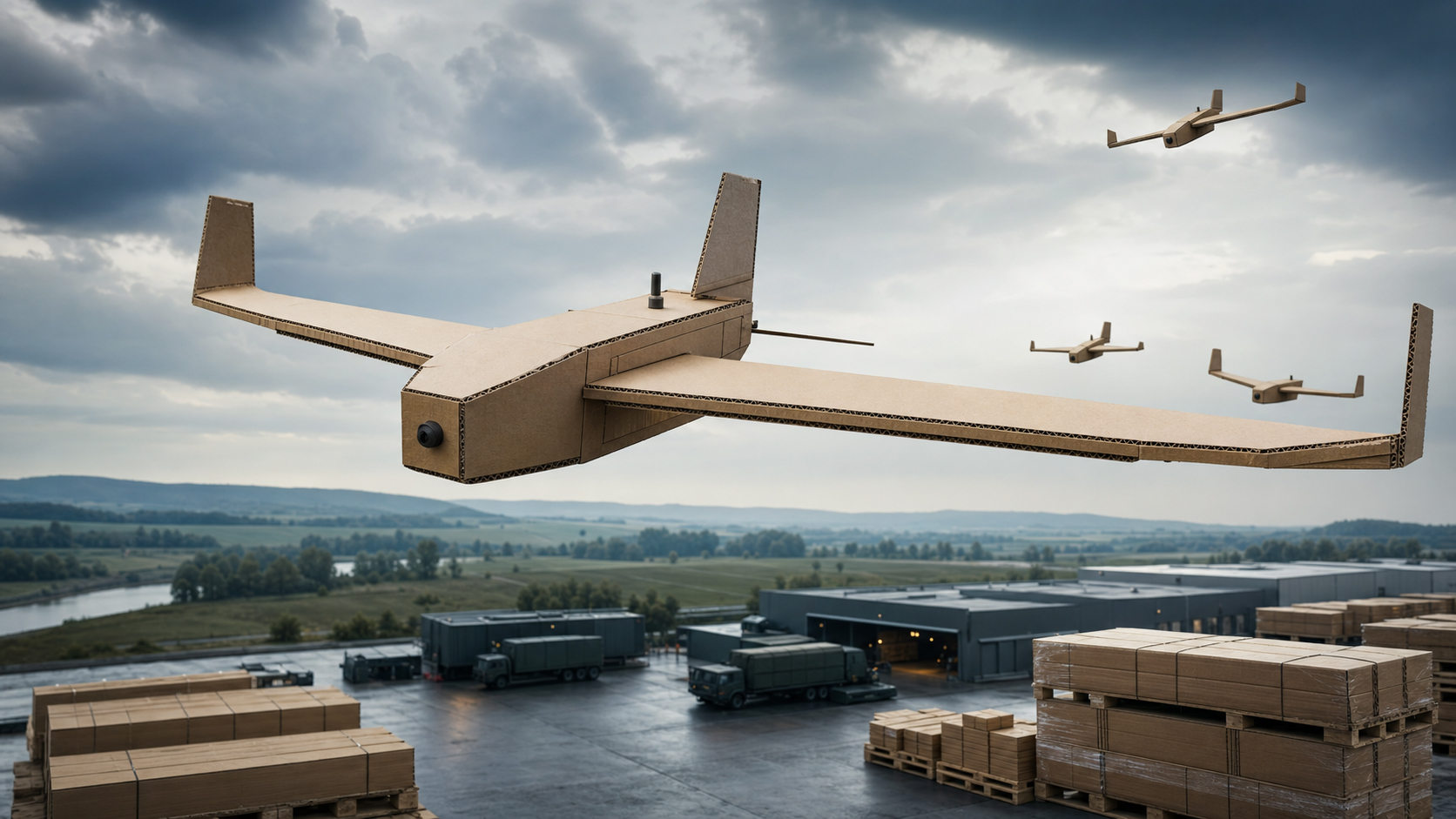
Cardboard drones versus high-tech: How simple AirKamuy 150 cardboard drones outsmart billion-dollar air defenses – Creative image on the topic, with AI: Xpert.Digital
Logistics miracle in a container: What Europe's arms industry needs to learn from the AirKamuy 150
Disposable weapons instead of luxury jets: The ingenious plan behind the new "flat-pack" strategy
Quantity over perfection: Why the future of the skies will be determined by cheap cardboard drones
Drones made of coated corrugated cardboard and simple foam board appear at first glance to be an improvised DIY project or a technical curiosity. But behind these unassuming "flat-pack" aircraft—such as the Australian Corvo system or the Japanese AirKamuy 150—lies one of the most radical developments in modern defense economics. While Western militaries relied for decades on multi-billion-dollar, highly complex, and long-lasting high-tech platforms, these cheap cardboard drones are now forcing a completely new paradigm. They are shifting the strategic focus from absolute peak performance to sheer industrial mass production, decentralized logistics, and asymmetric cost management. The simple yet highly effective logic: A system costing just a few thousand dollars is intended to serve as a consumable, tying up enemy anti-missile systems worth millions. Our comprehensive analysis shows why the industrialization of airspace consumption is turning global arms strategies upside down, why logistics from shipping containers is the real sensation, and what lessons Europe must learn from this development.
Cardboard drones are changing defense economics: The cheapest drone can force the most expensive defense decision
Cardboard drones may seem like a technological curiosity at first glance. In reality, they represent a fundamental economic shift in defense: military effectiveness is no longer solely determined by the most powerful, precise, and durable platform, but increasingly by the ability to deploy simple systems quickly, decentrally, in large numbers, and at reasonable costs. The cardboard drone is therefore less a replacement for high-quality military aircraft than a symbol of the industrialization of airspace consumption.
This topic deserves a sober assessment. Cardboard, foam board, wood, and simple plastics are not miracle materials. They have clear limitations in terms of weather resistance, durability, structural strength, sensor integration, and reusability. However, these very limitations can be economically acceptable under certain conditions. If an aircraft only needs to fulfill a one-off or short-term mission, its complete return, long service life, and maximum robustness may be less important than its price, availability, and ability to engage enemy systems.
The military value, therefore, does not stem solely from the cardboard material. It arises from a different production philosophy. The airframe is deliberately simplified, while the propulsion system, battery, control system, navigation, and any payload remain technically capable. This transforms the system into a modular, consumable item. Costs shift from a complex, aviation-certified product to a reusable core technical component and the most cost-effective, quickly replaceable outer shell possible.
This development does not only affect armed forces. It has consequences for industrial value creation, logistics, procurement policy, defense budgets, the role of medium-sized suppliers, and the cost-effectiveness of air defense systems. European states, in particular, face the question of whether they want to continue relying primarily on small production runs of very high-quality systems or whether they also need to develop a cost-effective, scalable, and expendable class of drones.
From aircraft logic to consumption logic
Traditional military aircraft operate on a high-capital-intensive logic. Development, testing, certification, material quality, electronic integration, training, and maintenance all incur high costs. This applies to fighter jets as well as many tactical reconnaissance drones. The economic justification is that an expensive system should complete as many missions as possible, remain operational for a long time, and offer high performance.
Cardboard drones partially reverse this assumption. They accept the loss of the airframe from the outset. A platform doesn't need to be maintainable for years if it's only intended to fulfill a single supply, reconnaissance, deception, or target simulation mission. The decisive metric is then no longer solely the purchase price, but the relationship between mission costs, production speed, availability, and expected impact.
The Australian Corvo Precision Payload Delivery System clearly demonstrates this concept. The platform is designed as a cost-effective, flat-packed system that can be assembled near the operational area. The airframe consists of a foldable foam panel, while the propulsion and avionics modules are reusable. The manufacturer specifies a payload of three kilograms, a range of 40 to 120 kilometers, and a flight time of one to three hours for the standard version. Assembly can take place in the operational area; after the autonomous mission, the airframe can be discarded.
Economically, this is a radical difference compared to a conventional military drone. Part of the system retains its value and is recovered whenever possible, while the bulky structure is intentionally designed as a cost-effective consumable. This not only reduces the material cost per unit but also lowers repair, storage, and return costs. This creates an advantage where returning an aircraft would be risky or uneconomical.
Publicly quoted prices for Corvo PPDS systems range roughly in the low four-figure range, depending on the configuration and quantity. Reports cite prices of approximately 1,000 to 5,000 Australian dollars or around 3,500 US dollars per unit. These variations demonstrate that actual prices depend heavily on batch size, payload, electronics, service, and procurement terms. Nevertheless, the scale is crucial: even at the higher end, such a system costs significantly less than many conventional military UAVs.
The economic relevance, therefore, lies not solely in absolute cost-effectiveness. It lies in repeatability. If an armed force can deploy a system hundreds or thousands of times without risking a high-value aircraft each time, the calculations change on both sides. The attacker or user calculates in terms of quantity. The defender, on the other hand, must decide whether to invest expensive sensors, personnel time, electronic countermeasures, or kinetic interceptors to defend against a very favorable target.
Japan is turning corrugated cardboard into an industrial strategy
The most prominent Japanese example at present is the AirKamuy 150. This fixed-wing UAV is primarily constructed from coated corrugated cardboard and transported flat-packed. Publicly available information indicates a unit price of approximately US$2,000 to US$3,000, an assembly time of about five minutes, speeds of up to 120 kilometers per hour, flight times of approximately 80 minutes to two hours, and ranges of around 80 to 150 kilometers. These variations are due to differing reports and likely variations in configuration.
Logistics is particularly relevant. Reports indicate that more than 500 units can be accommodated in a standard 20-foot container. This represents a significant difference compared to conventional fixed-wing UAVs, which require assembly, transport in special containers, or complex setup for operational readiness. Flat-pack capability reduces transport volume and facilitates the maintenance of decentralized inventory.
This is interesting for Japan's defense perspective for several reasons. Japan has a highly developed industry, but also geographical challenges. Long coastlines, island regions, maritime shipping lanes, and potential bottlenecks necessitate systems that can be deployed over long distances. Inexpensive, rapidly deployable aircraft could be attractive for reconnaissance, communications relay, deception, target simulation, or small-scale transport missions.
The AirKamuy 150 also demonstrates that the cardboard drone doesn't have to be merely an improvised emergency product. It can be designed as a deliberately engineered industrial product. Coated corrugated cardboard, standardized components, simple plug-in or glued connections, and modular avionics are not a step backward, but rather a different form of system design. The central question is not whether cardboard is inferior to carbon fiber or aluminum. It is whether the material used is sufficient for a defined mission.
This is precisely where the strategic provocation lies. High-quality Western defense systems are often optimized for reliability, longevity, and comprehensive performance. Cardboard drones, on the other hand, are optimized for sufficient performance at a minimal cost. Both approaches can be valid. The problem arises when one side possesses only a few high-quality systems, while the other side can deploy a large number of consumable, yet sufficiently powerful, platforms.
The price is not the whole bill
The statement that a cardboard drone costs only a few thousand dollars can be misleading when considered in isolation. The price of the drone itself is merely one item in a complex overall calculation. The real costs include development, testing, production facilities, batteries, motors, navigation modules, radio technology, software, payloads, training, storage, transport, launching devices, personnel, maintenance of ground stations, and, where applicable, satellite or radio communications.
Nevertheless, the low price of the airframe remains crucial. For drones that can be used sparingly, the user can shift the cost structure towards high-volume production. Expensive components are reused modularly wherever possible or reduced to a minimum of functionality. This improves scalability. A production line for folded or die-cut cardboard components has different requirements than the manufacturing of high-precision composite structures. It requires less specialized equipment, shorter processing times, and potentially a broader network of suppliers.
The decisive advantage, therefore, lies in industrial elasticity. A defense industry with only a few specialized production facilities can quickly reach its capacity limits under high demand. Production bottlenecks then arise with expensive sensors, engines, composite materials, and highly skilled personnel. With a simplified airframe, some of the capacity can be shifted to a broader industrial base. Cardboard processors, packaging manufacturers, printing and die-cutting companies, basic plastics processors, and regional assembly partners can generally be integrated more readily than those involved in the production of complex aircraft.
This doesn't mean that drone production can be improvised at will. The critical bottlenecks simply shift. Battery cells, navigation chips, radio modules, cameras, processors, secure software, and electric drives remain technologically demanding. Quality control also becomes crucial when hundreds or thousands of drones are expected to function reliably under variable weather conditions. The cardboard box is simple; system integration is not.
From an economic perspective, however, this creates a significant advantage. If the airframe represents only a small portion of the total costs and can be replaced if lost, the reuse of avionics and propulsion becomes attractive. The Corvo concept is precisely in this direction: the structural shell is designed for single use, while more valuable technology can be salvaged if necessary.
The asymmetric cost trap of air defense
Cardboard drones are not dangerous because they are particularly powerful. They are economically relevant because they can exacerbate an asymmetric cost problem. If an attacker deploys a platform costing a few thousand dollars and the defender responds with a much more expensive interceptor missile, an unfavorable cost exchange occurs. However, this effect is not automatic. It depends on which defensive measures are actually deployed and how reliably the threat is detected, classified, and countered.
A modern air defense system must first determine whether a target is harmless, militarily relevant, decoy, or part of a more complex attack. This decision consumes time, sensor power, and command and control capacity. Even if the actual defense is executed efficiently, the strain on radars, command centers, and readiness forces can be considerable. Cardboard drones can therefore serve as a testing and saturation element in a mixed threat scenario.
The greatest impact doesn't necessarily come from a single aircraft. It arises from the combination of different platforms. Some drones can carry sensors, others provide communication relays, and still others serve as decoys. Some can simply generate flight profiles that trigger enemy sensors. The Corvo PPDS-HL is explicitly positioned by the manufacturer for logistics, communication relays, reconnaissance, mapping, swarm operations, deception, and as a target platform for counter-UAS testing.
Economically, this means that the drone doesn't have to achieve a significant material impact every time. It can be sufficient to draw enemy attention, detect electromagnetic signatures, deter defensive capabilities, or consume expensive munitions. A seemingly simple aircraft can thus be integrated into a complex overall operation. Its military function then lies not only in what it carries, but also in the reactions it triggers in the enemy.
For defense planners, this has a clear consequence. Defending against cheap drones must not depend on permanently expensive, individual solutions. It requires a tiered cost architecture: inexpensive sensors for broad detection, electronic countermeasures, automated classification, mobile defense systems with low firing costs, passive protection measures, and, if necessary, kinetic systems for the most dangerous targets. The most economically viable defense is rarely the most expensive interceptor. It is the one that reliably prioritizes threats according to their severity.
Swarms as a business organizational problem
The term "swarm drone" is often associated with fully autonomous artificial intelligence. This is an oversimplification. A militarily relevant swarm can also consist of many units with only limited coordination. The crucial point is that the units together generate an effect that exceeds the value of individual platforms. This can be achieved through synchronized launches, different flight paths, distributed sensors, or a mix of real and deceptive payloads.
Cardboard drones are particularly suitable in this context because of their cost structure. An expensive drone is rarely used in large numbers as a consumable. A cheap, flat-packed platform, on the other hand, can be stockpiled in large quantities. This changes the planning. Instead of building each mission around a single, high-quality system, a military can consider many small systems as a distributed resource.
The practical limit lies in command and coordination. The more aircraft are deployed simultaneously, the more crucial precise scheduling, launch organization, collision avoidance, navigation, radio discipline, and the decoupling of data links become. A swarm doesn't necessarily require constant radio contact. Especially with simpler platforms, a pre-programmed route can be beneficial. This reduces the electromagnetic signature and susceptibility to interference. At the same time, it reduces the ability to react flexibly to unexpected events.
The economic question, therefore, is: What level of autonomy is truly necessary for which mission? Fully autonomous, adaptive systems with high-quality sensors and complex object recognition are expensive. Pre-programmed routes with simple navigation are significantly cheaper, but less flexible. For deception, radio relay, target simulation, or delivery to known coordinates, the simpler option may suffice. For dynamic reconnaissance or precision operations, the need for high-performance software and sensors increases.
A cost-effective swarm is therefore not primarily a hardware problem. It is a problem of system architecture. The cost-effective airframe can only realize its advantages if planning, communication, payloads, and resupply function effectively. In this respect, Western armed forces and industries will have to invest not only in drones, but also in digital mission planning, secure data infrastructures, simulation-based testing, and standardized interfaces.
Hub for Security and Defense - Advice and Information


Hub for Security and Defense - Image: Xpert.Digital
The Security and Defence Hub offers expert advice and up-to-date information to effectively support companies and organizations in strengthening their role in European security and defence policy. Working closely with the SME Connect Defence Working Group, it particularly promotes small and medium-sized enterprises (SMEs) that wish to further develop their innovative capacity and competitiveness in the defence sector. As a central point of contact, the Hub thus creates a crucial bridge between SMEs and European defence strategy.
Related to this:
Why logistics is more crucial than low unit price for cardboard drones
Weather limits the concept, but not its relevance
Cardboard drones in modern defense: Between strategic advantage and physical limits
The Achilles' heel of cardboard drones is clearly the weather. Corrugated cardboard and foam board are more susceptible to moisture, soaking, material fatigue, and long-term storage problems than high-quality composite materials. Coatings can improve resistance, but they don't eliminate the physical limitations. Operation in heavy rain, high humidity, ice, salty air, or strong gusts is more demanding than with more robust aircraft.
The AirKamuy 150 is said to have a water-repellent surface treatment. It is also reported to be operational in wind speeds of up to ten meters per second. This corresponds to approximately 36 kilometers per hour and is not a trivial value for a lightweight fixed-wing platform. However, this should not be interpreted as meaning that the system is fully all-weather capable. Publicly available data on long-term resistance to rain, high humidity, freeze-thaw cycles, or marine salt exposure is limited.
From an economic perspective, this doesn't automatically disqualify it. Many military and civilian operations are planned within specific meteorological timeframes anyway. If a cardboard drone functions reliably enough during a favorable weather window, its lower price can compensate for its reduced robustness. The user consciously accepts that the platform cannot handle all conditions. In return, they can maintain a larger number of units and more easily absorb losses.
The key factor is mission-related reliability. An expensive, reusable drone often needs to be available long-term and withstand numerous missions. A disposable platform only needs to meet defined flight time, range, and payload requirements. Under suitable conditions, this can be technically simpler and more economically efficient. However, under adverse conditions, the same platform can become disproportionately risky.
This results in a nuanced picture for European procurement policy. Cardboard drones should not be considered a universal solution for all operational environments. Their suitability depends on climate, operational duration, distance, payload, take-off and landing concept, and the accepted risk of failure. They can be attractive for dry or moderately humid periods, short-term missions, and decentralized deployment. For sustained maritime patrols, heavy rain, arctic conditions, or long-term operations, more robust platforms will continue to be superior.
Logistics is becoming the real competitive advantage
The most spectacular advantage of cardboard drones is perhaps not their low unit price, but their logistics. Traditional drone systems require protective containers, maintenance infrastructure, qualified personnel, spare parts, and sometimes elaborate runways. A flat-packed platform, on the other hand, can be transported in larger numbers, stored in depots, and assembled only near the deployment site.
This principle is particularly relevant when supply routes are vulnerable, congested, or extensive. Being able to pre-position a larger number of flat-packed airframes reduces dependence on individual central depots. Assembly shifts closer to the point of need. This increases reaction speed and makes it more difficult for adversaries to target a few critical logistics hubs.
AirKamuy-150's figure of more than 500 units per standard container illustrates the potential. Even if this number depends on the specific packaging, battery and payload separation, it demonstrates the scale. The aircraft are not transported as finished, bulky systems, but as flat structural components with separate technology.
This creates a new manufacturing model for European industries. Instead of operating a few large final assembly plants, modular production and assembly concepts could be established. Core technology could be developed and tested centrally, while airframes and simple assemblies could be produced regionally. This would shorten supply chains, facilitate scaling, and enable faster capacity expansion in the event of a crisis.
This decentralization also has disadvantages. It places higher demands on standardization, quality management, traceability, and cyber resilience. When many locations manufacture or assemble components, it must be ensured that dimensions, material properties, interfaces, and software versions remain consistent. Otherwise, the supposed scaling advantage risks turning into a quality problem.
The most economically viable solution likely lies in a modular system. Core components such as autopilot, navigation module, radio, power supply, and payload interfaces are standardized. Airframes and mission-specific superstructures can be manufactured regionally within clearly defined specifications. This combines industrial scaling with technical control.
The Ukrainian experience and its economic significance
The war in Ukraine has shown that simple drones are not merely fringe phenomena. They can be used extensively for reconnaissance, logistics, attack, deception, and target designation. In the context of the Corvo PPDS platform, its use in Ukraine has been publicly reported. Originally designed for the precise delivery of small payloads, the platform can be used in a variety of ways through different configurations.
The central economic lesson is not that every low-cost drone is automatically effective. It is that the ability to adapt quickly has become a strategic resource in its own right. A system that can be delivered as a flat kit, assembled on-site, and combined with different payloads has a different adaptation rhythm than a highly integrated platform with long procurement and certification cycles.
Under intense pressure, Ukraine has fostered a dynamic of innovation in which commercial technologies, simple components, and improvised adaptations play a significant role. This poses a challenge for established defense industries. Their processes are often geared towards long-term development programs, low production volumes, and stringent formal requirements. While these processes remain essential for complex systems, they are too slow when threats and countermeasures are changing on a monthly basis.
Cardboard drones fit into a different innovation culture. Their structure can be modified cost-effectively. Airframes can be adapted more quickly than highly complex composite structures. Payloads can be exchanged, launch procedures modified, and manufacturing processes scaled. Economic attractiveness increases when development times remain short and changes don't require a complete restart each time.
This also means that procurement authorities must adjust their evaluation criteria. Technical excellence alone should not be the deciding factor. Unit costs, time to operational readiness, monthly production capacity, maintenance requirements, spare parts dependency, supply chain risks, and adaptability are equally important. A drone with lower maximum performance can be strategically more valuable than a superior system that is only available in small quantities.
The limitations of cheap drones
A serious analysis must not overlook the limitations. Cardboard drones cannot replace high-performance reconnaissance drones with high-quality electro-optical sensors, long-range systems with satellite communication, heavy transport drones, or platforms for complex electronic warfare. Furthermore, the ability to navigate precisely under GPS interference, to maintain flight attitude in difficult weather conditions, and to land safely depends heavily on avionics and software, not on the airframe.
Furthermore, the cardboard structure is not necessarily invisible to radar. While non-metallic materials can reduce the radar signature under certain conditions, a flying object consists of more than just its outer shell. The motor, battery, cables, antennas, control surfaces, payload, and propeller still generate detectable features. Acoustic, optical, and infrared sensors can also be relevant. The claim that cardboard drones are inherently difficult to detect because of their material would therefore be an exaggeration.
Cost estimates should also be treated with caution. The price of a platform without high-quality payload or secure communication equipment says little about the total cost of a real mission. As soon as advanced cameras, encryption, jamming protection, precise sensors, or specialized payloads are integrated, the value per unit increases. Then the question becomes important whether the inexpensive airframe actually justifies the loss of the more expensive components.
Another limiting factor is production quality. A cardboard drone can be very inexpensive in small quantities. However, in large quantities, material tolerances, moisture protection, gluing, assembly errors, and quality control must be monitored. Scaling from hundreds to tens of thousands of units is not just a matter of the number of cardboard boxes. It's a matter of standardized processes, reliable electronics supply, software updates, and logistical discipline.
Europe's opportunity lies in its industrial breadth
Europe boasts a strong packaging, paper, mechanical engineering, electronics, and software industry. This creates excellent conditions for a distinct class of cost-effective, modular, fixed-wing UAVs. The advantage lies not in copying Japanese or Australian concepts, but in developing a European system portfolio tailored to its own geographical, regulatory, and industrial conditions.
Germany could contribute its strengths in automation, quality control, sensor technology, medium-sized manufacturing, and logistics software. The crucial task would be to transform a simple airframe into a scalable, robust, and interoperable overall system. This includes standardized payload interfaces, secure navigation alternatives, resilient radio links, data integration into command and control networks, and manufacturing that can be rapidly scaled up in a crisis.
A European concept should clearly distinguish three categories. First, it needs very affordable platforms for training, target simulation, basic reconnaissance, and deception. Second, it needs robust, weatherproof platforms for logistics, communication relays, and recurring missions. Third, it needs high-quality systems for complex sensors, long range, and demanding missions. The cardboard drone belongs primarily to the first category and partly to the second. It is not a substitute for the third.
The procurement approach should deliberately focus on quantity and testing. Instead of waiting years for perfect final solutions, larger pilot series would be more sensible. These should be tested under realistic conditions: rain, wind, cold, dust, malfunctions, transport, storage, and rapid assembly by personnel with varying levels of training. Crucial factors would include not only flight data, but also cost per available flight, failure rate, assembly time, container density, and the ability to quickly reconfigure the systems.
Industrial policy should also keep the critical components in mind. A cardboard shell can easily be produced in Europe. Battery cells, specialized semiconductors, secure radio modules, and optical sensors are more difficult to manufacture. A sustainable long-term strategy must therefore combine simple flight cells with a resilient European supply chain for core technical components. Otherwise, the inexpensive drone will remain dependent on global supply chains, which themselves could become a weak point in a crisis.
The economic outlook: Mass production becomes predictable again
Cardboard drones do not mark a transition to a completely new form of warfare. Rather, they accelerate a development that is already visible: air power is, in some respects, once again becoming a question of industrial scale. While high-quality platforms remain indispensable, a market is emerging for systems whose main advantage is not perfection, but availability.
The appeal of such systems is growing in an environment where traditional defense equipment has long procurement times, limited production capacities, and high unit prices. An affordable drone cannot solve all tasks, but it can fill gaps. It can equip units with an additional reconnaissance capability, extend communication ranges, simulate targets, transport supplies, or hamper enemy defenses.
The key economic question is not whether cardboard is a high-quality aerospace material. It isn't in the traditional sense. The key question is whether the combination of inexpensive material, modular technology, efficient logistics, and accepted dispensability generates more benefits than it incurs costs in a given application. In many scenarios, the answer is likely to be increasingly positive.
That's precisely why the cardboard drone isn't a mere footnote in defense technology. It's a litmus test for the ability of states and industries to balance peak performance with mass availability. Those who rely solely on expensive, individual systems risk low endurance. Those who focus solely on cheap mass production risk low reliability and limited effectiveness. The strategically sound solution lies in a tiered architecture where high-quality systems, robust, reusable platforms, and cost-effective, disposable drones work together in a targeted manner.
Cardboard won't win a war. But it can change the economic rules by which a war is waged, defended, and sustained.
Consulting - Planning - Implementation

Markus Becker
I would be happy to serve as your personal advisor.
Head of Business Development
Chairman SME Connect Defense Working Group
Consulting - Planning - Implementation
Konrad Wolfenstein
I would be happy to serve as your personal advisor.
You can contact me at wolfenstein∂xpert.digital or
Just call me on +49 7348 4088 965 .