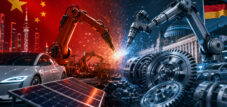
The 12 trillion dollar question: Can China escape the growth trap with "Industry 5.0"? – Creative image on the topic, with AI: Xpert.Digital
Overcapacity or stroke of genius? What's really behind China's gigantic industrial offensive?
China's industrial gamble: The transformation into a smart, green manufacturing powerhouse
AI, robots and green factories: China's radical master plan for a global industrial monopoly
China is preparing for an industrial transformation of historic proportions. With projected investments of around twelve trillion US dollars over the next ten years, the People's Republic aims to expand its role from the former "toolbox of the world" to the operating system of the global economy. The focus is no longer on sheer volume and cheap labor. The new goal is "Industry 5.0": a profound technological upgrade through artificial intelligence, advanced robotics, green energies, and seamless, digitally networked supply chains. But this gigantic gamble carries enormous risks. While Beijing is pushing for technological sovereignty, higher value creation, and immense productivity gains, it is simultaneously threatened by dangerous overcapacities, escalating international trade conflicts, and declining returns on capital. The following text analyzes in detail how China is reinventing its industry from the ground up, why the success of this strategy is by no means guaranteed, and what global upheavals this unprecedented investment supercycle could trigger.
Twelve trillion dollars – or the most expensive escape attempt from the growth trap
China is facing an industrial transformation of an extraordinary scale, even by the standards of the People's Republic. The focus is no longer solely on the ability to produce more goods at lower costs. Rather, the crucial question is whether it will succeed in elevating its already vast production base to a higher level of value creation through artificial intelligence, robotics, new materials, advanced semiconductors, industrial software, lower-emission energy, and tightly integrated supply chains. The frequently used term "Industry 5.0" is less a clearly defined official Chinese plan than an analytical code for the next stage of development: China aims to transform itself from the world's workshop into the operating system of global industry.
This perspective is economically plausible, but by no means guaranteed. China's strength lies in the combination of market size, industrial density, efficient infrastructure, high levels of investment, and a state capacity for long-term resource mobilization. The weakness of this same model is that while investment can be accelerated politically, profitable demand cannot be mandated to the same extent. Therefore, the announced or projected investment supercycle represents both an opportunity and a risk. It can increase productivity, technological sovereignty, and export capacity. However, it can also exacerbate overcapacity, price wars, capital misallocation, and international trade conflicts.
From investment boom to industrial system change
The oft-cited figure of twelve trillion US dollars does not represent a single government budget commitment. It is a model-based estimate of additional industrial investment that could be triggered between 2026 and 2035 by the transition to a smarter, more resilient, and technologically self-sufficient production structure. The total industrial capital expenditure during this period is projected to be significantly larger, at around 50 trillion US dollars, or approximately 340 trillion yuan. The twelve trillion dollars would therefore represent the additional investment associated with the new industrial development model, beyond the normal renewal and expansion of the capital stock.
The scale needs to be put into perspective. Spread over ten years, twelve trillion US dollars would equate to an average of 1.2 trillion US dollars per year. This wouldn't be an isolated stimulus package, but rather a long-term shift in capital allocation. Around 500 billion US dollars could flow into fundamental infrastructure such as data centers, AI computing power, power grids, storage, cooling, and digital networks. Approximately 5.5 trillion US dollars are earmarked for modernizing existing factories, including robotics, sensors, control technology, smart machines, and industrial software. A further six trillion US dollars could be used to build new capacity in strategic fields such as semiconductors, advanced materials, energy, mobility, and other future industries.
The economic logic behind this division is important. Infrastructure alone does not generate a productivity revolution. It merely creates the technological foundation on which companies can process data, network machines, and operate AI applications. The greatest immediate productivity effect is likely to result from modernizing existing facilities, because these already possess large production volumes, established supply chains, and experienced workforces. New capacities, on the other hand, are strategically important but carry the highest risk: If they are built in markets where demand is overestimated, oversupply, falling prices, and weak returns on investment will result.
The transformation is therefore more than a revival of classic industrialization. Previous phases of Chinese growth relied heavily on additional labor, additional capital, urbanization, infrastructure, and the relocation of production from industrialized countries. The new model must generate greater added value from data, technology, organizational quality, and more efficient use of existing resources. The decisive metric will no longer be the number of machines, but their networking, utilization, learning capacity, and flexibility. This represents the transition from extensive to more intensive growth: increased output should be achieved not only through greater input, but through higher productivity per unit employed.
Why Beijing is rearming right now
The timing is no coincidence. The Chinese real estate model has lost much of its former growth potential, local authorities are under financial pressure, and the aging population is limiting the labor supply in the long term. At the same time, export controls, sanctions, and geopolitical tensions are intensifying the incentive to develop critical technologies and industrial intermediates domestically. Advanced manufacturing is therefore intended to solve several problems simultaneously: it should create new demand for capital goods, increase productivity, reduce technological dependence, generate high-quality jobs, and secure China's position in global value chains.
This multifaceted function explains why industrial policy in China is not treated merely as sectoral economic development. It is simultaneously growth, security, employment, energy, and geopolitics. Semiconductors, robotics, batteries, new materials, aerospace, biotechnology, industrial AI, and modern power systems are not only considered profitable markets; they are understood as the infrastructure of national capability. From this perspective, an investment can be politically desirable even if its short-term private return is limited, provided it reduces import dependencies or creates strategic capabilities.
The 15th Five-Year Plan for 2026 to 2030 enshrines advanced manufacturing as the backbone of a modernized industrial system. It links the modernization of traditional industries with the development of new key industries and the widespread application of artificial intelligence. The Chinese strategy thus does not make a sharp distinction between old and new industries. Steel, chemicals, mechanical engineering, and shipbuilding are not simply to disappear, but rather to become more digital, automated, energy-efficient, and of higher quality. At the same time, semiconductors, robotics, advanced computer architectures, new energy systems, and future technologies are to grow more rapidly.
The starting point is enormous. According to calculations by the UN Industrial Development Organization, China accounted for 31.8 percent of global industrial value added in 2023, significantly more than the United States, Japan, or Germany. Within China, industrial manufacturing represented almost a quarter of the country's economic output in 2024. These two figures describe different aspects, but together they demonstrate the sector's extraordinary importance: China's economic model is heavily reliant on manufacturing, and it is also by far the world's largest industrial player.
Growth with higher technological density
The latest production data suggests that structural change has already begun. In 2025, the value added of Chinese industrial companies above the official size threshold increased by 5.9 percent. Equipment manufacturing grew by 9.2 percent and high-tech manufacturing by 9.4 percent. The production of 3D printers rose by 52.5 percent, that of industrial robots by 28 percent, and that of vehicles with new drive systems by 25.1 percent. Thus, those sectors that are central to the next stage of industrial development expanded particularly rapidly.
Research spending also underscores this ambition. In 2025, China spent approximately 3.92 trillion yuan on research and development, equivalent to roughly 2.8 percent of its economic output. For the first time, the share of basic research in total research and development expenditure exceeded seven percent. For a country whose rise was long characterized by the rapid adoption, adaptation, and scaling of existing technologies, this is an important signal. It indicates an attempt to create more original technologies rather than simply applying existing processes more cost-effectively.
Nevertheless, high growth in selected technology sectors should not be equated with overall economic productivity. A country can produce a great many robots, batteries, or solar panels and still suffer from declining returns on capital. The crucial factor is whether new technologies find widespread productive applications, whether inefficient companies are able to exit the market, and whether competition rewards innovation rather than mere capacity expansion. The success of Chinese industrial policy will therefore be measured less by production records than by sustainably higher margins, improved capital productivity, and increasing total factor productivity.
The factory becomes a learning platform
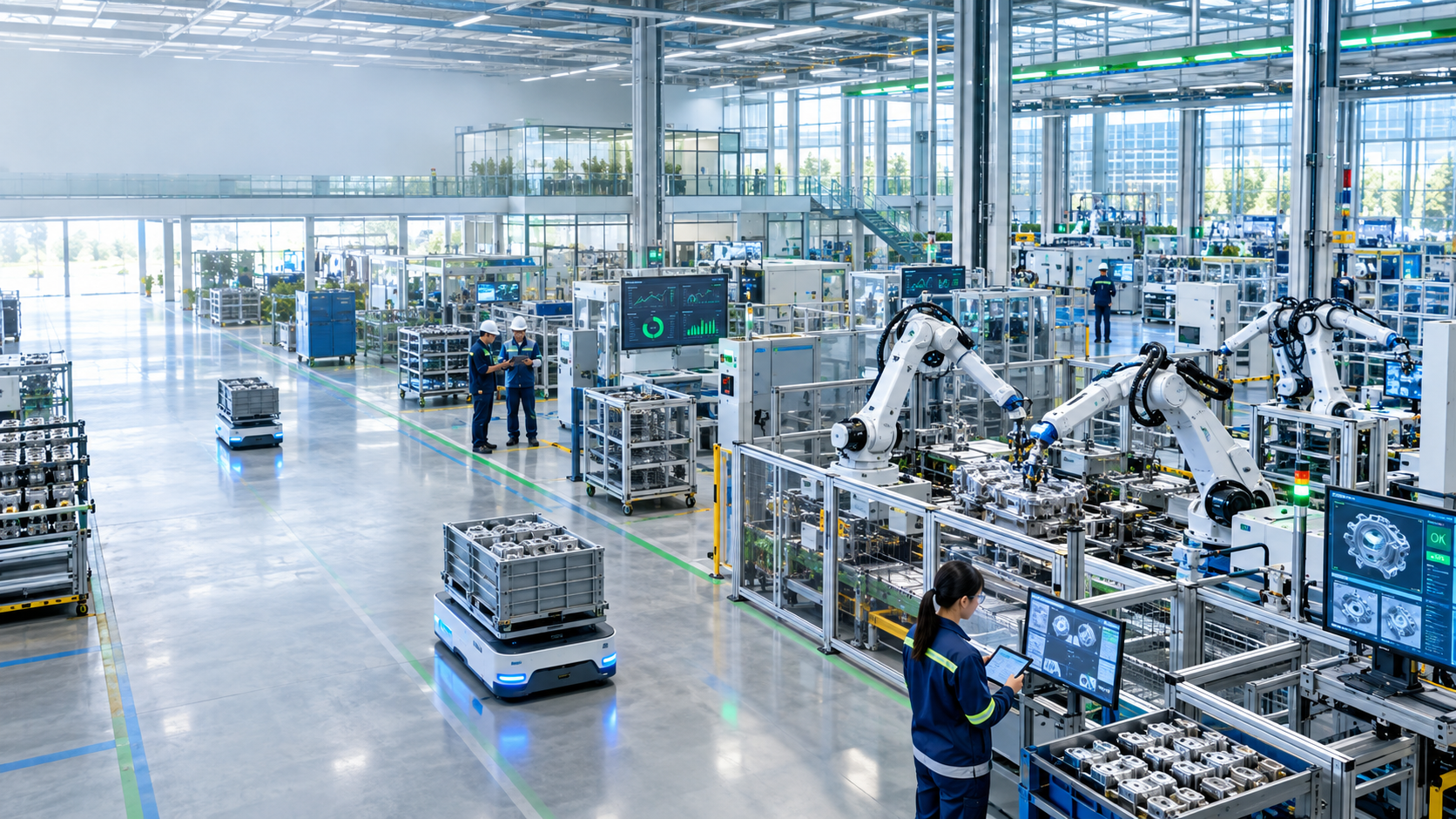
At the heart of the new manufacturing strategy lies the transformation of the factory from a sequence of individual machines into a data-driven, integrated system. Sensors record conditions and quality values, industrial networks connect systems, software digitally maps processes, and AI optimizes planning, maintenance, energy consumption, and material flows. Robots not only perform repeatable movements but also become more flexible through image processing, new gripping systems, and adaptive controls. The economic value arises from the interplay of these elements.
A common misconception is equating smart manufacturing with the highest possible level of automation. A fully automated system is not automatically economical. With frequently changing products, small batch sizes, or uncertain demand, flexible partial automation can be more advantageous than expensive, rigid full automation. Advanced manufacturing, therefore, means finding the most productive combination of people, machines, data, and organization. The best systems shorten changeover times, reduce scrap, detect errors earlier, and adapt production plans more quickly to changing orders.
China possesses a unique economies of scale for this transformation. Its dense industrial structure enables machine builders, software providers, component manufacturers, and end users to develop and rapidly test new solutions in close proximity. Feedback from production flows more quickly into product improvements. Large production volumes reduce costs and accelerate learning curves. The more widely Chinese suppliers deploy industrial hardware and software in their domestic market, the sooner they can develop standardized solutions for export.
This mechanism is already evident in robotics. In 2024, approximately 295,000 industrial robots were installed in China, representing 54 percent of all new installations worldwide. The operational stock exceeded two million units. For the first time, Chinese manufacturers, with a market share of 57 percent, delivered more robots to their domestic market than foreign suppliers. Just a few years ago, local suppliers lagged significantly behind. This development demonstrates how a very large user market can accelerate technological learning processes, price reductions, and the emergence of domestic suppliers.
Lighthouse factories as laboratories for scaling
The so-called lighthouse factories are showcase plants where technologies of the Fourth Industrial Revolution are deployed on a broad scale and with measurable results. Their value lies not in spectacular individual machines, but in demonstrating that digital solutions can simultaneously improve productivity, quality, delivery capability, and sustainability. They serve as demonstration plants, learning centers, and references for transferring these technologies to other factories. China now accounts for more than 40 percent of the sites in the World Economic Forum's global lighthouse network, thus possessing an exceptionally large group of such industrial pioneers.
This demonstration effect is particularly relevant for the Chinese economy. Alongside highly modern large corporations, the country has a vast number of small and medium-sized enterprises (SMEs) with widely varying levels of digitalization. A single leading factory has little impact on overall economic productivity. A broad effect only occurs when proven solutions are standardized, made more affordable, and accessible to smaller companies. The central challenge, therefore, is not to award ever more showcase facilities, but to transfer the processes developed there to tens of thousands of average factories.
China employs a tiered model for smart factories. By the end of 2025, there were more than 35,000 basic-level facilities, over 8,200 advanced factories, more than 500 plants at the excellence level, and 15 highly advanced pioneers. This classification provides guidance, can pool investments, and promote minimum technical standards. However, it also carries the risk that companies will optimize certifications and eligibility for subsidies without sufficiently improving the efficiency of their processes. Therefore, a credible assessment must be based on measurable results, such as productivity, scrap rate, energy consumption, throughput time, delivery reliability, and return on investment.
The flagship idea is only economically convincing if it doesn't stop at merely showcasing technical capabilities. A factory can be highly automated and still generate low profits if its products are interchangeable or the market is characterized by oversupply. Similarly, a digital platform can make processes transparent without correcting poor strategic decisions. Technology doesn't replace pricing power, customer proximity, or disciplined capital allocation. Rather, it increases the value of good business models while simultaneously accelerating the consequences of poor ones.
Green is production policy, not just climate policy
The green transformation of Chinese industry is often viewed primarily from a climate perspective. Economically, however, it is also a strategy for reducing energy and material costs, developing new export industries, and decreasing external dependencies. A factory that requires less electricity, water, and raw materials per unit improves its cost position. A company that digitally tracks energy consumption and emissions can optimize production processes more effectively and meet the stricter supply chain requirements of international customers.
China is therefore increasingly linking industrial digitalization with energy and resource efficiency. Intelligent controls can reduce peak loads, shift production steps to off-peak electricity times, make better use of waste heat, and identify maintenance needs early on. When factories are coupled with renewable energies, battery storage, and flexible grids, an integrated energy system is created. The factory then becomes not just an electricity consumer, but a controllable component of the energy market. This approach is particularly important because AI data centers, semiconductor manufacturing, battery cells, and new materials are sometimes very energy-intensive.
Between 2026 and 2030, China plans to build 500 carbon-free factories, among other things. At the same time, it intends to further develop AI standards, industrial networks, and smart manufacturing. This connection makes strategic sense: digitalization makes energy and material flows transparent, while decarbonization places new demands on control, storage, and production planning. Both developments reinforce each other, provided that reliable measurement methods, realistic energy balances, and transparent emission limits are used.
However, the term "green factory" alone is not proof of an overall low-emission value chain. Crucially, upstream materials, electricity generation, logistics, and subsequent use must also be considered. If energy-intensive intermediate products are merely outsourced, the individual plant's carbon footprint improves without a corresponding reduction in overall emissions. Similarly, more efficient production can lead to lower prices and higher sales, resulting in increased absolute resource consumption despite improved efficiency. A reliable assessment must therefore consider emissions per unit, absolute quantities, and the entire life cycle.
Integration as the actual source of power
The third pillar, alongside intelligence and ecological modernization, is integration. This refers to the connection of research, product development, manufacturing, energy, logistics, financing, and sales into a closely coordinated industrial ecosystem. China possesses an advantage here that is difficult to replicate: In numerous sectors, almost all stages of the value chain are located within the country or in closely integrated Asian production networks. This shortens delivery times, facilitates prototyping, and allows for rapid scaling up.
Integration increasingly means connecting different industries. An electric vehicle is simultaneously a mechanical engineering product, a battery application, a software platform, a data source, and a component of an energy system. A modern robot combines precision mechanics, power electronics, sensors, semiconductors, software, and AI models. Therefore, mastering individual components does not automatically mean controlling the entire system. China's goal is to develop as many of these layers as possible within its domestic ecosystems and to shape the interfaces itself.
This is precisely where the importance of industrial software lies. China is strong in many hardware sectors, but remains dependent on certain design, simulation, automation, and semiconductor design tools. As long as critical software, precision machinery, or high-performance chips have to be imported, a portion of the value chain and strategic control remains outside the country. Therefore, capital flows not only into visible factory equipment, but also into operating systems, development tools, data platforms, and standards.
The transition to a "global industrial operating system" would be achieved if Chinese companies not only exported products but also established entire production solutions, technical standards, financing models, maintenance networks, and supply chains abroad. Individual exporters would then become platform providers whose components and processes would be permanently integrated into the production structures of other countries. This would offer trading partners access to more affordable technologies and rapid industrialization. At the same time, it would increase their dependence on Chinese suppliers, spare parts, software updates, and financing.
Our China expertise in business development, sales and marketing

Our China expertise in business development, sales and marketing - Image: Xpert.Digital
Industry focus areas: B2B, digitalization (from AI to XR), mechanical engineering, logistics, renewable energies and industry
More information here:
A thematic hub offering insights and expertise:
- Knowledge platform covering global and regional economies, innovation and industry-specific trends
- A collection of analyses, insights, and background information from our key areas of focus
- A place for expertise and information on current developments in business and technology
- A hub for companies seeking information on markets, digitalization, and industry innovations
Overcapacities and their economic impact
Financing between patience and perverse incentives
An investment cycle of this magnitude requires an exceptionally robust financing architecture. In China, state-influenced banks, local governments, political funds, corporations, and capital markets each play distinct roles. For the projected cycle, bank loans are expected to provide the largest share, while corporate equity, government funds, and equity financing contribute the remainder. This model enables long-term projects and can stabilize investments even during periods of low private risk appetite.
The strength of long-term financing is also a source of potential misallocation. If loans are granted based on political priorities rather than realistic profit expectations, unprofitable capacity can persist for extended periods. Companies are then incentivized to pursue market share and production volumes more than returns. Local governments compete for factories, tax revenue, and prestigious future industries. As a result, several regions may promote similar projects, even though national demand only justifies a portion of the planned capacity.
The crucial question, therefore, is not whether China can mobilize twelve trillion US dollars. Given its high savings rate, state-controlled financial channels, and the size of its banking system, this seems fundamentally possible. The decisive factor is rather how disciplined the capital is in its deployment. Investments in bottlenecks, modernization, and productive infrastructure can generate high macroeconomic returns. Investments in already saturated markets, on the other hand, can destroy prices and profits, increase debt, and divert resources from more productive uses.
A sensible industrial policy therefore also requires exit mechanisms. Companies whose technologies are not competitive must be restructured or able to leave the market. Support programs should be time-limited, tied to verifiable performance indicators, and designed to be as technologically open as possible. The more political actors predetermine certain winners, the greater the risk that connections, size, and local interests will count for more than innovation and customer benefit.
The issue of overcapacity will determine success
The most vehement economic criticism of China's new industrial policy focuses on overcapacity. The International Monetary Fund already recorded an industrial capacity utilization rate of around 74 percent in 2024, compared to a pre-crisis average of 76.6 percent. At the same time, studies show that industrial policy instruments such as subsidies, tax breaks, cheap loans, and discounted land can promote misallocations. A recent model estimate puts the equivalent fiscal cost of these instruments at about four percent of economic output per year and the resulting loss in overall factor productivity at around 1.2 percent.
However, the problem requires a more nuanced perspective. Not all high capacity is overcapacity. Future markets require upfront investments, reserves, and learning opportunities before demand is fully developed. Western nations are also investing significant public funds in semiconductors, batteries, hydrogen, and clean technologies. Furthermore, economies of scale and intense competition can lower prices, accelerating the global adoption of these technologies. Affordable solar panels, batteries, and electric vehicles can accelerate the energy transition and deliver real benefits to consumers.
Overcapacity arises where supply cannot be sold at cost-covering prices on a sustained basis, and companies can only survive through continued subsidies. This risk is particularly evident in the battery and electromobility sectors. According to analyses, China's battery production capacity in 2024 was roughly twice that of domestic demand and even greater than global demand at the time. Such conditions lead to price wars, squeeze margins, and shift sales pressure to foreign markets.
The economic impact is ambivalent. Low prices force weak suppliers out of the market and accelerate innovation. However, if market exit remains politically blocked, the price decline continues without sufficient supply adjustment. Profits fall, investments become harder to refinance, and banks bear increasing risks. At the same time, trading partners react with tariffs, subsidy controls, and local production regulations. Industrial success in the domestic market can then generate a protectionist backlash that restricts access to international markets.
The question of returns behind the big numbers
Forecasts predicting that profit margins for Chinese industrial companies could increase from around five to eight percent by 2035 are based on a demanding assumption: that technology, market consolidation, and a more favorable product structure would have to dampen price wars more effectively than new capacities would intensify them. This is possible, but by no means a given. Automation reduces costs per unit. However, if all suppliers simultaneously cut costs and expand capacities, prices could fall even faster. The productivity gains would then go to customers, not manufacturers.
Higher margins therefore require differentiation. Companies must develop proprietary technologies, strong brands, software, services, data, or systems expertise that is difficult to copy. Sheer production scale offers only temporary protection in standardized markets. Areas that combine hardware and recurring digital services, such as predictive maintenance, factory control, industrial cloud services, or data-driven optimization, are particularly attractive. Here, providers can generate long-term revenue beyond the one-off sale of machinery.
Capital intensity must also be considered. A factory can increase its operating margin and still generate a disappointing return on capital if the necessary capital stock grows disproportionately. The relevant metric is therefore not just the profit margin, but the return on invested capital. An investment supercycle is successful when additional equipment sustainably generates more added value than the costs of financing, depreciation, energy, and maintenance.
For China, this represents a delicate balancing act. Too little investment would perpetuate technological bottlenecks and squander productivity opportunities. Too much investment would tie up scarce resources and create deflationary pressure. The optimal strategy lies neither in blanket expansion nor in a general withdrawal of the state, but rather in a more results-oriented allocation of capital. Competition, transparent data, insolvency, and open technological standards are just as important as subsidies.
Artificial intelligence is leaving the data center
The next stage in the development of industrial AI involves transferring digital models to physical processes. So far, public discourse has focused heavily on language models and data centers. In manufacturing, the greater long-term productivity impact may lie in less visible applications: automated quality inspection, maintenance prediction, process control, material development, production planning, digital twins, and autonomous logistics.
China has two advantages for this application level. First, its vast industrial base generates extensive process data and diverse application possibilities. Second, new solutions can quickly become more cost-effective through large-scale production. The government has therefore made "AI plus manufacturing" a priority and aims to deploy AI across research, development, production, quality control, operation, and maintenance. The new five-year plan also promotes AI agents, embodied intelligence, robotics, and smart devices.
Implementation is more demanding than with digital consumer applications. Errors in text output are annoying; errors in a production plant can endanger people, damage machines, or render entire batches unusable. Industrial AI therefore requires reliable data, traceable decisions, real-time capability, cybersecurity, and clear responsibilities. Many factories also have older machines from different manufacturers whose data formats and control systems are not readily compatible.
Therefore, the market will not be decided solely by the most powerful AI models. Successful providers will be those who combine models with sensors, controllers, machine knowledge, safety concepts, and workflows. Domain knowledge will become the bottleneck. Crucial innovation often arises not in the laboratory, but during the painstaking integration into existing production environments. China's large number of industrial deployment sites can generate a significant learning advantage here.
Automation as an answer to demographics
The aging of China's population increases the economic value of automation. As the number of available workers decreases and wages rise, replacing monotonous, dangerous, or physically demanding jobs becomes more attractive. Robotics is therefore not only a cost-cutting strategy but also a response to structural labor shortages. In certain scenarios, humanoid robots could compensate for a significant portion of the expected decline in the labor supply by 2035, although such forecasts are subject to considerable uncertainty.
Automation doesn't eliminate the need for skilled workers, but it changes it. Factories require fewer employees for simple, repetitive tasks, but more technicians, programmers, maintenance workers, data analysts, and process engineers. The bottleneck shifts from the number of hands to the quality of knowledge. Without further training, productivity gains can be accompanied by regional unemployment, skills mismatches, and social pressure.
For policymakers, this means that investments in machinery and software must be complemented by investments in people. Vocational schools, in-house training, and technical universities must be more closely aligned with the actual demands of modern factories. The qualification of older employees and those working in traditional industries is particularly important. Industrial transformation will be more socially acceptable if productivity gains not only benefit capital owners but also improve wages, job quality, and social security.
Global consequences of a Chinese supercycle
A Chinese investment cycle of this magnitude would have repercussions far beyond the country's borders. Manufacturers of machinery, sensors, semiconductors, automation technology, and specialty materials could benefit from increased demand, provided they retain access to the Chinese market. At the same time, China is becoming a direct competitor in more and more of these sectors. In the short term, this transformation could open up sales opportunities for foreign suppliers; in the long term, it could put pressure on their market share once Chinese alternatives become technically capable and more competitively priced.
This dual effect is crucial for Europe, and especially for Germany. German companies are traditionally strong in mechanical engineering, automation, industrial components, chemicals, and automotive technology. China's modernization is creating a large market for precisely these skills. At the same time, Chinese competitors are learning quickly, investing heavily, and benefiting from a larger domestic market. The old model of supplying high-quality capital goods to China and profiting from its industrial growth is therefore becoming less reliable.
European companies need a selective strategy. In sectors with technological advantages and close customer relationships, China can remain an important market. However, critical intellectual property, one-sided supply dependencies, and the possibility of politically enforced localization must be systematically assessed. Companies should not choose between complete withdrawal and unrestricted expansion, but rather differentiate products, technologies, and value chain steps according to strategic risk.
Emerging and developing countries also face opportunities and dependencies. Chinese companies can offer complete factories, energy plants, logistics systems, and financing from a single source. This accelerates industrialization and reduces entry costs. At the same time, a strong reliance on Chinese standards, software, and spare parts can limit technological autonomy. Recipient countries should therefore contractually secure local value creation, training, data sovereignty, and open interfaces.
Trade conflicts are becoming structural
The international tensions surrounding Chinese industrial capacity are not merely a temporary political dispute. They stem from a structural contradiction. China needs industrial expansion to support growth, employment, and technological security. At the same time, many trading partners want to protect their own future industries and reduce dependencies. If Chinese domestic demand fails to keep pace with its production potential, export pressure increases. Other countries then respond with tariffs, anti-subsidy proceedings, safety audits, and local development programs.
The debate should not, however, be reduced to a simple picture of state-subsidized dumping exports. The International Monetary Fund concludes that while subsidies in individual sectors can increase export volumes and crowd out imports, their impact on overall foreign trade is limited and not statistically uniform across all sectors. China's trade surpluses are also linked to high savings rates, weak consumption, investment patterns, and macroeconomic imbalances.
A lasting easing of tensions therefore requires more than trade barriers. China would need to strengthen private consumption, expand social security, facilitate market exits, and align capital allocation more closely with returns. Trading partners, in turn, would need to improve their own innovation and investment conditions instead of addressing competition problems solely through protectionism. Protective measures may be justified in strategic sectors, but they are no substitute for effective industrial policy.
What "Industry 5.0" actually needs to deliver
The term "Industry 5.0" should not obscure the fact that a large part of Chinese industry still has to overcome fundamental challenges in digitalization, standardization, and energy efficiency. There are significant differences between a state-of-the-art flagship factory and an average medium-sized supplier. Therefore, national economic success depends less on the technological excellence of individual plants than on the speed of widespread adoption.
Solutions must be affordable, interoperable, and easy to use. Small and medium-sized enterprises (SMEs) cannot finance complex systems with years of integration projects. What's needed are modular platforms, standardized interfaces, secure cloud and edge offerings, and service providers that combine technical modernization with process consulting. Access to financing must also be more strongly aligned with realistic productivity gains than with political slogans.
Secondly, industrial transformation must become resilient, not merely self-sufficient. Complete self-sufficiency in all technologies would be extremely expensive and stifle innovation. Resilience means understanding critical dependencies, developing alternative supply sources, maintaining reserves and backup solutions, and possessing domestic capabilities in key areas. International cooperation remains valuable nonetheless. The most efficient industrial ecosystems combine domestic expertise with access to global knowledge and competition.
Third, ecological modernization must go beyond certificates. Real savings in energy, materials, water, and emissions along the entire value chain are crucial. Fourth, labor productivity must increase without jeopardizing social stability. Fifth, capital must be more consistently reallocated between successful and unsuccessful companies. Only the interplay of these conditions transforms high investments into sustainable prosperity.
Between industrial dominance and declining returns on capital
The most likely outcome is neither an unqualified Chinese triumph nor a failure of the model. China is expected to further consolidate its leadership in numerous areas, including mass production, robotics, battery technology, solar technology, electric vehicles, and industrial scaling. While dependence on foreign suppliers will persist in selected key technologies, it will tend to decrease. At the same time, price wars and overcapacity will put many companies under pressure, forcing consolidation.
The investment supercycle will therefore not proceed smoothly. In the early years, capacity optimization, weak demand, and technological bottlenecks are likely to limit the pace. From 2028 onward, investment momentum could pick up as AI applications move from testing to widespread industrial use and domestic semiconductors, software, and automation solutions mature. Forecasts predict industrial investment growth of four to five percent in 2026 and 2027, followed by six to seven percent annually. However, these figures are scenarios and not certain outcomes.
The twelve trillion US dollars are therefore best understood as a measure of the scale of a potential transformation, not as a precise prediction. Whether this results in a productive supercycle or a new round of capital-intensive overexpansion depends on the quality of the investments. Robots, data centers, and new factories will only increase prosperity if they produce marketable products, greater efficiency, and sustainable returns.
China's strategic advantage lies in its ability to coordinate technology, production, infrastructure, and policy on a large scale. Its strategic risk lies in this same ability: if misconceptions are amplified centrally and multiplied regionally, errors can also reach enormous proportions. The coming decade will therefore not only show how much China can invest; it will show whether the country has learned to deploy capital more selectively, productively, and in a more market-oriented way.
The actual bet
Behind the industrial offensive lies a larger economic policy gamble. China is betting that technological productivity and new industries can compensate for the declining dynamism of real estate, demographics, and traditional infrastructure. At the same time, the leadership hopes to increase technological self-sufficiency without losing access to international markets and knowledge. These goals are compatible, but not automatically aligned.
Stronger domestic consumption would make the strategy more stable. If Chinese households spent a larger share of their income, new industrial capacity could be more strongly supported by the domestic market. This would reduce export pressure and trade conflicts. However, this would require far-reaching reforms in social security, income distribution, household registration, and local finance. Industrial policy alone cannot replace this macroeconomic reorientation.
The clear perspective, therefore, is this: China's investments in advanced manufacturing are neither mere propaganda nor a sure path to global industrial dominance. They represent a serious, and already tangible, attempt to place the world's largest manufacturing system on a new technological foundation. The potential is extraordinary because no other economy combines industrial scale, supply chain density, demand for robots, and state mobilization capacity in a comparable way. Equally extraordinary are the risks, because declining returns, overcapacity, weak consumption, and geopolitical backlash can be amplified precisely by this scale.
The decisive indicator for the coming years will therefore not be the number of new factories. What matters is whether each additional unit of capital generates more productive value, whether companies can earn sustainable profits despite tougher competition, and whether environmental and social costs actually decrease. Only then will China's twelve-trillion-dollar gamble become an industrial modernization that is more than just the most expensive leap forward in economic history.
🎯🎯🎯 Data-driven B2B industry hub as a quasi-in-house solution


The quasi-in-house solution: How Xpert.Digital closes operational gaps in B2B marketing and sales – Smart Content-Driven Business - Image: Xpert.Digital
Xpert.Digital is a data-driven B2B industry hub led by Konrad Wolfenstein . The company acts as an external, quasi-in-house solution for industrial partners, closing operational gaps in marketing, content, and sales – without requiring additional resources on the client side.
More information here:
Your global marketing and business development partner
☑️ Our business language is English or German
☑️ NEW: Correspondence in your native language!

Konrad Wolfenstein
I and my team are happy to be available to you as your personal advisor.
You can contact me by filling out the contact form here wolfenstein@xpert.digital:or simply call me at +49 7348 4088 965. My email address is
I'm looking forward to our joint project.