Business risk for companies: labor shortage, skills shortage and scarcity of young talent – data, facts & figures – Image: Xpert.Digital
🏭 Labor shortage or lack of cheap labor? Why the discussion in Germany is going the wrong way
💡 Labor shortage or a lack of cheap labor? Why the discussion in Germany is misguided. Energy and personnel costs are not only the highest expenses for companies, but also the most difficult to manage because high taxes cannot be offset.
🔍 A differentiated analysis of the causes and effects of the labor shortage
The debate surrounding the labor shortage in Germany is complex and often controversial. It revolves not only around a general lack of workers, but also touches upon deeper questions of wage policy, working conditions, and socioeconomic change within the German economy and society. A common argument is that the problem is not a shortage of workers per se, but rather a shortage of workers willing to work for the offered conditions. This discussion cannot be reduced to simplistic black-and-white thinking; it requires a nuanced examination of the causes, effects, and potential solutions.
🔍 The multidimensionality of the labor shortage
The perceived labor shortage is closely linked to the debate surrounding high energy and personnel costs in Germany. Business owners and trade associations regularly complain that these cost factors – exacerbated by high taxes and social security contributions – impair the competitiveness of German companies. However, it is important to understand that these costs cannot be considered in isolation. They are embedded in a comprehensive system of social security and environmental responsibility, designed for the long term, and whose restructuring could have far-reaching consequences.
🌐 The changing world of work
Digitalization and globalization have led to profound changes in the world of work. Work processes are increasingly automated and digitized, which on the one hand enables efficiency gains, but on the other hand also leads to uncertainty. Many employees are confronted with rapidly changing demands and must assert themselves in a labor market that is increasingly flexible and demanding. This dynamic leads to a discrepancy between the skills that employees possess and the demands of the labor market.
🎓 Education and further training as a key
A key challenge lies in designing the education and training system to meet the needs of a changing economy. Lifelong learning is increasingly becoming a necessity for remaining competitive in the job market. However, despite numerous efforts, significant gaps remain in the availability and accessibility of high-quality educational opportunities, particularly in technical and digital professions.
🌍 The role of immigration
Against the backdrop of demographic change, immigration is often discussed as a means of addressing labor shortages. Germany has made significant efforts in recent years to attract skilled workers from abroad. However, the integration of these workers presents its own challenges, particularly with regard to language acquisition and the recognition of foreign qualifications.
💼 Working conditions and wage policy
The discussion surrounding a shortage of cheap labor inevitably leads us to the question of working conditions and wage policy. In many sectors, employees are paid wages that barely cover their living expenses, resulting in precarious employment relationships. The call for higher wages and better working conditions is not only a matter of social justice but also of economic sense. A well-paid and motivated workforce is more productive and contributes to the long-term success of a company.
⚖️ The importance of flexibility and security
The 21st-century workplace demands a new understanding of flexibility and security. Employees are seeking ways to structure their work flexibly to better balance their professional and private lives. Companies must recognize that flexible work models, such as working from home or flexible working hours, not only meet the needs of their employees but can also contribute to increased productivity. At the same time, flexibility must not come at the expense of social security. Innovative models are needed that satisfy both demands.
🏢 Labor shortage in Germany
The debate surrounding the labor shortage in Germany and the associated challenges of energy and personnel costs requires a careful and multidimensional analysis. It is not only about the number of available workers, but also about the quality of jobs, the conditions under which these jobs are offered, and the ability of the economy and society to adapt to changing circumstances. Education and training, the integration of foreign workers, fair wages and good working conditions, as well as a balance between flexibility and security, are key elements that must be considered in this discussion. Only through the interplay of these factors can Germany meet the challenges of a changing world of work and create an economy that is sustainable, inclusive, and competitive.

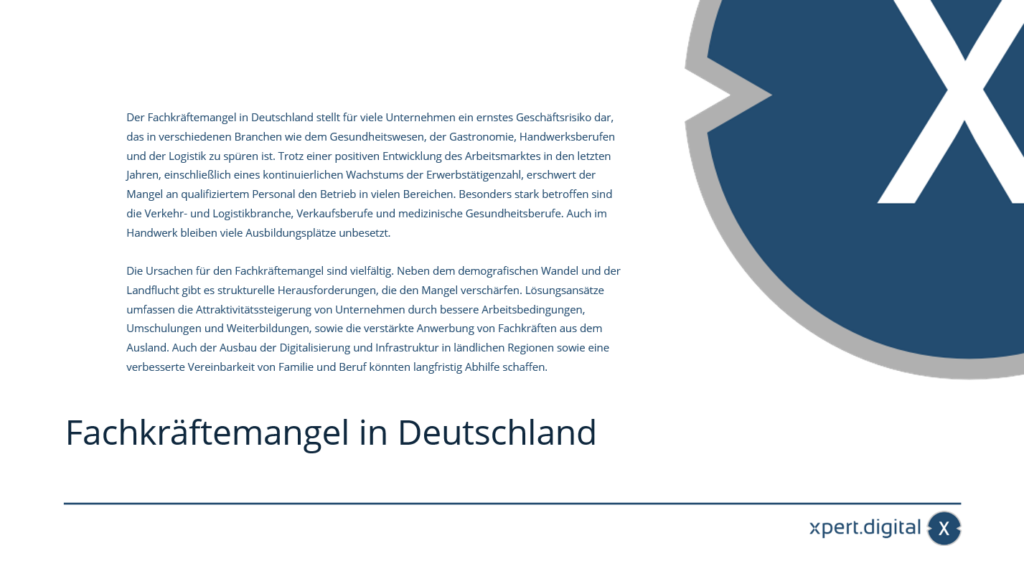
Skilled worker shortage in Germany – Image/PDF: Xpert.Digital
📣 Similar topics
- 🚀 Digitalization and the workforce: Opportunities and challenges
- 🏢 Businesses and the cost burden: Energy and personnel costs in focus
- 📈 Lifelong learning: Key to combating the skills shortage
- 🌍 Globalization and immigration: A look at the labor market
- 💼 Improving working conditions: For a sustainable economy
- 💰 Wage policy and social justice: Why fair wages are important
- 📊 Demographic change: Challenges and solutions
- 🧠 Continuing education in the digital age: Paths and opportunities
- 🔧 Automation and the labor market: Risks and opportunities
- 👨💼 Flexibility and security: A new working model
#️⃣ Hashtags: #LaborShortage #WagePolicy #FurtherEducation #Digitalization #Immigration
Our recommendation: 🌍 Limitless reach 🔗 Connected 🌐 Multilingual 💪 Sales power: 💡 Authentic with strategy 🚀 Innovation meets 🧠 Intuition


From local to global: SMEs conquer the world market with a clever strategy - Image: Xpert.Digital
In an era where a company's digital presence determines its success, the challenge lies in creating an authentic, personalized, and far-reaching presence. Xpert.Digital offers an innovative solution that positions itself as the intersection of an industry hub, a blog, and a brand ambassador. It combines the advantages of communication and sales channels in a single platform and enables publication in 18 different languages. Cooperation with partner portals and the ability to publish articles on Google News and a press distribution list with approximately 8,000 journalists and readers maximize the reach and visibility of the content. This represents a crucial factor in external sales and marketing (SMarketing).
More information here:
🚧 The battle for skilled workers: Impacts and solutions
📢 Skilled worker shortage in Germany: causes, effects and solutions
The shortage of skilled workers in Germany has become one of the most pressing challenges for the economy in recent years. This lack of qualified personnel affects many sectors and has far-reaching consequences for the economy and society. From the healthcare sector to skilled trades and logistics, many companies are struggling to fill vacancies, which is increasingly perceived as a serious business risk. Despite an overall positive development in the labor market and a rising number of employed people, the shortage of skilled workers is exacerbating the situation in many areas. Occupations in healthcare, skilled trades, and the transport and logistics sectors are particularly affected.
📉 The current situation on the labor market
The German economy recovered relatively quickly after the coronavirus crisis. In recent years, the number of employed people rose steadily, while the unemployment rate remained relatively stable until 2023, even though it recently increased slightly to 5.7 percent. Paradoxically, this positive development in the labor market presents an additional challenge for companies, as it makes it more difficult to find qualified personnel. The better the labor market situation, the harder it becomes to find suitable specialists, as the pool of available workers shrinks.
Some sectors are more severely affected than others. The demand for qualified professionals is particularly high in the transportation and logistics sector, in sales professions (e.g., retail), and in the medical field (e.g., nursing). The skilled trades are also suffering from a significant shortage of young talent. The number of unfilled apprenticeships reached almost 70,000 in 2022. The situation is especially dire in certain professions: In the fields of acting, dance, and movement arts, for example, employers had to wait an average of 293 days to fill a vacancy. In the construction industry, the average vacancy period is also well over 200 days.
📊 Causes of the skilled worker shortage
The reasons for the skills shortage are numerous and complex. One of the main causes is demographic change. The large baby boomer generation is increasingly retiring, while fewer young people are entering the labor market. Although the retirement age has been raised in recent years, a significant gap remains in many sectors because vacant positions cannot be fully filled.
Added to this is the rural exodus, which primarily affects rural regions. Young, well-educated people are increasingly moving to urban areas where they find better career opportunities and a higher quality of life. This creates shortages in rural regions, while competition for qualified personnel continues to intensify in cities.
Structural problems in the labor market further exacerbate the situation. Reconciling family and career remains a challenge, especially for women, who still shoulder the majority of childcare responsibilities. Consequently, the female employment rate is lower than that of men, representing untapped potential. Moreover, many jobs, particularly in the low-wage sector, are unattractive, resulting in a low number of applicants.
💼 Impact on the economy
The shortage of skilled workers is having a significant impact on the German economy. Many companies are forced to rethink their growth plans or postpone investments because they cannot find enough qualified personnel. In some cases, the lack of skilled workers even leads to businesses having to scale back operations or shut down entirely. Small and medium-sized enterprises (SMEs) are particularly affected, as they often lack the financial resources to invest in expensive recruitment measures or pay higher salaries.
The logistics sector, which plays a key role in the German economy, is suffering from a shortage of truck drivers and skilled warehouse workers. This leads to delivery delays and increased costs, which ultimately affect the entire economy. In the healthcare sector, the shortage of skilled workers has a direct impact on the quality of care. In nursing professions, where the staff shortage is particularly severe, existing employees can barely cope with the workload, resulting in increased workloads and a rise in sick leave.
The skilled trades are also severely affected. Many businesses can no longer process orders at their usual speed, leading to longer waiting times for customers. This not only damages customer trust in these businesses but also results in financial losses for the companies themselves.
🏋️♀️ Solutions to the skilled worker shortage
To counteract the skills shortage, both short-term and long-term measures are needed. One of the most important strategies is increasing the attractiveness of companies as employers. This includes financial incentives such as competitive salaries and bonuses, but also flexible working hours and the option to work from home. Younger employees, in particular, are increasingly valuing a healthy work-life balance and meaningful work.
Another approach is the targeted further training and retraining of workers. Particularly in professions with a high demand for skilled workers, retraining the unemployed or underemployed can be a solution. Programs that promote the transition from low-skilled jobs to professions with higher qualification requirements could help alleviate the skills shortage.
Recruiting skilled workers from abroad is another important measure. Germany has implemented various measures in recent years to facilitate the immigration of qualified workers. Nevertheless, the challenge remains not only to attract foreign skilled workers but also to integrate them in the long term. This requires not only adapting immigration laws but also reducing bureaucratic hurdles and promoting intercultural competence within companies.
In the long term, structural problems must be addressed to sustainably combat the skills shortage. Expanding digitalization and infrastructure in rural areas could help stop the exodus of young professionals and increase the attractiveness of these regions. Similarly, improved work-life balance could help integrate more women into the labor market and raise the employment rate.
Another important aspect is the promotion of STEM subjects (science, technology, engineering, and mathematics) in schools and universities. These fields are particularly affected by a shortage of skilled workers, even though they are crucial for the future of the German economy. Targeted educational programs and the promotion of girls and women in these fields could secure the next generation of talent and alleviate the shortage of skilled workers in these key areas.
🔍 Short-term solutions and long-term strategies
The skills shortage in Germany is a complex challenge that can only be overcome through a combination of different measures. Short-term solutions such as recruiting skilled workers from abroad and providing targeted training for the workforce are just as important as long-term strategies for improving work-life balance, promoting STEM subjects, and increasing the attractiveness of rural areas. Only through a coordinated approach can the skills shortage be overcome and the future viability of the German economy secured.
Overall, it is clear that the shortage of skilled workers is not just a problem for individual companies, but a challenge for society as a whole, which must be addressed jointly by politics, business, and society. Only in this way can Germany maintain its position as one of the world's leading economic nations in the long term.
📣 Similar topics
- 👥 Skilled worker shortage in Germany: causes, effects and solutions
- 📊 The current situation on the labor market
- 🔍 Causes of the skilled worker shortage
- 💹 Impact on the economy
- 🛠️ Solutions to the skilled worker shortage
- 📅 Short-term measures against the skilled worker shortage
- 🔧 Problems in rural regions: Rural exodus and its consequences
- 👩🏫 Work-life balance
- 🌎 Recruiting skilled workers from abroad
- 📚 Promoting STEM subjects: A key to combating the skills shortage
#️⃣ Hashtags: #skills shortage #labor market #economy #further education #migration
We are here for you - Consulting - Planning - Implementation - Project Management
☑️ SME support in strategy, consulting, planning and implementation
☑️ Creation or realignment of the digital strategy and digitization
☑️ Expansion and optimization of international sales processes
☑️ Global & Digital B2B trading platforms
☑️ Pioneer Business Development

Konrad Wolfenstein
I would be happy to serve as your personal advisor.
You can contact me by filling out the contact form below or simply call me on +49 7348 4088 965 .
I'm looking forward to our joint project.
Write to me


Xpert.Digital - Konrad Wolfenstein
Xpert.Digital is a hub for industry focusing on digitalization, mechanical engineering, logistics/intralogistics and photovoltaics.
With our 360° Business Development solution, we support renowned companies from new business to after-sales.
Market intelligence, smarketing, marketing automation, content development, PR, mail campaigns, personalized social media and lead nurturing are part of our digital tools.
You can find more information at: www.xpert.digital - www.xpert.solar - www.xpert.plus
Keep in touch