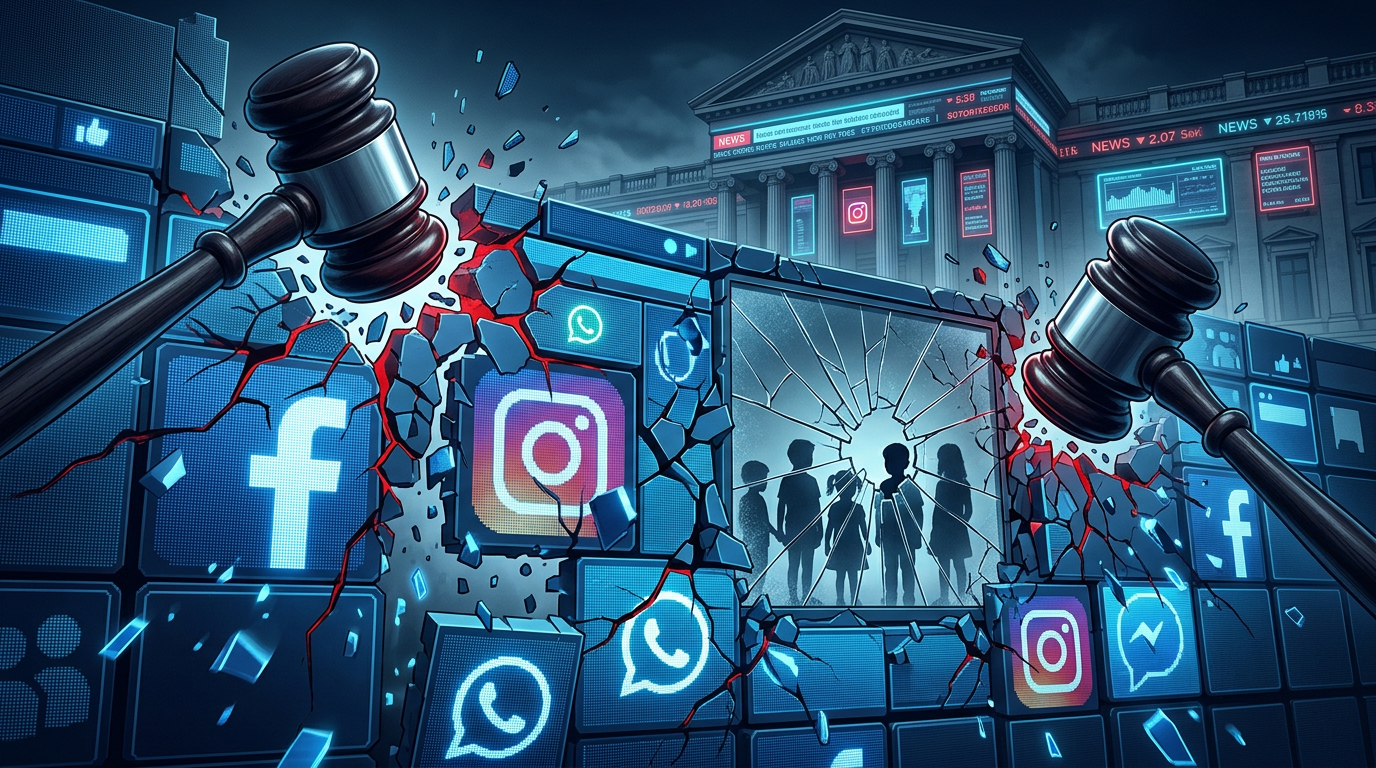
Lawsuits, debts, and AI bets: Is Meta's business model on the verge of collapse? – Image: Xpert.Digital
Historic rulings in the USA: Is Meta's algorithm bringing about the company's downfall?
A billion-dollar gamble on credit: Is Meta currently overplaying its hand with artificial intelligence?
375 million fine: Courts declare Meta's algorithm an illegal product for the first time
Tech giant Meta is at a historic turning point. Within just a few days, two landmark US court rulings have shaken the company's foundations: For the first time, the toxic, addictive architecture of platforms like Instagram has been legally classified as a product defect, for which the company is now expected to pay. While plaintiffs' lawyers are preparing thousands of further lawsuits and the European Union is threatening unprecedented billions in fines, CEO Mark Zuckerberg is embarking on the most expensive expansion in the company's history. With massive, debt-financed investments in artificial intelligence and a risky political rapprochement with Donald Trump, Meta is playing for time. But the era of digital impunity is irrevocably coming to an end – and the pressing question arises: Can the business model of unlimited attention exploitation even survive this decade?
Meta's moment of truth: Verdicts, AI bets, and the end of digital impunity
When a corporation is simultaneously fighting against children, courts, and the physics of money, it's no longer a crisis – it's a systemic failure
Within 48 hours in March 2026, two US jury verdicts were handed down that could fundamentally shake Meta Platforms' business model. A jury in New Mexico awarded the state $375 million in damages because, according to the jury, Meta knowingly exposed children to the risk of sexual exploitation and misled the public about the safety of its platforms. Simultaneously, a jury in Los Angeles found that Meta and Google's parent company, Alphabet, had used negligently implemented platform designs that led to a proven social media addiction with serious psychological consequences for a user who was a minor at the time. The jury awarded a total of $6 million – $4 million of which went to Meta. The financial damage is marginal for a company that generated $59.89 billion in revenue in the fourth quarter of 2025 alone. The legal symbolic impact, however, can hardly be overstated.
What the courts really decided
The New Mexico case was the result of a seven-week trial in which the court reviewed internal Meta documents and heard testimony from former employees. Their statements described a company that was aware of the dangers to minors on its platforms but failed to take any action. A former engineer described experiments in which underage Instagram users were deliberately exposed to sexually explicit content. New Mexico is thus the first US state to win a lawsuit against a major technology company over child protection issues. The verdict, based on the state's Unfair Practices Act, found that Meta intentionally made false or misleading statements about the safety of its platforms and knowingly employed "unscrupulous" business practices that exploited the inexperience and vulnerability of children.
The Los Angeles case is structurally different, but its significance as a precedent is potentially even greater. For the first time, a plaintiff in a social media addiction lawsuit has actually reached a jury verdict. This was possible because the presiding judge made a crucial preliminary decision: He refused to apply Section 230 of the Communications Decency Act as a shield of liability. This federal law, in effect since 1996, protects online platforms from civil liability for user-generated content—but not, as courts are increasingly distinguishing, for damages arising from the design of the platforms themselves. This means that algorithms, endless scrolling, notification loops, recommendation mechanisms—all elements that Meta intentionally and profitably developed—can now be legally prosecuted as product defects.
Related to this:


The avalanche has only just begun to roll
The real economic impact of these rulings lies not in the sums awarded, but in what follows. In California's coordinating trials for such cases alone, some 1,600 plaintiffs from over 350 families and 250 school districts are involved. Nationwide, more than 2,400 lawsuits are pending against Meta and other platform operators making similar allegations. These trials were deliberately designed as "bellwether trials": test cases whose outcomes determine how the thousands of pending follow-up lawsuits will be assessed. Plaintiffs' lawyers adopted this strategy from tobacco and opioid litigation, and with a remarkable parallel: In both industries, decades passed before courts condemned "systemic corporate conduct"—and when the dam finally broke, the extent of liability was existential.
More than 40 state attorneys general have already filed their own lawsuits against Meta, all targeting the same fundamental allegation: knowingly enabling an addictive architecture at the expense of underage users. Even if Meta appeals all rulings and utilizes lengthy appeals processes, the company will remain under constant legal and financial attack. Reputational damage, rising legal costs, and the renewed media attention surrounding the corporation triggered by each new verdict will inevitably impact user trust and advertising revenue.
A decade of looking the other way
It would be wrong to portray the verdicts as a surprise. What the juries in New Mexico and Los Angeles received as the basis for their decisions had essentially been known for years – initially as research findings by journalists and academics, and then, from 2021 onward, as documented internal corporate self-incrimination through the revelations of whistleblower Frances Haugen. The so-called "Facebook Papers" showed that Meta's own research department had documented significant harm caused by Instagram to the body image and mental health of teenage girls – and that management treated these findings not as a reason for platform reform, but as a risk management problem. The fact that it took ten years for a jury to rule against Meta for the first time in such a case is less a sign of the resilience of the corporate model than evidence of the efficiency with which corporate interests can delay the legal process.
Our US expertise in business development, sales and marketing


Our US expertise in business development, sales and marketing - Image: Xpert.Digital
Industry focus areas: B2B, digitalization (from AI to XR), mechanical engineering, logistics, renewable energies and industry
More information here:
A thematic hub offering insights and expertise:
- Knowledge platform covering global and regional economies, innovation and industry-specific trends
- A collection of analyses, insights, and background information from our key areas of focus
- A place for expertise and information on current developments in business and technology
- A hub for companies seeking information on markets, digitalization, and industry innovations
Meta under fire: How EU penalties and US rulings are shaking the empire
The EU flank: Regulators as a second front
In parallel with the US legal proceedings, the European Commission tightened the screws. In April 2025, it fined Meta €200 million – the first fine ever issued under the Digital Markets Act (DMA). The violation concerned Article 5 of the DMA: Meta had failed to offer its users a genuine, equal choice between personalized, data-driven advertising and a privacy-compliant alternative. Later that same year, the Commission warned that continued violations could result in daily fines of up to five percent of global daily revenue – at the revenue levels then in effect, a theoretical daily loss of over €27 million. While a provisional agreement for less personalized advertising was reached at the end of 2025, EU regulators have made it unequivocally clear that they consider Meta a systemically violating company. The American rulings are likely to serve as a blueprint for subsequent European lawsuits and increase political pressure on national regulators to initiate similar proceedings.
Related to this:

The cartel case: victory or postponement?
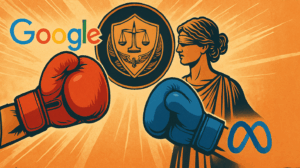
For a moment, it seemed as if Meta might be able to close one of its looming fronts. In November 2025, US District Judge James Boasberg ruled that the Federal Trade Commission (FTC) had not sufficiently proven that Meta still held a monopoly in the social networking market at the time of the ruling. The main argument: The rise of TikTok and YouTube as serious competitors had rendered the original grounds for the lawsuit from 2020 obsolete. The judge sharply criticized the FTC for ignoring these developments in its reasoning. The ruling prevented Meta from having to divest itself of Instagram and WhatsApp—a measure that, according to estimates, would have wiped out up to 50 percent of the company's revenue, since Instagram alone contributes roughly half of its advertising revenue.
But the victory is not final. In January 2026, the FTC filed an appeal. The case now moves to the next instance, with an uncertain outcome. Moreover, the political context has complicated matters: Zuckerberg's highly publicized rapprochement with the Trump administration—a $25 million settlement in a Trump lawsuit, a multi-million dollar contribution to Trump's inauguration fund, the removal of fact-checking on Facebook and Instagram—has temporarily relieved regulatory pressure from Washington. But it has also created a dangerous dependence on political favor, which could suddenly become a liability if the political landscape changes.
The AI gamble: Growth on credit or the future of the corporation?
Amid all this legal turmoil, Meta is forging ahead into the most expensive expansion phase in its history. The company plans to spend between $115 billion and $135 billion on capital expenditures in 2026—a 73 percent increase over the already record-breaking $72 billion of the previous year. The lion's share will go toward building AI data centers, recruiting top AI researchers, and developing what Zuckerberg calls "superintelligence for everyone." In parallel, it has signed a five-year, $60 billion chip supply contract with AMD, and Meta is reportedly in talks to use Google's TPUs for AI tasks.
The strategic rationale behind this bet is clear: Meta's advertising business—which accounts for 97.7 percent of the company's revenue—benefits directly from AI-powered targeting algorithms. The annual run rate of its fully AI-integrated advertising tools exceeded $60 billion by the end of the third quarter of 2025. At the same time, with total revenue projected at $201 billion in 2025 and an operating margin that has expanded to over 42 percent, Meta has an exceptionally solid earnings foundation.
Nevertheless, the risks are considerable. Meta has transformed its former net cash position of around $30 billion (2023) into net debt of $7 billion. The question of whether the massive AI spending can be sufficiently monetized is a major concern for investors – the 12.3 percent drop in the share price following the announcement of the capital expenditure plan in October 2025 served as a warning signal. According to a Deutsche Bank survey, 57 percent of the investors polled consider an AI valuation slump to be the biggest market risk of 2026. For Meta, which has committed itself to AI-driven growth more than almost any other company, such a scenario would be doubly dangerous: it would simultaneously slow revenue growth and force write-downs on multi-billion-dollar infrastructure investments.
The business model under scrutiny
The fundamental question that unites all these developments is: Is Meta's business model, in its current form, sustainable? This model is based on a single principle: generating maximum attention from as many users as possible for as long as possible and monetizing this attention as advertising space. The more effectively the platform's design engages users, the higher the advertising revenue. It is precisely this mechanism that has now become the subject of legal action.
The Los Angeles ruling is of particular significance: The court allowed the lawsuit despite Section 230 because it classified Meta's design decisions—algorithms, autoplay, "infinite scroll," notification optimization—as product liability-relevant actions of the company itself, not as a reaction to user-generated content. If this legal interpretation is upheld by the appellate courts and potentially confirmed by the Supreme Court, not only will thousands more lawsuits be pending, but the foundations of the entire digital advertising industry will be shaken. Targeted, attention-optimized design could thus become an unlawful act—with liability consequences that would fundamentally impact a company's bottom line more than any fine from the European Commission.
Between war chest and structural change
Meta is not finished. The company has substantial financial resources, a dominant global user ecosystem, and the political backing of the current US administration. However, the convergence of several structural burdens—ongoing and escalating legal battles, a regulatory tug-of-war with the EU, massive AI investments with uncertain returns, and a core business model increasingly subject to legal challenges—paints a picture that cannot be dismissed by simply pointing to short-term quarterly results.
The relevant question is not a binary one: Meta will not disappear. But it is plausible that the Meta of 2030 will be a fundamentally different company than the one of today. This could be due to a forced overhaul of its platform designs as a result of court orders, a spin-off from Instagram or WhatsApp ultimately forced in the appeals courts, an AI valuation shock that permanently compresses the share price and investment value – or a combination of all these factors. The digital impunity on which Meta's rise to one of the world's most valuable companies was based came to a partial end in the courtrooms of Santa Fe and Los Angeles in March 2026.
Your global marketing and business development partner
☑️ Our business language is English or German
☑️ NEW: Correspondence in your native language!

Konrad Wolfenstein
I and my team are happy to be available to you as your personal advisor.
You can contact me by filling out the contact form here wolfenstein@xpert.digital:or simply call me at +49 7348 4088 965. My email address is
I'm looking forward to our joint project.
☑️ SME support in strategy, consulting, planning and implementation
☑️ Creation or realignment of the digital strategy and digitization
☑️ Expansion and optimization of international sales processes
☑️ Global & Digital B2B trading platforms
☑️ Pioneer Business Development / Marketing / PR / Trade Fairs
🎯🎯🎯 Data-driven B2B industry hub as a quasi-in-house solution


The quasi-in-house solution: How Xpert.Digital closes operational gaps in B2B marketing and sales – Smart Content-Driven Business - Image: Xpert.Digital
Xpert.Digital is a data-driven B2B industry hub led by Konrad Wolfenstein . The company acts as an external, quasi-in-house solution for industrial partners, closing operational gaps in marketing, content, and sales – without requiring additional resources on the client side.
More information here: