
Building permit requirement? Whether carport or solar carport – in principle subject to approval, but not always necessary!

Language selection 📢
Published on: November 20, 2024 / Update from: November 20, 2024 - Author: Konrad Wolfenstein
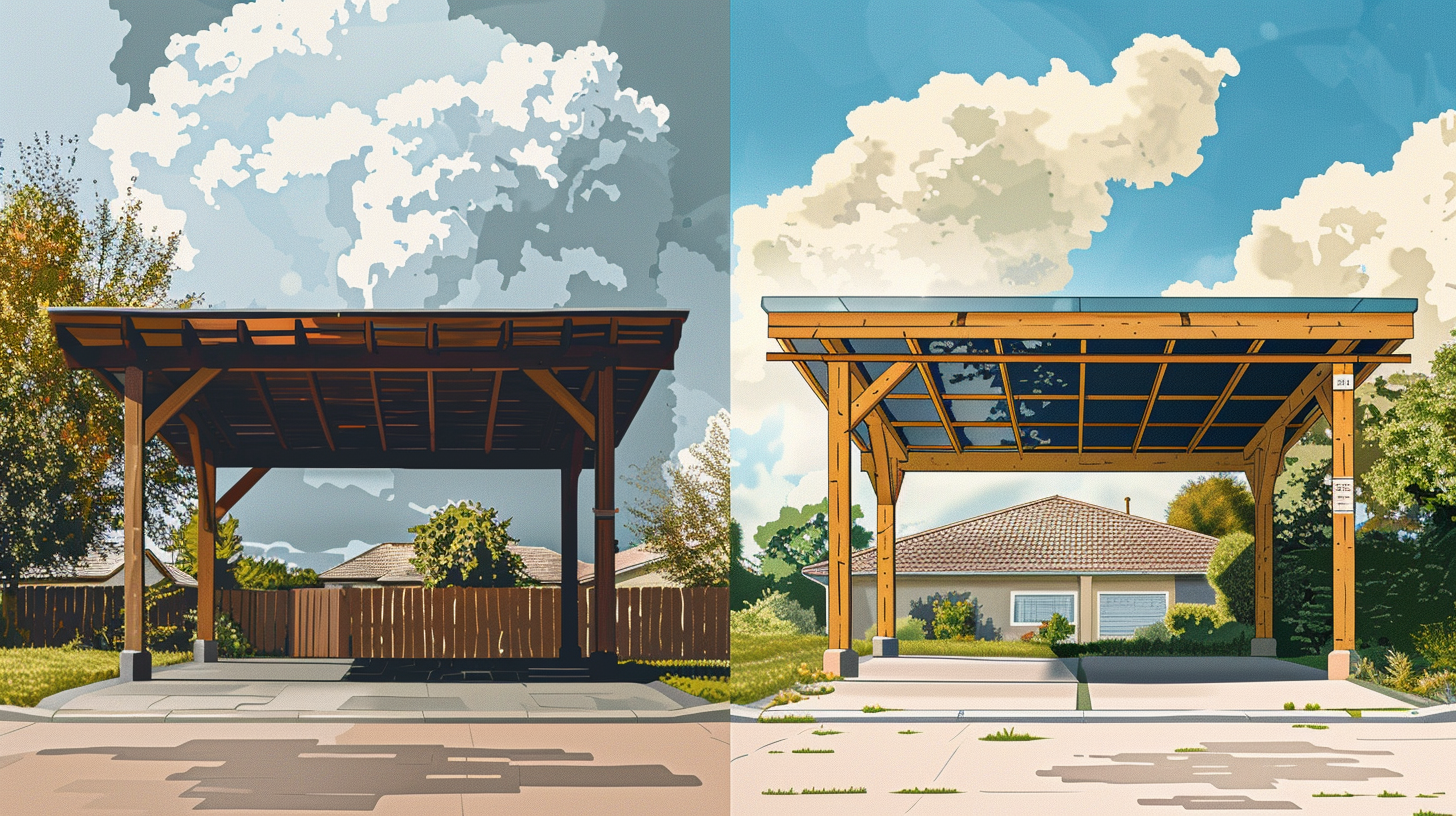
Building permit requirement? Whether carport or solar carport – in principle subject to approval, but not always necessary! – Image: Xpert.Digital
🚗🏠 Building permits for carports in Germany: What you need to know
🌍🔋 Building a carport is a practical solution to protect vehicles from the elements. However, before you start planning, it is essential to find out about the legal requirements. In Germany, carports are considered structural structures and their construction is subject to certain regulations that vary depending on the federal state. This guide provides you with a comprehensive overview of the most important aspects of building a carport.
📄 Permit requirement: When is a building permit required?
In principle, carports require approval because they represent a permanent structural change. However, there are exceptions in many federal states that allow for freedom from approval under certain conditions. These exceptions often relate to:
- Size of the carport: Many federal states allow carports of up to a certain area without approval, usually between 30 and 50 square meters.
- Height of the carport: A maximum height of 3 meters is often specified.
- Distance areas: Maintaining certain distances from property boundaries is crucial.
It is essential to check with the responsible building authority or building authority in your municipality whether a permit is required for your planned project. The regulations are not uniform nationwide and can even vary from municipality to municipality within a federal state.
📜 Different regulations in the federal states
Since building regulations are a matter for the states, there is no uniform regulation for the whole of Germany. Here are some examples:
- Baden-Württemberg: Carports up to a size of 40 m² do not require approval (Section 50 Paragraph 1 LBO).
- Bavaria: Freedom from approval for carports with a floor area of up to 50 m², provided they meet certain conditions (Art. 57 Para. 1 No. 1b BayBO).
- Berlin: A building permit is usually required here (§ 62 BauOBln).
- North Rhine-Westphalia: Carports with a floor area of up to 30 m² and an average wall height of 3 m do not require approval (§ 62 BauO NRW).
📏 Distance regulations and border development
Regardless of the approval requirement, the distance areas must be adhered to. These are regulated in the respective state building regulations and serve to protect fire and protect privacy. As a rule:
- Minimum distance: Often at least 3 meters to the neighboring property.
- Border development: Under certain conditions, a carport can be built directly on the property boundary, for example if the wall facing the neighbor is fireproof or the neighbor has consented.
It is advisable to talk to your neighbors and obtain a written declaration of consent in order to avoid later disputes.
💰 Costs for the building application
If a building permit is required, various costs arise:
- Field map and site plan: A current extract costs between 15 and 30 euros.
- Administrative fees: Depending on the federal state and municipality, these vary between 50 and 200 euros.
- Planning documents: Construction drawings and static calculations can cost a further 200 to 500 euros, especially if an architect or engineer is commissioned.
Overall, you should expect costs of at least 500 to 800 euros.
⚠️ Risks when building without permission
Building a carport without the necessary permits can have serious consequences:
- Building law measures: The building authority can order the demolition of the illegally built carport.
- Fines: There is a risk of severe fines.
- Subsequent approval: This is not guaranteed and may incur additional costs.
It is therefore advisable to obtain comprehensive information in advance and obtain all necessary permits.
🚧 Simplified procedures and construction notices
In some cases there are simplified procedures:
- Building notice: In some federal states it is sufficient to report the building project without submitting a complete building application.
- Exemption procedure: Under certain conditions, an approval procedure can be waived.
The same applies here: It is essential to ask the relevant authorities precisely.
🗂️ Preparation of the building application
For a successful building application you will generally need the following documents:
- Construction description: Detailed information about the planned carport.
- Site plan: 1:500 scale, no older than two years.
- Construction drawings: floor plan, views and sections at a scale of 1:100.
- Statistical proof: Required for larger carports or special constructions.
- Fire safety certificates: If the carport is built close to buildings or property boundaries.
The documents must be complete and correct to avoid delays in the approval process.
🛠️ Recommendations for a smooth process
- Early planning: Start preparing well in advance and get comprehensive information.
- Professional help: An architect or civil engineer can assist in preparing the documents.
- Communication with neighbors: Openness can avoid conflict and facilitate consent.
- Observe local regulations: In addition to the state building regulations, municipal statutes may contain additional regulations.
🌿 Material choice and construction
In addition to the legal aspects, you should also carefully plan the practical implementation:
- Materials: Wood, metal or aluminum – each material has advantages and disadvantages in terms of care, durability and cost.
- Roof shape: flat roof, pent roof or gable roof – the choice influences the approval requirement and the appearance.
- Foundation: A stable foundation is crucial for the longevity and safety of the carport.
- Additional functions: Consider whether the carport should also serve as a storage room or shelter for bicycles.
🌱 Environmental aspects and sustainability
- Green roof: A planted roof can make ecological sense and improve the microclimate.
- Rainwater use: Integrating a rain gutter with water storage can save resources.
- Sustainable materials: Using certified wood or recycled materials helps protect the environment.
🔒 Insurance questions
A carport can have an impact on your building insurance:
- Adjustment of the insured sum: Inform your insurance company about the cultivation in order to be covered in the event of damage.
- Liability issues: If the carport causes damage to third parties, liability insurance may be relevant.
📈 Increase in the value of the property
A properly constructed carport can increase the value of your property:
- Attractiveness for buyers: Additional usable space is often a plus point.
- Maintaining the appearance: A high-quality carport can contribute to the aesthetic enhancement.
🏁 Successfully realize construction projects.
Building a carport offers many advantages, but requires careful planning, taking legal requirements into account. Through early information and conscientious preparation, you can minimize legal risks and successfully realize your construction project. Remember that the regulations can be complex and depend on many factors. It is worth investing time and, if necessary, money in professional planning in order to enjoy your carport in the long term.
📝 Summary of key points
- Check approval requirements: Find out about the specific requirements from the relevant building authority.
- Observe distance regulations: Maintain the prescribed minimum distances from neighboring properties.
- Submit all documents: Make sure your application documents are correct and complete.
- Inform neighbors: Open communication can facilitate agreement and avoid conflict.
- Use professional advice: Experts can provide support with complex questions and avoid mistakes.
With these steps you will be well prepared to build your carport in a legally compliant manner and according to your ideas. In this way, you not only create a practical shelter for your vehicle, but also contribute to increasing the value of your property.
📣 Similar topics
- 📐 Building regulations for carports in Germany
- 🏡 When is a carport building permit necessary?
- 🏙️ Differences in the carport regulations of the federal states
- 🛡️ Distance regulations and neighborhood rights when building carports
- 💰 Costs of a building application for carports
- 🚫 Risks of building a carport without a permit
- 📄 Building application for carports – What documents are needed?
- 📏 Tips for a smooth carport construction
- 🌱 Environmentally friendly carport constructions
- 🏠 Increase in property value through carports
#️⃣ Hashtags: #Carport building permit #distance regulation #building regulations #sustainability #real estate value
🅿️🚘 Eco-PV solar carport: planning security for €6,000 per parking space, turnkey photovoltaic systems for parking spaces and parks

Eco-PV solar carport: planning security for €6,000 per parking space, turnkey photovoltaic system - Image: Xpert.Digital
The prices for a solar carport are usually between €3,500 and €25,000 per parking space. Logically, the services and quality vary depending on the price. An objective comparison shows that the price-performance ratio is crucial.
More about it here:
🔍 Regulations for carports and solar carports by federal state: An overview
🚗🏠 The legal regulations for carports and solar carports in Germany differ significantly between the federal states. These differences reflect the diversity of building codes, which take into account regional conditions and political priorities. The specific regulations and their meaning are explained in more detail here.
🚗🏠 1. Baden-Württemberg: Section 50 Paragraph 1 LBO
In Baden-Württemberg the focus is on a clear definition of the structural requirements for carports. Section 50 of the State Building Code (LBO) provides information about which areas and distance regulations must be adhered to. Spacing areas play an important role, especially with regard to solar carports, as they often have higher structures. However, innovative approaches to the use of solar energy are supported here, making the state a pioneer for sustainable building concepts.
🍺✏️ 2. Bavaria: 5th part, Art. 57 Para. 1 No. 1b BayBO
The Bavarian building regulations attach great importance to easy freedom from approval for smaller construction projects. Art. 57 Para. 1 No. 1b BayBO allows carports to be built under certain conditions without a building application. This not only makes private construction projects easier, but also promotes the expansion of solar carports, which are often considered permit-free systems as long as they do not exceed certain dimensions.
🇧🇪🏙️ 3. Berlin: § 62 BauOBln
In the capital, Section 62 of the Berlin Building Code (BauOBln) regulates the construction of carports. Given the urban space, Berlin attaches great importance to space-saving and aesthetically pleasing constructions. Solar carports are particularly encouraged here because they offer a dual benefit: protection for vehicles and the production of renewable energy, which is particularly important in a metropolis with limited space.
🌾🌞 4. Brandenburg: § 55 of the BbgBO
According to Section 55 of the Brandenburg Building Code (BbgBO), Brandenburg allows the construction of carports if certain structural and distance criteria are met. Due to the rural structure of the state, there are often more generous requirements for areas and distances. Solar carports are seen here as an opportunity to promote the regional expansion of renewable energies.
⚓️🏚️ 5. Bremen: § 61 BremLBO
In Bremen, Section 61 of the Bremen State Building Code (BremLBO) regulates the requirements for carports and solar carports. The small federal state is characterized by its dense development, which is why particular emphasis is placed on maintaining the distance areas and integrating them into the urban appearance.
🍎🏙️ 6. Hamburg: § 60 Art. 1 Para. 1.2 HBauO
The Hanseatic City of Hamburg actively promotes the construction of solar carports as they contribute to achieving climate goals. According to Section 60 of the Hamburg Building Code (HBauO), carports do not require approval under certain conditions, which makes it easier to develop environmentally friendly solutions.
🌳💼 7. Hesse: § 63 HBO
In Hesse, the building regulations for carports are regulated in Section 63 of the Hessian Building Code (HBO). Special requirements here relate to stability and materials, especially for solar carports that have to withstand additional loads from solar modules.
🌊🏡 8. Mecklenburg-Western Pomerania: § 61 LBauO MV
In Mecklenburg-Western Pomerania, Section 61 of the State Building Code (LBauO MV) applies generous regulations for the construction of carports. The extensive federal state relies on uncomplicated approval procedures to strengthen rural areas and promote solar carports as a sustainable alternative.
🐴🚗 9. Lower Saxony: Section 60 Paragraph 1 NBauO
The Lower Saxony building regulations (§ 60 NBauO) allow the construction of carports without a permit under certain conditions. This makes Lower Saxony an attractive location for construction projects in the private and commercial sectors. Solar carports benefit from particularly flexible legislation.
⚒️🌿 10. North Rhine-Westphalia: §§ 63, 67, 68 BauO NRW
NRW stands out for its detailed regulations in Sections 63, 67 and 68 of the building regulations. There are strict requirements, particularly in urban areas such as the Ruhr area, while there is more leeway in rural areas. Solar carports are a growing trend here as they help reduce CO₂ emissions.
🍇⌛ 11. Rhineland-Palatinate: § 62 LBauO
The regulations in Rhineland-Palatinate (§ 62 LBauO) place a clear focus on simplifying construction projects. Solar carports are viewed as an innovative addition to conventional carports and enjoy funding from various state programs.
⚜️🌍 12. Saarland: § 62 LBO
In Saarland, Section 62 of the State Building Code (LBO) regulates the construction of carports with particular attention to regional building aesthetics. Solar carports are becoming increasingly popular here because they harmonize well with climate protection objectives.
🐾🏰 13. Saxony: § 61 SächsBO
According to Section 61 of the Saxon Building Code (SächsBO), Saxony allows the construction of carports as long as the specified dimensions are adhered to. Innovative solutions such as solar carports are seen as an important investment in the future.
🚜🌱 14. Saxony-Anhalt: § 60 BauO LSA
In Saxony-Anhalt, Section 60 of the building regulations (BauO LSA) regulates the construction of carports. The combination of carports with solar panels is expressly encouraged to make rural and urban areas more sustainable.
🌬️🌊 15. Schleswig-Holstein: § 60 BauO SH
In the northernmost federal state of Schleswig-Holstein, Section 60 of the building regulations (BauO SH) applies. The construction of solar carports is viewed particularly positively here as it supports the country's climate goals.
🏔️🔋 16. Thuringia: § 60 ThürBO
Thuringia regulates the construction of carports in Section 60 of the Thuringian Building Code (ThürBO). The simple freedom from approval for small construction projects promotes the expansion of solar carports as a future-oriented solution.
⚖️📊 Comparison and meaning of the regulations
The regulations for carports and solar carports vary significantly between the federal states. While some states such as Bavaria and Lower Saxony have a very liberal and unbureaucratic approach, detailed requirements must be observed in more densely populated regions such as North Rhine-Westphalia or Hamburg. Solar carports play a central role in promoting renewable energies in many federal states.
🔮☀️ Future prospects and recommendations
- Standardization of regulations: Nationwide standardization could accelerate the expansion of solar carports.
- Support programs:** Financial incentives could encourage more private and commercial investment.
- Promote sustainability:** Solar carports should be more integrated into urban development concepts.
With a view to Germany's climate goals, solar carports represent an important interface between infrastructure and renewable energy. Promoting them and reducing bureaucratic hurdles could make a significant contribution to shaping a sustainable future.
📣 Similar topics
- 📣 Differences between federal states in carports
- 🔆 Solar carports as a solution for renewable energy
- 🏡 Freedom from approval for carports: federal state comparison
- 📏 Structural requirements for carports in Germany
- 🌿 Sustainable construction concepts with solar carports
- ⚖️ Building regulations in Germany: diversity and differences
- 🌍 Solar energy and climate goals: The contribution of solar carports
- 🛠️ Innovative approaches to carports in cities
- 🌞 Solar carports in rural and urban areas
- 📊 Comparison of regulations for solar carports
#️⃣ Hashtags: #Construction Law #Solar Energy #Carports #Sustainability #Germany
We are there for you - advice - planning - implementation - project management
☑️ From simple solar carports to large parking spaces
☑️ Your individual photovoltaic parking space advice with Xpert.Solar
Xpert.Solar is your ideal partner for the planning, consulting and construction implementation of ground-mounted photovoltaic systems and agricultural photovoltaic projects due to our many years of experience and expertise in the solar energy industry. Xpert.Solar has an experienced team of professionals that offers tailored solutions to farmers and investors. From location analysis to financial and legal advice to technical implementation and monitoring, Xpert.Solar supports its customers professionally and reliably to ensure successful and sustainable implementation.

Konrad Wolfenstein
I would be happy to serve as your personal advisor.
You can contact me by filling out the contact form below or simply call me on +49 7348 4088 965 (Munich) .
I'm looking forward to our joint project.
Write to me

Xpert.Digital - Konrad Wolfenstein
Xpert.Digital is a hub for industry with a focus on digitalization, mechanical engineering, logistics/intralogistics and photovoltaics.
With our 360° business development solution, we support well-known companies from new business to after sales.
Market intelligence, smarketing, marketing automation, content development, PR, mail campaigns, personalized social media and lead nurturing are part of our digital tools.
You can find out more at: www.xpert.digital - www.xpert.solar - www.xpert.plus
Keep in touch








