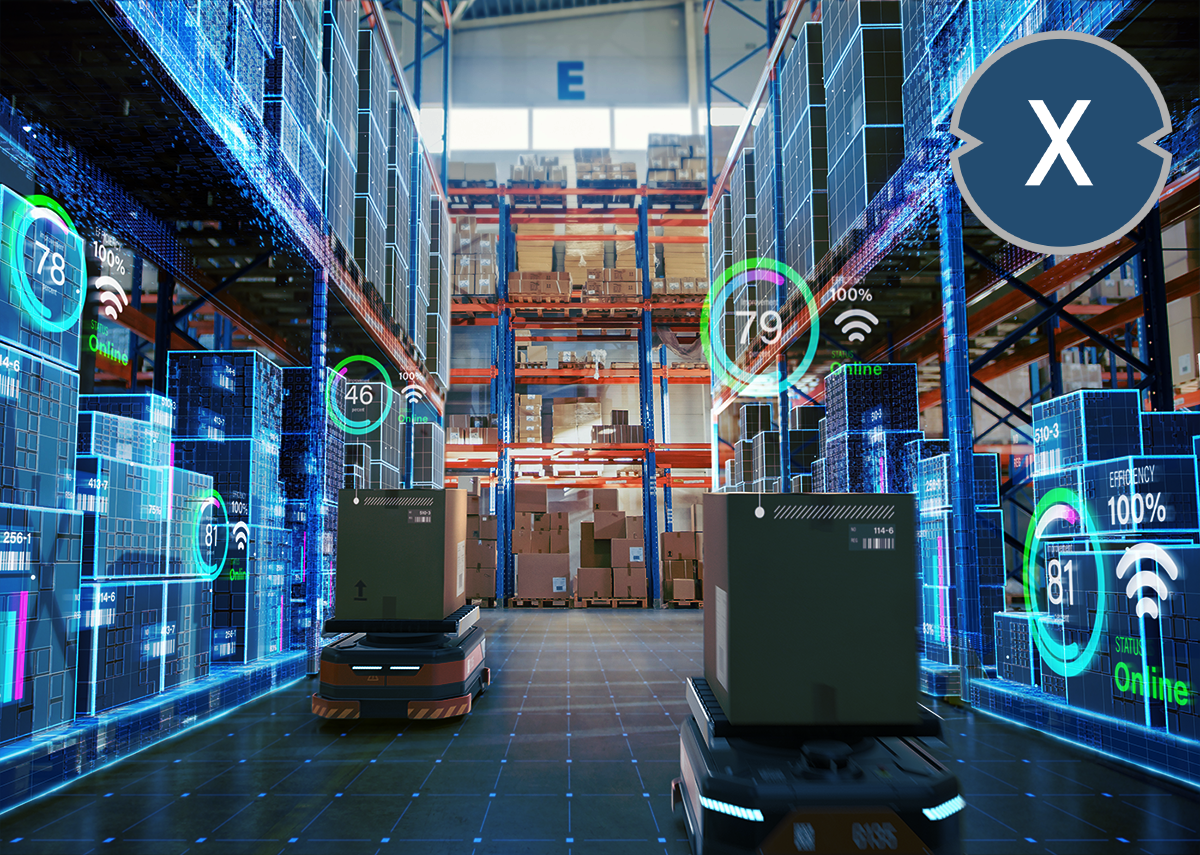
Supply chains: Relocation and buffer stocks for greater security – Image: Xpert.Digital / Gorodenkoff|Shutterstock.com
Disrupted supply chains. What to do?
For over two and a half years, logistics companies and businesses worldwide have been grappling with disrupted supply chains. Particularly since the start of the global COVID-19 pandemic, production outages and unexpected delays in ship handling have repeatedly occurred, potentially leading to months-long waits for the corresponding products or components in Europe. The war in Ukraine has added another risk factor, further exacerbating the situation and causing significant disruptions and delays in the supply chain.
For logistics companies, this uncertainty makes it virtually impossible to conduct strategically planned business. Conversely, companies are unable to produce and deliver sufficiently, resulting in valuable revenue losses despite sometimes high demand. The resulting supply chain disruptions ultimately lead many companies to view the future with skepticism or even fear for their survival, despite their order books being full.


Massive revenue losses due to supply chain chaos
In fact, supply chain issues, especially with seasonal goods, can lead to significant cash flow problems. A retailer selling summer merchandise will find it difficult to sell, and often only at substantial discounts, if they don't receive it until autumn or winter. There is virtually no way for them to compensate for the negative consequences of the current chaotic supply chains, meaning that lost business is virtually impossible to recover.
The fashion retail sector is particularly suffering from the current situation. According to a study by the German Association of Textile, Footwear and Leather Goods Retailers (BTE), only 5% of the retailers surveyed reported experiencing no or only minimal problems with deliveries. Conversely, 37% complained of losses of up to 10% and 20%, respectively. The affected companies must be in a very strong financial position to absorb the resulting revenue shortfalls.
However, the supply chain crisis is affecting companies of all sizes and sectors. This also applies to the local photovoltaic industry, as it too imports important raw materials and intermediate products from around the world. Yet, this sector is particularly well-suited for booming sales. The energy transition and the pressure to move away from fossil fuels, further intensified by the conflict with Russia, are leading to a significantly renewed demand for renewable energies. Solar power plants are booming across the country, but the figures could be even better if companies could meet this immense demand.
How to secure revenue
But what can be done to avoid the vicious cycle of impending supply bottlenecks, material shortages, production downtime, limited supply, and massive revenue losses? Since the beginning of 2020, at the latest, there has been increasing discussion about relocating parts of the production, some of which was outsourced to the Far East decades ago, closer to the domestic market and the company's own location. Furthermore, more and more business leaders are placing greater emphasis on production security, rather than solely on superficial efficiency, when choosing a production site.
Especially in highly automated manufacturing processes, relocation is a highly productive step, as countries with lower wages can hardly exploit their cost advantages there. Furthermore, manufacturers move closer to the production processes, giving them significantly better control and management capabilities than if production were taking place tens of thousands of kilometers away. In addition, companies that bring production back in-house are better able to manage any potential loss of know-how and sensitive data.
Buffer stocks offer another way to mitigate fluctuations in the supply chain. Forward-thinking companies have long relied on maintaining sufficient inventory levels. This means they are moving away from the just-in-time principle that dominated production in recent years. Here, too, the principle now applies that security and, from a purely business perspective, a potentially slightly overstocked warehouse are preferable to a logistics system that could collapse if the first required part is missing.
Supply chain on the brink? The delivery difficulties and solutions


Is the global supply chain tearing apart due to ongoing problems and regional crises? – Image: Xpert.Digital / Iaroslav Neliubov|Shutterstock.com
We recently wrote about this: “As has been described countless times before, globalization has severely strained supply chain structures, making them vulnerable to unexpected crises beyond their control. However, it has also failed to strategically sensitize them in a relatively short time. This means that no easing of the situation along the supply chain in logistics or intralogistics is in sight for the future.”
Now is the time to act. Anyone who only acts now is late – and there are many! As early as 2012, a survey revealed that 16.2% of companies polled had no solutions or strategies for supply chain risk management. A response is urgently needed now, because the current situation is here to stay. And what many aren't even considering: the danger of a chain reaction and the potential consequences of further crises is real. Can anyone seriously say that's it?
Action is needed to ensure continued functioning supply chains

Fragile supply chains: Supply chain under pressure – Image: Xpert.Digital / Travel mania|Shutterstock.com
Global supply chains are still strained by the pandemic. Many countries have implemented numerous anti-pandemic measures, triggering significant delays in value and supply chains. For example, control and quarantine zones at logistics hubs have led to supply bottlenecks. As a result, many suppliers have been hampered in their production and have been unable to fully meet their delivery obligations. A lack of components can quickly and severely disrupt production processes. Added to this are the shortages of workers due to illness or travel restrictions.
In-house expertise: The GridParity example
Relocating production back to local production requires that companies possess the expertise to manufacture the necessary materials or parts themselves. However, many companies have lost this know-how in recent years, instead becoming problematically dependent on their suppliers.
GridParity AG, a photovoltaic manufacturer, demonstrates how to do things efficiently and differently. The solar specialists from Karlsfeld near Munich have been pursuing self-sufficient methods for the production of their PV systems for some time now. For example, GridParity works closely with Agora Solar as in Slovakia for the production of modules. In this way, Agora Solar, in which GridParity holds a one-third stake, handles the manufacturing of many crucial components that would otherwise have to be shipped halfway around the world to be available to GridParity. This also helps to minimize uncertainties in the supply chain. At the same time, it shows that strategic decisions such as investing in a locally based manufacturer like Agora can significantly contribute to securing GridParity's future.
📦 Logistics consulting for industry and mechanical engineering - for logistics managers and warehouse managers
Do you need expert support in implementing your requirements? Do you have questions about Smart Factory, Smart Logistics, or digitalization?
🏬 Warehouse optimization and automation for industry, production and trade
Automating warehouses and supply chains is a key element of warehouse optimization. We can help you with that.
🛒 E-commerce warehousing solutions for returns, fast shipping (same-day delivery), and error-free order picking
E-commerce has specific requirements, and competition is constantly intensifying. It's no coincidence that e-commerce is considered a driving force behind market changes. Our strength lies in our digital expertise, which enables us to deliver innovative solutions and implementations.
Logistics consultants for secure supply chains and buffer storage: Use our Xpert.Plus service for your logistics consulting, warehouse planning or warehouse management needs
Xpert.Plus is a project of Xpert.Digital. We have many years of experience in supporting and consulting on warehouse solutions and in logistics optimization, which we combine under Xpert.Plus in a large network.

Konrad Wolfenstein
I would be happy to serve as your personal advisor.
You can contact me by filling out the contact form below or simply call me on +49 7348 4088 965 (Munich) .
I'm looking forward to our joint project.
Write to me


Xpert.Digital – Konrad Wolfenstein
Xpert.Digital is a hub for industry focusing on digitalization, mechanical engineering, logistics/intralogistics and photovoltaics.
With our 360° Business Development solution, we support renowned companies from new business to after-sales.
Market intelligence, smarketing, marketing automation, content development, PR, mail campaigns, personalized social media and lead nurturing are part of our digital tools.
You can find more information at: www.xpert.digital – www.xpert.solar – www.xpert.plus
Keep in touch