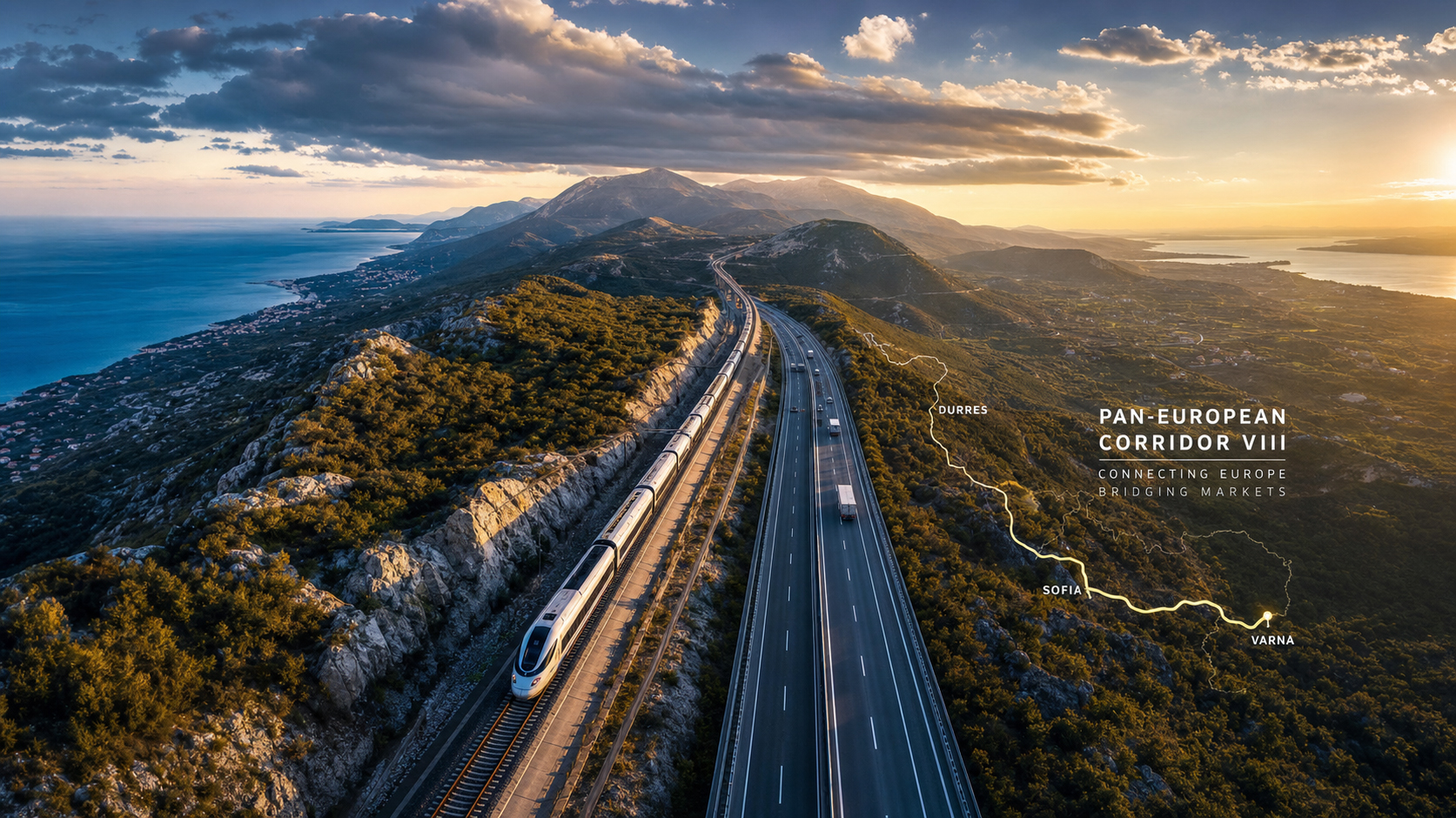
Brussels, Moscow and Beijing: The invisible battle for the most important new trade route in the Balkans – Creative image: Xpert.Digital
1,500 kilometers that will change everything: Why the whole world is suddenly looking at this European corridor
The Balkan bottleneck: Will Europe's most ambitious and riskiest transport corridor finally achieve a breakthrough?
What appears on the map as a logical connection, in reality turns out to be one of the most ambitious, expensive, and politically sensitive infrastructure projects of our time: Corridor VIII. Stretching approximately 1,500 kilometers, this state-of-the-art transport axis is intended to connect the Adriatic Sea directly to the Black Sea via the Western Balkans, thus creating a new east-west artery across Europe. But behind the massive construction plans for railways, highways, and seaports lies far more than just a logistical milestone. The multi-billion-euro project has become a geopolitical chessboard where the EU, NATO, China, and Russia are vying for strategic influence, security, and control of new trade routes. While the economic potential is enormous and the route promises a crisis-proof alternative for global supply chains, the project repeatedly threatens to become bogged down in a diplomatic minefield. Historical conflicts, political instability, and bureaucratic hurdles are slowing its development. This in-depth analysis sheds light on the struggle between the major powers, the enormous economic gravitational potential, and explores whether this historic vision will finally become reality after three decades of waiting.
Related to this:


Corridor VIII: Europe's underestimated trade corridor between two seas
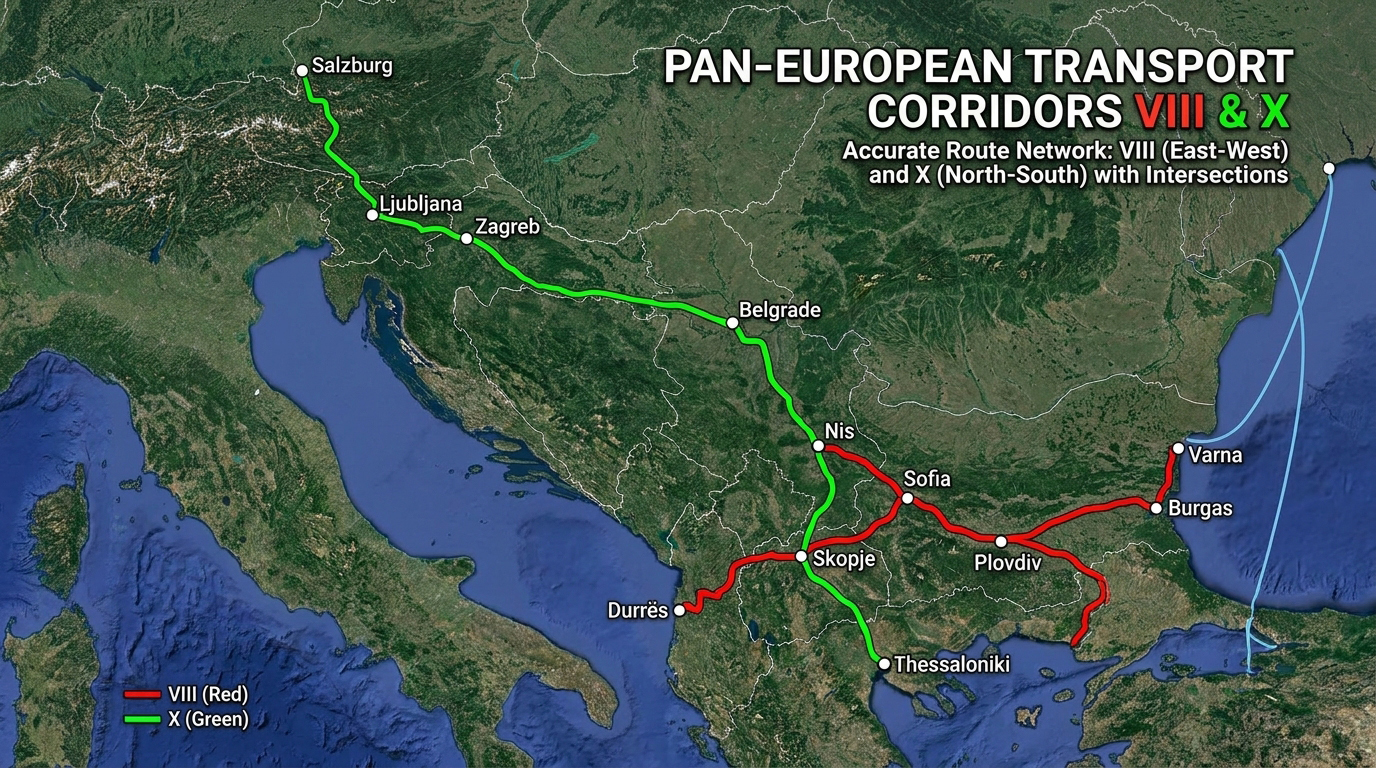
Corridor VIII: Europe's underestimated trade corridor between two seas – Image: Xpert.Digital
The idea is compelling in its geographical logic: a single multimodal transport axis connecting the Adriatic port of Durrës in Albania, via Tirana, Skopje, and Sofia, with the Black Sea ports of Burgas and Varna in Bulgaria – thus linking two of Europe's most important maritime regions by land. What appears simple and almost self-evident on a map is, in reality, one of the most complex, politically intertwined, and economically fascinating infrastructure projects on the entire European continent.
Corridor VIII was first conceptualized at the Second Pan-European Transport Conference in Crete in 1994 and adopted as one of ten pan-European transport corridors. The original goal was to complete the link within 15 years – by around 2009. Thirty years later, in 2026, the corridor remains fragmented, with significant gaps, particularly along the critical border section between Bulgaria and North Macedonia. Yet, precisely now, under the pressure of shifting geopolitical power dynamics, growing supply chain risks, and the momentum of EU enlargement, the project is gaining an urgency it has never possessed before.
The entire route comprises approximately 1,500 kilometers of road and rail infrastructure, running from the southern Italian ports of Bari and Brindisi via a ferry connection to Albania, then through the western Balkans to Bulgaria, from where international trade can flow across the Black Sea and onward towards Central Asia, Turkey, and the Middle East. The corridor touches three countries – Albania, North Macedonia, and Bulgaria – of which only Bulgaria is an EU member, while the other two have candidate status.
Economic gravitational potential along the route
A sober economic analysis reveals why this corridor is attracting so much attention. North Macedonia alone has planned investments of €1.3 billion in Corridor VIII and the parallel Corridor Xd, equivalent to approximately 10 percent of its national GDP. The direct economic impact of these construction projects is estimated at an annual additional contribution of over 2 percent of GDP over the entire project period from 2023 to 2027. In the construction sector alone, around 50 percent of the contracts will be awarded to domestic companies, resulting in a value-added effect of approximately €700 million for the local economy.
On the Bulgarian side, over €1.5 billion is earmarked for railway modernization by 2027, with a particular focus on the industrial hubs of Burgas, Stara Zagora, and Varna. With the eastern third of the corridor, Bulgaria controls direct access to the Black Sea ports – and thus the gateway to a vast hinterland stretching from Central Asia through the Middle Corridor to China. For manufacturers producing in Bulgaria, the fully upgraded line will provide access to the southern Italian ports and thus to the Western European market within 36 to 72 hours by truck or rail.
The Port of Durrës, the western gateway to the corridor, recorded a 6.3 percent increase in cargo volume to over 2 million tons between January and July 2025. In the container sector, the port handled 128,213 TEUs, a 9 percent increase compared to the same period of the previous year. In 2024 as a whole, the Port of Durrës handled 7.352 million tons of cargo and 196,507 TEUs of containers. These figures demonstrate that the western entrance to the corridor already plays a significant operational role in Adriatic trade – and could grow considerably more once the corridor is fully operational.
At the eastern end lies Varna, Bulgaria's largest seaport complex, with an annual cargo capacity of approximately 7.1 million tons and a container handling capacity of 160,000 TEU. The ports of Varna and Burgas are slated for modernization and expansion through public-private partnerships, aiming to increase cargo throughput by up to 30 percent. Connecting the two port systems via a functioning corridor would create a multimodal trade axis of immense regional importance.
Infrastructural progress and remaining gaps
The current state of development of the corridor is characterized by considerable progress in individual segments, but this progress is hampered by a critical bottleneck – the lack of a border connection between Bulgaria and North Macedonia. The EU's Western Balkans Investment Framework (WBIF) estimates the total investment volume for the rail section in North Macedonia and Albania at €2.1 billion, with a total length of 594.7 kilometers and approved EU grants of €367.6 million.
In North Macedonia, the 31-kilometer Kumanovo–Beljakovce section of the railway line was reopened in January 2025 after modernization. Trains can now travel at speeds of up to 100 kilometers per hour, and three new stations have been built. The project was financed by a €76.6 million loan from the EBRD and a €1.5 million EU grant. Simultaneously, construction is underway on the 34-kilometer Beljakovce–Kriva Palanka section, being carried out by the Turkish construction company Gülermak. The total financing package for the third phase of the eastern section—the 24 kilometers between Kriva Palanka and the Bulgarian border, as well as the electrification of the entire 88-kilometer Kumanovo–border line—amounts to €560 million, consisting of €150 million in EU grants and loans from the EIB and the EBRD. Once this section is completed, the route will be able to transport around 500,000 tons of goods and half a million passengers annually.
In Albania, the European Investment Bank (EIB) signed a €90.5 million financing package in April 2025 for the modernization of the 34-kilometer Durrës–Rrogozhina railway line – consisting of an EU grant of €60.5 million under the Western Balkans Investment Framework and an EIB loan of €30 million, with total project costs of €121 million. In the road sector, the completion of several construction sections in the Elbasan–Qafë Thanë segment, totaling 26 kilometers, is expected in 2026.
On the Bulgarian side, Sofia has announced plans to launch a tender process by the end of July 2025 for the remaining 2.4-kilometer section of track between Gyueshevo and the border with North Macedonia, financed with €69 million from the EU's 2021–2027 Transport Connectivity Programme. In addition, over €1.5 billion is earmarked for the modernization of the Sofia–North Macedonia railway line. In July 2025, at a meeting in Brussels, Bulgaria and North Macedonia reaffirmed their commitment to completing the missing sections and agreed to establish working groups for the Deve Bair cross-border railway tunnel.
Geopolitical significance: Between Brussels, Moscow and Beijing
Corridor VIII is no longer merely a transport infrastructure project. It has become an arena of geopolitical interests, onto which the EU, NATO, Russia, and China project their strategic objectives. The Tirana Summit Declaration of February 18, 2026, signed by the heads of state and government of Albania, North Macedonia, Bulgaria, and Italy, designates Corridor VIII as a strategic east-west axis connecting the Adriatic and Black Seas and contributing to the stability, prosperity, and security of Southeast Europe as a core component of the TEN-T network.
Bulgaria has previously articulated this assessment with unequivocal clarity: the corridor is developing into the most important logistics route along NATO's southern flank, from the Adriatic to the Black Sea. Refusal to build the basic components weakens the collective security of the alliance. This statement is not rhetorical. In light of Russia's war of aggression against Ukraine, military mobility in Europe has gained dramatically in importance. Corridor VIII offers NATO rapid land access from the southern Adriatic, across the Balkans, to Romania and the Black Sea region – a security aspect that is playing an increasingly significant role in planning scenarios for NATO's southern flank.
At the same time, the corridor opens up a perspective for the redesign of Eurasian trade routes. The so-called Middle Corridor, the Trans-Caspian International Transport Route, connects China with Europe via Kazakhstan, the Caspian Sea, Azerbaijan, Georgia, and the Black Sea. Transport volume on this route increased by 68 percent to 3.8 million tons in the first ten months of 2024, while container traffic increased 2.7-fold. The World Bank forecasts that the Middle Corridor's freight volume will triple from 2.3 million tons to around 11 million tons by 2030.
In this context, the function of the Black Sea ports of Varna and Burgas as hubs in a future integrated Eurasian logistics network becomes evident. Bulgaria is deliberately positioning itself as a bridge between the Central Corridor and the Western European market. Whoever controls Corridor VIII effectively controls the western end of this new Eurasian trade axis – an axis that Russia has increasingly bypassed since the outbreak of war in 2022, and whose importance grows with every package of sanctions against Moscow.
The EU has recognized this strategic opportunity. In May 2025, the European Commission presented a new strategy for the Black Sea region, which explicitly aims to link Europe more closely with the South Caucasus, Central Asia, and beyond – and to position the EU as a reliable geostrategic actor in the Black Sea region. Within this framework, Corridor VIII is no longer a peripheral project, but a central element of the European connectivity strategy.
The political minefield: a deadlock in the triangle of Skopje, Sofia and Brussels
Despite its clear strategic logic, Corridor VIII has for years been the victim of political disputes that extend far beyond transport planning. The central obstacle lies in the complicated bilateral relationship between Bulgaria and North Macedonia – a conflict with historical, linguistic, and identity-political dimensions, which is magnified by a single infrastructure project.
In 2020, Bulgaria vetoed the start of EU accession negotiations with North Macedonia, alleging that Skopje was violating the 2017 bilateral friendship treaty through differing provisions regarding history and language. The veto was only lifted in 2022 after the Bulgarian parliament accepted the so-called "French proposal," which obligates Skopje to enshrine the rights of national minorities—including Bulgarians—in its constitution. North Macedonia initially rejected this condition, which meant that formal EU accession negotiations did not begin until the end of 2024.
This political conflict has a direct impact on Corridor VIII. The VMRO-DPMNE government elected in Skopje in 2024 showed little willingness to advance the railway line towards Bulgaria. Transport Minister Aleksandar Nikoloski questioned the project's cost – at least €20 million per kilometer – and accused Bulgaria of not having the necessary project readiness for the cross-border section. In fact, the government cancelled the tender process for Phase III of the railway line on the North Macedonian side – a decision explicitly criticized by the European Commission in its 2024 North Macedonia report, which called for its completion to be accelerated.
In the summer of 2024, an interview with former Serbian minister Goran Vesić fueled further geopolitical speculation. He claimed that the Serbian high-speed rail project on Corridor X had averted a "dark scenario" for Serbia and positioned it as a key transit country – a statement interpreted by Albanian politicians as an indirect admission that Serbia had an interest in weakening Corridor VIII. This interpretation is not without geopolitical merit: Corridor VIII would effectively bypass Serbia on the east-west axis and diminish the importance of the north-south Corridor X for Serbian transit revenues.
On the Bulgarian side, the frequent changes of government – seven parliamentary elections in three years – are a structural obstacle to the political continuity that a major project of this scale requires. The infrastructure on Bulgarian territory suffers from the accumulated investment backlog of previous years and from an occasional discrepancy between political announcements and practical implementation, as can be seen in the unfinished Klepalo border crossing from 1998 to the present day.
Our EU and German expertise in business development, sales and marketing


Our EU and German expertise in business development, sales and marketing - Image: Xpert.Digital
Industry focus areas: B2B, digitalization (from AI to XR), mechanical engineering, logistics, renewable energies and industry
More information here:
A thematic hub offering insights and expertise:
- Knowledge platform covering global and regional economies, innovation and industry-specific trends
- A collection of analyses, insights, and background information from our key areas of focus
- A place for expertise and information on current developments in business and technology
- A hub for companies seeking information on markets, digitalization, and industry innovations
From Tirana to Varna: The corridor that could link Europe with Eurasia
Financing architecture and the role of European institutions
Rail instead of truck: How Corridor VIII reduces logistics costs and saves CO₂
The financing model behind Corridor VIII is complex and multifaceted, but it reflects the EU's political will to systematically integrate the Western Balkans into European infrastructure. The main sources of funding are the European Investment Bank (EIB), the European Bank for Reconstruction and Development (EBRD), the Western Balkans Investment Framework (WBIF), the EU Reform and Growth Facility, and national budgets.
As part of its Western Balkans Growth Plan for 2024-2027, the EU has allocated a total of €6 billion, of which €2 billion is in grants and €4 billion in low-interest loans. At least half of these funds are channeled through the Western Balkans Investment Fund (WBIF) into infrastructure investments, connectivity, and transport projects – including prominent sections of Corridor VIII. At the EU-Western Balkans Investment Forum in Tirana in October 2025, European Commission President Ursula von der Leyen emphasized that the goal is to double the regional GDP of the Western Balkans within the next ten years.
For North Macedonia alone, the financing package for Phase III of the rail corridor amounts to €560 million – one of the largest investment packages ever put together for the country. €121 million is available for the Albanian railway section between Durrës and Rrogozhina. According to WBIF estimates, the total investment in the North Macedonia and Albania rail section is €2.1 billion. Its inclusion in the EU's Global Gateway program – the European counterpart to China's Belt and Road Initiative – provides the project with additional political and institutional support.
While this financing structure protects the project from short-term national budget constraints, it also makes it vulnerable to political manipulation. If national governments reallocate funds or cancel tenders – as happened in North Macedonia – not only is their own infrastructure delayed, but the confidence of European institutions in the creditworthiness of the entire enlargement process is also damaged.
Corridor VIII as a catalyst for EU enlargement
The completion of Corridor VIII and the EU accession prospects of the Western Balkan countries are inextricably linked – in both directions. On the one hand, the prospect of EU membership is the decisive incentive for Albania and North Macedonia to adhere to their corridor commitment despite high costs and political resistance. On the other hand, the development of Corridor VIII itself is a litmus test for the seriousness of European integration – a measure of whether the countries are capable of implementing large-scale projects with multilateral financing and cross-border coordination.
As recently as June 2026, the head of the Austrian central bank, Martin Kocher, described EU enlargement to include the Western Balkans as a significant growth opportunity, especially since Austria is one of the most important investors in the region. The historical argument is compelling: Poland tripled its economic output in less than three decades after joining the EU; in Croatia, the unemployment rate fell from 17 to 4 percent in just over a decade.
Albania's EU accession path was decoupled from that of North Macedonia in September 2024 after Skopje blocked constitutional amendments recognizing the Bulgarian minority. This decision was frustrating for Albania, but it also allowed Tirana to move forward more quickly. The Corridor VIII Economic Forum held in Tirana on February 18, 2026, under Albanian chairmanship, was a deliberate political signal: Albania was positioning itself as a driving force behind the corridor and demonstrating to Brussels its capacity for regional leadership.
The Tirana Declaration of February 2026 formulates an overarching vision that goes beyond roads and railways: regional economic integration modeled on the four EU fundamental freedoms, improvement of logistics efficiency, strengthening of supply chains, decarbonization of transport and – centrally – the gradual integration of the Western Balkans into the European single market even before formal accession.
Supply chain resilience and the new logic of corridor trade
In the post-pandemic economy, shaped by the consequences of the war in Ukraine, the question of supply chain resilience has taken on a new political and economic dimension. Companies worldwide have recognized that excessive dependence on individual routes, suppliers, or jurisdictions poses a systemic risk. In this context, Corridor VIII possesses a structural appeal that extends beyond its immediate user countries.
For European industry, and especially for German companies, the region along Corridor VIII offers an attractive combination of low labor and tax costs, a strategic geographic location, and growing infrastructure connections. The example of Rheinmetall, which has opted for long-term investments in Bulgaria, illustrates how corridor infrastructure already plays a role in industrial location decisions. Companies report savings of 10 to 15 percent in annual logistics costs simply by choosing locations near the corridor compared to isolated, low-cost sites.
The connection between the Central Corridor and Corridor VIII also creates a new dimension of Eurasian supply chain integration. Goods from Central Asia or China could theoretically be transported via Kazakhstan, the Caspian Sea, Azerbaijan, Georgia, the Black Sea to Varna, and then via Corridor VIII onward to Western Europe – without crossing Russian territory. With a transit time of 13 to 21 days, the Central Corridor offers a significant time advantage compared to the sea route, which takes 35 to 45 days. A fully operational Corridor VIII would be the European endpoint of this alternative Eurasian route.
According to Kazakhstan's Ministry of Transport, the freight volume of the Central Corridor is projected to increase to 10 million tons by 2028 – up from 4.5 million tons in 2024, representing a growth of approximately 63 percent. These volumes require efficient and secure onward transport infrastructure in Europe. Whoever can provide this connection will secure a strategically important position in the trade network of the 21st century.
Sustainability, decarbonization and multimodal transformation
Corridor VIII is explicitly designed as a multimodal transport system – comprising roads, railways, seaports, inland waterways, and airports. This multimodality is not only logistically sound but also relevant from a climate policy perspective. Expanding the railway infrastructure along the corridor enables a shift of goods from road to rail – resulting in correspondingly reduced CO₂ emissions and less congestion on Europe's main transport routes.
The EBRD is explicitly financing the corridor's expansion for this reason as well, with sustainability in mind: an efficient rail link between Albania, North Macedonia, and Bulgaria reduces negative transport externalities, promotes modal shift, and contributes to achieving the EU's climate targets. The project documentation emphasizes its integration into the EU's Green Agenda and Sustainable Development Goals 9 and 11.
In the Western Balkans, less than half of the railway lines are electrified, most can only be travelled at a maximum speed of 60 kilometers per hour, and signaling technology is outdated in many places. Investments along Corridor VIII are changing this picture: new sections are being electrified, enabling speeds of up to 100 km/h and meeting EU standards – a transformation of the rail infrastructure that is changing not only the corridor itself, but also the entire regional mobility system.
Structural risks and systemic bottlenecks
Despite all the positive developments, a serious analysis cannot ignore the project's structural risks. The most serious bottleneck remains the lack of a rail connection on both sides of the Bulgarian-North Macedonian border. This section – with the planned Deve Bair tunnel as its centerpiece – blocks the continuous flow of traffic along the entire east-west axis and renders all other investments a chain without a final link.
Another structural risk lies in the political instability of the transit countries. Bulgaria has held seven parliamentary elections in three years, significantly impacting planning continuity for major projects. North Macedonia is struggling with a government that views infrastructure projects as bargaining chips in its bilateral conflict with Bulgaria, rather than treating them as independent economic priorities. These political risks are compounded by administrative bottlenecks, a lack of project maturity on both sides of the border, and capacity issues within national procurement agencies.
Furthermore, there is the risk of diverging priorities. Corridor X – the north-south axis through North Macedonia to Greece – is further advanced and more economically attractive for Skopje, as Greece, being an EU member and major trading partner, offers more immediate benefits. The temptation to divert EU funds from Corridor VIII to Corridor X is real and has been openly addressed by North Macedonian government officials. Brussels has rejected this option, but the political pressure remains.
Finally, there is the risk of a lack of synchronization between national investment cycles. A corridor is only as strong as its weakest link. If Albania completes its part, North Macedonia hesitates, and Bulgaria has structural gaps, the result will not be a network effect, but rather a series of isolated solutions with limited overall impact.
Perspectives and evaluation: When, how and under what conditions?
A realistic assessment of the completion prospects reveals the following: The road section in Albania is expected to be largely completed by 2026–2027. The North Macedonian rail section to the Bulgarian border – including the critical tunnel segment – could be completed by 2028–2030, assuming favorable political developments, if the tenders for Phase III are not cancelled again, and Bulgaria develops its border section in parallel. Realistically, full multimodal functionality of the corridor, including rail connections on both sides of the Bulgarian-North Macedonian border, cannot be expected before 2030.
Three factors are crucial for the acceleration: firstly, a decoupling of infrastructure policy from the bilateral identity politics between Bulgaria and North Macedonia; secondly, continued and consistent conditioning of EU funds to measurable construction progress; and thirdly, the geopolitical pressure from the Middle Corridor and NATO mobility requirements, which provides the strategic justification for accelerated action.
The integration into the revised trans-European transport network TEN-T and the associated Baltic-Black Sea-Aegean and Western Balkans-Eastern Mediterranean corridors is of crucial institutional importance: it anchors Corridor VIII in a system with clearly defined standards, deadlines and financing priorities that transcends national political trends.
What remains is the fundamental economic truth: A fully functioning Corridor VIII would be a transformative project for Southeast Europe. It would reduce trade costs, generate transit revenues, attract foreign direct investment, promote industrialization along the corridor regions, and structurally embed the region more deeply in European and Eurasian economic integration. The geographical logic is undeniable. The economic incentives are clear. The political will is there—though not yet consistent enough to build the final, crucial kilometers.
Your container high-bay warehouse and container terminal experts

Container high-bay warehouses and container terminals: The logistical interplay – expert advice and solutions - Creative image: Xpert.Digital
This innovative technology promises to fundamentally change container logistics. Instead of stacking containers horizontally as before, they will be stored vertically in multi-story steel racking structures. This not only allows for a drastic increase in storage capacity within the same area, but also revolutionizes all processes at the container terminal.
More information here:
Your global marketing and business development partner
☑️ Our business language is English or German
☑️ NEW: Correspondence in your native language!

Konrad Wolfenstein
I and my team are happy to be available to you as your personal advisor.
You can contact me by filling out the contact form here wolfenstein@xpert.digital:or simply call me at +49 7348 4088 965. My email address is
I'm looking forward to our joint project.
☑️ SME support in strategy, consulting, planning and implementation
☑️ Creation or realignment of the digital strategy and digitization
☑️ Expansion and optimization of international sales processes
☑️ Global & Digital B2B trading platforms
☑️ Pioneer Business Development / Marketing / PR / Trade Fairs
🎯🎯🎯 Data-driven B2B industry hub as a quasi-in-house solution


The quasi-in-house solution: How Xpert.Digital closes operational gaps in B2B marketing and sales – Smart Content-Driven Business - Image: Xpert.Digital
Xpert.Digital is a data-driven B2B industry hub led by Konrad Wolfenstein . The company acts as an external, quasi-in-house solution for industrial partners, closing operational gaps in marketing, content, and sales – without requiring additional resources on the client side.
More information here: