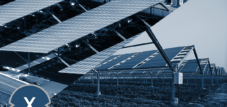
Building permit for solar power systems, solar carports and solar modules – Image: Xpert.Digital / Gearstd|Shutterstock.com
According to our Basic Law, every citizen has the right, pursuant to Article 14, Paragraph 1, Sentence 1, to build whatever they wish on their property. However, Paragraph 1, Sentence 2 of Article 14 of the Basic Law restricts this right of free use: property entails obligations. Its use should also serve the common good.
Precisely because of the potentially great dangers that can emanate from buildings, a permit is generally required: A building may only be erected, altered in its substance or use, or demolished if this has been approved by the building authority.
Building permit, building rights, building regulations and building permit
According to public building law in Germany, due to the constitutional protection of freedom to build, the decision to grant approval is not at the discretion of the building authority: If a project is compatible with the provisions of public law, the citizen has a right to the issuance of a building permit.
The basis for the building permit is the building code or state building code of the respective federal state, because the competence for building regulations lies with the respective federal states.
The requirements of building regulations relate primarily to construction, including parking spaces for motor vehicles. The aim of building regulations is to avert dangers to life and limb, prevent damage to property, and ensure public safety and order.
Conference of Ministers for Construction and the German Institute for Building Technology (DIBt)
Conference of Construction Ministers
To minimize differences in building regulations across the various German states, a conference of building ministers is held annually. This conference is a working group of the ministers and senators responsible for urban development, construction, and housing from the 16 states of the Federal Republic of Germany. The Federal Minister responsible for construction also regularly participates in this conference.
Model regulations and model decrees adopted by the Conference of Ministers for Construction serve as a basis for implementation in specific state law. They therefore have no direct legal effect. Each state decides to what extent its state regulations follow the model. The compilation is supplemented by guidelines and working aids.
Related to this:
German Institute for Building Technology (DIBt)
However, there is a binding agreement between the federal and state governments for the approval of unregulated construction products and building methods. The German Institute for Building Technology (DIBt), a technical authority in the construction sector, is responsible for this. It issues approvals, general building authority approvals, type approvals, and expert opinions for construction products and building methods.
Background:
After World War II, building supervision and building regulations in the Federal Republic of Germany fell under the jurisdiction of the individual federal states. These states faced two problems with the approval of construction products: Firstly, the technical complexity of the approval procedures increased significantly with the numerous new products and processes introduced during the economic boom. Secondly, the building materials industry demanded approvals with nationwide validity. In response, the Institute for Building Technology (Institut für Bautechnik) was founded in 1968 based on a federal-state agreement. The institute assumed responsibility for the approval process and other building technology tasks on a nationwide basis.
In the “Model Administrative Regulation on Technical Building Regulations (MVV TB)”, the DIBt brings together the technical rules for the planning, design and execution of buildings and for building products in one regulation.
This includes mechanical strength, stability, safety and accessibility in use.
Construction products or building methods for which no technical regulations exist are referred to as "unregulated construction products" or "unregulated building methods." In Germany, a general building approval can only be granted by the German Institute for Building Technology (DIBt) upon application. The validity of a general building approval is generally limited to five years. After its expiry, an application for renewal can be submitted.
If you want to use your construction product throughout Germany with a general building authority approval, your path automatically leads to the DIBt, the German approval authority for unregulated construction products. Our experts will guide you step by step through the process – from application to approval.
➡️ Application for approval (abZ) at the DIBt
Related to this:
General building authority approval (abZ)
In Germany, a general building approval can only be granted by the German Institute for Building Technology (DIBt) upon application. The validity of a general building approval is generally limited to five years. After its expiry, an application for renewal can be submitted.
Before a general building approval (abZ) is granted for a construction product or building type, all important aspects are examined, in particular safety-related properties and influences. These include structural stability, protection against harmful influences, health protection and protection of the natural environment, as well as fire, heat, sound, and vibration protection, and traffic safety. The legal basis for the general building approval is the Model Building Code.
A typical product that is not uniformly standardized in Germany, but rather becomes applicable through general building authority approvals, is prestressing steel and corresponding accessories for prestressed concrete construction.
External thermal insulation composite systems and large-format facade panels for ventilated curtain wall facades are also among the building products that can be used via a general building authority approval.
The approval process for obtaining a nationally valid, general building authority approval begins with the submission of a corresponding application to the DIBt (German Institute for Building Technology). The applicant is usually the manufacturer of a product. The DIBt, if necessary following a recommendation from an expert committee, determines the tests to be carried out and the required documentation. After the applicant submits the documentation, the DIBt reviews the case and, again if necessary with the assistance of the expert committee, grants the approval.
The abZ is a temporary approval!
The costs for obtaining a new general building approval (abZ) are stipulated in the DIBt's statutes. Depending on the product or design and the associated effort, the fees for a five-year approval range from €500 to €30,000. If a shorter approval period is requested in the application, the costs are reduced by 10% for each year of reduction. The fees for renewing an existing approval range from 10% to 50% of the costs for a five-year new approval.
If an Assessment Document (EAD) exists at the European level, a European Technical Assessment (ETA) can be applied for. The ETA regulates the placing on the market of the construction product/design in Europe. Further requirements (e.g., general building approval) may exist at the national level for usability in the respective member state.
Permit-free - Permit required
☑️ According to the model building code “MBO” of the Conference of Building Ministers, rooftop solar installations do not require a building permit.
⚠️Carport or solar carport
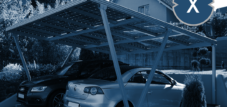
A carport or solar carport is a structure and therefore generally requires a building permit under public building law. In Baden-Württemberg, carports with a gross volume of up to 40 cubic meters can be erected without a permit in built-up areas and up to 20 cubic meters in outdoor areas. It is always advisable to check with the relevant building authority beforehand. Regulations and conditions of the respective federal state can change at any time. The best way to find out more is to search online for "application for a building permit in a simplified procedure" for the specific federal state.
⚠️ Solar parks or open-field installations
Large photovoltaic systems, such as open-field installations, always require a permit.
⚠️ Use of solar modules
According to the model administrative regulation on technical building regulations :
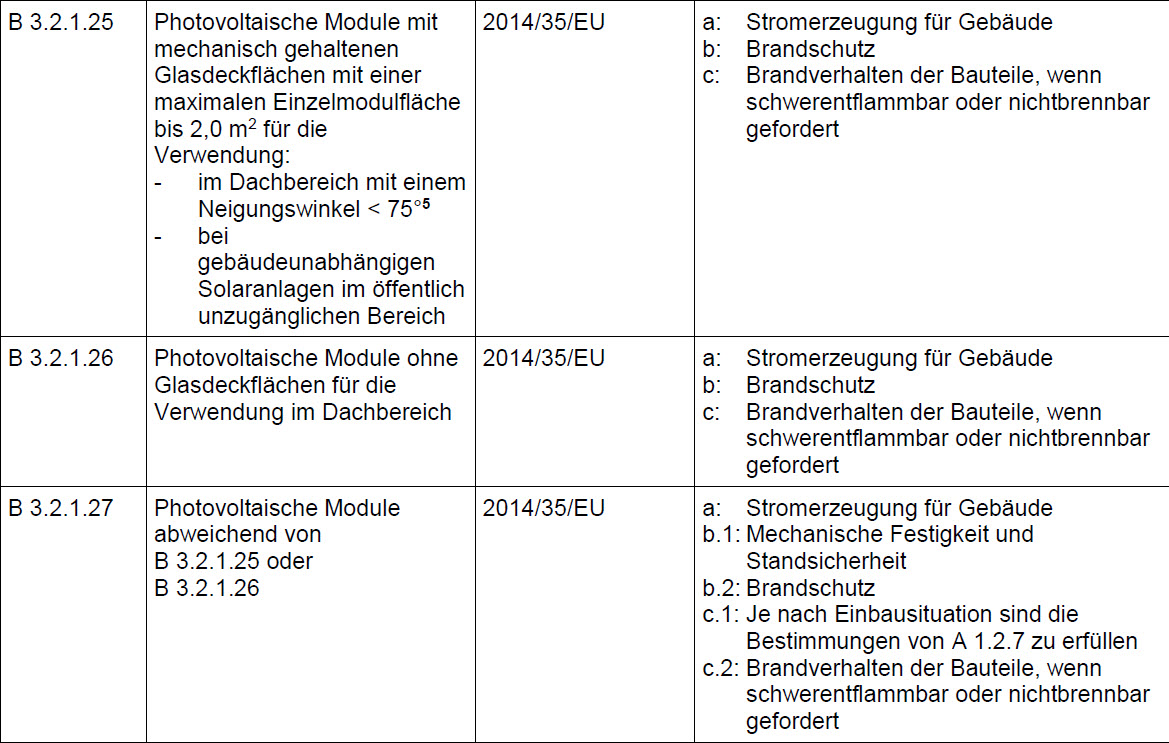
Model Administrative Regulation on Technical Building Regulations of the DIBt
Example glass-glass solar modules (applies to B 3.2.1.25)
⚠️ Single module area greater than 2.0 m²
⚠️ Inclination angle greater than 75° (e.g. as a solar facade)
⚠️ Solar carports without a roof (e.g., without trapezoidal sheet metal roofing, modules are accessible from below)
➡️ Requires a general building authority approval (abZ), application for approval to the DIBt
➡️ This applies especially to overhead glazing in patio roofs or carports or solar carports
The Model Administrative Regulation on Technical Building Provisions (MVV TB) stipulates that certain rules of "DIN 18008 Glass in Building Construction – Design and Construction Rules" must be applied to glass constructions. For laminated safety glass (VSG), verification must be carried out using the pendulum impact test according to "DIN EN 12600 Glass in Building Construction – Pendulum Impact Test – Methods for Impact Testing and Classification of Flat Glass".
See also:
➡️ VSG Float Glass: Laminated safety glass – Float glass
➡️ VSG TVG glass: Laminated safety glass – partially tempered glass
Float glass is a type of flat glass, specifically a single pane. It is manufactured using the "float glass process." A disadvantage of float glass is that it shatters into many sharp and pointed fragments when broken. The risk of injury is high.
Xpert.Solar offers consulting services for solar systems, solar carports, and solar modules
Xpert.Solar is a project of Xpert.Digital. We have many years of experience in supporting and consulting on warehouse solutions and logistics optimization, which we combine under the Xpert.Plus umbrella in a large network. With Xpert.Solar, we combine the same expertise in the field of photovoltaics and renewable energies.

Konrad Wolfenstein
I would be happy to serve as your personal advisor.
You can contact me by filling out the contact form below or simply call me on +49 7348 4088 965 .
I'm looking forward to our joint project.
Write to me


Xpert.Digital – Konrad Wolfenstein
Xpert.Digital is a hub for industry focusing on digitalization, mechanical engineering, logistics/intralogistics and photovoltaics.
With our 360° Business Development solution, we support renowned companies from new business to after-sales.
Market intelligence, smarketing, marketing automation, content development, PR, mail campaigns, personalized social media and lead nurturing are part of our digital tools.
You can find more information at: www.xpert.digital – www.xpert.solar – www.xpert.plus
Keep in touch