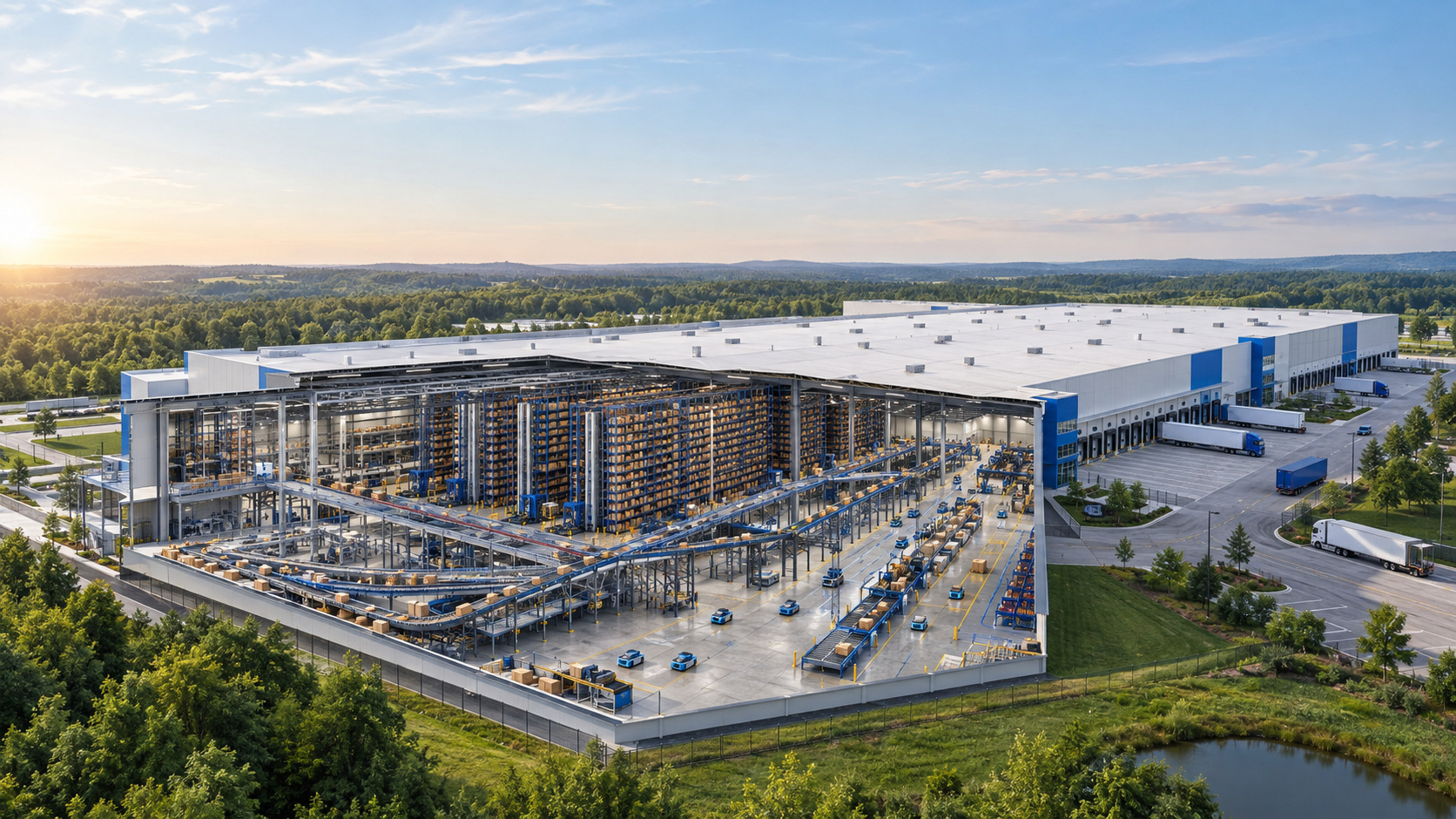
Automated logistics and fulfillment centers: Walmart invests $1.3 billion – What the new logistics center means for retail – Creative image on the topic, with AI: Xpert.Digital
Walmart's new fulfillment center: A big bet on faster deliveries
Automated logistics on the rise: This is how Walmart wants to change retail
Walmart is planning a $1.3 billion automated fulfillment center in the US state of Georgia. The facility will cover approximately 139,000 square meters and create 1,000 jobs. Construction in Carnesville is scheduled to begin in late 2026; an opening date has not yet been announced. The project is part of a broader strategy by which Walmart is expanding and further automating its supply chain. The goal is to process online orders faster and more efficiently. However, new technology alone does not guarantee economic success: Crucially, the center will be utilized effectively and integrated seamlessly into the existing network of warehouses, inventory, and transportation routes. This investment demonstrates how much competition in retail has shifted to logistics—and how much capital companies must commit to sustainably improve their delivery speed and costs.
Walmart's billion-dollar strategy: How automated logistics is redistributing power in retail
Those who want to deliver quickly tomorrow must commit billions today
Walmart is planning an automated fulfillment center in Carnesville, Georgia, with an investment volume of $1.3 billion. The facility will cover an area of approximately 1.5 million square feet (about 139,000 square meters) and create 1,000 jobs. Construction is scheduled to begin at the end of 2026. A specific date for commissioning is not mentioned in the available information. This is therefore an announced investment, the economic impact of which will only be realized after construction, ramp-up, and subsequent full utilization.
The significance of this project extends beyond an additional warehouse. Walmart is building a retail infrastructure where delivery speed, product availability, and operating costs can no longer be optimized separately. The company is attempting to improve these metrics simultaneously through automation and a targeted expansion of its logistics network.
The crucial economic question, therefore, is not whether a single location becomes more technically efficient. It is whether the entire supply chain can reliably process more orders at lower overall costs as a result. A highly automated center only represents a sustainable competitive advantage if its performance is aligned with regional demand, inventory distribution, and downstream transportation processes.
This is precisely where the strategic significance lies: Competition in the retail sector is shifting further from the visible sales surface to the underlying infrastructure.
A major project situated between regional expansion and national network strategy
Georgia is not an uncharted market for Walmart. The company already operates 209 Walmart and Sam's Club locations there, as well as eleven facilities within its supply chain. The new fulfillment center thus complements this existing operational presence.
This starting point is important because an additional location within an existing network has a different impact than an isolated new construction project. It can redistribute the flow of goods, relieve the burden on existing facilities, and change the allocation of orders to individual shipping points. Its value, therefore, does not lie solely in the packages that directly pass through its own systems.
However, the number of existing facilities does not necessarily indicate their precise function or their future connection to Carnesville. Without information on product ranges, transport routes, and capacities, it is impossible to determine what tasks the new building will perform.
Strategically, the direction is clear: Walmart is expanding its ability to fulfill online orders from a more densely connected and highly automated network. The investment is therefore both a regional capacity decision and a building block of a nationwide delivery strategy.
Why fulfillment means more than just storage
A fulfillment center is not simply a building where goods are stored. Its function is to transform customer orders into shipments ready for dispatch. This includes ensuring the availability of the correct items, consolidating them, packaging them, and handing them over to transport on time.
This distinction explains why online retail has different requirements than supplying brick-and-mortar stores. A store typically receives goods in larger, more predictable units. A single household, on the other hand, orders an individual combination of different items. From a large number of possible goods movements, a suitable process must be developed for each order.
Automation is intended to make this complexity more manageable. Its economic benefits therefore do not depend solely on how fast a single device works. What is crucial is how reliably all process steps mesh together.
No detailed technical specifications are available for the Carnesville project. Statements about specific robotic systems, warehouse technologies, or the precise division between manual and automated tasks would therefore be speculative. What is certain, however, is its classification as a state-of-the-art, automated fulfillment center within a broader modernization strategy.
The investment amount reflects the capital intensity, but not automatically the profitability
The announced $1.3 billion equates to approximately $9,300 per square meter. Based on the announced 1,000 jobs, this results in an investment volume of about $1.3 million per position.
Both figures illustrate the scale of the project, but must be interpreted with caution. The investment per square meter is not a definitive building price. Without a cost breakdown, it remains unclear what proportions are attributable to construction, land, technical installations, information technology, or other project components.
Similarly, investment per job does not measure the cost of an employee. It merely compares two announced variables. A capital-intensive location can combine high investment with significant employment because machinery, software, and personnel together generate output.
For a profitability assessment, crucial information is missing: expected order volumes, operating costs, service life, maintenance expenses, and the actual savings achieved within the network. The billion-euro sum thus initially demonstrates a substantial capital commitment. Whether this translates into an attractive return will only become clear during ongoing operations.
Capacity utilization is the key lever for economic efficiency
Automation is changing the cost structure of a logistics site. A larger portion of the costs is incurred even before the first order is processed. Buildings, conveyor technology, control systems, and other infrastructure must be financed and kept operational.
This leads to a fundamental relationship: the more suitable orders are processed through the same infrastructure, the better the fixed costs can be distributed across individual orders. High capacity utilization can therefore create a significant cost advantage.
However, this advantage is not unlimited. If a system is used beyond its practically manageable capacity, queues, delays, and additional costs can occur. Therefore, what makes economic sense is not the maximum possible utilization at any given time, but rather a sustainable balance between capacity utilization and reserve capacity.
Seasonal peaks are particularly challenging. If a plant is designed solely for exceptionally high volumes, unused capacity is likely to occur outside of these periods. If it is undersized, bottlenecks will arise precisely during periods of high sales. The quality of demand forecasting therefore becomes a crucial component of the return on investment.
Faster delivery is a geographical, not a purely technical, problem
Walmart is linking the expansion of its new generation of fulfillment facilities to the goal of increasing same-day or next-day deliveries. Simply speeding up processes within a warehouse is not enough to achieve this.
Several stages of time lie between placing an order and its delivery. The goods must be available, the order processed, the shipment loaded, and the journey to the customer completed. Time saved in one stage can be completely lost due to delays elsewhere.
An additional location can reduce geographical gaps if it reaches relevant demand areas more cost-effectively than existing facilities. At the same time, departure times, transport capacities, and delivery processes must be compatible.
Therefore, a new automated center does not automatically mean that all customers in its wider area will receive same-day delivery. Such promises depend on the item, the time of order, and the specific delivery address. What is economically relevant is how much the proportion of orders that can be delivered faster and reliably under realistic conditions increases.
The last mile limits the benefits of perfect warehouse processes
Even a highly efficient shipping process cannot solve all the cost problems of online retail. The final leg of the journey to the customer remains a separate economic bottleneck.
Their efficiency depends significantly on how many deliveries can be consolidated on a single route. If recipients are far apart, the transport effort per shipment increases. If many suitable orders are located close together, the same vehicles and working hours can handle more orders.
This creates a tension between speed and consolidation. Companies promising very short delivery times may have less leeway to wait for additional shipments on the same route. Faster delivery can therefore become more expensive, even though upstream warehousing costs decrease.
Carnesville's economic success must therefore be measured by the total cost of ownership (TCO) all the way to the customer. An isolated cost improvement within the fulfillment center would be insufficient if it simultaneously results in higher transportation costs. Optimizing the entire order fulfillment chain is crucial.
More locations create proximity, but require a more precise inventory distribution
A denser network can shorten delivery routes. However, it brings an additional challenge: goods must be distributed to more potential shipping points.
If an item is located in the wrong location, the proximity of another warehouse to the customer is of little help. In the worst-case scenario, the order has to be shipped from multiple facilities. This can result in additional packages, transport movements, and processing steps.
Increased customer proximity can also necessitate additional inventory. If identical items are to be available at multiple locations, the amount of tied-up capital increases under certain conditions. This effect can be countered by better bundling of individual product ranges and more precise forecasting.
The economic optimum, therefore, does not consist of stocking every item everywhere. It consists of positioning different products within the network according to their demand, delivery time requirements, and inventory risks.
A new fulfillment center therefore not only increases physical capacity. It also increases the demands on decisions about which inventory is economically viable at which time and location.
Data quality determines whether technology can achieve its intended purpose
Automated processes require reliable information. If inventory data, product attributes, or order information do not match the actual situation, a technically powerful system will not automatically operate economically.
The crucial questions are often quite mundane: Is an item actually available? Are its dimensions correctly recorded? Can it be shipped together with other products? Can an order still be assigned to a specific departure in time?
Errors in these fundamentals can propagate throughout the entire process chain. An incorrect inventory display might lead to an unsuitable order assignment. An inaccurate product attribute could necessitate unplanned manual intervention. An inappropriate transport assignment could delay an otherwise timely processed order.
This leads to an important economic point: The return on investment in physical infrastructure also depends on less visible investments in data maintenance, system integration, and operational discipline. Technology and organization are not separate success factors. Together, they form the basis for ensuring that increased speed is not achieved at the expense of additional errors.
New construction and modernization fulfill different tasks
Walmart's strategy isn't limited to new fulfillment centers. The company also plans to automate 23 of its 42 regional distribution centers. The long-term goal is to modernize all such locations.
The 23 planned facilities represent approximately 55 percent of the aforementioned regional distribution centers. However, this percentage describes the scope of the modernization project and not automatically the current stage of completion.
Equally important is the functional distinction: Regional distribution centers and e-commerce fulfillment centers should not be treated as identical location categories. Their tasks, product structures, and performance requirements can differ.
Economically, new construction and retrofitting complement each other. New facilities make it possible to align processes with a specific technical architecture from the outset. Modernizing existing facilities, on the other hand, utilizes existing sites and infrastructure, but must address their structural and operational constraints.
The overall strategy therefore aims at more than just additional shipping capacity. It gradually changes the production methods of logistics within a large retail network.
Your intralogistics experts

Consulting, planning and implementation of complete solutions for high-bay warehouses and automated storage systems - Image: Xpert.Digital
More information here:
Jobs and automation in fulfillment centers
The high degree of automation is progress, but not full automation
By 2025, more than half of Walmart's e-commerce fulfillment volume was already being processed through automated systems. This figure demonstrates that automation within the company is no longer just a limited experiment.
However, this figure should not be overinterpreted. The percentage refers to the volume processed and does not indicate that more than half of all activities, locations, or working hours were fully automated. Nor does it describe the proportion of total merchandise sales.
This distinction is crucial for an objective assessment. An order can go through automated process steps and still require human intervention. Even a highly automated facility needs monitoring, maintenance, quality control, and the handling of exceptions.
Economic development, therefore, does not necessarily progress from human labor to its complete disappearance. Rather, the distribution of tasks often shifts. Routine operations become more technologically supported, while the importance of system operation, troubleshooting, and coordination increases. Exactly how this shift will play out in Carnesville is not yet clear.
A thousand jobs are relevant, but they do not replace an employment balance sheet
The announced 1,000 jobs are a key figure for regional analysis. They demonstrate that a high degree of automation and a significant need for personnel are not mutually exclusive.
At the same time, the composition of this employment remains unclear. Without information on qualifications, pay, working time models, and start dates, the quality of the positions cannot be definitively assessed. The distribution between technical, administrative, and operational tasks is also unknown.
The number of locations alone is also insufficient to assess the overall economic impact on employment. Crucially, it would also be necessary to consider whether tasks are eliminated at other locations, new functions are created, or increasing volumes are handled with fewer additional working hours.
Automation can enable growth without employment increasing proportionally to order volume. This is desirable from a productivity perspective, but it means that new jobs and saved working hours can occur simultaneously. A dispassionate analysis must therefore distinguish between the announced employment at the new location and the net effect across the entire network.
Georgia is gaining potential, but regional benefits do not materialize automatically
A major project of this scale can impact the regional economy on several levels. The construction phase generates different demand effects than the later operation. In the long term, the most important factors are permanent employment, local services, and the involvement of regional businesses.
The total investment volume does not correspond to the regional value creation. Technical equipment or specialized services can be supplied from outside. Therefore, how much economic benefit actually remains locally depends on the origin of the services and the subsequent expenditure structure.
At the same time, a large logistics hub requires a suitable workforce, reliable transport links, and a sufficiently efficient supply infrastructure. These requirements can stimulate investment but also create additional burdens.
A comprehensive regional cost-benefit analysis would require information on public infrastructure expenditures, potential subsidies, and fiscal returns. Such data is not available. While the location gains are plausible, their net magnitude cannot be reliably quantified. From an economic policy perspective, the crucial factor is whether private investment and regional conditions are compatible in the long term.
Modernization follows a multi-year industrial logic
Walmart first unveiled plans for four next-generation fulfillment centers in 2022. In 2023, a fifth facility in California was announced, scheduled to open in 2026. Carnesville is thus part of a multi-year expansion.
This timeline is economically significant. Large logistics systems are not created arbitrarily in the short term. Several development stages lie between strategic decision-making, planning, construction, and stable service provision.
A multi-year program generally allows experience from previous projects to be transferred to later locations. However, this does not automatically mean that every new plant will be cheaper or more successful. Regional differences, changing technical requirements, and the complexity of integration remain.
This development primarily demonstrates a long-term capital investment. Walmart treats automated logistics not as a temporary addition, but as a structural component of its business model. The competitive advantage is intended to arise from an integrated system, not from a single, particularly modern property.
The investment peak in 2026 and 2027 intensifies the question of returns
Walmart's supply chain expenditures are expected to peak during 2026 and 2027, thus concentrating a significant portion of the financial burden into a limited period.
For valuation purposes, a distinction must be made between cash outflow and impact on earnings. Investment expenditures initially burden available funds. Depreciation, on the other hand, spreads a portion of the balance sheet burden over later periods of use. Operational benefits, in turn, only materialize once the assets are actually in use and their processes are running with sufficient stability.
Therefore, high investments and still limited productivity gains can temporarily coexist. A new location needs to build up inventory, train staff, and coordinate its processes.
Furthermore, a subsequent decline in investment spending would not necessarily mean an end to the need for capital. Maintenance, replacement investments, software updates, and technical upgrades would remain essential. The crucial question is whether the temporarily high level of capital expenditure will subsequently generate sustainable operating returns.
Productivity must be reflected in the order result
Higher throughput is an important, but not sufficient, success criterion. A logistics system can move more units per hour and still be economically disappointing if, for example, additional partial shipments or high exception rates arise.
Several factors are therefore relevant for the assessment: the cost of a fully fulfilled order, the delivery reliability, the inventory accuracy, and the proportion of orders that can be processed without additional intervention.
The quality of the delivery also matters. A cheaply processed order loses its advantage if errors later lead to reprocessing, replacement deliveries, or customer contact. Similarly, short-term cost savings through inadequate maintenance can cause higher downtime in the long run.
Therefore, from an economic perspective, it makes sense to consider the entire project and longer timeframes. The most impressive technical achievement is not the deciding factor, but rather repeatable performance under real-world conditions. This is precisely the standard by which an investment of US$1.3 billion must be measured.
Faster delivery is not equally worthwhile for every order
Shorter delivery times can make a retailer's offer more attractive. However, this does not mean that the fastest possible delivery is economically sensible for every item.
The benefit depends on the specific demand. Some customers urgently need an item, while others are willing to wait longer. At the same time, goods differ in terms of margin, size, transport costs, and shelf life.
A uniform speed guarantee can therefore lead to an unfavorable cost structure. A more economically sound approach is differentiated management, where delivery options are tailored to the shopping cart, location, and available capacity.
For Walmart, a more efficient infrastructure primarily opens up more flexibility. The company can quickly fulfill more suitable orders without necessarily having to make the same commitment for its entire product range.
Profitability, therefore, doesn't arise solely from speed. It arises from the appropriate alignment of speed with economic benefit. Faster logistics is particularly valuable when it improves purchasing decisions or fulfills existing orders more efficiently, rather than simply incurring higher costs.
The competitive barrier increases due to the interplay of quantity and capital
A large retailer can spread high investments across a large order volume. If this is successful, it creates a structural advantage over competitors who have to utilize similar technology with significantly fewer orders.
This relationship can trigger a reinforcing competitive effect. A favorable cost position enables more attractive services. These can attract additional demand, which in turn improves capacity utilization.
However, this mechanism is not automatic. High fixed costs can have the opposite effect when demand is weak. A large-scale plant can then become a burden, while a more flexible model ties up less capital.
For the competition, Walmart's expansion doesn't mean that every supplier has to replicate the same infrastructure. However, it does increase the pressure to clearly define one's own logistics position. Anyone who wants to compete sustainably on speed and price for standardized goods needs a robust answer to the economies of scale offered by large networks.
Smaller retailers need a different logic than the multi-billion dollar replica
For small and medium-sized enterprises, it would be economically problematic to adopt the investment model of a large corporation unchanged. They often lack both the volume and the financial resources to cover comparable fixed costs.
Their potential strength lies more in a more precise definition of their own product range. A specialized assortment, good availability of selected products, or reliable delivery commitments can be more relevant than the fastest possible shipping speed for all items.
Using external logistics can also be an alternative to investing entirely in-house. However, this changes the cost and dependency structure. Less tied-up capital can come at the cost of less direct control over processes.
The strategic benchmark is therefore not technical similarity to Walmart, but the economic viability of its own value proposition. A smaller provider doesn't need to possess every capability of a large network. It must master those capabilities that are truly crucial for its customers and its revenue structure.
Increased automation also increases the demands on resilience
High-performance technical systems can stabilize processes. At the same time, their increased interconnectedness creates new dependencies. If a key component fails, many downstream processes can be affected.
Resilience therefore requires more than just the availability of additional square meters. Maintenance, spare parts supply, clear responsibilities, and practical options for handling orders differently in the event of disruptions are essential.
This creates an economic tension. Reserves cost money as long as they are not needed. If they are lacking in an emergency, the resulting costs can be significantly higher. Therefore, the economically sensible reserve cannot be determined solely based on normal daily output.
No specific details regarding contingency plans or technical redundancy are available for Carnesville. However, it remains a fundamental principle that a site's robustness is not solely determined by its level of automation. The crucial factor is whether the technical architecture and the overall network remain operational even if individual processes malfunction.
The environmental impact depends on actual trade flows
An automated logistics center is not environmentally friendly simply because it operates efficiently. Shorter distances within the facility or better consolidation can save resources. However, additional technology, construction work, and energy consumption have the opposite effect.
Faster deliveries also have a complex environmental impact. While shorter, more streamlined transport chains can offer advantages, increased speed can lead to more individual trips or additional partial shipments, potentially worsening the overall environmental balance.
A reliable assessment would therefore have to consider the entire process: construction, operation, capacity utilization, packaging, and transport. Equally important would be the question of which existing goods flows will be replaced.
For the planned center, insufficiently detailed information is available regarding energy supply, consumption, or emissions. Therefore, a concrete environmental benefit cannot be quantified. The objective perspective is that automation offers potential for efficiency, but this will only translate into an ecological advantage through the actual design and use of the system.
Three economic development paths illustrate the uncertainty
In a favorable scenario, the relevant order volume grows sufficiently, the site achieves high capacity utilization, and its processes function reliably. Shorter delivery routes and more efficient processing then reduce overall costs, while improved delivery options strengthen the competitive position.
In a medium stage of development, the technology generally works, but the benefits materialize more slowly. Ramp-up takes longer, inventory needs to be redistributed, or transportation limits the impact of the increased internal performance. The investment can still be worthwhile, but it requires more time to realize its economic benefits.
In an unfavorable scenario, demand falls short of the planned capacity, or integration results in permanently higher costs. High fixed costs then coincide with insufficient utilization. Additional price competition could further strain profitability.
These development paths are not forecasts. They show which conditions determine the return. The technical capabilities of the plant are only one part of the equation; demand, network management, and capital discipline are equally important.
The real bet is on the industrial organization of trade
Walmart's project in Carnesville exemplifies a trend in which retailers are increasingly organizing their competition through capital-intensive infrastructure. While the customer's purchasing decision remains visible, its economic fulfillment is increasingly shaped by warehouse architecture, data quality, and transportation management.
The justified perspective is neither unbridled enthusiasm for the technology nor fundamental skepticism. The investment is strategically understandable because it combines additional capacity with an already extensive modernization and aims for better geographic coverage. However, its actual profitability cannot yet be demonstrated based on the published key data.
The crucial factor will be whether Walmart makes more of the new facility than just a high-performing standalone location. The economic added value must arise from its interaction with existing inventory, facilities, and delivery processes.
Carnesville thus exemplifies the central investment question of modern commerce: How much capital must be tied up today so that every additional order tomorrow can be fulfilled more economically? Whoever answers this question convincingly not only gains speed, but also shifts the cost benchmarks by which all competition must measure itself.
Your global marketing and business development partner
☑️ Our business language is English or German
☑️ NEW: Correspondence in your native language!

Konrad Wolfenstein
I and my team are happy to be available to you as your personal advisor.
You can contact me by filling out the contact form here wolfenstein@xpert.digital:or simply call me at +49 7348 4088 965. My email address is
I'm looking forward to our joint project.