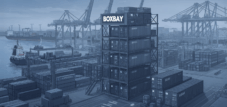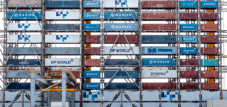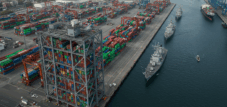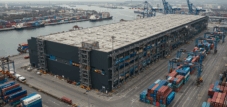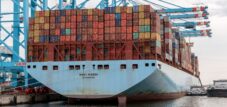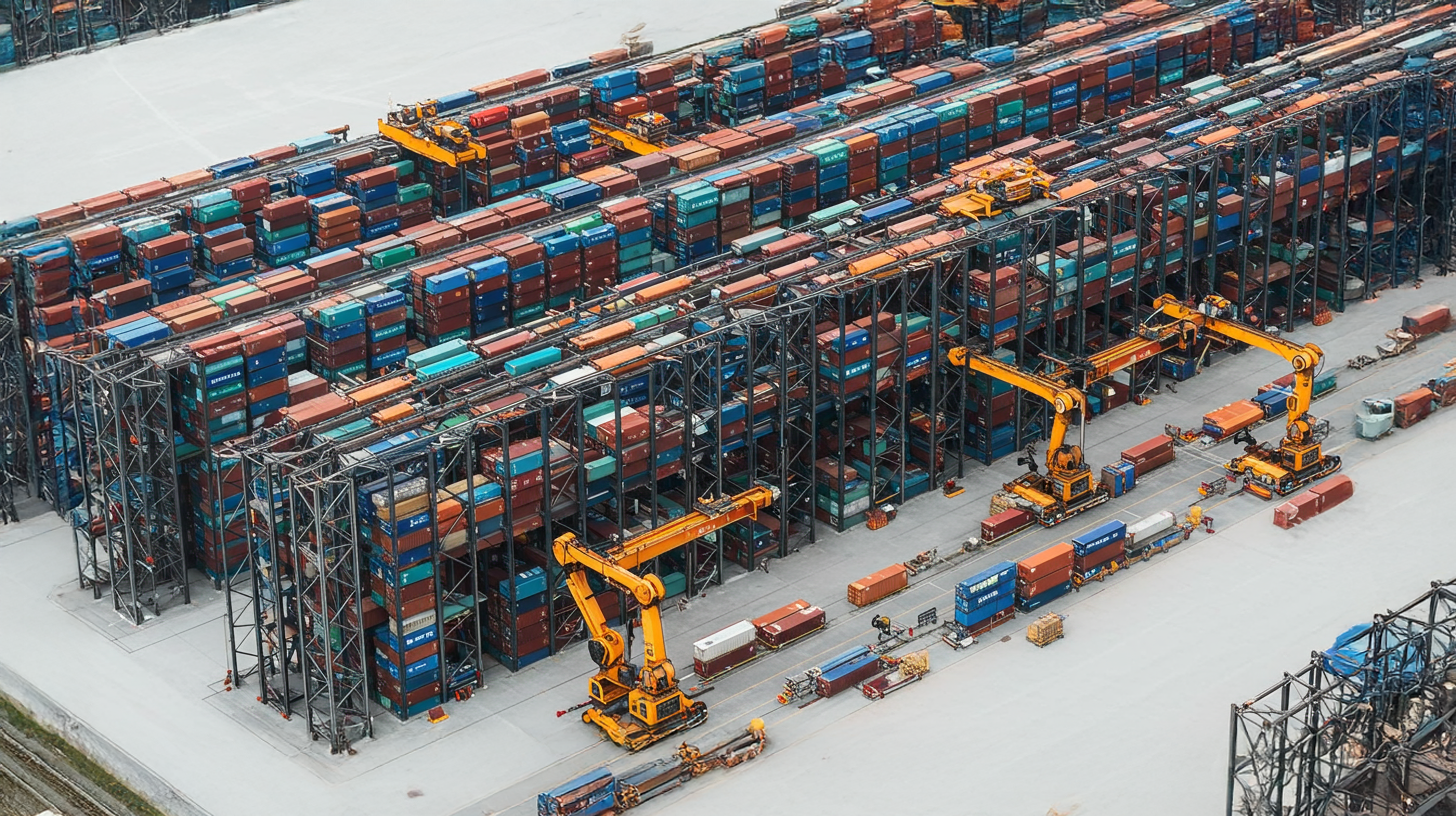
A comprehensive analysis of the automated high-bay container warehouse – Creative image: Xpert.Digital
A comprehensive analysis of the automated high-bay container warehouse by Konecranes and Pesmel
What is the fundamental challenge of traditional container storage and why are new solutions needed?
The traditional method of container storage in seaports and logistics centers faces fundamental challenges that increasingly limit its efficiency, safety, and scalability. The core problem lies in the block stacking system, where containers are stacked in blocks, often up to five or six layers high, using cranes or straddle carriers. This seemingly space-saving method creates significant operational inefficiencies. When a container is needed that is located at the bottom of a stack, all the containers above it must first be reshuffled. This process, known as "reshuffling" or "shuffle move," is extremely unproductive. Studies have shown that up to 60% of all crane movements in a conventional container yard are due to such unproductive reshuffling operations.
This inefficiency is not merely an isolated operational problem, but triggers a cascade of delays throughout the entire supply chain. An unproductive crane lift not only wastes time and energy for the terminal, but also causes the truck waiting for the container to stand idle, leading to congestion and longer processing times. This, in turn, can jeopardize the on-time departure of ships and delay the arrival of goods at distribution centers. The resulting unpredictability undermines the principles of modern just-in-time logistics and forces companies to maintain larger and more expensive buffer stocks to absorb supply uncertainties. Eliminating reshuffling is therefore not just a matter of optimization, but a strategic necessity to ensure the speed and resilience of global supply chains.
Another critical problem is the increasing scarcity of land. Large seaports are often located in densely populated urban areas where land is extremely expensive and scarcely available. Horizontal expansion of storage areas is therefore often economically or physically impossible. This creates a capacity bottleneck that hinders the growth of global trade volumes. Finally, traditional container yards are complex and potentially hazardous working environments. The intensive traffic of heavy equipment and the presence of numerous employees create a high risk of accidents, which can be minimized through automation solutions. The combination of operational inefficiencies, land scarcity, and safety risks makes it clear that fundamentally new approaches to container storage are needed.
Related to this:

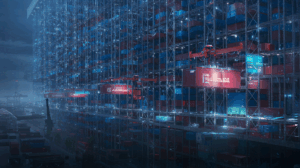
What is an automated high-bay container warehouse (HBS) and how does it address these challenges?
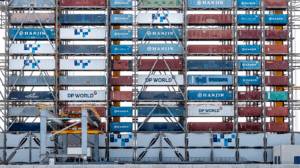
An automated high-bay container warehouse, often referred to as HBS (high-bay warehouse), represents a revolutionary alternative to traditional block stacking. It is a logistics system that stores standard shipping containers—typically 20-foot (TEU) or 40-foot (FEU) containers—in a high-density, vertical steel racking structure. Think of it as a giant, fully automated bookshelf for containers. Instead of stacking containers haphazardly on top of each other, each container is assigned a fixed, individually addressable racking location.
The storage and retrieval of containers is fully automated by specialized robotic systems, mostly rail-guided stacker cranes, which move in the aisles between the rows of racks. The key advantage of this system is direct and immediate access to every single container at any time. Time- and energy-intensive reshuffling is completely eliminated, meaning that 100% of crane movements are productive. This leads to a dramatic increase in handling speed and reliability.
Space efficiency
By consistently utilizing the vertical dimension with stacking heights of 7 to 18 layers, a high-bay stacker (HBS) can accommodate three to four times the number of containers on the same footprint. This allows ports to massively increase their capacity without having to develop new, expensive land.
Security
HBS systems are fully encapsulated and automated. The actual storage area is never entered by people, which drastically reduces the risk of workplace accidents.
sustainability
The systems are generally fully electric and can be powered by renewable energy. Many designs integrate photovoltaic systems on the large roof areas and utilize energy recovery systems (recuperation) during braking or load reduction. This enables CO₂-neutral or even energy-positive operation and significantly reduces noise emissions.
Perhaps the most profound change brought about by a Hardware Storage System (HBS) is the transition from "chaotic storage" to "deterministic storage." In a traditional yard, the effort required to access a specific container is variable and unpredictable. In an HBS, the time and energy needed to access any given container are constant and precisely calculable. This predictability is the fundamental prerequisite for the effective digitalization of port processes. It enables seamless integration into higher-level control systems such as Terminal Operating Systems (TOS) and the creation of precise digital twins. A digital twin, which accurately models the behavior of the physical system, in turn opens up possibilities for AI-supported optimization, predictive maintenance, and the simulation of complex operational scenarios. An HBS is therefore not just a hardware solution for space problems, but a fundamental platform for the intelligent control of the entire port logistics operation.
Related to this:
Who are Konecranes and Pesmel, and what core competencies does each company bring to the partnership?
The partnership behind Automated High-Bay Container Storage (AHBCS) unites two Finnish technology specialists whose expertise strategically complements each other to create a comprehensive solution for the automated container storage market.
Konecranes profile
Konecranes Oyj, headquartered in Hyvinkää, Finland, is a leading global manufacturer of lifting equipment and crane technology. The company, which traces its roots back to 1933 as part of the Kone Corporation and became an independent entity in 1994, is one of the world's largest crane manufacturers, producing approximately one in ten cranes worldwide. With around 16,800 employees in over 50 countries, Konecranes achieved record sales of €4.2 billion in 2024. Its business activities are divided into three segments: Industrial Equipment, Service, and Port Solutions.
The Port Solutions division is central to the partnership. It offers a full range of container handling equipment used in ports and terminals worldwide. This includes ship-to-shore (STS) cranes, rubber-tired (RTG) and rail-mounted (RMG) gantry cranes, straddle carriers, and reach stackers. Konecranes has proven expertise in automating these systems, as demonstrated by the successful implementation of automated RTG (ARTG) and RMG (ARMG) systems at leading terminals. The company invests heavily in research and development, as evidenced by its "Zero4" innovation program and more than 1,700 active and pending patents. Konecranes thus contributes its global market presence, established customer relationships in the port sector, and deep understanding of container handling requirements to the collaboration.
Pesmel profile
Pesmel Oy, founded in 1978, is a highly specialized company for automated material handling systems. The company focuses on demanding industries such as paper, metal, and tire manufacturing, where heavy and bulky goods must be handled with high precision and speed. Pesmel's core offering is the "Material Flow How®" concept, an integrated approach that combines handling, packaging, storage, and logistics into a seamless, comprehensive solution.
A key Pesmel technology is the automated high-bay warehouse, often based on the principle of "deep lane storage," which enables exceptionally high storage density. Pesmel delivers turnkey systems that include a proprietary warehouse management system (WMS). This WMS is designed to integrate seamlessly with customers' overarching enterprise resource planning (ERP) and manufacturing execution systems (MES) and can also control third-party equipment. With over 400 systems delivered worldwide, Pesmel has decades of experience in developing durable (up to 50-year lifecycle) and energy-efficient automation solutions. As a privately held company, Pesmel contributes its specialized automation technology and software expertise, proven in heavy industry, to the alliance.
The partnership
The cooperation, officially announced in January 2022, is based on a Memorandum of Understanding from November 2021. It represents a strategic symbiosis that enables both companies to penetrate the emerging market for container high-bay warehouses more quickly and with less risk than would have been possible for either company individually. For Konecranes, the partnership offers immediate access to proven high-bay warehouse technology without having to undergo a lengthy and risky in-house development process. They can leverage their global sales and service network to market a ready-made solution. For Pesmel, the cooperation is a force multiplier: through the Konecranes brand, they gain immediate credibility and access to the global port market, which would otherwise be difficult to penetrate. Konecranes contributes its market power and port expertise, while Pesmel provides the specialized automation technology. The marketing claim that this is not a “radically new technology” is a clever positioning strategy that builds on this synergy: It is Pesmel’s proven industrial automation applied to the port environment dominated by Konecranes.
What are the main technical components and operating principles of the Automated High-Bay Container Storage (AHBCS) system?
The Automated High-Bay Container Storage System (AHBCS) is a holistic system comprised of several closely integrated main components to ensure fully automated, efficient, and safe container storage operations. Its architecture combines robust steel structures with advanced crane technology and intelligent software control.
System components
steel shelving structure
The system is based on a robust, high-bay steel structure, equipped with a roof and side cladding to protect the stored containers from the elements. This structure can be implemented in two ways: as a freestanding rack within a separate building envelope, or as a rack-supported building, where the rack itself is part of the building's load-bearing structure – a construction method that Pesmel has already successfully implemented in other industries. The structures are designed for an exceptionally long service life, typically 50 years, and are precisely calculated and manufactured, taking into account local conditions such as temperature fluctuations, wind and snow loads, and seismic requirements.
Handling equipment
The core of the material handling system in the AHBCS consists of fully automated, electric overhead traveling cranes, responsible for storing and retrieving containers from the racking bays. Instead of traditional, massive stacker cranes serving an entire aisle, the concept relies on a more flexible system of fast-moving shuttle cranes. These shuttles, or "shuttle load-carrying devices," move within the racking aisles and can dynamically adjust their spacing to accommodate different container sizes, such as 20-foot or 40-foot containers. These shuttles work in conjunction with central lifting devices (lifts) that handle vertical transport. This architecture, designed for speed, flexibility, and redundancy, reflects Pesmel's experience in high-performance intralogistics. The failure of a single shuttle does not paralyze the entire aisle but only reduces the overall throughput, thus increasing system availability.
Container exchange zone
There is a dedicated zone for the interface with land-based traffic (trucks). Here, containers are loaded and unloaded by separate overhead cranes equipped with spreaders. This area is decoupled from the actual high-bay warehouse to ensure smooth and rapid truck handling.
Control system (WMS)
The brain of the entire system is a central warehouse management system (WMS) that coordinates and controls all processes. This is a core competency of Pesmel. Their proprietary WMS is designed to integrate seamlessly into the customer's IT landscape, particularly enterprise resource planning (ERP) and manufacturing execution systems (MES). The actual machine control at the lowest level is handled by proven programmable logic controllers (PLCs) from manufacturers such as Siemens (Simatic) or Rockwell (Allen-Bradley). A key component of the Pesmel approach is the intensive use of simulation and digital twins. These tools are employed as early as the planning phase to validate the system layout, identify bottlenecks, and virtually commission the WMS functionality before the first steel beam is even installed.
Your intralogistics experts
Consulting, planning and implementation of complete solutions for high-bay warehouses and automated storage systems - Image: Xpert.Digital
More information here:
Intelligent container buffer storage
What specific performance characteristics, such as stacking height and handling speed, distinguish the AHBCS?
The ABHCS from Konecranes and Pesmel is defined by a number of specific performance characteristics that position it for use in modern logistics and distribution centers. These characteristics relate to its physical dimensions, operational speed, and ability to meet specific requirements.
Stacking height
The system is designed for a considerable stacking height of up to 14 layers. This enables extremely high storage density and maximizes capacity on a given footprint. Compared to other systems on the market, the AHBCS is thus positioned in the upper range. It surpasses, for example, the Boxbay system, which is designed for 11 layers, but falls short of the theoretical maximum heights specified by suppliers such as ZPMC (up to 18 layers) or Amova (structures up to 50 meters high).
Access time and throughput
A key performance promise is speed. The system allows direct access to every single container in less than 5 minutes. This fast and, above all, predictable access time is a fundamental advantage over traditional yards. Combined with the elimination of unproductive restacking operations, the system is designed to enable up to 75% higher throughput. Truck turnaround time is reduced to just a few minutes, preventing congestion in the terminal area and drastically improving the efficiency of landside logistics.
Load capacity and temperature range
The system is designed for handling containers with a payload of up to 18 tons. A particularly noteworthy feature, however, is its ability to operate in refrigerated environments at temperatures as low as -28°C. The combination of these features, especially the ability to store refrigerated containers (reefer containers) at extremely low temperatures, positions the AHBCS as a highly specialized premium solution. While the storage of standard dry containers is a low-margin, high-volume business, handling reefer containers places higher technical demands (e.g., on power supply, temperature monitoring, and material resistance) and is associated with higher margins. The ability to operate at -28°C presents a significant technical challenge in terms of material embrittlement, lubrication, and electronic reliability, and represents a clear differentiator in the market. Therefore, the AHBCS is not only aimed at the mass storage of dry cargo but also, and especially, at value-added logistics chains such as those found in the pharmaceutical or food industries. In these sectors, the reliability of the storage system has a direct impact on the value of the stored goods, and a system failure could mean the loss of goods worth millions. This justifies the higher investment costs and positions the AHBCS not only as a space saver but as an integral part of a quality-assured cold chain.
Related to this:
In what way is the direct connection to distribution centers a unique selling point of the ABHCS?
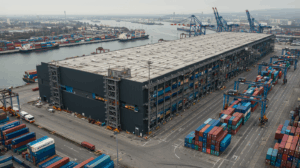
A key and innovative feature that sets Konecranes and Pesmel's ABHCS apart from many other HBS concepts is its explicitly designed direct connection to adjacent distribution centers or production halls. This seamless integration goes beyond simply optimizing warehousing at the port and creates a new level of supply chain integration.
The concept involves physically connecting the high-bay warehouse directly to the loading docks of a warehouse or factory. This enables so-called "goods-to-hall" scenarios. A container arriving by ship or truck is not only temporarily stored in the HBS, but can also be transported fully automatically and without further manual intervention directly to the correct loading bay of the adjacent building. This approach eliminates the traditional intermediate step of transporting a container from the yard storage area to the distribution center by truck. The advantages are obvious: significant savings in time, transport costs, and CO₂ emissions. This seamless connection between the logistics of incoming and outgoing containers and internal distribution processes is a key selling point of the AHBCS.
This feature fundamentally shifts the function of the HBS. It transforms from a passive "buffer warehouse" in the port into an active "sorting and sequencing center" for the customer's intralogistics. It becomes the physical manifestation of a fully integrated supply chain. A traditional HBS optimizes the port operator's processes; the container is handed over to them and later picked up again. The AHBCS with direct connectivity extends the system's control and optimization scope all the way to the customer's loading dock.
Pesmel's expertise in industrial material flow control plays a crucial role here. Their warehouse management system (WMS) is designed to manage complex material flows in factories. It can therefore not only track the location of a container, but also, based on the customer's production or picking schedules, determine precisely when that container is needed at which specific dock. This enables true just-in-time delivery directly from the shipping warehouse to the production line.
This functionality fundamentally changes the value chain. Customers no longer simply purchase storage space, but rather an on-demand container delivery service directly to their factory gate. This makes the ABHCS particularly attractive for companies with large logistics or production facilities near ports, such as major retailers, automotive manufacturers, or e-commerce giants. It enables them to link their internal logistics processes directly and seamlessly with global maritime transport, thus achieving a new level of efficiency and predictability.
How does the AHBCS position itself in comparison to competing systems?
The market for automated high-bay container storage (HBS) systems is still young, but already characterized by several top-tier suppliers with different technological approaches and strategic focuses. The AHBCS from Konecranes and Pesmel positions itself in this competitive environment with a unique combination of proven technology and an innovative integration concept.
A comparative analysis of the main players reveals the different profiles:
Boxbay (a joint venture between DP World and SMS Group): This system, already in operation in Jebel Ali, Dubai, stacks containers up to 11 layers high. It utilizes fully automated storage and retrieval systems and places a strong emphasis on maximum space savings (same capacity in one-third of the area) and sustainability, including the installation of solar panels on the roof. The primary focus is on optimizing terminal operations for the port operator.
Amova (part of the SMS Group): Amova brings decades of experience from the metal industry and specializes in heavy-duty storage and retrieval systems (HBS) for extremely heavy loads (up to 50 tons). Their systems can theoretically reach heights of up to 50 meters and utilize very robust, rail-guided stacker cranes. The theoretical storage density is extremely high, exceeding 160,000 TEU per hectare per year.
LTW Intralogistics (part of the Doppelmayr Group): This Austrian provider is known for customized intralogistics solutions. They also offer container HBS for loads up to 18 tons and, similar to the AHBCS concept, have particular expertise in the construction of deep-freeze warehouses (down to -28°C).
ZPMC (Shanghai Zhenhua Heavy Industries): The Chinese giant in port infrastructure construction is developing an "automated stereoscopic empty container storage system" for the port of Ningbo-Zhoushan. This system stacks containers nine layers high and initially targets the specific, but high-volume, market segment of empty containers.
The following table summarizes the most important features:
The AHBCS compared to competing systems
Compared to competing systems, the automated high-bay container storage system (AHBCS) from Konecranes and Pesmel exhibits several remarkable features. Its maximum stacking height of 14 layers and the use of shuttle cranes and lifts make it particularly noteworthy. A unique selling point is its direct connection to distribution centers and its ability to store goods at extremely low temperatures down to -28°C.
Other providers, such as Boxbay, also rely on high-bay warehouse concepts and can triple storage capacity on the same footprint, placing a particular emphasis on sustainability. Amova, in turn, specializes in high-performance solutions with stacker cranes that can handle heavy loads of up to 50 tons and enable storage levels of up to 50 meters.
LTW Intralogistics offers flexible container storage systems with customized solutions, while ZPMC focuses on storing empty containers in a stereoscopic system with rail-mounted cranes. Each provider brings its own technological innovations and specializations to the automated storage systems market.
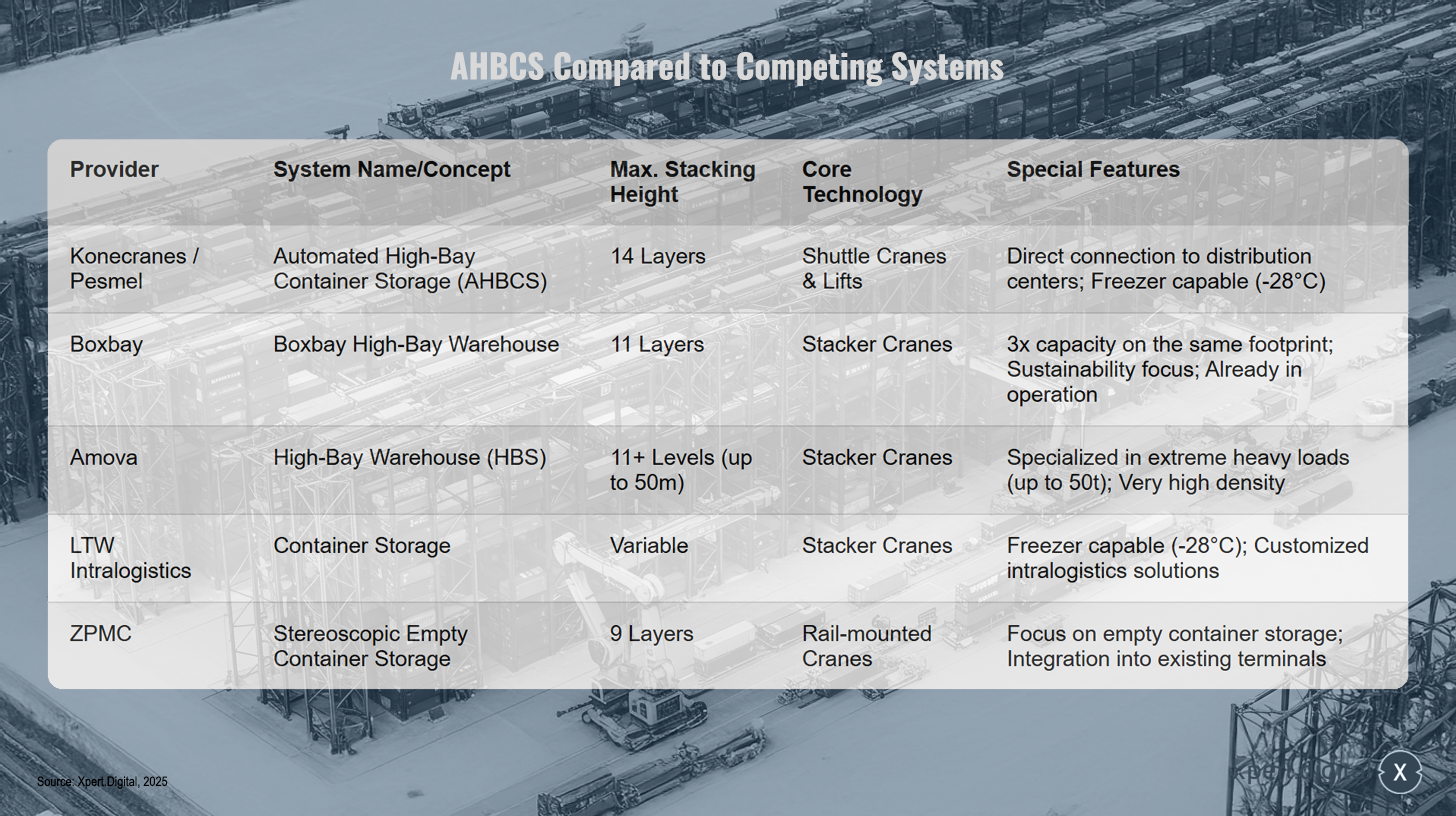
The ABHCS compared to competing systems – Image: Xpert.Digital
This comparison clearly shows that the HBS market is segmented into different use cases. While Boxbay and Amova primarily focus on maximizing density and throughput within the terminal, and ZPMC serves a niche segment, Konecranes and Pesmel's ABHCS is uniquely positioned at the intersection of port logistics and industrial intralogistics. Their "goods-to-warehouse" concept addresses a hybrid customer: the port operator and the owner of the adjacent distribution center. They sell not just a warehousing solution, but an end-to-end supply chain solution. This positioning presents a significant opportunity, as it promises higher value creation potential and deeper customer loyalty. At the same time, it poses a challenge, since the projects require complex coordination between multiple stakeholders (port, logistics company, end customer).
Your dual-use logistics experts

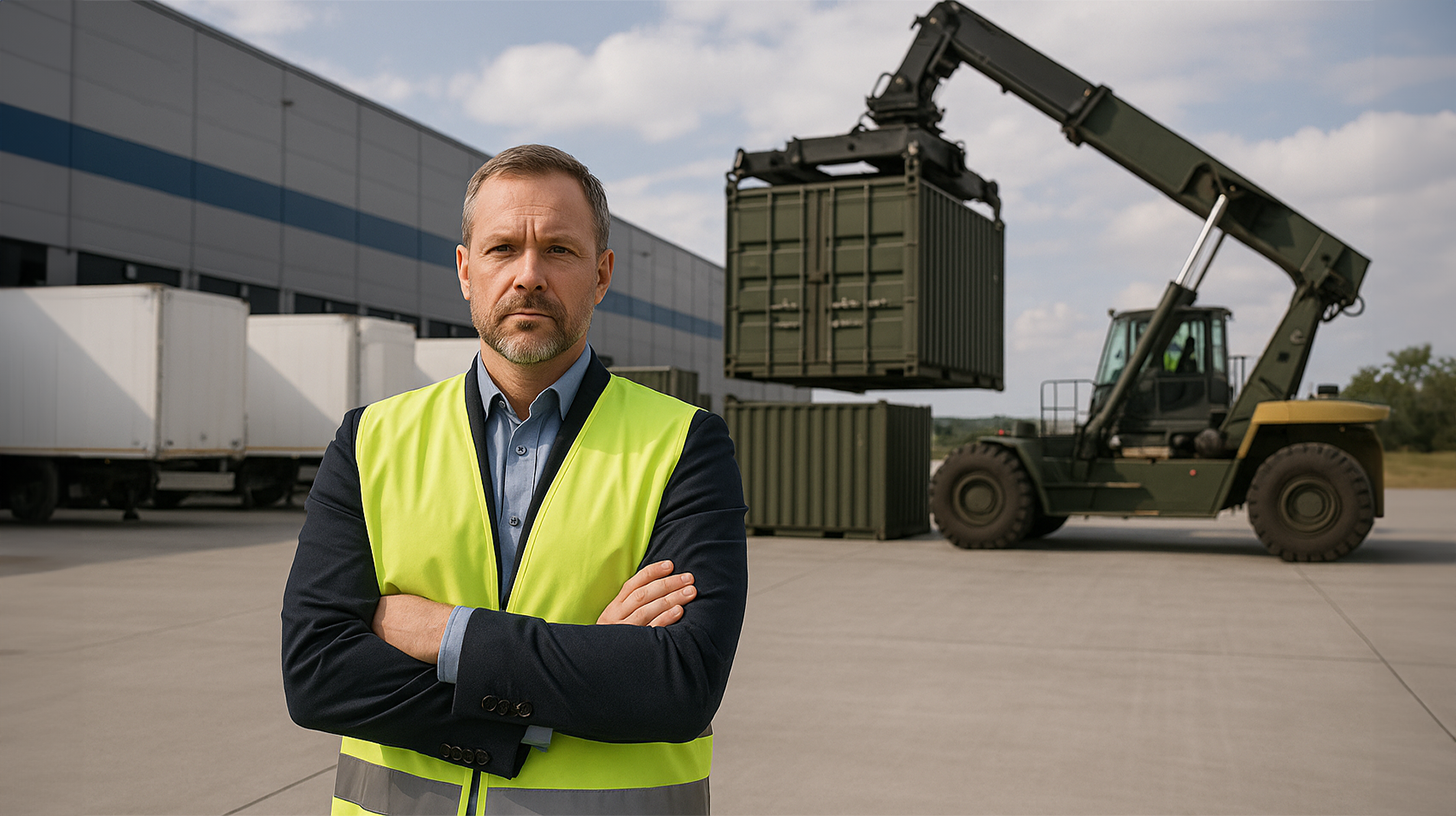
Dual-use logistics experts - Image: Xpert.Digital
The global economy is currently undergoing a fundamental transformation, a watershed moment that is shaking the foundations of global logistics. The era of hyper-globalization, characterized by the relentless pursuit of maximum efficiency and the "just-in-time" principle, is giving way to a new reality. This new reality is marked by profound structural breaks, geopolitical power shifts, and increasing fragmentation of economic policy. The once taken-for-granted predictability of international markets and supply chains is dissolving and being replaced by a period of growing uncertainty.
Related to this:
Container Handling 4.0: The smart way to ultra-functional port logistics
What quantifiable advantages does AHBCS offer in terms of space efficiency, operating costs, and throughput?
Automated high-bay container storage (AHBCS) promises a number of significant and quantifiable benefits that directly impact the efficiency and performance of logistics operations. These benefits relate to the three core areas of space efficiency, operating expenses (OPEX), and throughput.
Space efficiency
Perhaps the most dramatic advantage is the reduction in space requirements. Through consistent vertical storage in up to 14 layers, the system can reduce the space needed for containers by up to 80%. This massive space saving has far-reaching strategic implications. It allows ports and distribution centers to significantly increase their capacity on existing sites without having to acquire expensive and scarce land or relocate. Land, one of the biggest cost centers, is thus used far more efficiently.
Operating and investment costs (OPEX/CAPEX)
Konecranes emphasizes that AHBCS leads to lower total cost of ownership (CAPEX/OPEX). This is due to several factors. On the OPEX side, the complete elimination of unproductive restacking movements results in a dramatic reduction in energy consumption. The all-electric drives are inherently more efficient than diesel generators and can be further optimized through energy recovery systems. A Konecranes case study from another industry illustrates the potential: After installing new, more efficient cranes, maintenance costs decreased by 80% and the facility's overall electricity consumption by 12%. Automation also reduces the need for operational personnel. On the CAPEX side, while the investment in the technology itself may be high, this is offset by the massive savings in land costs and the potentially smaller number of handling devices required compared to a conventional yard.
Throughput and efficiency
The system is designed for maximum performance. With 100% of movements being productive, an increase in overall throughput of up to 75% is projected. A key advantage is that this performance is predictable and consistent, regardless of the warehouse's fill level. In traditional yards, performance often drops significantly at high fill levels, as the likelihood of costly restacking increases. AHBCS, on the other hand, maintains its high throughput. This results in drastically reduced truck turnaround times, eliminating yard congestion and improving the efficiency of the entire landside logistics chain.
The true financial leverage of ABHCS lies not only in direct cost reduction, but also in increased facility productivity and the development of new revenue streams. The 80% reduction in land area means that a port operator can utilize the freed-up space for other, more value-added activities, such as logistics services, repair centers, or even additional berths. The land is transformed from a mere cost center into a productive asset. Simultaneously, the higher and, above all, predictable throughput enables the handling of more vessels in less time and also allows for more efficient servicing of the ever-larger Ultra Large Container Ships (ULCS). This directly increases revenue per berth and per square meter of terminal area. A comprehensive cost-benefit analysis must therefore go beyond a simple CAPEX/OPEX comparison and quantify these strategic advantages, which represent an investment in growth and long-term competitiveness.
Related to this:
What are the potential challenges and risks involved in implementing an AHBCS?
Implementing a complex, highly automated system like the AHBCS involves significant challenges and risks that extend beyond purely technical aspects. Careful planning and comprehensive risk management are essential for the success of such projects.
High initial investment (CAPEX)
Constructing an automated high-bay warehouse is extremely capital-intensive. The costs for the massive steel structure, the precision crane technology, the automation hardware, and the complex control software represent a significant financial hurdle. Financing and the long-term amortization of this investment must be carefully planned.
System complexity and integration
The technical complexity is enormous. Seamlessly integrating the HBS into the customer's existing IT infrastructures, such as the Terminal Operating System (TOS) or the Enterprise Resource Planning (ERP) system, is a critical challenge. This requires intensive collaboration and coordination between the provider (Konecranes/Pesmel) and the customer's internal IT and operations teams to avoid data inconsistencies and interface problems.
Maintenance and technical reliability
As with any high-tech system, technical problems or failures can lead to costly downtime. A high-performance building system (HBS) requires regular, planned, and preventative maintenance to ensure high system availability. Providers like Pesmel address this risk with comprehensive service and maintenance contracts, often including 24/7 support. Nevertheless, the risk of an unforeseen failure of a critical component remains.
Fire protection and insurance
Automated high-bay warehouses pose a significant fire risk. The high storage density, the enormous fire loads within the containers, and the proximity of electrical ignition sources (motors, electronics) to potentially flammable materials necessitate sophisticated fire protection concepts. These typically include sprinkler systems in each individual racking aisle, smoke and heat detectors, and a clear fire response strategy. Insurers scrutinize these risks closely and often impose stringent requirements. This can lead to high insurance premiums. The greatest financial risk is the potential business interruption following a major fire, as restoring such a complex system can take an extremely long time.
Limited operational flexibility
A HBS (High-Benefit System) is optimized for specific, predefined parameters. It can struggle to respond flexibly to unforeseen changes, such as a sudden, massive increase in containers with different dimensions or weight classes, if these were not considered in the original design.
Perhaps the greatest, and often underestimated, risk is not technical, but organizational. Implementing an AHBCS requires a fundamental shift in operational philosophy – from reactive, manually controlled processes to proactive, fully data-driven operations. A traditional container yard is often managed reactively; problems are solved as they arise. A fully automated HBS, on the other hand, requires that all relevant data – from ship arrivals and truck time slots to the exact container contents – be accurate and available in the system in advance. The "garbage in, garbage out" principle applies here to an extreme degree. An error in the input data can disrupt the entire automated logic chain. This necessitates a cultural shift throughout the entire company: planning processes must be more disciplined, data quality impeccable, and collaboration between departments (operations, IT, sales) seamless. Therefore, implementation failure is often less attributable to a technical fault in the crane than to a flaw in the organizational process that "feeds" the system. Investing in an AHBCS is therefore inextricably linked to investing in the digital transformation and change management of the entire company.
How is the ABHCS concept positioned to integrate into future “smart port” ecosystems?
The concept of the Automated High-Bay Container Warehouse (AHBCS) is not only a response to today's challenges in port logistics, but is designed from the ground up to seamlessly integrate into future "Smart Port" ecosystems and even actively shape them. A "Smart Port" utilizes a network of digital technologies such as the Internet of Things (IoT), Big Data, Artificial Intelligence (AI), and digital twins to automate processes, maximize efficiency, and improve sustainability.
The AHBCS is essentially a cyber-physical system and therefore a natural component of a smart port. Its central warehouse management system (WMS) acts as an intelligent data hub, designed to connect and exchange data with any higher-level terminal operating system (TOS). The simulation models and digital twins that Pesmel used extensively during the design phase provide the perfect foundation for creating an operational digital twin of the warehouse during ongoing operations. Such a digital twin—a real-time virtual replica of the physical warehouse—makes it possible to monitor, analyze, and optimize operational processes. It can be used for predictive maintenance by detecting wear patterns before a failure occurs. It can feed data to AI algorithms to develop optimal warehouse strategies, or it can be used to simulate malfunctions and train personnel.
Furthermore, the AHBCS perfectly aligns with the sustainability goals of modern ports (“Green Port Initiatives”). Its all-electric design, the potential for integrating solar energy on its large roof surfaces, and the significant reduction in noise and local emissions directly contribute to decarbonization and improved acceptance in urban environments.
Ultimately, the AHBCS is not just a passive participant in a smart port, but an active enabler. It solves the fundamental problem of the physical disorder and unpredictability of a traditional container yard. Applying effective AI optimizations or a precise digital twin to a chaotic system with unreliable processes and data is extremely difficult. The AHBCS, on the other hand, creates a controlled, lab-like environment on an industrial scale. Every movement is digitally recorded, every state is known, and every process time is measurable and predictable. This structured and data-rich environment is the "data goldmine" that fuels advanced digital applications. Based on this perfect data, AI can learn to optimize storage strategies—for example, by automatically placing containers that will soon be needed near the exits—or minimize energy consumption through intelligent control of crane movements. The deterministic and automated nature of the system also creates the precise and predictable interfaces that are essential for integrating future technologies such as autonomous truck fleets or automated guided vehicles (AGVs). Investing in an AHBCS is therefore not just an investment in steel and cranes, but also in creating a high-quality data infrastructure that multiplies the value of future investments in AI and digitalization.
What is the final expert assessment of the potential and market position of the AHBCS from Konecranes and Pesmel?
The Automated High-Bay Container Storage System (AHBCS), the result of the strategic partnership between Konecranes and Pesmel, represents a highly competitive and sophisticated solution in the emerging, yet still young, market for automated container storage. Its market position and potential stem from a synthesis of its technological features, the strength of the partners, and its unique strategic focus.
The strength of the offering undoubtedly lies in the credible combination of the partners' respective core competencies. Konecranes contributes its global market power, decades of experience, and established customer relationships in the port sector. Pesmel provides the technological substance in the form of automation technology for high-bay warehouses, proven and tested in heavy industry, complete with a sophisticated software and control system. This synergy minimizes development risk and maximizes speed of market entry.
The key differentiator of the AHBCS is its "goods-to-warehouse" concept. By bridging the physical and procedural gap between port logistics and the intralogistics of distribution centers or production facilities, it addresses a new, hybrid market. It shifts the focus from pure warehouse space optimization to creating a seamless end-to-end supply chain solution. Combined with its specific technical performance characteristics, particularly its ability to store refrigerated containers at -28°C, the AHBCS clearly positions itself in the premium segment for value-added, quality-sensitive logistics chains.
The biggest challenges to widespread market acceptance are the high initial investment and the immense organizational complexity of implementation. An AHBCS project is not simply a sale of standard equipment; it is a profound transformation project that requires a fundamental shift in the customer's operational processes and corporate culture.
In summary, the success of AHBCS will depend less on sheer technological superiority—as competitors also have strong offerings—than on Konecranes and Pesmel's ability to successfully manage these complex, turnkey projects. A project integrating the systems and processes of a port, a logistics center, and potentially a production hall is exponentially more complex than installing equipment in a self-contained terminal area. It demands in-depth consulting, planning, and project management skills more akin to those of a large IT systems integrator than a traditional mechanical engineering firm. The partnership must demonstrate its ability to deliver not just hardware and software, but seamless, integrated project delivery from initial simulation to long-term maintenance and optimization. While AHBCS's market position is technologically and strategically strong, its ultimate success will hinge on excellence in the execution and management of these transformative projects. It is a test not only for the technology, but for the strategic alliance itself.

Xpert.Plus Warehouse Optimization - High-bay warehouses and pallet warehouses: Consulting and planning
We are here for you - Consulting - Planning - Implementation - Project Management
☑️ Our business language is English or German
☑️ NEW: Correspondence in your native language!

Konrad Wolfenstein
I and my team are happy to be available to you as your personal advisor.
You can contact me by filling out the contact form here wolfenstein@xpert.digital:or simply call me at +49 7348 4088 965. My email address is
I'm looking forward to our joint project.