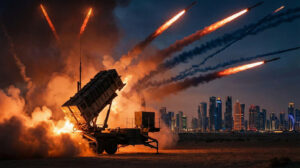
Stock market crash | Asian stock markets in free fall: The global nightmare begins – The Iran conflict is shaking the global financial system – Image: Xpert.Digital
“Bloodbath in the markets”: Are we currently witnessing the beginning of the next major global economic crisis?
Operation Epic Fury: The secret CIA plan in Iran and its consequences for the stock market
Following coordinated attacks by the US and Israel on Iran, Asian stock markets are plummeting into a historic bloodbath, while the price of gold is soaring to new all-time highs in a panic. At the epicenter of this geopolitical earthquake lies the Strait of Hormuz: Iran's threat to block the world's most vital oil pipeline is fueling fears of a devastating energy crisis and plunging Western central banks into an almost impossible dilemma between fighting inflation and the threat of recession. Meanwhile, reports are mounting of covert CIA operations that could escalate the conflict into an uncontrollable conflagration. Learn about the three scenarios now facing the global economy and what this historic turning point means for markets, supply chains, and consumers.
Related to this:


When bombs fall, stock prices plummet – and the next oil crisis is already knocking at the door
On February 28, 2026, the coordinated attacks by the US and Israel on Iran marked the beginning of a new era in global financial markets. What Washington calls "Operation Epic Fury" and Israel "Operation Roaring Lion" triggered a chain reaction within days, its effects felt from the trading floors of Tokyo and Seoul to Frankfurt and New York. The killing of Iranian Supreme Leader Ali Khamenei, the destruction of nuclear facilities, and the Iranian retaliation with missile attacks on US bases in six Gulf countries set in motion a geopolitical spiral of escalation, the economic consequences of which are only beginning to emerge. Simultaneously, reports are mounting that the CIA intends to arm Iranian Kurdish forces in order to bring about regime change in Tehran—a historically high-risk undertaking that could further intensify the conflict.
Related to this:
Asian stock markets in free fall: A “bloodbath” of historic proportions
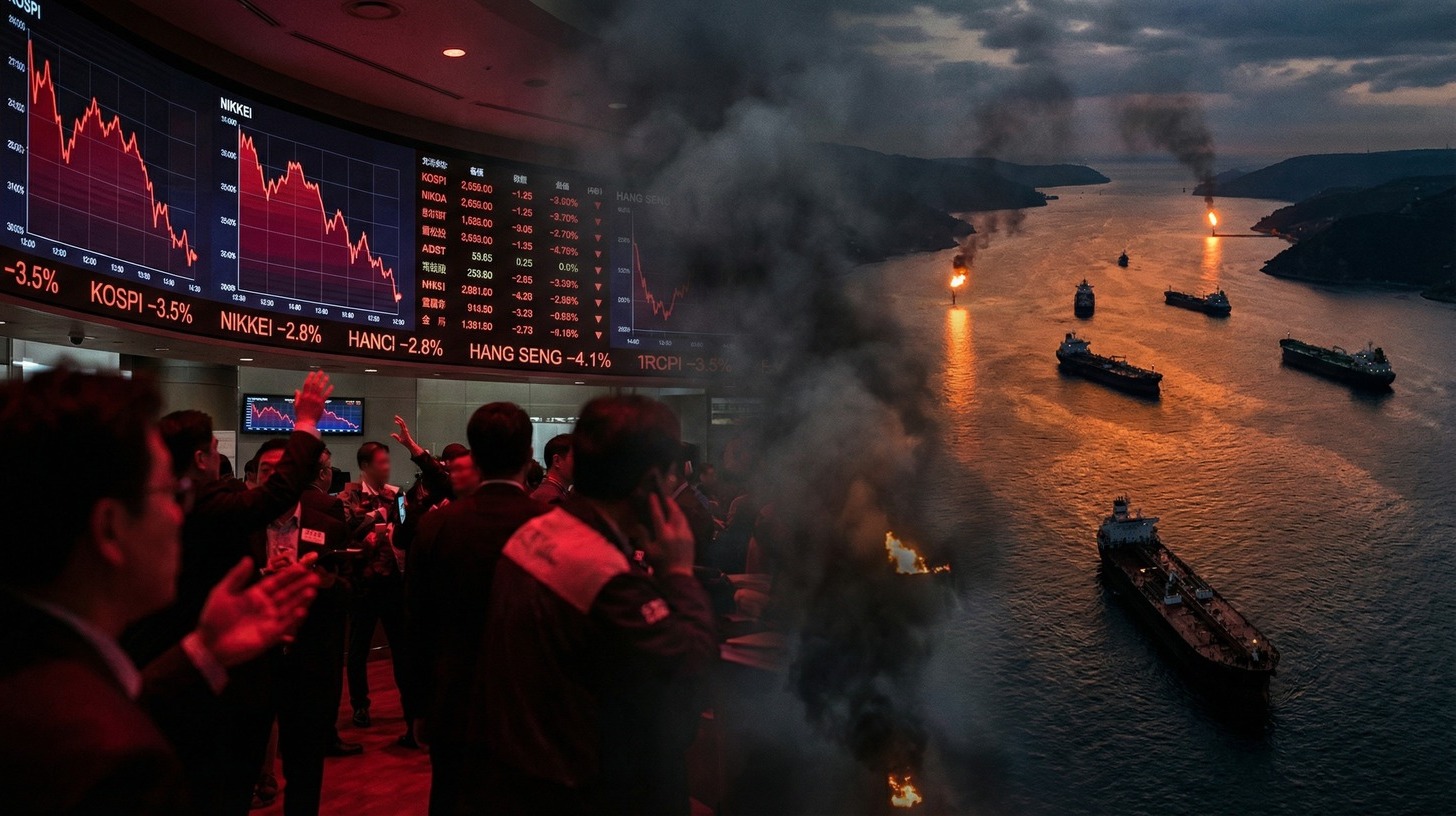
Asian stock markets suffered losses in the first trading days after the outbreak of war, losses so dramatic they recalled the darkest chapters of financial history. South Korea's benchmark KOSPI index plunged 12.1 percent on Wednesday to 5,093 points, surpassing even the percentage drop of September 11, 2001, and the crash during the 2008 global financial crisis. The Korea Exchange had to temporarily suspend trading after the so-called circuit breaker was triggered when the index exceeded an eight percent threshold. The tech-heavy KOSDAQ also fell by almost 14 percent.
The losses were particularly concentrated in the semiconductor sector, the former driving force of the Korean market. Samsung Electronics, the company that had benefited just weeks earlier from global demand for artificial intelligence chips, lost 11.7 percent of its market value. Rival SK Hynix fell 9.6 percent. The situation was exacerbated by the news that Samsung had once again postponed mass production at its new semiconductor factory in Taylor, Texas, until 2027. Shipping and logistics companies such as Pan Ocean, HMM, and KSS Line plummeted between 17 and 19 percent, as the Strait of Hormuz shutdown directly threatens their business models.
That South Korea is being hit so hard is no coincidence. The country imports 98 percent of its fossil fuels. The KOSPI had surged by more than 40 percent in the first two months of 2026, fueled by the global AI boom that propelled Korean chip stocks to dizzying heights. This abrupt crash after such a steep rally intensifies the downward pressure, as leveraged investors are forced to sell due to margin calls, further increasing the downward pressure.
In Tokyo, the Nikkei 225 index fell 3.9 percent to close at 54,059 points, its lowest level in months. Like South Korea and Taiwan, Japan is heavily reliant on oil and gas imports from the Persian Gulf, making the index particularly vulnerable to disruptions in supply routes there. Hong Kong's Hang Seng index dropped 2.9 percent to 25,023 points, while the Shanghai Composite fared relatively well, falling 1.2 percent to 4,074 points. Taiwan's Taiex lost 4.4 percent, and the Bangkok Stock Exchange plunged 8 percent. The broad MSCI index of Asia-Pacific stocks excluding Japan declined 1.5 percent, extending its losing streak to two days.
The oil bottleneck in the Persian Gulf: Why the Strait of Hormuz holds the world in suspense
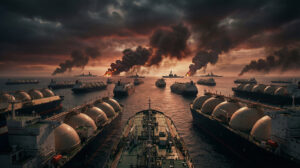
The Strait of Hormuz is the true epicenter of the economic shockwaves of this war. Approximately 20 million barrels of crude oil flow through this narrow strait, only about 33 kilometers wide, at the entrance to the Persian Gulf, representing roughly one-fifth of global oil consumption. Following the attacks, Iran has declared the strait closed and threatened to fire on any ship attempting to pass through. Around 3,000 ships normally transit the strait each month, including supertankers transporting crude oil and liquefied natural gas from Saudi Arabia, Iraq, Kuwait, Qatar, and the United Arab Emirates to consumer markets in Asia and Europe.
The immediate impact on the energy market was dramatic. The price of Brent crude temporarily surged to $85.54 per barrel, its highest level since July 2024. Since the start of the war, both oil grades have risen between eight and nine percent. Charter costs for supertankers from the Middle East to China reached a record high of more than $400,000 per day. Insurance premiums for the Persian Gulf rose by 50 percent, with major insurers already announcing cancellations of war risk coverage effective March 5.
Investment bank Bernstein raised its 2026 oil price forecast from $65 to $80 per barrel and warned that in the extreme case of a prolonged conflict, prices of $120 to $150 were even possible. Commerzbank anticipates oil prices exceeding $100 if the Strait of Hormuz is completely blocked, reducing supply by 20 percent. Such a scenario would be devastating for the global economy. China obtains roughly half of its crude oil imports through the Strait of Hormuz, and a sustained disruption of these supplies could severely impact the industrial production of the world's second-largest economy. The Gulf states, whose government revenues derive 30 to 90 percent from oil and gas exports, would face a fiscal crisis.
Europe and Wall Street: Between shock and flight to safe havens
The German stock market felt the full force of the shockwaves. The DAX lost 3.44 percent on Tuesday, closing at 23,790 points, after having temporarily dropped more than 1,000 points. The significant fall below the 100- and 200-day moving averages also considerably clouded the long-term technical picture. After just two sharp days of losses, the gains since the beginning of the year had turned into a clear loss. Stocks particularly dependent on economic cycles and commodities suffered disproportionately: Siemens lost 5 percent, Deutsche Bank 5.4 percent, and BASF, which needs crude oil for its production, fell 2.7 percent. Bucking the trend, only defense stocks like Rheinmetall, which rose by 5.3 percent, managed to gain ground. Deutsche Börse also benefited from increased trading activity and was among the few winners.
Trading on Wall Street was initially less dramatic, but the nervousness was palpable. The S&P 500 closed Tuesday down 0.9 percent at 6,816 points, after having plunged as much as 2.5 percent earlier in the day. The Dow Jones Industrial Average lost 0.8 percent to close at 48,501 points, and the Nasdaq Composite fell 1 percent. The relatively moderate losses on Wall Street mask the underlying uncertainty. Analysts point out that in recent years, US markets have been so fixated on technological narratives that geopolitical risks have been systematically undervalued. The crash in Asia could be a harbinger of what awaits Western markets should the conflict escalate further.
Gold at an all-time high: The flight to the last safe haven
The historic escalation has catapulted the price of gold to levels that were considered unthinkable just a few months ago. On February 28, the day of the first attacks, the price of gold broke the $5,300 mark per troy ounce for the first time in history, after rising by more than $200 in just a few hours. This move was no ordinary price increase, but a panicked flight to safety as investors realized the full implications of a direct military conflict between the world's largest economy and a major oil-producing nation.
Gold had already staged a remarkable rally before the escalation, gaining around 22 percent since the beginning of the year – its longest winning streak since 1973. JPMorgan analysts now expect gold to rise to $6,300 by the end of 2026. Other forecasters consider prices of $5,500 to $6,000 realistic in the event of further escalation, with some particularly bullish scenarios reaching as high as $8,000. The asymmetry of the potential outcomes clearly favors the gold price: while a swift end to the conflict would consolidate gains, any escalation could drive the price to previously unimaginable heights.
Our global industry and economic expertise in business development, sales and marketing

Our global industry and economic expertise in business development, sales and marketing - Image: Xpert.Digital
Industry focus areas: B2B, digitalization (from AI to XR), mechanical engineering, logistics, renewable energies and industry
More information here:
A thematic hub offering insights and expertise:
- Knowledge platform covering global and regional economies, innovation and industry-specific trends
- A collection of analyses, insights, and background information from our key areas of focus
- A place for expertise and information on current developments in business and technology
- A hub for companies seeking information on markets, digitalization, and industry innovations
Like in the 70s? That's why the fear of stagflation is suddenly real – the interest rate turnaround has been cancelled and why the oil price is now changing everything
Central banks in a dilemma: Between fighting inflation and the risk of recession
The Iran war has created a nightmare scenario for the world's major central banks. Just a few weeks ago, the Federal Reserve was facing the prospect of further interest rate cuts after the yield on ten-year US Treasury bonds fell below 4.0 percent for the first time since November. But with the sharp rise in oil prices, the situation has dramatically changed. Money markets now expect the first rate cut no earlier than September, instead of June as previously anticipated. Some economists are even speculating that the Fed might be forced to raise interest rates again if the oil shock persists.
Every $10 increase in the price of oil can raise inflation by 0.2 to 0.4 percentage points, as calculated by Scott Anderson of BMO Capital Markets. With oil prices remaining consistently above $100, the disinflation the Fed has worked so hard to achieve would be wiped out in one fell swoop. Adding to the US's woes is the fact that roughly 33 percent of all outstanding marketable government debt will need to be refinanced within the next 12 months, likely at higher interest rates than when it was originally issued.
The European Central Bank (ECB) also faces an uncomfortable conflict of objectives. ECB Chief Economist Philip Lane warned that a prolonged war could fuel inflation in the eurozone and slow economic growth. Internal ECB analyses indicate that a sustained rise in oil prices of this magnitude could increase inflation by 0.5 percentage points and dampen growth by 0.1 percentage points. Commerzbank Chief Economist Jörg Krämer even anticipates that, in the risk scenario of a prolonged conflict, inflation in the eurozone could rise from its recent 1.7 percent to almost 3 percent, which would mean a noticeable loss of purchasing power for consumers. The parallels to the stagflation of the 1970s, when high oil prices simultaneously caused inflation and economic stagnation, are striking.
Related to this:
The Metzler Model: Three Scenarios for the Global Economy
In a remarkable analysis, the Frankfurt-based private bank Metzler has outlined three possible development paths for the global economic consequences of the conflict. In the moderate scenario A, the oil price stabilizes in the range of $80 to $90 per barrel. In this case, inflation would receive a temporary boost, and growth would be slowed but not stifled. The picture of a robust, if not euphoric, global economy would remain intact.
In scenario B, with an oil price between $90 and $100, the situation becomes more critical. This range represents a macroeconomic threshold beyond which the inflation path becomes "stickier," real incomes fall, and central banks find themselves in a genuine dilemma. For the eurozone, which had recently signaled upward trends, this would be the classic exogenous damper, not necessarily ending the upswing, but noticeably flattening it.
In the extreme scenario C, with an oil price above $100, a supply shock triggers a stagflationary sequence: high inflation, low growth. The probability of a recession in importing regions increases significantly, and emerging economies with current account deficits become vulnerable. Clemens Fuest, president of the ifo Institute in Munich, offered a more nuanced assessment in an initial analysis, arguing that the global economy is less dependent on the region today than it was in the 1970s. However, this assessment dates back to the early hours of the conflict, when the full escalation was not yet foreseeable.
Secret service shadow wars: The CIA and Kurdish calculations
Alongside the open military confrontation, a second, covert front is emerging. According to reports by the US broadcaster CNN, the CIA is working to arm Iranian Kurdish forces in order to incite a popular uprising against the regime in Tehran. US President Trump personally spoke by telephone with Mustafa Hijri, the president of the Democratic Party of Iranian Kurdistan, one of the groups that has already been targeted by drone strikes from the Revolutionary Guard.
The strategy follows a specific logic: Armed Kurdish fighters, thousands of whom operate along the Iraqi-Iranian border, are intended to tie down and restrain Iranian security forces, allowing unarmed civilians to take to the streets in major Iranian cities without fear of lethal violence. A high-ranking Kurdish official told CNN that Kurdish opposition forces would soon participate in ground operations in western Iran and expected support from the US and Israel.
But history cautions against this approach. The CIA has a decades-long, complicated, and often painful history of working with Kurdish groups. The Kurds have repeatedly been used as strategic tools and then abandoned when Washington's political priorities shifted. Moreover, US intelligence reports consistently conclude that Iranian Kurdish forces currently lack both the influence and the resources to mount a successful uprising against the Iranian government. Alex Plitsas, a national security analyst at CNN and a former Pentagon official, put it succinctly: The US was attempting to ignite a regime-change movement by arming the Kurds, who had historically been allies in the region. The Iranian population is largely unarmed, and without a collapse of the security forces, seizing power will be difficult.
Critics, including former US State Department officials, warn that arming the Kurds could further destabilize the already precarious security situation on both sides of the border and undermine Iraqi sovereignty. Should an uprising fail and the US withdraw, this would reinforce the narrative of betrayal of the Kurds—a warning voiced privately by officials within the Trump administration itself.
Supply chains under attack: Global logistics at a crossroads
The economic repercussions of the Iran-Iraq War extend far beyond the energy sector. The closure of the Strait of Hormuz has resulted in the disruption of liquefied natural gas (LNG) supplies from Qatar, one of the world's largest LNG exporters. A 20 percent reduction in global LNG supply increases the likelihood of industrial stagnation and internal energy shortages in consumer countries. Furthermore, the suspension of flight operations at Dubai International Airport disrupts the transit of 2 million passengers annually, severing a vital logistical link between Western and Asian markets.
Saudi Arabia was forced to shut down its largest refinery following a drone attack, further restricting oil supplies. Diesel prices in the US have already reached a two-year high, while European gas oil has become 2.7 percent more expensive. For export-dependent economies like Germany, whose economy is already suffering from the effects of high energy costs since the war in Ukraine, this latest energy shock comes at the worst possible time. NordLB warned that the longer the interventions continue and the further the attacks spread to other countries in the region, the greater the risk of a genuine, damaging event for the capital markets.
Related to this:

Looking ahead: Between short-term shock and structural turning point
The crucial question for investors and economies now is whether the Iran war will remain a short-lived geopolitical event or develop into a structural crisis. Some analysts believe a stock market recovery is possible if the war doesn't last too long. But this hope rests on shaky ground. The experience of the 2022 Russian-Ukrainian conflict, when a seemingly brief escalation impacted energy markets and inflation for months, serves as a warning. As Bernstein's Asia strategists in Singapore emphasized, economic and political uncertainty was already elevated before the Iran conflict, and the last time geopolitical and economic risks increased simultaneously, the outcome was not favorable for Asian markets.
Several key factors are emerging for the markets. First, the duration of the Hormuz blockade: every week the strait remains closed exponentially exacerbates the energy shortage. Second, the response of OPEC countries and whether the strategic oil reserves of IEA member states can compensate for the shortfall. Third, the behavior of central banks, which must navigate between combating inflation and supporting the economy. And fourth, the risk of escalation due to covert CIA operations with the Kurds, which could transform the conflict from a military intervention into a protracted war of destabilization.
The Iranian economy was already on the brink of collapse before the war began. The International Monetary Fund put inflation in Iran at over 40 percent, and the World Bank predicted a 2.8 percent contraction in GDP for 2026. Under these circumstances, a regime change, which the CIA now appears to be pursuing, would be a leap into the unknown with incalculable consequences for regional stability and global energy markets. Financial markets have begun to price in these risks. Whether the current correction marks the end or just the beginning of a larger upheaval will become clear in the coming weeks and months.
Your global marketing and business development partner
☑️ Our business language is English or German
☑️ NEW: Correspondence in your native language!

Konrad Wolfenstein
I and my team are happy to be available to you as your personal advisor.
You can contact me by filling out the contact form here wolfenstein@xpert.digital:or simply call me at +49 7348 4088 965. My email address is
I'm looking forward to our joint project.
☑️ SME support in strategy, consulting, planning and implementation
☑️ Creation or realignment of the digital strategy and digitization
☑️ Expansion and optimization of international sales processes
☑️ Global & Digital B2B trading platforms
☑️ Pioneer Business Development / Marketing / PR / Trade Fairs
🎯🎯🎯 Benefit from Xpert.Digital's extensive, five-fold expertise in one comprehensive service package | BD, R&D, XR, PR & Digital Visibility Optimization

Benefit from Xpert.Digital's extensive, five-fold expertise in a comprehensive service package | R&D, XR, PR & Digital Visibility Optimization - Image: Xpert.Digital
Xpert.Digital possesses in-depth knowledge across various industries. This allows us to develop tailored strategies precisely aligned with the requirements and challenges of your specific market segment. By continuously analyzing market trends and monitoring industry developments, we can act proactively and offer innovative solutions. The combination of experience and expertise generates added value and provides our clients with a decisive competitive advantage.
More information here: