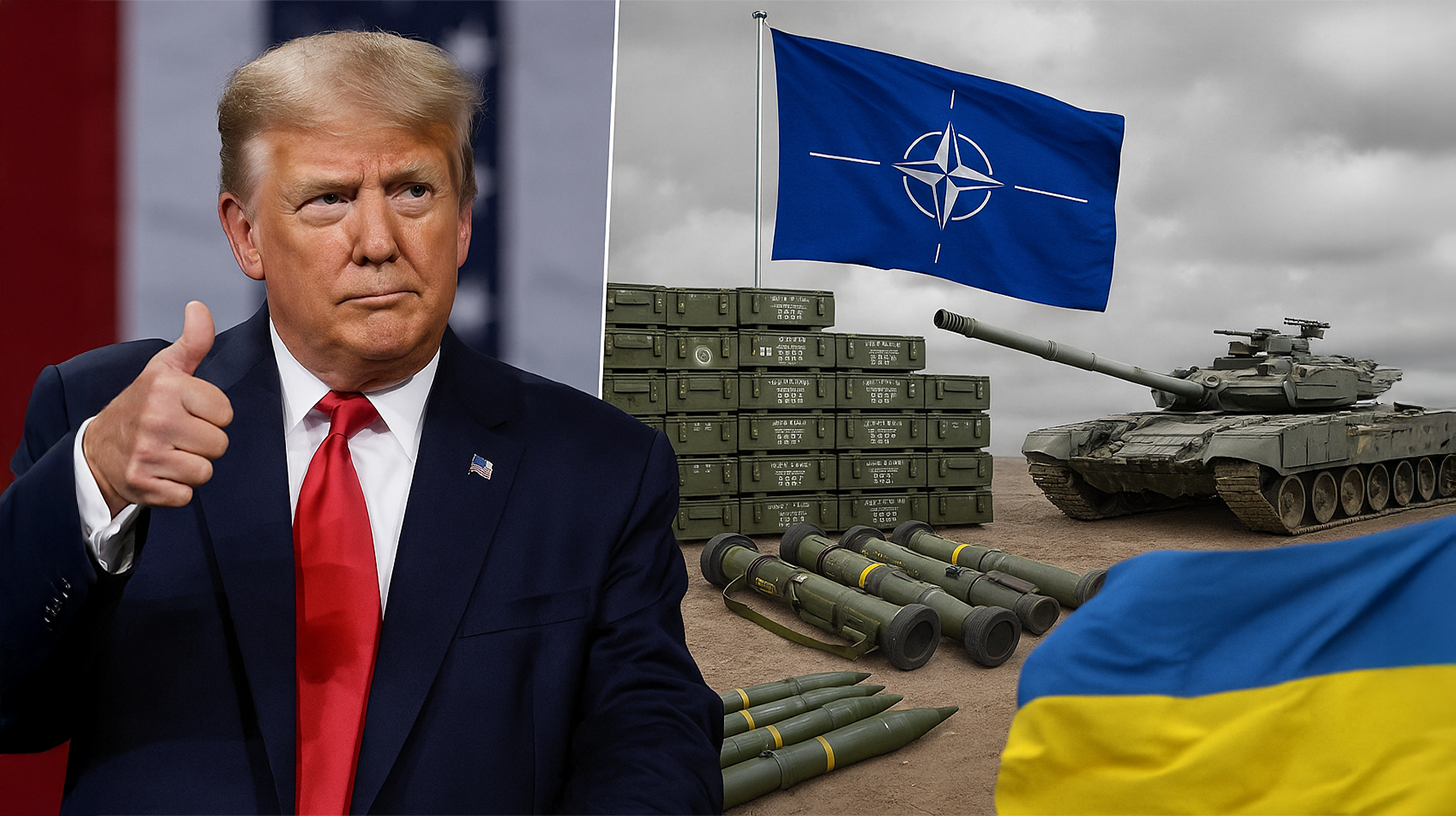
US President Donald Trump's new American strategy: arms deliveries to Ukraine via NATO – Creative image: Xpert.Digital
Trump reverses course on Ukraine: NATO will finance future arms deliveries
New US strategy: Weapons for Ukraine via NATO without American costs
The geopolitical landscape has changed considerably in recent months. Since returning to the White House, US President Donald Trump has made a remarkable U-turn in his Ukraine policy. While he initially suspended military support for Ukraine and pressed for swift peace negotiations, he has now expressed increasing frustration with Russian President Vladimir Putin and his uncompromising stance in the war against Ukraine.
In an interview with the American television network NBC News, Trump announced a new strategy that is both surprising and groundbreaking: The United States will supply weapons to Ukraine, but not directly; instead, they will be delivered via NATO. The unique aspect of this arrangement is that NATO will bear the full cost of these arms shipments. Trump explained that the US will send weapons to NATO, and NATO will reimburse the full cost of these weapons. NATO would then forward these weapons to Ukraine.
This new approach marks a significant turning point in American foreign policy. Trump, who has always been keen to minimize the financial burden on the US, has apparently found a way to continue providing military support to Ukraine without American taxpayers having to foot the bill directly. This agreement was already reached at the last NATO summit in The Hague, according to Trump.
Frustration with Putin is growing
The reasons for Trump's change of heart are multifaceted. In recent weeks, Russia has massively intensified its attacks on Ukraine. The Ukrainian air force reported the heaviest air strikes since the start of the war, with over 700 drones and dozens of missiles fired at Ukrainian cities. This escalation has apparently also led to a change of thinking in Washington.
Trump himself expressed his disappointment with Putin unusually clearly. "You get a lot of crap from Putin," the US president said, adding that he was disappointed in Russia. This frustration was also voiced by US Secretary of State Marco Rubio during a meeting with his Russian counterpart, Sergey Lavrov, in Kuala Lumpur. Rubio conveyed both disappointment and frustration at the lack of progress toward a peaceful solution.
Trump also announced that he intended to make a significant statement on Russia the following Monday. The exact details of this announcement remained unclear at first, but expectations were high that it could represent a further hardening of the American position toward Russia.
The mechanisms of the new arms deliveries
A special presidential authorization will be used to implement the arms deliveries. This allows the president to access US military stockpiles without having to go through the lengthy congressional process. According to information from government sources, the first package could be worth around $300 million and include important defense systems such as Patriot anti-missile systems and medium-range missiles.
Ukrainian President Volodymyr Zelenskyy expressed his satisfaction with this development. Following talks with Trump, he reported a concrete timetable for the resumption of US arms deliveries. Zelenskyy described the talks as constructive and particularly praised the participation of US representatives in meetings with countries that support Ukraine.
Germany's role in the new support concept
Parallel to the developments in the US, Germany has also increased its support for Ukraine. At the international reconstruction conference in Rome, Chancellor Friedrich Merz announced that Germany intends to purchase Patriot air defense systems from the US and make them available to Ukraine. Merz had already discussed this possibility in a telephone call with President Trump and asked him to supply these systems.
Negotiations between the defense ministries of both countries are already underway. According to President Zelenskyy, the talks concern two Patriot systems, which Germany would finance. Norway has also pledged to finance the purchase of another Patriot system. This development demonstrates that European countries are prepared to take a more active role in providing military support to Ukraine.
The Patriot systems are among the most advanced air defense systems in the world. They can engage enemy aircraft, ballistic missiles, and cruise missiles at a range of approximately 100 kilometers and altitudes of up to 30 kilometers. Given the intense Russian air strikes against Ukraine, these systems are crucial for protecting the Ukrainian civilian population and critical infrastructure.
The European perspective and the reconstruction conference
The Rome Reconstruction Conference, held on July 10 and 11, 2025, became an important forum for coordinating international support for Ukraine. At this conference, the European Union announced a new financial package of €2.3 billion. This package includes €1.8 billion in loan guarantees and €580 million in grants. It is expected that this package will mobilize up to €10 billion in investment in Ukraine.
At the conference, European Commission President Ursula von der Leyen emphasized that the EU reaffirms its role as Ukraine's strongest partner. She stated that it is not only the largest donor but also a key investor in the country's future. The signed agreements aim to mobilize investments for rebuilding homes, reopening hospitals, revitalizing businesses, and ensuring a secure energy supply.
Particular attention was paid to the newly established European Flagship Fund for the reconstruction of Ukraine. This fund, supported by the European Commission through the European Investment Bank as well as by France, Germany, Italy, and Poland, launched with initial capital of €220 million. The fund is expected to mobilize around €500 million by 2026, with further funding planned as security conditions improve.
The challenge of burden sharing
One of the central challenges in supporting Ukraine remains the fair distribution of the financial and military burden among NATO members and other supporting countries. So far, some countries have committed significantly more than others. The US, Germany, and a few other countries bear the brunt of the costs, while other major European nations such as France, Italy, and Spain have been comparatively restrained.
NATO Secretary General Mark Rutte has called for a fairer burden-sharing arrangement. He emphasized that European allies and Canada provided more than half of the €50 billion in security aid to Ukraine last year. Rutte urged member states to increase their defense spending and reiterated his demand for a new NATO spending target above three percent of GDP.
The discussion about a long-term financial commitment to Ukraine is gaining momentum. Jens Stoltenberg, the former NATO Secretary General, proposed that NATO members provide €40 billion annually in fresh funds for Ukraine. These contributions could be calculated based on gross domestic product, with the US contributing approximately 50 percent and the European allies and Canada providing the remainder.
Hub for Security and Defense - Advice and Information

Hub for Security and Defense - Image: Xpert.Digital
The Security and Defence Hub offers expert advice and up-to-date information to effectively support companies and organizations in strengthening their role in European security and defence policy. Working closely with the SME Connect Defence Working Group, it particularly promotes small and medium-sized enterprises (SMEs) that wish to further develop their innovative capacity and competitiveness in the defence sector. As a central point of contact, the Hub thus creates a crucial bridge between SMEs and European defence strategy.
Related to this:
Reconstruction of Ukraine: Private sector to co-finance 850 billion euros in damages
The current military situation
The military situation in Ukraine remains extremely tense. Russia has significantly intensified its attacks in recent months. The Ukrainian Air Force has repeatedly reported massive drone and missile attacks, primarily targeting the civilian population and critical infrastructure. In a single night, over 700 drones and dozens of missiles were launched at Ukrainian cities.
Cities like Kharkiv, Odessa, Sumy, and the capital Kyiv have been particularly affected. Residential buildings, hospitals, schools, and even kindergartens have been hit in the attacks. Ukrainian air defenses are working tirelessly to repel these attacks, but the sheer number of weapons being used is increasingly overwhelming their defense capabilities.
The World Bank estimates the war damage in Ukraine to date at more than €500 billion. Ukrainian Prime Minister Denys Shmyhal even cited a figure of €850 billion for the complete reconstruction of the country. These enormous numbers illustrate the scale of the destruction and the long-term challenges facing Ukraine.
The importance of military support
Military support for Ukraine has increased steadily since the start of Russia's war of aggression in February 2022. In total, Ukraine has received approximately €267 billion in aid over the past three years, amounting to more than €80 billion per year. Of this, around €130 billion was military aid, €118 billion financial assistance, and €19 billion humanitarian aid.
Germany has established itself as one of Ukraine's largest supporters. The German government has provided approximately €28 billion in military aid to date. This includes both deliveries from the Bundeswehr's own stockpiles and the financing of arms purchases from German industry. More than 10,000 Ukrainian soldiers have received military training in Germany.
Support is provided through various mechanisms. In addition to direct arms deliveries, there is the European Peace Facility, through which EU member states can be reimbursed for their bilateral arms deliveries to Ukraine. Furthermore, the concept of a reciprocal exchange was developed, whereby NATO partners supplying weapons to Ukraine are compensated by Germany with newer equipment.
The role of the private sector
A key aspect of the support for Ukraine is the increasing involvement of the private sector. Hundreds of companies participated in the reconstruction conference in Rome, including approximately 40 German firms. Michael Harms, Chairman of the German Eastern Business Association, emphasized that, given the enormous challenges of reconstruction, mobilizing private investment is essential.
Chancellor Merz confirmed that German companies have a strong interest in contributing to the reconstruction of Ukraine. He emphasized the importance of private sector involvement, as the public sector cannot bear the enormous costs of reconstruction alone. The newly established European Flagship Fund is intended to help direct private investment to strategically important sectors of the Ukrainian economy.
The question of Russian assets
The use of frozen Russian assets remains a controversial issue. These assets amount to hundreds of billions of euros and are primarily located in the EU. Chancellor Merz made it clear that Russia must compensate for the damages caused. Until this happens, Russia will not have access to the frozen assets.
Currently, the interest income from these assets is being used to secure a multi-billion-euro loan to Ukraine. However, Merz indicated that this could change in the future. The assets themselves could also be liquidated, if necessary, in connection with a corresponding agreement, he said.
Trump's Russia announcement and NATO arms deliveries: Crucial months for Ukraine
The new American strategy of supplying weapons to Ukraine via NATO marks a significant turning point in international support for the country. It demonstrates that, despite political shifts and initial reluctance, the need to support Ukraine in its fight to defend itself against Russian aggression is now recognized.
The challenges remain enormous, however. The ongoing Russian attacks, the massive destruction of infrastructure, and the humanitarian crisis demand a long-term and coordinated international response. The reconstruction conference in Rome demonstrated that the international community is ready to meet this challenge.
The coming months will be crucial. Trump's announced major statement on Russia could introduce new dynamics into the conflict. The implementation of the new arms delivery strategy via NATO will show whether this model works and whether it leads to a fairer burden-sharing arrangement.
Military support remains vital for Ukraine's survival. Patriot systems and other modern weapons systems are crucial for repelling Russian attacks and protecting the civilian population. At the same time, reconstruction is already of paramount importance to maintain morale in the country and offer people a future.
The international community faces the task of maintaining and strengthening its support for Ukraine. This is not only a matter of solidarity, but also of its own interest in a stable and peaceful order in Europe. As Chancellor Merz emphasized, supporting Ukraine is also a defense of the shared political order of freedom in Europe.
Consulting - Planning - Implementation

Markus Becker
I would be happy to serve as your personal advisor.
Head of Business Development
Chairman SME Connect Defense Working Group
Consulting - Planning - Implementation
Konrad Wolfenstein
I would be happy to serve as your personal advisor.
You can contact me at wolfenstein∂xpert.digital or
Just call me on +49 7348 4088 965 .