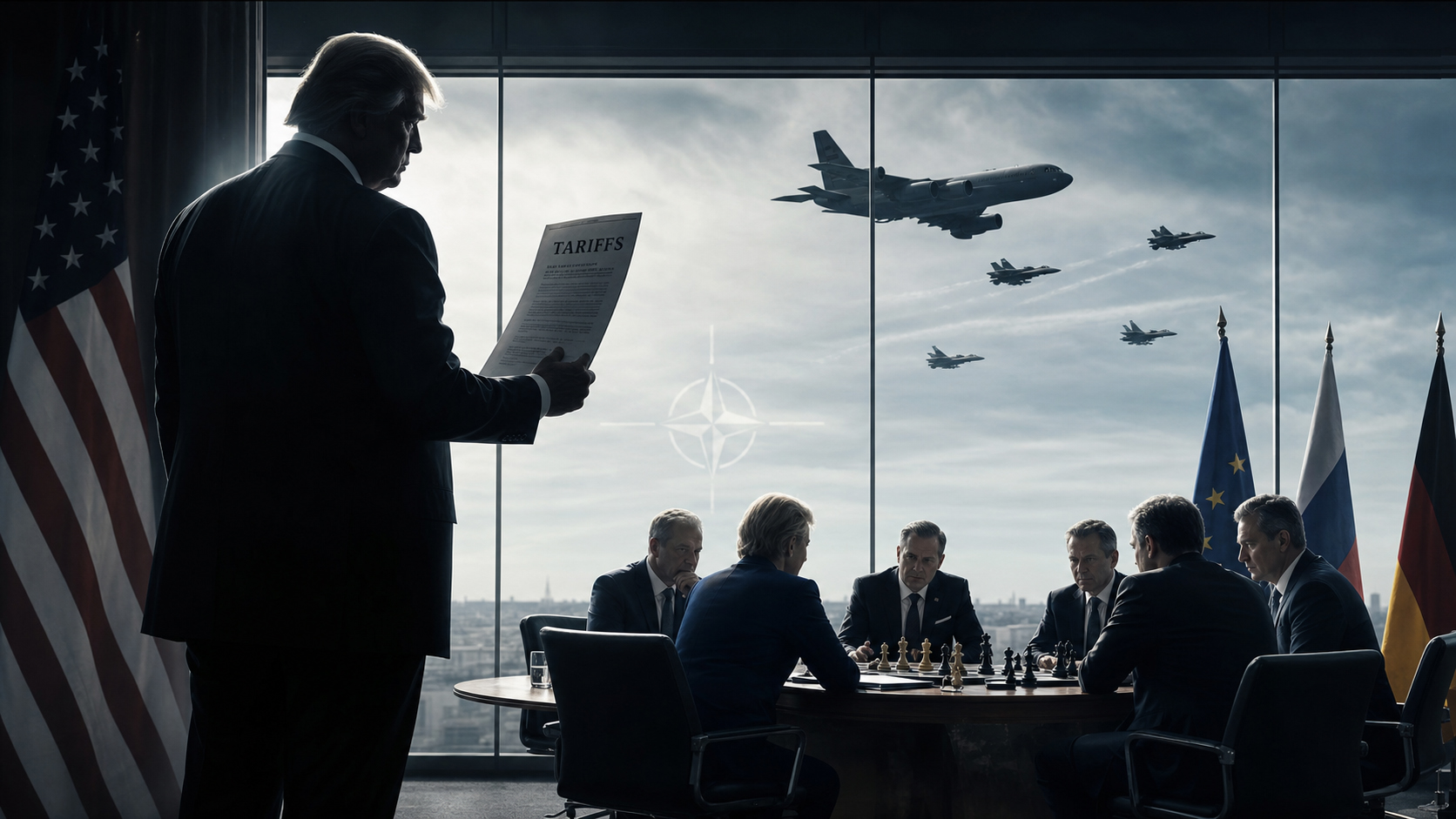
The USA is not necessarily a friend – America's structural hegemony over Europe – Image: Xpert.Digital
Gas, cloud computing and weapons: The EU's risky triple dependence on the USA
Liquefied natural gas, technology & tariffs: How Washington systematically exploits Europe's weakness
The cost trap of US dependence: Why the EU must now draw drastic strategic conclusions
For decades, Europe clung to the comforting narrative of a transatlantic community of values based on equality. But behind the facade of this historic alliance lies an uncomfortable truth: the US does not act as a selfless protector of Europe, but as a calculating hegemon, consistently exploiting its structural superiority for its own benefit. Whether through the creation of new, costly dependencies on US liquefied natural gas (LNG), the overwhelming dominance of American tech giants that siphon off European data and funds, or the targeted use of tariff threats and dollar hegemony – Europe has been gradually reduced to a junior partner, a sales market, and a dutiful payer. The following analysis ruthlessly exposes the five key areas in which European sovereignty is being systematically eroded. It shows why much of this weakness is self-inflicted due to internal divisions and what compelling strategic consequences European politics and business must now draw in order to regain their economic and security capabilities.
Not an equal partner: How Washington uses Europe as a sales market, payer, and junior partner
Those who reduce transatlantic relations to a simple friend-or-foe dichotomy are missing the point. And those who describe them as a partnership of equals are deluding themselves. The uncomfortable truth lies somewhere in between: The US and Europe are bound by a deep, historically developed alliance – but this alliance has always been asymmetrical. Washington has systematically shaped it to its advantage, and Europe has tolerated this for decades, sometimes out of conviction, sometimes out of a lack of alternatives, but always with the unspoken knowledge that its American partner is not a selfless protector, but a hegemon that uses its power to its advantage.
This analysis shows in which specific fields – energy, digital technology, trade, financial power and security – the structural power asymmetry between the US and the EU is visible today, how it works and what strategic consequences this has for European companies and politics.
From allies and previous participants: The nature of the transatlantic relationship
The narrative of the "West" as a values-based community of equal democracies is politically useful, but analytically deceptive. Since the end of World War II, the US has indeed played a decisive role in shaping the liberal world order—but always in such a way that it remained the primary beneficiary of this order. The Marshall Plan was not an act of pure generosity, but rather paved the way for American export markets and Washington's influence in Europe. NATO was never an alliance of equals, but a hierarchical system that institutionalized American claims to leadership.
This fundamental structure has persisted to this day. It is barely noticeable in calm times because the interests of both sides largely converge. But in times of tension – under President Trump, amidst trade conflicts and energy crises – it becomes ruthlessly apparent. This is not fraud in the legal sense, nor is it a breach of treaties. It is the exploitation of structural superiority in areas where Europe is simply weaker.
The EU is the world's largest single market, but politically fragmented, militarily dependent, digitally lagging, and chronically lacking sovereignty in energy policy. This combination of economic size and political weakness makes Europe the ideal partner for American hegemonic interests: large enough to be significant as a market and payer; weak enough not to constitute a serious counterweight.
Liquefied gas as leverage: How energy became a weapon
The shift was dramatic. As recently as 2021, EU member states sourced only around five percent of their natural gas from the US. Following Russia's invasion of Ukraine and the near-complete cessation of Russian pipeline deliveries, this ratio has fundamentally changed. In the third quarter of 2025, almost 60 percent of all European LNG imports by ship came from the US – the highest figure ever recorded. According to an analysis by the Institute for Energy Economics and Financial Analysis (IEEFA), Europe could source nearly two-thirds of its LNG imports from the US in 2026. For certain import terminals, the dependency is even more pronounced: at the German LNG ports in Wilhelmshaven, Brunsbüttel, and Mukran, the US share reached 96 percent in 2025.
These figures tell a story that goes far beyond mere market dynamics. The transition from Russian pipelines to American liquefied natural gas (LNG) was celebrated by European governments as diversification. In reality, it is initially a swap of one dependency for another. The difference lies in the nature of the dependency: Russian pipeline gas was a geopolitically risky but price-stable infrastructure connection. US LNG is more market-driven – but this market is politically overlaid.
The Trump administration openly used LNG exports as a foreign policy tool. Under the trade and customs agreement negotiated in July 2025 between EU Commission President Ursula von der Leyen and President Trump, the EU declared its intention to purchase $750 billion worth of energy products from the US by the end of 2028. This would represent a tripling of current US energy imports—a commitment that energy experts consider "absolutely unrealistic," but one that demonstrates the extent of political capitulation in this area.
At the same time, Washington is attacking European climate regulations that could restrict the LNG market: The methane emissions regulation, the sustainability directive CSDDD, and the CO₂ import tariff CBAM are all under American pressure. The pattern is clear: The US not only wants to maintain Europe as a stable LNG buyer, but also to prevent European climate policy from reducing this dependence.
However, some voices offer a more sober assessment of the situation. LNG expert Anne-Sophie Corbeau from Columbia University's Center on Global Energy Policy points out that, unlike pipeline gas, LNG suppliers can be replaced much more quickly. The US also has a vested interest in stable customers, as it is massively expanding its LNG capacity and urgently needs buyers after losing the Chinese market due to the trade dispute. In this respect, the dependency is indeed reciprocal – but it is not symmetrical. Europe, as a price taker, is exposed, while the US, as a supplier, has far more options.
EU member states dependent on LNG and lacking sufficient storage capacity are particularly vulnerable. In 2025, the EU imported more than 140 billion cubic meters of LNG. Countries like Belgium, Poland, and Italy are especially susceptible to market turbulence due to their reliance on specific supply sources. If IEEFA's forecast for 2030 suggests that 75 to 80 percent of European LNG imports could come from the US, assuming existing supply contracts are fulfilled, this represents a state of structural vulnerability – not diversification.
The digital tribute system: Why Europe regulates, but America profits
A power structure has established itself in the digital sphere that can only be described as a silent sell-off of European economic power. While the EU generates substantial trade surpluses with the US in goods, the picture is reversed in services trade. In 2024, the US achieved a services surplus of around €148 billion with the EU – driven primarily by the dominance of American technology companies: Apple, Amazon, Microsoft, Meta, and Google are systematically siphoning off license, cloud, and platform fees from the European market.
The scale of this dependency becomes tangible when looking at individual market share figures: US hyperscalers control 72 percent of the European cloud market. Microsoft holds a market share of around 70 percent for operating systems in Europe – from small businesses to public administration, including sensitive government agencies. Of the 50 largest technology companies worldwide, only four are European. This is not a market failure; it is the result of decades of investment and scaling advantages, made possible in the US by the close integration of the military, research, and the tech sector.
Furthermore, there is a specifically digital power asymmetry created by American law: The US CLOUD Act allows US authorities to access data stored by American companies – regardless of whether the servers are located in Europe. This structurally undermines the European General Data Protection Regulation (GDPR) and forces European companies and authorities into a permanent legal ambiguity between European data protection and American access privileges.
The EU's reaction to this is a costly paradox: Europe has become the world's leading regulator of digital markets – with the DMA, DSA, GDPR, the AI Act, and now the Cloud and AI Development Act (CADA) – and yet earns nothing from it. American corporations pay fines that are peanuts compared to their European revenues, make minor adjustments to their interfaces, and continue operating as before. The pattern, which can be aptly described by a pointed formula, is: Europe sets the rules, America makes the money.
The cost of building a truly sovereign European cloud infrastructure is estimated at around €200 billion. This is politically feasible, technically challenging, and economically viable only if European customers are genuinely willing to bear the additional costs of sovereignty. This willingness is currently limited. Lock-in effects resulting from years of using American platforms, a lack of compatible alternatives, and sheer convenience keep companies and government agencies dependent.
The situation is particularly critical with regard to artificial intelligence. Europe's lag in building its own AI infrastructure is not only an economic problem, but also a security policy issue: The AI systems that European administrations, corporations, and media are increasingly relying on run on US infrastructure, trained with global datasets under American jurisdiction. The next wave of digital dependency is already emerging, even before the previous one has been overcome.
Tariffs as an instrument of power: The art of asymmetric pressure
The Trump administration's trade policy has exposed the latent power imbalance between the US and the EU. By imposing punitive tariffs on European steel, aluminum, and automobile exports, as well as temporarily setting a general tariff of 20 percent on all EU goods, Washington has used a tool of pressure that has no formal basis in WTO rules, but is effective.
The economic simulations are sobering: A prolonged transatlantic trade war could halve EU exports to the US in the long term. The effects would be highly unevenly distributed – countries like Slovakia, Austria, and Lithuania would be disproportionately affected, as would sectors such as automotive, pharmaceuticals, mechanical engineering, and electronics. This sectoral concentration is no coincidence: Washington is specifically targeting tariffs in areas where Europe has strong export interests – cars, chemicals, and machinery.
The EU responded to this challenge with a characteristic combination of restraint and rhetorical toughness. Retaliatory measures were announced several times and just as often postponed. This has a rational basis: aware that further escalation would also harm Europe, Brussels is pursuing a strategy of de-escalation. The problem is that Washington interprets this strategy as a weakness that invites further pressure.
The trade and customs agreement reached between the EU and the US in July 2025 contains some attempts to de-escalate the conflict, but is clearly asymmetrically structured in favor of Washington. The EU commits to massive energy purchases, while the US makes investment pledges whose actual binding effect is disputed. The tariff dispute is not resolved; it is frozen – under conditions dictated by Washington.
Particularly astute is the finding by the Kiel Institute for the World Economy that trade in services is systematically ignored in this trade debate. Including the volume of services, which amounted to €816.9 billion in 2024, significantly alters the overall picture of the transatlantic trade balance. The seemingly massive European goods surplus is put into perspective as soon as American services surpluses of around €148 billion are added. The narrative of an "unfair European trade surplus," which Trump uses to justify his tariffs, is therefore factually incorrect – but politically useful.
Dollar hegemony and financial architecture: Europe's silent tribute relationship
Less visible than tariffs or LNG contracts, but structurally just as significant, is the dollar's dominance in the global financial system. The US dollar continues to account for approximately 57.8 percent of global foreign exchange reserves and dominates over 50 percent of global payment flows in the SWIFT system. European central banks, companies, and states are thus structurally forced to operate in a currency controlled by a foreign central bank.
This dominance has concrete economic consequences for Europe. When the US Federal Reserve raises interest rates to combat American inflation, the dollar appreciates – and with it, the cost of European energy imports, which are settled globally in dollars. The European Central Bank is effectively forced to anticipate American interest rate decisions if it wants to avoid an unwanted devaluation of the euro. Europe bears some of the burden of adjusting to a US-centric global financial order without possessing the corresponding power to control it.
Even more serious are the extraterritorial sanctions powers of the US. Any European company that conducts business in dollars or uses US banks is de facto subject to American legal jurisdiction. This allows Washington to penalize European companies that trade with countries against which the US has imposed sanctions – regardless of whether these sanctions are compatible with European law. The Iran trade case and the disputes surrounding the SWIFT system have vividly demonstrated this. Europe protested, but never took effective countermeasures. The effort to establish an alternative payment system (INSTEX) remained largely symbolic.
The fiscal dimension is another factor: The US runs structurally large budget deficits and finances them through international capital markets, to which European investors and central banks make significant contributions. Foreign central banks hold a record $8.67 trillion in US Treasury bonds. Europe is thus subsidizing Washington's fiscal flexibility to a considerable extent – and in return receives, essentially, the promise of financial stability, i.e., the maintenance of an order that benefits America.
Our US expertise in business development, sales and marketing


Our US expertise in business development, sales and marketing - Image: Xpert.Digital
Industry focus areas: B2B, digitalization (from AI to XR), mechanical engineering, logistics, renewable energies and industry
More information here:
A thematic hub offering insights and expertise:
- Knowledge platform covering global and regional economies, innovation and industry-specific trends
- A collection of analyses, insights, and background information from our key areas of focus
- A place for expertise and information on current developments in business and technology
- A hub for companies seeking information on markets, digitalization, and industry innovations
From the reflex of dependency to Europe's strategic independence
The security framework as a cage: NATO between promises of protection and blackmail
The security dimension of transatlantic asymmetry is the deepest and most difficult to reform. After the Second World War, Europe consciously placed itself in a position of security dependence on the US – with good reason, given the Soviet threat. But this framework has created a lasting structure in which Washington can act as an indispensable protecting power when it wants to increase political pressure on Europe.
The German Institute for International and Security Affairs (SWP) has precisely described this structure: The unequal burden-sharing within NATO is the flip side of American hegemony. The US bears the lion's share of the alliance's military costs – not out of altruism, but because this dominance secures it political influence it would otherwise lack. When Trump forces European NATO partners to massively increase their defense spending, the US is not only morally justified – it is also exploiting a dependency it has cultivated for decades as leverage.
This dependence has a material dimension: Europe is the main recipient of American arms. US arms companies profit directly from European defense spending, which is increasing due to NATO pressure. This means that the more Europe relies on its own defense, the more it pays—initially to American suppliers, since European defense capabilities still need to be developed. The mandated rearmament is, at least in the short term, also an export program for the American arms industry.
NATO Secretary General Mark Rutte recently stated openly that an independent European defense system is not in NATO's interest—that is, not in the interest of the American-led alliance. This is a remarkably honest statement about the institutional interest in European dependence. For Europe, this raises the fundamental question posed by the SWP: How much economic and political sovereignty is compatible with permanent security dependence?
Structural weaknesses of Europe: Self-inflicted vulnerability
It would be dishonest to attribute European weakness solely to American power strategy. A significant portion of the asymmetry is self-inflicted. An IMF study from 2024 found that the EU's GDP per capita, measured at purchasing power parity, was only about 72 percent of the US level. Around 70 percent of this shortfall is attributable to lower productivity growth. Europe simply hasn't developed the economic dynamism that would allow it to achieve true parity with the US.
The reasons for this lie within the European system itself. The EU single market is well integrated in the goods sector, but remains highly fragmented in the services sector. National regulations, a lack of mutual recognition of qualifications, and differing legal systems keep European companies small and hinder their scaling. Added to this is the chronic shortage of venture capital: European startups receive significantly less access to growth capital than their American competitors, which is why promising European technology companies either stagnate or are acquired by American corporations.
The Capital Markets Union, declared a strategic priority for years, is making no progress. National interests of the member states are blocking deeper integration of capital markets, which would give European companies access to comparable investment capital as is standard practice in the US. This is not American fault – it is European inability to reform.
Politically, this weakness manifests itself in a characteristic hesitancy: Out of fear of economic or security policy consequences—tariffs, withdrawal of American security guarantees, loss of the US market—the EU systematically avoids confrontational stances toward Washington. This restraint is rational from the perspective of individual member states, but collectively self-destructive. It signals to the US that threats work—and thus invites further threats.
Scenario 1: Europe as an energy policy price taker
For companies – especially in German industry – the energy dimension is the most immediately noticeable. Since 2022, Europe has decoupled from Russian pipeline gas and, in doing so, has slipped into a new dependency. Long-term LNG supply contracts with US providers bind European energy suppliers for decades. The IEEFA predicts that, if these contracts are honored, up to 80 percent of European LNG imports could come from the US by 2030.
The result is a structural price problem for European industry. US LNG is traded at a higher price on the spot market than formerly Russian pipeline gas. Energy-intensive industries – chemicals, steel, aluminum, basic chemicals – are thus permanently exposed to higher energy costs than their American or Asian competitors. This is not a distortion of competition in the legal sense, but a structural disadvantage that was deliberately accepted as part of the security-policy-driven energy transition.
The intertwining of energy, industrial, and security policies creates a highly unpredictable environment for European companies. Investment decisions in energy-intensive sectors increasingly depend on geopolitical variables beyond national or corporate control. Anyone planning a new production facility must factor in LNG price scenarios that hinge on Washington's willingness to act – hardly a sound basis for long-term location decisions.
Scenario 2: Europe's data as an export commodity
In the digital sphere, a silent transfer of economic value from Europe to the USA takes place daily. European companies and users pay for cloud services, software licenses, app ecosystems, and AI services that run on US infrastructure, operate under US law, and whose profits appear on American balance sheets. The EU is the most profitable foreign market for American technology companies—a premium sales region with high average revenues and a comparatively low willingness to switch markets.
The dependency extends far into public infrastructure: European authorities, universities, hospitals, and defense companies use Microsoft products, Amazon Web Services, and Google Cloud to an extent that cannot be reversed in the short term. The Austrian Defense Minister has explicitly classified this as a security risk. EU member states have known this for years and yet have failed to act – the convenience factor is too great, the migration costs too high, and the political will too weak.
In June 2026, the European Commission adopted the Cloud and AI Development Act (CADA), an initiative aimed at structurally reducing dependence on third-party providers. The law defines four levels of sovereignty for cloud services and mandates European providers for sensitive areas. At the same time, the EU intends to triple its data center capacity through the CAIDA law. These are the right steps – but they are late and will take years to have an impact. In the meantime, Europe continues to pay tribute to Silicon Valley.
Scenario 3: Junior partner with limited negotiating power
The combination of security dependency and economic fragmentation makes the EU a structurally weak negotiating partner in any bilateral dispute with Washington. When the US threatens tariffs, EU member states with differing export profiles and interests face the question of whether to respond with solidarity or negotiate national exemptions. This internal fragmentation is Washington's strategic advantage: a united Europe would be an equal adversary, a fragmented one is manageable.
The transatlantic power imbalance is particularly evident in the agricultural sector, which is regularly used as political leverage in trade negotiations. US farmers with lower environmental and social standards can produce more cheaply than European farmers – a pressure to open the market that the EU counters with protective tariffs, while Washington brands these tariffs as "protectionist" in order to extort other concessions.
In its analysis, the SWP advocates for a redefinition of European foreign policy under the heading "With, without, or against Washington." These three positions describe the spectrum of maturing strategic autonomy: In some areas, cooperation with the US remains sensible; in others, Europe must pursue its own path; and in still others, resistance becomes necessary. The crucial prerequisite for this is that Europe finally stops accepting the price of its security dependence as inevitable and instead actively invests in economic and military independence.
From reflex to strategy: What European businesses and politicians must do now
The analysis of American hegemony is not a call to anti-Americanism. It is a plea for realism. The US is and will remain an important ally, a key trading partner, and an indispensable security power—at least until Europe has built its own. But the uncritical narrative of a transatlantic community of values among equals obscures the need for structural reforms.
This analysis has concrete strategic consequences for European companies, particularly B2B players in Germany. First, energy price risks must be systematically factored into pricing as geopolitical risks, not just market risks. Dependence on US LNG suppliers directly impacts location decisions, production setup, and investment calculations. Nearshoring to countries with lower energy prices and investing in domestic renewable energy supply are no longer options, but strategic necessities.
Secondly, cloud and software dependency on US providers is a strategic risk that must be factored into every IT governance decision. This does not mean immediate migration – which is hardly realistic in the short to medium term – but it does mean: examining European alternatives, drafting contracts with exit clauses, documenting dependencies and migration costs, and actively supporting European cloud sovereignty initiatives.
Thirdly, diversifying sales markets reduces vulnerability to US tariff threats. The EU has recently accelerated its trade diversification efforts – with agreements with Canada, Japan, South Korea, and the conclusion of deals with the Mercosur and ASEAN countries. For German exporters, this means establishing new market relationships before the US resorts to further tariff measures.
The path to strategic autonomy for Europe is long. It leads through the completion of the single market, the Capital Markets Union, the development of its own defense capabilities, the cultivation of European tech champions, and the consistent use of renewable energies as a domestic, non-compliable energy supply base. None of these goals are new – all have been on European agendas for years. What is lacking is the political will to implement them against short-term national interests and American pressure.
The question Europe ultimately has to answer is not whether the US is a friend. It is – in its own way, on its own terms. The question is whether Europe is prepared to be a friend on equal terms. This requires ceasing to confuse dependence with loyalty.
Your global marketing and business development partner
☑️ Our business language is English or German
☑️ NEW: Correspondence in your native language!

Konrad Wolfenstein
I and my team are happy to be available to you as your personal advisor.
You can contact me by filling out the contact form here wolfenstein@xpert.digital:or simply call me at +49 7348 4088 965. My email address is
I'm looking forward to our joint project.
☑️ SME support in strategy, consulting, planning and implementation
☑️ Creation or realignment of the digital strategy and digitization
☑️ Expansion and optimization of international sales processes
☑️ Global & Digital B2B trading platforms
☑️ Pioneer Business Development / Marketing / PR / Trade Fairs
🎯🎯🎯 Data-driven B2B industry hub as a quasi-in-house solution


The quasi-in-house solution: How Xpert.Digital closes operational gaps in B2B marketing and sales – Smart Content-Driven Business - Image: Xpert.Digital
Xpert.Digital is a data-driven B2B industry hub led by Konrad Wolfenstein . The company acts as an external, quasi-in-house solution for industrial partners, closing operational gaps in marketing, content, and sales – without requiring additional resources on the client side.
More information here: