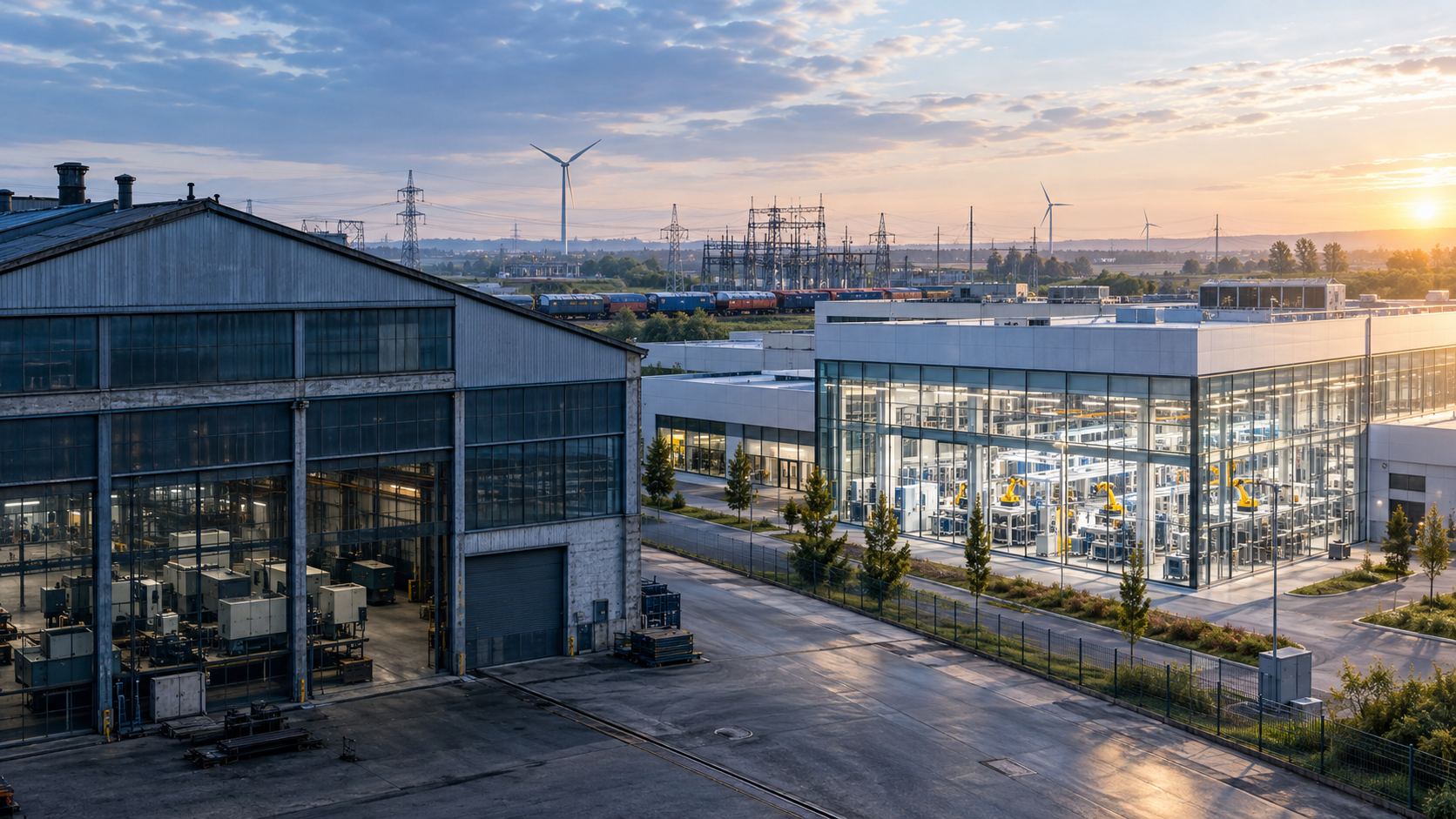
Almost a decade without growth: How serious is Germany's industrial recession? – Creative image on the topic, created with AI: Xpert.Digital
The next factory will be built elsewhere: What Germany's industry needs now
High costs, low investment: Is Germany's industry facing a permanent decline?
Germany's industry has been losing ground for years: While domestic production is significantly below 2015 levels, many neighboring countries have seen strong growth. High energy and labor costs, weak investment, and slow permitting processes are putting a strain on the country's competitiveness. But a declining production index doesn't tell the whole story. Companies are increasingly earning money from software, maintenance, and other services – and value creation and production don't always develop in tandem. How deep does this industrial weakness really run? A look at the figures, a comparison with neighboring countries, and the question of whether government relief measures can secure future investments for Germany.
Germany's industry is losing its future: Neighbors are building, Germany is downplaying the situation
Germany's industrial weakness is more than a temporary economic downturn. The longer-term decline in production, reluctance to invest, and the better performance of many neighboring countries point to a structural problem that cannot be solved with isolated tax relief measures. At the same time, it would be economically inaccurate to equate every decline in production figures directly with an equal loss of prosperity. Industrial companies are changing their business models, combining machinery with software, and increasingly generating revenue through services. A sound analysis must therefore consider two developments simultaneously: the decline of traditional manufacturing and the transformation of industrial value creation.
The crucial question is not whether Germany is still a major industrial nation. The crucial question is whether the country generates sufficient new investments, productive jobs, and technological competitive advantages to maintain this position. A high industrial share indicates the existing economic substance. Whether this substance grows, is modernized, or slowly erodes, however, depends on today's investments.
A decade without industrial progress
German industrial production in 2025 was almost eleven percent below the 2015 level, while Poland increased by 54 percent and Denmark by 48 percent over the same period. Austria achieved an increase of 23 percent; overall, seven of Germany's nine immediate neighboring countries increased their production.
This comparison reveals a significant development gap, but not a ranking of absolute industrial size. A country with a smaller starting point can achieve high growth rates without necessarily producing more industrial goods overall than Germany. Similarly, the difference between a Polish increase of 54 percent and a German decrease of almost 11 percent does not mean that German industry has shrunk by 65 percent compared to Poland. These are simply different changes relative to their respective starting points.
The economic warning signal remains clear. Over the course of a decade, Germany has lost production volume while a large part of its immediate economic environment has expanded. This argues against an explanation that points solely to a general European industrial weakness. Shared pressures can produce different outcomes. This is precisely why, in addition to global economic shocks, national location factors, industry structures, and entrepreneurial decisions must also be examined.
The crisis began before 2022
As early as 2021, German industrial production was around 4.1 percent below the 2015 level. The Russian attack on Ukraine and the subsequent energy price shock thus hit a location whose industrial dynamism had already been declining.
However, 2021 was not an unproblematic year for comparison either. The pandemic, material shortages, and disrupted supply chains complicate the interpretation of this single point in time. Therefore, the longer-term trend is more meaningful: Comparative studies show a decline in industrial production in Germany as early as 2018, while Austria only entered a downward industrial phase later.
Economically, a distinction must be made between triggers, amplifiers, and underlying causes. The energy price shock immediately worsened the profitability of certain production processes. Weak demand further reduced capacity utilization. Lengthy permitting processes, investment uncertainty, or a lack of digital capabilities can, in turn, prevent companies from reacting quickly to such pressures.
This distinction is crucial for the solution. If a company is temporarily suffering from high energy costs, temporary relief can be beneficial. However, if its business model is permanently losing market share, or if the next plant is being built abroad due to unattractive conditions, an electricity subsidy is insufficient.
The comparison of neighbors requires depth of field
The better production figures of other countries are an important finding, but not yet a complete explanation. Poland, Denmark, and Austria represent different industrial development models. A catching-up location can grow through new factories and stronger integration into international supply chains. A highly specialized location can expand through individual, particularly successful sectors. A broadly diversified industrial economy, on the other hand, must compete in many markets simultaneously.
Poland's growth cannot therefore be reliably attributed solely to lower labor costs or a single economic policy decision. The production index shows the result, not the precise weighting of its causes. A robust explanation would require examining factors such as investment, productivity, industry composition, demand, and international production links.
Conversely, the necessary differentiation must not become an excuse. Differences in initial conditions put a comparison into perspective, but do not eliminate it. If Germany performs worse over many years, it must be examined which burdens were truly unavoidable and which could have been mitigated by better framework conditions.
The relevant economic policy question is therefore not which neighboring country should serve as a blanket model. The question to be asked is which specific locational advantages will enable additional investments, and which of these Germany itself can create or restore.
Denmark's growth has a pharmaceutical core
Denmark's industrial success counters the notion that highly developed European economies are fundamentally incapable of further industrial expansion. However, its development is significantly influenced by the pharmaceutical industry. Studies show that Denmark's and Switzerland's industrial growth advantage over Austria diminishes considerably when the pharmaceutical sector is excluded.
This changes the economic policy interpretation. A sharply rising national production index does not automatically mean that all of a country's industries are growing successfully at the same time. One particularly dynamic sector can significantly influence the overall result. Successful specialization and a broad-based industrial upswing are different developments.
This presents Germany with a dual challenge. On the one hand, it must revitalize its existing industrial strengths. On the other hand, it needs sufficient companies and technologies capable of generating comparable dynamism in new growth sectors. An industrial location cannot sustain itself solely by defending existing market positions for as long as possible.
Denmark does not provide a readily transferable recipe. However, the comparison illustrates the economic difference that internationally successful companies in research-intensive industries can make. The relevant question is whether the German innovation system sufficiently enables such developments and subsequently translates them into additional industrial activity.
Austria makes Germany's lag need explaining
Austria is a particularly interesting point of comparison because it, too, is a developed industrial location closely integrated into European value chains. Its consistently better long-term performance cannot therefore be explained simply by a fundamentally different level of economic development.
At the same time, it would be wrong to portray Austria as a trouble-free industrial location. According to preliminary figures, Austrian industry generated a nominal production value of €209 billion in 2025, three percent more than in the previous year; however, this increase was not sufficient to compensate for the previous losses. Furthermore, nominal production values should not be equated with price-adjusted production indices.
The comparison remains revealing nonetheless. Studies show that Austria performed significantly better than Germany in terms of industrial hourly productivity (excluding the pharmaceutical sector) during the years under review. This highlights not only the cost level but also the ability to utilize labor and capital productively.
A convincing German industrial policy should therefore not only ask how to reduce burdens. Equally important is why existing skilled workers, machinery, research expenditures, and industrial experience are not generating enough additional economic output. Cost reduction can buy time. Productivity gains determine whether this time is actually used effectively.
Production is not the same as value creation
The Federal Ministry for Economic Affairs' observation regarding the more stable development of price-adjusted gross value added is technically justified. Industrial production and industrial value added do not measure the same thing. Gross value added is calculated by subtracting intermediate inputs from the value of production; therefore, changes in production structures and declining intermediate input ratios can cause these two indicators to diverge.
A machine manufacturer can sell fewer systems and still make a greater economic contribution if development, software, maintenance, or other services become more important. Similarly, changes in purchased components and in-house services can alter the relationship between production volume and added value.
It follows that a decline in production cannot be automatically translated into an equally large loss of prosperity. An economy does not become more successful simply by producing as many tons, vehicles, or machines as possible. The additional economic value it creates in the process is also crucial.
However, gross value added is not synonymous with corporate profit. It includes, among other things, employee wages; it also contains other income components and depreciation. Therefore, a comparatively stable value added does not prove either a consistently strong profitability for all companies or a secure employment outlook for all industrial regions.
The services are changing the business model
The transformation of industrial business models is not merely a theoretical possibility. For 2024, the revenue of German industrial companies from product-related services was estimated at around €166 billion. In mechanical engineering, these services accounted for 13.2 percent of revenue, in automotive engineering 7.3 percent, and in the electrical industry 6.8 percent.
Such services include, for example, consulting, installation, and maintenance. Economically, this can lead to additional customer relationships, recurring revenue, and greater differentiation from competitors. A company then no longer simply sells a machine, but supports the customer for a larger portion of its lifespan.
The figure of 166 billion euros, however, is a sales estimate and not an additional gross value added. It should neither be added in full to the already recorded economic output nor interpreted as proof that services compensate for all losses in goods production.
It is also important to distinguish between the successful transformation of individual companies and the development of the entire location. A corporation can stabilize its earnings through digital services, while its local supplier base nevertheless shrinks. A nuanced analysis acknowledges new business models without automatically concluding that the industrial base is secure.
Old studies are no substitute for a current diagnosis
An analysis using data up to 2023 can explain why production and value creation differed at that time. However, it cannot prove that this stability continued unchanged in 2025 or 2026. Especially during a period of multiple successive challenges, the temporal scope of economic statements is crucial.
The first official annual report for 2025 already showed a price-adjusted decline in gross value added of 1.3 percent in the manufacturing sector compared to the previous year. According to the calculations at that time, this marked the third consecutive year of decline. Such preliminary results can be revised later, but they contradict a general assumption of permanently unaffected industrial value added.
The appropriate perspective is therefore: Value creation can develop better than production and still be under economic pressure. These two statements are not mutually exclusive.
For economic policy, this means monitoring several key indicators together. Production represents an important aspect of operational activity. Real value added describes the economic contribution. Investment, employment, and productivity, in turn, show how resilient this contribution might be in the future. None of these indicators should be used as the sole indicator for relief or as a warning sign.
Size does not protect against erosion
According to the aforementioned preliminary figures, in 2025 the manufacturing sector accounted for 19.4 percent of total gross value added in Germany, compared to 15.8 percent on average across the EU. Germany thus continues to possess a comparatively large industrial base.
This finding is important, but it answers a different question than the development of production volume. A high percentage primarily describes the economic structure. It does not automatically indicate whether the companies in question are investing sufficiently, increasing their productivity, or gaining new markets.
Furthermore, a relative share can remain comparatively stable if other sectors of the economy also experience weak growth. The size of a sector is therefore not a reliable substitute for analyzing its dynamics. A large company can lose market share; likewise, a large industrial sector can gradually lose competitiveness.
The existing industrial base is nevertheless a significant advantage. It encompasses experience, customer relationships, training structures, and specialized skills. These advantages make renewal possible, but not unnecessary. The greater the economic importance of industry, the more serious a sustained loss of its investment and innovation capacity becomes.
Energy-intensive industries are under particular pressure
Between February 2022 and March 2026, seasonally and calendar-adjusted production in energy-intensive industries fell by 15.2 percent. Across the entire industrial sector, defined here as manufacturing and mining, the decline over the same period was 9.5 percent.
This difference underscores the particular vulnerability of energy-intensive processes. However, it does not allow for an exact calculation of the damage caused solely by energy prices. Demand, capacity utilization, the state of the construction industry, and international competition also influence production.
High energy prices have economic consequences on several levels. First, they increase operating costs. Companies trading internationally can often only pass these additional costs on to their customers to a limited extent. Declining margins then weaken their financial resources. Finally, when considering new investments, companies examine whether the same process would be more economically viable at a different location in the long term.
This is precisely where the long-term danger lies. A temporarily throttled-back plant can be utilized more intensively again when conditions improve. Conversely, failing to modernize or building a production line elsewhere alters future production possibilities. The economic impact of high energy costs therefore extends far beyond the current electricity or gas bill.
The electricity price is only one part
The focus of the political debate on electricity prices is understandable, but incomplete. Industrial processes require different energy sources and temperature levels depending on the sector. For some companies, electricity is the central factor, for others it's gas, heat, or the material use of raw materials.
Therefore, reducing electricity demand cannot solve all energy-related site-specific problems. For a process that currently relies primarily on gas, the crucial question is whether an electric alternative is technically available, economically viable, and can be connected in a timely manner. The mere desire for electrification is no substitute for a sound investment analysis.
Furthermore, there is the time perspective. A production facility is not planned solely based on today's energy price. Companies must be able to estimate the costs, grid access requirements, and supply risks over many years. Uncertainty can prevent an investment even if the current price has become more favorable in the short term.
A sustainable energy policy must therefore combine ongoing relief with structural improvements. Subsidies can bridge a transitional phase. However, a location will only become permanently competitive when energy supply, grid infrastructure, flexibility, and operational adaptation options are aligned.
Our EU and German expertise in business development, sales and marketing

Our EU and German expertise in business development, sales and marketing - Image: Xpert.Digital
Industry focus areas: B2B, digitalization (from AI to XR), mechanical engineering, logistics, renewable energies and industry
More information here:
A thematic hub offering insights and expertise:
- Knowledge platform covering global and regional economies, innovation and industry-specific trends
- A collection of analyses, insights, and background information from our key areas of focus
- A place for expertise and information on current developments in business and technology
- A hub for companies seeking information on markets, digitalization, and industry innovations
Focus on the challenges facing German industry
High wages demand high productivity
In the German manufacturing sector, an hour of work cost an average of €49.50 in 2025, according to the European comparative calculations used at the time. The corresponding publication quantified the difference to the EU average for this sector at approximately 41 percent.
Such costs are a relevant location factor, but not yet proof of a lack of competitiveness. In a broader analysis encompassing both manufacturing and services, labor costs in Denmark in 2025 amounted to €51.70 per hour, exceeding the German figure of €45. High labor costs, therefore, do not fundamentally preclude industrial success.
The crucial factor is the economic output generated by each paid hour of work. High wages are sustainable when companies with skilled employees, efficient facilities, and successful products generate sufficient added value. The combination of high costs and weak productivity growth becomes problematic.
A strategy focused solely on wage reduction would therefore fall short. Equally inadequate would be to completely ignore cost pressures. The more economically sophisticated solution lies in reducing administrative inefficiencies, facilitating investment, and more consistently translating technological possibilities into productive processes.
Job cuts and skills shortages are not mutually exclusive
In March 2026, around 794,400 people worked in energy-intensive industries, 6.3 percent fewer than in February 2022. At the same time, there may still be a shortage of certain skilled workers.
The apparent contradiction resolves itself as soon as qualifications and regions are considered. Employees from a shrinking manufacturing sector cannot simply fill every open position in automation, electrical engineering, or software development. Geographical distances, family ties, and differing requirements also complicate a direct balancing of labor markets.
This presents economic policy with a challenging transitional task. Continuing education must begin as early as possible and be tailored to actual business needs. Recognition procedures for foreign qualifications should function reliably. At the same time, it is important to create conditions under which people can actually use and further develop their existing qualifications.
Reforms to the labor market and social security systems should therefore not be viewed solely from the perspective of short-term cost reduction. Their economic quality also depends on whether they facilitate career transitions, enable skills development, and stabilize long-term financing. Industrial structural change will not be more successful if available skills remain unused.
Replacement investments are not sufficient in the long term
The reluctance to invest is particularly critical because it affects performance in the coming years. At the beginning of 2026, a broad survey of companies revealed that 23 percent planned to increase their investments, while 31 percent planned cuts. Investments were primarily focused on replacement and efficiency improvements, and less frequently on additional capacity.
Replacement investments are by no means unproductive. A modern plant can consume less energy, operate more precisely, and enable additional automation. However, its economic significance differs from that of a new production line or an additional factory.
If companies primarily maintain existing capacities, industrial expansion remains limited. At the same time, a lack of modernization can trigger a negative cycle: Productivity grows too slowly, high costs become a greater burden, profits come under pressure, and the financial leeway for new investments shrinks.
From an economic policy perspective, the total amount of investment should therefore not be the only factor considered. Its composition and purpose are equally important. A location that primarily replaces existing facilities develops differently than a location where companies can scale new technologies and meet additional international demand.
The exodus begins before the closure
Industrial erosion doesn't necessarily begin with spectacular factory closures. It can initially consist of a new plant being built at a different location, a development project not being expanded, or a potential investor not even considering Germany in the first place.
Such underinvestment is harder to detect than layoffs. However, it alters future economic opportunities. Existing factories can continue production for a long time, even though the next generation of facilities is already being built elsewhere.
It is important to distinguish between the interests of a company and the development of the location. A foreign investment can be beneficial for a German corporation because it fosters customer proximity or opens up new sales markets. Therefore, it is not automatically evidence of a move away from Germany.
For the German economy, however, the crucial factor remains which domestic activities are growing. If development, production, and skilled services gain additional prospects here, international expansion can strengthen Germany's position. Conversely, if Germany increasingly focuses on operating existing facilities, the success of individual corporations can mask a decline in the country's economic dynamism.
The relief measures address real weaknesses
The permanently low electricity tax for the manufacturing sector as well as agriculture and forestry, subsidies for transmission network costs, and the abolition of the gas storage levy address concrete burdens. The gas storage levy was abolished on January 1, 2026; its previous costs are now covered by the federal government. A subsidy of €6.5 billion was allocated for transmission network costs in 2026.
However, these measures differ economically. Maintaining an already low tax rate prevents any potential increase in the tax burden. A government subsidy changes how network costs are financed. Abolishing a levy eliminates a specific item on the bill, but does not completely remove the underlying expenses.
Shifting costs to the state can be sensible if it limits economically damaging peak burdens. Nevertheless, it remains a distributional decision. What companies or consumers do not pay directly must be financed elsewhere.
Therefore, the impact should not be measured solely by the announced amount of relief. What matters is the actual reduction in operating costs, the reliability of this relief, and whether it leads to additional productive investments.
The industrial electricity price is not a uniform tariff
The industrial electricity price for the billing years 2026 to 2028 is a temporary, retroactive relief measure for certain energy-intensive and trade-intensive activities. It does not represent a general electricity tariff for all industrial companies.
For 2026, the relevant reference price is 8.744 cents per kilowatt-hour, and the resulting differential price is 3.744 cents. Half of the eligible electricity consumption is eligible for subsidies. Therefore, the frequently cited target price of five cents should not be interpreted as the final price for all of a company's electricity consumption.
Furthermore, companies must invest at least 50 percent of the basic aid in recognized decarbonization measures. Electricity volumes for which electricity price compensation is already being claimed may not simultaneously be subsidized via the industrial electricity price.
The instrument can improve the competitive position of eligible companies. However, its economic effectiveness also depends on whether it creates planning certainty in a timely manner and supports a viable perspective beyond 2028. Temporary assistance can serve as a bridge. Without a discernible improvement in long-term business conditions, however, it risks merely postponing the next decision point.
Compensation does not replace competitiveness
Electricity price compensation serves a different purpose than a general reduction in all energy costs. It partially offsets certain indirect costs arising from the European emissions trading system. In July 2026, the extension of the German regulation to additional energy- and trade-intensive sectors was approved.
This distinction is important because different instruments cannot simply be added together as equivalent forms of relief. Their prerequisites, eligible consumption patterns, and economic effects differ.
In principle, government support can be justified if international competitive conditions are significantly distorted or if the relocation of certain production capabilities would cause additional macroeconomic damage. However, this does not imply a right to permanently maintain every existing facility, regardless of its future viability.
A convincing industrial policy must therefore distinguish between temporary bridging measures and long-term safeguarding. It should facilitate investment in competitive processes, rather than accustoming companies to ever-new forms of aid. Otherwise, a structure will emerge in which eligibility for subsidies becomes increasingly important than productivity, innovation, and customer benefit.
Bureaucracy ties up time and capital
Administrative burdens are often less visible than high electricity prices. Nevertheless, they can be significant economically. A later production start not only means additional consulting costs, but also later available revenue and longer-term tied-up capital.
Predictability is particularly important. Companies can handle demanding requirements when responsibilities, deadlines, and necessary documentation are clear. Unforeseen procedural loops, contradictory information, and repeated requests for data that already exists become problematic.
Digitizing a complex process doesn't automatically solve this problem. A lengthy process remains lengthy, even if the form can be filled out online. Productivity gains only arise when processes themselves are simplified, information can be reused multiple times, and decisions become more reliable.
Therefore, reducing bureaucracy should not be equated across the board with lowering environmental, safety, or participation standards. An administration that efficiently enforces legitimate requirements is economically sound. The relevant metric is not the number of forms eliminated, but the actual time saved in achieving legally compliant implementation of an investment.
China is changing competitive pressure
Germany's industrial problems do not originate solely within its own borders. The increasing ability of Chinese companies to manufacture machinery and other capital goods themselves is simultaneously changing sales opportunities and competitive conditions for German suppliers.
This shifts the role of a key market. A country can simultaneously be a customer, a production location, and a competitor. As companies develop technological capabilities, their need for certain imports may decrease, while they simultaneously emerge as suppliers in other markets.
This development cannot be explained solely by lower German energy prices. Development times, software expertise, industrial scalability, and the ability to identify emerging customer needs early on will also be crucial. Costs remain important, but they are not the only competitive factor.
Added to this are geopolitical uncertainties and the adjustment of international supply chains. German companies are responding at their foreign locations with measures including a broader supplier base, new sales markets, and increased local production. For Germany, this increases the pressure to offer clear economic benefits within the international business network, rather than relying solely on historically established location ties.
AI must improve operations
Digital technologies offer a potential solution to productivity problems, but they do not replace business strategy. An AI project is not economically successful simply because a model has been implemented or a pilot project has been publicly presented.
The benefits arise where waste decreases, maintenance work is better planned, development times are shortened, or production processes become more reliable. For this to happen, data quality, technical integration, and clear responsibilities must be in place. Without these foundations, additional software can actually increase complexity.
The transfer of successful individual applications to the entire operation is particularly important. A functioning demonstrator in one production line does not automatically translate into measurable improvements across all plants. Scaling requires investment, training, and an organizational structure that truly embraces new ways of working.
Industrial services also offer starting points. A study found that companies with research and development activities or AI applications generate higher revenue shares from product-related services. While this correlation does not prove automatic causality, it does demonstrate that technological innovation and changing business models should be considered together.
Industrial strength arises from collaboration
The economic significance of a factory extends beyond its directly identifiable added value. Production requires specialized inputs, technical services, logistics, maintenance, and financing. If these relationships weaken, it can affect other businesses in a region.
These interconnections, however, do not justify arbitrarily adding up supposed multiplier effects. The same economic output should not be counted multiple times. For political decisions, it is more important to consider which skills are particularly difficult to replace and whether their loss would negatively impact other productive activities.
Not every intermediate product needs to be manufactured in Germany. International division of labor can reduce costs, enable specialization, and make companies more efficient. Strategic resilience does not mean complete self-sufficiency.
The challenging task lies in identifying critical dependencies and competencies that are difficult to rebuild. For certain materials, manufacturing processes, or technical expertise, the loss of individual sites can have greater consequences than for easily replaceable standard services. A differentiated industrial policy therefore does not indiscriminately protect all existing capacity, but rather improves the conditions for particularly productive and future-proof industrial networks.
The associations are not always right
The criticism from the BDI and DIHK regarding high costs, bureaucracy, and slow implementation must be taken seriously from an economic policy perspective. It points to the discrepancy between a promised reform and an improvement actually noticeable in the workplace.
A concrete indication of this burden can be found in the Energy Transition Barometer 2026: 35 percent of the industrial companies surveyed stated that they were postponing investments in their core processes due to high energy costs. Such surveys capture corporate assessments and intentions, but not directly the causal contribution of a single cost factor to the overall decline in investment.
This distinction is crucial. Companies have direct knowledge of their operational problems. Associations pool this experience but also represent specific interests. Therefore, their demands should neither be rejected outright nor adopted without scrutiny.
A sound policy assessment combines business surveys with official data and an analysis of overall economic costs. Not every additional subsidy is automatically beneficial. Likewise, a lack of investment cannot be overcome simply by urging companies to be more optimistic. The crucial factor is whether the underlying economic conditions improve.
Success requires verifiable intermediate goals
A serious reform approach requires more than just a list of fundamentally sound projects. Faster approvals, better infrastructure, and lower burdens will only become economically relevant when businesses can actually use them.
Verifiable interim targets should be set for this purpose. For administrative procedures, the actual processing time is what counts. For electricity grids, the focus is on available connections and usable capacity. For investment subsidies, it must be examined whether additional projects are being created or whether only planned expenditures are being supported.
Industrial development itself should also be assessed using several indicators. Initially, increased production can only signal better utilization of existing facilities. A broader recovery would be more convincing if real value creation, productivity, and private expansion investments also increased.
A politically guaranteed return to 2015 production levels would be unreliable. Demand, technology, and international trade conditions cannot be completely controlled. However, the government can stipulate binding deadlines for when certain framework conditions should be improved. The credibility of its industrial policy should be measured precisely by these controllable outcomes.
The next facility is crucial
Several development paths are conceivable for Germany. Improved demand and falling costs could initially trigger an economic recovery. However, if modernization and expansion investments remain weak, this would not yet constitute a lasting industrial transformation.
A more ambitious path combines relief with renewal. Companies would need to adopt new processes, develop additional industrial services, and increase their productivity. The government would need to improve infrastructure, administration, and economic predictability to such an extent that long-term investments become more attractive again.
A gradual erosion is also a possibility. Existing companies could initially stabilize their economic performance through higher-value activities, while new manufacturing capacities increasingly emerge outside Germany. Such a development would not constitute a sudden industrial collapse. Nevertheless, it could permanently alter the economic opportunities of individual regions.
The decisive factor, therefore, is not how often existing industrial strength is invoked. What matters is where the next production line, the next modern plant, and the next scalable business model emerge. An industrial location doesn't remain strong simply because it was successful in the past. It remains strong when companies believe its future is investable.
Header image
The image was adjusted to the desired pixel dimensions. I cannot guarantee that it was created specifically with Gemini 3.1 Pro.
🎯🎯🎯 Data-driven B2B industry hub as a quasi-in-house solution


The quasi-in-house solution: How Xpert.Digital closes operational gaps in B2B marketing and sales – Smart Content-Driven Business - Image: Xpert.Digital
Xpert.Digital is a data-driven B2B industry hub led by Konrad Wolfenstein . The company acts as an external, quasi-in-house solution for industrial partners, closing operational gaps in marketing, content, and sales – without requiring additional resources on the client side.
More information here:
Your global marketing and business development partner
☑️ Our business language is English or German
☑️ NEW: Correspondence in your native language!

Konrad Wolfenstein
I and my team are happy to be available to you as your personal advisor.
You can contact me by filling out the contact form here wolfenstein@xpert.digital:or simply call me at +49 7348 4088 965. My email address is
I'm looking forward to our joint project.