


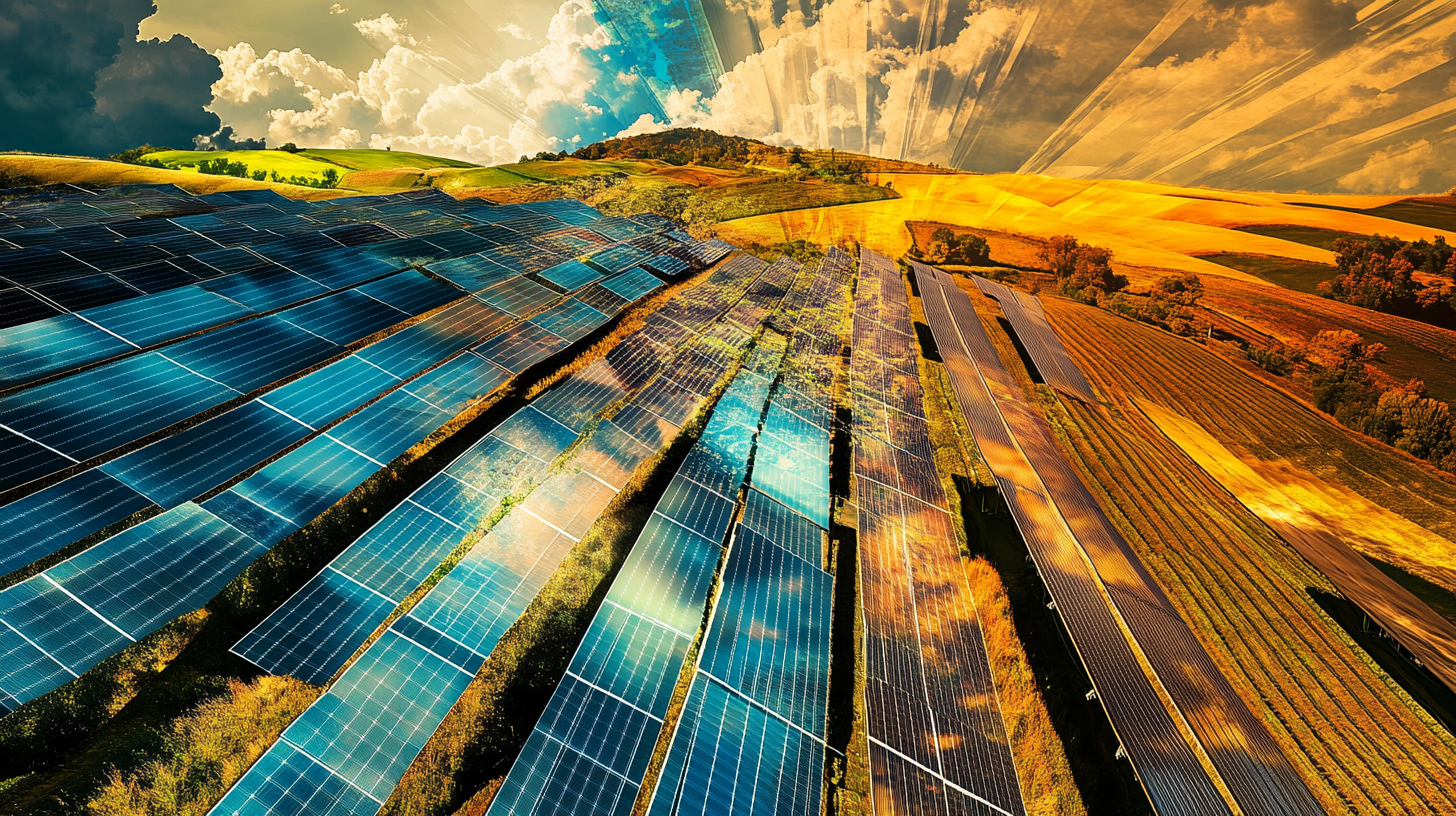
Agri-photovoltaics: Synergies and areas of tension in a dual-use strategy – Creative image: Xpert.Digital
Potentials and conflicts: The role of agri-PV in the energy transition
Agri-photovoltaics: How dual land use is transforming the energy future
The increasing prevalence of agri-photovoltaics (agri-PV) marks a shift in land use, where the simultaneous production of electricity and food on the same area generates both technological innovations and societal conflicts of interest. Current studies predict that agri-PV systems in Central Europe could cover up to 68% of energy demand if only 9% of agricultural land were developed for this technology. While global installed capacity has increased exponentially from 5 MWp in 2012 to over 14 GWp in 2021, ambitious expansion targets, such as Germany's goal of 215 GW of PV capacity by 2030, face the challenge of overcoming acceptance gaps and regulatory hurdles. Fraunhofer ISE identifies a potential of 1,700 GWp for elevated agri-PV in Germany, but projects such as the planned 300-ha solar park in Geiseltal, Saxony-Anhalt, show that the transformation of agricultural landscapes can trigger profound socio-economic disruptions.
Technological innovations and agroecological interactions
System design and yield optimization
Modern agri-PV concepts are based on a triple optimization: energy yield, agricultural productivity, and ecological resilience. Bifacial solar modules, which absorb light on both sides, achieve a light transmittance of 70–80% through increased mounting height (3–5 m) and generous row spacing (10–15 m), resulting in a 42–87% increase in land productivity in the APV-RESOLA project. Vertical installations like the Next2Sun system utilize east-west orientations to generate peak electricity in the mornings and evenings, while ensuring sufficient light for plant growth at midday. This counter-cyclical power production reduces grid congestion and, thanks to modular steel structures, allows for the use of harvesting machinery.
Microclimatic effects and plant yields
Partial shading by PV modules creates a more stable microclimate, which can lead to yield increases of up to 16% in berry crops during dry years. Long-term measurements at the Lake Constance experimental station documented higher wheat yields under PV modules (+7%) during the heatwave summer of 2018, while simultaneously reducing irrigation requirements by 20%. In contrast, yield losses of up to 33% occurred in years with balanced weather, highlighting the dependence on climate stress levels. Adaptive systems with tracking modules or light-selective coatings could enable demand-based shading control in the future.
Economic transformation potentials and operational risks
Income diversification for farms
Agri-PV offers farmers a dual source of income: while electricity production generates lease payments of €3,000–4,000/ha, 85% of EU direct payments are retained. A Polish case study shows that combined wheat/electricity yields increase the net profit per hectare by €1,268 (PV+wheat) compared to the losses expected for monoculture in 2024. The University of Göttingen determined an acceptance rate of 72.4% among farmers, with income security (68%) and future viability (52%) being the main motivations.
Infrastructural and market-related challenges
Despite falling production costs to 4–6 ct/kWh, grid bottlenecks are hindering the connection of large-scale agri-PV parks. The Geiseltal project, with a planned capacity of 300 MW, requires the construction of 23 km of new medium-voltage lines, which accounts for 30% of the total investment. Furthermore, standardized lease agreements are lacking: While energy cooperatives, such as the one in Peißenberg, offer farmers free land use in exchange for PV electricity, revenue-sharing models with fixed lease payments and profit sharing are dominant among commercial project developers.
Sociopolitical acceptance conflicts and planning law barriers
Local resistance and professionalization of protest culture
The planned solar park in Kienberg (Bavaria) reveals typical lines of conflict: A citizens' initiative with 1,836 voters (12.4% share) won three city council seats and announced legal action against the project. Professionally run campaigns use visual narratives ("paving over the landscape") and cooperate with nature conservation associations that object to habitat loss for European hamsters. Communication experts like Sándor Mohácsi emphasize that early public participation and transparent visualizations (VR simulations) increase acceptance, but that "hard core" groups are hardly reachable through rational arguments.
Planning law fragmentation and area layouts
Despite the 2023 amendment to the Renewable Energy Sources Act (EEG), which promotes agri-PV as a "special type of solar installation," inconsistent land designations are hindering market growth. While Bavaria permits agri-PV across the board in rural areas, states like Baden-Württemberg require complex case-by-case assessments according to Section 35 of the German Building Code (BauGB). The Fraunhofer study criticizes the fact that 70% of German agricultural areas are closed to PV development due to protected status (FFH, water protection), while at the same time, 8% of arable land across the EU in the Visegrad countries would be available for 180 GW of PV potential.
Regulatory innovation requirements and future development paths
Harmonization of funding frameworks and technology standards
Current feed-in tariffs under the German Renewable Energy Sources Act (EEG) do not differentiate between agri-PV system types, even though vertical installations (Next2Sun) achieve 30% lower yields with twice the land-use efficiency. A three-tiered bonus system – 0.5 ct/kWh for basic installations, +0.3 ct for biodiversity measures, +0.2 ct for specialty crops – could incentivize targeted innovation. In parallel, a DIN standard (currently in preparation: DIN SPEC 91434) is needed to define minimum light availability (600–800 µmol/m²/s) and machine clearance heights (>3.5 m).
Integration into smart farming ecosystems
Future projects like "Agri-PV 4.0" combine PV modules with IoT sensors for microclimate monitoring (humidity, leaf wetness duration) and automated irrigation control. Pilot plants in Rhineland-Palatinate are testing semi-transparent organic modules with adaptive light transmission that use AI to analyze weather forecasts and plant growth data. These systems could potentially integrate hydrogen production (electrolyzers under the modules) and agri-photocatalysis (air purification using TiO2-coated modules).
Agri-PV as a catalyst for an integrated land-use transition
The integration of PV technology into agricultural land is not a technocratic excess, but rather a necessary symbiosis for addressing the climate and food crises. As the ReWA project demonstrates, acceptance rises to 78% when regional electricity models (25% on-site consumption) are linked to citizen participation (5–10 kWh shares starting at €500). Crucially, clear spatial planning (priority areas on low-yield soils) and cooperative planning formats (roundtables with farmers, conservationists, and municipalities) will be essential to institutionalizing the productive coexistence of crops and electricity. The upcoming EU agricultural reform of 2027 offers the opportunity to specifically utilize eco-schemes for biodiversity-promoting agri-PV systems, thus reaping the double dividend of climate protection and biodiversity.
Related to this: