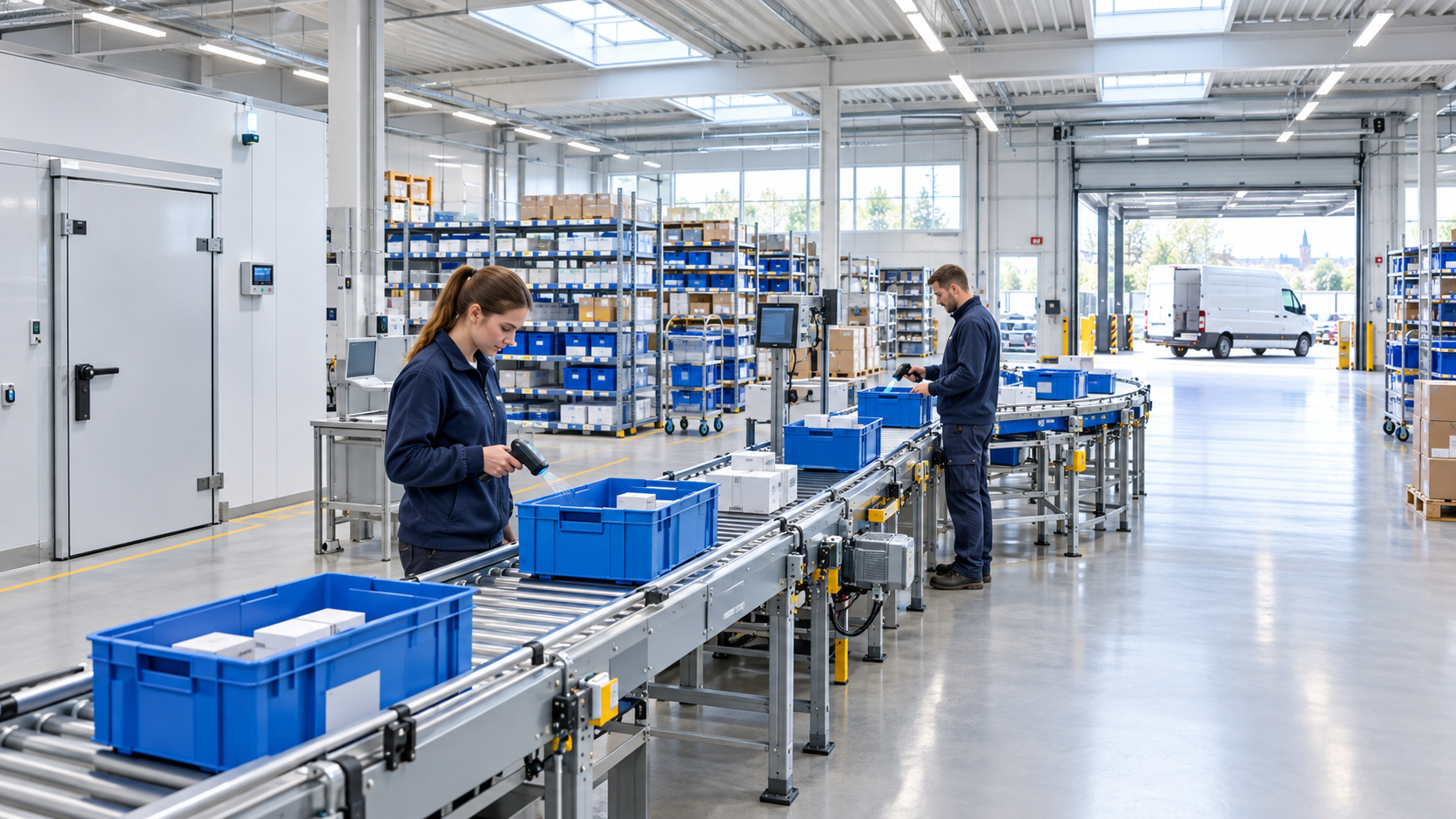
A new logistics center for the northeast: Sanacorp's plans for Stralsund and what the new building could mean for pharmacies – creative image on the topic, with AI: Xpert.Digital
New pharmaceutical warehouse in Stralsund: Why Sanacorp is opting for a modern location
Faster, safer, more efficient? More than just a new warehouse: Why Sanacorp's Stralsund location is important
Sanacorp is investing more than €20 million in a new branch in Stralsund. The new building is intended to modernize a key hub for pharmaceutical supply in northeastern Germany – and thus improve the processes behind the delivery to more than 200 pharmacies. However, a new building alone guarantees neither higher returns nor the elimination of drug shortages. The crucial factor is whether warehouse technology, personnel, IT, cold chains, and delivery work together reliably. The Stralsund site demonstrates what modern pharmaceutical logistics is all about: efficient processes, secure goods movements, and a robust regional supply. The true extent of the investment's benefits, however, will only become apparent once the facility is operating smoothly and consistently.
Sanacorps new building in Stralsund: Why pharmaceutical logistics is becoming a location issue
Those who only save on storage costs risk supply
Sanacorp is investing more than €20 million in a new branch in Stralsund, thereby modernizing a key interface in the pharmaceutical supply chain in northeastern Germany. Economically, the project is primarily an investment in faster, more reliable, and sustainable processes. Its value is therefore measured not only by additional storage space, but also by how reliably medications reach pharmacies under increasing technical, financial, and organizational demands.
The new building represents a fundamental shift in the understanding of logistics: a pharmaceutical warehouse is not merely a storage facility, but rather part of a time-critical supply chain. However, this does not guarantee a high return on investment or an automatic solution to drug shortages. The project's economic strength lies instead in modernizing an existing regional supply center without sacrificing the benefits of geographical proximity. The crucial factor will be whether the building, storage technology, personnel, data processing, and delivery operations truly function as a cohesive system.
A regional node with a wide reach
As early as 2024, the Stralsund branch supplied more than 200 pharmacies in a large area stretching from Altenkirchen on the island of Rügen to Kühlungsborn and Penkun. The service area includes Mecklenburg-Western Pomerania and northern Brandenburg. More than 100 delivery routes are handled daily from Stralsund. This scale alone makes it clear that the economic importance of the location extends far beyond the Hanseatic city or the Vorpommern-Rügen district.
It's important to distinguish between three factors: a delivery route is not a single pharmacy delivery, a pharmacy receiving a delivery is not a single patient, and the processing time in the warehouse is not the total delivery time. At Sanacorp, the average time between receiving an order and loading the delivery vehicle is approximately 30 minutes; pharmacies are supplied up to three times a day, depending on the supply concept. The actual waiting time for a patient's medication also depends on the order time, product availability, departure time, and route.
The economic function of this system is to consolidate large inventories while still enabling a high delivery frequency. This means pharmacies don't have to stock every rarely needed medication themselves. Wholesalers handle part of the warehousing and manage the balance between a wide product range and limited on-site space. A well-run branch therefore not only increases productivity within its own operations but also supports the operational efficiency of its customers.
The investment replaces structural bottlenecks
The new site is being built at Albert-Schweitzer-Straße 9 on a plot of land measuring approximately 13,500 square meters. The logistics facility will comprise around 5,400 square meters, along with an adjacent administrative area. The investment covers the complete renovation of the building and the technical warehouse logistics. It is therefore not simply an additional warehouse alongside an otherwise unchanged operational structure.
The current site is located in a three-story building constructed in 1963, whose systems, despite subsequent modifications, have become maintenance-intensive. The new building will be a single-story structure, allowing traffic routes and workflows to be tailored to actual requirements from the outset. This investment addresses a classic industrial bottleneck: existing buildings can be adapted over decades until their basic structure increasingly hinders further efficiency gains.
Such a replacement must be assessed differently from an economic perspective than a mere capacity expansion. Part of the capital is used to cover necessary modernization costs anyway. Another part can create additional capacity. Those who measure all expenditures solely by future revenue growth may underestimate avoided maintenance and breakdown costs. Conversely, those who view every modernization effect as additional profit overlook depreciation, financing, and new operating costs.
The schedule demands a sober assessment
Construction began on August 12, 2025, with completion scheduled for summer 2026. However, an initially announced date is not equivalent to a confirmed completion date. This assessment is not based on a reliably documented current commissioning date. Therefore, the anticipated productivity gains should be treated as investment objectives and not as already measured results of fully established, regular operation.
Especially in pharmaceutical logistics, a distinction must be made between structural completion and reliable, regular operation. Equipment, IT systems, and critical processes must be adequately qualified, tested, or validated before use. Temperature distribution, goods movements, and data processing must not only be technically feasible but also function reliably and reproducibly. A finished roof and installed conveyor technology alone are insufficient.
A previously announced timeframe, without further information, does not allow for the conclusion of a specific cost overrun or a concrete delay. However, from an economic perspective, a general benchmark emerges: the later productive use becomes possible compared to the plan, the longer capital commitment and parallel expenses can persist. Conversely, it would be short-sighted to convert a sensitive utility operation under time pressure if this would increase the likelihood of errors or outages. The appropriate benchmark is not solely the earliest possible opening, but rather the reliable commencement of a consistently stable service.
One level changes the flow of goods
The change from three floors to one level may initially appear to be a structural decision, but it is primarily a process decision. Where goods have to pass through different levels, additional transfers, potential waiting times, and dependencies on vertical conveyor technology arise. Consolidating everything on one level offers the opportunity to reduce these interfaces and better coordinate goods receiving, storage, order picking, and shipping.
The crucial point is not that single-story buildings are inherently superior to any multi-story solution. They often require more land and, if poorly designed, can result in long horizontal distances. Their advantage only arises from a layout that integrates demand frequency, packaging sizes, temperature requirements, and shipping times. Therefore, a larger footprint does not automatically equate to a better process.
For Stralsund, the starting point suggests significant modernization benefits: The existing site had already largely exhausted its spatial capacity by 2024. A new building would allow not only the replacement of individual machines but also a complete reorganization of the entire process. From a business perspective, therefore, the number of packages processed per hour should not be the sole focus. Equally important are consistent performance during peak order periods, low error rates, and the ability to quickly manage deviations.
More technology is not an end in itself
The new branch also completely replaces the previous technical warehouse logistics. However, this does not imply that every task is fully automated or that a specific robotics solution is installed. Publicly available project information does not justify claims about specific levels of automation, robot models used, or guaranteed throughput increases.
The economic benefits of automation depend on which tasks it automates. Recurring, standardized processes are often more suitable than irregular, exceptional cases. A sensible division of labor could involve technically accelerating regular goods flows and allowing employees to focus more on quality control, exceptions, maintenance, and process control. This is one possible design direction, not a proven implementation of the new building in Stralsund.
Furthermore, every additional technical dependency must be taken into account. A system can reduce labor costs while simultaneously increasing the consequences of a control error. Spare parts availability, maintenance access, manual backup options, and reliable support from technical partners must therefore be included in the same cost-benefit analysis as achievable speed. The most economically viable solution is not necessarily the most technically spectacular, but rather the one that reliably achieves the right balance between performance, effort, and manageability in daily operation.
Cold chains make quality a cost factor
Pharmaceuticals must be stored and transported according to their specific product requirements; there is no uniform temperature requirement for the entire product range. For many refrigerated pharmaceuticals, a temperature range of two to eight degrees Celsius is relevant, but the specific approved storage and transport conditions remain decisive. Refrigeration is therefore not simply an additional space, but an ongoing quality assurance task.
The European rules of Good Distribution Practice (GDP) require, among other things, suitable premises, documented processes, qualified personnel, and adequate temperature monitoring. Before using storage areas, the temperature distribution must be examined under representative conditions; monitoring devices must be positioned to detect critical fluctuations. Goods receipt, transport, and the handling of deviations are also part of this system.
Economically, such requirements initially incur investment and operating costs. However, they simultaneously create the conditions necessary to ensure that goods remain usable and that delivery performance fulfills its purpose. A drug transported on time, but whose quality is not guaranteed, does not constitute a successful logistics process. Conversely, robust temperature control can limit avoidable write-offs and additional processing. Therefore, the new building must be evaluated not only on transport speed but also on proven product integrity.
Security is part of the architecture
The planned facilities in Stralsund include a narcotics safe with a corresponding vault door, compliant with the guidelines of the Federal Institute for Drugs and Medical Devices. Furthermore, a roof covering approximately 430 square meters is planned for the loading areas. Both features demonstrate that a pharmaceutical logistics facility meets requirements that go beyond simply providing dry storage space.
Security encompasses different levels. Particularly sensitive products require special spatial and organizational precautions. Recalled, expired, or counterfeit medications must be kept separate from saleable goods. This also includes controlled access, appropriate documentation, and transparent decisions regarding recalls and re-releases.
The economic consequences underscore the importance of proper initial planning. If safety zones, return areas, or shipping routes are undersized, later adjustments can be costly. At the same time, oversized special areas generate ongoing costs. Good planning, therefore, is not solely based on the current average daily volume but also considers plausible peaks and disruptions. For the evaluation of the new building, it is crucial whether these requirements are functionally integrated, rather than being added as makeshift solutions that impede the flow of goods.
Revenue is not the same as profitability
Sanacorp achieved group-wide sales of approximately €7.9 billion in fiscal year 2025, representing growth of 7.5 percent compared to the previous year. Around 3,000 employees supply approximately 8,000 pharmacies across 19 locations. This scale demonstrates that the new building in Stralsund is embedded in a significantly larger logistical and financial network.
However, the operational efficiency of an individual warehouse cannot be directly derived from sales figures. For wholesalers, the value of the goods traded, the number of packages, and the actual handling effort are all different factors. If more expensive medications constitute a larger share of sales, revenue can increase without a corresponding increase in the number of logistical operations. Conversely, special warehousing requirements can disproportionately increase the effort involved.
The cooperative reported a pre-tax profit of €78.8 million in 2025, including special items. This figure should not be indiscriminately linked to group revenue to arrive at a supposedly meaningful operating margin: the perspective and the components of the result are not identical. For Stralsund, a separate cost accounting system, inventory data, and reliable performance indicators would be necessary. These are not publicly available in a format that would allow for a sound, location-specific return calculation.
High inventory values increase the pressure to finance
The legally regulated wholesale remuneration for the relevant prescription-only finished medicinal products comprises a fixed surcharge of 73 cents per package plus an additional maximum percentage surcharge of 3.15 percent, capped at €37.80. The resulting maximum of €38.53 is not net profit, but rather a remuneration framework from which the wholesaler's economic activities must be covered.
This mechanism explains why high-priced products are not automatically particularly profitable. Above the cap, the percentage surcharge does not increase further. However, the value of the goods, and thus the financial risk, can be considerably higher. Factors to consider include the duration of pre-financing, payment terms, and the consequences of a potential loss. If additional costs for temperature control or insurance increase, a growing high-price segment can exacerbate the economic burden.
For the new building, this means that optimized goods movements alone are not sufficient as a target variable. The time between goods receipt and payment receipt also deserves attention. A warehouse can become technically more productive and yet tie up more capital if the product range or inventory becomes more expensive. Effective investment management must therefore consider physical and financial goods flows together. The mere fact that the investment volume exceeds 20 million euros does not automatically imply either overinvestment or sufficient financial security.
Your intralogistics experts

Consulting, planning and implementation of complete solutions for high-bay warehouses and automated storage systems - Image: Xpert.Digital
More information here:
Innovative pharmaceutical storage solutions for the future
Specialized real estate is not automatically a gold mine
The term "pharmaceutical logistics" can give the impression that it is necessarily a high-margin, particularly safe asset class. This conclusion is too simplistic. The economic characteristics of a property, the profitability of the company operating there, and the social necessity of its services are three distinct issues.
A specialized new building can offer its user significant operational added value. However, this does not automatically mean that the same value can be realized in a later sale or lease. The more closely the floor space and technical installations are tailored to a specific business, the more carefully its suitability for other users must be examined. Therefore, it remains relevant whether the building would also be suitable for other commercial purposes, whether technical modifications are possible, and whether other tenants could be found.
The ratio of investment amount to area should not be hastily interpreted as a purely construction cost indicator. In Stralsund, the buildings and warehouse technology are being constructed entirely from scratch; furthermore, the unstable soil necessitates a special foundation, and the terrain requires adjustments through earthworks. Without a precise breakdown by land, building, technology, and ancillary costs, a comparison with conventional warehouses would be misleading. This project is a specialized operational investment and not a universally applicable price benchmark for logistics properties.
Proximity costs money, distance does too
The new building strengthens an existing regional hub within the Sanacorp network. Therefore, it initially demonstrates a modernization of existing structures, not a general nationwide trend towards an increasing number of branches. Nevertheless, it illustrates the economic trade-off between centralized operations and regional accessibility.
A few large warehouses can offer advantages in terms of technical utilization, inventory consolidation, and standardized processes. Regional locations, on the other hand, can ensure proximity to pharmacies and facilitate short-notice deliveries. Which structure is more advantageous depends not only on square footage or number of employees, but also on the distribution of demand, delivery commitments, and actual travel times. Since Sanacorp is relocating within Stralsund, shorter external delivery routes due to the new building alone have not been proven; the most immediately apparent benefit lies in internal processes.
For coastal and rural areas, simply considering distances as the crow flies is therefore of little use. Supply chains must function on actual roads and within specific timeframes. A more centralized warehouse may appear more cost-effective on paper if transport delays and buffer zones are underestimated. Conversely, regional proximity should not justify every inefficient structure. The most compelling approach is therefore: as much consolidation as economically viable, and as much regional presence as necessary to guarantee the promised supply. Within this framework, Stralsund is a case for modernizing an existing hub.
Fewer pharmacies are changing the tour economy
At the end of 2025, there were 16,601 public pharmacies in Germany, 440 fewer than a year earlier. By the end of June 2026, the number had fallen further to 16,488; in the first half of the year, 143 closures were offset by only 30 new openings. This development provides an important framework for any long-term investment in supplying independent pharmacies.
Fewer locations do not necessarily mean a corresponding decrease in the demand for medication. Demand can shift to remaining pharmacies or change between distribution channels. For wholesalers, this alters the spatial and operational distribution of orders. Larger individual quantities delivered to fewer points can make routes more economical. Conversely, if widely separated locations remain, the mileage per package delivered can increase.
For Stralsund, this does not imply a clear growth forecast or a fundamental objection to the new building. Rather, it creates the challenge of considering various developments: a changing pharmacy network, different ordering patterns, and potential shifts between regular and short-term needs. Flexibility in space utilization, staffing, and route planning has its own economic value under such conditions. Conversely, a rigid approach based on the current customer structure could limit the investment's adaptability.
Seasonal demand requires flexible capacity
Regional supply cannot be determined solely from the number of permanent residents. Mecklenburg-Western Pomerania recorded approximately 8.2 million guest arrivals and 33.3 million overnight stays in registered accommodation establishments in 2025. Such figures provide a relevant planning framework for supply in a tourism-oriented state, even if they do not allow for the direct calculation of pharmaceutical demand for a single branch.
Guest arrivals should not be equated with a corresponding number of additional patients. Similarly, overnight stays do not necessarily reflect a fixed medication consumption. For logistical planning, it is crucial to recognize that locations and potential ordering needs can change throughout the year. In areas with higher seasonal occupancy, the capacity of the local supply network also warrants attention.
In addition, there are general seasonal fluctuations, such as those caused by waves of infection, which can increase the demand for certain medications. A well-sized, efficient center therefore doesn't need to constantly operate at peak capacity. Instead, it should be able to maintain targeted reserves. This includes flexible working hours, sufficient shipping capacity, and inventory levels that account for anticipated fluctuations without tying up unnecessary capital. The challenge lies in organizing operations that are neither too expensive on average days nor too vulnerable on peak days.
Securing jobs is a separate effect
At the start of construction, Sanacorp employed 60 people and nine trainees in Stralsund. The continuation and modernization of the site therefore affects an existing workforce of 69 people. This is a different statement than the announcement of a significant increase in staff. A sound economic analysis should differentiate between existing and newly created jobs.
The regional benefits can still be considerable. A modernized site, implemented over the long term, stabilizes career prospects and preserves company expertise. The existing collaboration with Stralsund University of Applied Sciences and the company's own training programs offer starting points for the further development of logistics and commercial skills. Especially during the transition to new facilities and digital processes, this knowledge can make the difference between nominal and actually usable productivity.
During construction, temporary services are also generated for building construction, technical equipment, and commissioning. The extent of their regional value creation depends on which companies are involved and where they perform their services. Without corresponding data, no reliable local employment multipliers can be derived from this. In the long term, it is likely more important whether the location remains competitive and secures skilled employment. Simply counting the additional workforce would therefore only incompletely reflect the nature of this modernization.
Cooperative interests require economic discipline
Sanacorp is a pharmacist-owned company, headed by the cooperative and thus its members. This ownership structure changes the perspective on investments: alongside a viable wholesale operation, supporting pharmacies is a key economic objective. A regional warehouse can therefore be strategically important even where a short-term comparison of isolated location costs only captures part of its benefits.
A cooperative orientation does not, however, eliminate economic constraints. Capital is limited here as well, and a persistently deficit-ridden operation cannot be justified solely by its charitable purpose. The challenging task lies in reconciling security of supply with the capacity to invest. Overly generous short-term distributions or favorable terms could weaken the very financial flexibility needed for new infrastructure.
The fact that Sanacorp is simultaneously implementing a future-oriented and efficiency program and investing in logistics and digitalization is therefore not inherently contradictory. Savings and modernization can complement each other if they eliminate structural weaknesses. However, they can also hinder each other if insufficient personnel or technical resources make the new infrastructure more vulnerable. The crucial factor is which costs are actually eliminated and whether performance is lost in the process. The new construction should therefore not be assessed in isolation, but rather as part of the long-term performance of the entire network.
Data can be used to manage inventories more intelligently
New warehouse technology is particularly beneficial when goods movements, inventory levels, and orders are digitally coordinated. Furthermore, applications using artificial intelligence and machine learning can fundamentally improve demand forecasting, warehouse organization, and operational processes. However, no concrete system decisions or already realized savings can be derived from this for the new building in Stralsund. Technological possibilities and proven local implementation must be clearly distinguished.
A sensible approach would be to align inventory levels with different demand rates. Frequently ordered products require different supply processes than rarely needed medications. At the same time, algorithmic inventory optimization should not be based solely on rapid turnover, because rare products, in particular, can have a high supply value. The decision regarding availability therefore remains a combination of demand analysis, economic considerations, and pharmaceutical responsibility.
Equally important is data quality. Incomplete inventory reports, faulty master data, or undocumented goods movements can negate the benefits of improved software. GDP regulations require suitable evidence of reliable operation, data protection, and defined procedures for computerized systems to function reliably and in the event of failures. Therefore, digitalization should not be evaluated solely based on the number of steps saved. It must also improve transparency, traceability, and restart capability. A seemingly optimal inventory is of little value if, in the event of a disruption, the company does not know which goods are actually available and released.
A new warehouse will not end supply shortages
A more efficient distribution center can improve the availability of existing medications. However, it cannot distribute medications that are not manufactured, not approved, or not delivered. Production problems, quality defects, and dependence on a few manufacturers are among the causes of supply shortages. These problems sometimes arise long before regional distribution.
For Stralsund, a distinction must therefore be made between local capacity and overall drug availability. Improved warehousing processes can reduce delays within one's own sphere of influence. Smart stockpiling can mitigate certain fluctuations. However, this does not automatically guarantee the availability of a drug that is permanently unavailable. Anyone describing this investment as a comprehensive solution to drug shortages is confusing an important sub-function with the entire system.
Even increased safety stock is not a cost-free solution. Additional goods tie up capital, require suitable storage space, and can lead to losses if they have a limited shelf life. Good Distribution Practice (GDP) regulations stipulate inventory rotation based on the principle of delivering products with the earliest expiration dates first. Security of supply, therefore, is not achieved by fully stocked shelves, but rather through an appropriate combination of inventory levels, transparency, reliable supplier relationships, and coordinated responses to disruptions. This is where the realistic role of new construction lies: it can improve regional resilience without eliminating global dependencies.
Solar power is not yet an emergency power supply
A photovoltaic system is planned for the new location to cover part of its own energy needs. This is generally suitable for a business that requires electricity during the day for technology and building functions. However, the actual savings will depend on the system size, generation capacity, consumption profile, and energy prices. Without this information, any concrete amortization claim would be speculative.
Equally important is the distinction between energy efficiency and reliability. A typical grid-connected photovoltaic system does not automatically continue to supply power for operations during a power outage. This requires suitable technical functions and a coordinated supply and switching concept. Therefore, the mere presence of solar modules does not guarantee the protection of cold storage facilities, IT systems, and conveyor technology.
From an ecological perspective, the entire system must be considered. Shorter internal routes and more efficient facilities can create advantages. However, additional space, construction costs, and a potential increase in delivery traffic all generate additional expenses. More frequent, underutilized vehicles can also negatively impact the environmental footprint. Therefore, the appropriate assessment criterion would be a transparent analysis of energy consumption and transport performance in relation to the reliably delivered supply. A sustainable building is one component, but not yet proof of an overall more sustainable supply chain.
The transition is a separate risk area
While the new building is under construction, the existing branch will maintain uninterrupted service. This continuity is a crucial part of the project. However, the subsequent relocation remains a separate operational process, the risks of which do not disappear upon completion of construction.
Mastering the transfer of inventory, the correct allocation of storage locations, the linking of orders and goods movements, and employee training are all essential tasks. Temperature-sensitive products and specially secured pharmaceuticals have additional requirements regarding appropriate storage and transport conditions. Therefore, a successful migration must be prepared in physical, digital, and organizational terms.
From a business perspective, it would be prudent not to dismiss temporary increases in workload during this phase as avoidable inefficiency. Parallel operation, testing, and additional staffing may incur costs, but they can also prevent more serious disruptions. Coordination with the pharmacies is also crucial to ensure reliable ordering and delivery processes. The productive benefits of the new building therefore depend not only on the planning of the new hall but also on the quality of the transition. A rushed changeover could jeopardize advantages that were only achieved through years of investment.
How can the benefit be measured?
A reliable assessment is currently lacking in publicly available, site-specific data on expected throughput, operating costs, capacity utilization, and amortization period. Therefore, it is impossible to make a reliable statement about how many years it will take for the more than 20 million euros to pay for itself. However, an economic analysis can identify what evidence would be necessary for a convincing result.
First, it would need to be demonstrated that orders are processed more completely and reliably within the promised timeframes. This includes error rates, inventory accuracy, and documented temperature deviations. Next, costs and productivity would need to be considered: for example, the labor required per order item, the energy consumption per processed unit, and the delivery costs with comparable service performance. Finally, the financial perspective would need to be taken into account, particularly capital commitment, maintenance, depreciation, and ongoing necessary renewal expenses.
A good outcome would not only be higher peak performance, but also a sustained reduction in vulnerability with the same or even better level of care. Additional capacity would then be particularly valuable if it remains usable at realistic costs and can be adapted to changing demand. This is the justified perspective on Sanacorp's investment in Stralsund: it is primarily a modernization of regional healthcare infrastructure. Its economic success will be demonstrated by whether the new space and new technology result in a reliably improved operation.
Your global marketing and business development partner
☑️ Our business language is English or German
☑️ NEW: Correspondence in your native language!

Konrad Wolfenstein
I and my team are happy to be available to you as your personal advisor.
You can contact me by filling out the contact form here wolfenstein@xpert.digital:or simply call me at +49 7348 4088 965. My email address is
I'm looking forward to our joint project.