A government at the limit of public support: When a coalition governs against its own people – and yet has no other choice – Image: Xpert.Digital
Partial sick leave is coming: This is how the government wants to reduce extreme sick leave rates
When a coalition governs against its own population – and yet has no other choice
Record debt and pension increases: The risky billion-euro plan of the Merz government
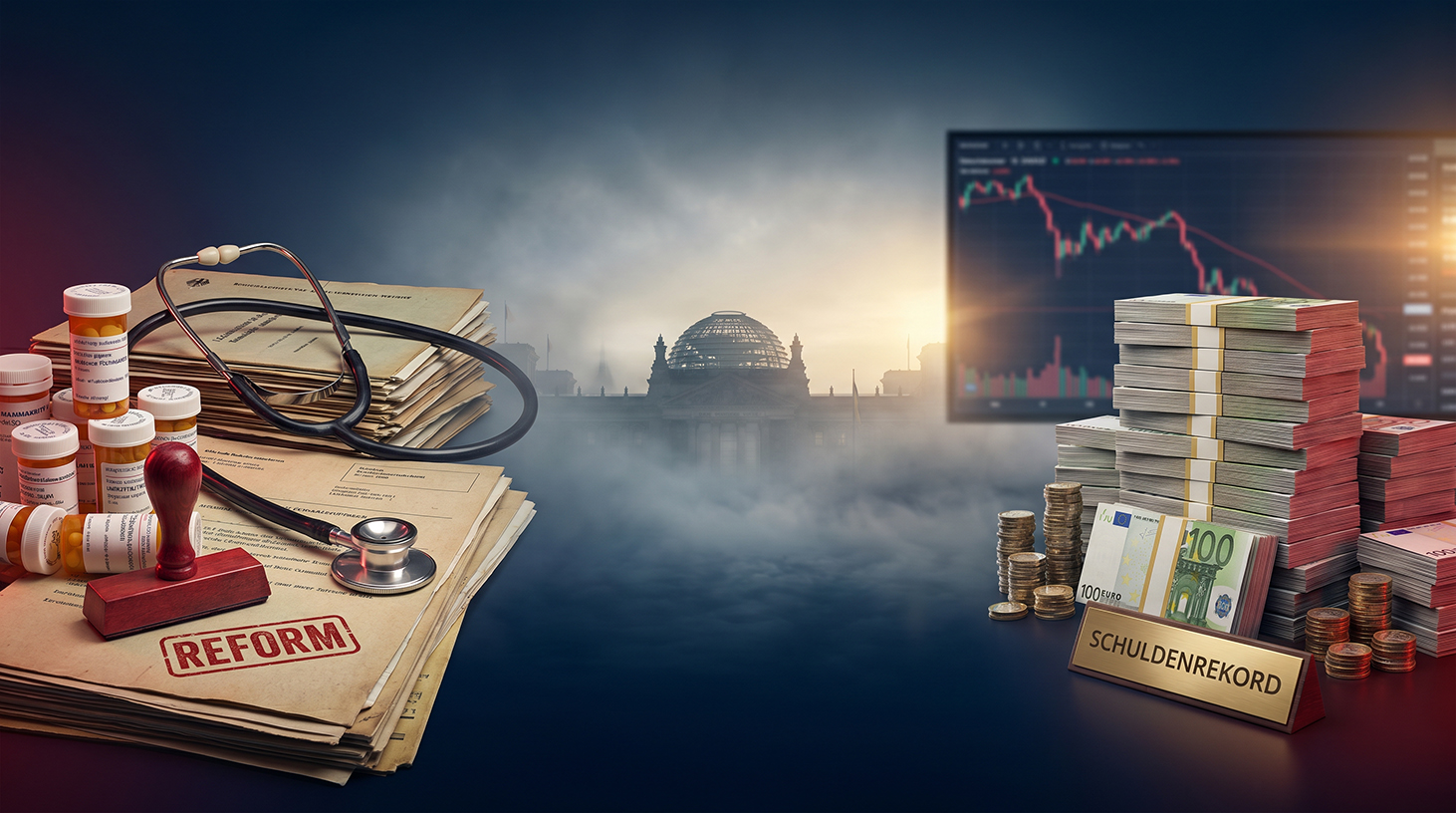
The German government under Chancellor Friedrich Merz is under immense pressure. With poll numbers at a historic low and a population increasingly losing faith in the coalition's ability to govern, the cabinet is now attempting a decisive move. On a truly pivotal day for fiscal policy, far-reaching decisions were made that will shape the daily lives and wallets of millions of citizens: A tough healthcare reform will bring higher co-payments and benefit cuts, while the dilemma surrounding health insurance contributions remains unresolved. At the same time, some 23 million pensioners can look forward to an increase of over four percent – financed against the backdrop of a 2027 budget proposal based on staggering record levels of debt. A deep dive into a political package of measures caught between necessary consolidation, heated debates about sick leave, and the risky plunge into new debt.
Health, debt, economy: Germany's fateful day in fiscal policy
The center-right/center-left coalition government has a serious credibility problem. According to the ARD-DeutschlandTrend poll from April 2026, only 15 percent of Germans are satisfied with the coalition's performance – the lowest figure since it took office. The ZDF Politbarometer from the same month reached similar conclusions: only 27 percent said they were generally satisfied, while 63 percent gave the government a failing grade. Even more revealing is the comparison: shortly after the government was formed in spring 2025, satisfaction was still at 38 percent according to YouGov – today, 75 percent of citizens are dissatisfied. In this political climate, the Merz cabinet is attempting to reverse this trend with precisely two of its largest and most painful reform projects: healthcare reform and the 2027 budget.
Chancellor Friedrich Merz and his Vice-Chancellor and Finance Minister Lars Klingbeil are losing personal support. Merz's approval rating has dropped to just 21 percent – a decrease of eight points – while Klingbeil's is at 18 percent, a decline of 15 percentage points. These figures are not merely a personal problem for the two leading politicians, but a structural signal: the public doubts that the measures adopted will improve their lives. This makes the question all the more pressing: can today's cabinet decisions reverse this trend – or will they exacerbate it?.
The crumbling foundation of the health system
The core of the healthcare reform is not ideological, but simply accounting-related. The expenditures of statutory health insurance funds have risen significantly faster than their revenues in recent years. In 2025 alone, expenditures increased by 7.8 percent, while revenues grew by only 5.3 percent. Medical treatments became 9.7 billion euros more expensive in the same year; outpatient medical treatments rose by 8.6 percent, and medications by 5.9 percent. Without countermeasures, statutory health insurance faces a structural shortfall of around 40 billion euros by 2030 – and the deficit could already exceed 15 billion euros by 2026. Since the beginning of 2026, the average supplementary contribution rate has been 3.13 percent, according to the National Association of Statutory Health Insurance Funds – a record high which, together with the general contribution rate of 14.6 percent, is driving the overall burden on employees and employers to historic highs.
Federal Health Minister Nina Warken (CDU) appointed a commission of experts which, after six months of work, presented 66 recommendations for action. This commission calculated that full implementation could relieve the burden on health insurance funds by approximately €42.3 billion in 2027 alone – and by 2030, a cumulative effect of more than €60 billion would be achievable. The cabinet has now agreed on a significantly more selective implementation of these recommendations. Warken herself assumes that the adopted reform will close the current deficit of the health insurance funds, which amounts to around €15 billion.
What insured persons can specifically expect in the future
The reform takes effect in several areas simultaneously. Co-payments for medications will increase from a minimum of five euros to a minimum of 7.50 euros and from a maximum of ten euros to a maximum of 15 euros; in addition, an annual adjustment will be introduced. Homeopathic remedies will no longer be covered by statutory health insurance. Free family insurance will be eliminated for many spouses, although exceptions apply to parents of children under seven. A mandatory second opinion will be introduced for planned, costly surgeries. Employees will be able to receive partial sick leave for 25, 50, or 75 percent of their weekly working hours, which is intended as a business-related tool to reduce the economic losses caused by absenteeism. Furthermore, the contribution assessment ceiling will increase by 300 euros in 2027.
Healthcare providers will also be held more accountable. Reimbursements for doctors, hospitals, and pharmaceutical companies will only be allowed to increase as quickly as the health insurance funds' revenues – a clause that effectively sets a spending cap. This symmetrical distribution of the burden is politically astute, as it protects the reform from accusations of solely burdening the insured. Nevertheless, the burden on consumers is noticeable. The shift in the cost limit for co-payments disproportionately affects chronically ill individuals who require regular medication.
The blind spot of the reform: The citizen's income problem
Despite all reform efforts, a fundamental design flaw remains in the system, which the current measures do not rectify. The state pays a monthly flat rate of €144 to the health fund for each recipient of basic income support. However, health insurance associations and experts estimate the actual cost of medical care for these individuals at €310 to €350 per month. The resulting monthly funding gap of approximately €180 to €210 per person amounts to an annual system deficit of around €12 billion, which is cross-subsidized by the contributions of those with statutory health insurance.
The head of the Techniker Krankenkasse (TK), Jens Baas, clearly identifies this imbalance: Insuring people who are not working costs a total of around 20 billion euros annually – a genuine government responsibility. However, the federal government only covers about a third of this, roughly 8 billion euros; the remaining 12 billion euros are borne by those with statutory health insurance. The National Association of Statutory Health Insurance Funds (GKV-Spitzenverband) therefore filed a lawsuit against the federal government at the end of 2025 before the North Rhine-Westphalia State Social Court. The Federal Council (Bundesrat) also called on the federal government in a resolution to ensure that the flat-rate contribution for recipients of citizen's benefits covers all costs. Health Minister Warken herself admitted that this imbalance in the system is a problem and that she would have preferred greater federal participation – however, the tight budget situation does not allow for this.
Our EU and German expertise in business development, sales and marketing


Our EU and German expertise in business development, sales and marketing - Image: Xpert.Digital
Industry focus areas: B2B, digitalization (from AI to XR), mechanical engineering, logistics, renewable energies and industry
More information here:
A thematic hub offering insights and expertise:
- Knowledge platform covering global and regional economies, innovation and industry-specific trends
- A collection of analyses, insights, and background information from our key areas of focus
- A place for expertise and information on current developments in business and technology
- A hub for companies seeking information on markets, digitalization, and industry innovations
Sick leave debate exposed: structural problems instead of laziness
Pensions are rising – but the reality is more complicated
The cabinet also approved the pension adjustment effective July 1, 2026: The statutory pension will increase by 4.24 percent. The current pension value will thus rise from €40.79 to €42.52 per earnings point. This represents a noticeable improvement for approximately 23 million pensioners; for a standard pension after 45 years of contributions, this translates to a monthly increase of around €77.85. The Federal Council still needs to approve the measure, which is considered a formality.
The pension adjustment is based on the wage-related pension formula according to Section 68 of the German Social Code, Book VI (SGB VI), and follows the relevant wage development, which the Federal Statistical Office quantifies at 4.25 percent. In nominal terms, the pension increase thus exceeds inflation. While the Federal Ministry of Labor and Social Affairs (BMAS) forecasts an inflation rate of approximately 2.1 percent for 2026, other sources point to higher price pressures – particularly due to increased energy prices resulting from geopolitical upheavals. On paper, this results in a real increase in purchasing power, but in the lived reality of many pensioners, rising energy and food prices in previous years eat up a considerable portion of this increase.
The 2027 budget: Debt as an economic policy strategy
The second major decision of the day was the draft budget for 2027. The cabinet approved the draft from the Finance Ministry, which projects total expenditures of €543.3 billion and new borrowing of nearly €197 billion – consisting of €110.8 billion in new loans in the core budget as well as further debt from special funds for infrastructure and the armed forces. This represents the second-highest level of debt in the history of the Federal Republic. Interest payments alone on existing debt amount to €42.7 billion in 2027 – money that will not go towards hospitals, schools, or infrastructure, but will simply be used to service existing debts.
By 2030, annual federal spending is projected to rise to around €625 billion. New debt exceeding €850 billion is budgeted for the entire legislative period from 2025 to 2029. These figures directly contradict the fundamental principles of sound fiscal policy and undermine any concept of medium-term debt consolidation. The largest single budget allocation goes to the Ministry of Labor under Bärbel Bas, followed by massively increased defense spending. Christian Haase, the chief budget expert for the CDU/CSU parliamentary group, explicitly warns that the defense budget, with an additional €20 billion annually, is spiraling out of control and that Germany is heading towards uncontrolled debt.
Between investment crisis and debt spiral: The economic policy logic
The 2027 budget reflects the fundamental dilemma of German economic policy: Germany is caught in an investment crunch and must simultaneously finance its welfare state, defense, and infrastructure – without the necessary growth to cover these costs from current revenues. The economic weakness of recent years, structural productivity problems, and demographic change have created a situation in which the public sector must borrow heavily to maintain its ability to act. However, economists point out that debt-financed consumption expenditures – such as social benefits and pension payments – do not have a sustainable economic impact unless accompanied by structural reforms on the supply side.
What is particularly concerning is that around €20 billion of the planned expenditures are to be saved through structural reforms – concrete proposals for which are not expected to be drawn up until the beginning of July. This means that a significant portion of the draft budget is based on savings plans that have not yet been defined. This is risky from a fiscal policy perspective, as such short-term financing measures have regularly led in the past either to further borrowing or to short-term spending cuts in sensitive areas. The overall picture is a budget that combines politically necessary spending with economic optimism – and in doing so, underestimates the risks of interest payments in a long-term low-growth environment.
Sick leave and work ethic: The wrong debate at the right time
Chancellor Merz has repeatedly addressed the high rate of sick leave in Germany in recent weeks, sparking a debate that has caused more political damage than it has helped. According to him, Germany averages around 20 sick days per year – he publicly questioned whether Germany must truly be such a sick nation that it has one of the highest rates of sick leave in Europe. The statistically reliable figure is 14.5 sick days per employee per year, although this does not fully include short-term sick leave of one or two days. Merz considers sick leave by telephone a major driver of this trend; his camp has long been pushing for its abolition or at least its restriction.
The reactions to this debate demonstrate how politically risky moralizing interpretations of complex issues can be. The German Trade Union Confederation (DGB) accused Merz of expressing a lack of confidence in millions of employees. Health economists pointed out that the sick leave rate in Germany has remained virtually unchanged for years and that structural factors such as overwork, skills shortages, and mental health issues are the real causes. The coalition ultimately left wage continuation during illness and waiting periods untouched, instead introducing partial sick leave as a flexible instrument – a pragmatic compromise intended to at least facilitate the return to work without putting employees under pressure.
A fateful day with an uncertain outcome
April 29, 2026, marks a government's attempt to regain lost trust through a two-pronged approach of welfare state reform and debt policy. The healthcare reform is structurally necessary, economically justifiable, and largely technically sound – however, it fails to address the core problem of the statutory health insurance system's underfunding due to insufficient citizen's income contributions, leaving a ticking time bomb in the system. The 2027 budget postpones the question of the sustainability of German public finances – and in doing so, imposes an interest burden that will severely constrain future governments. The 4.24 percent pension increase is fair and legally mandated, but it exacerbates the demographically driven cost pressures on the pension system.
What the coalition decided today is not a decisive breakthrough, but rather a laborious muddling through a chronic structural crisis. The question of whether Germany can conduct an honest debate about the limits of its economic capacity without resorting to populist moralizing or blind debt accumulation remains open. Polls suggest that the public is still waiting for an answer to this question.