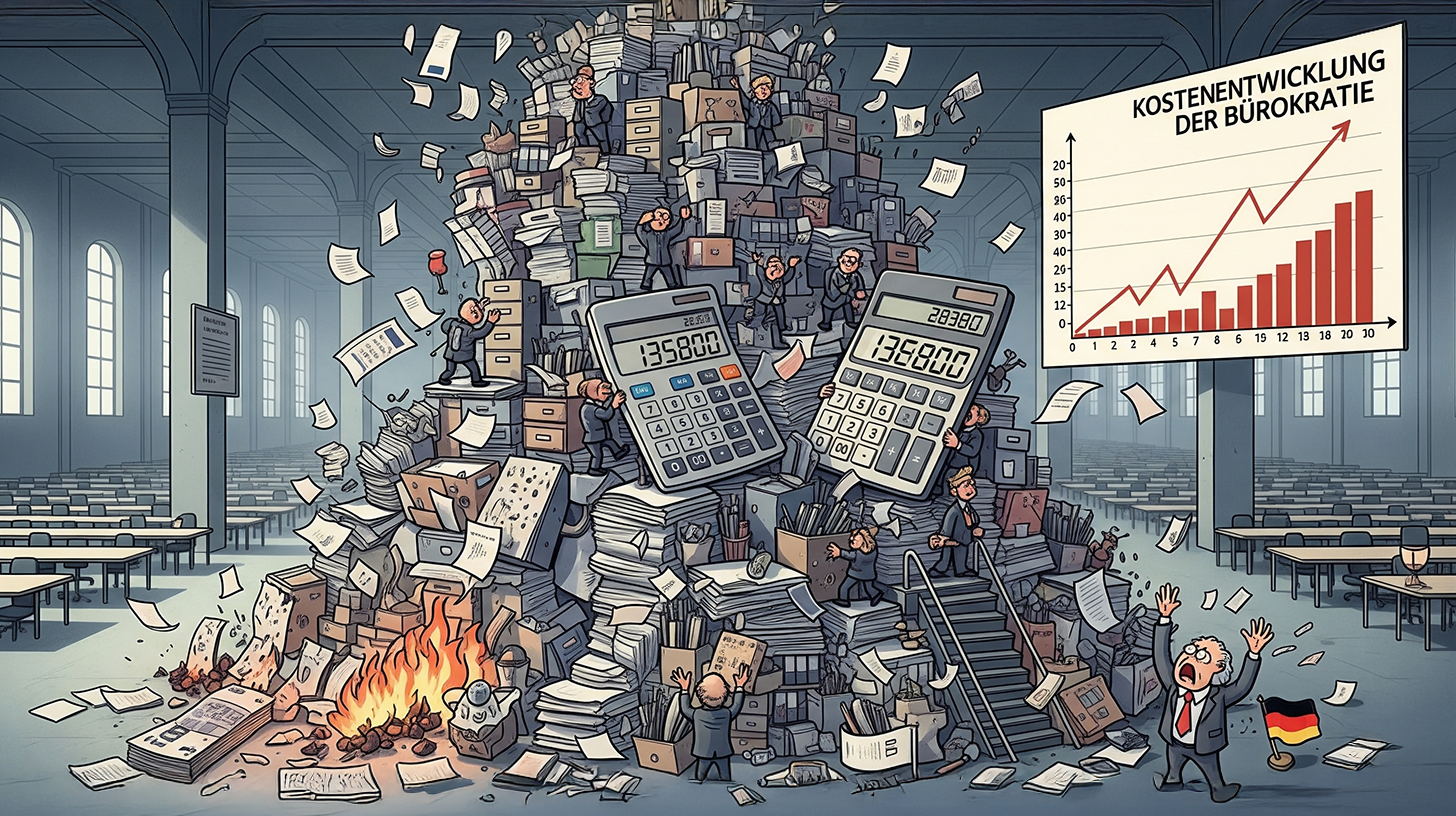
German administration and bureaucracy: 835 million euros per day – Are the costs for Germany's civil servants really exploding? – Image: Xpert.Digital
Billions wasted? Study reveals: 60,000 public sector jobs could be lost
### Germany's bloated civil service: More and more civil servants despite stagnant population growth – what's the reason? ### The trillion-euro burden: Why civil servant pensions threaten to overwhelm Germany's finances ###
Germany's public administration is a giant – and an expensive one at that. With daily personnel costs of €835 million and a workforce that has grown to 5.4 million people, the state apparatus is increasingly the focus of critical debate. This growth seems all the more remarkable given that the population has stagnated for years and the private sector, particularly industry, is cutting jobs. The central question is: Is this increase justified or a sign of inefficiency?
While unions argue that new tasks such as digitalization and all-day childcare are necessary, studies show enormous potential savings of up to 60,000 jobs and over three billion euros annually. The financial burden is exacerbated by a looming wave of pensions that will burden future budgets with trillions of euros. The political debate has ignited, ranging from radical reforms of the civil service to concrete cost-cutting plans, while Germany's staffing levels remain surprisingly lean compared to other countries.
Related to this:


What does the German state cost daily for its employees?
The financial scale of the German public administration is impressive: According to calculations by the Federal Statistical Office, states and municipalities in Germany spend approximately €835 million daily on their personnel. This figure includes the salaries and personnel costs of all public employees at the state and municipal levels. It is important to understand that these costs are continuously rising, while Germany's population has stagnated at between 83 and 84 million for the past six years.
The total number of people employed in the public sector rose to approximately 5.4 million by mid-2024, an increase of almost 96,000. This means that nearly twelve percent of all employed people in Germany work in the public sector. This development reflects a significant shift in the employment structure: while the industrial sector had around 146,000 fewer employees subject to social security contributions in June than in the previous year, 45,000 new jobs were created in public administration during the same period.
How has the number of employees in the public sector developed?
The development of the public sector over the past ten years shows significant growth at all levels of government. Between 2013 and 2023, the number of municipal employees increased by 24 percent and the number of state employees by almost twelve percent. The increase at the federal level was considerably lower, at approximately four percent.
Particularly noteworthy is the development in certain areas. The area of responsibility "political leadership and central administration" was significantly expanded at all levels: at the federal level, the number increased by 11,000 employees (32 percent), at the state level by 28,000 (21 percent), and at the municipal level by 79,000 (27 percent). On average, the number of municipal employees per 100,000 inhabitants increased by almost 21 percent during the period under review.
Significant increases are also evident in the education and childcare sectors. The number of employees in municipal daycare centers has more than doubled since 2009. By mid-2024, over one million people were employed in schools, including 354,800 salaried employees and 693,200 civil servants. Universities, including university hospitals, recorded a staff increase of approximately 41 percent compared to 2009.
What reasons are given for the increase in staff?
Unions and civil service associations consider the increase in personnel necessary, citing increased responsibilities. The German Civil Service Federation (DBB) lists "all-day childcare, property tax, the changing times, the digitalization of public administration, documentation requirements, and child basic income" as reasons for the additional staffing needs. According to a DBB survey from July 2025, the staffing situation is dire, and the state is short 600,000 employees.
This line of reasoning, however, is subject to critical scrutiny. In particular, the argument that digitalization must lead to an increase in jobs is not immediately convincing, since digitalization should normally enable efficiency gains and staff reductions. The justification of a "turning point" is also criticized as incomprehensible.
The administration is certainly aware of its own shortcomings. In a nationwide survey of over 300 public authorities, almost half of the heads of these agencies believe that the state is overwhelmed by its tasks and problems. At the same time, demographic change and attractiveness as an employer are at the top of the list of the greatest challenges.
How efficiently do the different federal states operate?
A recent study by the German Economic Institute (IW) compared the efficiency of the public sector in the various German states. The results show significant differences between the states. Saxony-Anhalt is considered the leader in efficiency, while other states have considerable potential for savings.
According to calculations, North Rhine-Westphalia could cut 13,000 public sector jobs if the state managed its finances as efficiently as Saxony-Anhalt. In Baden-Württemberg, the figure would be around 10,000. Nationwide, this analysis suggests that approximately 60,000 jobs could be saved.
Administrative costs per capita vary considerably between the German states. While the national average is €3,663 per capita, Mecklenburg-Western Pomerania, at €3,215, is around twelve percent below this figure. Hamburg, on the other hand, is 34 percent above the average at €4,914. These differences demonstrate that the city-states operate at significantly higher costs compared to the larger, less densely populated states.
Related to this:

What potential financial savings exist?
Study leader Martin Beznoska from the German Economic Institute notes that the search for efficiency reserves is worthwhile. Based on the average gross annual salary in public administration in 2024, the nearly 60,000 redundant positions would correspond to potential savings of €3.4 billion per year for states and municipalities.
This calculation demonstrates the significant financial potential inherent in more efficient personnel planning. However, it should be borne in mind that staff reductions are not easily implemented and various legal and practical obstacles must be overcome. Furthermore, it must be ensured that public services can continue to be provided.
The cost increase is further exacerbated by pension liabilities. The federal government alone already spends over €60 billion annually on pensions and similar benefits. The average civil servant pension is around €3,400 per month, while average statutory pensions are significantly lower.
How much do civil servant pensions cost the state?
Civil servant pensions represent a significant financial burden on public budgets. The public sector spends €63.4 billion annually on its 1.4 million pensioners and their surviving dependents. These costs will increase dramatically in the coming years, as approximately 1.5 million civil servants will retire in the next few years.
According to the latest pension report from the Federal Ministry of the Interior, pension liabilities will rise from approximately €6.8 billion in 2023 to €7.8 billion this year and will even reach €25.4 billion by 2060. A study by Professor Bernd Raffelhüschen estimates the total costs for civil servant pensions at €1.3 to €1.4 trillion by 2050.
The differences between civil service pensions and statutory pensions are considerable. In 2020, pensioners in the German federal states received a gross monthly pension of €3,590 (men) and €2,970 (women). Average statutory gross pensions are far lower; even for those with over 45 years of contributions, the payments amount to only €1,637 (men) and €1,210 (women).
🎯🎯🎯 Benefit from Xpert.Digital's extensive, five-fold expertise in one comprehensive service package | BD, R&D, XR, PR & Digital Visibility Optimization

Benefit from Xpert.Digital's extensive, five-fold expertise in a comprehensive service package | R&D, XR, PR & Digital Visibility Optimization - Image: Xpert.Digital
Xpert.Digital possesses in-depth knowledge across various industries. This allows us to develop tailored strategies precisely aligned with the requirements and challenges of your specific market segment. By continuously analyzing market trends and monitoring industry developments, we can act proactively and offer innovative solutions. The combination of experience and expertise generates added value and provides our clients with a decisive competitive advantage.
More information here:
State lottery: Why personnel costs vary so much in Germany
How do personnel costs differ between the federal states?
Personnel expenditures in the German federal states show considerable differences, partly attributable to structural peculiarities. In 2015, personnel expenditures for core and extra-budgetary funds amounted to €135.18 billion, which corresponds to €1,665 per capita.
Among the German states, Saarland has the highest per capita personnel expenditure at €1,820, while Brandenburg has the lowest at €1,306. Generally, it can be observed that the eastern German states have lower per capita personnel expenditure than the western German states. A key reason for this is the significantly lower pension levels, as pension entitlements in the eastern German states only arose after reunification.
Among the city-states, Hamburg has the highest personnel costs at €3,184 per capita, followed by Bremen at €2,974 and Berlin at €2,687 per capita. These higher costs are explained by the fact that city-states must perform all municipal tasks in addition to their state responsibilities.
Related to this:


What role does digitalization play in efficiency?
Digitalization is seen as a crucial factor for the future of public administration, but its implementation is lagging behind expectations. Only 19 percent of the population believes that government agencies and public offices operate as efficiently as private companies. At the same time, for around half of citizens, digital services are a reason to regain more trust in the government.
The digitalization of public administration is seen as a "silver bullet in the fight for efficiency and savings." However, less than a fifth of administrative services are available digitally. Successful examples demonstrate the potential: The social security reporting and contribution system processes more than 500 million social security notifications annually via the statutory health insurance communication server. At Deutsche Bahn, the digitalization and centralization of platform announcements alone has resulted in the elimination of over 600 jobs.
Experts see the greatest potential for efficiency gains in digitalization. Investing one percent of annual personnel costs – around three billion euros – in digital processes could provide lasting relief. Without digitalization, any increase in staff risks only generating higher costs without delivering better services.
What political reform proposals are there?
The political debate surrounding reforms in the public sector has yielded various approaches. CDU General Secretary Carsten Linnemann proposes restricting civil service status to a few areas with sovereign powers. "We should only grant civil servant status where there is a special duty of loyalty to the state, for example, in the police, fire service, or other security sectors, as well as for tax officials or customs officers," he said.
The German federal government plans to cut eight percent of ministry staff by 2029. However, this measure will have little impact given that personnel costs are primarily incurred at the state and local levels. The majority of civil servants work for states and municipalities, especially as teachers, and not for the federal government.
Bavarian Premier Markus Söder announced plans to cut 5,000 jobs in the Bavarian administration. The civil service association counters that hundreds of thousands of staff are already lacking. These differing perspectives highlight the tension between efficiency efforts and the functioning of the administration.
How are budget planners reacting to the rising costs?
The federal government's budget situation is strained. Finance Minister Lars Klingbeil, faced with a looming budget shortfall of more than 30 billion euros, emphasized that "no option is off the table." He raised the possibility of higher taxes for top earners and the wealthy. Chancellor Friedrich Merz disagrees, stressing that the CDU/CSU and SPD had agreed in their coalition agreement not to raise taxes.
The German government's financial plan for 2027 to 2029 projects a shortfall of approximately €172 billion. The government is primarily relying on an economic upswing and increased tax revenues. Tax revenues in Germany have been rising steadily for years and are expected to surpass the €1 trillion mark in 2026.
The pressure to consolidate is high, which is why the federal government is planning various cost-saving measures: combating undeclared work and VAT fraud, reforming basic income support for job seekers, reducing personnel costs with the exception of security authorities, halving the number of federal commissioners and reducing material administrative expenses.
What are the long-term challenges?
The long-term challenges facing the public sector are multifaceted. The combination of a wave of retirements among the baby boomer generation, with approximately 1.3 million employees expected to retire by 2030, an increasingly competitive labor market, and the significantly altered expectations of Generation Z is leading to critical staffing shortages in many public administrations.
The accumulated pension reserves are far too small to adequately secure civil servants' retirement. In Lower Saxony, the assets in the pension fund would be depleted after just 1.7 months; in most other German states, the savings wouldn't even last a year. It's important to remember that civil servants spend an average of more than 20 years in retirement.
A study shows that almost two-thirds (63 percent) of public sector employees are satisfied with their current jobs, but younger employees are significantly less satisfied. The Employee Net Promoter Score is minus 37 percentage points, meaning there are considerably more detractors than promoters.
Related to this:

How do international comparisons rate the German administration?
In a European comparison, the German public sector performs well in terms of efficiency, cost-effectiveness, and transparency. Germany spends only around 7.8 percent of its gross domestic product on public sector employee salaries, while the top performers Denmark (15.2 percent), Sweden (12.7 percent), and France (12.5 percent) spend this amount.
This is also reflected in the number of employees: Denmark employs around 28 percent of all its workforce in the public sector, Sweden around 29 percent, and France around 23 percent. In Germany, only around 10.5 percent of all employees work in the public sector. At the same time, Germany is among the European countries where citizens place the greatest trust in the impartiality of the public service, as well as in the government and administration.
These figures show that Germany has a relatively lean public service compared to other countries, which at the same time enjoys a high level of public trust. Nevertheless, there is room for improvement, particularly regarding the digitalization and efficiency of processes.
Related to this:
What solutions are politicians discussing?
The political discussion focuses on various solutions. A central point is digitalization, which is seen as the key to greater efficiency. The coalition is planning an "ambitious modernization agenda for the state and public administration." A new Ministry for Digital Affairs and Public Administration is intended to promote standardization and interoperability.
Reform of the civil service system is also being discussed. Besides Linnemann's proposals to restrict civil service appointments to sovereign functions, there are considerations for the long-term integration of civil service pensions into the statutory pension insurance system, as Austria has successfully demonstrated.
The debate about a comprehensive employment insurance scheme that also includes retirement provisions for the self-employed and civil servants has been ongoing for some time. However, experts consider implementation before 2030 unlikely, as these are "enormously complex systems that have evolved organically over time.".
The discussion shows that fundamental reforms are necessary to increase administrative efficiency and manage long-term cost trends. Both the functioning of the state and its financial sustainability must be taken into account.
A new dimension of digital transformation with 'Managed AI' (Artificial Intelligence) - Platform & B2B solution | Xpert Consulting
A new dimension of digital transformation with 'Managed AI' (Artificial Intelligence) – Platform & B2B solution | Xpert Consulting - Image: Xpert.Digital
Here you will learn how your company can implement customized AI solutions quickly, securely and without high entry barriers.
A managed AI platform is your all-inclusive, worry-free solution for artificial intelligence. Instead of dealing with complex technology, expensive infrastructure, and lengthy development processes, you receive a ready-made solution tailored to your needs from a specialized partner – often within just a few days.
The key advantages at a glance:
⚡ Rapid implementation: From idea to ready-to-use application in days, not months. We deliver practical solutions that create immediate added value.
🔒 Maximum data security: Your sensitive data stays with you. We guarantee secure and compliant processing without sharing data with third parties.
💸 No financial risk: You only pay for results. High upfront investments in hardware, software, or personnel are completely eliminated.
🎯 Focus on your core business: Concentrate on what you do best. We take care of the entire technical implementation, operation, and maintenance of your AI solution.
📈 Future-proof & scalable: Your AI grows with you. We ensure continuous optimization and scalability, and flexibly adapt the models to new requirements.
More information here:
We are here for you - Consulting - Planning - Implementation - Project Management
☑️ SME support in strategy, consulting, planning and implementation
☑️ Creation or realignment of the AI strategy
☑️ Pioneer Business Development

Konrad Wolfenstein
I would be happy to serve as your personal advisor.
You can contact me by filling out the contact form below or simply call me on +49 7348 4088 965 .
I'm looking forward to our joint project.
Write to me


Xpert.Digital - Konrad Wolfenstein
Xpert.Digital is a hub for industry focusing on digitalization, mechanical engineering, logistics/intralogistics and photovoltaics.
With our 360° Business Development solution, we support renowned companies from new business to after-sales.
Market intelligence, smarketing, marketing automation, content development, PR, mail campaigns, personalized social media and lead nurturing are part of our digital tools.
You can find more information at: www.xpert.digital - www.xpert.solar - www.xpert.plus
Keep in touch