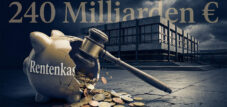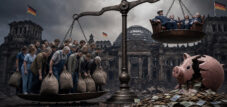
Hoping for votes: 77 years of failed pension policy? 53 years of CDU and 24 years of SPD – How two major parties undermined a promise of the century – Image: Xpert.Digital
The big pension check: Who really ruined our retirement savings – the CDU or the SPD?
The pension illusion: How the CDU/CSU and SPD have been plundering the pension fund for decades
77 Years of Pension Mistakes: How Election Gifts from Politicians Destroyed Our Pension System
When it comes to the statutory pension system in Germany, emotions run high. Falling pension levels, exploding contribution rates, and an ever-later retirement age are the main concerns of those paying into the system. In the heated political debate, the question of blame is often passed back and forth like a hot potato: Did the SPD, with its expensive benefit promises and fixation on pension levels, drive the system into the ground? Or was it the CDU/CSU, which, with unfunded election promises like the mothers' pension or the integration of millions of East Germans at the expense of those paying into the system, plundered the pension fund?
A frank look at 77 years of German pension history – shaped by 53 years of CDU and 24 years of SPD chancellorships – reveals a far more uncomfortable truth. The history of our old-age security system is not a tale of one-sided party failure, but a chronicle of costly compromises. It is the story of a system designed for a growing, young population that today groans under the weight of demographics and non-insurance-related benefits. The following retrospective shows how two major parties gradually eroded a century-old promise – and why the constant search for a scapegoat obscures the real, pressing solutions.
Related to this:


From Adenauer to Merz: The parties' secret game with our pensions
Seventy-seven years have passed since the founding of the Federal Republic of Germany in May 1949, and in virtually every one of these seven decades, the statutory pension insurance system has been at the center of political debates. For the vast majority of this time, around 53 years, the CDU/CSU alliance provided the Chancellor, while the SPD held the position of head of government for approximately 24 years. This unequal distribution of governmental responsibility raises the question of whose political influence has more strongly shaped today's pension system, which is often described as overburdened. However, a more nuanced analysis reveals that responsibility for structural problems in pension financing cannot be neatly attributed to a single party, but rather is the result of decades of decisions, often made across party lines.
A welfare state on credit for the future
Since its fundamental reform in 1957, the statutory pension insurance system in Germany has been based on a pay-as-you-go system, in which the contributions of the working generation directly finance the pensions of current retirees without building up any significant capital reserves. This system functions smoothly only as long as the ratio of contributors to pensioners remains stable, which was the case in the early decades of the Federal Republic due to a young population and strong economic growth. As early as the 1950s, the contribution rate was fourteen percent of gross earnings, while the state supplemented this with a federal subsidy, which in 1957 still covered more than a quarter of total pension expenditures. From the outset, the pension insurance system was therefore not purely contribution-based, but a hybrid construct into which the state regularly injected tax revenue to enable additional political benefits that were not fully generated by the insured themselves.
Related to this:


How the Adenauer era invented the principle of dynamic pensions
The decisive turning point for the early Federal Republic of Germany came in 1957 under Konrad Adenauer, when the major pension reform introduced the so-called dynamic pension, which linked pension amounts to general wage growth. This was an enormous social policy achievement that, for the first time, guaranteed pensioners participation in the economic upswing, but at the same time installed an automatic mechanism that was virtually impossible to reverse in economically challenging times. The CDU-led governments of the 1950s and 1960s thus built a promise whose long-term demographic viability was hardly questioned at the time, because birth rates were high and the number of employed people was growing. However, the consequences of this fundamental decision would only become apparent decades later, when the demographic pyramid increasingly inverted and the number of contributors per pensioner steadily declined.
Social-liberal expansion and the limits of the growth promise
During the era of the social-liberal coalition under Willy Brandt and later Helmut Schmidt in the 1970s, pension levels reached their historical peak: in 1977, the standard pension amounted to almost sixty percent of the average annual wage, the highest value ever recorded. This period was characterized by the expectation that sustained economic growth would automatically refinance any additional social benefits, an assumption that proved overly optimistic in light of the oil crises of the 1970s and the onset of structural growth slowdown. Even under the social-liberal coalition, initial adjustments had to be made, and contribution rates had to be gradually increased to finance the higher benefit levels. The Social Democratic Party (SPD) bears considerable responsibility for this period because it politically raised pension levels to a point that was structurally unsustainable without increasing contribution rates to an extent that would have jeopardized the competitiveness of the economy.
The Kohl years: between consolidation and the burden of reunification
With the change of government to Helmut Kohl in 1982, a period began in which CDU-led coalitions initially attempted to curb the growth of pension expenditures and gradually reduce the pension level, which had already fallen to fifty-five percent of the previous average by 1990, down from its peak in the late 1970s. However, German reunification in 1990 presented the pension insurance system with an unprecedented historical challenge, as East German pension entitlements had to be integrated into the West German system without the new federal states having paid corresponding contributions for decades. This integration was effectively co-financed by West German contributors, a decision made politically by the CDU-led federal government, but one that must be understood from a societal perspective as a necessary historical task and can hardly be considered a partisan failing. Nevertheless, a pattern emerges here that runs through the entire history of the Federal Republic: Political necessities were regularly financed via the pension fund instead of the general tax budget, which increasingly blurred the line between original old-age security and general social and reconstruction policy.
Non-insurance-related benefits as a silent, ongoing burden
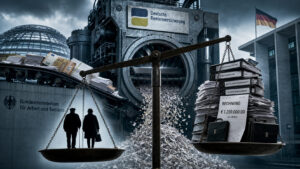
A key, often underestimated mechanism contributing to the gradual strain on the pension system lies in so-called non-insurance-related benefits—payments that actually fulfill societal functions but are financed through contributions from the insured rather than general tax revenue. These include, for example, the pension-related recognition of child-rearing periods, compensation payments for the consequences of war, and the integration of the East German population after reunification. While the federal government has paid a subsidy since 1957 specifically intended to offset these benefits, analyses show that this subsidy does not fully cover the actual non-insurance-related costs. In 2024, federal subsidies totaled €87.78 billion, representing just over 22 percent of total pension insurance expenditures; an increase to over €93 billion was projected for 2025. This practice of financing society-wide services at the expense of the solidarity community of contributors has been continued and in some cases even expanded for decades by both CDU-led and SPD-led governments, resulting in exactly the pattern that is often colloquially described as dipping into the pension fund for extraneous purposes.
Key pension reforms after the coalition
| Period / Year | Coalition (rough allocation) | key measure (selection) | Impact on pension funds (trend) |
|---|---|---|---|
| 1992–1998 | CDU/CSU–FDP (Chancellor Kohl) | Dampening pension adjustments, first steps towards a longer working life | slight relief (dampens the increase in spending) |
| 1999–2004 | SPD-Greens (Chancellor Schröder) | Pension reforms including Riester pension, sustainability factor, contribution rate damping | Relief in the medium term (less pronounced pension increases, promotion of private pension provision) |
| 2005–2009 | Grand Coalition CDU/CSU–SPD (Chancellor Merkel I) | Gradual increase of the retirement age to 67 years | significant long-term relief (later pension payment, longer contribution years) |
| 2010–2013 | CDU/CSU–FDP (Merkel II) | Consolidation, continuation of the retirement age of 67, no major new pension increases | Rather neutral to slightly relieving effect (stabilization phase) |
| 2013–2017 | Grand Coalition CDU/CSU–SPD (Merkel III) | Retirement at 63 (without deductions after 45 years of contributions), Mothers' Pension I | significant additional burden (additional costs in the billions per year) |
| 2018–2021 | Grand Coalition CDU/CSU–SPD (Merkel IV) | Mothers' pension II, stabilization of pension levels at 48% until 2025 | additional burden (higher benefit level, more non-insurance-related benefits) |
| 2021–2025 | SPD–Greens–FDP (traffic light coalition) | Pension package II (pension level 48% until 2039, "generational capital"), no further increase in the retirement age | Short- and medium-term increased burden (fixed level), long-term slight relief planned through capital stock |
| since 2025 | CDU/CSU–SPD (Merz coalition, 21st legislative period) | Guaranteed pension level of 48%, expansion of mothers' pensions, early retirement pension (children's savings accounts), gradual increase of the retirement age above 67, introduction of capital-linked pensions | Mixed effect: higher expenditures due to mothers' pension and guaranteed pension levels, planned long-term relief through capital-based pensions and a higher retirement age |
The red-green coalition and the Riester pension reform as a savings reform with side effects
Under Gerhard Schröder's red-green coalition government from 1998 onward, the SPD executed a remarkable political about-face, for the first time consistently focusing on reducing statutory pension entitlements in favor of stronger private and occupational pension schemes. The introduction of the Riester pension and, later, the sustainability factor in the pension formula ensured that the pension level declined noticeably in the following years, from around 53 percent in 2000 to below 49 percent in 2012. From a purely fiscal perspective, this was one of the most effective relief reforms in postwar history, because it structurally curbed the spending growth of the statutory pension insurance system for the first time in decades. At the same time, this revealed an ambivalence that continues to characterize the entire pension debate to this day: Relieving the burden on the pension fund directly reduced the individual retirement security of many insured individuals, while private pension schemes via the Riester pension largely failed to meet expectations due to low capital market returns and high administrative costs.
The grand coalition and the most expensive pension gifts in post-war history
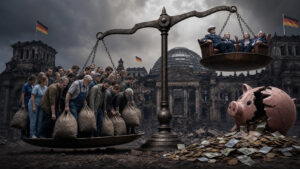
Paradoxically, the most consequential structural decisions in recent pension history occurred during periods when the CDU/CSU and SPD governed together in a grand coalition. Under Angela Merkel's first government, the gradual increase of the retirement age to sixty-seven was decided upon starting in 2007—a measure that promises significant long-term relief because it extends the working life and shortens the period of pension receipt. However, in 2014, Merkel's third government initiated a costly counter-movement with the so-called "retirement at sixty-three," which allowed those with particularly long contribution periods to retire earlier without deductions. This was accompanied by the first "mothers' pension," which increased the value of child-rearing periods for children born before 1992. Both measures were agreed upon jointly by the CDU/CSU and SPD in the coalition agreement and continue to generate additional annual costs in the tens of billions of euros, without any corresponding financing outside of contribution-based contributions. This is perhaps the clearest example of how the greatest burdens on the pension fund in recent history were not the work of a single party, but the result of a political quid pro quo between the Christian Democrats and the Social Democrats, in which both sides catered to their respective voter bases with expensive concessions.
The traffic light coalition and the adherence to the high pension level
During the term of the SPD, Greens, and FDP coalition government, the Pension Package II enshrined a legal guarantee to permanently stabilize the pension level at a minimum of 48 percent until 2039, supplemented by the establishment of a capital-funded generational capital intended to provide long-term relief. However, academic critics had already pointed out beforehand that such a promise, without a corresponding increase in the retirement age or alternative sources of financing, would inevitably lead to further increases in contribution rates, with estimates for the coming decades projecting contribution rates well above 22 percent. This development reflects a fundamental social-democratic conviction that the stability of the benefit level should be prioritized over strict contribution rate stability – a position that, while understandable from a social policy perspective, places further structural strain on the pension system from a purely actuarial standpoint.
Related to this:
The current government and unresolved conflicts of objectives
With the inauguration of the new CDU/CSU and SPD coalition in 2025 under Chancellor Friedrich Merz, the pattern of joint, sometimes contradictory, decisions continued. On the one hand, the pension level guarantee of 48 percent was maintained and the mothers' pension was further expanded; on the other hand, the early retirement pension was intended to strengthen funded pension schemes and gradually raise the effective retirement age by incentivizing longer working lives. Within the coalition, significant tensions were already emerging in the summer of 2026, particularly between those SPD representatives who wanted to maintain the pension without deductions after 45 years of contributions and those CDU/CSU politicians who demanded structural reforms to stabilize contribution rates. These current disputes are ultimately a continuation of a conflict that has permeated the entire post-war history of the Federal Republic: the tension between short-term, popular benefit promises and the long-term financial sustainability of the system.
Figures that demonstrate shared responsibility
A look at the raw figures significantly puts any simplistic blame being placed on a single party into perspective. The contribution rate to the statutory pension insurance system rose from fourteen percent in 1957 to its historical peak of 20.3 percent in 1997 and 1998, with this increase occurring over decades under changing government coalitions. Remarkably, the current contribution rate of 18.6 percent is even below this historical peak, which contradicts the widespread thesis of an uncontrolled, exploding system in such a simplistic way. A comparative analysis by the German Economic Institute (IW) on spending trends under different chancellorships concluded that average annual spending increases under CDU-led governments were around 3.8 percent and under SPD-led governments around 3.2 percent – a difference that, given the very different economic and demographic conditions of each government period, can hardly be considered statistically reliable evidence of fundamentally different fiscal discipline.
Related to this:
Why the question of blame obscures the real problems
The public debate about which party has caused more damage to the pension system distracts, in a sense, from the real structural challenges, which extend far beyond party affiliations. Germany's demographic development, with a steadily declining birth rate since the 1970s and a simultaneously increasing life expectancy, presents every pay-as-you-go pension system with a mathematical challenge that no single party can solve or create alone. The ratio of contributors to pensioners has shifted dramatically since the founding of the Federal Republic, regardless of which party was in power. While political decisions could influence how this development was handled, they could not alter the underlying demographic reality. Against this backdrop, it seems more appropriate to speak of a structural flaw that has developed over decades, in which both major parties participated during their respective periods in government by prioritizing short-term, politically attractive benefit promises over sustainable long-term financing concepts.
A nuanced conclusion on the question of responsibility
Anyone seeking a clear answer to the question of which party has placed the greatest burden on the pension system will be disappointed by the available data, as the empirical evidence argues against a straightforward attribution of blame. It can be generally stated that CDU-led governments, during their time in office, were responsible for the most costly individual measures in recent history, particularly the mothers' pensions and the early retirement at age 63, which, however, were always enacted in coalition with the SPD and thus also enjoyed social democratic support. The SPD, in turn, bears the primary responsibility for the political entrenchment of a historically high pension level in the 1970s, as well as for the current legal guarantee of the pension level, both of which structurally necessitate higher contribution rates or higher federal subsidies. In the end, it becomes clear that German pension policy over the past 77 years is less a story of unilateral partisan failure, but rather a story of recurring political compromises, in which both major parties were alternately willing to prioritize short-term voter interests over the long-term stability of a system that was originally designed for a completely different demographic and economic reality.