The $500 million junk heap: How a $30,000 cheap drone is embarrassing America's military power – Stock image/Creative image: Xpert.Digital
Satellite images reveal the truth: What the US military wanted to conceal in the Iran conflict
Fatal gap in airspace: This is why the loss of this super-aircraft is so dangerous for the USA
Burning jets and a disabled aircraft carrier: The true price of the new Middle East war
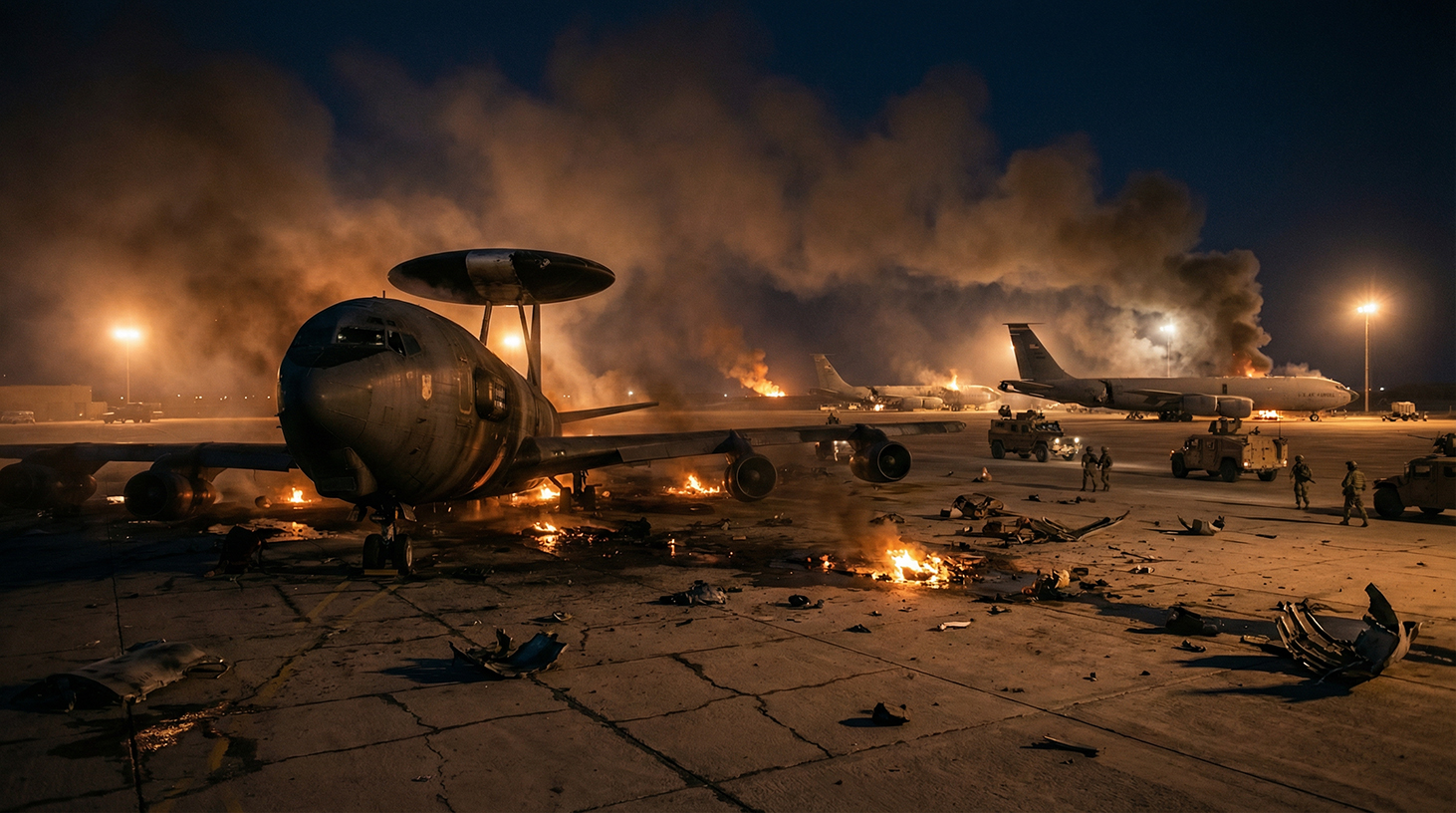
A burning wreck on the desert concrete, where the logistical and tactical brain of the US Air Force should have been: The attack on Prince Sultan Air Base in March 2026 marks a historic turning point in modern warfare. When an Iranian drone worth the price of a used car reduces a state-of-the-art AWACS reconnaissance aircraft worth half a billion dollars to scrap metal, a decades-old military certainty shatters. Suddenly, it's no longer just about destroyed steel and shattered radar installations, but about the strategic Achilles' heel of the Western superpower: the intractable cost problem of asymmetric warfare. While official sources attempt to downplay the damage as "minor," commercial satellite imagery contradicts them and reveals the true extent of the vulnerability. This conflict proves ruthlessly: The era in which technological superiority and expensive precision weapons automatically guaranteed victory is definitively over.
The attack on Prince Sultan Air Base
On March 27, 2026, a coordinated Iranian attack using missiles and drones struck Prince Sultan Air Base, located about 100 kilometers south of Riyadh, sparking a debate that went far beyond the military damage assessment of "minor damage." At least one ballistic missile and several unmanned attack drones hit the Saudi base, injuring between 10 and 15 American soldiers, several of them seriously, according to various reports. US Central Command initially refrained from any official comment—an institutional reticence that is remarkable given the severity of the casualties.
The centerpiece of the damage wasn't a replaceable fighter jet, but a Boeing E-3 Sentry AWACS reconnaissance aircraft—a flying command and control center with a procurement value of around $500 million. Published satellite images and photos on social media showed the aircraft on the base's tarmac: the rear fuselage burned out, the characteristic rotodome radar array destroyed, only a charred wreckage left on the concrete. What Iran celebrated as a decisive hit, American officials described as "significant damage"—a semantic difference that is difficult to maintain in light of the images.
The true extent of the losses
The destruction of the E-3 Sentry was not the only loss in this attack. Five KC-135 Stratotanker refueling aircraft were also hit and damaged on the runway; satellite imagery suggested that at least one of them may have been completely destroyed. These aircraft are the logistical backbone of any air operation over the Persian Gulf: without aerial refueling, the range and endurance of all combat aircraft are drastically reduced. Iran thus targeted not only prestige targets, but also the operational infrastructure of American air warfare.
The pattern of damage since the start of the conflict on February 28, 2026, is far more extensive than official statements suggest. According to calculations by the American Enterprise Institute, American military assets worth between $1.4 billion and $2.9 billion were damaged or destroyed in the first three weeks of the war. These include an AN/FPS-132 early warning radar in Qatar worth $1.1 billion, a THAAD radar in the United Arab Emirates worth an estimated $500 million, three F-15E Strike Eagles lost due to accidental Kuwaiti fire, and more than a dozen MQ-9 Reaper drones. In addition, there was a mid-air collision of two KC-135 aircraft over Iraq that killed six crew members.
The strategic gap in AWACS
The loss of even a single E-3 Sentry is not merely a matter of material damage from a strategic perspective. Before the attack, the US Air Force had only 16 operational aircraft of this type – less than half the number in the 1990s, when the fleet numbered around 30. The E-3 is an aircraft from the 1970s that has not yet been fully replaced because the planning of its successor was subject to years of political and budgetary stagnation.
The E-7A Wedgetail, intended as a modern replacement, experienced a textbook procurement disaster: Unit costs ballooned from an initial $588 million to over $724 million per aircraft during the planning phases. Shortly before the outbreak of the conflict, the Air Force had signed a $2.4 billion contract with Boeing for the development and production of a number of E-7 aircraft. Work on these aircraft is scheduled for completion by August 2032—seven years too late to close the current strategic gap. Some reports even suggested the program might be canceled altogether. The consequence is clear: Any further damage to the dwindling E-3 fleet weakens the US ability to monitor airspace, detect threats early, and coordinate interception operations—precisely those capabilities that are indispensable in the initial weeks of a conflict involving more than 1,000 Iranian drones and missiles.
Hub for Security and Defense - Advice and Information


Hub for Security and Defense - Image: Xpert.Digital
The Security and Defence Hub offers expert advice and up-to-date information to effectively support companies and organizations in strengthening their role in European security and defence policy. Working closely with the SME Connect Defence Working Group, it particularly promotes small and medium-sized enterprises (SMEs) that wish to further develop their innovative capacity and competitiveness in the defence sector. As a central point of contact, the Hub thus creates a crucial bridge between SMEs and European defence strategy.
Related to this:
Pentagon under financial stress: Can arms production and budget withstand a drone flood?
The economics of asymmetric warfare
The core problem that the attack on Prince Sultan so ruthlessly exposes is not a military-tactical one, but an economic one. An Iranian Shahed attack drone costs, according to Western estimates, between $20,000 and $50,000. One of these missiles struck an aircraft worth half a billion dollars. The ratio of attack costs to losses is so extreme that it should alarm even the most hardened defense economists.
The cost problem of defense is even more serious. A Patriot PAC-3 interceptor missile costs around $4 million; a NASAMS interceptor system about $1 million. Even with the cheaper option, shooting down a single $35,000 drone consumes defense equipment worth many times that amount. In an attack involving hundreds or thousands of drones simultaneously, the supply of interceptor missiles is finite – and producing more takes months or even years. The result is a systematic erosion process: Every Iranian attack forces the American side to incur disproportionately high defense expenditures, while Tehran builds up capabilities relatively cheaply. Iran is estimated to produce around 10,000 drones per month.
The aircraft carrier in the Adriatic Sea and the question of operational readiness
On March 28, 2026, the USS Gerald R. Ford entered the Croatian port of Split. The world's largest and most modern aircraft carrier in the US Navy, with over 5,000 crew members and more than 70 combat aircraft on board, it represents an unparalleled mobile military base. It had previously been deployed for months in connection with Operation Epic Fury against Iran. According to official US statements, this was a "planned port visit and maintenance stop"—triggered by a laundry room fire on March 12 that injured three sailors and caused significant damage to approximately 100 sleeping berths. Blocked plumbing was cited as another reason for the operational disruption.
The question many observers are asking is less about the official justification than about the timing. A warship of this size, which was stationed off the Persian Gulf as a strategic force multiplier, is now docked in an Adriatic port for repairs lasting at least several months, while the conflict in the Middle East escalates. Repairs are time-consuming: ship fires leave behind complex structural and electronic damage that can require months of repairs, even in cases classified as "minor." Regardless of the exact cause, the operational consequence is the same: the carrier and its 70 combat aircraft are unavailable for active combat.
Information control as a strategic instrument
What makes the case analyzed here both interesting and symptomatic is the systematic discrepancy between official American statements and what independent sources, satellite data, and OSINT analyses show. The US Central Command remained silent for days while images of the destroyed AWACS circulated around the world. President Trump personally attacked the Wall Street Journal, calling its reporting on the damaged KC-135 tankers "the exact opposite of the actual facts.".
This tendency to downplay losses is not new from a military history perspective. In the Vietnam War, the Iraq War, and Afghanistan, a significant time lag between actual losses and official confirmations was observed. However, in the information age, this strategy is only partially effective: when commercial satellites can photograph every runway in the Saudi Arabian desert in real time, and these images circulate on social media within hours, state control of information loses its power. The question of the full extent of the damage to over 20 US aircraft and installations reported as "slightly damaged" thus remains one of the central open questions of this conflict.
The entire bill for the war
The overall context of the conflict since February 28, 2026, underscores the gravity of the situation. With the launch of Operation Epic Fury—a coordinated American-Israeli surprise attack on Iran with nearly 900 individual strikes in the first twelve hours—an escalation spiral began that has so far claimed the lives of at least 13 American soldiers and injured approximately 300 others. Iran responded with what it had developed over years of preparation: an asymmetric counterattack with hundreds of missiles and over a thousand drones.
The economic toll of the first few weeks is sobering for the US. Damaged and destroyed equipment worth at least $1.4 to $2.9 billion in three weeks – a rate that, if the conflict continues, will push the Pentagon's budget planning and industrial supply capacities to their limits. The Pentagon has already requested a supplementary budget of $200 billion to compensate for losses and expenditures. At the same time, stockpiles of interceptor missiles are being depleted faster than they can be produced. While the US defense industry has increased production of individual systems – for example, the AIM-9X by 18 percent to 137 units per month – the overall balance remains negative given the rate of consumption.
The strategic lesson: What is expensive cannot be protected cheaply
The case of Prince Sultan's AWACS is more than an episode in an ongoing conflict. It is a litmus test for fundamental assumptions of Western military planning over the past three decades. The doctrine of technological superiority through expensive, precision systems produced in small numbers was designed for adversaries who lacked both the resources and the production capacity to overwhelm it with sheer numbers. Iran possesses both: ideological resolve and an industrial foundation for the mass production of simple but effective drones.
What first became apparent in Ukraine against Russia is now being repeated on an even larger scale in the Persian Gulf: the cost imbalance between offense and defense has reversed. Anyone who concentrates their strength in $500 million aircraft and has to protect them with a $4 million system per interceptor missile will ultimately run out of money – even if they win individual tactical engagements. The images of the burnt-out AWACS on the Prince Sultan airfield will therefore not only go down in history as documentation of war damage. They are a symbol of the end of an era of military hegemony based on technological superiority.
Consulting - Planning - Implementation

Markus Becker
I would be happy to serve as your personal advisor.
Head of Business Development
Chairman SME Connect Defense Working Group
Consulting - Planning - Implementation
Konrad Wolfenstein
I would be happy to serve as your personal advisor.
You can contact me at wolfenstein∂xpert.digital or
Just call me on +49 7348 4088 965 .