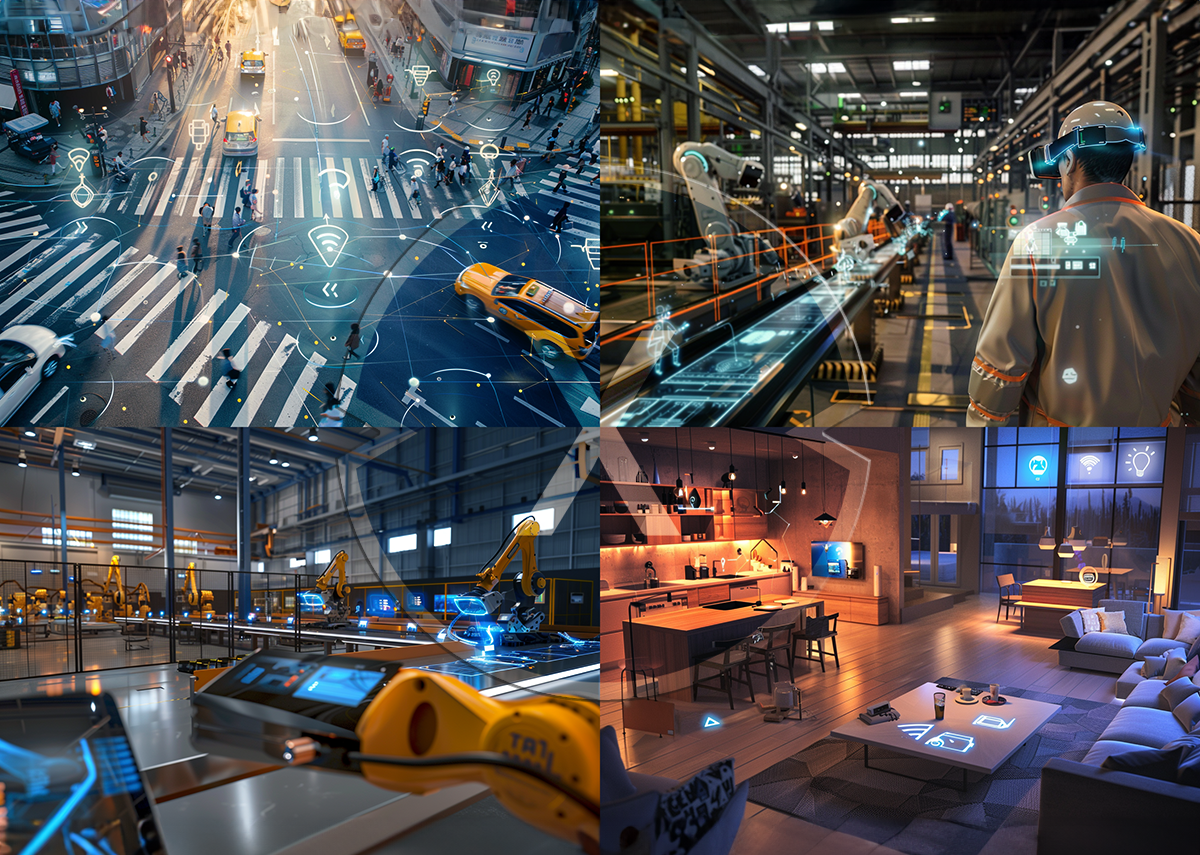
Sensor technology in cities and businesses: Sensors for IoT & Industry 4.0 | Industrial & City Metaverse – Image: Xpert.Digital
🤖💡 The goal of artificial intelligence (AI), digital technologies and technological expertise in mechanical engineering
🌟 The goal of artificial intelligence (AI), digital technologies, and technological expertise in mechanical engineering is automation and the creation of scalability and flexibility in products and machines. This development affects various industrial sectors, including logistics in warehousing and other industrial segments. Examples of technologies used include scanners, measuring sensors, pressure sensors, temperature sensors, and tilt sensors. Sensors are of central importance, particularly in the growing field of "smart cities," forming the lifeblood of urban infrastructure.
📊📡 Without the widespread integration of sensor technology
Without the extensive integration of sensor technology, neither the concept of the Industrial Metaverse nor the realization of Industry 4.0 or similar initiatives would be conceivable. Sensor technology serves as the foundation and crucial interface for the economic and urban future, as well as for the development of digital twins.
📉🛠️ In detail, this means
In detail, this means that sensors provide the data foundation upon which modern industrial and urban applications are built. These sensors capture a wide range of information, which is processed in real time to optimize and streamline processes. In logistics, scanners and measuring sensors enable precise inventory management and stocktaking. Pressure and temperature sensors are essential in industrial manufacturing, as they monitor the conditions under which machines and equipment operate in order to maximize their performance and lifespan.
🌡️📏 Temperature sensors also play a crucial role
Temperature sensors also play a crucial role in monitoring and controlling environmental conditions, whether in cold storage facilities or in monitoring production processes where specific temperatures must be maintained. Pressure sensors are used to monitor pressure conditions in various industrial applications, such as hydraulic or pneumatic systems. Tilt sensors, on the other hand, are used in a wide variety of industries, from construction to aerospace, to precisely control the orientation and movement of objects.
🔧🔍 Technological advances in sensor technology
Technological advances in sensor technology have enabled applications such as predictive maintenance. This involves using sensor data to monitor the condition of machines in real time and detect potential failures early. This allows maintenance work to be carried out as needed, rather than relying on fixed intervals, which significantly improves the efficiency and lifespan of machines.
🌆🌿 In the Smart City
In smart cities, sensors are also used in many areas. From monitoring air quality and analyzing traffic flow to intelligent street lighting – sensors collect and provide the necessary data for making smart urban decisions. The networking of these sensors creates complex systems that make life in urban areas safer, more environmentally friendly, and more efficient.
📈🏙️ “The future of urban development lies in the intelligent networking of infrastructure and data”
"The future of urban development lies in the intelligent networking of infrastructure and data," one could argue. Sensor technology plays a crucial role in creating a sustainable and efficient urban living environment. Digital twins, virtual representations of physical objects, systems, or cities, are based on the continuous data streams generated by sensors. These digital twins make it possible to simulate and analyze complex scenarios, thereby enabling more effective decision-making.
🚦🏢 An example of the application of digital twins
One example of the application of digital twins can be found in urban planning. By simulating various traffic situations or environmental conditions, urban planners can evaluate the impact of new infrastructure projects in advance. This reduces the risk of planning errors and increases the efficiency and sustainability of urban development.
🏭💻 “Industry 4.0”, the concept of the fourth industrial revolution
Industry 4.0, the concept of the fourth industrial revolution, takes the digitalization of production to a new level. Here, the entire production chain is networked and monitored in real time. Sensor technologies enable the seamless integration of production facilities and the real-time collection of operational data. This leads to highly flexible, adaptive production that can respond to individual customer requirements.
🕶️🔬 In the context of the Industrial Metaverse
In the context of the Industrial Metaverse, the combination of sensors, machine learning, and advanced 3D visualizations opens up new possibilities. Companies can create virtual copies of their production facilities and use them to test different production scenarios before making physical changes. This not only minimizes costs and risks but also fosters innovation through experimentation in a safe, digital environment.
🌐🛡️ Another growing area through the use of sensor technology
Another growing area driven by the use of sensor technology is the remote monitoring and control of industrial plants. Connecting to the Internet of Things (IoT) allows companies worldwide to access and monitor their systems, regardless of location or time. This enables unprecedented flexibility and responsiveness, especially in critical industrial applications.
🤔💡 In the long run, the continuous development of sensor technology will be beneficial
In the long term, the continuous development of sensor technology contributes to machines and systems becoming increasingly intelligent and autonomous. For example, scientists are developing sensors that can not only collect data but also process it directly on-site. This so-called "edge computing" technology enables rapid data processing and analysis at the point of origin, thereby minimizing latency and reducing data privacy concerns.
🚀🌍 In addition, increasingly precise and reliable sensors are coming onto the market
In addition, increasingly precise and reliable sensors are coming onto the market, capable of operating even in extreme environments, be it under heavy mechanical stress, extreme temperatures, or corrosive conditions. This robustness significantly expands the application possibilities of the sensors and makes them a key component of modern industrial systems.
🏙️🔄 The comprehensive integration of AI and digital technologies in mechanical engineering
The comprehensive integration of AI and digital technologies in mechanical engineering and industry will lead to a significant transformation of production processes and urban infrastructures in the long term. The increased use of sensor technology and the associated data analysis will make it possible not only to automate processes but also to design them flexibly and scalably, thus considerably increasing efficiency and sustainability. The future of these technologies therefore promises an era in which efficiency and innovation are closely intertwined, supported by a solid foundation of sensor technology and data intelligence.
📣 Similar topics
- 🤖 The role of AI and digital technologies in mechanical engineering
- 🌡️ Temperature sensors: Key factors for industry and logistics
- 🏢 Smart Cities: Sensors as the foundation of modern urban infrastructures
- 🔄 Predictive maintenance through advanced sensor technology
- 📊 Pressure sensors: Supporters for precise industrial applications
- 🕶️ Industrial Metaverse: New dimensions through sensors and 3D visualizations
- 💡 Tilt sensors in industry: Applications and advantages
- 🌐 IoT and remote monitoring: A revolution in the industrial sector
- 💻 Industry 4.0: Integration and real-time monitoring through sensors
- 🏙️ Air quality, traffic flow and lighting: Smart City sensors in use
#️⃣ Hashtags: #SensorTechnology #Industry4.0 #SmartCity #PredictiveMaintenance #DigitalTwin
Our recommendation: 🌍 Limitless reach 🔗 Connected 🌐 Multilingual 💪 Sales power: 💡 Authentic with strategy 🚀 Innovation meets 🧠 Intuition


From local to global: SMEs conquer the world market with a clever strategy - Image: Xpert.Digital
In an era where a company's digital presence determines its success, the challenge lies in creating an authentic, personalized, and far-reaching presence. Xpert.Digital offers an innovative solution that positions itself as the intersection of an industry hub, a blog, and a brand ambassador. It combines the advantages of communication and sales channels in a single platform and enables publication in 18 different languages. Cooperation with partner portals and the ability to publish articles on Google News and a press distribution list with approximately 8,000 journalists and readers maximize the reach and visibility of the content. This represents a crucial factor in external sales and marketing (SMarketing).
More information here:
🌐 🚀 After sensor technology, the 5G network, or rather the private 5G campus networks, are crucial for the industrial and city metaverse
🏙️🏗️ In today's world, the integration of various technological innovations represents a significant advancement for industry and urban environments. Alongside the crucial role of sensor technology, which forms the basis for many modern applications, 5G networks, and especially private 5G campus networks, are of vital importance for the industrial and urban metaverse. These new network technologies offer not only higher transmission speeds but also lower latency and greater reliability, with far-reaching implications for various industries and urban infrastructures.
📡 Technology and transmission speeds 📈
5G networks have the potential to fundamentally change how data is transmitted and processed in real time. In the industrial metaverse, where digital twins and predictive maintenance are becoming increasingly important, 5G networks enable seamless and rapid communication between machines, sensors, and central control systems. The high data transmission speed and low latency allow for the processing of immense amounts of data in real time, enabling precise monitoring and control of industrial plants. This leads to optimized production processes, as problems can be detected and resolved more quickly.
🏢 Networks and enterprise applications 📡
Private 5G campus networks offer the additional opportunity to create dedicated network infrastructures for businesses, specifically tailored to their individual needs. These networks are particularly important in environments where data security and network reliability are paramount. Companies can thus operate their own communication networks, which not only increases security but also improves control over resource usage and distribution. By integrating these private networks into the industrial metaverse, companies can monitor and control their production facilities in real time, enabling unprecedented flexibility and efficiency.
🏙️ Smart Cities and connected devices 🌐
Another key element of 5G technology is its support for a large number of devices that can be connected and active simultaneously. This is particularly relevant for the concept of the smart city, where countless sensors and networked devices are used to monitor and control urban infrastructure. From traffic management and public safety to energy and water supply, 5G enables these devices to be efficiently networked and the diverse data they generate to be processed in real time.
🚗 Autonomous vehicles and communication 📶
The higher bandwidth and reliability of 5G networks also mean improvements in the communication technologies needed to support autonomous vehicles. These vehicles, which are intended to become an integral part of smart cities, require continuous and latency-free communication with their environment and with each other to operate safely and efficiently. 5G ensures that the vast amounts of data needed for navigation and decision-making can be transmitted without delays or outages.
🌍 Global Integration and Cooperation 🏭
In industrial environments, 5G networks can improve collaboration and integration between different production sites worldwide. Companies can monitor and control production lines and processes in real time, regardless of where their factories or warehouses are located. This is particularly important in a globalized economy where production facilities are often geographically dispersed and close coordination is essential to ensure maximum efficiency.
🕶️ Augmented Reality (AR) and Virtual Reality (VR) 🌌
An interesting application of 5G in industry is the concept of augmented reality (AR) and virtual reality (VR). By utilizing 5G, AR and VR applications can operate with low latency and high bandwidth, which is extremely beneficial in production environments. Maintenance personnel, for example, can receive real-time instructions and information via AR glasses while working on machines. This not only improves efficiency but also reduces the likelihood of errors.
🔧 Predictive maintenance and AI 🧠
The development of the Industrial Metaverse, based on the combination of sensor technology, AI, and 5G, enables significant advances in predictive maintenance. Sensors continuously provide data on the condition of machines and equipment, while 5G networks transmit this data instantly for analysis. AI-powered systems can use this information to detect anomalies and predict maintenance needs before costly breakdowns occur. This leads to a reduction in unplanned downtime and extends the lifespan of machines, saving costs and increasing productivity.
🚦 Intelligent transport systems and safety 🛣️
In urban environments, 5G technology contributes to the development of intelligent transportation systems that optimize traffic flow and increase road safety. Sensors and cameras installed along roads collect data on vehicle movements and traffic conditions. This data is transmitted via 5G networks to central control systems, which can adjust traffic signals in real time to reduce congestion and improve traffic flow. Furthermore, these systems enable emergency services to reach accident scenes more quickly, thus significantly reducing response times.
💊 Healthcare industry and telemedicine 🏥
5G also opens up new possibilities in the healthcare sector. Telemedicine and remote surgery are application areas that benefit from the high bandwidth and low latency of 5G networks. Doctors can remotely access patient data in real time, make diagnoses, or even perform surgical procedures using robotic arms controlled via 5G. These innovations improve medical care, especially in remote or underserved areas.
⚡ Energy industry and smart grids 🌍
The integration of 5G into the energy sector is also significant. Smart grids use sensors and communication networks to monitor and control energy consumption in real time. 5G enables faster and more reliable transmission of this data, leading to more efficient use of energy sources and a better balance between supply and demand. This is particularly important with regard to the integration of renewable energies, which often have variable production volumes.
🤖 Edge computing and data processing 📊
A notable advantage of 5G technology is its support for edge computing, where data processing and analysis take place closer to the data sources. This significantly reduces latency and ensures that data-intensive applications operate quickly and efficiently. In industrial applications, machines and sensors can process their data locally and send only relevant information to central systems, reducing network load and improving response times.
🌆 Development of the Industrial and City Metaverse 🌐
The integration of 5G networks and private 5G campus networks has a significant impact on the development of the industrial and urban metaverse. They provide the necessary infrastructure for the fast and reliable transmission of large volumes of data, forming the basis for numerous innovative applications and processes. The combination of sensor technology, AI, and 5G networks enables industrial and urban infrastructures to be designed more efficiently, flexibly, and scalably. This leads to a significant improvement in economic viability and sustainability, paving the way for a smarter, interconnected future.
📣 Similar topics
- 🌟 The Revolution of the Industrial and City Metaverse through 5G
- 🏭 5G campus networks: The future of industrial communication
- 🌉 Smart Cities: How 5G is transforming urban infrastructure
- 🚀 Real-time data processing in the Industrial Metaverse via 5G
- 🔒 Security and control: Advantages of private 5G networks for businesses
- 🌐 Global production networking and integration through 5G
- 🔧 Efficient predictive maintenance thanks to 5G and AI
- 🛣️ Intelligent transport systems through 5G technology
- 🩺 Advances in telemedicine thanks to 5G networks
- ⚡ 5G and Edge Computing: A new era of data processing
#️⃣ Hashtags: #IndustrialMetaverse #5GNetworks #SmartCities #PredictiveMaintenance #EdgeComputing
We are here for you - Consulting - Planning - Implementation - Project Management
☑️ SME support in strategy, consulting, planning and implementation
☑️ Creation or realignment of the digital strategy and digitization
☑️ Expansion and optimization of international sales processes
☑️ Global & Digital B2B trading platforms
☑️ Pioneer Business Development

Konrad Wolfenstein
I would be happy to serve as your personal advisor.
You can contact me by filling out the contact form below or simply call me on +49 7348 4088 965 .
I'm looking forward to our joint project.
Write to me


Xpert.Digital - Konrad Wolfenstein
Xpert.Digital is a hub for industry focusing on digitalization, mechanical engineering, logistics/intralogistics and photovoltaics.
With our 360° Business Development solution, we support renowned companies from new business to after-sales.
Market intelligence, smarketing, marketing automation, content development, PR, mail campaigns, personalized social media and lead nurturing are part of our digital tools.
You can find more information at: www.xpert.digital - www.xpert.solar - www.xpert.plus
Keep in touch