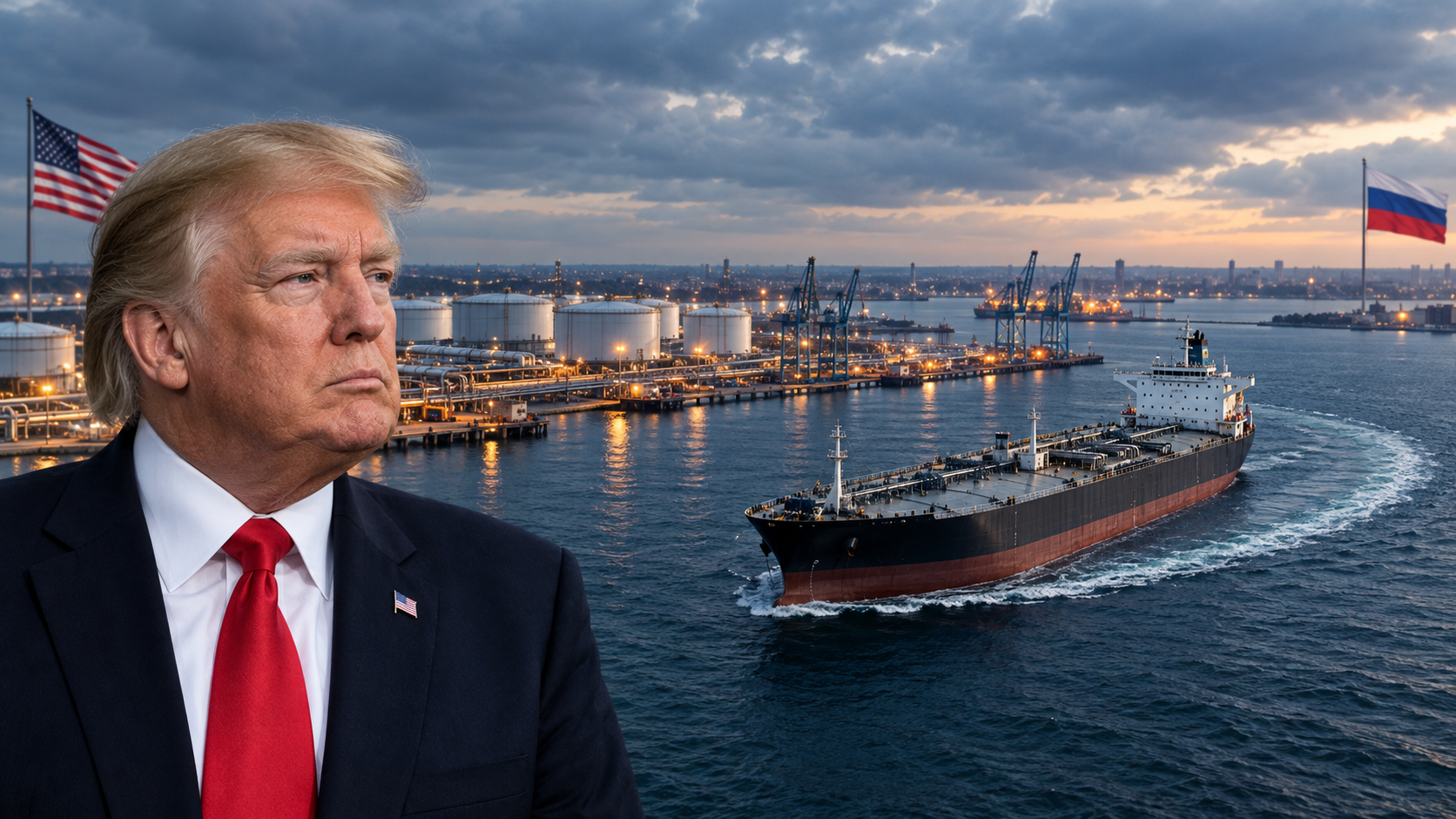
Trump's diesel deal stalls: Why Russian fuel isn't easing US supply pressure – tankers are turning back, buyers are hesitant – creative image on the topic, with AI: Xpert.Digital
Russian diesel for the USA: Why political promises don't guarantee delivery
Trump's diesel dilemma: Between sanctions dispute, tanker diversions and dwindling supplies
Pressure mounts after election defeat: Trump's controversial diesel deal remains stalled
Donald Trump wanted to ease the strained US fuel market with Russian diesel. However, significant obstacles lie between the political announcement and actual delivery: Several tankers changed their plans, potential buyers and financiers are hesitant, and the legality of the temporary sanctions exemption is disputed. As of the most recent documented information, no confirmed delivery to the United States has yet taken place.
This case illustrates why an announced quantity does not guarantee a reliable supply. Even if fuel is available and the government temporarily permits business, traders, banks, insurers, shipping companies, and port operators must be prepared to conduct the transaction. As soon as one key stakeholder deems the risks too high, the entire supply chain can grind to a halt.
At the same time, it would be premature to interpret the diversion of individual ships as the definitive end of all delivery options. However, they do demonstrate that Trump's plan has not yet created the commercial certainty necessary for a functioning supply route. Even the announced volume of more than 300,000 tons would not be a national breakthrough: it could support individual markets, but it would not, on its own, resolve a persistently strained supply situation.
The timing is particularly critical. Low inventories increase the value of every reliably available delivery, while the Republican defeat in the midterm elections intensifies the political pressure on Trump. The diesel deal thus becomes a test of his ability to act decisively in energy policy – and, for example, of the fact that security of supply is not achieved with a handshake, but through a reliable interplay of law, financing, transport, and actual consumers.
A failed exoneration strategy coincides with a weakened presidency
First the election defeat, then the tanker turnaround: America's energy problem cannot be solved with a handshake
Donald Trump's plan to relieve pressure on the American fuel market with Russian diesel is turning into a cautionary tale about the limitations of personal summit diplomacy. Following the loss of Republican majorities in both houses of Congress in the November 3, 2026, midterm elections, an energy policy initiative intended to demonstrate short-term economic flexibility is also coming under pressure. Several tankers carrying Russian diesel have altered their original itineraries, which were headed for the American East Coast. According to the most recently documented information, the agreement had not yet resulted in a confirmed delivery to the United States.
However, it would be premature to conclude from this that all supply options are definitively at an end. Course changes of individual ships, unclear unloading destinations, and the reluctance of potential buyers demonstrate significant implementation problems. They do not prove that Russian diesel will never be able to reach American ports in the future. The economically decisive finding is more specific, but serious enough: There is a considerable gap between the political announcement of additional supplies and an actually functioning supply chain.
This is where the significance lies beyond the individual case. A president can announce an agreement, and his administration can grant exemptions from sanctions. However, this does not guarantee that buyers will be found, banks will be convinced, insurance policies will be taken out, or port operators will be willing to accept a shipment. Especially in a politically and legally contentious business, formal authorization from an authority is not necessarily sufficient to induce private companies to act.
The diesel deal therefore represents more than just a potential foreign policy defeat. It demonstrates how institutional uncertainty can economically paralyze a commodity that is otherwise readily available. At the same time, it makes clear why even successful individual deliveries do not automatically and fundamentally change a strained supply situation.
What was agreed upon and where implementation is stalling
On October 9, 2026, Trump announced an agreement with Russian President Vladimir Putin. According to this agreement, more than 300,000 tons of Russian diesel were to be made available to the American and international markets in the short term. Larger shipments were to follow. The US Treasury Department temporarily permitted transactions that would otherwise have been subject to sanctions. According to the department, the exemption covers the sale, delivery, unloading, and import of Russian diesel until April 7.
At first glance, this sounds like a manageable trade policy measure: an additional supply meets a tight market and is intended to dampen prices. However, crucial publicly available details are missing. Neither the American nor the Russian government disclosed whether the agreement was put in writing. Prices, payment terms, and the companies involved were also unknown. Likewise, it remained unclear whether there were already confirmed American buyers for all the shipments.
This lack of transparency is economically significant. An announced export volume is not the same as a contractually secured import volume. And a contractually secured import volume, in turn, is not synonymous with the actual amount of fuel unloaded and distributed domestically.
Numerous decisions lie between these stages. The seller must provide the goods. A trader must finance them. The shipping company must undertake the transport. Insurers must accept the risks. A terminal needs the technical and legal prerequisites to accept the cargo. Finally, a buyer must be willing to take delivery of the cargo and pay for it.
If just one crucial link in this chain fails, the entire operation can grind to a halt. That's precisely why the number of announced tonnes, while politically impressive, is not in itself a reliable measure of supply security.
The price changes indicate a market problem, not just a shipping problem
The uncertainty was particularly evident in the movements of individual tankers. The Talisman and the Leruo, sailing under the Sierra Leonean flag, had left the Russian Baltic port of Primorsk, initially stating their destination as the American East Coast. At the beginning of November, one of the ships instead headed for Brazil, the other for the Mediterranean. Another tanker changed its destination from New York to an open-ended instruction, with the final unloading location still undetermined.
An important distinction must be made here. A genuine change of course towards a different sales market is a stronger signal than a change of destination displayed in the shipping traffic system. An open destination notification initially only means that further commercial use has not yet been definitively determined or publicly disclosed.
The number of affected ships should therefore not be interpreted schematically. Reports concerning at least three out of four tankers no longer clearly headed for the American Atlantic coast encompass different situations: a clear diversion, a changed destination declaration, or a still possible but uncertain arrival. For an objective assessment, the common thread behind these observations is more important than the sensational headline: a lack of sufficient commercial certainty.
A tanker doesn't enter a port out of political loyalty. Its deployment is driven by contracts, expected revenues, costs, and risks. If another market proves more readily accessible, a diversion may be economically sound, even if it contradicts the political intent of the original deal.
This shifts the perspective. The problem is not that Russia is fundamentally incapable of shipping diesel. The problem is that American market participants apparently do not consider the acquisition of this specific commodity to be sufficiently predictable.
The legal dispute becomes an economic cost factor
At the heart of the difficulties lies the relationship between a temporary sanctions exemption granted by the executive branch and the statutory ban on Russian energy imports. The United States prohibited such imports following Russia's major invasion of Ukraine in 2022. Critics of the new agreement argue that the government cannot simply circumvent this congressional ban through an administrative exemption. The government, however, maintains that its authorization is lawful. According to the documented information, no court ruling has been issued regarding this specific dispute.
This raises a different question for businesses than for political decision-makers. They don't have to definitively predict which side will prevail in a later legal dispute. They have to decide whether the business is worthwhile today, given the current uncertainties.
It's not enough to simply consider potential fines. Investigations, legal advice, delayed payments, and the temporary suspension of business operations can also be costly. Furthermore, there are potential conflicts with lenders, business partners, and internal compliance regulations.
New Jersey Governor Mikie Sherrill ordered port and terminal operators in her state to refuse entry to ships carrying Russian diesel fuel. She announced she would use the state's legal and regulatory powers to stop such transactions. At the same time, senators from both parties warned banks, port authorities, and fuel dealers of potential civil or criminal penalties, as well as future congressional investigations.
Such warnings have economic consequences, even if their legal scope is disputed. A bank can decline a transaction without a court ruling that it is unlawful. A terminal can prioritize another customer. A merchant can demand a higher risk discount or choose an alternative supplier.
The resulting reluctance is not merely a psychological reaction. It is a rational response to difficult-to-calculate follow-up costs.
Why an exemption permit does not create a functioning market
The economic logic can be illustrated using a simplified business example. A retailer expects a profit from the difference between the purchase price and the sales revenue. From this, they must pay for transport, financing, insurance, storage, and processing. Added to this are the anticipated costs of potential disruptions.
The more uncertain the legal situation, the higher this final item will be. Even a small probability of very large damages can negate the expected benefit. For example, if a company can only achieve a limited trading margin but simultaneously fears significant investigation costs or the loss of important banking relationships, it may forgo the transaction.
Crucially, the varying risk-bearing capacities along the supply chain are also significant. A specialized commodity trader might be willing to consider a politically sensitive deal, but their financing bank could still decline. A shipping company might be prepared to transport the goods, while the insurer imposes additional conditions. A buyer might be interested but unable to find a suitable unloading location.
The entire system is thus not geared towards the most risk-tolerant participant, but often towards a particularly cautious, indispensable one. This characteristic explains why politically sanctioned business deals can practically cease to occur.
In the case of diesel engines, the uncertainty is also time-dependent. A permit with a limited validity period must not only cover the ship's arrival. Companies are also interested in whether payments, inspections, and potential disputes can still be handled legally at a later date.
In international trade, reliability therefore means more than mere permission at the moment of contract signing. It encompasses the expectation that the key rules will remain transparent and comprehensible throughout the entire economic life cycle of the business.
The announced quantity is significant, but it's not a national breakthrough
The figure of over 300,000 tons of diesel warrants a sober assessment. For individual dealers, terminals, or regional markets, such a quantity can be economically significant. However, measured against total American fuel demand, it is not a scale that alone could resolve a prolonged supply crisis.
A rough conversion illustrates the relationship. Assuming a diesel density of approximately 0.84 kilograms per liter, which is a simplification, 300,000 tons correspond to roughly 357 million liters or about 2.25 million barrels. The exact conversion depends on the actual product density. This calculation describes a quantity, not a confirmed delivery amount.
Furthermore, the announced quantity was explicitly intended for the American and global markets. It should therefore not be interpreted entirely as a guaranteed inflow into American warehouses. The very political wording allowed for distribution across multiple sales markets.
A concrete example is the tanker Agioi Fanendes, whose cargo was reported to be around 300,000 barrels. According to published estimates, this amount corresponds to roughly one-tenth of what the American transportation sector alone consumes daily. Even a successful arrival would therefore contribute to the supply, but not fundamentally solve the national problem.
The difference between a one-off delivery and a continuous supply flow is crucial. A market can absorb a short-term influx without significantly altering the longer-term scarcity. For a sustainable improvement, additional quantities would need to be reliably available over an extended period.
Politically, stock levels and ongoing supply flows are often conflated. Economically, they must be strictly separated. A full tanker is visible. A reliable supply, on the other hand, arises from regularly recurring deliveries, sufficient processing, and functioning distribution.
Our US expertise in business development, sales and marketing


Our US expertise in business development, sales and marketing - Image: Xpert.Digital
Industry focus areas: B2B, digitalization (from AI to XR), mechanical engineering, logistics, renewable energies and industry
More information here:
A thematic hub offering insights and expertise:
- Knowledge platform covering global and regional economies, innovation and industry-specific trends
- A collection of analyses, insights, and background information from our key areas of focus
- A place for expertise and information on current developments in business and technology
- A hub for companies seeking information on markets, digitalization, and industry innovations
The uncertainty of diesel supply in the USA
Low inventory levels increase the value of every reliable delivery
A fuel market is particularly sensitive when its stockpiles dwindle. At the beginning of November, the American supply situation was described as being at its lowest level in approximately 20 years. However, without a precise breakdown by product, region, and seasonal comparison, no general conclusion should be drawn about an imminent nationwide supply shortage.
Inventories serve several functions. They balance differences between production and consumption, bridge transport times, and cushion unexpected disruptions. The smaller this buffer becomes, the more supply depends on the smooth flow of daily deliveries.
Therefore, the same additional delivery can have different effects in two market situations. In a well-supplied market, it supplements existing supply. In a tight market, it can help avoid particularly expensive short-term procurement. Its economic value depends not only on the quantity but also on the location and timing of its availability.
At the same time, low inventory levels do not automatically equate to physical shortages. As long as production and ongoing imports cover consumption, a market with relatively small inventories can function. However, it becomes more vulnerable to disruptions.
This distinction is important because dramatic wording can quickly create the impression that diesel will run out at gas stations immediately. Low stock levels primarily result in a greater need for reliable replenishment and less leeway for unexpected shortages.
This is precisely where the failure or delay of a politically announced delivery program becomes relevant: It concerns not only the additional quantity, but also the credibility of an expected security contribution.
Why a lot of crude oil doesn't automatically mean a sufficient amount of diesel
A common misconception is equating crude oil production with the availability of individual fuels. Even a large oil producer can face high diesel prices or regional supply shortages at times. Between crude oil and marketable diesel lies refinery processing.
Refineries produce various products simultaneously. The quantities of diesel, gasoline, jet fuel, or other products produced depend, among other things, on the type of crude oil used, the technical equipment, and the operating procedures. Therefore, production cannot be arbitrarily focused on a single product without side effects.
In addition, the fuel must reach where it is needed. A theoretically sufficient national production only helps a regionally strained market if transport capacity, storage, and trade relations enable delivery.
This leads to a crucial limitation for the debate: A general strategy for expanding oil production does not automatically answer the short-term question of additional diesel on the American East Coast.
Conversely, importing a finished product can be beneficial even if a country produces large quantities of crude oil. It can fill a specific gap without the need to first create additional refining capacity.
However, such product imports are only a viable instrument if they are commercially and legally sound. A politically controversial supply route can prevent a technically feasible solution. The diesel dilemma thus also serves as an example of how closely industrial capacities and institutional conditions are intertwined.
Diesel fuel not only makes refueling more expensive, but also impacts the entire economy
The economic impact of high diesel prices extends far beyond the directly affected vehicle owners. The fuel is used in road freight transport and agriculture. As a result, higher production and transport costs can be passed on to numerous goods prices.
However, the pass-through of costs is neither complete nor uniformly fast everywhere. A logistics company with a contractually agreed fuel surcharge can more easily pass on rising costs to its clients than a provider with fixed prices and long contract durations. A trading company with significant market power may be able to shift additional transport costs more easily than a small supplier.
Timing is also crucial for agriculture. If fuel is particularly expensive during a busy period, the farm cannot simply postpone consumption. Many tasks are tied to weather, vegetation, and harvest windows.
From a macroeconomic perspective, several effects converge in this situation. Companies lose margins when they absorb additional costs themselves. Consumers lose purchasing power when these costs are reflected in higher final prices. Businesses may postpone investments when uncertainty about their future cost base increases.
Nevertheless, simply equating diesel price increases with general inflation would be wrong. The share of fuel costs in the final price varies considerably between products. Competition, productivity, inventory levels, and contractual agreements also influence how these costs are passed on.
The political significance of diesel is explained precisely by this broad impact. Unlike an isolated price increase for a single consumer good, a more expensive energy carrier for transportation affects numerous value chains simultaneously. A government can therefore come under considerable pressure, even if it has only limited control over the immediate causes.
The election links the cost of living with political responsibility
The Republican defeat in the midterm elections exacerbates Trump's energy policy problem. The Democrats regained majorities in the House of Representatives and the Senate, significantly altering the political landscape for the remainder of his term.
It would nevertheless be analytically untenable to explain this election result solely on the basis of diesel prices or the controversial Russian business dealings. An election decision encompasses numerous motives. These include economic expectations, the assessment of the government, foreign policy conflicts, and the respective candidates.
However, there is an economic explanation for why fuel prices can be particularly impactful. They are frequently visible, are paid regularly, and for many people represent the development of the cost of living. At the same time, companies experience them as recurring cost pressures.
A promised tax relief deal therefore creates a particular expectation. The government claims to be solving a specific problem through its own actions. If the promised effect fails to materialize, the initial demonstration of decisiveness becomes an additional indicator of political failure.
Following the election defeat, the likelihood of intensive parliamentary scrutiny also increases. For companies, this can increase uncertainty surrounding controversial transactions. Even if the government maintains its legal position, market participants must expect stronger public and political scrutiny.
The new majority, however, cannot simply be equated with an immediate and complete reversal of all measures. Further steps exist between political intention, parliamentary procedure, and the actual legal situation. This transitional phase, in particular, could trigger additional reluctance, because the future stability of the business model is more difficult to assess.
Russia does not only benefit from a potential sale
From a Russian perspective, the agreement has several potential benefits. The most obvious is commercial: additional sales opportunities could generate revenue and expand the pool of potential buyers. However, without published pricing and payment terms, it is impossible to quantify the actual economic benefit that the specific transactions would have brought.
Furthermore, the political understanding itself already possesses symbolic value. If an American government introduces Russian fuel to relieve pressure on its own market, this undermines the political message of consistent economic demarcation.
This effect persists, in part, regardless of whether a particular tanker later unloads in an American port. The public debate is shifting from the question of excluding Russian energy to the question of under what conditions it could be permitted again.
At the same time, Russia's position should not be overestimated. A politically announced sales channel that fails due to buyer reluctance does not constitute full market access. Detours can cause additional time and costs. Alternative buyers can exploit the difficult negotiating position to demand more favorable terms.
The geopolitical advantage is therefore not clear-cut. On the one hand, Moscow can point to American demand for Russian diesel. On the other hand, the implementation problems demonstrate that a personal agreement at the presidential level does not eliminate institutional hurdles.
This case thus illustrates the dual nature of politicized commodity deals: they can simultaneously be economic transactions, diplomatic signals, and instruments of public self-promotion. These functions do not necessarily coincide.
Diverted charges can have an effect without solving the American problem
An important distinction concerns the global market. If a Russian shipment is sold not in the United States, but in Brazil or the Mediterranean, it does not automatically disappear from the global supply.
Under certain conditions, such a delivery can replace other quantities of fuel. These could then become available elsewhere. Indirect relief effects are therefore conceivable.
However, the effect depends on a crucial question: Is it actually additional supply or merely a redistribution of already available quantities? If a tanker only diverts an existing trade flow, the increase in global supply will be less than the political announcement suggests.
Regional boundaries also play a role. While fuel is internationally tradable, it is not universally interchangeable without additional costs and delays. Transport routes, product characteristics, available tankers, and regional demand all influence how quickly a redistribution takes effect.
Therefore, two statements can be true simultaneously: A Russian shipment to a third-party market can contribute to global supply. Nevertheless, the specific American relief plan could practically fail.
This distinction is essential for evaluating government policy. A general global market effect does not replace proof that the announced measure actually replenishes American inventories or measurably lowers domestic prices.
Without reliable information on additional quantities, delivery dates and price effects, such relief remains a plausible possibility, but not a proven result.
The Shadow Fleet is not a single, unified category
The term "shadow fleet" quickly gives the impression of a clearly defined group of ships. However, this label is insufficient for a sound economic and legal analysis. The decisive factors are the specific ownership, operational, insurance, and sanctioning circumstances of each individual tanker.
In this case, two of the diverted ships were explicitly described as sanctioned. This is more precise information than a blanket classification of all tankers involved as belonging to a supposedly unified fleet.
For buyers and service providers, both the origin of the cargo and the characteristics of the vessel used can be relevant. Even if a particular transaction is approved in principle, the parties involved must verify whether the approval actually covers all the relevant prohibitions and business procedures.
This complicates practical implementation. A company cannot simply conclude from the political statement that Russian diesel is permitted that every conceivable transport of this diesel is unproblematic.
Here, too, the difference between public communication and business decision-making becomes apparent. Political messages simplify matters. Compliance checks must differentiate. The greater the gap between these two levels, the more likely delays and cancellations become.
A stable supply channel would therefore require not only additional quantities, but also transparent conditions for the specific ships and companies involved. Without this clarity, the economic value of the permit remains limited.
What a robust relief strategy would have to achieve
The events so far reveal a clear economic policy priority: A government should not measure the reliability of additional supplies by the size of an announcement, but by their actual feasibility.
This includes, first and foremost, legal certainty. If different levels of government send conflicting signals, companies must factor these conflicts into their decisions. A comprehensible, institutionally coordinated regulation can therefore be more economically valuable than a spectacular but controversial exception.
Secondly, delivery commitments must be linked to verifiable commercial structures. Without known buyers, suitable unloading locations, and financially viable contracts, it remains unclear whether an available export volume will actually translate into a usable import volume.
Thirdly, the impact would need to be assessed quantitatively. Crucial factors would not be just tonnage or barrels, but their relationship to consumption, regional supply, and the delivery timeframe. A one-off influx can provide short-term relief, while sustained relief requires reliable repetition.
Fourth, a strategy should differentiate between different time horizons. In the short term, it's about available goods and functioning logistics. In the medium term, it's about resilient supply relationships and sufficient processing capacity. In the long term, it's about reducing the economy's vulnerability to individual fuel shortages.
None of these levels can be completely replaced by another. Increased efficiency will not solve next week's supply shortage. Conversely, an additional tanker load will not eliminate the structural vulnerability of a heavily fuel-dependent transport and production system.
The real bottleneck is the credibility of the implementation
The developments surrounding the Russia deal warrant a critical yet precise conclusion. Based on the most recently documented information, the promised easing of supply restrictions has not been reliably implemented. Several ships changed their plans, potential buyers expressed reluctance, and a confirmed American delivery initially failed to materialize. This represents a significant setback for the government, but not yet definitive proof that any future delivery is impossible.
Economically, a different finding carries more weight than the question of the next individual tanker. The political leadership has promised an offer whose legal and commercial prerequisites were apparently not sufficiently secured.
This creates a credibility problem. A market doesn't react permanently to the claimed availability of a good, but to the expectation that it can actually be delivered under predictable conditions. If this expectation is lacking, even existing quantities may remain inaccessible to the target market.
The election defeat increases the political cost of this implementation deficit. It transforms a difficult energy policy measure into a test of the remaining capacity for action of a weakened presidency. However, this does not change the fundamental economic logic.
Security of supply is not achieved through personal promises alone. It relies on a robust interplay of production, trade, financing, transport, and applicable law. Trump's diesel dilemma demonstrates what happens when political staging precedes this interplay: The goods may already be at sea while the promised economic relief still hasn't reached a safe harbor.
🎯🎯🎯 Data-driven B2B industry hub as a quasi-in-house solution


The quasi-in-house solution: How Xpert.Digital closes operational gaps in B2B marketing and sales – Smart Content-Driven Business - Image: Xpert.Digital
Xpert.Digital is a data-driven B2B industry hub led by Konrad Wolfenstein . The company acts as an external, quasi-in-house solution for industrial partners, closing operational gaps in marketing, content, and sales – without requiring additional resources on the client side.
More information here:
Your global marketing and business development partner
☑️ Our business language is English or German
☑️ NEW: Correspondence in your native language!

Konrad Wolfenstein
I and my team are happy to be available to you as your personal advisor.
You can contact me by filling out the contact form here wolfenstein@xpert.digital:or simply call me at +49 7348 4088 965. My email address is
I'm looking forward to our joint project.