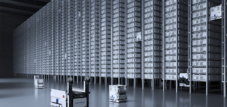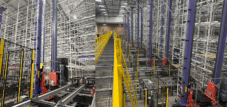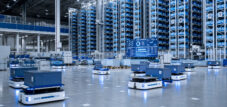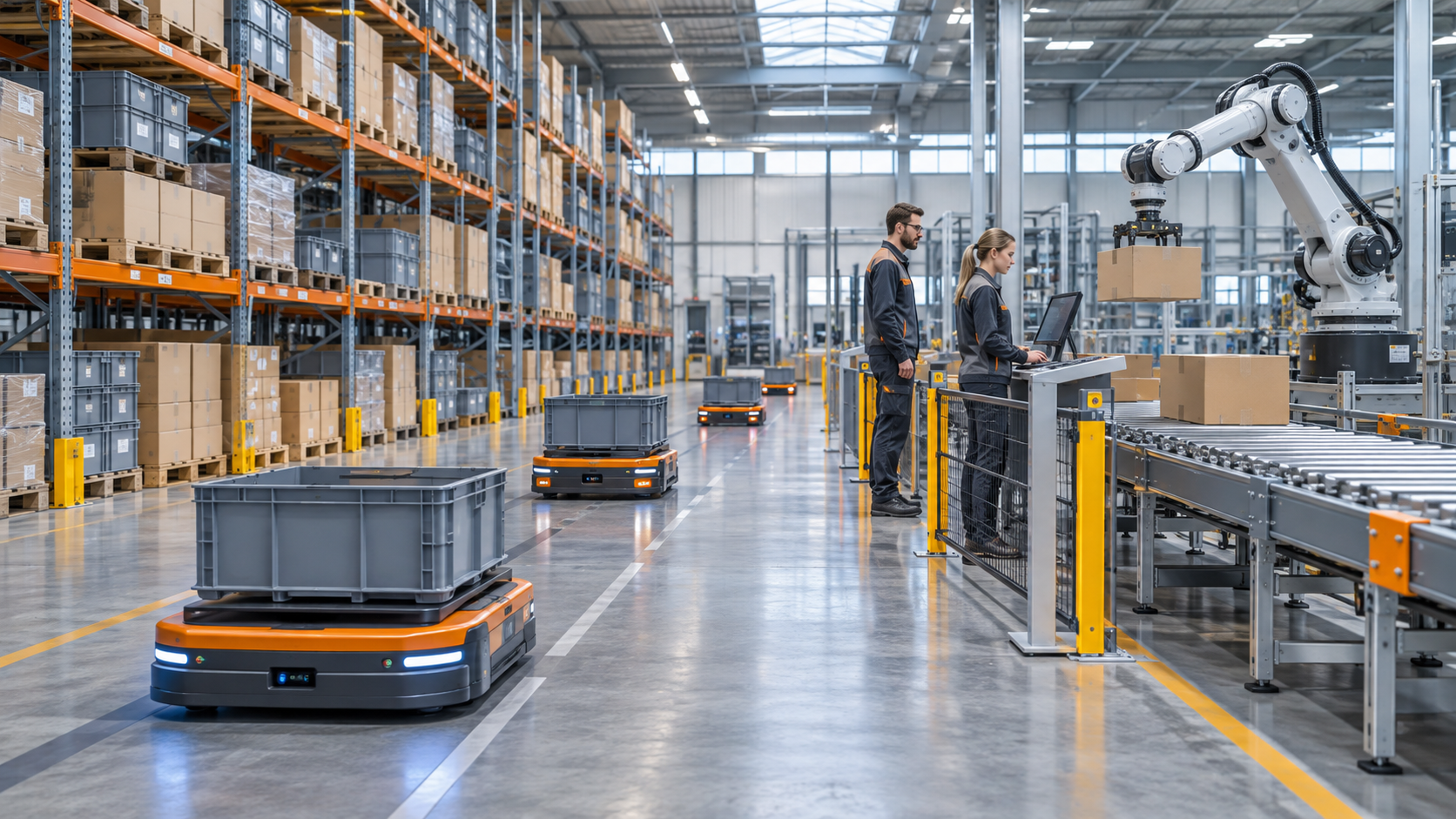
Warehouse automation by 2030: Why robots alone won't create a competitive advantage – Creative image on the topic, with AI: Xpert.Digital
More robots in the warehouse – but does automation really pay off?
Warehouses of the future: Why good processes are more important than as much technology as possible
AI and robotics are changing logistics: What matters now when investing
Robotics, artificial intelligence, and powerful control software are opening up new possibilities for warehouse logistics. Mobile robots transport goods, automated systems accelerate order picking, and intelligent systems help coordinate material flows. At the same time, companies are under increasing economic pressure: High financing costs, uncertain demand, and a shortage of skilled workers are making investment decisions more challenging. Even the most modern system is of no use if it doesn't fit the actual flow of goods or if it creates new bottlenecks elsewhere.
Warehouse automation is expected to continue growing until 2030 – though not uniformly and not in the form of a widespread transition to fully autonomous warehouses. A combination of stationary storage technology, mobile robots, software, and still necessary manual processes is more likely. The crucial factor is not so much how many tasks can be technically automated, but rather which of them deliver measurable benefits to the company. These benefits include not only savings in working time, but also improved delivery reliability, better utilization of limited storage space, and safeguarding operational capacity.
Economic success therefore depends on more than just the performance of individual machines. Data quality, system integration, utilization, maintenance, and the adaptability of a system all influence whether an investment pays off in the long run. Automating inefficient processes may only exacerbate existing problems. This overview shows which technological and economic developments are likely to shape warehouse logistics by 2030 – and what companies should pay attention to in order to turn automation into a sustainable competitive advantage.
Automating bad processes only makes the problems worse
Between technological breakthrough and economic disillusionment
Warehouse automation is entering a crucial phase of development. Robotics, artificial intelligence, and powerful control software are significantly expanding the technological possibilities. At the same time, high financing costs, uncertain sales markets, and more demanding profitability requirements are forcing companies to take a more pragmatic approach to evaluating their investments. Not every technically compelling system makes economic sense. Conversely, foregoing automation can prove costly if staff shortages, limited storage capacity, or inadequate delivery quality hinder growth.
The central development, therefore, is not simply that warehouses are becoming increasingly unmanned. Rather, the relationship between labor, capital, space, and information is changing. Routine tasks can be increasingly mechanized, while planning, monitoring, and exception handling are gaining in importance. The economic benefit arises where these elements interact: A faster robot alone will not improve the supply chain if goods receipt remains unreliable or shipping becomes a bottleneck.
Market developments present a mixed picture. Global order intake for warehouse automation increased by approximately seven percent in 2025. However, this growth was partly due to higher project prices and large investment programs by individual customers. A recent industry forecast anticipates average global growth of roughly six percent annually for the period from 2025 to 2030. This suggests a structurally growing industry, but not a uniform investment boom across all market segments.
Why rising order values do not necessarily prove a widespread boom
For a reliable market analysis, order intake, revenue, installed capacity, and actual productivity must be distinguished. These factors are related but do not necessarily develop simultaneously. An order can be received long before a plant is commissioned. Revenue becomes visible with a time lag, depending on the project's progress and accounting methods. Only after installation and commissioning does it become clear whether the planned performance is being achieved.
Added to this is inflation within the projects themselves. If steel, assembly services, control technology, or skilled personnel become more expensive, the nominal order value can increase even if the number of plants hardly changes. For example, order intake in the US was projected to grow by twelve percent in 2025, with approximately six percent of that growth expected to be due to price increases. A significant portion of the reported growth would therefore not be direct evidence of a correspondingly stronger real demand.
The focus on a few major customers is also relevant. When large retailers implement extensive distribution programs, individual system providers benefit disproportionately. At the same time, smaller and medium-sized customers may postpone investments. A positive overall market then masks a weak breadth of business.
Therefore, simply looking at the growth rate is insufficient for evaluating the industry. Equally important are the distribution of orders, the quality of customer financing, project margins, and the share of recurring revenue. A full order backlog only creates economic value if it can be translated into functioning plants and positive cash flows without excessive cost increases.
Market forecasts are only meaningful with clear boundaries
The apparent accuracy of many market forecasts can be deceptive. Warehouse automation encompasses various combinations of conveyor technology, automated storage and retrieval systems, mobile robots, sorting systems, software, and integration services. Other studies focus exclusively on robotics or include related areas of material handling technology.
Therefore, different growth forecasts can be plausible simultaneously. While one forecast for the global warehouse automation market assumes an average annual growth rate of approximately six percent until 2030, another study expects growth of seven to ten percent for its specific market of material flow and warehouse automation. This discrepancy is not sufficient proof that either estimate is incorrect. Rather, it necessitates an examination of the market size, the base year, and the underlying assumptions.
It is particularly important to distinguish between a large, established market and a smaller, rapidly growing sub-segment. Mobile robotics can expand significantly faster than traditional conveyor technology without overtaking it in terms of total revenue in the short term. Furthermore, high percentage growth rates are more easily achieved from a small starting point.
A reliable outlook for 2030 should therefore not depend on a single market size. A more meaningful perspective is the combination of structural drivers, investment cycles, technological maturity, and economic viability. The direction of change can often be determined more reliably than its exact annual pace.
Staff shortages are changing corporate investment calculations
A key driver of automation is not solely the level of wages, but also the availability of suitable employees. A company can operate a manual process cost-effectively on paper and still lose orders if shifts cannot be filled. Jobs involving high physical strain, inconvenient working hours, and strong seasonal fluctuations are particularly problematic.
Under these conditions, automation fulfills two distinct functions. It can save working hours and simultaneously safeguard operational capacity. The second effect is often underestimated in simple cost-benefit analyses. If a lack of staff limits shipping performance, the benefits of a system cannot be measured solely in personnel cost savings.
The proliferation of professional service robots underscores the importance of logistics applications. In 2024, approximately 102,900 robots in the transport and logistics application category were sold worldwide, about 14 percent more than in the previous year. This means that more than half of all recorded sales of professional service robots fell into this category. However, this figure does not represent the entire warehouse automation market, nor does it exclusively include robots used in traditional warehouses.
What is economically crucial is which tasks are actually eliminated. Fewer walking distances do not automatically mean fewer employees. The freed-up time can enable additional orders, reduce overtime, or improve quality control. Only when these effects are specifically planned and measured does technological relief translate into a verifiable economic benefit.
Online commerce primarily increases complexity
E-commerce is changing the demands on warehouses not only through increased volume. The change in order structure is at least as important. Instead of fewer large deliveries, many small orders with different items often need to be processed. Added to this are short delivery times, fluctuating demand, and complex returns processes.
This increases the number of necessary decisions for each unit delivered. A warehouse must manage inventory precisely, bundle orders effectively, select suitable packaging, and ensure timely access to transport capacity. The economic challenge lies not only in quickly retrieving a product, but also in reliably coordinating all steps.
This results in differentiated automation requirements. A spare parts dealer with many rarely requested items needs a different solution than a food retailer with short shelf lives or a fashion retailer with seasonally changing assortments. Even identical daily quantities can justify completely different system concepts if product dimensions, order sizes, and peak loads differ.
At the same time, online retail remains a cyclical driver of demand. Following the pandemic-induced surge in investment, a period of overcapacity and postponed projects ensued. This illustrates a fundamental risk: those who perpetuate exceptional demand phases risk tying up capital long-term in underutilized assets.
The economic value arises throughout the entire material flow
A warehouse is a chain of interconnected processes. Goods receipt, storage, replenishment, order picking, packing, and shipping all influence each other. The overall system's efficiency is limited by its respective bottlenecks.
Therefore, accelerating a single work step does not automatically lead to more deliveries. A high-performance picking system can create additional intermediate stock if the packaging process cannot keep up. A fast sorter is of little use if orders are released late or if the carriers' pickup times do not align with the processing logic.
Therefore, from an economic perspective, it makes sense to consider the entire process, from the incoming goods flow to the finished order ready for shipment. Not all areas need to achieve the same level of automation. Sometimes it is sufficient to eliminate a limited bottleneck. In other cases, a comprehensive restructuring is necessary because several process steps need to be coordinated.
The key performance indicator is not a machine's maximum speed, but its reliably usable total output with a realistic product mix. This includes malfunctions, supply interruptions, maintenance windows, and unusual orders. Those who plan solely based on idealized peak values often overestimate the economically available capacity.
Mobile robots expand the scope of existing warehouses
Autonomous mobile robots are among the most visible developments in intralogistics. They take over transport tasks and, depending on the design, can move containers, shelves, carts, or pallets. Their particular economic appeal lies in the fact that transport capacity can be expanded gradually without having to build an entire new warehouse.
This flexibility is particularly advantageous in existing buildings. Companies can initially automate clearly defined transport routes and later add further processes. This limits the initial capital investment and creates the opportunity to gain experience under real-world conditions.
However, flexibility is not synonymous with arbitrariness. Mobile systems also require suitable traffic areas, reliable communication, sufficient charging infrastructure, and consistent order management. If too many vehicles are deployed to an unsuitable area, traffic problems arise instead of additional capacity.
The economic limit, therefore, lies not only in the individual robot, but in the interaction of the entire fleet with humans and stationary systems. Market forecasts for mobile robotics are correspondingly sensitive to changing project assumptions. The fact that significant downward revisions have recently been made demonstrates how large the gap can be between long-term potential and short-term realized demand.
Stationary plants remain strong where volumes and processes are stable
The focus on mobile robotics should not obscure the fact that stationary automation continues to fulfill essential tasks. Conveyor systems, automated pallet warehouses, container storage systems, shuttle systems, and sorters can achieve high and consistent performance under suitable operating conditions.
Their strength lies primarily in standardized material flows with sufficient capacity utilization. When large quantities follow similar routes over extended periods, a permanently installed system can be more economically viable than a flexible solution with higher operating costs per unit transported.
The disadvantage lies in the stronger dependence on the building, layout, and process assumptions. If the product range changes fundamentally or demand shifts, certain systems can only be adapted with considerable effort. This lack of adaptability is a business risk that must be considered during the planning phase.
By 2030, a complete replacement of stationary technology is therefore less likely than a greater integration of different systems. High-density storage areas, mobile transport, and manual special processes can complement each other. The crucial factor is not belonging to a specific technology category, but rather the alignment between the system structure and the actual business model.
Area productivity is becoming an independent driver of returns
Automation can improve a site's profitability without significantly reducing staff. A key lever is better utilization of available space. Higher storage density, additional usable building height, and more compact deployment can postpone expansions or relocations.
This effect is particularly relevant when an existing location is well connected to customers, production, or transport networks. Avoiding new construction then not only saves on building costs, but also eliminates relocation, parallel operations, additional transport routes, and organizational changes.
However, a distinction must be made between storage density and operational efficiency. A system that accommodates a particularly large number of items in a small space is not necessarily optimal for every access method or order structure. Therefore, the economic evaluation must consider both space savings and the required service capacity.
In addition, land use influences the value of logistics properties. A building with suitable height, load-bearing soil, and sufficient technical infrastructure can be more attractive for automation. Conversely, a low rental price can be offset by high adaptation costs. Therefore, land costs and technology costs cannot be meaningfully optimized separately.
Software determines the usefulness of hardware
With increasing automation, part of the value creation shifts from mechanics to software. Inventory management, warehouse management, material flow control, and fleet management must work together seamlessly. Each of these levels considers a different aspect of the operation.
Inventory management systems, for example, map commercial inventory and business processes. Warehouse management systems organize storage locations, stock levels, and orders. Material flow and execution software coordinate operational processing. Robotics systems, in turn, control specific movements and local processes. The exact division of tasks varies depending on the architecture.
Problems arise when multiple systems set conflicting priorities or exchange status information with a delay. This can lead to technically available capacity remaining unused. Equally critical are unclear responsibilities in the event of malfunctions: If a robot reports an error, it must be clear whether the cause lies within the vehicle, the communication, the master data, or the higher-level task.
The long-term competitive advantage therefore increasingly lies in a manageable system architecture. Good interfaces, transparent decision rules, and clearly defined data responsibility reduce integration costs. At the same time, they facilitate future expansions and limit dependence on individual vendors.

Expert partner in warehouse planning and construction

Artificial intelligence improves warehouse automation
Artificial intelligence must solve measurable operational problems
Artificial intelligence can improve warehouse automation on several levels. It can recognize patterns in order data, position inventory more efficiently, coordinate transport routes, and analyze visual information for robots. It becomes particularly valuable where rigid rules reach their limits under changing conditions.
A striking example is the coordination of large robot fleets. In 2025, Amazon announced its DeepFleet model, which aims to improve the travel times of its robot fleet by ten percent. At the same time, the company reported deploying its millionth robot in a network of more than 300 locations. These figures are company-specific and not a general performance benchmark for the industry.
The economic significance of such systems lies in the added value of already installed technology. Better coordination of existing vehicles can generate more power without a corresponding increase in hardware. Software thus becomes a lever for capital productivity.
However, partial improvements cannot be applied to the entire warehouse. Ten percent shorter travel times do not automatically translate into ten percent lower overall costs. The actual effect depends on what proportion of the costs are attributable to transportation and whether other process steps can absorb the additional capacity.
Gripping robotics can only unlock difficult tasks step by step
The automated movement of standardized containers is technically different from the picking of arbitrary individual items. Products differ in shape, weight, surface finish, packaging, and deformability. Transparent films, reflective materials, or interlocking objects can complicate detection and handling.
Improvements in cameras, grippers, and machine learning models expand the range of tasks that can be automated. However, for an economic evaluation, it is not enough that a system can, in principle, grip many items. Reliability, cycle time, and the effort required to handle problematic cases are crucial.
A robot that autonomously handles the majority of items can be attractive if exceptions are handled quickly and reliably. However, the same level of automation can be uneconomical if every interruption halts the entire material flow.
Therefore, hybrid operating models will remain important. Machines take over manageable tasks, while people handle damaged packaging, unusual items, or complex returns. The most economically viable solution often lies not in maximum technical completeness, but in an intelligent separation between standard cases and exceptions.
Data quality is an underestimated investment requirement
Automated systems require reliable information. Item dimensions, weights, packaging units, storage conditions, and inventory data directly influence whether a process functions correctly. Errors that are compensated for through experience in a manual warehouse can have a systematic impact in an automated system.
An incorrectly entered weight can influence the selection of a means of transport. Inaccurate dimensions can lead to unsuitable storage locations or packaging. A supposedly existing inventory can block orders, even though the technical system is functioning correctly.
This makes data cleansing an integral part of the investment, rather than a subsequent administrative task. Companies must define who enters master data, checks changes, and corrects discrepancies. Equally important is the link between physical goods movements and digital inventory reports.
The economic benefits of this work extend beyond automation. Better data supports purchasing, inventory planning, and customer service. Nevertheless, the effort involved should not be underestimated. A system can be installed within a few months, while the organizational implementation of reliable data processes takes considerably longer.
Digital twins make planning assumptions verifiable
Simulations and digital twins can help identify flawed decisions before installation. This involves digitally mapping a planned or existing operation to analyze, for example, traffic flows, buffer sizes, and order strategies.
Such models are particularly valuable when dealing with complex interactions. An additional machine does not necessarily increase overall performance. It can also cause new bottlenecks, overload supply areas, or negatively alter the order of order processing. Simulations make such effects visible earlier.
However, this requires that the models use realistic inputs. Average values alone are often insufficient. Factors needed include peak order times, product distribution, disruptions, and varying processing times. A model that ignores exceptions will, in case of doubt, only confirm the original planning assumptions.
Even larger companies use digital twins to develop new robotics systems. However, the fundamental principle is independent of company size: virtual tests can complement real-world trials, but they cannot eliminate all operational uncertainty. Their economic value lies in making critical assumptions visible and verifiable.
The total costs exceed the price of the plant
A sound investment analysis must capture all costs over the entire useful life. In addition to hardware, this includes software, integration, building modifications, training, maintenance, spare parts, and potentially additional skilled personnel. Ramp-up costs and temporary performance losses are also relevant.
Expenditures outside the actual machine are particularly often underestimated. These include changes to the warehouse management system, safety concepts, wireless network, power supply, and the adaptation of existing workflows. Internal project work also ties up resources, even if it is not fully recorded as an investment.
Several levels of benefit can also be distinguished. Direct savings arise, for example, from fewer paid working hours or lower error costs. Avoided costs can result from a postponed expansion. Additional revenue is possible if higher capacity actually enables additional profitable orders.
These effects must not be counted twice. A saved working hour cannot simultaneously be fully allocated to both personnel cost reduction and the basis for additional output. A sound cost-benefit analysis therefore separates cash flow effects, capacity effects, and qualitative benefits.
Capacity utilization and capital costs determine the return on investment
Automation often shifts the cost structure towards higher fixed expenses. This can be advantageous with stable production volumes, as the investment is spread across many units. However, with low capacity utilization, the cost per order increases.
A simplified example illustrates the relationship. If an investment amounts to five million euros and generates one million euros in cash flow annually after additional operating costs, the simple amortization period is five years. If the annual cash flow drops to 600,000 euros, it extends to just over eight years. This calculation does not yet take into account financing, taxes, or the time value of money.
For a complete evaluation, a discounted approach is therefore advisable. Future savings are economically less valuable than immediately available funds. If the required cost of capital increases, projects whose benefits only materialize later become less attractive.
Added to this is the ramp-up risk. If the planned output is only achieved after a longer start-up phase, savings are postponed. A project should therefore not only be convincing in the optimistic growth scenario. What is crucial is how robust it remains in the event of lower volumes, higher costs, or delayed commissioning.
Usage models redistribute risks, but do not eliminate them
Besides traditional purchasing, rental, leasing, and usage-based models are gaining importance. With robotics as a service, for example, the customer pays recurring fees instead of a large, one-time purchase price. In the transport and logistics robot segment, this business model increased significantly in 2024; growth of 42 percent was reported for corresponding RaaS (Robots as a Service) offerings.
Such models can facilitate market access and reduce initial capital commitment. Particularly when planning certainty is limited, it can be attractive to initially procure capacities with greater flexibility in terms of timing or quantity.
At the same time, the costs don't disappear. Financing, maintenance, failure risks, and the provider's required margin are factored into the ongoing fees. Over a long usage period, a service model can therefore be more expensive than buying.
The economic quality depends heavily on the contract terms. Minimum contract durations, guaranteed availability, price adjustments, upgrade options, and data access are just as important as the monthly base price. Flexibility has value, but only if it is actually included in the contract.
Regional differences will shape growth until 2030
Global warehouse automation is developing differently across regions. For the period from 2025 to 2030, average annual growth of approximately seven percent is expected for Europe, the Middle East, and Africa combined. The corresponding forecast for the Americas is around six percent, and for Asia-Pacific, around five percent. At the same time, an estimated revenue decline of eight percent has been projected for Asia-Pacific in 2025, due in part to weak Chinese demand.
These regional categories should not be confused with homogeneous markets. Within Europe, wages, financing options, and building stock vary considerably. Within Asia, highly automated logistics hubs exist alongside markets where manual labor remains comparatively inexpensive.
Germany's advantages include a shortage of skilled workers, high demands on delivery quality, and the importance of industrial value creation for a sustained need for automation. These factors are countered by economic uncertainty, complex existing buildings, and sometimes limited investment budgets.
In lower-cost locations in Central and Southeastern Europe, a purely personnel cost analysis is often less straightforward. Nevertheless, automation and partial automation can be beneficial when personnel becomes scarce, export-oriented customers demand reliable processes, or the available building needs to be used more efficiently.
Different industries require different automation logics
There is no one-size-fits-all system concept suitable for all industries. In the food sector, temperature, shelf life, and hygiene requirements influence the design. In the spare parts business, a wide variety of products and the rapid availability of individual items are often paramount. In the fashion industry, seasonal changes and returns make stable standardization difficult.
Logistics service providers also face a unique situation. They may invest in equipment whose economic lifespan extends beyond the contract with a single customer. This creates a significant risk of continued business. A highly specialized solution might be efficient for one client but unsuitable for the next.
For industrial companies, the connection to production is crucial. Here, a stable supply of materials can be more economically important than the lowest cost per inventory movement. Avoiding a production stoppage has a different value than slightly faster individual order picking.
The investment decision must therefore be based on the business model. Only then should the technology be selected. Reversing this order risks adapting one's own processes to an attractive machine instead of solving an economic problem.
Employment changes without automatically disappearing
Automation reduces certain tasks while simultaneously creating new demands. Walking distances, heavy transport, and repetitive movements can decrease. However, maintenance, system support, data management, and troubleshooting become more important.
This transformation is not automatically smooth from a social or organizational perspective. Employees' qualifications do not necessarily match the newly emerging tasks. Therefore, companies must plan for further training and personnel development early on.
The workload can also shift. An ergonomically improved workstation can reduce physical strain, but at the same time dictate a faster work pace. Whether automation improves work quality therefore depends not only on the technology, but also on staffing levels, break scheduling, and management decisions.
From an economic perspective, employee acceptance is a key success factor. Those who work with a system daily often identify practical problems that were overlooked during the planning phase. Capitalizing on these experiences early on can reduce start-up difficulties. Conversely, a purely technical implementation without organizational involvement jeopardizes expected productivity.
Networking creates efficiency and new vulnerabilities
With increasing connectivity comes a growing dependence on software, communication networks, and external service providers. A manual process can sometimes improvise to overcome disruptions. However, a tightly coupled automated system requires clearly defined fallback options.
This includes, among other things, secure access, traceable changes to control systems, and the separation of critical systems. Equally important are spare parts strategies, restart plans, and the ability to continue processing at least prioritized orders even with limited technology.
The economic assessment should therefore consider not only average availability but also the consequences of rare, severe outages. A short interruption may be manageable. However, a prolonged shutdown during a seasonal peak can trigger significant follow-up costs.
The dependency on individual vendors also deserves attention. Proprietary interfaces or restricted data access can increase the cost of later expansions. Low initial costs, therefore, do not necessarily guarantee a favorable overall offer. The crucial factor is whether the company can adequately control its operational capability throughout the entire usage period.
Sustainability demands a balance sheet, not an advertising promise
Automation can save energy and resources, but it doesn't have to. Shorter transport routes, reduced space requirements, and fewer damaged goods can have a positive impact. Higher storage density can also reduce the need for buildings and, if necessary, temperature-controlled areas.
This is offset by electricity consumption, battery production, additional electronics, and the materials used for the systems. The manufacturing and subsequent upgrades of the technology must also be included in a comprehensive analysis.
Therefore, a distinction must be made between relative and absolute effects. If energy consumption per order decreases, but the processed volume increases significantly, the total electricity demand can still rise. Similarly, a particularly efficient system can economically enable more transport activity.
A reliable sustainability assessment therefore considers both the individual service unit and the entire site. Relevant factors include energy consumption per order, total consumption, lifespan, repairability, and the source of the electricity. Ecological benefits do not arise from the degree of automation itself, but from the demonstrable improvement of the overall system.
For suppliers, the competition is shifting towards implementation expertise
The economic logic is also changing on the supplier side. Good hardware remains important, but is increasingly insufficient. Customers expect functioning interfaces, verifiable performance commitments, manageable ramp-up, and reliable service.
Project-based business is particularly demanding. Individual customizations can increase revenue, but at the same time, they also increase development costs and risks. If every installation effectively becomes a new, individual project, the advantages of a scalable product platform diminish.
Providers with standardized modules and reusable software can gain an advantage here. However, standardization must not mean ignoring real customer requirements. Economic success lies in a controlled balance between reusability and necessary customization.
Recurring revenues from software, maintenance, and operational support can stabilize the business. However, their quality depends on whether customers receive measurable, long-term value. The crucial competitive question, therefore, is not just who offers the most powerful technology, but who can reliably and profitably integrate it into diverse operating environments.
By 2030, the importance of economic adaptability will increase significantly
From today's perspective, further growth in warehouse automation seems plausible. Staff shortages, more complex order structures, and higher demands on delivery capability remain key drivers. At the same time, financing, trade conflicts, and investment cycles will influence annual developments.
A realistic baseline scenario is therefore not a complete transition to fully autonomous warehouses. A more likely scenario is the widespread adoption of tiered solutions: compact storage technology, mobile transport, automated sub-processes, and software-supported coordination.
A more favorable trajectory is possible if integration costs decrease, robotics becomes more reliable, and standardized solutions become more readily available to smaller businesses. A weaker trajectory is likely if demand uncertainty, high capital costs, or disappointing project results delay investments.
The common denominator of these scenarios is the importance of adaptability. Companies benefit from systems that not only handle today's order profile well, but can also be modified with reasonable effort. This adaptability is not a free bonus, but an economic value that must be weighed against higher acquisition costs.
The best automation is not the biggest, but the most sustainable
The future of warehouse automation is not decided solely in the development lab. It is decided by investment calculations, data sets, shift schedules, and failure-prone everyday processes. Technological progress expands the possibilities, but it does not replace sound business analysis.
Companies that accurately identify bottlenecks, use realistic data, and provide organizational support for change will be particularly successful. They view automation not as an isolated technology purchase, but as a long-term transformation of their service delivery.
This also includes the willingness to forgo a technically feasible solution. Where quantities are too small, processes too variable, or data too unreliable, a simpler improvement may be economically superior. Conversely, a comprehensive facility may be justified if it operates at high capacity for years and secures a strategically important location.
The crucial perspective up to 2030 is therefore this: the highest degree of automation does not automatically create the greatest competitive advantage. What matters is how reliably a company generates marketable logistics performance from invested capital, available space, skilled labor, and sound information. This is precisely the difference between an impressive facility and an economically convincing investment.
Your intralogistics experts

Consulting, planning and implementation of complete solutions for high-bay warehouses and automated storage systems - Image: Xpert.Digital
More information here:
Your global marketing and business development partner
☑️ Our business language is English or German
☑️ NEW: Correspondence in your native language!

Konrad Wolfenstein
I and my team are happy to be available to you as your personal advisor.
You can contact me by filling out the contact form here wolfenstein@xpert.digital:or simply call me at +49 7348 4088 965. My email address is
I'm looking forward to our joint project.
☑️ SME support in strategy, consulting, planning and implementation
☑️ Creation or realignment of the digital strategy and digitization
☑️ Expansion and optimization of international sales processes
☑️ Global & Digital B2B trading platforms
☑️ Pioneer Business Development / Marketing / PR / Trade Fairs
Our global industry and economic expertise in business development, sales and marketing


Our global industry and economic expertise in business development, sales and marketing - Image: Xpert.Digital
Industry focus areas: B2B, digitalization (from AI to XR), mechanical engineering, logistics, renewable energies and industry
More information here:
A thematic hub offering insights and expertise:
- Knowledge platform covering global and regional economies, innovation and industry-specific trends
- A collection of analyses, insights, and background information from our key areas of focus
- A place for expertise and information on current developments in business and technology
- A hub for companies seeking information on markets, digitalization, and industry innovations