TK Accelis before its IPO: Why coil storage will become the decisive test
Xpert Pre-Release

Available in 27 languages 📢
Prefer Xpert.Digital on GoogleⓘPublished on: October 25, 2026 / Updated on: October 25, 2026 – Author: Konrad Wolfenstein
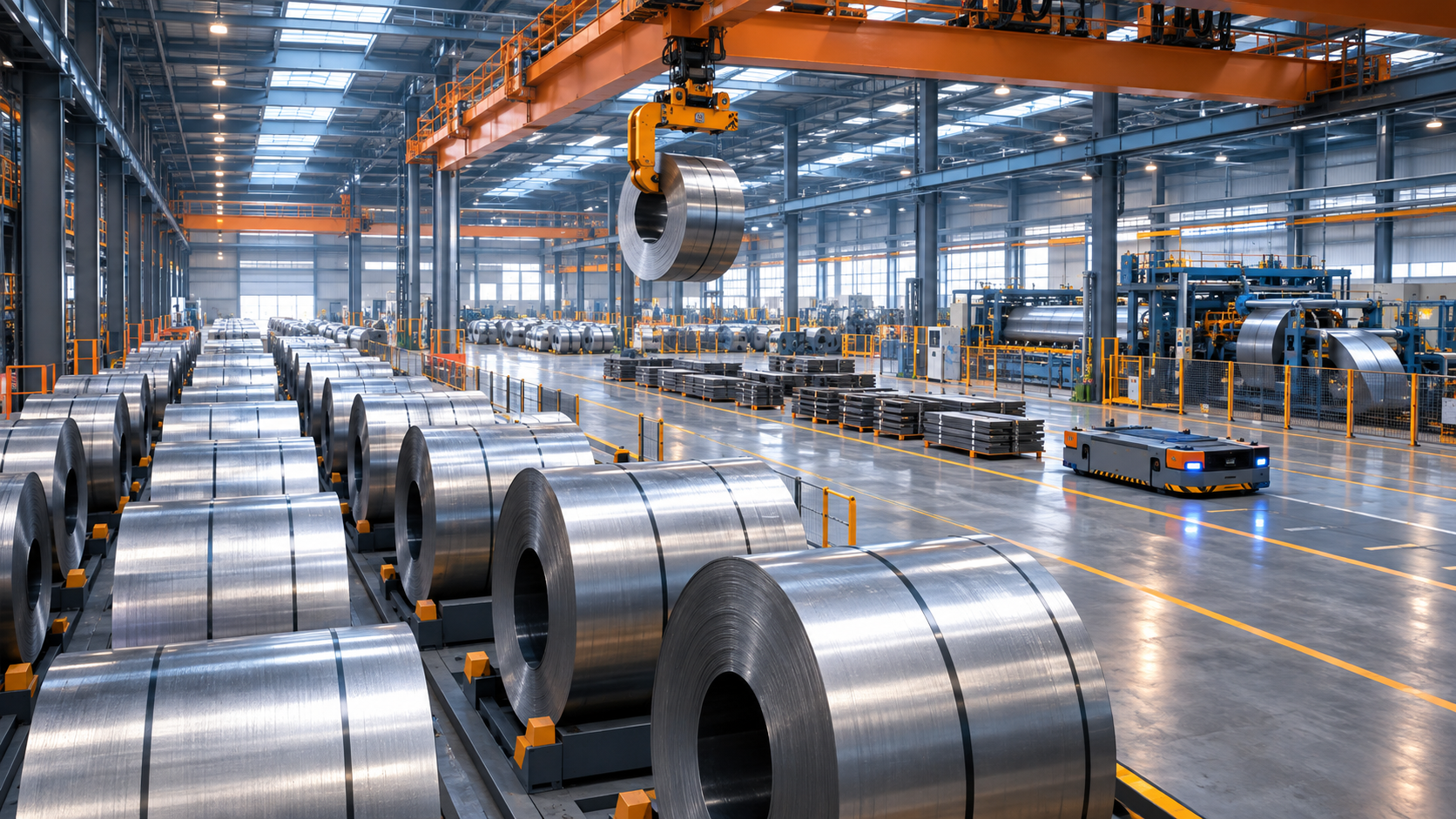
TK Accelis before its IPO: Why coil storage will become the decisive test – Creative image on the topic, with AI: Xpert.Digital
Thyssenkrupp's materials business becomes independent – but success will be determined in the warehouse
50,000 tons of steel in Mannheim: What the coil warehouse reveals about tk accelis
More than just steel trading: How tk accelis plans to become more profitable through processing and logistics
With the planned IPO of tk accelis, Thyssenkrupp's materials business is moving more into the spotlight. However, whether this new independence will be economically viable cannot be determined solely by its stock market valuation. Crucially, the company must be able to better coordinate its inventory, storage technology, processing, and supply chain management. Coil warehouses present a particularly demanding test case: They combine high material values and heavy loads with tight delivery windows and complex customer requirements. tk accelis must prove that large steel coils will not only generate revenue but also sustainably increase added value.
tk accelis: Trial by fire in the coil warehouse: Stock market hype doesn't move a ton.
From a global intralogistics perspective, the spin-off of tk accelis is more than just another step in Thyssenkrupp's transformation: it highlights the extent to which industrial competitiveness now depends on the interplay of material supply, storage technology, processing, and data management. Since June 2026, the company has been operating the former materials and services division, thyssenkrupp Materials Services, under a new brand, combining material trading, customer-specific processing, and supply chain management. Coil storage facilities, in particular, demonstrate whether this approach can result in a robust business model with higher added value. This is because they involve high material values, heavy loads, tight delivery windows, and a production process that only functions when physical material flow and digital information are perfectly aligned.
From this perspective, the crucial issue is not the breakup of an industrial conglomerate. The decisive question is whether an independent materials service provider can generate more return on every euro of capital invested. A coil warehouse is a particularly demanding test case for this: it must keep material readily available without tying up unnecessary capital and reliably supply the processing without becoming a cost factor itself through additional movements.
More independence, not complete separation
As of October 25, 2026, the initial stock market listing of tk accelis is scheduled for October 28; the spin-off is expected to become effective on October 27. The plan is to allocate 49 percent of the shares to existing Thyssenkrupp shareholders, while Thyssenkrupp will retain a 51 percent majority stake. One share of the new company is planned for every 20 Thyssenkrupp shares. This will create a separately listed company, but not a company completely separate from its former parent company.
This distinction is economically important. An independent stock market listing creates its own valuation and opens up additional financing options; however, it does not automatically mean that fresh capital will flow into the warehouse and production sites through the allocation of shares. For a coil warehouse, investments only become real when budgets for cranes, transport technology, additional halls, software, or modernization are actually approved and implemented.
The strategic opportunity therefore lies less in the ownership label than in a more targeted use of capital. A materials service provider must prioritize different investments than a steel manufacturer or a naval shipbuilding company. Making decisions closer to inventory levels, customer demand, and processing facilities can create an advantage. However, additional administrative, financing, and reporting obligations can partially offset this advantage.
Steel rollers as an industrial switching point
Coils are wound metal strips, made of materials such as carbon steel, stainless steel, or aluminum, and serve as raw material for further processing. In slitting lines, wide strips are cut into narrower slit strips; cut-to-length lines produce sheets or blanks of defined lengths. The coil warehouse forms the interface between the supply quantities from metal producers and the much more diverse demands of the processing industry.
This brokerage service is more complex than the term "warehouse" suggests. A roll of material is not defined solely by its weight. Material quality, strip thickness, width, surface condition, and intended use all determine its suitability for a specific order. Therefore, a large overall inventory says little about whether the required version is actually available.
For economic evaluation, this leads to a key point: security of supply is not achieved by storing as many tons as possible, but by ensuring the right composition of the inventory. A warehouse can be overstocked and simultaneously have bottlenecks. In such cases, capital is tied up without a corresponding increase in delivery capacity. The challenging task lies in combining product variety, processing sequence, and customer demand in such a way that inventory is transformed into readily available output.
Mannheim demonstrates the physical scale
The Mannheim site illustrates the scale of this business: Approximately 30,000 square meters of hall space house seven cross-cutting and slitting lines, while the storage areas offer space for around 50,000 tons of coils. The combination of large inventories, heavy individual units, and multiple processing lines demands a precisely coordinated material supply. At this scale, intralogistics is not a secondary, auxiliary process, but a direct prerequisite for industrial production.
A storage capacity of 50,000 tons, however, is not the same as the actual average inventory or the annual processing volume. These three figures address different questions. Capacity describes the available space under the respective technical conditions, inventory the actual stored material, and throughput the quantity moved or processed within a given period. Mixing them up quickly leads to an overestimation of the economic significance of a location figure.
The Mannheim site's connection to waterways, rail, and highways further underscores the importance of external transport links. No matter how efficiently a coil warehouse is organized within its halls, uneven deliveries or a lack of shipping capacity will inevitably lead to buffer stocks and waiting times. Therefore, optimization only becomes economically effective when goods receipt, storage, production, and shipping are considered as an integrated system.
Stuttgart expands its service promise
At the Stuttgart site, production, packaging, and storage capacities were expanded through a double-digit million-euro investment; the design, announced in August 2026, achieves an annual processing capacity of up to 350,000 tons. The expansion includes an additional 2,000-square-meter shipping and finished goods hall, modernized slitting technology, and increased automation of setup, monitoring, and packaging processes. The processing range covers strip thicknesses from 0.2 to 5.0 millimeters as well as applications with electrical steel.
This involves more than just an increase in volume. A broader processing range can improve access to more demanding applications. At the same time, the requirements for material protection, identification, and the coordination of individual process steps are increasing. Additional machine capacity is worthless if the correct coil is not available at the machine in time or if a backlog occurs in the packaging after processing.
For intralogistics, such an expansion therefore means a system overhaul. Storage areas, cranes, transfer stations, and shipping must be adapted to the new performance capacity. An investment calculation that considers only the speed of the cutting line falls short. The actual increase in throughput that can be sold is limited by the weakest link in the entire process chain.
Billions in revenue with a narrow profit base
In fiscal year 2024/25, Materials Services, or tk accelis, generated revenue of approximately €11.4 billion and adjusted EBIT of €132 million, according to segment reporting. This results in an adjusted operating margin of approximately 1.2 percent. The €132 million figure is explicitly not profit before taxes, but rather adjusted earnings before interest and taxes (EBIT) excluding certain special items.
This distinction is not a minor accounting matter. With a low operating margin, financing costs, write-downs, restructuring expenses, and changes in material prices can significantly impact earnings. At the same time, even a limited improvement in operational efficiency can be economically significant. Based on €11.4 billion in revenue, one percentage point of margin equates to €114 million; this is a measure of magnitude, not a forecast of actual achievable savings.
For coil storage facilities, this results in a sober benchmark. Not every additional automation has to look spectacular. Even fewer incorrect movements, better inventory allocation, or more reliable supply can be valuable. Whether they are worthwhile, however, depends on the total costs and the capital tied up, not on the number of installed sensors or a particularly impressive warehouse layout.
The improvement is measurable, not guaranteed
In the first nine months of fiscal year 2025/26, Materials Services' revenue increased from €8.640 billion to €9.131 billion; adjusted EBIT rose from €82 million to €178 million. This represents an increase of approximately 5.7 percent in revenue and about 117 percent in adjusted operating profit. In the third quarter, revenue reached €3.378 billion, compared to €2.860 billion in the same period of the previous year; adjusted EBIT rose from €45 million to €82 million.
The operational performance thus indicates a real improvement. However, it does not yet prove that the restructuring will be permanently successful regardless of the market environment. The aforementioned drivers of this performance include not only efficiency and restructuring measures, but also higher prices for key product groups, increased volumes, and particularly favorable performance in the North American distribution business. Cyclical support and structural improvements are therefore working simultaneously.
This distinction is crucial for evaluating a coil storage operator. Rising material prices can increase revenue and, at times, profit margins, without any improvement in storage processes. A sustainable improvement, on the other hand, would be evident in comparable orders being processed with fewer movements, less waste, shorter lead times, and lower capital expenditure. Group or segment figures alone are insufficient to determine this.
From metal sales to supply solutions
TK Accelis' business model is divided into the areas of Materials, Processing, and Solutions. For 2024/25, preliminary, unaudited combined revenues of approximately €7.0 billion, €3.1 billion, and €1.4 billion, respectively, were reported. These figures are based on a different presentation method than the segment figure of €11.4 billion and should not be treated as completely identical without reconciliation.
From a coil logistics perspective, the three areas of activity form an economic development path. First, material is procured and sold. Revenue is then generated from slitting, cutting, and further processing. The more comprehensive stage involves managing inventory, call-offs, transport, and data flows for the customer. The customer then purchases not just metal, but a reliably available service perfectly suited to their production process.
The strategic concept of Materials as a Service describes this combination of material supply and services. However, it should not be confused with a fully digitized, virtually capital-free platform business. Coils remain physical inventory, warehouses require space, and heavy loads need suitable equipment. Services can stabilize revenue, but they do not automatically eliminate risks associated with material prices, capacity utilization, and financing.
Higher margins require different contracts
TK Accelis has set medium-term goals of average annual revenue growth of more than four percent and an adjusted EBITDA margin of four to five percent. For Materials, the targets are around three percent, for Processing three to four percent, and for Solutions twelve to fourteen percent, all as EBITDA-based targets. These are ambitions, not results already achieved; furthermore, EBITDA is not directly comparable to EBIT due to the depreciation not yet deducted.
The significantly higher target margin for solutions explains why supply chain services are strategically attractive. However, their economic quality depends on the contracts. Whoever assumes responsibility for storage, availability, and on-time delivery must precisely define the guaranteed quantities, how fluctuations in demand are compensated, and who bears the risk for special materials stored for extended periods.
A service contract is not profitable simply because its scope of services is large. The crucial factor is whether additional responsibility is adequately compensated. Especially with custom-made coils, changes to material approvals, production programs, or order quantities must be taken into account. Otherwise, unsaleable inventory accumulates while the originally calculated service fee has long since been exhausted.
Existence is both security and a burden
As part of the preparations for its independence, tk accelis secured financing of €1.7 billion, the availability of which is linked to the value of certain collateral, particularly receivables and inventories. Such a secured credit line is not equivalent to fully drawn debt. However, it illustrates how closely material flow and financing are intertwined in the materials business.
This creates a dual challenge for coil warehouses. They must maintain a sufficient supply of suitable material while simultaneously preventing inventories from growing faster than profitable sales. Rising prices can increase the cost of financing the same physical inventory. Conversely, falling prices can trigger valuation risks and, depending on the contractual terms, reduce the loan-to-value ratio of collateral.
Therefore, faster growth is not automatically self-financing. Increased sales may initially require additional inventory and higher customer receivables. The more economically attractive order is not necessarily the one with the largest tonnage, but rather the one that, after accounting for material, processing, logistics, and financing costs, delivers a reasonable return on invested capital.
Consignment shifts responsibility
The service portfolio includes consignment warehouses, Kanban systems, customized storage solutions, and the outsourcing of warehousing tasks to customers, sometimes even independent of material sales. This is attractive for industrial supply because procurement, warehousing, and on-demand delivery can be more closely integrated. However, the precise economic impact depends on the transfer of ownership, payment terms, and inventory risks.
In a typical consignment agreement, the material remains the property of the supplier until the contractually defined withdrawal date. This frees up capital for the customer. However, the capital tied up within the entire supply chain does not disappear; it is initially redistributed. A genuine macroeconomic benefit only arises when inventories are better consolidated, turned over more quickly, or financed more cheaply.
Especially with coils, the limitations of such pooling must be considered. A widely used standard material is easier to distribute among several customers than a specially approved material with narrowly defined properties. Successful concepts must therefore differentiate between shared inventory and customer-specific reservations. Otherwise, supposed supply efficiency merely shifts the storage risk to the service provider.
Fewer movements beat higher speed
Modern coil storage technology combines overhead cranes, suitable lifting devices, defined storage locations, and a central control system. The maximum travel speed of a single crane is often not the decisive economic factor. More important is the number of movements required to process a customer order completely and on schedule through the system.
Very dense storage can necessitate additional relocations if the required coil is not immediately accessible. A more spacious arrangement can improve access but requires more space. This conflict of objectives cannot be resolved with a general recommendation. It depends, among other things, on the product range, the frequency of order processing, the production sequence, and the spatial constraints of the location.
A robust optimization therefore considers the entire range of movement requirements. By positioning frequently used materials appropriately, bundling production orders effectively, and coordinating packaging processes, throughput can increase without requiring every machine to run faster. Conversely, a poorly chosen sequence can only be partially compensated for, even with high-performance technology.
LTW Intralogistics Solutions

LTW Intralogistics – Engineers of Flow - Image: LTW Intralogistics GmbH
LTW offers its customers not individual components, but integrated complete solutions. Consulting, planning, mechanical and electrotechnical components, control and automation technology, as well as software and service – everything is networked and precisely coordinated.
In-house production of key components is particularly advantageous. This allows for optimal control of quality, supply chains, and interfaces.
LTW stands for reliability, transparency, and collaborative partnership. Loyalty and honesty are firmly anchored in the company's philosophy – a handshake still means something here.
Related to this:
The right technology for efficient coil storage: Why full automation is not always the solution
The right technology instead of full automation
The technical range extends from crane-operated floor storage systems and laid-out coil stacking racks to stationary or mobile transfer stations and automated high-bay racking solutions. HubTrans, for example, offers coil bundle storage systems and bundle lifting trucks for coordinated feeding and transport to and from processing lines. This is an independent manufacturer's offering; no affiliation with tk accelis can be inferred from this.
At tk accelis, too, a distinction must be made between operator services, technical services, and the manufacturing of individual plant components. Industrial Services covers, among other things, maintenance, plant engineering, internal transport, warehousing, and coil packaging. Assembly expertise for crane systems and heavy steel structures is also part of the described service profile. However, this does not mean that all cranes, lifting beams, or racking systems used in a coil warehouse are manufactured in-house.
The most economically suitable solution depends on the specific application. A plant with stable material formats and recurring orders can automate more extensively than a site with fluctuating special orders and highly heterogeneous loads. Similarly, limited investment budgets may favor a phased modernization approach. Full automation is not a quality feature in itself if the added complexity outweighs its benefits.
Steel, stainless steel and aluminum differ
Different material groups place varying demands on load-bearing capacity and surface protection. Magnetic lifting methods are not a universal solution for non-magnetizable materials; suitable mechanical or other approved lifting devices must be appropriate for the specific load. Therefore, the technical selection depends not only on the weight, but also on the material, geometry, packaging, and sensitive surfaces.
For particularly sensitive metal strips, it is essential to define during the design phase which surfaces may bear stress and which contact points require protection. This applies to the entire process, from goods receipt through storage to transfer to the machine. Therefore, a solution proven effective for robust standard products is not automatically suitable for every thin or surface-critical design.
For cost accounting, this means that a uniform price per ton moved can quickly become misleading. Demanding materials may require additional testing, special storage conditions, or gentler handling procedures. These services must be clearly outlined in the quote. Otherwise, simple standard orders will inadvertently subsidize complex, specialized cases, or conversely, valuable additional services will not be adequately compensated.
Without a reliable identity, there is no transparency
Modern warehouse management must connect the physical role with its digital dataset. Automated systems link coil identification, dimensions, storage locations, transport orders, and production requirements, among other things; corresponding solutions can also incorporate goods receipt, rail and truck handling, and mobile transport technology. The key performance lies not in displaying as much data as possible, but in triggering the right decisions based on reliable information.
Traceability becomes particularly challenging after splitting or cutting. Multiple products are created from a single raw material, and these must still be clearly identifiable. At the same time, digitally available material must not appear freely available if it is already reserved for a customer, blocked for quality control purposes, or physically inaccessible.
This leads to a clear sequence for digitization projects. First, identification, master data, and booking processes must function reliably. Only then can effective planning be built. An additional analysis platform cannot rectify inconsistent data if the underlying transactions are incompletely or incorrectly recorded.
Digitalization must measurably reduce downtime
A concrete example is the networking of production facilities at the Stuttgart site using the toii platform. In the described project, 15 individual units were connected, measurement methods were digitally integrated, and order data from the enterprise resource planning (ERP) system was made available to the systems. The result was a reduction in process-related downtime of more than ten percent.
This metric must be interpreted narrowly. It does not automatically translate to ten percent lower total costs or ten percent higher annual production. The economic impact of an avoided downtime depends on whether it affects a truly fully utilized bottleneck, whether there is additional demand, and whether upstream and downstream processes can absorb the freed-up capacity.
This is precisely where a sound perspective on industrial digitalization lies. The benefits don't arise from the buzzword itself, but from a demonstrable intervention in the process. When measurement data is available more quickly, order data is transferred without re-entry, and malfunctions can be more clearly attributed, sources of error can be addressed more effectively. The financial impact must then be verified using actual operational data.
Artificial intelligence needs clear boundaries
tk accelis explicitly links its further development to data-driven and AI-supported supply chain solutions. For coil warehouses, this particularly includes demand forecasting, order sequencing, inventory management, and the early detection of unusual process conditions. The economic potential lies in better managing uncertainty, not in outsourcing every decision to a model.
Improved forecasting can help to more effectively size safety stocks. However, it cannot provide security against sudden changes in customer programs or political interventions. Therefore, forecast errors and their economic consequences should be systematically measured. A model that is accurate on average can still be problematic if it consistently fails, particularly with regard to critical specialty materials.
Different standards apply to safety-critical movements. Optimizing a sequence must not override the established limits of machine and personnel safety. Therefore, effective implementation distinguishes between economic planning, operational control, and tested safety functions. Furthermore, the more networked the warehouse becomes, the more important controlled access, secure remote maintenance, and practical emergency operating procedures become.
Security is an economic prerequisite
Transporting heavy coils poses significant hazards due to the load itself and potentially loosened straps; transporting them over people and across work areas is prohibited. Suitable lifting equipment, secure storage positions, and coordinated movement areas are therefore essential components of a functioning system. Speed must not compromise these requirements.
From an economic perspective, safety should not be seen as the opposite of productivity. A process that is only fast under ideal conditions but becomes risky in the event of disruptions is not robust. Especially during close handovers between crane, transport vehicle, and equipment, responsibilities must be clearly defined. This also applies to external companies, maintenance, and short-term changes in operating conditions.
Investment evaluation should therefore consider both technical availability and reliably manageable malfunctions. An automated system can relieve the burden on ongoing operations, but at the same time requires additional expertise for troubleshooting and restarting. It is economically compelling if it not only performs well under normal conditions, but can also be operated in a controlled manner under realistic deviations.
The global market doesn't deliver a sure thing
Global demand for finished steel products is estimated at around 1.722 billion tons for 2026, practically at the same level as the previous year; growth of 1.7 percent to approximately 1.752 billion tons is expected for 2027. The October 2026 forecast is therefore more cautious than the earlier expectation of a stronger recovery. Consequently, an integrated materials services provider cannot rely on a robust increase in total volume to mask operational weaknesses.
At the same time, developments vary considerably from region to region. India is expected to see growth of 7.9 percent in 2026 and 8 percent in 2027, while China is projected to experience declines of 2 percent and 1 percent, respectively. The European Union is expected to see a decrease of 0.3 percent in 2026 and a recovery of 3.1 percent in 2027; in the USA, projected growth rates are 2 percent and approximately 1.5 percent, respectively. However, these overall figures are not a direct measure of the coil bearing market, as they also include other steel products and applications.
This leads to a differentiated investment logic for global intralogistics. In expanding industrial regions, additional capacity can be beneficial. In mature markets, however, modernization, higher service quality, and better utilization of existing space may be more important than new warehouses. Growth in tonnage and growth in added value must therefore be assessed separately.
Overcapacities exacerbate inventory pressure
Global steel production overcapacity was estimated at around 640 million tons for 2025; by 2028 it could rise to 745 million tons. These figures refer to crude steel capacity and its relationship to demand and should not be directly equated with the demand for finished steel products. Nevertheless, they illustrate the continued significant structural pressure on prices, capacity utilization, and trade flows.
For a materials trader, a large inventory can initially create better procurement opportunities. At the same time, it increases the risk that goods purchased at high prices can later only be sold at lower prices. Therefore, a coil warehouse does not profit in the long run by keeping as much material as possible in stock for as long as possible. It must assess how quickly the inventory can be converted into a paid customer order and what price risks remain.
A combination of falling prices, slower inventory turnover, and additional special stocks would be particularly dangerous. This would not only reduce profit margins but potentially also financial flexibility. A robust strategy therefore requires clear rules for aging inventory, unused reservations, and the timely adjustment of procurement to changing demand.
Regionalization is changing location competition
TK Accelis focuses its operations on Europe and North America; the company has approximately 400 locations in more than 30 countries and employs around 15,500 people. Its North American expansion includes, among other things, the expansion of production capacity in Santa Teresa and the acquisition of the Mexican materials processor Aceroteca. This aligns with a business model that combines international sourcing with processing closer to the customer.
However, regionalization does not equate to complete isolation. An international service provider must organize local availability without sacrificing the advantages of a broad procurement network. For coil warehouses, this means coordinating regional buffers, material releases, and production sites in such a way that supply chains become more resilient without creating unnecessary parallel inventories.
This also changes the way locations are calculated within Europe. Labor costs and land prices are no longer the only decisive factors. Rail and port connections, proximity to customers, availability of skilled workers, energy supply, and the quality of local industrial networks all contribute to determining whether a warehouse location is economically viable. A seemingly inexpensive warehouse location can prove costly if every delivery results in additional transport or delays.
Climate data becomes part of material quality
Since January 1, 2026, the final phase of the European carbon border adjustment mechanism CBAM has been in effect; this affects, among other things, certain iron, steel, and aluminum products. For relevant imports, this means additional requirements for recording embedded emissions and fulfilling corresponding obligations. In the materials sector, this increases the importance of reliable attribution of origin and emissions data, in addition to physical identity.
For a coil warehouse, this creates a further dimension of traceability. After a coil is split, not only must material and quality information remain traceable, but also, where applicable, emission information relevant to customers or regulatory obligations. Errors in this allocation can impair the economic value of an otherwise technically sound delivery.
A distinction must be made between different verification methods. Direct physical allocation is not the same as an accounting allocation model; the respective regulatory admissibility must be examined separately. Likewise, additional digital documentation does not automatically justify a higher price. A viable added value arises when the data is actually verifiable and relieves the customer of concrete verification, procurement, or decision-making tasks.
New industries are changing the material mix
TK Accelis' strategically focused customer sectors include aerospace, data centers, industrial electrification, and defense. For coil storage companies, not every one of these sectors directly drives volume to the same extent. What is more interesting is how material requirements, delivery methods, and processing services change across the entire portfolio.
Electrical steel, sophisticated aluminum semi-finished products, and custom-cut parts may require different processes than a widely standardized commercial product. The expansion of Stuttgart's processing capabilities demonstrates, at least, how technical expertise can be extended to include additional applications. Whether this translates into attractive returns subsequently depends on capacity utilization, customer approvals, quality costs, and the prices actually achievable.
The economic opportunity, therefore, does not lie in using every growth industry as proof of guaranteed expansion. It lies in a targeted selection of applications where the company's own network offers a verifiable advantage. A coil warehouse can become more strategically valuable, even if its tonnage growth is limited, provided that processing depth and the paid service component increase.
Size only helps with coordinated processes
TK Accelis serves around 250,000 customers; the ten largest together account for less than ten percent of annual revenue. This broad base limits direct dependence on individual customers. However, it does not eliminate a shared dependence on industrial investment cycles, material prices, or regional declines in demand.
A large network of locations can consolidate procurement and create additional supply flexibility. At the same time, it risks duplicate inventory, inconsistent master data, and additional internal transport. The advantage of size only materializes when the locations know which materials are actually available, technically usable, and economically viable to relocate. Not every coil reported as available is suitable for every order.
This leads to a clear limitation of the network concept: central oversight and local decision-making authority must work together. A completely centralized approach can overlook regional specificities. Purely local control, on the other hand, forfeits potential synergy effects. The economic value lies in a reliable, shared database with clearly defined responsibilities, not solely in the number of locations.
Success requires different key performance indicators
Revenue, storage capacity, and stock market valuation are insufficient for evaluating a coil storage strategy. Crucial are key performance indicators (KPIs) that map the path from stored material to a profitably fulfilled customer order. These include inventory turnover, throughput time, on-time delivery, inventory accuracy, damage rate, unplanned downtime, and the number of additional movements per order.
These factors should not be optimized in isolation. Faster inventory turnover is of little value if it leads to less reliable supply. Higher floor space utilization can be economically disadvantageous if it results in more relocations. Similarly, excellent machine availability can mask a weak overall process if receiving or shipping is regularly overloaded.
For investments, a life cycle analysis is therefore recommended. In addition to acquisition and installation, maintenance, software updates, spare parts, training, and potential production interruptions must be factored in. A project only becomes viable if it offers a demonstrable benefit even under weaker demand and with realistic disruptions. A short payback period under ideal conditions is not sufficient proof of robustness.
Comparing stock market data can quickly lead to misunderstandings
A similar corporate spin-off does not make tk accelis and TKMS economically comparable companies. In naval shipbuilding, large projects and their payment structures shape the business; in materials trading, factors such as material prices, inventory levels, and shorter-term sales fluctuations play a role. Therefore, the success of another spun-off division cannot be used to reliably predict the share price performance of tk accelis.
From an intralogistics perspective, a different comparison would be more meaningful: Does the return improve after financing and necessary investments? Are inventories used more productively? Does the proportion of recurring, appropriately compensated services increase? And can technical improvements at individual locations be economically transferred to other operations without ignoring their specific characteristics?
The progress seen so far is a positive sign, but not yet conclusive proof. The strategic direction is economically sound because material procurement, processing, and supply chain management can collectively create greater customer value. The crucial factor will be whether tk accelis reliably delivers this value, prices it appropriately, and combines it with disciplined capital investment. If so, the coil warehouse would not merely be a place where steel waits, but the operational core of a self-sustaining industrial business.
Consulting - Planning - Implementation

Konrad Wolfenstein
I would be happy to serve as your personal advisor.
You can contact me at wolfenstein∂xpert.digital or
Just call me on +49 7348 4088 965 .
Your intralogistics experts

Consulting, planning and implementation of complete solutions for high-bay warehouses and automated storage systems - Image: Xpert.Digital
More information here: