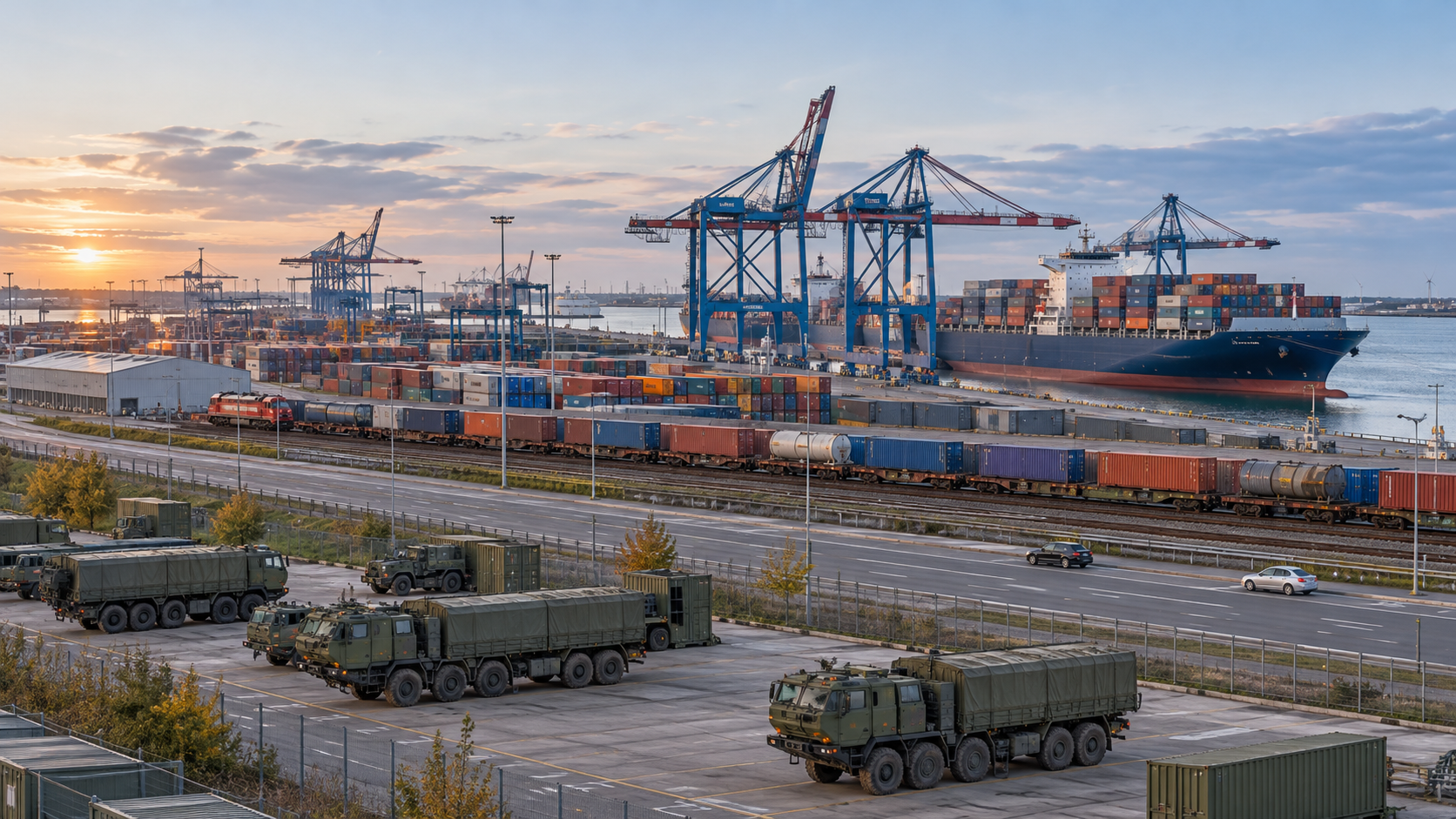
1.3 billion euros for Bremerhaven: Europe's defense begins at the quayside – Why Bremerhaven is being expanded – Creative image on the topic, with AI: Xpert.Digital
Bremerhaven is becoming a strategic hub: What the port expansion means for Germany's economy
Heavy-load bridges, railway tracks and quay facilities: What is set to change in Bremerhaven by 2031
Port under heavy load: Can Bremerhaven handle trade and military transports simultaneously?
Bremerhaven is to become a more efficient hub for trade and defense by the end of 2031. The Deployment Hub Bremerhaven 2031 (DHB31) project comprises 42 infrastructure measures with a planned total volume of up to €1.3 billion. Plans include modernized quays, additional heavy-load areas, improved rail connections, and more efficient roads. The investments are intended to enable the handling of even particularly heavy and bulky transports – without disrupting ongoing port operations.
However, a larger cargo volume alone does not make a strategically strong port. The crucial factor is whether the entire transport chain functions effectively: from ships to port areas, and on to roads and railways. At the same time, it must be determined how civilian and military usage requirements can be reconciled and whether the new facilities will deliver lasting economic benefits in everyday use.
The expansion offers Bremerhaven the opportunity to strategically strengthen existing infrastructure and develop additional capabilities. However, a guaranteed economic gain is not guaranteed. Whether the investment will be sustainable in the long term depends on whether it eliminates actual bottlenecks, whether construction and port operations are effectively coordinated, and whether the additional capacity is reliably available. Therefore, the measure of success is not solely the total investment, but rather whether the individual measures combine to create a robust overall system.
What the multi-billion euro port expansion means for Germany's economy
The economic and security-related importance of a port is not solely measured by the number of containers its terminals handle. Crucially, it must also remain efficient under exceptional circumstances: during periods of sharply increasing transport volumes, disruptions to transport links, or when civilian supply chains and military transports simultaneously rely on the same land, rail, and road infrastructure. Bremerhaven aims to significantly expand this capability by the end of 2031. The Deployment Hub Bremerhaven 2031 project, or DHB31 for short, comprises 42 infrastructure measures with a planned total volume of up to €1.3 billion. This raises a fundamental question: How can defense capabilities be organized in such a way that the civilian economy simultaneously becomes more efficient in the long term?
The project is therefore more than just the expansion of a transshipment facility suitable for military use. It changes the requirements for an existing universal and container port whose economic value is based on international trade relations, industrial supply chains, and efficient hinterland connections. Modernized quays, additional heavy-load areas, adapted port basins, improved rail connections, and more robust road structures are intended to create an infrastructure that functions effectively in normal business operations and can assume additional tasks in the event of increased military needs.
Economically, this presents a significant opportunity, but not an automatic increase in prosperity. Whether the investment volume actually translates into a sustainable locational advantage depends on the selection of measures, their technical coordination, the subsequent operating costs, and how competing usage demands are managed. A particularly challenging aspect is that the expansion is to take place while the port remains fully operational. The infrastructure must therefore be improved without significantly weakening its current economic function.
The crucial perspective, therefore, is this: Bremerhaven will not become strategically more important solely through additional construction. The location will only gain value when individual investments combine to create a robust overall logistics system.
A trading location acquires an additional strategic function
Bremerhaven's importance stems from its access to the North Sea, its existing transshipment facilities, and its transport routes to the German and European hinterland. Due to its geographical location, Germany plays a central role in national and alliance defense, particularly in the reception, processing, and onward transport of its own and allied forces. The German Operations Plan also outlines the interaction of military and civilian services in this context. Within this framework, Bremerhaven is a crucial maritime access point for personnel and materiel.
The economic advantage of such a location lies in the fact that not all capabilities need to be developed from scratch. An existing port already possesses nautical expertise, terminal operations, handling technology, transport connections, and specialized service providers. By strategically expanding these structures, additional capabilities can be created that would require considerable effort to develop at a completely new location.
However, existing port expertise should not be equated with unrestricted military suitability. A port may be highly efficient in international container traffic and yet still reach its limits with particularly heavy vehicles, unusual cargo dimensions, or short-term, concentrated transport movements. Military usability therefore requires a different assessment than the usual evaluation of commercial handling capacity.
This also shifts the concept of efficiency. In civilian competition, high utilization, short turnaround times, and low costs per transport unit are often paramount. From a defense policy perspective, additionally available reserves, alternative options, and the ability to move significant quantities within a short time are important.
These objectives can complement each other, but are also sometimes in tension with one another. A fully utilized facility may be profitable under normal market conditions, but offers little leeway for unexpected additional demand. A strategically robust facility, on the other hand, requires capacity whose benefits are not immediately apparent in daily throughput figures.
The billion-dollar investment must be measured by its impact
Up to €1.3 billion for 42 projects characterizes a comprehensive infrastructure program. However, this sum does not represent fully spent funds or a guaranteed economic return. It primarily defines the financial framework of the project. Similarly, the end of 2031 is a planned completion date and not a guarantee that technical, construction, and operational risks have been eliminated.
For a sound economic assessment, several levels of impact must be distinguished. First, construction work generates demand for planning, engineering expertise, building materials, machinery, and labor. Subsequently, modernized facilities can improve the port's efficiency. Furthermore, there is the security policy benefit of increased cargo handling and deployment capacity.
These effects cannot simply be added together. A construction company certainly generates revenue when it builds a bridge. However, this does not automatically mean that the overall economic benefit of the bridge outweighs its costs. Crucially, this depends on which bottlenecks are eliminated, how frequently the infrastructure is used, and what economic damage it prevents during normal operation or in a crisis.
Without detailed project and regional data, it's impossible to give a reliable, fixed figure for employment effects. Some of the expenditure may have a regional impact, while other parts flow to supra-regional specialist companies or into imported intermediate goods. Furthermore, already fully utilized construction capacities could lead to additional demand driving up prices rather than generating additional real output.
The economic benchmark should therefore not be how large the investment program appears. What is more important is whether the individual measures together generate greater societal benefit than alternative uses of the same financial and human resources.
Why civilian port operations remain the actual starting point
The additional military function coincides with a significant and by no means stagnant economic hub. In the first half of 2026, the total seaborne cargo handled by the ports of Bremen reached 34.5 million tons, 5.9 percent higher than in the same period of the previous year. Container throughput rose to approximately 2.6 million TEU, an increase of 5.7 percent. TEU refers to the standardized unit of measurement for a 20-foot container and is not the same as the number of containers actually moved. Bremerhaven accounted for approximately 29.2 million tons of seaborne cargo in the same half-year, 5.3 percent more than a year earlier.
These figures are important because they illustrate the economic context of the expansion. The military use is not being established on largely unused land, but rather integrated into a complex, existing production and service system.
The most recent available monthly data also show increasing demand. Up to and including August 2026, approximately 3.46 million TEU were reported for the ports of Bremen. This represents an increase of 6.4 percent compared to the same period of the previous year. Bremerhaven achieved a seaborne cargo throughput of around 39 million tons during these eight months, 5.1 percent more than in the corresponding period of 2025. These are preliminary figures for the interim year, not a final annual result.
No reliable long-term growth forecast can be derived from this. However, the data shows that construction sites and additional usage requirements are impacting a location with significant economic activity. Therefore, every blocked transport link and every temporarily unavailable transshipment area can have immediate operational consequences.
Civilian competitiveness is therefore not a secondary condition of the project. It is an essential basis for ensuring that the shared infrastructure can be operated economically and maintained at a high technical level in the long term.
Heavy-duty capability changes the entire transport chain
A key component of the project is adapting the infrastructure to heavier vehicles and more demanding loads. Plans include new heavy-load areas, additional container storage spaces, a new heavy-load bridge, and the upgrading of existing transport links. The requirements therefore extend significantly beyond simply adding more parking spaces.
When handling heavy loads, it's not just the total weight that matters. Crucial factors also include how that weight is distributed, the axle loads, the forces generated during braking and maneuvering, and where loads are transferred into the ground. Therefore, an area adequately sized for typical port uses is not necessarily suitable for every class of military vehicle.
This technical question becomes economically relevant due to the principle of the weakest link. A highly resilient transshipment area offers only limited benefit if the adjacent bridge lacks sufficient load-bearing capacity. Conversely, a strengthened bridge does not eliminate a bottleneck if access roads, curve radii, or connecting surfaces impede transport.
Heavy-load capacity must therefore be planned throughout the entire process: from the ship via ramp or crane, through intermediate storage and inspection areas, to the subsequent road or rail transport. Only this continuity transforms individual load-bearing structures into a usable transport chain.
This could create additional opportunities for the civilian economy, for example in the handling of heavy machinery, large industrial components, or other project cargo. However, such added value is not automatically guaranteed. It requires that the relevant areas and facilities are actually available for civilian use, that suitable handling technology is available, and that there is corresponding demand.
Larger ships trigger a spatial chain problem
The planned measures include the renovation and modernization of the container quay wall, adjustments in the Kaiserhafen (Emperor's Harbor), and the expansion of the connecting canal, including the associated bridge. The reasons for these measures include the need for larger ships to be used for transport tasks, which require correspondingly adapted access and berths.
This reflects a typical problem in port economics: larger transport units can offer economic advantages on individual routes, but create more concentrated demands at the hubs. When more cargo arrives with a single ship call, it must be unloaded, sorted, temporarily stored, and transported onward within a limited timeframe.
A high-capacity berth alone is therefore not enough. If there is a lack of available space or suitable onward transport capacity, the bottleneck shifts from the water to land. This can result in longer waiting times, blocked transport routes, and higher costs for the entire transport chain.
In military transport, cargo is not arbitrarily interchangeable. Vehicles, equipment, and other materials may need to be forwarded in a specific sequence or according to a schedule. Therefore, from an economic perspective, it's not just the total tonnage moved that matters, but also the ability to provide the right units at the right time.
For investment planning, this means that nautical accessibility, berth capacity, site organization, and hinterland transport must be treated as a cohesive task. Otherwise, a lot of money will be spent without a corresponding increase in the overall available capacity.
The scope of the port expansion will be determined by the railway
The expansion of the railway facilities in Speckenbüttel is one of the explicitly mentioned components of DHB31. Regardless, the existing expansion plans further specify the importance of this area: An expansion of the staging tracks at the port railway station from 16 to 23 has been announced, along with an electronic interlocking system and integration into the Prinos digital port railway operating system. This information describes the announced development of the port railway infrastructure and should not simply be considered as entirely additional measures to the rest of the program.
Marshalling tracks serve an important buffering and organizational function. Here, wagons can be positioned, train movements prepared, and timing coordinated with terminal processes. Without such facilities, even minor delays can disrupt large parts of operations.
Rail transport is not merely an environmentally friendly addition. For large quantities and heavy vehicles, it is an essential component of logistical capacity. At the same time, its usefulness depends on whether suitable routes, appropriate vehicles, and functioning connections are available beyond the port area.
A study on container hinterland transport for 2024 highlights the strong position of rail in Bremerhaven, indicating a share of over 50 percent. This share refers to the hinterland transport examined and not to all containers handled in the port, which also includes quantities transported onward by sea.
This distinction is economically significant. Only by clearly separating modes of transport and reference values can we identify where additional capacity is needed. An increase in total throughput does not necessarily lead to a proportional increase in road or rail traffic in the hinterland. The crucial factor is which transport chains actually grow.
Hub for Security and Defense - Advice and Information


Hub for Security and Defense - Image: Xpert.Digital
The Security and Defence Hub offers expert advice and up-to-date information to effectively support companies and organizations in strengthening their role in European security and defence policy. Working closely with the SME Connect Defence Working Group, it particularly promotes small and medium-sized enterprises (SMEs) that wish to further develop their innovative capacity and competitiveness in the defence sector. As a central point of contact, the Hub thus creates a crucial bridge between SMEs and European defence strategy.
Related to this:
The new road infrastructure must do more than just provide military transit
The new road infrastructure must do more than just provide military transit
The planned heavy-load bridge and the proposed bypass are intended to facilitate the onward transport of vehicles and goods. Once completed, the bypass will also be open to civilian use, relieving pressure on the existing road network. Additionally, existing bridges in the hinterland will be reinforced to accommodate heavy Bundeswehr vehicles.
The potential economic benefits therefore extend beyond mere savings in transport time. By diverting heavy traffic out of unsuitable town centers, conflicts with residents, local businesses, and other road users can be reduced. At the same time, more reliable travel times can improve the planning of port and industrial operations.
However, a new connection is not automatically more economically advantageous simply because it is technically more efficient. Land use, construction and maintenance costs, noise pollution, and the impact on neighboring transport routes must also be considered.
A key point of consideration is the coordination between road and rail. The two modes of transport must not be pitted against each other. Roads offer flexible connections and can be indispensable where rail connections are lacking. Rail, on the other hand, can consolidate large transport volumes and relieve congestion on road sections.
A robust system therefore does not require a blanket preference for one mode of transport, but rather a sensible distribution of tasks. In the event of a crisis, it is also crucial whether a technically and organizationally viable alternative exists if one connection fails.
Dual use creates opportunities, but not free additional capacity
The project's guiding economic principle is the shared civilian and military use of infrastructure. Quays, transport routes, and land should not be used exclusively for a single purpose. This allows for the potential pooling of investments and better utilization of existing structures.
The appeal of this approach is obvious. If a modernization that is necessary anyway simultaneously creates greater resilience and additional usage possibilities, costs can be avoided compared to separate systems. Furthermore, the infrastructure remains in regular use through ongoing civilian operations.
However, dual use is not synonymous with conflict-free dual use. An area cannot simultaneously serve without restriction as a container storage area, construction site facilities, and staging area for additional vehicles. Berths, access roads, and maneuvering capacities are also limited at any given time.
Therefore, a clear consideration of availability is essential for the economic evaluation. Who is authorized to use which facility and when? What lead times are required? How are restrictions on civilian operation limited? And how is it ensured that commercial users do not base investment decisions on capacities that are unavailable to them in certain situations?
Such questions are not mere organizational details. They determine the actual quality of the location. Reliable usage rules can be more valuable to companies than a nominally high capacity whose availability remains unclear.
The added value of shared infrastructure therefore arises from technical suitability and predictable operating conditions. Without both, dual use may be implemented in terms of construction, but will fall short of its economic potential.
Building while operations continue is a productivity test in itself
The construction work will be carried out partly in parallel while regular port operations continue. Initially, work will focus on the port itself; this will be followed by work on the airport and hinterland connections. The aim is to be able to handle additional military transport tasks alongside normal port operations.
This approach is necessary, but demanding. A port functions as a tightly coupled system. If access is restricted, this may affect not only individual trucks, but also shift schedules, warehouse capacity, handling times, and coordination with rail and shipping.
The economic costs of a construction site therefore consist not only of the invoices from the contractors. Additional costs can include detours, waiting times, extra personnel, and less efficient use of existing facilities. Such indirect costs must be reflected in the construction schedule.
The sequence of measures is particularly important. A new area may be needed as an interim solution before an existing area is closed. An alternative access route may need to be operational before work can begin on the main connection. Therefore, the success of individual construction phases depends on other phases.
Parallel implementation only accelerates the overall program if it does not lead to a simultaneous overload of critical areas. Time savings come from good coordination, not from having as many construction sites as possible at the same time.
For civilian customers, reliability is paramount. Early notification of restrictions makes it easier to plan for them than last-minute changes. Effective communication thus becomes a direct productivity driver.
The airport expands the system but does not replace maritime capacity
The inclusion of Bremen Airport demonstrates that the project extends beyond the actual port area. The plans consider measures within the port, at the airport, and in the hinterland. However, no specific additional air freight volumes or already determined new handling capacities can be derived from this.
From an economic perspective, combining different modes of transport is generally beneficial if it leverages their respective strengths. Sea transport is suitable for large and heavy loads. Air transport can offer advantages for certain time-critical shipments. Rail and road handle the spatial distribution in the hinterland.
The crucial point is not that the same load could be transported arbitrarily between all modes of transport. Rather, different parts of a total logistical requirement can be handled via different routes. This allows for better coordination of processes.
Additional modes of transport, however, also increase coordination requirements. Arrival times, onward transport, staff availability, and access requirements must all align. Without this coordination, the result is merely a coexistence of efficient, isolated locations.
For a sound assessment, therefore, restraint is necessary regarding further expectations. The inclusion of the airport indicates a more comprehensive logistical approach. It is not yet proof of a quantifiable additional economic benefit.
New markets and higher demands are emerging for companies
The investment program can stimulate demand in several sectors, including hydraulic engineering, civil engineering, bridge construction, railway construction, technical equipment, engineering services, and digital operational support. Later, during operation, additional opportunities may arise for logistics providers, maintenance companies, and specialized heavy haulage companies.
However, the regional economic impact depends on the services that local companies can actually provide. A high project value does not automatically translate into a correspondingly high level of regional added value. Specialized technology, specific building materials, or particular engineering services can be sourced from elsewhere.
Of particular long-term value are skills that remain economically viable after the construction phase is complete. These include experience in handling heavy and unusually sized goods, coordinating complex transport chains, and maintaining demanding infrastructure.
Logistics companies are also facing increasing demands. Additional tasks may require special security procedures, robust personnel planning, and more precise documentation. Whether such investments pay off depends on actual usage and the predictability of demand.
It would therefore be an oversimplification to view the project merely as an additional sales market. For many companies, it is also an adaptation process. They must examine which of their existing skills are transferable and where additional qualifications, technology, or operational resources are needed.
The location benefits most in the long term when temporary project demand leads to permanently applicable knowledge and competitive services.
The real return lies partly in the avoided damage
Traditional infrastructure calculations often focus on saved transport time, lower operating costs, and increased volumes. For strategically important infrastructure, this perspective is insufficient. Part of the benefit comes from making severe disruptions less likely or more manageable.
This benefit is similar to insurance. Additional load-bearing capacity, alternative transport routes, and readily available space can only be used to a limited extent over a longer period. In exceptional cases, however, their availability can be crucial.
This does not mean that every reserve is economically justified. Security capacities also incur construction, operating, and opportunity costs. Areas kept free of reserve capacity are only available for other uses to a limited extent. Additional facilities must be assessed and maintained.
A proper assessment should therefore examine normal operating conditions and exceptional load situations separately. Under normal operating conditions, the focus is on the resulting productivity gains. Under load, the focus is on the additional quantities that can actually be moved and how well the system remains functional in the event of failures.
The perspectives complement each other. An infrastructure optimized solely for everyday use may be undersized. Conversely, an infrastructure designed solely for rare extreme situations can become unnecessarily expensive.
The art of economics lies in building up reserves where their added value is greatest. This requires identifying critical bottlenecks, rather than simply expanding all facilities to their maximum capacity.
Digitalization must secure processes, not just collect data
The full potential of a port's infrastructure can only be realized if information is available in a timely manner. A port needs coordinated data on which cargoes are arriving, which areas are available, when trains will be ready, and which transport routes can be used.
This importance increases in civil-military cooperation. Not all parties involved need the same information, and not all data should be shared without restriction. The challenge lies in enabling operational coordination while simultaneously providing adequate protection for sensitive information.
Digital systems can help identify bottlenecks earlier and plan processes more effectively. However, they do not replace missing tracks or insufficient load-bearing capacity. Their economic value lies in making existing physical capacities more reliably usable.
Equally important is the resilience of the digital processes themselves. If a failure of central IT applications paralyzes the entire operation, a new vulnerability arises, even with modern infrastructure. Therefore, a robust system also requires well-established backup procedures and clearly defined responsibilities.
The announced deployment of an electronic interlocking system in conjunction with the Prinos port railway operating system illustrates how closely physical development and operational control are already linked. Crucially, such components must not function in isolation, but rather be integrated into the existing port processes.
Environmental and local residents' interests must be included in the economic calculations
Strategic port expansion requires land, alters traffic flows, and causes additional burdens during the construction phase. These impacts are economically significant, even if they are not fully reflected in the immediate project costs.
A bypass can relieve existing roads, but at the same time create burdens elsewhere. Additional rail capacity can reduce road transport, while rail operations themselves generate noise. Heavy-duty areas create new land-use opportunities, but may also seal off additional land.
A nuanced assessment must weigh such effects against each other. Blanket statements that the expansion is either fundamentally environmentally damaging or already fully justified by its strategic importance are insufficient.
In the long term, it is also important to consider the conditions the facilities must withstand during their service life. For port infrastructure, this includes in particular water-related stresses, drainage, and the functionality of energy and transport connections.
From an economic perspective, it can be advantageous to consider such requirements during new construction or major modernization projects. Retrofitting later can be more complex and disrupt operations again.
Societal acceptance is not achieved solely through references to national importance. It becomes more likely when local burdens are demonstrably limited and civic improvements actually impact everyday life.
Until 2031, operational capability will be what counts, not just construction progress
The planned completion by the end of 2031 provides a common timeframe. The German Armed Forces (Bundeswehr), specifically the Federal Office for Infrastructure, Environmental Protection and Services of the Bundeswehr (BAIUDBw), the Free Hanseatic City of Bremen, and bremenports are all involved in the project. Representatives from these institutions include BAIUDBw President Roland Börger, Head of the Senate Chancellery Thomas Ehmke, and bremenports Managing Director Robert Howe. Implementation therefore requires a close integration of military requirements, public infrastructure responsibilities, and practical port expertise.
However, a common end date is not enough for economic success. Crucial are comprehensible intermediate goals and the question of when additional capabilities will actually become available.
A completed bridge can already be beneficial before the entire program is finished. Conversely, a completed transshipment area may only be of limited use if the necessary access road or technical equipment is lacking. Therefore, progress should not be judged solely on the basis of invested resources or completed individual measures.
More meaningful are operational criteria: What vehicle weights can be transported continuously? What additional space is available? How quickly can cargo be transferred between ship, storage, and onward transport? What restrictions arise for civilian operation?
Not all answers can be publicly disclosed in detail for security reasons. Nevertheless, a distinction can be made between the legitimate protection of operational information and transparent economic accountability.
A project of this scale requires both: confidentiality regarding sensitive skills and transparency about whether public funds will lead to the intended functional improvements.
Bremerhaven's strength stems from a resilient overall network
The expansion can strengthen Bremerhaven's position within German and European logistics. However, it will only reach its full potential in conjunction with other locations and transport routes.
A port with a larger cargo capacity does not automatically increase overall performance if the downstream shipping lanes remain congested. Similarly, a strong concentration on a few facilities can create new dependencies. Strategic performance therefore requires not only high-capacity hubs but also alternative routes and sufficiently robust connections.
From an economic perspective, this is an important distinction between a location-based and a network-based approach. Additional demand can be attractive for an individual port. For the overall system, however, it is crucial whether this demand can be reliably distributed and transmitted.
Bremerhaven should therefore not be judged solely on additional tonnage or container movements. More important is whether the location becomes more reliable, can handle heavier loads, and remains operational even under exceptional strain.
This project thus represents a broader shift in infrastructure policy. Port facilities, bridges, and railway lines are not merely tools for trade. They also determine the actual economic and governmental options available.
The well-founded economic outlook is therefore generally positive, but subject to clear conditions: The expansion is particularly valuable if it eliminates demonstrable bottlenecks, strengthens civilian operations, and creates additional strategic capabilities without unnecessary parallel structures. Its success will not be determined by the size of the announced sum, but by whether the 42 measures result in a continuous, reliable, and financially sustainable transport capability in the long term.
Consulting - Planning - Implementation

Markus Becker
I would be happy to serve as your personal advisor.
Head of Business Development
Chairman SME Connect Defense Working Group
Consulting - Planning - Implementation
Konrad Wolfenstein
I would be happy to serve as your personal advisor.
You can contact me at wolfenstein∂xpert.digital or
Just call me on +49 7348 4088 965 .