
Counting leads measures activity – identifying sales opportunities generates revenue before the competition even calls – creative image on the topic, using AI: Xpert.Digital
Optimizing B2B sales: Why quality is more important than quantity
The difference between leads and sales opportunities in B2B business
Successful B2B strategies: Recognizing the value of sales opportunities
In today's B2B sales landscape, it's essential to distinguish between the terms "lead" and "sales opportunity." While a lead is simply an indication of a potential contact, a sales opportunity is a concrete, well-founded business opportunity. This encompasses not only identifying a need but also analyzing relevant contacts, project triggers, and a realistic path to establishing contact. In a market characterized by complex products and long sales cycles, the quality of these business opportunities is crucial for business success. Companies that can accurately identify and pursue sales opportunities can recognize revenue potential before their competitors react. Transforming vague contact signals into tangible business opportunities is the key to an effective sales strategy. In this article, we will examine the differences between leads and sales opportunities in detail and demonstrate how companies can gain significant competitive advantages by focusing on the quality of their sales opportunities.
How a precise sales opportunity revolutionizes the sales process
Sales Opportunity instead of Lead: Why B2B sales need concrete projects instead of digital contacts
In B2B sales, the terms lead, qualified lead, prospect, and sales opportunity are often used as if they simply described different stages of the same linear process. This view is convenient, but economically inadequate. A lead is initially just an indication of a potentially relevant person or organization. A sales opportunity, on the other hand, describes a concrete, well-founded business opportunity that combines a need, a project impetus, suitable contacts, demonstrable partner relevance, and a realistic path to establishing contact. The difference, therefore, lies not only in the quantity of data, but in the quality of the economic message.
Especially in B2B business, with products requiring explanation, high order values, multiple decision-makers, and long investment cycles, this distinction is crucial. A download, a webinar registration, or a visit to a product page can indicate interest, but says little about whether a company will actually invest, which department is affected, who makes the decisions, what the technical requirements are, and when a supplier can meaningfully enter the process. A well-founded sales opportunity reduces precisely this uncertainty. It transforms a vague contact signal into a structured hypothesis about a real business opportunity.
The strategic value of a sales opportunity arises from the combination of market observation, project knowledge, company analysis, contact intelligence, and sales expertise. It is therefore neither merely a more enriched lead nor a finished order. It is a solid basis for deciding whether, why, when, and with what offer a sales representative should become active. For companies that sell capital goods, automation technology, industrial software, consulting services, energy systems, logistics systems, or other complex B2B solutions, this form of pre-qualification is often significantly more valuable than a large number of digitally generated contacts.
The confusion of terms in sales
The term "lead" became popular in marketing because it refers to an early, still open point of contact. A lead can be a person who has filled out a form, a business card from a trade fair, a company on a target list, or a record from an external database. The only thing these cases have in common is that a potential business relationship seems conceivable. Whether there is actually a need, budget, decision-making authority, or a realistic timeframe remains unclear at this stage.
A Marketing Qualified Lead (MQL) additionally fulfills certain marketing criteria. These can include industry, company size, contact's job title, repeated website visits, downloaded content, or event attendance. An MQL signals a higher degree of fit or activity than an unqualified lead. However, it often remains a marketing assessment. A genuine purchase intention or a concrete investment project does not necessarily follow from it.
A Sales Qualified Lead (SQL) has been reviewed by sales and deemed worthy of follow-up. In a well-defined process, a sales representative has confirmed at least some indications of need, responsibility, budget feasibility, and timeliness. An SQL is therefore closer to the business than an MQL. Nevertheless, it can still primarily represent a qualified individual or organization without a clearly defined project with solid revenue potential.
The term "prospect" is used inconsistently. Often it refers to a lead who matches the target customer profile and can therefore be actively contacted. In other companies, a prospect is already a contacted interested party. This ambiguity highlights a fundamental problem: sales terms only have operational value if the company defines transparent entry and exit criteria for each stage. Without such rules, leads are upgraded to opportunities simply because someone replied to an email, or genuine projects remain in the CRM as mere contacts.
In a narrower sense, a sales opportunity no longer refers primarily to a person, but rather to a potential transaction or a concrete business plan. It is associated with a company, a need, a solution category, an expected order value, a project phase, and a group of stakeholders. In traditional CRM systems, an opportunity is often translated into a deal with a sales phase, probability of closing, expected revenue, and planned closing date. However, for project-oriented B2B business, the term should be defined more broadly: A sales opportunity can exist even before a formal tender, budget approval, or direct customer inquiry, provided the economic trigger has been reliably identified.
In addition, other categories exist. A Product Qualified Lead (PQL) typically arises when a user actively uses a product or trial version, thereby demonstrating concrete interest. A Service Qualified Lead (SQL) signals a desire for consultation or a higher-value service. An Account Qualified Lead (AQL) or Account Qualified Opportunity (AQOP) focuses not on an individual contact, but on a strategically suitable target company. Intent Qualified Leads (IQLs) are based on observed research or behavioral signals. Trigger-based Opportunities arise from events such as investments, plant expansions, new locations, mergers, regulatory changes, staff increases, or technological modernization. For industrial B2B sales, these event-based opportunities are particularly important because they indicate real pressure for change within the company.
Why the lead is still needed
The lead is not useless. It fulfills an important function as a low-threshold entry point into the sales and marketing process. Companies need a category for contacts whose value is not yet determined. Without this preliminary stage, unknown, early, or weak signals would either be lost or prematurely interpreted as business opportunities. The lead creates an organizational buffer between awareness and active sales efforts.
In digital marketing, this category is indispensable because large volumes of heterogeneous signals need to be processed. Not every newsletter subscriber, white paper reader, or trade fair visitor warrants a personal call from an experienced sales representative. Leads can be automatically captured, segmented, enriched, and further developed through content. In this way, marketing takes on the task of filtering out, from a broad target group, those contacts for whom more intensive follow-up seems worthwhile.
Leads only become problematic when their mere existence is considered a success. A high number of leads can document activity, but it proves neither market demand nor future revenue. If compensation, campaign evaluation, or management reports are too heavily based on the number of leads generated, a perverse incentive for quantity is created. This leads to a decrease in the requirements for data quality and relevance, while sales has to spend more and more time evaluating weak leads.
The lead should therefore be understood as a raw material, not a finished product. Its value only arises through classification. A good lead process answers, step by step, whether a contact fits the target customer profile, whether there is a plausible need, whether the company can actually invest, whether a relevant role has been reached, and whether there is a concrete reason for a conversation. A sales opportunity begins where this classification no longer just evaluates a person, but describes a potential business deal.
From digital signal to real-world need
An online lead typically originates from a measurable digital action. This could be a download, a search query, a click on an ad, a completed contact form, or registration for a webinar. Such signals are attractive because they can be automatically captured, quickly analyzed, and attributed to larger campaigns. They are well-suited for measuring reach and engagement. However, their economic significance remains limited without context and project relevance.
A download might originate from a student, competitor, consultant, or technically interested employee who has neither budget nor decision-making influence. An individual might consume content out of general interest, even if the company isn't currently planning any procurement. Conversely, highly relevant industry projects can emerge without a decision-maker ever filling out a form on a potential supplier's website. Therefore, those who rely solely on incoming online leads only see a fraction of the addressable market.
A sales opportunity doesn't necessarily require a digital signal of consent from the target customer. Its starting point can be a publicly announced investment, an approved plant expansion, a new production line, increased capacity, regulatory pressure to adapt, or a strategic shift in the supply chain. Such events create an objectively verifiable need, even if the specific procurement process isn't yet apparent. Sales then doesn't react to an inquiry, but rather works proactively based on a well-founded project hypothesis.
This is precisely where a crucial difference in value lies. An online lead demonstrates that someone has taken action. A sales opportunity explains why a company likely needs to act. The first signal is behavioral, the second is contextualized economically and organizationally. In complex B2B sales, a company's perceived need for action is often more meaningful than the click activity of an individual.
The economic superiority of opportunity
The value of a sales opportunity cannot be meaningfully assessed solely based on the price of a data record. The decisive factor is the expected economic contribution after considering the probability of closing the deal, the potential order value, processing costs, and the time to close. A cheap lead can become expensive if several employees invest hours in research, validation, and unsuccessful contact attempts. Conversely, a meticulously researched opportunity can be economically attractive if it reveals a major project early on and connects the sales team directly with the relevant decision-makers.
In simplified terms, the expected value of an opportunity can be derived from the potential contribution margin, the realistic probability of profit, and the costs of handling it. The probability of closing the deal should not be understood as a subjective gut feeling. It should be based on observable criteria: project status, strategic fit, urgency, competitive situation, access to the buying center, technical suitability, budget plausibility, and the ability to influence the specifications.
In industrial project business, a single suitable opportunity can outweigh the economic value of hundreds of weak leads. This is especially true when a supplier not only sells a standard product but also combines engineering, integration, software, service, and long-term maintenance. The potential customer value then encompasses not only the initial order but also expansions, spare parts, upgrades, follow-up projects, and referrals. A precise opportunity thus opens a strategic account, whereas a digital lead often represents only a single, isolated contact.
Time also has economic value. Those who only recognize an investment project when a formal inquiry is sent will encounter defined specifications and an established supplier list. Those who identify the need during the planning phase can explain technical options, help shape requirements, address customer risks, and build trust. A sales opportunity is therefore all the more valuable the better it identifies the right time for market entry.
The economic reason behind the deal
The core of a high-quality sales opportunity is a precise project description. It shouldn't simply state that a company is growing or investing. Information is needed about the project sponsor, location, objectives, scale, investment volume, timeline, project status, technical focus, and identifiable demand indicators. Only these elements transform a general company announcement into a sales opportunity.
A prime example is the planned expansion of a Pirelli tire plant in Rome, Georgia. The project entails an investment of approximately one billion euros, or about 1.2 billion US dollars. Production capacity is slated to increase from roughly 400,000 to around six million passenger car tires per year by 2033. The expansion will begin in 2027, with the first robotic phase gradually building capacity from 2028 onwards, eventually reaching approximately three million tires annually. A second, fully automated conventional production line will contribute an additional three million tires.
These figures describe not just growth, but a profound industrial transformation. The plant is to become a highly automated production site for premium, high-performance, and connected tires. The latest generation of the Modular Integrated Robotized System combines flexible, autonomous robotics with digitized production processes. In addition, the production of the Cyber Tyre is planned, in which sensors, software, and vehicle communication transform the tire into a data-providing system component. This will change not only the quantity of tires produced, but also the technological complexity of production, quality assurance, material flow, and data integration.
The planned scale of the expansion is a strong indicator of demand. A fifteenfold increase in annual capacity requires additional space, machinery, material supply, storage capacity, conveyor technology, IT connectivity, energy supply, staff training, and maintenance. Around 1,000 new jobs are expected to be created, while the current site already houses production, innovation, and North American corporate functions. Staffing levels are expected to increase significantly starting in 2029, with full operation planned for 2033.
The project is based on a local-for-local strategy. Pirelli aims to manufacture technologically advanced products closer to the US market, shorten delivery times, and reduce its dependence on international supply chains. The US market represents a significant share of the global volume in the high-margin, high-value segment. At the same time, geopolitical tensions, technological requirements, and regulatory issues influence the location decision. The investment is therefore not just a capacity expansion, but a response to changing risks and market conditions.
For a provider of industrial solutions, the sales opportunity isn't automatically the total investment sum. It arises from the individual needs that align with their own services. For an intralogistics specialist, this might include automated storage and material flow systems, stacker cranes, conveyor technology, heavy lifting equipment, control systems, energy optimization, and integration with production facilities. For other partners, the focus might be on energy supply, building technology, industrial IT, sensors, cybersecurity, quality assurance, recycling, recruitment, or training. A professional opportunity analysis therefore breaks down the large-scale project into realistically addressable service packages.
From organizational chart to buying center
Contact information is a necessary component of a sales opportunity, but a mere list of names, email addresses, and phone numbers does not constitute contact intelligence. In B2B, decisions are rarely made by a single individual. A complex investment project is driven by a buying center in which technical users, plant management, engineering, maintenance, purchasing, supply chain, IT, finance, sustainability, and corporate management all play distinct roles.
The task is to map these roles to the specific project. In a highly automated plant expansion, the Head of Engineering and Maintenance is likely relevant for technical feasibility, integration, and plant availability. A Technology Manager assesses the degree of automation, digitalization, and long-term architecture. The Supply Chain Manager considers throughput, inventory, resilience, and logistics costs. Purchasing and Supplier Management review commercial terms, approvals, quality, and contractual risks. The Executive Management decides on strategic priorities and capital commitment.
External stakeholders also play a role. Regional economic development agencies may possess information about the timeline, site development, and project partners. Authorities and planning bodies are relevant when construction, land use, infrastructure, or permits affect project progress. Energy suppliers, training programs, and local development agencies can also provide insights into emerging needs. These entities are not necessarily purchasers of the project's solution, but they can validate the project context and facilitate access to an industrial ecosystem.
The quality of an opportunity increases when contacts are prioritized according to role and importance. An operational project manager is often better suited for initial contact than a board member because they understand the specific needs and can respond professionally. A high-level decision-maker, on the other hand, can be important as a sponsor or escalation contact. Procurement is rarely the ideal first point of contact for a still-unspecified technical solution, but becomes indispensable at the latest during supplier registration and the quotation process.
Contact details must also be verified and continuously updated. Changes in roles, incorrect responsibilities, outdated email addresses, and unclear naming conventions not only create extra work but can also damage the sender's credibility. Especially with AI-supported research, it's crucial to distinguish between raw data found and confirmed business contacts. A high-quality opportunity indicates its verification status, documents the source internally, and recommends revalidation via official company channels, professional networks, or the switchboard before contacting the potential partner.
🎯🎯🎯 Data-driven B2B industry hub as a quasi-in-house solution


The quasi-in-house solution: How Xpert.Digital closes operational gaps in B2B marketing and sales – Smart Content-Driven Business - Image: Xpert.Digital
Xpert.Digital is a data-driven B2B industry hub led by Konrad Wolfenstein . The company acts as an external, quasi-in-house solution for industrial partners, closing operational gaps in marketing, content, and sales – without requiring additional resources on the client side.
More information here:
The impact of data quality on sales opportunities in B2B sales
Where your own offering creates real project value
Partner relevance analysis answers the most important question from a sales perspective: Why should this particular target company talk to this supplier right now? A general product description is not enough. The analysis must connect the observed project requirements with the specific capabilities, references, and economic advantages of the company itself.
For a provider of automated intralogistics systems, the Pirelli project is relevant because the massive capacity expansion requires a scalable and reliable material flow. Raw materials, semi-finished products, tire components, molds, auxiliary materials, finished goods, and scrap must be moved between storage, production, and testing areas. With increasing production volume, not only do the absolute volumes rise, but so do the demands on cycle times, traceability, and system availability. A bottleneck in intralogistics could slow down highly automated production lines and thus reduce the overall return on investment.
Storage and retrieval systems and conveyor technology can be relevant in this environment if they are tailored to the loads, containers, throughput, and spatial constraints of tire production. The crucial factor is not the individual device, but the system integration. Warehouse management, material flow control, production planning, sensors, and plant control systems must work together seamlessly. The more digital the product and the more flexible the production process, the more important transparent inventory levels and precise line supply become.
Energy efficiency is another key area of focus. Automated storage and conveying systems operate for many years and incur significant operating costs over their lifespan. Drive technology with energy recovery, optimized operating profiles, reduced peak loads, and predictive control can therefore make a measurable contribution to cost-effectiveness. A technology like CAPDRIVE should not be presented as an isolated feature, but rather as part of a life cycle cost analysis. Customer benefits arise from lower energy costs, increased system availability, and a better alignment of productivity and sustainability goals.
The relevance analysis must also define its limitations. A plant expansion does not automatically mean that a specific intralogistics system will be put out to tender or that the target customer will seek external partners. Parts of the technology may be standardized internally, already contracted out, or integrated into comprehensive packages from a general contractor. Therefore, the analysis should differentiate between confirmed need, strong indications, and open hypotheses. This objective approach increases credibility and prevents the sales team from treating a suspected opportunity as a confirmed order.
How relevance becomes a reliable first contact
A contact strategy translates research into action. It determines who is contacted first, through which channel, with what value proposition, in what order, and with what goal. Without this translation, even a good opportunity remains an information document. With it, research becomes a manageable sales process.
The initial contact should focus on the specific project and demonstrate that the supplier understands the industrial challenge. A generic company presentation or a lengthy product catalog generates little relevance. A short, concise message that connects the identified need with a viable solution is more effective. In the case of a factory expansion, the hook could be that the planned scaling and robotization place particular demands on material flow, plant availability, and energy efficiency, and that comparable tasks can be solved using modular intralogistics.
The first point of contact should ideally be the person responsible for engineering and maintenance, as this is where technical integration and operational feasibility converge. A technology manager is a sensible second approach if the focus is on digital architecture, automation, or the level of innovation. Supply chain management becomes particularly relevant when inventory, lead times, local supply, and resilience are key considerations. If there is no response, avoid sending out numerous emails indiscriminately. A controlled escalation through appropriately qualified alternative contacts is preferable.
The initial message should not force a full sale. Its goal is to confirm the hypothesis and arrange a technical discussion. Specific questions are suitable for this purpose: Which production and logistics areas will be restructured in the two expansion phases? Which material flows are considered particularly critical? What interfaces exist between MIRS, conventional production, and warehouse technology? What requirements are placed on energy consumption, redundancy, and scalability? Such questions demonstrate competence and allow the contact person to narrow down the requirements.
Following up several business days later is worthwhile if it's concise and respectful. Email, phone, and professional networks can be combined, but shouldn't create an uncoordinated barrage of contact. All steps should be recorded in the CRM to prevent multiple employees from approaching the same organization with conflicting messages. The desired next outcome is a qualifying conversation, not an immediate offer. Only after the need, responsibility, project phase, and next steps have been confirmed should the opportunity move to a more advanced sales stage.
The source material as an early warning and validation system
Comprehensive media and source links are not merely decorative. They form the chain of evidence for an opportunity. Official company announcements provide investment amount, timeline, technology, and strategic objectives. Government and economic development agency communications supplement this with information on jobs, site support, and project phases. Regulatory documents can clarify financing, governance, or permits. Industry media contextualize technical implications, while regional media offer insights into infrastructure, tax incentives, and local implementation.
Sources should be structured according to reliability and function. Primary sources confirm what companies and authorities have actually announced. Independent business media help to assess motives, risks, and potential conflicts. Trade publications translate a project into technical requirements. Local news often identifies earlier than international media when land issues, tax agreements, staffing increases, or construction activities become concrete.
For the Pirelli expansion, combining these perspectives provides a significantly more robust picture than a single press release. The investment level, two-stage capacity expansion, start in 2027, production ramp-up from 2028, staff increase from 2029, and full operation by 2033 can be integrated into a coherent project logic. The combination of MIRS robotics, fully automated conventional production, and cyber-tire technology reveals several areas for technical procurement. The local-for-local strategy explains the economic rationale, while regulatory and geopolitical factors increase the urgency.
Media monitoring should not be equated with unchecked acquisition. Information may differ, be outdated, or be based on the same original report. Investment amounts in euros and US dollars must be clearly distinguished. Planned capacities must not be presented as already realized production. Furthermore, the mention of potential contacts in public sources does not automatically confirm their current responsibility. Therefore, a good approach is to internally document the date, source, inconsistencies, and necessary verification.
The right timing is crucial
A sales opportunity has a life cycle. In the very early stages, the influence on specifications is high, but so is the uncertainty. As the project becomes more concrete, the risk decreases, while supplier lists, technical standards, and budgets become more defined. The optimal entry point often lies between strategic announcement and formal procurement: The project is real enough to justify resources, but open enough to still allow for shaping the solution path.
When expanding a plant from 2027 onwards, early contact is particularly advisable if planning, automation, and infrastructure decisions are made before the actual construction and installation work begins. Suppliers must consider that individual trades have different lead times. Building structure, energy supply, production layout, IT architecture, and material flow all influence each other. A supplier who only appears after the central planning is complete may be technically suitable but still be too late.
At the same time, selling too early is inefficient if a project team doesn't yet exist, responsibilities are unclear, or strategic decisions are pending. Therefore, every opportunity needs observable next steps. These include permits, land acquisitions, construction partners, job postings, supplier registrations, investor information, new project roles, or initial tenders. These signals enable a dynamic reassessment.
The opportunity is therefore not a static report, but a living data set. If the timeline changes, the contact strategy also shifts. If a technology decision is announced, the partner relevance must be adjusted. If a contact person changes, the buying center must be reassessed. The benefit arises not only from the initial research, but from continuous updates until qualification, disqualification, or conversion into an active deal.
A robust evaluation model
To make sales opportunities comparable, companies need a standardized scoring system. This should consider more than just the size of the target company or the investment amount. A billion-dollar project might be less relevant for a specialized provider than a smaller investment with a direct technical fit. The evaluation should focus on project attractiveness, solution fit, accessibility, maturity, competition, and data quality.
Project attractiveness encompasses the addressable order value, growth potential, strategic importance, and possible follow-up business. Solution fit assesses how closely the company's own products, competencies, and references meet the need. Accessibility describes whether relevant contacts have been identified, relationships exist, and realistic access to the buying center is possible. Time maturity indicates whether the project is only being discussed, has already been approved, financed, planned, or implemented.
Negative criteria are also important. These include already contracted general contractors, proprietary corporate standards, missing approvals, unfavorable delivery terms, political risks, or a limited chance of influencing technical requirements. An opportunity with a high project budget but virtually closed supplier access should not automatically be given top priority. Conversely, a smaller project with clear responsibilities and urgent needs may represent a better allocation of resources in the short term.
The scoring system should trigger a decision. High-rated opportunities are assigned a responsible account manager, a concrete next step, and an update date. Medium-rated opportunities are monitored and reassessed when new triggers occur. Low-rated or rejected opportunities are deferred with justification. This prevents the CRM from being cluttered with seemingly open opportunities that are neither actively pursued nor realistically won.
Why online leads still remain part of the system
The higher value of a sales opportunity doesn't mean that digital leads should be eliminated. Both serve different purposes. Online leads are suitable for building reach, early interest measurement, content nurturing, and scalable market development. Sales opportunities, on the other hand, focus on the targeted pursuit of specific business opportunities. A powerful go-to-market model connects both.
A digital lead can strengthen an existing opportunity. If several employees of a target company access technical content, attend a webinar, or visit product pages, this can be an additional intent signal. Conversely, an already identified plant expansion can be used to deliver precisely targeted content and account-based marketing campaigns to the buying center. Digital activity is then not evaluated in isolation, but within the context of a real-world project.
The reverse is also possible. A seemingly insignificant online lead can become an opportunity through research if the contact reveals an investment program, a technological shift, or an acute capacity bottleneck. Therefore, the crucial factor is not the channel from which a signal originates, but whether it can be enriched with economic context.
The contrast, therefore, is not digital versus personal. Modern B2B buyers move seamlessly between digital information, AI-powered research, internal coordination, and conversations with suppliers. Sales teams must master this same multi-channel logic. A high-quality opportunity combines public data, digital signals, and human validation into a coherent picture.
Data quality, data protection and credibility
The more detailed a sales opportunity becomes, the more important data quality and responsible handling of personal information become. Publicly available contact details are not automatically accurate, up-to-date, or suitable for every form of communication. Companies must consider legal basis, legitimate interest, transparency obligations, rights of objection, and national specifics. The rules can differ significantly in cross-border acquisition.
From a business perspective, poor data quality is particularly damaging because it negates the supposed efficiency gains of the research. Undeliverable emails, incorrect functions, and duplicate data records waste sales time and impair the deliverability of future campaigns. The reputational damage is even more serious when a contact person is confronted with demonstrably false or sensitive information.
A professional opportunity therefore distinguishes between facts, assumptions, and recommendations. Confirmed project data is recorded as facts. Needs derived from the project are marked as reasoned hypotheses. Contact information is assigned a verification status. The recommended approach is formulated as a strategy, not as an assertion about internal decisions of the target company.
AI can significantly accelerate research, summarization, and pattern recognition. However, it can confuse similar names, render features obsolete, incorrectly complete email patterns, or overestimate relationships. Therefore, every sales-relevant output should be reviewed by a human before use. The combination of broad machine intelligence and subject-matter validation is powerful; unchecked automation is risky.
How CRM and organization need to be adapted
Many CRM systems only display opportunities after a salesperson has already spoken with the customer. For trigger-based B2B sales, this is too late. It's advisable to differentiate between a researched opportunity, an accepted sales opportunity, and an actively qualified deal. This way, it remains clear which opportunities stem from market research and which have already been confirmed by the target customer.
A researched opportunity includes a project description, sources, potential needs, buying center, partner relevance, and a contact plan. After an internal review, the sales team decides whether it aligns with the target customer profile and strategy. Only then is it assigned a manager and concrete actions are initiated. Following a qualifying meeting, it can be converted into an active deal with a defined volume, phase, and closing date.
This separation improves forecast quality. Projects identified early should not be included in sales planning with the same probability as confirmed procurement processes. At the same time, they shouldn't disappear outside the CRM into individual spreadsheets or email inboxes. A tiered model preserves strategic early warning information without inflating the official forecast.
Responsibilities must also be clear. Research and business development can identify and prepare opportunities. Marketing provides market and intent signals. Sales validates demand and access. Specialist departments support technical evaluation. Management decides on resources and partnerships for strategic accounts. An opportunity gains value when these functions collaborate, rather than simply passing information sequentially through rigid handoffs.
The right key performance indicators
Focusing solely on leads can easily lead to optimizing the wrong metric. Meaningful key performance indicators (KPIs) must map the path from information to economic outcome. This includes the percentage of researched opportunities accepted by sales, the time to the first qualifying conversation, the conversion rate to active deals, the pipeline built, the closing rate, and the contribution margin. Equally important are data accuracy, contactability, and the percentage of opportunities with a clearly defined next step.
A cost analysis should not only include external data or campaign costs. Research time, validation, sales hours, technical pre-checks, and travel expenses should also be considered. Only then can it be assessed whether a seemingly expensive opportunity is actually more economical than many inexpensive leads. In high-quality B2B sales, the cost per opportunity is often more meaningful than the cost per lead.
Quality is also demonstrated in the discipline of disqualification. A good system not only generates more opportunities but also terminates unsuitable ones earlier. If technical fit, access, timing, or economic viability are lacking, resources should be released. The rationale for disqualification provides valuable learning information for target customer profiles, product strategy, and future research.
Finally, it's important to measure how early a company identifies relevant projects. The head start compared to public tenders or direct inquiries can be a decisive competitive advantage. It creates time for relationship building, solution design, and partnerships. This lead time is an asset, even if it's barely visible in traditional marketing metrics.
From contact volume to sales intelligence
The fundamental difference between a lead and a sales opportunity lies in the distinction between a possibility and a well-founded course of action. A lead indicates that a person or organization could be potentially interesting. A qualified lead increases this likelihood through matching and behavioral criteria. A sales opportunity, on the other hand, connects a concrete business reason with an addressable need, relevant stakeholders, and a feasible contact strategy.
In B2B, this connection is particularly valuable because purchasing decisions aren't made with a single click. They develop within organizations where technical, financial, operational, and strategic interests must be aligned. Large investments aren't linear. Requirements change, budgets shift, contacts change, and internal majorities need to be built. A sales opportunity reflects this reality better than an isolated contact record.
The example of the Pirelli plant in Georgia illustrates how publicly available project information can be transformed into a sales opportunity. Investment volume, capacity increase, automation, cyber-tire production, timeline, jobs, local-for-local strategy, and regional integration combine to create a robust project profile. Assigning potential intralogistics needs, analyzing the buying center, and prioritizing contacts transform this into a viable opportunity. Nevertheless, a crucial distinction remains: the project itself is confirmed, but the specific needs of individual suppliers still require validation.
Companies should therefore not pit leads against opportunities, but rather clearly separate their functions. Leads ensure broad reach and early attention. Qualification checks for fit and purchase intent. Sales opportunities bundle the most valuable signals into an investable sales decision. Active deals only materialize when the customer confirms need, process, and next step.
The provocative consequence is this: A large lead database can feign business activity, while a small number of well-researched sales opportunities create genuine market proximity. In the complex world of B2B sales, the company with the most contacts doesn't necessarily win. Often, the company that wins is the one that recognizes a relevant change process early on, understands the economic logic, reaches the right people, and precisely aligns its contribution with the customer's project value.
📈🚀 From visibility to trust 👀🤝 Your scalable path with Xpert.Digital

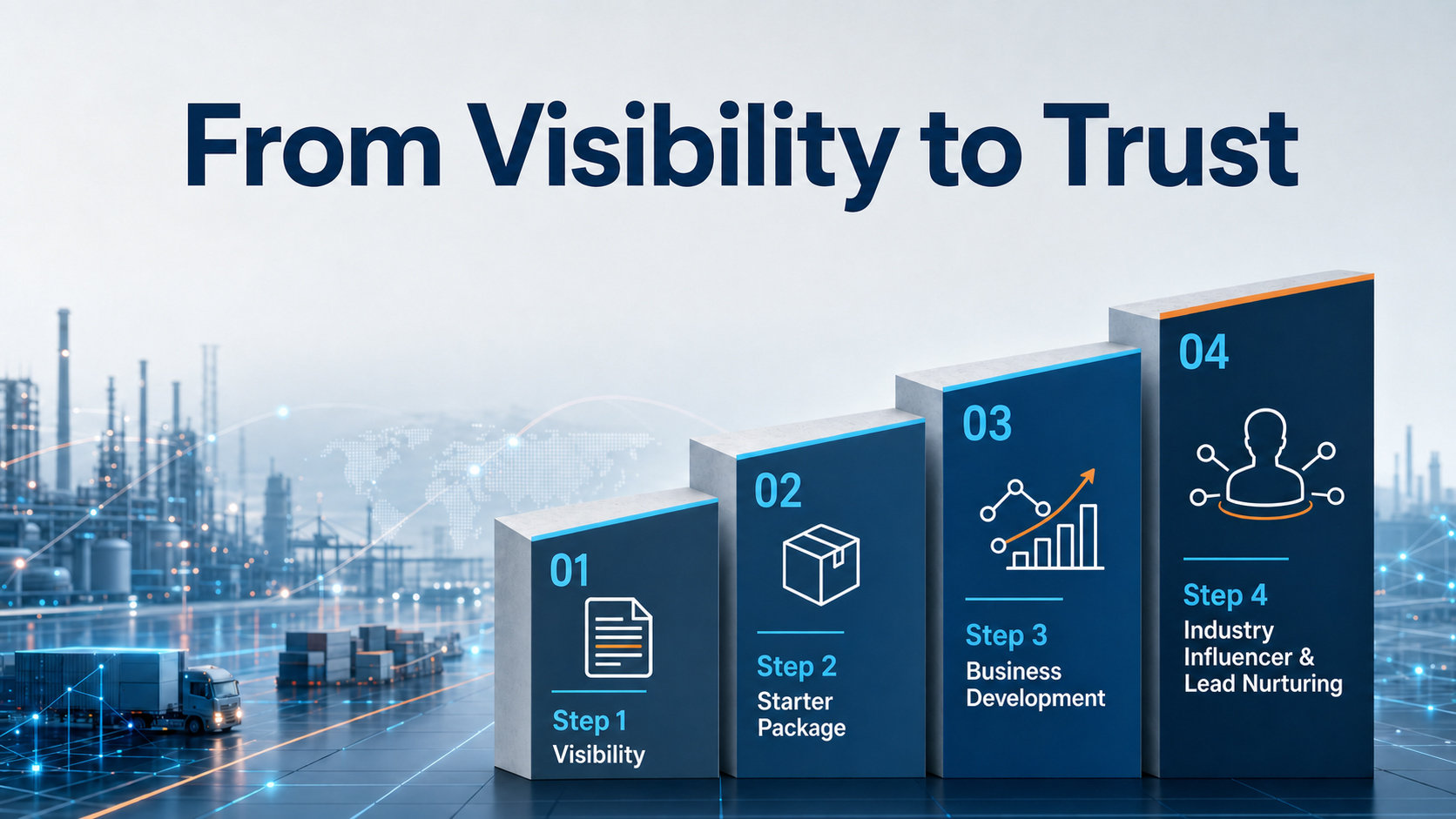
From visibility to trust: Your scalable path with Xpert.Digital - Image: Xpert.Digital
In industrial B2B, sustainable business relationships rarely emerge overnight. They develop step by step – through visibility, professional relevance, recurring touchpoints, and growing trust. Xpert.Digital's 4-stage model addresses precisely this: It offers a structured path that begins with a manageable entry point and can evolve into deeper collaboration in business development if needed.
Instead of relying on loud marketing promises, this model puts the relationship at the forefront. Companies start with clearly defined, easily calculable measures and then decide, based on their own experience, how far they want to expand the collaboration. A key factor for this undisturbed trust-building process: The platform completely avoids annoying advertising ads, so the editorial focus remains solely on the companies' expertise.
More information here:
Your global marketing and business development partner
☑️ Our business language is English or German
☑️ NEW: Correspondence in your native language!

Konrad Wolfenstein
I and my team are happy to be available to you as your personal advisor.
You can contact me by filling out the contact form here wolfenstein@xpert.digital:or simply call me at +49 7348 4088 965. My email address is
I'm looking forward to our joint project.