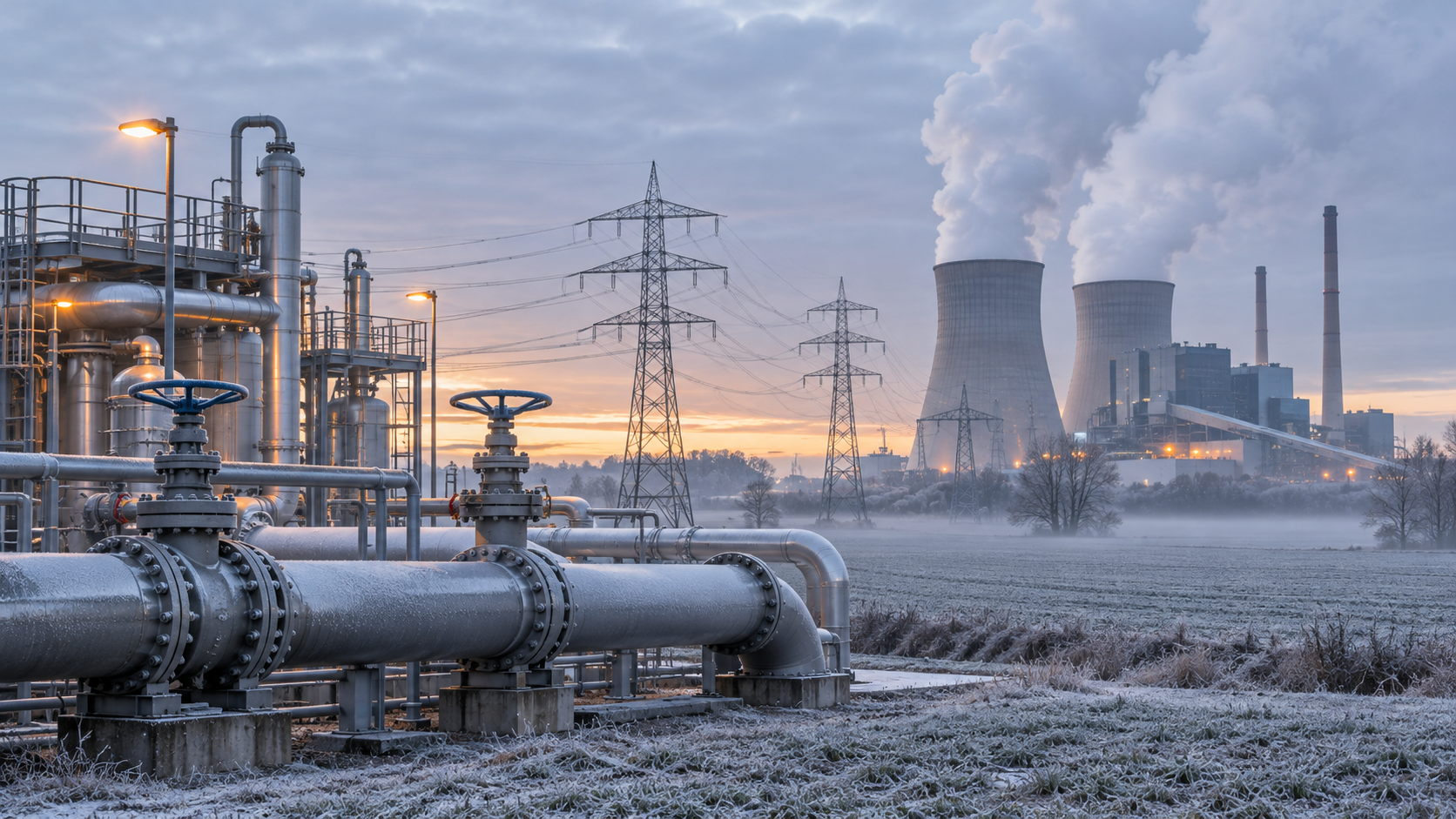
When the gas buffer shrinks: Germany's energy policy under stress – Are gas reserves and power plant reserves sufficient? – Creative image on the topic, created with AI: Xpert.Digital
Germany's gas risk: Why the return of old power plants reveals a deeper problem
Gas supply under pressure: Why low storage levels don't necessarily mean a shortage
What consequences are there for electricity prices and industry?
Germany is entering the winter of 2026/27 with comparatively low gas storage levels. At the same time, Federal Minister for Economic Affairs Katherina Reiche is preparing a way to temporarily increase the use of coal and oil-fired power plants for electricity generation in the event of a looming gas shortage. This is intended to save gas – but neither low storage levels nor a planned power plant reserve, in themselves, mean that a supply crisis is imminent.
The crucial factor is how well imports, storage facilities, grids, and available power plants interact. Smaller reserves leave the energy system less flexibility to absorb supply disruptions or exceptionally high demand. At the same time, precautionary measures cost money and can influence market prices. This presents Germany with a fundamental economic policy question: How much security of supply can the market itself provide – and when must the state organize additional safeguards?
The planned reserve can reduce gas consumption for electricity generation, but it does not replace missing gas imports or a proactive storage policy. Furthermore, its actual impact and costs depend on whether the older power plants are ready for operation in time and actually displace gas-fired power plants. The debate therefore touches on far more than just which power plants operate in winter: it also concerns electricity prices, industrial competitiveness, climate targets, and confidence in German energy policy.
Note regarding text checking:
The transmitted text breaks off mid-sentence ("Germany now has a different gas supply than…"). Therefore, this final paragraph cannot be fully checked for spelling and content.
Trust the market first, then burn coal: The bill for a lack of preparation comes due in winter
Germany is entering the winter of 2026/27 with unusually low gas reserves. At the same time, Federal Minister for Economic Affairs Katherina Reiche is preparing legislation to allow for the temporary, increased use of coal and oil-fired power plants for electricity generation in the event of a looming gas shortage. What initially appears to be a technical emergency measure touches upon a fundamental economic policy question: How much security of supply does a liberalized energy market inherently provide, and what additional safety buffer must the state organize?
The answer not only determines whether there is enough gas for heating. It also affects electricity prices, industrial competitiveness, public budgets, and the credibility of German energy policy. An energy system can function normally and still be insufficiently protected against an exceptionally cold winter or a major supply outage. Conversely, low storage levels do not automatically mean that a supply crisis is imminent.
The core of the current debate lies precisely between these two observations. The planned reliance on older power plants is fundamentally understandable as a safeguard. However, it does not yet answer the question of whether Germany had previously secured its gas supply in an economically sound and sufficiently forward-looking manner.
A low memory level is a warning signal, but not yet a shortage
As of November 1, 2026, German gas storage facilities were only about 61 percent full. This meant the heating season began with a significantly smaller supply than in many previous years. The fill level continued to fall until mid-November. In its situation assessment of November 13, the Federal Network Agency put it at 57.7 percent, or 142.7 terawatt-hours. At the same time, it assessed the supply as stable and, based on the information available at that time, still considered the risk of a gas shortage to be low.
These statements do not contradict each other. Storage facilities are only one component of the supply. Germany also receives a continuous supply of natural gas throughout the winter via pipelines and as liquefied natural gas (LNG), which is regasified after delivery. As long as these inflows are sufficient, winter consumption does not have to be entirely covered by previously stored quantities.
Storage facilities primarily serve a balancing function. They bridge the gap between ongoing imports and temporarily higher demand. This gap widens considerably during periods of extreme cold. A lower initial stock level therefore shortens the period in which the system can absorb additional loads.
The appropriate conclusion, therefore, is not that Germany is inevitably heading towards a gas shortage. It is that the available buffer has shrunk, thus increasing the importance of reliable imports, functioning infrastructure, and manageable demand.
Why the actual failure to meet targets needs to be examined more closely
The legal fill level requirements also necessitate a differentiated analysis. For most German reservoirs, a target level of 80 percent applied as of November 1st. However, six facilities had lower targets of 45 percent. This resulted in a calculated target value of approximately 70 percent across all reservoirs. A nationwide fill level of around 61 percent was therefore about nine percentage points below this combined target value, and not a blanket 19 percentage points below a uniform national requirement.
This distinction is more than a statistical subtlety. Mixing different reference points either exaggerates or downplays the supply gap. For a reliable assessment, the actual stock level, the legally mandated minimum fill level, and any potentially useful additional safety buffer must be considered separately.
Equally important is the distinction between percentage points and percent. A decrease from 70 to 61 percent corresponds to nine percentage points. Relative to the planned inventory, the deviation is larger.
However, an aggregated target value does not directly reveal the specific risk level in individual regions. The distribution of reserves, the capacity of storage facilities, and the transport capacity of the network play an additional role in this.
Storage devices not only contain energy, but also provide time for action
The economic value of a gas storage facility does not lie solely in the quantity of fuel stored. Crucially, it also depends on how quickly this gas can be made available and transported to the points of consumption.
A full storage capacity buys the energy system time. In the event of a supply disruption, additional loads can be procured, transport routes adjusted, and consumption responses organized. Companies can retool their production, suppliers can modify their procurement, and government agencies can prepare further measures if necessary.
This time saving has considerable economic value. A short-term production interruption can be significantly more expensive than an adjustment announced in advance. This is especially true where plants are operated continuously, intermediate products are closely coordinated, or technical processes cannot be easily stopped and restarted.
Furthermore, there is a physical limitation: depending on the storage type and operating state, the potential discharge capacity can decrease as the fill level drops. Therefore, a theoretically remaining amount of energy is not necessarily available at every desired speed.
Security of supply must therefore be considered simultaneously in terms of energy quantities, daily output, transport options, and response times. A single percentage value only partially reflects these interrelationships.
The planned power plant reserve is intended to save gas, not produce gas
Reiche's draft of a second law on maintaining reserve power plants focuses on the link between the gas and electricity markets. Under certain conditions, coal and oil-fired power plants would be permitted to temporarily generate additional electricity. This would allow gas-fired power plants to operate less and consequently consume less natural gas.
This measure does not directly replace missing gas imports. It reduces a portion of gas demand. The saved gas could then remain available for other applications, such as space heating or industrial processes where a short-term fuel switch is more difficult.
This currently concerns the preparation of a legal course of action, not a determination of an existing gas shortage. According to available information, it was still unclear in mid-November whether the legislative process would actually be initiated. The draft legislation is intended to allow for temporary deployment should a corresponding crisis situation be declared.
This distinction is crucial for public assessment. Contingency planning is not automatically an admission of imminent failure. It is fundamentally part of a robust energy system. It becomes critical when short-term safeguards permanently replace timely preparedness.
The relaunch of a crisis instrument demonstrates political continuity
A similar instrument was introduced in 2022 under then Federal Minister for Economic Affairs Robert Habeck. Following the Russian attack on Ukraine and the massive decline in Russian gas deliveries, additional coal and oil-fired power plants were intended to limit gas consumption in electricity generation. The exemptions in place at that time expired at the end of March 2024. Reiche is thus resorting to a mechanism that her predecessor government had already used.
This does not imply that the two situations are identical, nor that every repetition of the same measure would be equally justified. In 2022, the abrupt loss of a key source of supply was the primary concern. Today, the import structure is different, while geopolitical tensions and low storage levels are once again raising precautionary concerns.
Rather, the continuity lies in the economic logic: if gas becomes scarce or particularly valuable, other fuels should take over part of the electricity generation.
An objective assessment should therefore not depend on which party developed or revived the instrument. The decisive factors are the expected benefits, the actual operational capability of the systems, the costs incurred, and whether less burdensome alternatives are available.
🎯🎯🎯 Data-driven B2B industry hub as a quasi-in-house solution


The quasi-in-house solution: How Xpert.Digital closes operational gaps in B2B marketing and sales – Smart Content-Driven Business - Image: Xpert.Digital
Xpert.Digital is a data-driven B2B industry hub led by Konrad Wolfenstein . The company acts as an external, quasi-in-house solution for industrial partners, closing operational gaps in marketing, content, and sales – without requiring additional resources on the client side.
More information here:
Companies are struggling with low gas reserves
Why companies are unable to store enough data despite identifiable risks
Low storage levels immediately raise the question of economic incentives. Storing gas means spending money today, paying for storage capacity, tying up capital, and assuming price risks. For a company, this is only worthwhile if the later use or sale of the stored gas is expected to cover these costs.
Therefore, the absolute price level is not the only decisive factor. The relationship between current prices and expected winter prices is equally important. If gas is expensive in the summer and no sufficiently higher revenues are expected for the winter, additional storage may be economically unattractive.
Added to this are uncertainties regarding weather, demand, and geopolitical developments. Those who expect falling prices have an incentive to postpone purchases. If the anticipated easing of the situation fails to materialize, they may have to procure goods later under less favorable conditions.
Based on recent developments, market participants were betting on a stabilization of the strained energy markets. This expectation was not sufficiently fulfilled. However, this did not automatically lead to irrational behavior by individual traders. A company can act understandably based on its own assumptions, while the overall outcome offers too little certainty for the economy as a whole.
This is precisely where the task of regulatory policy begins.
Security of supply has a societal value that market prices do not fully capture
A gas supplier primarily considers its delivery obligations, procurement costs, and economic risks. However, the macroeconomic consequences of a severe supply crisis extend far beyond its own balance sheet.
When an industrial plant shuts down, customers and suppliers may also lose revenue. If intermediate goods become scarce, disruptions can propagate along several stages of the value chain. Higher energy prices put a strain on households, reduce other consumer spending, and can trigger additional government support needs.
A single company does not typically receive full compensation for the fact that its additional inventory reduces such consequential costs for others. Therefore, the socially beneficial safety stock can be larger than the stock resulting from purely individual economic decisions.
Economically, this represents a positive effect of precautionary measures on third parties, which is only incompletely taken into account in private calculations.
However, this does not give the government carte blanche for unlimited procurement. Additional security also costs money. The real challenge lies in weighing the anticipated damage from rare crises against the ongoing costs of hedging. Neither maximum stockpiling nor complete reliance on short-term market supply is automatically optimal.
Wealthy individuals' restraint had an economic logic, but also a price
The concern that government gas purchases could further increase prices is fundamentally understandable. If a large buyer enters a tight market, demand rises. With a short-term supply limitation, this can lead to higher prices.
Furthermore, there is a risk of crowding out private procurement. If market participants expect the state to step in during stock shortages anyway, they might reduce their own precautionary efforts. A poorly designed state guarantee can thus weaken precisely the incentives it is intended to supplement.
These arguments explain the initial reluctance of the Ministry of Economic Affairs. However, they do not prove that late intervention is ultimately more advantageous.
If the government waits too long, the remaining procurement period may shorten. At the same time, demand increases with the onset of winter. A price impact initially avoided can then turn into higher procurement costs later on or a greater supply risk.
The crucial factor is therefore not the abstract alternative between market and state. What matters are the timing, scope, and design of the intervention. Early, rule-based preventative measures can be more economically predictable than late intervention under mounting political pressure.
The additional procurement is relevant, but not a complete substitute for precautionary measures
At the end of September, Reiche instructed the state-owned energy company SEFE to procure and store eight terawatt-hours of gas by December 15. This supplemented the previously cautious approach with targeted, state-initiated procurement.
Eight terawatt-hours is not an insignificant amount. However, its actual impact on security depends on when it becomes available, what other procurements are taking place in parallel, and how much demand increases in the meantime.
A distinction must also be made between a purchase order and an already fully available stock. A target quantity for mid-December does not automatically increase the stock level at the beginning of November. Therefore, for risk assessment, the timeline is what matters, not just the total announced quantity.
This measure can be understood as a subsequent strengthening of the safety buffer. However, its adequacy cannot be assessed in isolation. This would require information on expected import volumes, weather assumptions, supply contracts, and potential disruptions.
However, a legitimate political question remains: Were the criteria for this intervention clearly defined beforehand, or was the decision only made when the low fill levels became increasingly problematic in the public eye?
Coal-fired power plants only effectively save gas if they actually replace gas-fired power plants
The benefit of additional coal and oil power plants does not depend solely on their installed capacity. Crucially, it depends on how many hours they are operated and what other electricity generation they displace.
A simplified calculation example illustrates the order of magnitude. If an additional power plant generates one terawatt-hour of electricity and thus completely replaces a gas-fired power plant with an electrical efficiency of 50 percent, approximately two terawatt-hours of gas energy are saved.
This calculation, however, is only an illustration, not a forecast for actual reserve deployment. In practice, the electricity mix changes hourly. Additional coal-fired power can also reduce imports, increase exports, or displace other forms of generation.
Combined heat and power plants are particularly important. If a gas-fired power plant supplies district heating in addition to electricity, it cannot simply be shut down. The missing heat would have to be generated elsewhere. This could, in turn, require gas.
The actual savings effect must therefore be assessed within the context of the entire energy system. A high level of additional electricity production from coal does not automatically translate into a correspondingly high reduction in the gas supply.
Old power plants will not become available immediately simply through a law
Between legal authorization and actual electricity production lie technical and organizational prerequisites. Reserve power plants require maintenance, personnel, fuel supply, and a reliable grid connection. Depending on their condition, inspections, repairs, or additional preparatory work may be necessary.
Fuel must also be procured and transported in a timely manner. For hard coal, rail and waterways can play a role. Oil-fired power plants require sufficient tank reserves and guaranteed deliveries. Therefore, a reserve is only credible if the entire supply chain functions properly.
Operators incur costs even before potential deployment. Staff must remain available, equipment must be kept operational, and fuel may need to be pre-financed. These expenses are incurred even if the winter remains mild and no additional electricity is produced.
From an economic perspective, such expenditures are not automatically wasted. They are comparable to an insurance premium. However, it must be verifiable what service is provided in return.
A sensible reserve policy therefore does not merely compensate for the formal existence of old power plants, but for their demonstrably available capacity under defined conditions.
Climate costs don't disappear even in an emergency
Coal and oil-fired power plants cause additional environmental pollution when they replace lower-emission electricity generation. Particularly when efficient gas-fired power plants are displaced, carbon dioxide emissions per unit of electricity generated can increase significantly. Furthermore, older plants may also emit other air pollutants.
This creates a real conflict of objectives. A measure can secure the gas supply in the short term while simultaneously being detrimental to climate policy. An objective assessment must address both sides.
However, a fair comparison is not necessarily coal versus an immediately available, completely emission-free alternative. In an acute shortage, the actual alternative may also be an industrial production shutdown or another equally costly emergency measure.
That's precisely why clear boundaries are necessary. A short-term reserve is something different from a permanent return to higher coal-fired power generation. It would become problematic if the crisis justification triggered investments that subsequently created political or economic pressure for long-term use.
The credibility of climate policy therefore depends not only on the existence of a reserve, but also on its frequency of use, its time limit, and its integration into a decreasing dependence on fossil fuels.
Additional electricity can dampen prices, but it does not guarantee cheap energy
More available power plant capacity can relieve pressure on the electricity market. If additional plants displace more expensive generation or prevent extreme shortages, wholesale prices can fall.
However, this does not automatically mean that the entire use of reserves is economically advantageous. Fuel, emission allowances, personnel, maintenance, and standby all incur costs. If these are financed through levies, grid fees, or the state budget, they do not disappear. They are merely distributed across different payment channels.
The influence on end-customer prices is also limited. Households and businesses do not only pay the short-term market price, but also, depending on the contract, longer-term procurement costs and other price components.
The same applies to gas. If less gas is used for electricity generation, this can reduce demand and thus price pressure. However, the extent of this effect depends on the amount saved and the European or global market situation.
The economically relevant question is therefore not simply whether an instrument lowers a visible stock market price. The crucial question is whether it reduces the total costs of supply, hedging, and potential defaults.
For industry, predictability is often more important than the final price point
Industrial companies need not only affordable energy, but also reliable framework conditions. A company can sometimes cope better with higher, but predictable, energy prices than with sharp price fluctuations and unclear intervention risks.
This is especially true for long-term investments. New facilities are used for many years. Companies therefore need to be able to assess how energy supply, infrastructure, and regulation will interact in the future.
Prolonged uncertainty can delay investments, even without actual gas rationing. Businesses are holding onto additional liquidity, hedging prices at higher rates, or considering alternative locations more attractive. These precautionary measures incur economic costs that are hardly noticeable when simply looking at the current gas bill.
At the same time, industrial consumption restrictions would not be uniformly manageable. Some companies can postpone production times or switch fuels. Others need gas as a raw material or for processes that are technically difficult to replace.
Effective crisis preparedness therefore considers value chains, technological adaptability, and consequential damages. The blanket assumption that industry can simply reduce its consumption in a pinch underestimates the complexity of industrial production.
Import diversification reduces individual dependencies, but does not eliminate global market crises
Germany now has a different gas supply than
📈🚀 From visibility to trust 👀🤝 Your scalable path with Xpert.Digital


From visibility to trust: Your scalable path with Xpert.Digital - Image: Xpert.Digital
In industrial B2B, sustainable business relationships rarely emerge overnight. They develop step by step – through visibility, professional relevance, recurring touchpoints, and growing trust. Xpert.Digital's 4-stage model addresses precisely this: It offers a structured path that begins with a manageable entry point and can evolve into deeper collaboration in business development if needed.
Instead of relying on loud marketing promises, this model puts the relationship at the forefront. Companies start with clearly defined, easily calculable measures and then decide, based on their own experience, how far they want to expand the collaboration. A key factor for this undisturbed trust-building process: The platform completely avoids annoying advertising ads, so the editorial focus remains solely on the companies' expertise.
More information here:
Your global marketing and business development partner
☑️ Our business language is English or German
☑️ NEW: Correspondence in your native language!

Konrad Wolfenstein
I and my team are happy to be available to you as your personal advisor.
You can contact me by filling out the contact form here wolfenstein@xpert.digital:or simply call me at +49 7348 4088 965. My email address is
I'm looking forward to our joint project.