
Humanoid robots in the factory: When will the hype really pay off?
Xpert Pre-Release

Available in 27 languages 📢
Prefer Xpert.Digital on GoogleⓘPublished on: October 21, 2026 / Updated on: October 21, 2026 – Author: Konrad Wolfenstein
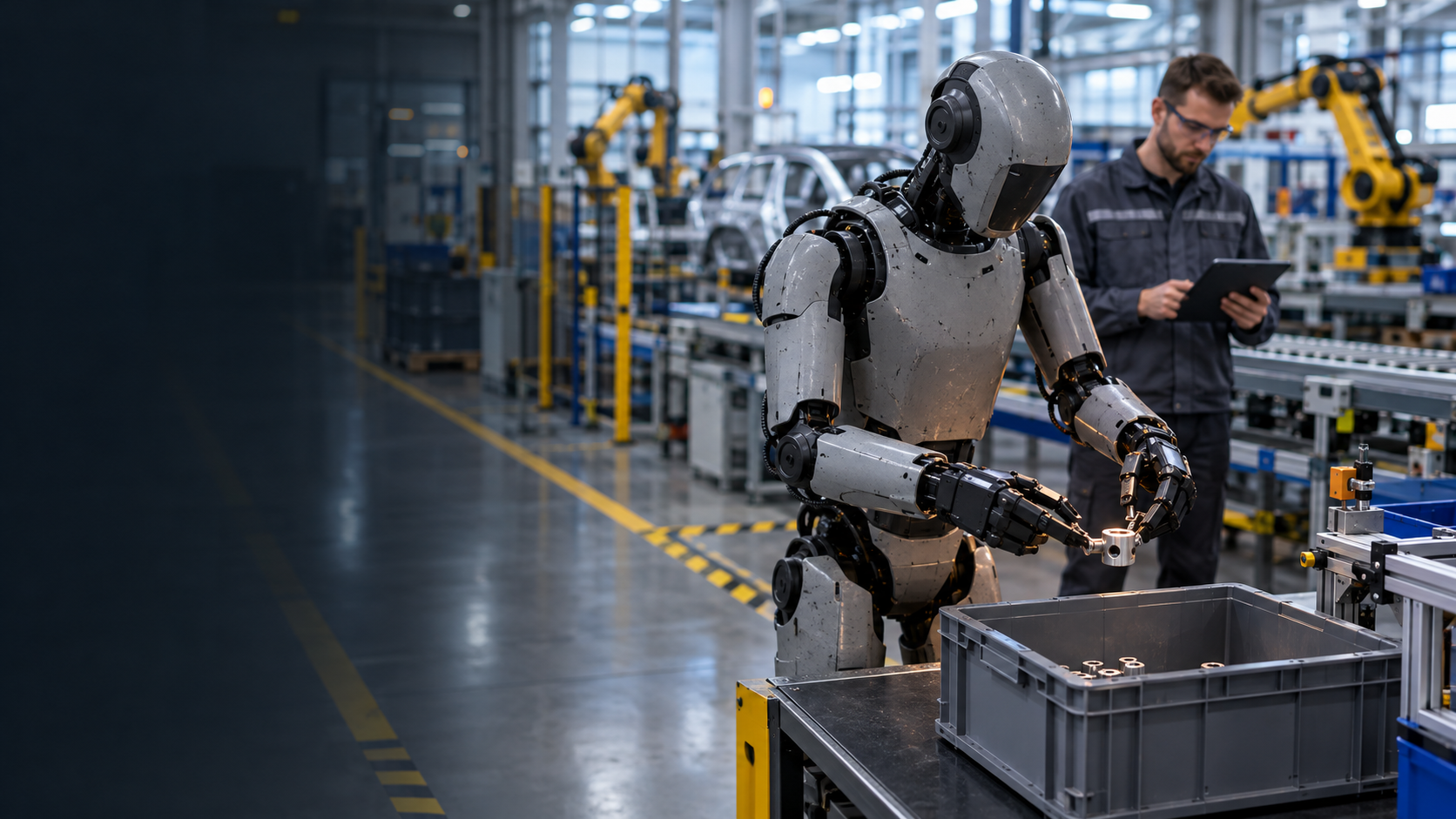
Humanoid robots in the factory: When will the hype really pay off? – Creative image on the topic, with AI: Xpert.Digital
From demonstration robot to employee: The crucial hurdle for humanoid machines
Humanoid robots are booming – but who is actually making money with them?
Robots in factories and warehouses: Why impressive movements are not yet a breakthrough
Humanoid robots are being delivered, tested, and deployed in companies with increasing frequency. However, rising sales figures and spectacular demonstrations do not yet prove that these machines are already operating reliably and profitably in factories and warehouses. So far, they primarily perform clearly defined tasks such as transporting containers, providing components, and sorting parts. The crucial question, therefore, is not whether a robot can execute an impressive movement, but whether it can perform a specific task safely, reliably, and at competitive overall costs over an extended period. Examples from BMW and the logistics sector illustrate where humanoid systems are already being used – and why the path from a successful pilot project to economically viable everyday use is still a long one.
Humanoid robots: The hype meets the cost accounting: Those who only impress in the factory haven't earned a single cent
The market for humanoid robots is indeed growing. However, the available data so far primarily demonstrates a boom in deliveries, development, and testing – not yet a widespread breakthrough of economically operating machines in factories and warehouses.
The crucial shift occurs between public perception and industrial reality. While spectacular movements and humanoid figures generate attention, documented operational deployments focus on narrowly defined tasks such as parts supply, container transport, and sorting. This is less exciting than the idea of a universal robot workforce, but economically far more meaningful.
The central question is therefore no longer whether a humanoid robot can perform an impressive feat. The crucial question is whether it can reliably, safely, and at competitive overall costs perform a sufficiently valuable task over an extended period. The current disillusionment is thus neither conclusive proof of the technology's failure nor merely a matter of perception. It arises where grand visions of the future first collide with the cost accounting of a concrete business.
The boom has several faces
The term humanoid robotics encompasses a variety of economic activities. These include research platforms, machines for generating training data, demonstration robots, small educational products, humanoid service robots, and industrial material handling systems. These categories serve different customers, fulfill different purposes, and are not subject to the same economic requirements.
A research institute buys a robot to develop new processes. An operator of a data acquisition center needs it to generate movement and interaction data. An industrial company, on the other hand, expects a reliable contribution to its production process. All three purchases can generate real revenue, but they do not demonstrate the same level of industrial maturity.
Furthermore, there is a question of definition: According to the International Association of Robotics, humanoid robots must appear human-like and be able to work autonomously in an environment designed for humans; two legs are not strictly necessary. Therefore, anyone who thinks solely of upright-walking machines with arms and legs is only considering a portion of what appears in some market statistics as humanoid robotics.
A reliable market analysis must keep these differences open. Otherwise, the sales figures for a research tool will be imperceptibly reinterpreted as evidence for the imminent automation of entire factories.
Large growth rates need context
For the first half of 2026, approximately 25,000 humanoid robots were shipped worldwide, representing a market volume of more than US$740 million. Compared to the same period of the previous year, this corresponds to a unit growth of 432.1 percent and a value growth of 322.7 percent.
These figures contradict the blanket assertion that the market consists solely of videos and announcements. Machines are being delivered, customers are spending money, and economic activity is increasing. However, a percentage increase appears particularly large when the starting point is small. A young industry can multiply in size and still be far from accounting for a significant share of industrial work.
The composition of demand is particularly important. Research and education, demonstrations, and government data collection centers together accounted for 69 percent of recorded shipments in the first half of 2026; for the entire year of 2025, this share was 83.8 percent. The decline suggests broader application, but also shows how strongly the market continues to be driven by development, demonstration, and data collection.
The correct interpretation is therefore: Commercialization is progressing, but delivery statistics are not yet productivity statistics. Between the two lies precisely that everyday industrial reality in which the grand promises must prove themselves.
Why different market sizes don't have to be a contradiction
Another survey estimated the number of humanoid robots sold worldwide in 2025 for industrial and professional service applications at approximately 7,000 units. Consumer and military applications were excluded; medical robots were categorized separately.
This figure cannot be directly compared to broader delivery statistics. The study period, product definition, manufacturers included, and customer groups differ. Even the question of whether to include smaller educational robots, humanoid robots on wheels, or devices for private users changes the result.
Problems arise when different figures are presented side-by-side without these limitations. This creates either the impression of explosive industrial penetration or the opposite impression, suggesting that the industry has fabricated its own sales figures. Both can be based on flawed comparisons.
The available data allows for a clearer statement about the direction than a single, unambiguous total market value. The direction is growth. What remains considerably less transparent is what proportion of the delivered machines are already regularly performing economically viable work without intensive human intervention.
The real competitor has long been working
Humanoid robots are not entering an untapped automation market. By the end of 2025, around five million industrial robots were in operation worldwide; more than 600,000 new units were installed in that same year. In addition, almost 250,000 professional service robots were delivered, including approximately 117,000 systems for transport and logistics.
This means that humanoid systems are facing a large existing landscape of automation. Their economic competitors are not solely human workers. They also include stationary robot arms, conveyor technology, driverless transport systems, specialized gripping solutions, and improved workflow design.
A humanoid robot can be technically fascinating and still be the wrong investment. If a conveyor belt can perform the same task more easily, or a mobile transport robot without arms and legs suffices, the added complexity must provide a tangible benefit.
The most compelling economic justification for humanoid systems, therefore, does not lie in replacing existing automation everywhere. It lies in the remaining gaps: changing tasks, existing jobs, and processes where a rigid, specialized solution would be too costly. Whether these gaps are large enough to support the industry's expectations has not yet been conclusively proven.
BMW delivers an important reality check
The deployment of Figure 02 at the BMW plant in Spartanburg is one of the better-documented industrial examples. Within ten months, the robot supported the production of more than 30,000 BMW X3s, moved over 90,000 components, and logged approximately 1,250 operating hours.
These figures represent significant progress. They demonstrate sustained operation over an extended period and under actual production conditions. The specific task involved removing sheet metal parts for the welding process and positioning them precisely.
Equally important is what this does not imply. The robot did not independently build 30,000 vehicles. It supported a specific step within a highly specialized production system. The number of vehicles thus describes the production context, not the machine's full capabilities.
The approximately 1,250 operating hours cannot be translated into a reliable availability rate without additional information. This would require, among other things, planned operating times, reasons for downtime, maintenance requirements, and a precise definition of productive operating time. This example demonstrates industrial usability in a specific application, but not yet a general superiority over other automation solutions.
The next task is less spectacular
In June 2026, BMW described the next step with Figure 03: The robot is to pick up unsorted components and sort them into a sequencing cart before established transport systems move the parts on to assembly.
This division of labor is particularly attractive from an economic perspective. The humanoid robot does not necessarily take over the entire material flow. It is intended to handle a variable processing step, while other systems retain their already established tasks.
This suggests a complementary strategy rather than a complete replacement of existing technology. The potential added value lies at the interface between unstructured material and structured production processes. Additional flexibility could be valuable here, provided it is not achieved at the expense of insufficient speed or high support requirements.
At the same time, the boundary between announced deployment, ongoing testing, and proven economic scalability remains crucial. Describing a new use case does not yet provide a complete calculation of how many machines will be needed permanently, what performance they will achieve, and whether the deployment will be profitable after all additional costs.
Real use is created in logistics
Documented work assignments also exist in warehouse logistics. Agility Robotics reports more than 65,000 cumulative operating hours across various customer locations; at the GXO site Flowery Branch, more than 100,000 containers moved were reported.
Such data is more meaningful than an isolated demonstration because it reflects repeated activity over longer periods. Nevertheless, a clear distinction must be made here as well: the cumulative hours of several machines and locations are not equivalent to the continuous operating time of a single robot.
The applications described publicly so far focus heavily on material handling, such as moving containers, dispensing parts, and sorting components. This aligns with a phased market entry strategy, initially aiming to master limited tasks.
Economically, there's nothing disappointing about this. A robot doesn't need to be universal to make a meaningful contribution. What would be disappointing is selling such a limited application as already proven for a universally applicable artificial workforce. There's a significant difference between a useful special case and a universal product.
The data factory comes before the robot factory
The extent to which the industry remains engaged in fundamental research is demonstrated by Apptronik's Robot Park, unveiled in Austin in June 2026. The nearly 90,000 square foot facility serves for data acquisition and the training of humanoid robots for tasks in logistics, production, and other application areas.
Apollo 2 is explicitly being used as a platform for data collection and testing. The information gathered will support the further development of robotic AI models and be incorporated into the subsequent commercial product, Apollo 3.
This is not a minor detail, but rather an indication of the current value chain. Some of the robots built today initially produce the learning basis for future robots. The machine is therefore not only a potential work tool for the customer, but also the manufacturer's development infrastructure.
This generates real revenue and potentially valuable knowledge. However, it would be wrong to equate this demand entirely with an already self-sustaining demand for automated work performance. In the long term, it remains to be seen whether the learning process will result in a product whose benefits for independent customers outweigh the ongoing costs. Otherwise, a growing development infrastructure would merely serve ever-increasing development needs.
Everyday life doesn't fail because of a somersault
Industrial stress testing often begins with seemingly simple processes. A component is positioned differently than expected, a box is tilted, a handle is partially obscured, or an object behaves differently when lifted than during training. Such deviations are more important for economic efficiency than whether a machine can perform a spectacular movement.
That these detailed problems are still being addressed is evident from the manufacturers' development descriptions. UBTECH, for example, cites the response to significantly inclined containers and the adaptation to dynamically delivered material as specific areas of application for its VLA-based control system. VLA refers to the combination of visual perception, verbal instructions, and generated robot actions.
The crucial skill is not simply the successful execution of an ideal movement. It consists of recognizing deviations, adapting one's own action, and continuing to work effectively after a mistake.
This is precisely where the public demonstration format loses its relevance. A successful demonstration answers the question of whether something is possible. An industrial operator also needs to know how often it fails, what the consequences are, and how costly it is to restore stable operation.
Reliability is more than success rate
A published success rate can only be evaluated to a limited extent without knowledge of the task. It makes a difference whether a robot successfully performs a single grasping movement or completes a longer work sequence entirely. Equally important is whether a failed attempt is corrected automatically or requires human intervention.
UBTECH's half-year report contains an insightful caveat: For a described VLA approach to loading and unloading, the company cites a success rate of 75 percent under laboratory conditions. This figure pertains to a specific development approach and should not be interpreted as a general success rate for all products or customer applications.
However, it illustrates how far individual research advances can be from an industrially viable solution. A process may be scientifically promising but still not sufficient for an unsupervised production process.
The economically decisive key performance indicator is therefore often the intervention frequency: How long does the system operate before someone has to intervene? This includes the duration of the intervention, required qualifications, and potential impact on downstream processes. A high nominal success rate can be of little value if the remaining errors are particularly costly or difficult to correct.
🎯🎯🎯 Data-driven B2B industry hub as a quasi-in-house solution

The quasi-in-house solution: How Xpert.Digital closes operational gaps in B2B marketing and sales – Smart Content-Driven Business - Image: Xpert.Digital
Xpert.Digital is a data-driven B2B industry hub led by Konrad Wolfenstein . The company acts as an external, quasi-in-house solution for industrial partners, closing operational gaps in marketing, content, and sales – without requiring additional resources on the client side.
More information here:
The future of humanoid robots in industrial applications
The human hand remains a difficult model
The further development of Figure 03 includes improved hands with tactile sensors and cameras in the palms. This focuses the development on an area that is particularly important for commercially viable manipulation: the contact between machine and object.
Recognizing an object does not automatically mean you can grasp it securely. Likewise, a successful grasp does not guarantee that the object can subsequently be used, placed down, or transferred to another device in a controlled manner. Practical performance only arises from the interplay of these steps.
From an economic perspective, this raises a fundamental design question: How human-like does the hand actually need to be? For some tasks, a simpler gripper may suffice. For other applications, greater dexterity could provide the decisive advantage.
Greater mobility is not automatically better. It must create additional economic value that justifies the development costs, maintenance, and potential sources of error. The best industrial robot is not necessarily the one that most accurately replicates a human. It is the one whose capabilities are best suited to the intended work process.
Two legs have to add up
Even in the chassis design, the technical ideal diverges from economic practicality. Apptronik offers Apollo 2 in both a bipedal and a wheeled configuration. BMW, in Leipzig, is also investigating Hexagon's AEON, a humanoid system that moves on wheels and can accommodate various gripping or measuring tools.
These variations demonstrate that human-like manipulation and bipedal walking are not necessarily inextricably linked. The economic benefits of arms, reach, and flexible handling can exist without every movement being modeled on the human body.
For the user, the right question is therefore not which design looks more futuristic. It is what level of mobility the task actually requires. Where navigating stairs or obstacles offers no added value, a more complex drive system must be particularly well justified.
Long-term developments could therefore be less uniform than the public debate suggests. A market of diverse body types utilizing similar AI methods is possible. The success of the underlying technology would then not necessarily mean that humanoid bipeds would be roaming the halls everywhere.
The purchase price is just the beginning
The economic evaluation of a humanoid robot should not end with the purchase price. The decisive factor is the overall cost, including the machine itself, financing, integration, software, maintenance, support, and the consequences of downtime. What matters is not the theoretically available operating time, but the actual usable performance.
The BMW project alone demonstrates how many operational areas need to be involved. The company describes the early integration of production IT, occupational safety, process management, and shop floor logistics, as well as integration via standardized interfaces.
This work doesn't disappear just because the machine looks human-like. While an existing workstation can limit some of the adaptation effort, it doesn't replace secure integration into material flow, responsibilities, and production control.
The distinction between technical activity and economically effective relief is particularly critical. If employees frequently have to assist the robot, or if the freed-up time cannot be used effectively from an organizational perspective, the benefit falls short of the sheer number of automated tasks.
A convincing calculation must therefore start with the process. First, it is necessary to clarify which problem is to be solved. Only then can a decision be made as to whether a humanoid robot, another automation solution, or a change in the process is the more economically viable answer.
Care can become a hidden cost center
Teleoperation, or remote control by humans, plays a crucial role in development. Apptronik combines human remote control and autonomous execution to generate training data. Mercedes-Benz also described how employees transfer their production knowledge to Apollo using teleoperation and augmented reality.
This is understandable for training purposes. However, it doesn't automatically translate into a sustainable operating model in the long term. The crucial factor is how much human support will still be needed after implementation.
Remote support becomes economically attractive when a small number of skilled workers can only occasionally maintain numerous machines. A problematic model, however, would be one in which a seemingly autonomous robot is regularly and almost entirely dependent on a human operator.
The crucial distinction, therefore, is not between complete autonomy and any form of human assistance. Even established technology requires support. The decisive factors are the scope, predictability, and cost of this support. An economically useful robot may require assistance; however, it must still generate sufficient additional output or reduce workload despite this assistance.
Service models do not solve every problem
Agility's collaboration with GXO and Toyota describes models where the use of robots is organized as a service. Such offerings can facilitate entry because the customer does not necessarily have to bear the entire initial investment.
This doesn't eliminate the economic risk, however. It simply shifts the distribution. The provider must organize hardware, maintenance, replacements, and support in such a way that the agreed-upon revenue is sufficient in the long term. The customer, in turn, must assess whether the price is commensurate with the actual service provided.
Contracts and operational data that describe not only a provided machine, but also clearly defined services and responsibilities would be particularly informative. Who is responsible for the consequences of recurring interruptions? What support is included? How are changing tasks handled?
A low initial price can accelerate the testing phase. However, it does not replace proof of viable unit costs. Therefore, for the market, it is less important whether the machine is purchased, leased, or obtained as a service. What matters is whether the entire value chain functions economically in the long term.
China is accelerating the market
China represents a key growth focus. In the first half of 2026, more than 19,000 humanoid robots were delivered there, corresponding to approximately 77.9 percent of the global volume in the relevant market survey.
This magnitude is industrially relevant. It indicates a large domestic market and significant dynamics in supply and demand. However, it should not be automatically interpreted as an equally large proportion of productive robot working hours.
Precisely because research, education, demonstration, and data acquisition applications continue to represent a significant portion of the global market, Chinese growth must also be assessed in terms of their application. High shipment volumes can accelerate further development, but they are not yet complete proof of successful automation at the end-user level.
The potential strength of a large domestic market lies in learning processes, supply chains, and repeated practical testing. The potential risk is that production capacities and expectations grow faster than economically viable applications. Both developments can occur simultaneously. A sober analysis should therefore neither downplay the dynamism of China nor view every delivery as a completed productivity revolution.
UBTECH shows growth and losses
A concrete look at company figures helps to ground the abstract debate. UBTECH achieved total sales of approximately 1.269 billion yuan in the first half of 2026. The product and service category for life-size humanoid systems reached 590.3 million yuan in sales with 921 units sold, representing 46.5 percent of the group's total revenue.
At the same time, the company recorded a period loss of approximately 338.8 million yuan. This combination is particularly important for economic assessment: a company can exhibit real demand, strong growth, and significant losses simultaneously.
The loss alone does not necessarily mean that the technology will remain permanently unprofitable. Likewise, revenue growth does not prove that a sustainably profitable business model already exists. Development, market launch, and organizational setup can significantly impact the profitability of a new product category.
Furthermore, the aforementioned revenue category encompasses products and services of varying orientations. It should neither be attributed to a single robot model nor understood solely as revenue from productive factory work. Such distinctions are crucial in determining whether an analysis remains reliable or inadvertently shifts into the language of marketing.
Artificial intelligence also helps competitors
Progress in robotic AI is real. Google DeepMind's Gemini Robotics 1.5 describes models that can translate visual information and instructions into actions and transfer capabilities between different robot platforms. Transfers between various systems were demonstrated, including Apollo and two-armed robot platforms.
However, this leads to a frequently overlooked consequence: improved AI is not solely a competitive advantage for humanoid body shapes. If similar technologies also make traditional robotic arms or mobile manipulators more powerful, the competition will improve simultaneously.
The economic success of physical AI and the economic success of bipedal robots are therefore not identical. The underlying intelligence could become widespread, while certain humanoid designs will only prevail in selected applications.
Furthermore, there is the boundary between research evidence and industrial guarantee. Successful task transfer is valuable, but it does not yet demonstrate unlimited adaptability to any workplace. The crucial economic question remains: how much new data collection, adaptation, and validation is required for each additional deployment?.
Safety determines the usable performance
Apptronik justifies the wheeled version of Apollo 2, among other things, by stating that it adheres to existing safety standards for mobile industrial robots and can be more easily integrated into existing operational processes. At the same time, the company explicitly identifies safety and reliability as key areas of development for its two-legged platform.
This makes it clear that safety is not something that is added at the end of an otherwise complete cost-benefit analysis. It influences how and where a machine can be used in the first place.
For operational evaluation, the maximum speed of an isolated demonstration is therefore irrelevant. What matters is performance under the actually permissible conditions at the intended workplace. If protective measures, distances, or interruptions alter usage, the cost accounting must reflect these conditions.
Here, too, a less spectacular design can be economically superior. The relevant criterion is not how convincingly a system imitates humans, but how well it operates safely and reliably in a specific environment. Therefore, the technical demonstration and permissible operational use must be consistently kept separate.
A shortage of workers creates demand, but it's not a guarantee of success
Demographic change and labor shortages are among the long-term drivers of robotics demand. Furthermore, the humanoid applications described so far primarily focus on monotonous or physically demanding tasks.
This creates a plausible demand basis. A company may also be interested in automation even if it does not intend to immediately reduce staff, but rather wants to stabilize existing processes or reduce burdensome work.
Nevertheless, a shortage of skilled workers is no substitute for proof of performance. A machine only solves the problem if it reliably performs the task in question. If, instead, it requires scarce skilled workers for frequent maintenance, the bottleneck can merely shift.
An economically sound analysis therefore begins at the task level, not with the entire job description. A robot can take over a burdensome sub-step without replacing an entire position. The benefit then arises from an improved division of labor. For a reliable evaluation, it must be examined whether this new division of labor functions organizationally and whether its advantages outweigh the additional costs.
The household market follows a different logic
In addition to industrial applications, smaller humanoid products are being developed for education, personal interaction and companionship; these categories are described as additional growth areas in current market analyses.
Their sales should not be equated with the demand for a universal household helper. A device can be successful as a learning platform or interactive product without reliably sorting laundry, tidying up objects, or performing demanding handling tasks.
This also means that the economic criteria differ. For an educational product, learning value and programmability can justify the purchase. For a work robot, however, the focus must be on the task it performs.
Public perception often conflates these categories into a single narrative of the future. This makes the overall market appear larger and closer to a breakthrough than the individual application warrants. Such a market can still be attractive to manufacturers, but it provides only limited insights into assessing industrial productivity.
Less excitement does not mean less development
The subjective impression of a quieter news environment does not necessarily indicate a reliable market decline. Rather, the documented steps taken by BMW and Apptronik show that in 2026, their work will focus on additional use cases, data collection, and practical integration.
These activities produce less spectacular images than a first public presentation. An improved interface, a more robust gripping process, or reduced maintenance requirements are more difficult to stage than a walking robot. Nevertheless, they could be significantly more important economically.
Conversely, it would be equally wrong to automatically interpret every quiet phase as a productive maturation process. A lack of transparency can also mask problems. Without information on production volumes, operating times, interventions, and subsequent purchases, external evaluation remains limited.
The appropriate stance is therefore neither premature enthusiasm nor blanket disillusionment. What matters is whether the nature of the published evidence improves. A market doesn't grow by being talked about less, but by making its promises more verifiable.
The next breakthrough requires repeat orders
For further evaluation, repeated purchase decisions by independent customers would be particularly informative. An initial pilot purchase can express an interest in learning, strategic positioning, or a desire for early access to the technology. A larger repeat order after extended use would be a significantly stronger signal of economic benefit.
It's not enough to simply count the number of installed machines. Important factors include the specific scope of work, productive operating times, frequency of interventions, maintenance costs, and the development of costs per completed task.
Equally important is scalability. If every additional job requires a substantial development project, the business will grow differently than with a largely standardized product. While a valuable market may emerge, it might not become the rapidly scaling mass market that particularly optimistic expectations anticipate.
The crucial test, therefore, is: Can a successful individual case become a repeatable deployment? Only when this repeatability is combined with a sustainable cost structure will a series of impressive projects become an industrially robust boom.
The great selection process begins on a small scale
Everyday life doesn't necessarily disprove the basic idea of humanoid robotics. It primarily disproves overly simplistic assumptions about its path to market. Current data shows growth and real-world applications, but also highlights the crucial importance of research, training, and narrowly defined tasks.
This clearly answers the initial question: It's not just marketing hype. A significant portion of public expectation precedes the proven economic performance.
The most important development, therefore, is probably not a sudden replacement of human labor, but a selection process based on concrete benefits. Some tasks will be suitable, while others will remain better solved by humans or specialized automation. Some manufacturers will achieve technological advances without turning them into a profitable business. Others could be more economically successful with less spectacular solutions.
The benchmark for the next phase should be correspondingly unspectacular: less support, fewer interruptions, simpler implementation, and more reliable costs. The humanoid robot doesn't need to impress every person. It needs to convince the person responsible for its actual operation—not just on the day of the visit, but also during a regular shift when no one else is watching.
📈🚀 From visibility to trust 👀🤝 Your scalable path with Xpert.Digital

From visibility to trust: Your scalable path with Xpert.Digital - Image: Xpert.Digital
In industrial B2B, sustainable business relationships rarely emerge overnight. They develop step by step – through visibility, professional relevance, recurring touchpoints, and growing trust. Xpert.Digital's 4-stage model addresses precisely this: It offers a structured path that begins with a manageable entry point and can evolve into deeper collaboration in business development if needed.
Instead of relying on loud marketing promises, this model puts the relationship at the forefront. Companies start with clearly defined, easily calculable measures and then decide, based on their own experience, how far they want to expand the collaboration. A key factor for this undisturbed trust-building process: The platform completely avoids annoying advertising ads, so the editorial focus remains solely on the companies' expertise.
More information here:
Your global marketing and business development partner
☑️ Our business language is English or German
☑️ NEW: Correspondence in your native language!

Konrad Wolfenstein
I and my team are happy to be available to you as your personal advisor.
You can contact me by filling out the contact form here [email protected]:or simply call me at +49 7348 4088 965. My email address is
I'm looking forward to our joint project.