
Far-left extremists, migrants, looters, frustration: What's behind France's unrest?
Xpert Pre-Release

Available in 27 languages 📢
Prefer Xpert.Digital on GoogleⓘPublished on: October 19, 2026 / Updated on: October 19, 2026 – Author: Konrad Wolfenstein
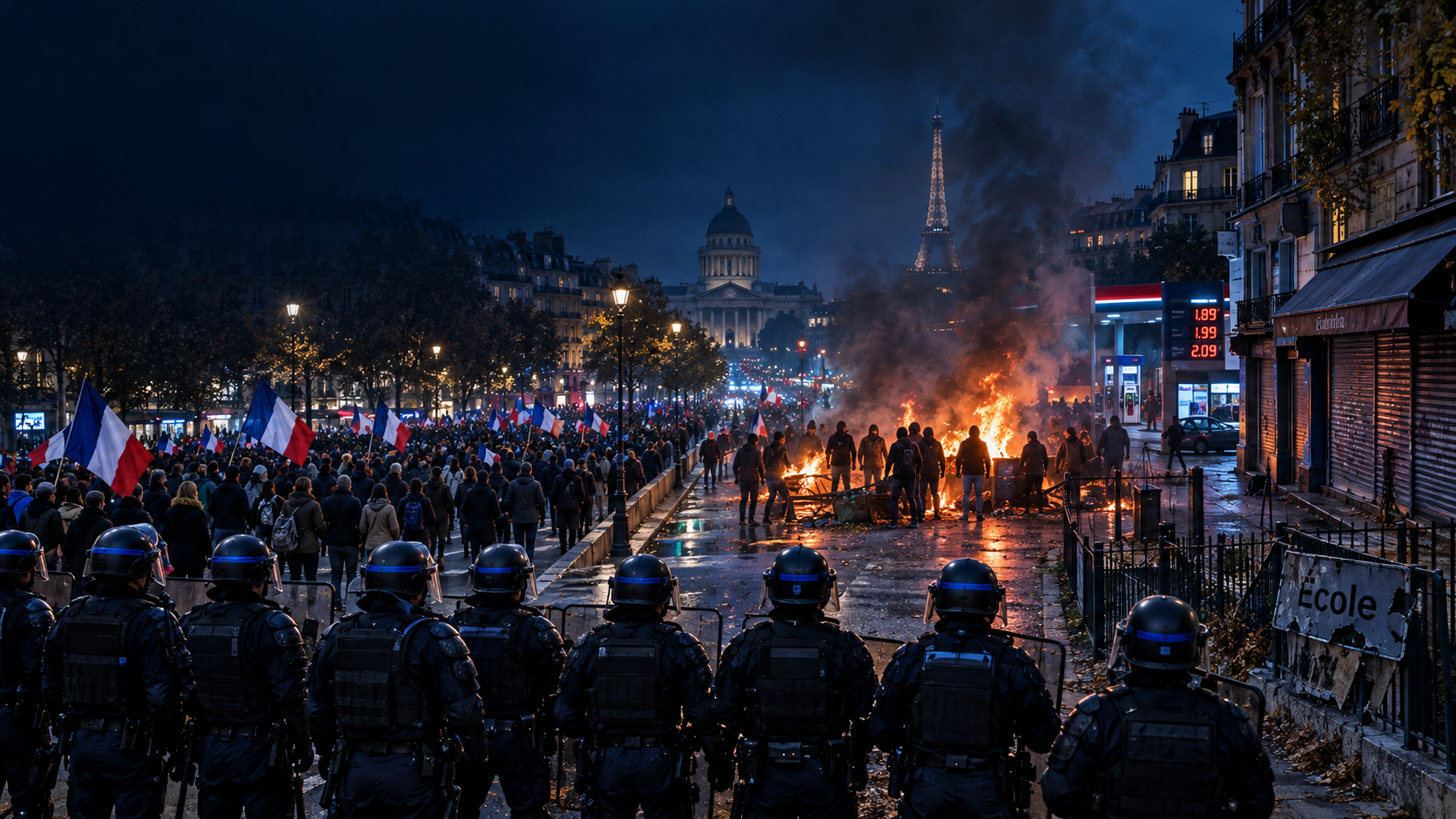
Far-left extremists, migrants, looters, frustration: What's behind France's unrest – a creative image on the topic, created with AI: Xpert.Digital
Those who only blame migrants are taking the easy way out – those who ignore left-wing extremists and organized violence are acting dangerously recklessly
France's riots: Why social anger and extremism are escalating together
France at a tipping point: How state failure and violence reinforce each other
France's riots cannot be explained by a single cause. What began as a protest against problems in schools escalated into a nationwide conflict over purchasing power, social inequality, and the state's effectiveness. While the vast majority demonstrated peacefully, violent groups exploited the chaotic situation to launch attacks, arson, and looting. German Interior Minister Alexander Dobrindt sees this as a dangerous alliance between left-wing extremists and segments of migrant communities. His warning points to real overlaps but does not solely describe the complex dynamics on the streets. Social hardship, institutional distrust, integration problems, and organized violence can reinforce each other—without necessarily creating a unified alliance. It is therefore crucial to clearly distinguish between peaceful protest and violence while simultaneously taking the root causes of the growing anger seriously. The following article analyzes why France's unrest is escalating, where Dobrindt's diagnosis holds true, and what lessons can be learned for Germany.
France's riots: The explosive alliance of social anger, extremism and state failure
France is experiencing an unusual wave of protests. What began with school blockades, complaints about teacher shortages, dilapidated buildings, and bleak future prospects has escalated into a nationwide confrontation within just a few weeks. Hundreds of thousands of people took to the streets to protest high living costs, rising energy prices, social inequality, and the visible decline of public services. The vast majority protested peacefully. At the same time, organized rioters, autonomous groups, and criminal sympathizers transformed parts of the demonstrations into scenes of massive destruction. Town halls, shops, and other public buildings were attacked, vehicles were set on fire, stores were looted, and security forces were assaulted with fireworks, Molotov cocktails, and projectiles.
Federal Interior Minister Alexander Dobrindt interprets this escalation as a joint action by left-wing extremists and segments of migrant communities against the democratic system. His diagnosis touches on a real security policy issue, but only partially captures the overall societal dynamic. There is indeed an operational overlap between various groups prone to violence. However, this does not necessarily unite them with a shared ideology, a permanent organization, or a unified political plan. On the same street, committed autonomists, politically engaged youths, locally rooted petty criminals, radicalized activists, and opportunistic looters can all operate without this necessarily constituting a cohesive alliance.
The crucial question, therefore, is not whether social problems or extremism caused the riots. Both are at work simultaneously and reinforce each other. Economic pressure breeds discontent, institutional distrust weakens commitment to the political order, spatial segregation concentrates hopelessness, social media accelerates mobilization, and professional networks of violence exploit the emerging crowd as cover. Those who point only to social causes downplay the deliberate violence. Those who solely blame migration and left-wing extremism mistake the accelerant for the entire fuel supply.
From school protest to nationwide state crisis
The movement originated in the education system. Students protested against canceled classes, overcrowded classrooms, dilapidated buildings, and inadequate resources. In disadvantaged suburbs, these problems coalesced into a fundamental experience of state inequality. France's republican ideal formally promises equal opportunities, but the actual quality of public services depends heavily on where someone lives and their social environment. Precisely where schools are in greatest need of support, experienced teachers, reliable substitute teachers, and functioning infrastructure are often lacking.
The protests spread because the education issue struck a chord with a broader societal sentiment. Unions, employees, pensioners, farmers, and supporters of the Yellow Vest movement all contributed their own demands. Criticism of schools evolved into a general protest against the loss of purchasing power, high fuel prices, the housing shortage, and the perceived decline in public services. This gave the movement enormous breadth, but at the same time, it diminished its organizational cohesion. The more heterogeneous a mobilization becomes, the more difficult it is to control its objectives, routes, security measures, and political messages.
This very openness offered an opportunity to violent actors. Large demonstrations create anonymity and overwhelm traditional police structures. Masked groups can infiltrate peaceful marches, break away at key points, and deliberately initiate confrontations. As soon as the police have to react, chaotic situations arise in which peaceful demonstrators, militant activists, and apolitical rioters are virtually indistinguishable. The violence then completely shifts public attention: The focus is no longer on canceled classes, poverty, or purchasing power, but on fires, looting, and injured police officers.
This marks a strategic turning point in the escalation. The legitimate protest movement loses its interpretive authority and public support, while radical actors create precisely the images that confirm their narrative of an irreconcilable conflict between the street and the state. The government, in turn, can tighten security measures without having to immediately address the material causes of the discontent. Ultimately, both sides of the democratic center lose: peaceful citizens see their concerns ignored, and state institutions appear either powerless or repressive.
Dobrindt's diagnosis contains a kernel of truth
Dobrindt's warning about a connection between left-wing extremists and groups with a migrant background should not be reflexively dismissed as mere exaggeration. In France, it is evident that militant groups deliberately exploit demonstrations, attack state symbols, and provoke confrontations with the police. Added to this are young people and young adults from socially disadvantaged neighborhoods, some of whom already have experience with the police, the justice system, or the informal economy. Where these two groups meet, a dynamic of division of labor can emerge: politically experienced activists possess mobilization expertise, tactics, and a preconceived notion of the enemy; local groups contribute local knowledge, numbers, a spontaneous willingness to use violence, and access to criminal networks.
This connection is particularly dangerous because it translates different motives into the same act. The anarchist attacks a town hall as a symbol of state power. The disillusioned youth directs his anger against an institution that fails to represent him. The looter exploits the chaos for material gain. Outwardly, the same image is projected, even though the underlying motivations diverge significantly. For the state, this difference plays only a limited role at the moment of the act of violence: an incendiary device remains an incendiary device, regardless of whether it is ideologically, socially, or criminally motivated.
Dobrindt is therefore right to demand that the anti-democratic nature of organized violence be clearly identified. Attacks on town halls, schools, fire stations, shops, and police forces are not simply a harsher form of political expression. They destroy the material and institutional prerequisites for democratic conflict resolution. Anyone who systematically prepares violence, carries protective gear, uses fireworks as weapons, or coordinates attacks on public buildings crosses the line between protest and politically or criminally motivated violence.
The diagnosis becomes problematic when observable overlaps are interpreted as construing a cohesive alliance. A lasting alliance would require joint leadership, coordinated objectives, robust structures, and a long-term strategy. Sufficient evidence for this is currently lacking. A situational convergence is more likely: different groups recognize the same adversary at the same time and act in parallel for a period of time. This is serious enough from a security policy perspective, but should not be overstated analytically.
No unified alliance
The term "alliance" suggests stability and shared interests. In reality, significant contradictions exist between the radical left, religiously conservative circles, secular youth from immigrant families, and ordinary criminals. Far-left groups often pursue anti-capitalist, anti-state, and internationalist goals. Conservative or religious circles can hold completely opposing views on family, gender roles, sexuality, and social order. Criminal actors, on the other hand, are primarily interested in profit, local power, or weakening police control.
What temporarily unites these groups is less a shared vision of the future than a common antagonism. The police, the central government, the government, and economic elites become projection screens for various frustrations. Such a negative coalition can be very effective on the streets, even though it remains politically unstable. It doesn't need a common program as long as its immediate goal is to disrupt the established order.
This distinction is crucial. The state combats an ideologically entrenched organization differently than a loose, event-driven mobilization. Investigations, financial controls, bans, and the dismantling of logistical networks are effective against established structures. Against spontaneous convergence, early situational awareness, local prevention, the swift separation of peaceful assemblies from violent offenders, and digital intelligence gathering are more important. Those who treat every instance of unrest as the product of a centrally controlled alliance risk making strategic errors.
At the same time, it would be negligent to mistake the lack of central control for harmlessness. Decentralized violence can be harder to predict than the actions of a hierarchical group. Small units can coordinate flexibly via encrypted communication channels, social networks, and short-term meeting points. The threshold from bystander to follower decreases when violence has already begun and state control visibly weakens. A large, violent mob can thus emerge from a few prepared actors in a short time.
The concept of armed struggle is politically effective, but analytically risky
Dobrindt's use of the term "armed struggle" conveys the necessary message that attacks with incendiary devices, fireworks, and other dangerous objects must not be downplayed as mere vandalism. It emphasizes that the use of force is systematic and targeted against people and institutions. In this limited sense, the term describes a real escalation.
At the same time, it is highly charged with historical and legal connotations. Armed struggle evokes images of terrorist underground organizations, persistent command structures, and attempts to overthrow the state through systematic violence. While the current riots demonstrate serious and, in some cases, organized violence, they do not yet constitute a widespread uprising with a unified leadership. Therefore, overly broad war rhetoric can obscure the different perpetrator groups, motives, and levels of escalation.
Politically, this choice of words has two effects. It mobilizes support for a tougher security policy and forces other parties to clearly distance themselves from the perpetrators of violence. At the same time, it can alienate parts of the peaceful protest movement if they get the impression that their social demands are being treated as a blanket attack on democracy. Effective government communication must therefore achieve both simultaneously: name organized violence without euphemism and clearly distinguish the peaceful majority from the perpetrators.
France's president has explicitly articulated this dual approach. The state must acknowledge legitimate concerns about the cost of living and education, but it cannot tolerate the destruction of republican institutions. This is precisely the central political challenge. A state that only listens but does not stop violence loses authority. A state that only cracks down but ignores legitimate problems breeds new radicalization.
The economic pincers behind the anger
The French economy is in a situation where almost every political response creates losers. Real growth remains weak, unemployment is rising, and despite a very high spending ratio, the government has increasingly less fiscal leeway. Growth forecasts for 2026 range only between roughly 0.7 and 1.0 percent. At the same time, the unemployment rate is just over eight percent. The transition of young people into the labor market is particularly strained. Youth unemployment has recently been close to or above 20 percent, significantly higher than the European average.
These values do not explain violence, but they do describe the economic context. A generation confronted with long periods of education, high housing costs, precarious employment, and weak prospects for upward mobility is more sensitive to visible inequality. When schools simultaneously close, public buildings fall into disrepair, and access to stable jobs is perceived as unfair, the impression of a broken social contract arises.
The situation is exacerbated by higher energy and fuel prices. While France has a relatively low-carbon electricity mix, it remains dependent on fossil fuels in the transport sector and parts of industry. Price increases primarily affect households outside well-connected city centers that rely on cars. This echoes a pattern seen in the Yellow Vest protests: a measure justified by macroeconomic factors or an external price shock is perceived in everyday life as a direct burden, while the benefits appear abstract and unequally distributed.
For low-income households, the official inflation rate is not the only decisive factor. The personal shopping basket is crucial. Those who spend a large portion of their income on rent, food, energy, and transportation experience price increases more intensely than wealthier households. When disposable income dwindles to almost nothing towards the end of the month, even moderate cost increases can become politically explosive. The perception of a purchasing power crisis can therefore be more pronounced than the overall economic average would suggest.
An expensive welfare state with visible gaps in services
France spends an exceptionally high amount on government compared to other European countries. In 2025, public spending amounted to around 57 percent of GDP, significantly above the EU average. Despite this, many citizens perceive schools, hospitals, transport systems, security services, and local authorities as overburdened. This contradiction is central to understanding the unrest: the disappointment stems not from a small state, but from a very expensive state whose services fall short of expectations in terms of both local quality and performance.
High spending does not automatically translate into high effectiveness. A large portion of the budget is tied up long-term, primarily through pensions, social transfers, personnel costs, and debt servicing. Additional funds for schools, housing, or local infrastructure must therefore be secured against powerful existing demands. At the same time, complex responsibilities between the central government, regions, departments, and municipalities make targeted use of funds difficult. Citizens see the burden of taxes and levies but often cannot understand why basic local services are still lacking.
This problem is particularly evident in education. France invests considerable sums overall, but achieves only unsatisfactory results in terms of equal opportunities and basic skills. Nearly three out of ten 15-year-olds recently failed to meet basic mathematical competency levels; among socially disadvantaged youth, it was almost one in two. The latest performance comparisons also show results at a historic low, while the gap between privileged and disadvantaged students remains large.
The political explosiveness lies in the connection between high expectations and disappointed reality. The French Republic derives much of its legitimacy from universal public services. If these services function worse in poor suburbs than in wealthier areas, a practical problem becomes a systemic issue. The damaged classroom then represents not only a lack of investment, but also the feeling that the Republic's promise of equality is not being fulfilled.
Debt limits any solution
France's public debt stood at around 115.5 percent of gross domestic product in 2025 and is projected to rise to approximately 118 percent in 2026. The budget deficit remains at around five percent of economic output, significantly exceeding the European target of three percent. Without additional consolidation measures, the debt-to-GDP ratio could climb to around 127 percent by 2030. This trend limits the ability to permanently quell social unrest through increased spending.
This creates a politically almost irresolvable triangle. The population demands better schools, higher purchasing power, and more efficient public services. Financial markets and European regulations require a credible limit on the deficit. At the same time, the economy is too weak to stabilize the debt ratio through growth alone. Every government must therefore either prioritize spending, increase revenue, or implement structural reforms. All three approaches generate resistance.
Short-term concessions can dampen unrest, but they increase the fiscal burden. Following the Yellow Vest protests, the government responded with billions in tax relief. Politically, it bought time, but it didn't solve the underlying problem. Repeating such measures creates a dangerous incentive: whoever generates the most pressure on the streets receives the fastest financial response. This weakens parliamentary processes and rewards escalation.
A harsh consolidation would also be risky. Cuts to education, local government, or social infrastructure could hit precisely those areas where trust in the state is already low. Economically necessary fiscal discipline could thus generate additional security-related costs. The crucial task is not simply saving, but rather reallocating spending from consumption-based and less effective expenditures toward education, integration, housing, digitalization, and local security.
Migration is a factor, but not a sufficient explanation
The involvement of people from migrant backgrounds in parts of the riots must be openly investigated. It must neither be concealed for fear of stigmatization nor used to justify the blanket condemnation of entire population groups. For decades, France has absorbed large immigrant populations without achieving successful social, spatial, and economic integration everywhere. In many suburbs, low incomes, high unemployment, inadequate schools, discrimination, the informal economy, and a conflict-ridden relationship with the police are compounded.
Labor market data reveals significant differences. The unemployment rate for immigrants and their descendants was recently around eleven to twelve percent, considerably higher than that of people without a direct immigration history. Six years after completing their education, the employment rate of immigrants' descendants is also lower than that of the comparison group. Part of the difference is related to educational attainment and place of residence, but it persists even with similar qualifications.
Discrimination is therefore part of the analysis. People perceived as Black, Arab, or North African report significantly more often experiencing discrimination when looking for work. Such experiences can damage trust in the republic's promise of social welfare. Those who get the impression that they are not treated equally despite language, education, and citizenship are more susceptible to withdrawal, developing alternative identities, or resorting to radical interpretations.
But disadvantage does not absolve individual responsibility. Discrimination does not justify arson, looting, or attacks on emergency personnel. Nor should the involvement of a few perpetrators be interpreted as evidence of the actions of millions of peaceful citizens with immigrant backgrounds. The majority live law-abiding lives, work, pay taxes, and are themselves affected by destroyed businesses, schools, and public transportation. It is precisely in disadvantaged neighborhoods that riots often hit hardest those in whose name they are supposedly taking place.
The Republic loses where origin becomes a substitute analysis
A blanket ethnic explanation is not only morally problematic but also analytically weak. Origin alone does not explain why some young people become violent while others do not under similar circumstances. Crucial factors include combinations of social background, family structure, education, peer groups, local crime, ideological indoctrination, police experience, and individual choices. Effective policy must differentiate these mechanisms rather than lumping them together in a single category.
Equally inadequate is the opposite claim, that migration plays no role at all. Where immigration is geographically concentrated, integration efforts are overwhelmed, and parallel social norms emerge, conflicts of loyalty and distance from the majority society can grow. The situation becomes particularly critical when radical political or religious actors instrumentalize real discrimination and translate it into a narrative of enduring hostility between the state and the minority.
French universalism exacerbates this dilemma. The Republic formally treats its citizens as equals and avoids official ethnic categories. This protects against the state's imposition of group identities, but sometimes makes it difficult to precisely measure discrimination. When statistical invisibility meets visible segregation, a political blind spot is created. Problems are recognized late and subsequently often treated only as security issues.
A sustainable integration policy must therefore demand both: equal rights and binding obligations. It must consistently combat discrimination, ensure language acquisition, improve educational opportunities, and open access to the labor market. At the same time, it must clearly sanction violence, antisemitism, religious extremism, misogyny, and the rejection of democratic rules. Integration without the enforcement of common norms is as incomplete as a social safety net without real opportunities for upward mobility.
Left-wing extremism provides tactics and legitimacy
The contribution of far-left groups lies not only in their numerical strength. Crucially, they possess the ability to ideologically reinterpret protests and escalate them tactically. Militant autonomous groups have experience with demonstrations, police tactics, masking, barricade construction, and decentralized communication. They can escalate initially small conflicts to such an extent that a larger crowd is drawn in.
Their ideology also offers a moral justification. If the state is fundamentally understood as a repressive instrument of an unjust order, violence against its representatives appears not as an attack on democratic institutions, but as supposed resistance. Property crimes are reinterpreted as attacks on capitalism, police officers are depersonalized, and public buildings are declared legitimate targets. This language lowers inhibitions, even if many followers hardly engage with the theory.
This is particularly dangerous for the democratic left. When politicians emphasize social causes without equally clearly condemning organized violence, it creates the impression of tacit approval. This undermines the credibility of legitimate criticism of inequality. Conservative and right-wing forces can then associate any social mobilization with extremism, while peaceful unions and student representatives are put on the defensive.
A credible progressive policy must therefore draw a clear line. Social justice and public order are not mutually exclusive. People with low incomes, in particular, depend on functioning schools, safe streets, accessible government offices, and open shops. Destroying this infrastructure doesn't target abstract power, but rather concretely weakens the living conditions of those who are already disadvantaged.
Criminal opportunists are changing the nature of the protest
Not every perpetrator of violence pursues a political goal. Looting, arson, and vandalism develop their own dynamic in chaotic situations. As soon as the police are tied up and businesses appear unprotected, organized and spontaneous perpetrators seize the opportunity. This creates an economic motive of plunder that no longer has anything to do with the original demands.
Criminal groups benefit in multiple ways. They generate short-term profits, test the responsiveness of security forces, and strengthen their local position. Images of retreating police can be perceived as a show of force in certain circles. At the same time, the blurring of lines with political protests makes investigations and public debates more complex and difficult to navigate.
The consequences for affected neighborhoods are severe. Small businesses often lack substantial cash reserves. Even with insurance coverage for property damage, deductibles, business interruptions, delayed compensation payments, and lost customers remain. Some businesses close permanently or avoid certain locations in the future. As a result, jobs and essential services disappear precisely where economic activity is already weak.
The riots thus create a negative local cycle. Violence drives away investment, declining investment reduces opportunities, reduced opportunities increase frustration, and frustration facilitates new mobilization. This mechanism explains why public order is not only a security asset but also an economic prerequisite for social development.
The high price of destruction
Previous unrest shows that direct material damage can quickly reach hundreds of millions of euros. Following the riots of 2023, reported insurance claims totaled around 730 million euros; later estimates approached 800 million euros, while a parliamentary inquiry placed the total material costs in the region of one billion euros. Damage to businesses and municipal infrastructure was particularly costly.
The overall economic impact, however, often remains smaller than dramatic images might suggest. The Yellow Vest protests are estimated to have reduced growth in the affected quarter by approximately 0.1 to 0.15 percentage points. At the national level, some of the lost spending is being made up for, and France's large economy can statistically absorb local damage. For individual retailers, hotels, transport companies, and municipalities, however, the losses can be existential.
Added to this are indirect costs that are difficult to measure: police overtime, sick leave, legal proceedings, repairs, higher insurance premiums, security investments, lost tourism, and declining investor confidence. The expectation of recurring violence is particularly problematic. Companies evaluate locations not only based on current damage but also on future risk. If unrest becomes more frequent, risk premiums and investment barriers increase.
The state also bears long-term costs. If schools, town halls, or public transportation are destroyed, scarce budget funds must be used for reconstruction instead of modernization. Society thus pays twice: first through the loss of existing infrastructure and then through the postponement of planned future investments. In a highly indebted country, this loss of opportunity is particularly severe.
The crisis of confidence is the real bombshell
Behind the material conflicts lies a deep crisis of political representation. At the beginning of 2026, only around 22 percent of the French population trusted politics in general. Political parties garnered about 15 percent, the National Assembly 20 percent, and the president 18 percent. At the same time, 82 percent considered democracy to be a good form of government in principle. The problem, therefore, is less a rejection of democracy than a conviction that its institutions are no longer effective or responsive.
This combination is dangerous. People want democracy, but no longer believe that parties, government, and parliament can solve their problems. As a result, street protests gain importance over institutional processes. Demonstrations become not only an expression of opinion, but also the seemingly only way to force a political response. The more often governments only make concessions after massive disruption, the more this behavior is reinforced.
What is remarkable is the significantly higher level of trust in local institutions and specific public services. Mayors, police, gendarmerie, hospitals, and social security score considerably better than national political actors. This shows that the state is not rejected outright. Trust exists where citizens experience concrete service, proximity, and recognizable responsibility.
This leads to an important reform perspective. France's highly centralized state must strengthen local agency and make responsibility more visible. Municipalities and schools need flexible budgets, clear responsibilities, and verifiable goals. At the same time, decentralization must not mean abandoning poorer regions to their problems. National solidarity must enable, not replace, local self-reliance.
Why France is particularly vulnerable
France has a strong protest culture. Political conflicts are traditionally played out more on the streets than in many northern European countries. This is not initially a sign of democratic weakness, but rather part of its republican history. It becomes problematic when institutional capacity for compromise declines and protest is regularly overshadowed by violence.
The first-past-the-post electoral system, a strong president, and a centralized administration can make political decisions efficient, but weak legitimacy creates a feeling of great distance. If the government lacks a stable parliamentary majority or pushes through reforms against widespread opposition, the state appears both powerful and politically paralyzed. This paradoxical perception fuels anger: the leadership can make many decisions, yet seems unable to solve key everyday problems.
Added to this is the spatial structure of many large cities. Wealthy centers and marginalized suburbs are geographically close, but socially far apart. Public transport, the housing market, and schools partially reproduce this divide. Young people experience the country's prosperity directly, but do not automatically have access to its opportunities. Visible inequality has a stronger political impact than abstract income data.
Finally, the upcoming presidential election exacerbates the conflict. Parties and candidates have incentives to integrate the unrest into their respective narratives. The right emphasizes migration, loss of control, and security. The left points to social inequality, public services, and police violence. The political center attempts to combine order with the capacity for reform but suffers from low credibility. Thus, a complex crisis is dissected into competing, simplistic interpretations.
Germany's lessons from the French escalation
Germany differs institutionally and socially from France, but is not immune to similar dynamics. High housing costs, weak municipal infrastructure, problems in the education system, unequal opportunities, and integration deficits also exist here. Far-left groups also have experience in mobilization and violence. In addition, there are youth environments shaped by migrants, where social disadvantage, identity conflicts, and distrust of the state can overlap.
Dobrindt's warning is therefore justified as a preventative signal. German security authorities should monitor whether French tactics, symbols, and forms of mobilization are being adopted. Particularly relevant are short-notice arrangements made via social media, attacks with pyrotechnics, attempts to occupy schools or universities, and the deliberate involvement of apolitical youth groups. Simply looking at formal organizations is insufficient when dealing with such loose networks.
Germany should avoid the mistake of preemptively placing social protests under suspicion of extremism. Those who treat students, unions, or migrants as a blanket security risk risk risk exacerbating the very alienation that radicals exploit. Prevention therefore means protecting peaceful assemblies, isolating perpetrators of violence early on, and addressing legitimate concerns politically.
The most effective lesson is this: security and social policy must be considered together. Police can limit acute violence, but they cannot replace a lack of teachers. Additional educational programs can improve opportunities, but they cannot stop incendiary devices. Only the combination of a strong rule of law, functioning infrastructure, integration policies, and credible democratic participation can prevent French patterns from becoming entrenched.
What a capable state would have to do now
In the short term, France needs a clear distinction between peaceful protest and organized violence. Demonstration routes, danger zones, and known militant structures must be analyzed early on. Mobile investigation teams should identify perpetrators of violence in a way that will stand up in court, without criminalizing entire gatherings indiscriminately. Swift legal proceedings are advisable, provided that the rule of law is upheld and sentences are based on individual culpability.
At the same time, the state must visibly stabilize particularly affected schools and communities. Small, quickly implementable improvements can be more politically effective than large national programs: functioning sanitary facilities, reliable substitute teacher reserves, smaller class sizes in disadvantaged areas, safe routes to school, and accessible social work services. Crucially, citizens must experience a concrete change within a few months.
In the medium term, France needs a shift in budgetary priorities. With government spending at around 57 percent, the answer cannot lie solely in increased overall expenditures. A systematic review of existing programs, subsidies, and administrative structures is necessary. Funds must be directed to areas where they measurably improve educational outcomes, employment, and local security. The most politically painful question will be identifying which current expenditures must be reduced to achieve this.
The labor market should better integrate vocational training, on-the-job training, and the transition from school to employment. France can learn from dual training elements without copying the German system. Companies need incentives to train young people from disadvantaged areas, and at the same time, application processes must be reviewed for discrimination. Work does not automatically create integration, but it is one of the strongest bridges into society.
Order without renewal is not enough
A purely repressive approach might calm the streets in the short term, but it would leave the root causes of the next outbreak unaddressed. If schools continue to close, youth unemployment remains high, and concerns about purchasing power grow, protests will return with the next crisis. Stricter laws can even be counterproductive if their application is perceived as blanket treatment of specific neighborhoods or population groups.
Conversely, a large-scale social program is insufficient without consistent law enforcement. Where violence achieves success, the democratic process loses value. Peaceful citizens must be able to trust that their businesses, homes, and public facilities will be protected. The state must not give the impression that it negotiates more quickly under the pressure of arson than after parliamentary debate.
The correct order is therefore not either order or reform, but both simultaneously. Acute violence must end while credible reforms begin. Visible law enforcement and visible improvements in public services should proceed in parallel. Only in this way can it be prevented that each side exclusively implements measures that confirm its own image of the enemy.
Furthermore, France needs a new language of political responsibility. Neither the government nor the opposition should label all demonstrators as insurgents, nor all security measures as repression. Differentiation is not a sign of weakness, but a prerequisite for effective politics. A democracy must be able to distinguish between peaceful protest, civil disobedience, spontaneous rioting, organized extremist violence, and ordinary crime.
The inconvenient truth behind the riots
France's riots are not the result of a single conspiracy or simply spontaneous anger. The escalation is the consequence of several mutually reinforcing crises: weak growth, high youth unemployment, rising living costs, an over-indebted state, unequal educational opportunities, spatial segregation, integration deficits, discrimination, loss of political trust, and organized violence.
Dobrindt's central thesis is convincing where it points to a real operational connection between left-wing extremists and segments of migrant-influenced, violence-prone circles. It becomes too simplistic when it derives from this a unified alliance or a comprehensive explanation for the protests. The perpetrators of violence exploit societal crises, but they did not create these crises alone. The peaceful demonstrators raise legitimate concerns, but these concerns do not excuse the violence.
The danger to democracy lies precisely in this conflation. Radical actors hide behind the guise of legitimate discontent. Political forces then instrumentalize this violence to devalue entire groups or all social demands. This erodes the political center, where discussions about security, justice, and economic sustainability should simultaneously take place.
France's problem is therefore bigger than a series of riots. The country is fighting for the credibility of its republican promise. A state that demands high taxes must provide reliable services. A democracy that allows protest must limit violence. An immigrant society that promises equality must facilitate integration and enforce common rules. And a government that has to cut spending must explain why some priorities are protected and others are changed.
The crucial dividing line is not between natives and migrants, or between left and right. It is between those who seek to resolve conflicts within the democratic order and those who employ destruction as a political or criminal tool. Those who blur this line aid the extremists. Those who simultaneously ignore the economic and social causes provide them with new recruits. France can only overcome the crisis if it understands both of these factors.