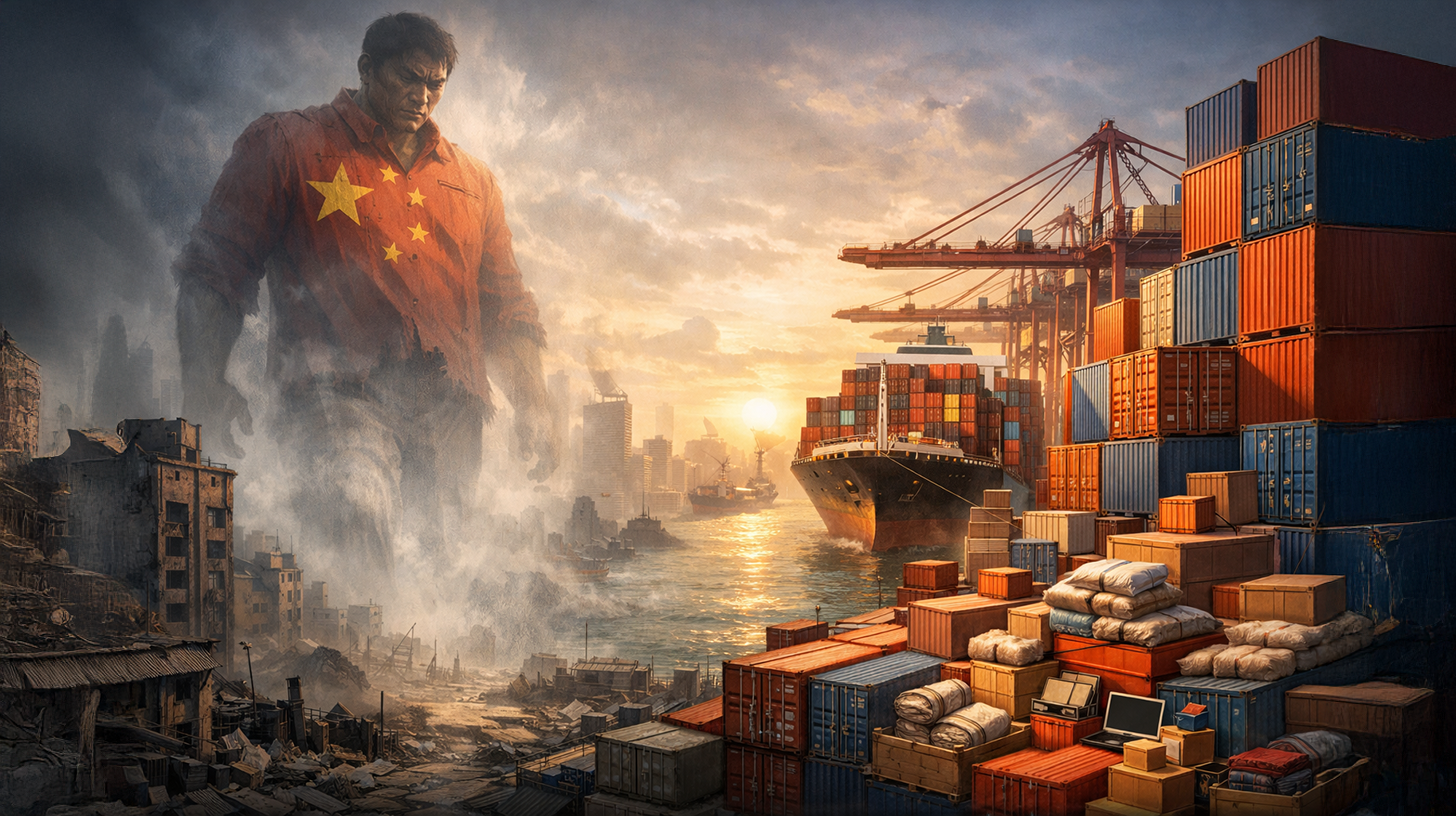
The apparent giant and disenchanted behemoth: China can only save its weakening domestic growth with a record trade surplus – Image: Xpert.Digital
China's growth model: Export boom as a stopgap solution for structural weakness
The apparent strength of the gigantic trade surplus masks a dangerous internal weakness
China narrowly achieved its 2024 growth target of five percent, but the joy over this achievement remains overshadowed by massive structural problems. Growth in the fourth quarter of 2024 was only 4.5 percent, a significant decline compared to the previous quarter. Official statistics show that while the Chinese economy is still generating growth, the quality and sustainability of this growth are increasingly being questioned. International economic research presents a more nuanced picture. While the Chinese National Bureau of Statistics reported 5.4 percent growth in the fourth quarter, independent analysts arrive at considerably lower figures. The Cologne Institute for Economic Research (IW) points to forecasts that predict an average growth of only 4.6 percent for 2024. The Rhodium Group, a renowned US research institute, even puts the actual growth for 2024 at only 2.4 to 2.8 percent.
The discrepancy between official figures and independent estimates is remarkable and raises questions about the statistical quality of Chinese data. Forecasts for 2025 are even more pessimistic. Of 22 leading economic institutes, only one expects growth to reach the five percent mark again. The average forecast for 2025 is 4.4 percent, and for 2026 it is only 4.1 percent. These figures do not signal a temporary dip, but rather a profound structural shift towards a significantly more moderate growth phase.
Related to this:


From 5.3 percent to 4.5 percent: Growth is losing momentum
The slowdown in growth is not a new phenomenon, but the speed and duration of the slowdown are worrying. After a strong 5.3 percent in the first quarter of 2024, the economy steadily lost momentum. The second and third quarters already showed clear signs of weakness, which could only be offset by massive export stimulus in the final quarter. This export dependence is problematic because it makes China vulnerable to external shocks and geopolitical tensions. The economic structure has been shifting increasingly in recent years. While industrial production is still growing relatively robustly, private consumption is stagnating and private investment is lacking. The reasons are manifold and range from the ongoing housing crisis and high youth unemployment to a general loss of consumer confidence in the economic future.
The Chinese government is responding with a mix of cyclical measures and structural reforms, but their effectiveness is limited. The ongoing liquidity crisis in the real estate sector, debt-ridden local governments, and high levels of household debt restrict the scope for expansionary monetary policy. The interest rate cuts of recent months have had little lasting impact on investment activity. The central government faces a dilemma: an overly expansionary monetary policy could further fuel already high levels of debt and jeopardize financial stability, while an overly restrictive policy would further weaken growth momentum.
Related to this:

A trillion dollar surplus: The export machine is running at full speed
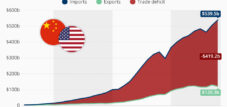
China's trade surplus reached a historic high in 2024, surpassing the one trillion dollar mark for the first time. Exports totaled $3.415 trillion in the first eleven months, while imports reached only $2.339 trillion. This resulted in a surplus of $1.076 trillion, already exceeding the previous year's level by almost nine percent. This surplus is equivalent to nearly the entire economic output of Switzerland or Poland. Chinese exports outpace imports by almost 50 percent, an extreme imbalance that destabilizes the global economy.
The composition of exports shows that China no longer functions solely as a low-wage country. High-tech products such as electric vehicles, batteries, solar panels, and electronic components dominate exports. These products are promoted through massive government subsidies, leading to significant distortions of competition in global markets. A comprehensive study by the European Union confirmed that Chinese electric vehicles can be offered at around 20 percent lower prices than comparable EU products, solely due to government support. Exports to Europe rose by approximately eight percent in 2024, while imports from Europe fell by two percent. The development is particularly dramatic in trade with Germany and Italy, where Chinese exports increased by more than ten percent in each country, while imports from Germany fell by 3.5 percent and from Italy by 6.6 percent.
The trade surplus is being artificially inflated by declining imports. Chinese imports fell by 0.6 percent in 2024 compared to the previous year, while exports rose by 5.4 percent. This development is atypical for a growing economy and indicates weak domestic demand. The reason lies in the high savings rate of private households and their need for security in the face of an uncertain economic future. Consumers are saving more and consuming less, which is suppressing import demand for consumer goods. At the same time, China is using exports as an outlet for its overcapacity in numerous industrial sectors.
The consumption stagnation: Why the Chinese are no longer buying
Weak domestic demand is the central structural problem of the Chinese economy. Private consumption is growing only moderately and is lagging behind expectations. Consumers are uncertain and are increasing their savings rate to record levels. The reasons for this behavior are manifold. The ongoing housing crisis has damaged the wealth of millions of families, as the majority of Chinese private wealth is tied up in real estate. Falling property prices have eroded the sense of prosperity and security. In addition, high youth unemployment is dampening the willingness of young people, who have traditionally been a key driver of consumption growth, to spend.
Private investment is also stagnating. Companies are hesitant to make new investments because the demand outlook is uncertain and capacity utilization is already low in many sectors. The government has launched numerous programs to support consumption, including subsidies for the purchase of electric vehicles and household appliances, but their impact remains limited. The underlying cause lies in a loss of confidence among economic actors. Uncertainty about future economic development, political stability, and social security is leading to more cautious behavior from both households and businesses.
The savings rate in China is traditionally high, but it has increased significantly in recent years. Private households are saving as a precaution against illness, old age, and social insecurity. The social security system in China is less comprehensive than in developed economies, which increases the need for private savings. Cultural factors also play a role, as saving is traditionally considered a virtue in Chinese society. However, the current increase in the savings rate goes beyond cultural and demographic norms and reflects a genuine economic insecurity.
Related to this:

Trade War 3.0: Washington's punitive tariffs as a catalyst for a new geo-economic regime
The trade conflict between China and the United States has evolved in recent years from a classic tariff dispute into a comprehensive geo-economic systemic conflict. The US government has drastically expanded punitive tariffs on a wide range of Chinese products, particularly in strategic industries such as electric vehicles, batteries, semiconductors, solar technology, and other high-tech products. Tariffs on certain categories of goods have been raised to as high as 100 percent, effectively excluding many Chinese products from the US market. This policy should be understood less as a short-term pressure measure and more as part of a long-term strategy to curb China's rise in key future industries and reduce the West's dependence on Chinese supply chains.
These measures have significant consequences for China. While the United States is no longer the largest single buyer of Chinese goods, it remains a major market with high purchasing power and technological clout. The loss of market share in the US is forcing Chinese companies to redirect their surplus production to other markets, particularly Europe, emerging economies, and the Global South. This, in turn, exacerbates trade tensions with the European Union, which is increasingly feeling the pressure from a wave of aggressively priced Chinese imports. Thus, American tariff policy has repercussions far beyond the bilateral framework and is driving the global fragmentation of world trade.
The Chinese leadership is responding to US measures with legal action within the framework of the World Trade Organization and bilateral diplomacy, as well as with a strategic realignment of its export flows and investment objectives. China is attempting to open up new markets in the Global South, for example through increased activity within the framework of the Belt and Road Initiative, bilateral free trade agreements, and investments in infrastructure projects in Africa, Latin America, and Southeast Asia. Furthermore, Beijing is increasingly focusing on building its own technology platforms to reduce its dependence on US technology, particularly in the areas of chips, software, and high-tech machinery. The trade war is thus accelerating a technological decoupling that is likely to change the structure of the global trading system in the long term.
Our China expertise in business development, sales and marketing
Our China expertise in business development, sales and marketing - Image: Xpert.Digital
Industry focus areas: B2B, digitalization (from AI to XR), mechanical engineering, logistics, renewable energies and industry
More information here:
A thematic hub offering insights and expertise:
- Knowledge platform covering global and regional economies, innovation and industry-specific trends
- A collection of analyses, insights, and background information from our key areas of focus
- A place for expertise and information on current developments in business and technology
- A hub for companies seeking information on markets, digitalization, and industry innovations
Weak inside, aggressive outside: The dangerous game of the Chinese economy
Brussels under pressure: Europe's fight against the Chinese export wave
The European Union is caught between China's aggressive export strategy and the protectionist policies of the United States. Europe is both a significant market and an important technology partner for China, but increasingly finds itself the target of an export deluge fueled by overcapacity in the People's Republic. This is particularly evident in sectors such as electric vehicles, solar technology, wind turbine components, batteries, steel, and chemicals. European manufacturers complain of considerable price pressure, which they believe would be impossible without extensive state subsidies in China. The European Commission has therefore launched several investigations into distortions of competition and imposed provisional countervailing duties and minimum prices in sensitive sectors.
These trade policy measures mark a paradigm shift in European policy towards China. While Europe long relied on dialogue, cooperation, and market opening, a defensive industrial protection is increasingly taking center stage. In the electric vehicle sector, additional tariffs and minimum prices have been introduced to prevent a ruinous price war that could structurally weaken the European automotive industry. In solar technology, which was once brought to the brink of collapse by a wave of Chinese exports, a repeat of this development is to be prevented. The EU is attempting to combine industrial policy objectives, such as building its own capacities for batteries, semiconductors, and green technologies, with trade policy defense instruments.
For China, this development is ambivalent. On the one hand, European markets remain attractive despite additional tariffs, as willingness to pay is high and demand for green technologies is being politically promoted. On the other hand, Brussels is signaling unequivocally that a permanent business model based on subsidized surplus production will not be accepted. For European companies, the question arises as to how to strike a balance between protection against dumping and openness to competition. An overly harsh protectionist approach carries the risk of countermeasures from China, such as restrictions on exports of critical raw materials or technological access, while an overly lenient approach could exacerbate deindustrialization trends in Europe.
Export-driven growth as a dead end: The limits of the Chinese model
For decades, China's growth model has been based on a combination of high investment, rapid industrial development, low wages, and export-oriented production. This model has been extraordinarily successful, but it is reaching its limits in the current environment. Global markets cannot absorb China's steadily increasing production capacity indefinitely. Trade conflicts with the US and the EU's growing defense spending demonstrate that the era of virtually unchecked export expansion is over. At the same time, political pressure is mounting in the Global South to develop its own industries and not serve as a permanent market for Chinese surplus production.
China is attempting to resolve this dilemma by shifting the industrial value chain upwards, focusing on high technology, green technologies, and complex industrial products. However, this does little to alter the fundamental logic of the model: overcapacity continues to be reduced through exports, while domestic demand lags behind growth potential. The structural weakness of private consumption, the low wage share of national income, and the high savings rate prevent the domestic economy from assuming the role of a stable engine of growth. Attempts to mask this problem with ever-expanding industrial programs and government subsidies ultimately exacerbate overcapacity and debt risks.
A sustainable transformation of China's growth model would require a significant strengthening of private consumption and the service sector. This would necessitate far-reaching reforms to the social security and pension systems to reduce mandatory retirement savings, as well as greater income redistribution in favor of households. Furthermore, the state would have to be prepared to wind down inefficient state-owned enterprises, strengthen market mechanisms, and create more space for private companies. However, these measures conflict with the leadership's political objective of prioritizing control and stability over market dynamics. The resulting reform gridlock contributes to the entrenchment of structural growth weakness.
Risks for Europe: If China's weakness becomes a global shock
For Europe, and especially for export-oriented economies like Germany, developments in China are of central importance. China is not only a major market for machinery, cars, chemical products, and capital goods, but also a key component of global value chains. A significant slowdown in growth in China therefore impacts European industry through several channels. First, demand for European exports, particularly capital-intensive industrial goods, declines. Second, China compensates by intensifying its export push into other markets, increasing competitive pressure on European producers. Third, financial and currency market reactions, such as a devaluation of the renminbi, can trigger further disruptions in global trade.
Europe thus faces a dilemma: On the one hand, there is an interest in a stable, prosperous China, which serves as a sales market, investment location, and partner in global challenges such as climate protection and the energy transition. On the other hand, China's export strategy is increasingly forcing the EU to protect its own industries from dumping and to reduce strategic dependencies. While a deep crisis in China could boost exports in the short term, it could also contribute to a global recession in the medium term, which would hit the export-oriented European economies particularly hard. The European response will therefore have to consist of a dual strategy of risk diversification and selective cooperation.
For German and European companies, this means that dependencies on China in procurement, production, and sales should be systematically reduced. Diversifying supply chains toward other Asian countries, Latin America, or Eastern Europe will become increasingly important. At the same time, the Chinese market remains indispensable for many industries, making a purely confrontational approach unrealistic. Strategically, it will be crucial to identify those segments where cooperation with China remains worthwhile and those where building independent capacities or forging alternative partnerships should take precedence.
China's path out of the growth trap is becoming a global test
The current state of the Chinese economy presents a contradictory picture of impressive export strength and increasing structural fragility. While the target of five percent growth is being met through a combination of export offensives, government intervention, and statistical smoothing, the internal engine of growth is sputtering. Domestic demand remains significantly below its potential, the real estate crisis is acting as a drag, debt levels are high, and consumer and business confidence is fragile. At the same time, overcapacity in key industries is exacerbating trade tensions with the US and the EU and accelerating the fragmentation of the global economy.
For China, the central challenge will be to shift its growth model from export-driven surplus production to a more domestically oriented, innovation-based, and productivity-driven structure. Whether this transition succeeds will determine not only the social and political stability of the People's Republic but also the future architecture of the global economy. A controlled, reform-supported transition would limit global shocks and keep avenues for cooperation open. A disorderly adjustment process, on the other hand, characterized by financial instability, protectionist backlash, and growing political uncertainty, could become the greatest stress test for the international economic system in decades.
Europe and the US face the challenge of clearly defining their interests vis-à-vis China while simultaneously preserving the openness of the global trading system as much as possible. A purely confrontational approach would lead to a loss of prosperity on all sides and hinder the resolution of global problems. A pragmatic, strategic policy that combines defensive instruments against unfair trade practices with targeted cooperation in selected areas appears to be the realistic path forward. It is within this tension between rivalry and cooperation that the outcome will be determined: whether China's transition to a new growth model becomes an orderly adjustment or a global flashpoint.
Your global marketing and business development partner
☑️ Our business language is English or German
☑️ NEW: Correspondence in your native language!

Konrad Wolfenstein
I and my team are happy to be available to you as your personal advisor.
You can contact me by filling out the contact form here wolfenstein@xpert.digital:or simply call me at +49 7348 4088 965. My email address is
I'm looking forward to our joint project.