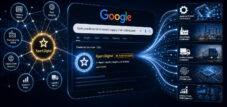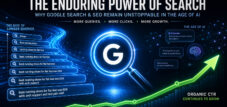
SEO was yesterday? Google Zero: The death of Google Search, the Süddeutsche Zeitung and Media Mix Modelling - Image: Xpert.Digital
Visible, but without visitors: Why the classic last-click model is finally obsolete
When AI answers the question: How to prepare your website for the new Google reality
The Death of the Click: How AI Search is Reshaping the Internet Economy
The classic rules of search engine optimization no longer apply. For years, the equation in digital marketing was simple and reliable: a good ranking on Google guaranteed clicks, delivered consistent traffic, and ultimately generated revenue. But with the widespread introduction of AI summaries—the so-called AI Overviews—this decades-old chain of cause and effect is breaking down. The phenomenon of "Google Zero" illustrates a drastic tectonic shift: the majority of search queries are now answered directly on the results page, without users ever having to click on a link. For companies, marketing managers, and publishers, this decoupling of visibility and website visits is a fundamental turning point. Those who continue to rely solely on outdated click metrics and the last-click model not only lose their focus in terms of measurement but also risk becoming economically invisible in the new era of language models. Read on to find out why the economics of the internet is undergoing a fundamental transformation and what strategic responses are now essential.
The search doesn't disappear, but the visit
If visibility increases but traffic decreases – who is still measuring the truth?
When the Süddeutsche Zeitung reported on the phenomenon of "Google Zero" in mid-August 2026 under the headline "The Death of Google Search," it wasn't a wake-up call for experts, but rather a confirmation of what has long been a reality in e-commerce. Traditional internet search isn't dying in the sense that users are ceasing to ask questions. It's dying in its previous economic function as an intermediary between query and website visit. The crucial shift lies not in the decline of search queries, but in the breaking of the previously inseparable chain of search query, ranking, and click. A company can now appear prominently in an AI-generated answer, be quoted, and still not drive a single visitor to its own website. This decoupling of visibility and traffic is the real break that marketing managers, CEOs, and investors must understand, because it calls into question the fundamental assumption of decades of success measurement in digital marketing.
The raw numbers powerfully support this thesis. Recent studies based on Similarweb clickstream data show that in the first four months of 2026, around 68 percent of all US Google searches ended without a single click on a website, compared to around 60 percent in 2024. This means that out of every 1,000 search queries, only 276 actually reach the open web, whereas in 2024 it was 374. Other surveys arrive at slightly lower, but equally dramatic figures between 60 and 65 percent, depending on the methodology and time period. Regardless of the exact percentage, all available studies point in the same direction: The proportion of search queries that lead to a visit to an external website is shrinking continuously and has accelerated even further since the widespread introduction of AI summaries.
If the answer already answers the question
The central driver of this development is so-called AI Overviews, AI-generated summaries that Google displays directly above the traditional search results. These overviews combine information from multiple sources and provide users with a complete answer without requiring them to visit the underlying websites. Depending on the study, AI Overviews now appear in between 20 and almost 60 percent of all Google search queries, with significant variations depending on the industry, the type of query, and the time of the survey. In sectors like healthcare or education, where users predominantly ask informational questions, the coverage with AI summaries is considerably higher than average, sometimes exceeding 80 percent.
The impact on click-through rates is clearly documented. A comprehensive study by Seer Interactive, analyzing 53 brands, 5.47 million search queries, and 2.43 billion impressions between January 2025 and February 2026, found an organic click-through rate of just 0.61 percent for queries with an AI overview, compared to 1.62 percent without this summary—a drop of 61 percent. Paid ads also suffered significantly: their click-through rate fell from 19.7 to 6.34 percent, a decrease of 68 percent, during the same study period. The Pew Research Center reached a similar conclusion in a separate panel study: users clicked on an organic search result only 8 percent of the time when an AI summary was displayed, compared to 15 percent without such a summary—almost a halving. Another statistic from this study is particularly noteworthy: only about 1 percent of users even clicked on any of the source links cited in the AI summary itself. The source is mentioned, but practically never visited.
A gentle sigh of relief, not a comeback
Interestingly, the latest data from the first quarter of 2026 suggests a slight recovery, though it requires nuanced analysis. The organic click-through rate (CTR) for queries with AI Overview rose from a low of 1.3 percent in December 2025 to 2.4 percent in February 2026, an 85 percent increase in just two months. Google appears to have optimized the placement of links within the summaries, slightly improving the visibility of individual sources. A revealing detail emerges: pages actually cited as sources within an AI Overview achieve a CTR of around 2.1 percent, while uncited pages on the same results page only manage 0.9 percent. However, both figures remain significantly below the baseline of approximately 3.3 percent measured for search queries without any AI summary. The recovery is real, but it doesn't represent a return to the old normal. It merely shifts the new, permanently lower level slightly upward.
A second differentiating factor concerns the query type. For so-called brand search queries, where users explicitly search for a specific company or product, a contrasting trend emerges: The click-through rate for such queries rose from 2.8 percent at the beginning of 2025 to 3.8 percent in February 2026. This suggests that while AI summaries can replace clicks for general, exploratory queries, they can still trigger a visit when a brand preference already exists, possibly even more frequently than before, because the AI response further sharpens interest in the brand. This observation is economically significant because it shows that the position in the purchase decision funnel plays a crucial role in whether or not visibility translates into traffic.
Visibility does not equal sales, but it is not worthless either
The core thesis that a ranking can generate visibility without triggering a visit is clearly confirmed by the available data, without, however, falling into the other extreme position of declaring visibility meaningless. Several studies point to an indirect effect that systematically remains invisible in traditional click metrics. For example, brands mentioned in an AI overview are said to receive, on average, 2.1 times more brand searches within 24 hours than brands that were not mentioned. This effect means that while an AI mention doesn't trigger an immediate click, it may provoke a later, deliberate search for the brand, which then certainly leads to a visit or a transaction. Such a causal pathway is practically impossible to map with traditional attribution models that primarily focus on the last click before a conversion, because several days or even weeks can pass between the initial AI mention and the actual conversion, and no technical link exists between the two events.
At the same time, the data also shows that this delayed effect doesn't even come close to compensating for the immediate loss of traffic. Research by the consulting firm Bain suggests that around 80 percent of consumers rely on zero-click results in at least 40 percent of their search queries, reducing overall organic web traffic by an estimated 15 to 25 percent. For companies whose business model relies on organic search traffic as their primary source of acquisition, this represents a structural erosion of customer acquisition that cannot be offset by isolated optimization measures but requires a fundamental realignment of their digital strategy.
Why position one no longer means position one
The development of the click-through rate (CTR) for the traditionally most valuable position in search results—the first organic result—is particularly revealing. An analysis by the SEO tool provider Ahrefs shows that the CTR for position one in search queries using AI Overview has plummeted by 58 percent, with the absolute value falling from 7.3 percent in December 2023 to just 1.6 percent in December 2025. This figure is remarkable because, for years, the number one position was considered the ultimate goal of all search engine optimization, and entire business models, pricing structures for backlink services, and content strategies were built upon this single objective. When even the supposedly most valuable position in the search results now delivers only a fraction of its former value, the classic ranking as the sole indicator of success loses considerable significance.
A further contributing factor is that search queries without AI Overviews are also affected by a general decline in click-through rate, albeit to a lesser extent. The click-through rate for non-AI Overview queries fell from 7.6 to 3.9 percent during the same period. This demonstrates that the entire search results page is changing, not just those areas where an AI summary is actually displayed. Over the years, Google has introduced additional elements such as knowledge panels, image carousels, video previews, and other interactive modules, which, together with the AI Overviews, capture users' attention on the results page itself, even before a traditional blue link catches their eye.
The deceptive simplicity of the last-click model
From an economic perspective, the real break lies not primarily in the technology, but in the measurement logic that companies have used for decades to evaluate the success of their digital marketing. The so-called last-click attribution model, in which the last click before a conversion receives full credit for the sales success, has always been a simplification that ignores the actual, often lengthy and multi-stage decision-making process of consumers. This simplification was tolerated for years because it was easy to implement, easy to communicate, and seemingly objectively verifiable. As long as there were a sufficient number of clicks, this method provided at least a rough indication, even if it systematically overvalued certain marketing channels and undervalued others.
With the decline in clicks, however, this crutch finally collapses. If 60 to 68 percent of all search queries no longer generate a click, but still influence purchasing decisions, then the last-click model measures only a shrinking portion of the actual impact of marketing. Paradoxically, this gap creates a favorable market environment for providers of new measurement and analysis tools who position themselves as the solution to the resulting uncertainty, without these tools necessarily providing a fundamentally better understanding of the actual causality. The desire to measure something is understandable from both a human and business perspective, but it must not lead companies to buy into supposed precision where, in reality, significant uncertainty persists.
🎯🎯🎯 Data-driven B2B industry hub as a quasi-in-house solution


The quasi-in-house solution: How Xpert.Digital closes operational gaps in B2B marketing and sales – Smart Content-Driven Business - Image: Xpert.Digital
Xpert.Digital is a data-driven B2B industry hub led by Konrad Wolfenstein . The company acts as an external, quasi-in-house solution for industrial partners, closing operational gaps in marketing, content, and sales – without requiring additional resources on the client side.
More information here:
Invisibility in AI models: The underestimated risk to your digital market presence
Media Mix Modelling as an answer to an old question
In this context, a methodology that is decades old is gaining renewed relevance: media mix modeling. This statistical approach assesses the influence of different marketing channels on total revenue without relying on individual click or cookie data, but rather on aggregated time series data and econometric models. In the past, many advertisers dismissed media mix modeling as too complex, too slow, and lacking in granularity, particularly because the last-click model seemed to offer a simpler and faster answer to the question of which channel generated which revenue. However, this apparent simplicity, as it now turns out, was an illusion based on the availability of click data, which inevitably loses its explanatory power as its availability declines.
The return to holistic measurement models like media mix modeling is therefore less a passing fad than a structural necessity. Companies that continue to rely solely on click-based metrics risk systematically drawing incorrect conclusions about the effectiveness of their marketing expenditures and misallocating budgets. A model that considers total revenue, brand awareness, and external factors such as seasonality, competitive activity, or macroeconomic conditions together can at least partially reveal the indirect effects on brand perception generated by AI summaries, even if precisely attributing causality to individual touchpoints remains difficult.
Clicks from AI responses perform poorly, but not the worst
Another important finding concerns the actual quality of clicks that do result from AI-generated results. Available performance data indicates that clicks originating from AI responses, such as AI Overviews or direct answers from language models, perform below average compared to virtually all other performance marketing channels, as measured by metrics like conversion rate or time spent on the landing page. Social media ads are a notable exception, with their click quality being even lower in comparable analyses. This observation challenges the widespread assumption that AI search results automatically deliver high-quality, purchase-ready traffic simply because the user has already received a sophisticated answer before even reaching a website.
The most obvious explanation for this pattern lies in the changed state of information available to the user at the time of the click. Those who have already received a complete, AI-generated answer to their question tend to click only out of residual curiosity, to verify a detail, or out of general interest, but not primarily with an immediate intention to buy. In many cases, the actual conversion decision has already been made before the click or is made entirely without visiting the website, for example, directly within the chat interface of an AI assistant. For companies, this means that while the remaining traffic from AI sources is measurable, it may reveal little about the actual business impact of their visibility within AI systems.
The real problem is invisibility, not lost clicks
Perhaps the most important, yet least discussed, insight from the current debate is that the decline in click-through rates isn't the most pressing problem for many companies. Far more serious is the fact that a significant number of businesses simply don't appear in the results of major language models at all. While the SEO industry has developed sophisticated methods for achieving visibility in traditional search results over the past two decades, optimization for language models, often referred to as Generative Engine Optimization or AI visibility optimization, is still in its early, experimental stages. Many mid-sized companies have yet to develop a strategy or even an awareness of whether and how they are mentioned in ChatGPT, Gemini, Perplexity, or Google's AI summaries.
This visibility deficit is potentially more economically significant than the mere loss of clicks because it can mean complete market exclusion. A company that, despite a lower click-through rate, is still prominently mentioned in AI-generated results retains at least some access to the consumer decision-making process. Conversely, a company that simply doesn't exist in AI systems completely loses access to the growing share of purchasing decisions that are now initiated via AI assistants rather than traditional search engines. Given that, according to Gartner, 71 percent of B2B research processes already begin with a generic search query, but less than half of these actually result in a website visit, it becomes clear how high the stakes are for companies that are not present in these early stages of the decision-making process.
SEO versus GEO is the wrong question
The intense debate among experts about whether traditional search engine optimization (SEO) should be replaced by a new discipline called Generative Engine Optimization (GEO) overlooks the real strategic challenge, according to an analysis of the available data. It's not a question of either/or between two competing optimization disciplines, but rather the need for an integrated presence strategy across multiple, structurally different layers of information. Ultimately, what matters is not the label under which a measure is implemented, but whether a brand is equally present in traditional organic search results, in AI summaries within the search engine, and in the responses of independent language modeling applications.
This online presence must then translate into actual demand, whether in the form of direct brand searches, organic traffic growth, or ultimately measurable revenue. While the technical mechanisms by which a website ranks in traditional search results differ from those that determine whether a language model cites a brand in its response, both mechanisms rely on a common foundation: structured, authoritative, trustworthy, and frequently cited content. Companies that focus their content strategy exclusively on one of these two worlds systematically miss out on potential in the other.
What remains of classic search engine optimization?
Despite all the shifts, it would be premature to declare traditional search engine optimization obsolete. According to current estimates, Google still processes approximately 8.5 billion search queries per day, a large proportion of which, while ending without a click, still result in a website visit. Particularly for transactional search queries, where users have an immediate intention to buy, the zero-click rate remains significantly lower, at between 38 and 49 percent, compared to purely informational queries, which sometimes achieve zero-click rates of over 80 percent. For companies with a strong transactional search profile, such as in e-commerce with specific product searches, the traditional organic channel therefore remains economically important, albeit with a declining trend.
The strategic consequence, therefore, is not a complete abandonment of traditional search engine optimization, but rather a re-evaluation of expectations and key performance indicators (KPIs). Traditional SEO remains relevant for transactional and highly commercial search intent, but is systematically losing effectiveness for informational, exploratory, and comparative search queries, which are increasingly answered directly within the search results page or by an AI assistant, without requiring a click.
Business options in the new reality
Several concrete strategic consequences can be derived from the available data, going beyond general recommendations. First, companies should fundamentally revise their success measurement and move from a purely click- and conversion-based logic to a multidimensional model that considers brand visibility, mention frequency in AI systems, and long-term brand search trends as independent, equally important metrics. Second, a systematic review is necessary to determine whether and how the brand appears in relevant language models, as many companies currently lack this basic assessment. Third, high-quality, clearly structured, and fact-based content is gaining importance because language models tend to favor authoritative, well-documented, and unambiguously formulated content when selecting citable sources.
Fourth, marketing budgets should be more strongly focused on building direct brand relationships, for example via email lists, communities, or recurring user relationships that are not dependent on the intermediary role of a search engine or language model. Fifth, a return to holistic, econometric measurement models such as media mix modeling is recommended to at least partially compensate for the blind spots in performance measurement that have arisen due to the changing click landscape. Companies that make these adjustments early gain a structural advantage over competitors who continue to rely exclusively on a measurement model whose foundation is constantly shrinking.
A structural shift with no return
The available data leaves little doubt that the current trend is not a temporary anomaly, but rather a permanent structural shift in the digital economy. The proportion of clickless search queries has risen steadily over several years, from around 50 percent in 2019 to the current 60 to 68 percent, and forecasts predict a further increase to 68 to 72 percent by 2028. This trend is further amplified by the increasing prevalence of standalone AI assistants like Perplexity, whose zero-click rate, according to available data, is around 93 percent, as these applications are designed from the ground up to answer questions directly and completely without redirecting the user to an external website.
For companies, publishers, and content creators, this means that the central question in the coming years will not be how to win back lost clicks, but how to generate economic value even when clicks as the mediating event are increasingly rare. This requires a fundamental shift in thinking that goes beyond tactical adjustments to individual marketing campaigns and re-examines basic questions about positioning, content monetization, and the definition of success in the digital space. Those who still think exclusively within the logic of the past decade and define success primarily by rankings, click-through rates, and organic traffic are becoming increasingly blind to the value creation that has long since moved beyond these metrics, and equally blind to the real erosion of their own market presence in a search ecosystem that is undergoing a fundamental reorganization.
📈🚀 From visibility to trust 👀🤝 Your scalable path with Xpert.Digital


From visibility to trust: Your scalable path with Xpert.Digital - Image: Xpert.Digital
In industrial B2B, sustainable business relationships rarely emerge overnight. They develop step by step – through visibility, professional relevance, recurring touchpoints, and growing trust. Xpert.Digital's 4-stage model addresses precisely this: It offers a structured path that begins with a manageable entry point and can evolve into deeper collaboration in business development if needed.
Instead of relying on loud marketing promises, this model puts the relationship at the forefront. Companies start with clearly defined, easily calculable measures and then decide, based on their own experience, how far they want to expand the collaboration. A key factor for this undisturbed trust-building process: The platform completely avoids annoying advertising ads, so the editorial focus remains solely on the companies' expertise.
More information here:
Your global marketing and business development partner
☑️ Our business language is English or German
☑️ NEW: Correspondence in your native language!

Konrad Wolfenstein
I and my team are happy to be available to you as your personal advisor.
You can contact me by filling out the contact form here wolfenstein@xpert.digital:or simply call me at +49 7348 4088 965. My email address is
I'm looking forward to our joint project.