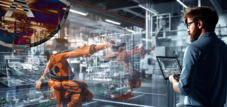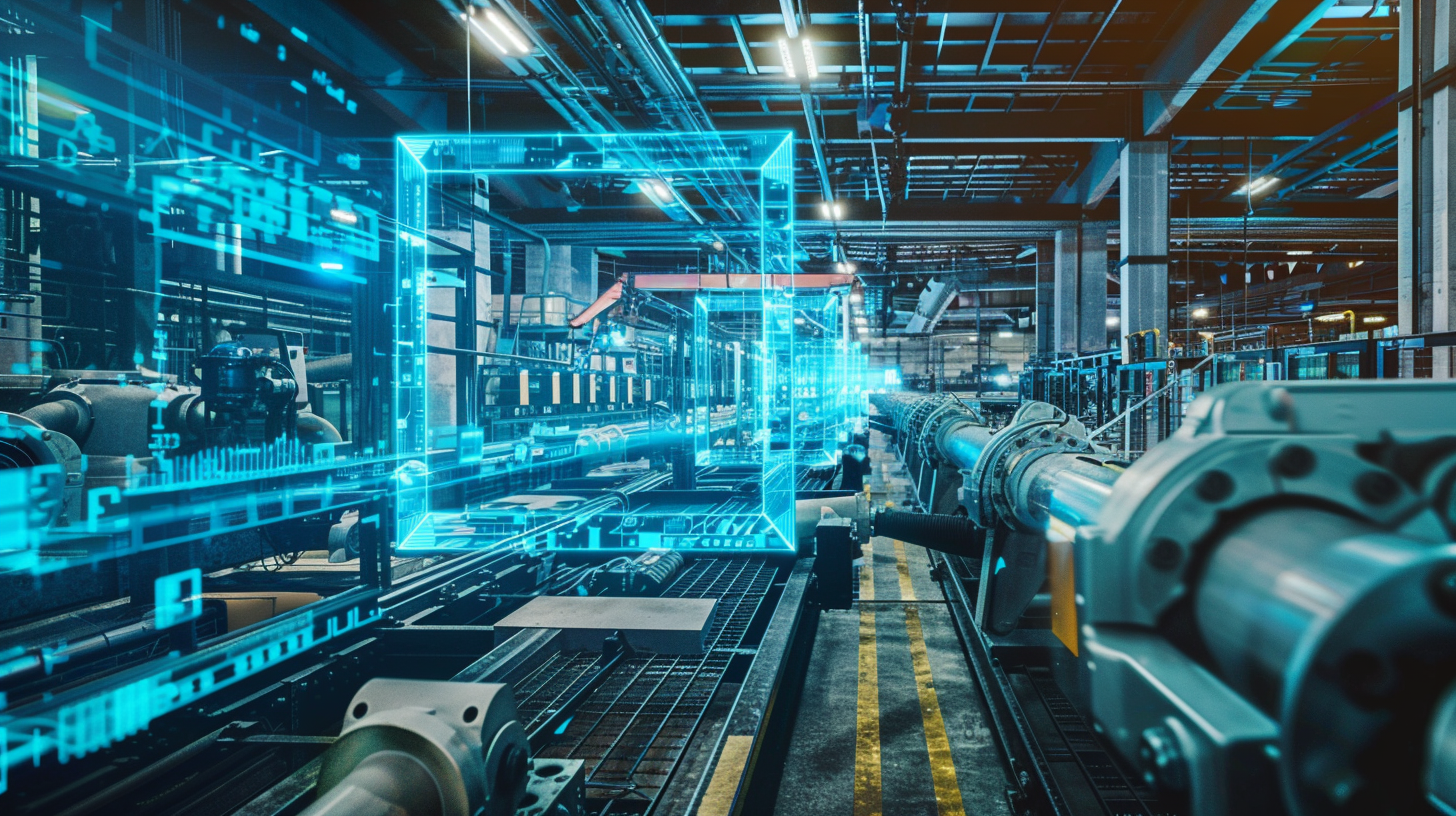
The digital twin in Industry 4.0: between the virtual and physical worlds – Image: Xpert.Digital
🌐💡 The virtual twin: Key technology of the future
🔍✨ Virtual Twins: New Dimensions for Industry
Virtual twins have long been considered a crucial key to making production processes more efficient, cost-effective, and future-proof. As the ongoing digitalization and networking of machines, systems, and entire production lines within the framework of Industry 4.0 gains increasing importance, digital representations of physical products, systems, and processes open up entirely new possibilities. These virtual representations enable companies to conduct extensive simulations, tests, and optimizations long before a product is physically manufactured. This allows for both reduced development costs and increased quality, ultimately leading to a more sustainable, flexible, and competitive manufacturing landscape. But what exactly is meant by the term "virtual twin," how can its potential be fully exploited, and what impact will this technology have on our industrial future?
🖥️🤖 Virtual Twins: Digital Mirror Images of Reality
The virtual twin, often also called a digital twin, is essentially an exact digital replica of a physical object, process, or even an entire system. It doesn't matter whether it's a single machine, a complex production line, a complete factory, or a finished product. The digital image reflects all the properties, functions, and states of its real-world counterpart and is continuously updated with real-time data from sensors, machine controls, or other digital sources. This creates a dynamic digital model that provides a complete and up-to-date overview of the real object's state at any given time. You can think of this model as a constantly updated mirror that allows you to transfer the real world into a virtual environment and examine it at will.
A key advantage of this concept lies in the ability to simulate various scenarios without consuming real resources or causing any damage. In a digital development environment, companies can test new materials, optimize production processes, better plan maintenance intervals, and identify potential weaknesses early on. A virtual twin, therefore, doesn't just represent static properties, but is a living, constantly evolving system that operates based on data, algorithms, and models. Production managers, engineers, and maintenance personnel can thus understand complex processes in detail in real time and at the touch of a button, initiate potential improvements, and make precisely coordinated decisions.
🌍🔗 Industry 4.0 and the virtual twin: The digital ecosystem
In the context of Industry 4.0, networking plays a crucial role. Integrating the virtual twin into a comprehensive digital ecosystem enables different business units and systems to communicate with each other. Sensors in production facilities continuously provide data such as temperature, pressure, vibrations, and capacity utilization. An enterprise resource planning (ERP) system can provide information on material availability or supply chain status. Simulation and analysis tools process this data and deliver recommendations for action. All this information flows into the virtual twin. Connecting it to other emerging technologies such as artificial intelligence, machine learning, and the Internet of Things (IoT) makes it possible to gain valuable insights from data, create forecasts for future developments, and optimize processes autonomously.
⚙️🔧 Application: Predictive maintenance and efficiency improvement
A concrete application example can be found in predictive maintenance. Instead of adhering to fixed intervals for replacing components, the actual stress on machine components can be assessed in real time using the digital twin. Intelligent algorithms can determine when a part is likely to reach its maximum permissible service life and whether a failure is imminent. This allows downtime to be minimized, maintenance interventions to be planned efficiently, and failures to be avoided from the outset. The virtual twin provides precise information on when and how maintenance measures should be implemented most effectively. The result is increased plant availability, extended equipment lifespan, reduced downtime, and ultimately, higher overall productivity.
🚀🛠️ Product development: Design flexibly and quickly
But the benefits aren't limited to maintenance. Another key area of application is product development. Companies have long been relying on holistic digital concepts where new products are initially designed, simulated, and tested entirely virtually before the first prototype is built. This drastically shortens development phases and reduces material usage and costs. If requirements or standards change later in the development process, the digital twin can be flexibly adapted to the new circumstances. The result is a smoother, faster, and more resource-efficient innovation process that gives companies a significant competitive advantage.
📈🎯 Customer focus: Developing tailor-made products
The digital twin also plays a crucial role in adapting to customer requirements. Individual customer requests, which once required complex custom designs, can now be implemented much more quickly. The production process can be flexibly adjusted, as changes are first tested virtually. Customers are integrated into the development process earlier, gain comprehensive insights into the designs, and can directly incorporate their suggestions into the virtual model. This close collaboration between manufacturers and customers leads to products that precisely meet market needs without the need for extensive physical testing.
♻️🌱 Sustainability thanks to digital twins
Besides increasing efficiency, the virtual twin also offers significant advantages in terms of sustainability. Precise simulations and analyses allow for the early identification of ways to minimize material usage and energy consumption. This applies to individual components as well as entire production facilities. Maintenance work can be carried out in a targeted manner, less waste is generated, and energy consumption can be continuously optimized. Overall, this contributes to the economically and ecologically sound design of industrial processes. In this way, the virtual twin seamlessly integrates into the concept of the circular economy, in which products and materials are kept in the value chain for as long as possible.
🏭👷♂️ The impact on the world of work
The impact on the world of work should not be underestimated. Skilled workers in industry can benefit considerably from these new opportunities. Engineers, developers, production managers, and maintenance specialists gain a reliable tool through the digital twin, facilitating data-driven decisions. Instead of relying on vague assumptions, they can access solid, fact-based, and continuously updated information. This makes work not only more efficient but also safer. Complex processes become transparent, sources of error are identified early, and workflows can be better coordinated. Ultimately, this also increases the quality and value of manufactured goods, as potential quality defects can be identified and eliminated as early as the planning phase.
💰💻 The necessary investments and challenges
However, the virtual twin is not a solution that can be implemented without effort. Companies must be prepared to invest in digital infrastructure, sensors, data processing, and the necessary software. Specialized expertise and training are also required to fully exploit the potential of these virtual representations. But those who take this step will be rewarded in the long run. The introduction of digital twins is more than just another technological gimmick – it marks a true milestone on the path to the factory of the future. This factory is highly flexible, highly automated, sustainable, and closely integrated with other stages of the value chain. It reacts dynamically to market changes, fluctuations in supply chains, or unforeseen events.
🔍🕹️ Scenario planning with digital twins
With the help of digital twins, production planners can already simulate various future scenarios. What happens if demand for a particular product suddenly increases sharply? How can production capacity be expanded quickly without compromising quality? What bottlenecks in the material flow would occur, and how can these be avoided in time? All these questions can be answered in the digital realm before they manifest in the real world. The virtual twin also offers valuable support in the face of global crises, volatile markets, or new legal requirements.
📈🌎 The scalability of digital twins
Scalability is another key aspect. A virtual twin doesn't have to be limited to a single product or machine. Entire production sites can be transferred into a digital world. For the first time, this offers the opportunity to map complex supply chains, production in different countries, or even the interaction of different plants in a uniform and transparent way. This allows for better coordination of global processes, more efficient resource allocation, and more informed strategic decisions.
🔐🛡️ Handling sensitive data
At the same time, with advancing digitalization, the responsibility for handling data also grows. The virtual twin is based on a constant flow of data: it accesses design data, production parameters, sensor measurements, and much more. It is essential that companies establish robust security concepts to protect their sensitive data from unauthorized access. Equally important is protecting the privacy of employees and business partners. Data must be carefully managed, access rights clearly defined, and security measures regularly reviewed. Only in this way can it be ensured that the virtual twin becomes a strong pillar of the company's strategy, rather than a weak point.
🌍🔗 From Industry 4.0 to digital integration
Overall, the virtual twin is more than just a technological trend. It is the next logical step in a development that leads from pure automation, through networking, to the complete digital integration of all business areas. Industry 4.0 describes precisely this path, in which the digital and the physical merge ever more closely. Real-world production is augmented by a virtual layer where errors can be detected cost-effectively, innovations accelerated, and resources used more efficiently.
🏗️🩺 Beyond the manufacturing industry
Looking to the future, it is becoming clear that virtual twins will not only play a role in the traditional manufacturing industry, but will also find their way into other sectors. Applications in logistics, construction, medical technology, and even agriculture are conceivable. Wherever processes are complex, costly, and closely intertwined, a digital counterpart can help to better understand and control them, and adapt them to future challenges. Even today, virtual twins create real advantages by helping companies remain competitive, operate economically, and always keep the increasing demands of environmental and climate protection in mind.
🛠️🌟 The virtual twin as a milestone
Ultimately, the virtual twin symbolizes a new era of industrial value creation, in which the interplay of humans, machines, and digital tools becomes commonplace. Its ability to manage complexity, reduce costs, minimize risks, and foster innovation makes it an indispensable companion for all those embarking on the journey into the digital future. The question is less about whether to engage with virtual twins, but rather when and how intensively. Those who make the right decisions early on will benefit from the real advantages this technology offers. Thus, it can already be said today: Virtual twins mark the next step in production toward the digital future and form a central foundation for a successful Industry 4.0.
📣 Similar topics
- 📢 Virtual Twins: Key to the Factory of the Future
- 🌍 Promoting sustainability through digital twins
- 💡 Accelerate innovation with digital twins
- 🛠️ Optimizing production: Virtual twins in everyday industrial life
- 📊 Data-driven: What the digital twin makes possible
- 🔒 Security and data protection in the world of virtual twins
- 🤖 Industry 4.0 and the next step towards digitalization
- 🌱 Circular economy reimagined through simulations
- 🧩 Networking and interaction: Digital twins in practice
- 🔜 Future visions: How virtual twins are transforming industry
#️⃣ Hashtags: #VirtualTwins #Industry4Zero #Digitalization #Sustainability #FutureTechnologies
Our recommendation: 🌍 Limitless reach 🔗 Connected 🌐 Multilingual 💪 Sales power: 💡 Authentic with strategy 🚀 Innovation meets 🧠 Intuition

From local to global: SMEs conquer the world market with a clever strategy - Image: Xpert.Digital
In an era where a company's digital presence determines its success, the challenge lies in creating an authentic, personalized, and far-reaching presence. Xpert.Digital offers an innovative solution that positions itself as the intersection of an industry hub, a blog, and a brand ambassador. It combines the advantages of communication and sales channels in a single platform and enables publication in 18 different languages. Cooperation with partner portals and the ability to publish articles on Google News and a press distribution list with approximately 8,000 journalists and readers maximize the reach and visibility of the content. This represents a crucial factor in external sales and marketing (SMarketing).
More information here:
🌐 The digital twin in Industry 4.0: between the virtual and physical worlds
✨ A digital twin is a digital representation of a physical object, process, or system that is connected to its physical counterpart in real time. This technology bridges the virtual and physical worlds and plays a central role in modern industry, particularly in the context of Industry 4.0.
🔧 Function and features of a digital twin
A digital twin is based on the integration of data from sensors, devices, and other sources to accurately replicate the state, behavior, and performance of the real-world object or system. The connection between the physical and digital worlds enables:
- To collect and analyze real-time data.
- To conduct simulations in order to optimize processes - to identify potential problems early on.
- Making data-driven decisions.
The technology comprises three main components:
- Physical object in real space.
- Virtual model in digital space.
- A data connection that links both worlds.
🏭 Areas of application in industry
Digital twins are used in various industrial applications, including:
- Production and manufacturing: Optimization of production processes through simulations, quality assurance and virtual commissioning of machines.
- Maintenance: Predictive maintenance through condition monitoring and fault prediction.
- Product development: Simulating new products before physical manufacturing to save time and costs.
- Logistics: Use in automated warehouses or with autonomous vehicles to optimize material flows.
✅ Benefits for industry
The introduction of digital twins offers numerous advantages:
- Increased efficiency: Simulations can be used to optimize production processes and reduce errors.
- Cost reduction: Fewer breakdowns and more precise maintenance planning reduce operating costs.
- Individual customer solutions: Companies can tailor products to specific customer needs by collecting detailed data on the variants used.
- Sustainability: Optimized processes lead to less resource consumption and waste.
🚧 Implementation challenges
The successful implementation of digital twins requires:
- A robust IT infrastructure and data architecture.
- Integration of IoT technologies for real-time data transmission.
- Collaboration between different departments within a company.
With advancing digitalization, the digital twin will be able to take on increasingly complex tasks. It will not only represent individual objects but also simulate entire systems, opening up new possibilities for autonomous decision-making and intelligent production. This technology is a key building block for the transformation towards the Smart Factory and Industry 4.0.
In summary, the digital twin represents a bridge between the physical and virtual worlds. It enables companies to make their processes more efficient, reduce costs, and drive innovation – a crucial step towards a data-driven future.
🤖 How exactly does the connection between the physical product and its digital twin work?
The connection between a physical product and its digital twin is established through a combination of sensors, data transmission, real-time communication, and digital technologies. Here are the key elements and mechanisms of this connection:
1. Sensors and data sources
Physical objects are equipped with sensors that continuously collect data on various parameters. These sensors can provide information such as:
- Temperature,
- Pressure,
- Position,
- Speed,
- energy consumption or
- Collect information on environmental conditions (e.g., weather).
This data forms the basis for the digital representation of the object.
2. Real-time data transmission
The collected data is transmitted to the digital twin in real time or near real time. This occurs via networks and communication protocols such as MQTT, HTTP(S), or AMQP, which are specifically optimized for IoT applications. IoT hubs act as central interfaces to establish the connection between physical devices and the cloud.
3. Digital Processing and Modeling
In the digital twin, the transmitted data is processed and integrated into a virtual model. Using big data, artificial intelligence (AI), and machine learning, this data can be analyzed to:
- Recognizing patterns
- Making predictions and
- To identify anomalies.
The digital model is continuously updated to accurately reflect the current state of the physical object.
4. Simulation and Interaction
The digital twin enables simulations based on the collected data. These simulations can be used to test scenarios or make optimizations. Furthermore, the digital twin can actively interact with the physical object by sending control commands back to influence the behavior of the physical system.
5. Visualization
Modern technologies such as 3D models or augmented reality (AR) make it possible to visually represent the digital twin. This facilitates the understanding of complex systems and supports decision-making processes.
Summary of the connection
The connection between the physical and digital worlds is based on a bidirectional flow of information:
- Sensors continuously send data from the physical object to the digital twin.
- The digital twin analyzes this data, performs simulations, and sends control commands back to the physical object as needed.
This process enables a close integration of the real and virtual worlds, allowing companies to gain insights, optimize processes and identify problems early on.
📣 Similar topics
- 📊 Industry 4.0: How the Digital Twin is revolutionizing production
- 🛠️ Predictive maintenance through digital twins – opportunities and advantages
- 🌐 Smart Factory: Digital Twins as the Key to Digitalization
- 🤖 Digital twin and AI: The perfect symbiosis for the future
- 💡 From idea to reality: Product simulation through digital twins
- 🚀 Optimized logistics with digital twins – efficiency reimagined
- 🌱 Sustainability through digital technologies: The digital twin in focus
- 🔄 Data-driven management through real-time networking
- 👩🔧 Practical applications: How the digital twin is changing maintenance
- 📐 Simulation as the future: Virtual models for real results
#️⃣ Hashtags: #Industry40 #DigitalTwin #SmartFactory #Sustainability #IoT
We are here for you - Consulting - Planning - Implementation - Project Management
☑️ SME support in strategy, consulting, planning and implementation
☑️ Creation or realignment of the digital strategy and digitization
☑️ Expansion and optimization of international sales processes
☑️ Global & Digital B2B trading platforms
☑️ Pioneer Business Development

Konrad Wolfenstein
I would be happy to serve as your personal advisor.
You can contact me by filling out the contact form below or simply call me on +49 7348 4088 965 .
I'm looking forward to our joint project.
Write to me


Xpert.Digital - Konrad Wolfenstein
Xpert.Digital is a hub for industry focusing on digitalization, mechanical engineering, logistics/intralogistics and photovoltaics.
With our 360° Business Development solution, we support renowned companies from new business to after-sales.
Market intelligence, smarketing, marketing automation, content development, PR, mail campaigns, personalized social media and lead nurturing are part of our digital tools.
You can find more information at: www.xpert.digital - www.xpert.solar - www.xpert.plus
Keep in touch