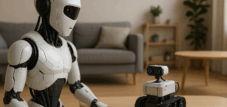
The start-up IntuiCell: The vision of a digital nervous system and a virtual brain for robots – Image: Xpert.Digital
Self-learning robots: A breakthrough from Sweden is changing machine technology
New generation of robots learns through experience instead of programming
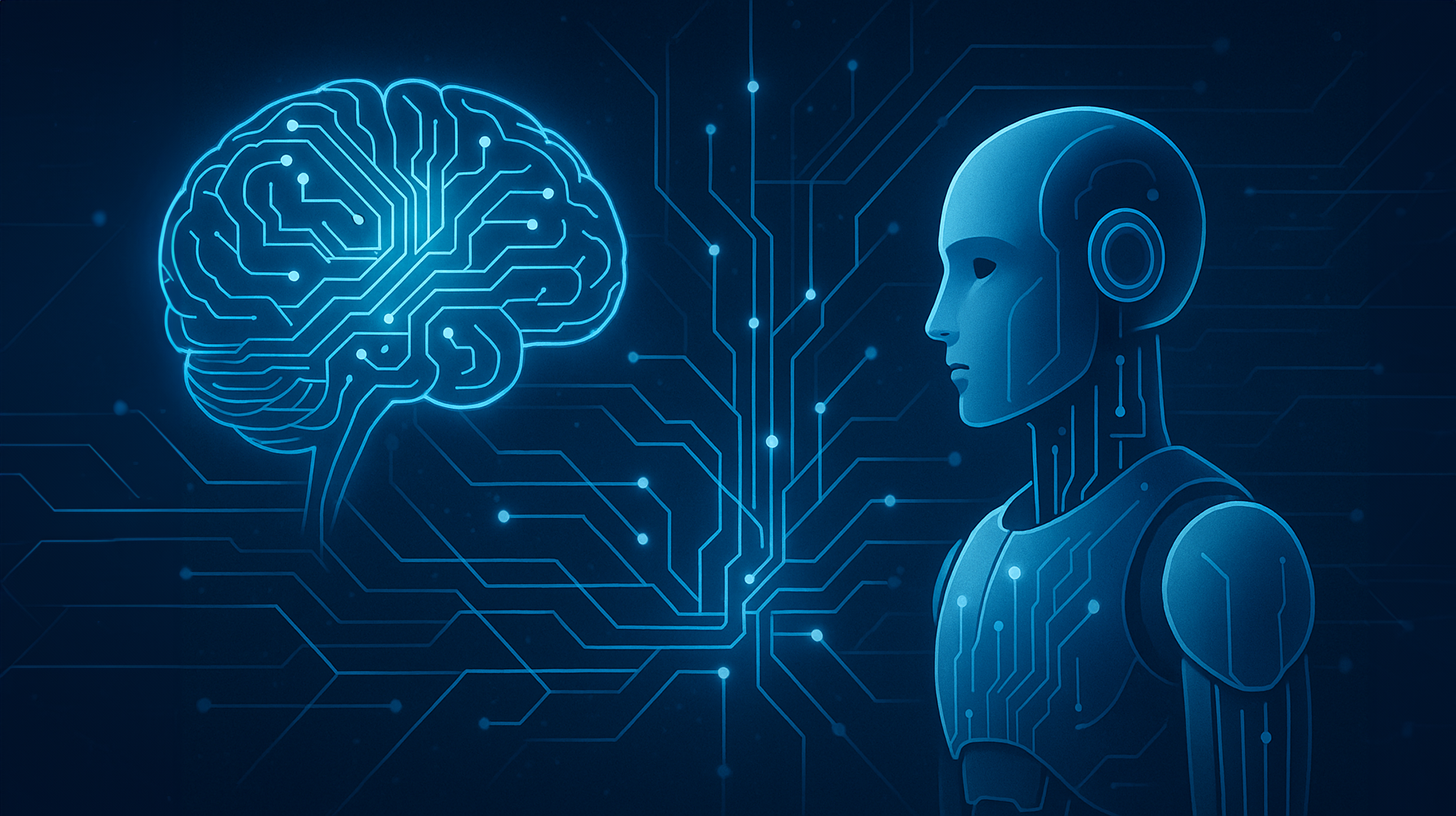
The Swedish startup IntuiCell is pursuing a revolutionary approach to robotics that could fundamentally change how machines learn and interact with their environment. At the heart of this innovation is the development of a digital nervous system and a virtual brain that enables robots to learn through experience, much like humans and animals. This concept goes far beyond conventional programming and could pave the way for a new generation of machines capable of autonomously adapting to and interacting with their surroundings.
IntuiCell was founded about four years ago by a research group from Lund University in Sweden. The company builds on approximately 30 years of neuroscience research on the brain and engineering research into digital intelligence. This research encompasses the transmission of signals between synapses, neuronal firing properties, and whole-body coordination for self-assisted locomotion – all fundamental aspects that contribute to understanding how the brain perceives and interacts with the world.
Luna – The robot dog with learning capabilities
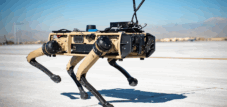
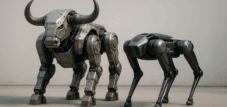
At first glance, Luna, the robot dog from IntuiCell, doesn't seem particularly unusual. With its four legs, slim, can-like body, and a head equipped with a laser scanner, camera, and accelerometers, it resembles many other robot dogs currently on the market. In fact, Luna is based on a GO2 Pro Robot Dog model from the Chinese manufacturer Unitree, which can be purchased for around €3,500.
What sets Luna apart from conventional robot dogs, however, is not its appearance, but its inner workings. While most robots are based on pre-programmed algorithms and extensive datasets, Luna possesses a digital nervous system that allows it to learn through direct interaction with its environment – without elaborate pre-training or massive data centers in the background.
Luna's digital nervous system consists of artificial neurons that are significantly more complex and function differently than those used in conventional AI models. These neurons were designed based on an understanding of neurophysiology and can independently prioritize tasks and select actions to solve their own local problems. With a prototype network of several hundred digital neurons, Luna can learn independently without being connected to an AI model in the cloud. The computer that enables this learning is located within the robot dog itself.
The learning process: The world as a feedback loop
At the beginning, Luna was like a blank slate. The robot dog had received no information about itself or its environment – it didn't even know it had four legs or how to control them. But the researchers were able to give it a mission, such as reaching a specific point in space.
Luna then sends out various impulses that, for example, set her limbs in motion, and incorporates data from the LiDAR and camera. The virtual nervous system records and processes how her state changes in relation to the initial situation. In this way, Luna gradually learns how to move her legs, modulate force, and combine this information with the sensor data to achieve targeted movement.
This learning process closely resembles motor learning in animals and humans. Instead of relying on pre-programmed movement sequences, Luna learns through trial and error how to navigate its environment. The world itself serves as a feedback loop – an approach that differs fundamentally from conventional AI systems.
From reflexes to thought: The development of a digital cortex
Luna's current digital nervous system is merely a "reflexive system," similar to the spinal cord. It cannot plan or think, but rather reacts to immediate problems. To further develop Luna, the IntuiCell team is currently working on integrating another component of its digital nervous system: the cortex.
This digital cortex is intended to represent something like the "big brain" through which Luna can develop an understanding of intention and context. For example, if Luna is asked to do something using gestures or body language, or if he is shown an object that piques his curiosity and then it is thrown away, he should understand that he is supposed to interact with this object.
To develop these skills, the IntuiCell team even hired a real dog trainer to further train Luna. The time Luna needs to learn a new skill varies greatly – sometimes it's only minutes, sometimes it takes a little longer.
IntuiCell: Infrastructure provider for the next generation of AI
IntuiCell doesn't see itself as a traditional robotics company like Boston Dynamics, Figure, Apptronik, or Unitree. Instead, the startup positions itself as an infrastructure provider, developing software for the next stage of artificial intelligence. The company aims to integrate its unique AI software into robots used by established companies, enabling them to achieve more than is possible with current AI models.
There is considerable interest in this technology, and initial collaborations are already underway. IntuiCell is currently at the stage where the architecture is being implemented jointly with external partners. All the essential components are in place and functioning. However, it will still be some time before the first robots with IntuiCell networks reach the market, as the components and functionalities still need to be tested, bugs identified, and safety mechanisms implemented. Nevertheless, the first robots with an artificial neural network and brain could be available in approximately one to two years.
The vision of the future: A world full of synthetic life forms
Viktor Luthman, CEO and co-founder of IntuiCell, sees this technology as a potential paradigm shift. Robots with a digital nervous system are no longer simple machines that follow predefined commands and instructions from a rigid digital model. Rather, they would be "synthetic creatures" that can flexibly adapt to situations – much like humans and animals that learn through interaction and experience.
Luthman prophesies: “If it were up to me, we would one day have a world full of digital creatures in all sorts of forms. A world that will be radically different from ours.” Sooner or later, new life forms and various digital species could emerge – both those resembling animal models and those with exotic forms. These artificial creatures would be built rather than born, but that wouldn't change their nature. Humans would work with them instead of just using them as tools or toys.
The technological foundation: More than just neural networks
What distinguishes IntuiCell's approach from conventional AI systems is the way its digital nervous system is structured. While traditional neural networks are designed to recognize patterns in large datasets and determine statistical relevance, IntuiCell's system goes a step further.
The artificial neurons developed by IntuiCell are not only capable of processing information, but can also make independent decisions and set priorities. They are able to react to changes in the environment in real time and adjust their responses accordingly. This allows Luna to learn how to navigate his environment without prior programming or training.
This approach differs fundamentally from conventional AI systems, which often reach their limits when confronted with unforeseen situations. While traditional AI models perform well in familiar environments, they struggle to adapt to new situations. Retraining such systems is expensive, time-consuming, and requires new datasets.
In contrast, IntuiCell's digital nervous system is designed to learn directly from experience. It is based on stimulus-response principles and reacts directly to environmental changes. Learning doesn't happen in the cloud, but live – through movement, experimentation, and adaptation. This approach is more reminiscent of motor learning in animals than conventional machine learning.
Potential applications: From space travel to disaster relief
IntuiCell's technology could find applications in numerous fields where robots must operate in unpredictable environments. Space exploration is a particularly promising area, where robots are often on their own and must react quickly to unexpected situations. Robots equipped with a digital nervous system could also provide valuable services in deep-sea research, where communication with the surface is limited.
Another important area of application is disaster relief. Here, robots with the ability to quickly adapt to new environments could help in the search for survivors or in managing dangerous situations. The ability to learn and react in real time could make all the difference in such scenarios.
Robots with a digital nervous system could also open up new possibilities in everyday life. From household robots that adapt to the individual needs of their owners to assistive robots in caregiving – the ability to learn through interaction could fundamentally change the way we interact with robots.
Ethical and societal implications
The development of robots with a digital nervous system also raises important ethical and societal questions. If robots become increasingly capable of learning independently and making decisions, how should we treat them? What moral status should we ascribe to them?
Viktor Luthman is aware of these questions and emphasizes the need to consider the ethical implications of this technology early on. "We need rules and guidelines for this," he says. "I would be delighted if we could discuss this with the brightest minds in the world. If we could help develop a vision for this world."
The development of robots with a digital nervous system could also have profound implications for the world of work. As robots become increasingly capable of handling complex tasks and adapting to new situations, they could be deployed in more and more areas. This could lead to changes in the workplace, but also open up new opportunities for collaboration between humans and machines.
The comparison to Blade Runner: Science fiction becoming reality?
Viktor Luthman's vision of creating a world full of digital creatures is reminiscent of science fiction scenarios like those in "Blade Runner." In that film, replicants exist—artificial beings that are virtually indistinguishable from humans and possess their own thoughts and feelings. Although we are still far from such scenarios, the development of robots with a digital nervous system raises similar questions: What constitutes a living being? What moral status should we ascribe to artificial beings?
The parallels to "Blade Runner" are not coincidental. The film addresses the dangers, uncertainties, and moral and ethical ambiguities associated with the creation of advanced artificial intelligence. The interactions between humans and the advanced androids, the replicants, depict a world in which the boundary between "real" and "artificial" humans is inextricably blurred.
Although we are still far from a world where robots possess consciousness and are virtually indistinguishable from humans, technologies like IntuiCell's digital nervous system could represent a step in that direction. The ability to learn through experience and adapt to new situations is a key aspect of what we consider intelligence.
The technical implementation: From concept to reality
Developing a digital nervous system is no easy task. It requires a deep understanding of both neurobiology and computer science. IntuiCell has taken on this challenge and developed a system that translates the fundamental principles of the biological nervous system into software.
Luna's digital nervous system is based on a network of artificial neurons that communicate with each other and process information. However, these neurons are not simply mathematical models like those used in conventional neural networks. Instead, they were designed based on an understanding of neurophysiology and can independently prioritize and make decisions.
A key aspect of the system is how it handles sensor data. Instead of simply processing this data and reacting in a pre-programmed way, the system uses it to develop an understanding of its environment and its own body. This allows Luna to learn through trial and error how to navigate its surroundings.
Integrating the digital cortex presents a further challenge. This is intended to enable Luna to understand intentions and context – an ability that goes far beyond simple reflexes. Developing such a system requires a deep understanding of how the brain functions and how it processes information and makes decisions.
The path to the future: challenges and opportunities
The development of robots with a digital nervous system is still in its early stages, and numerous challenges remain. One of the biggest challenges is scaling the system. While Luna operates with a network of a few hundred digital neurons, the human brain has billions of neurons. Scaling the system to a size that allows for more complex behaviors presents a significant engineering challenge.
Another challenge is integrating the system into different robot platforms. IntuiCell aims to integrate its technology into robots from established companies, which requires close collaboration and adaptation to various hardware platforms.
Despite these challenges, IntuiCell's technology offers tremendous opportunities. Its ability to learn from experience and adapt to new situations could enable robots to operate in environments that are too unpredictable for conventional robots. This could open up new areas of application and fundamentally change the way we interact with robots.
Conclusion: A new era of robotics
The Swedish startup IntuiCell is on the cusp of a new era in robotics. With its digital nervous system and virtual brain, it could fundamentally change the way robots learn and interact with their environment. The ability to learn through experience and adapt to new situations could enable robots to operate in environments that are too unpredictable for conventional robots.
Viktor Luthman's vision of creating a world full of digital creatures may still sound like science fiction today. But with every advance in the development of the digital nervous system, this vision moves a step closer to reality. In a world where robots are increasingly capable of learning independently and making decisions, we will have to grapple with new ethical and societal questions.
The development of robots with a digital nervous system is still in its early stages, and numerous challenges remain. However, IntuiCell's technology offers tremendous opportunities and could pave the way for a new generation of robots that are not only programmed but actually capable of learning and adapting – much like humans and animals.
In the coming years, we will likely see further progress in this area. With each step towards a world where robots can learn through experience, we will also have to grapple with the question of what it means to be a living being and what place these new synthetic creatures should occupy in our society.
Your global marketing and business development partner
☑️ Our business language is English or German
☑️ NEW: Correspondence in your native language!

Konrad Wolfenstein
I and my team are happy to be available to you as your personal advisor.
You can contact me by filling out the contact form here wolfenstein@xpert.digital:or simply call me at +49 7348 4088 965. My email address is
I'm looking forward to our joint project.