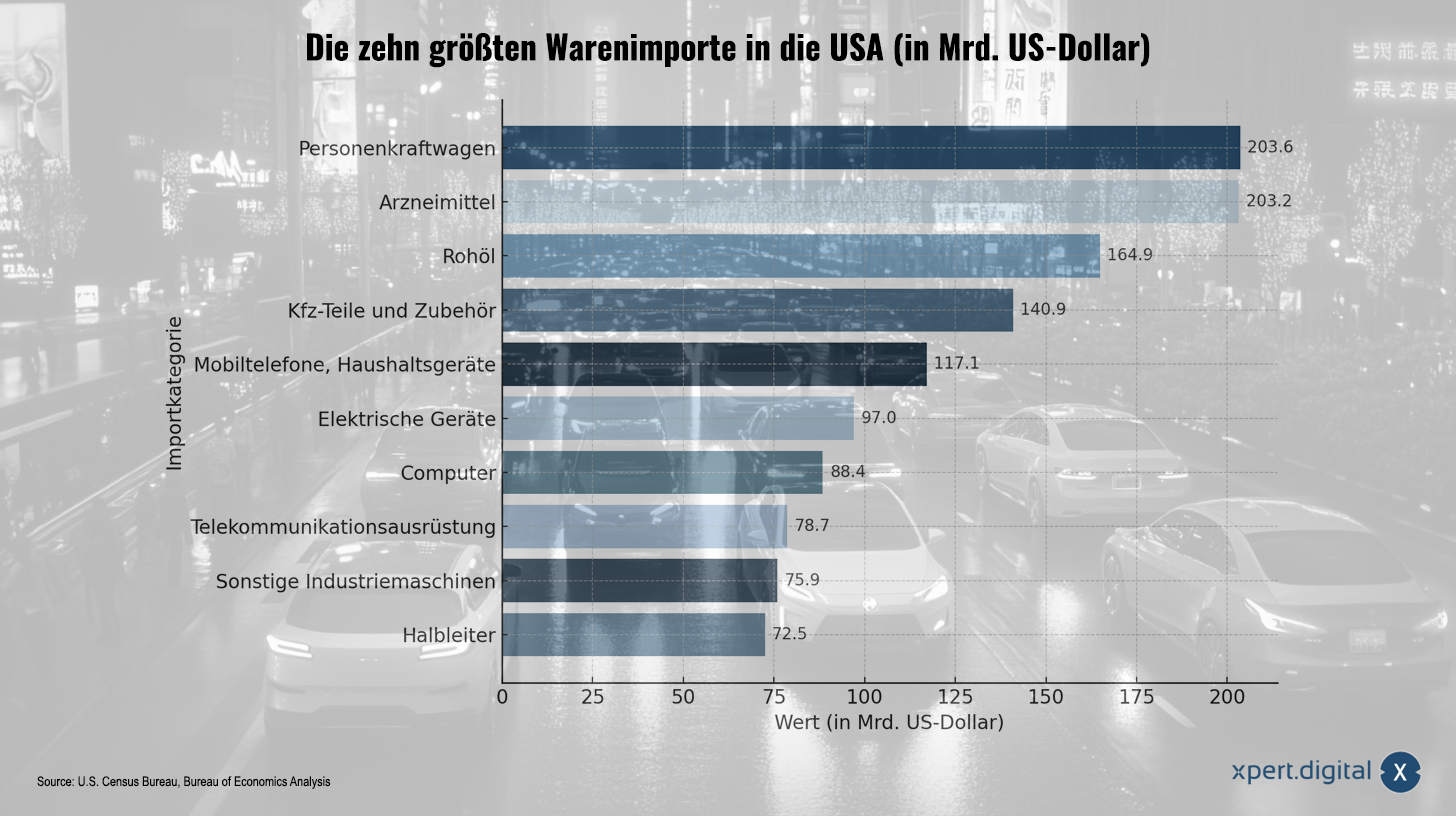
Automobiles: Cars remain the most important import commodity in the USA – Image: Xpert.Digital
🚗🚙🌟 The United States of America as a significant import market
🌟 Automotive industry and international trade relations
The United States is one of the world's largest import markets. In 2022, it imported goods worth approximately 3.3 trillion US dollars. Besides crude oil, the most important imports include automobiles, pharmaceuticals, and a wide range of technologies such as smartphones, computers, and semiconductors. These goods are essential for the American economy and the daily needs of its population.
🛠️ Impact of trade conflicts on the economy
Under the administration of President Donald Trump, trade conflicts with key partners such as China and the European Union escalated. By imposing high tariffs on certain imports, the administration attempted to protect the domestic economy and reduce the trade deficit. However, this led to retaliatory measures from other countries and disrupted global supply chains.
🖥️ The role of technology and supply chains
Technological advancements and global competition in the field of electromobility have further transformed the dynamics of international trade. Demand for electric vehicles is rising worldwide, and countries like China are investing heavily in this technology. The US faces the challenge of expanding its own production of electric vehicles and related batteries to remain internationally competitive and secure domestic jobs.
💊 Pharmaceutical imports and healthcare
Pharmaceutical products are also a significant import. The COVID-19 pandemic has highlighted the importance of safe and reliable access to medical products. The U.S. imports many drugs and medical devices, which can lead to shortages during times of crisis. Strategies to promote domestic production and ensure stable supply chains are therefore of great importance for national health security.
📊 Free trade versus protectionism
The debate over free trade and protectionism remains a prominent issue in the United States. Proponents of free trade argue that open markets lead to economic growth, innovation, and lower prices for consumers. While protectionist measures may protect certain industries in the short term, they ultimately result in higher prices and a decline in competitiveness.
🤝 Relationships with key trading partners
Relations with Europe and Asia are of great importance to the United States. The European Union is one of its most important trading partners, and despite shared values, there have been tensions in the past regarding trade practices and regulations. Close cooperation and the reduction of trade barriers could bring significant economic benefits to both sides.
🏢 Impact on consumers and businesses
These developments have direct consequences for the American economy and consumers. Rising prices for imported goods can fuel inflation and reduce consumer purchasing power. Businesses that rely on international supply chains face increased costs and uncertainties. Small and medium-sized enterprises are particularly affected, as they have fewer resources to adapt to changing trade conditions.
🔍 Future prospects of international trade
The future of US international trade remains uncertain. While globalization and international cooperation are essential for many industries, there is growing pressure to protect national interests and minimize economic dependencies. The balance between free trade and protectionism will continue to be a central theme of American economic policy in the coming years.
🔚 Reduce the trade deficit without losing the benefits of global trade
The US remains heavily reliant on imports to meet demand for essential goods such as cars, technology, and pharmaceuticals. The challenge lies in reducing the trade deficit without sacrificing the benefits of global trade. A careful assessment of measures and close cooperation with international partners are essential to ensuring economic prosperity and stability.
📣 Similar topics
- 🚗 Role of the automotive industry in US trade
- 📉 The US trade deficit and its challenges
- 🌍 The importance of international trade relations for the USA
- 🤖 Impact of technology and electromobility on trade
- 💊 Pharmaceutical imports and their importance for the USA
- ⚖️ Free trade versus protectionism: A constant balancing act
- 🇺🇸 US trade relations with Europe and Asia
- 🔗 Strategies for diversifying global supply chains
- 🌿 Sustainable technologies and their role in international trade
- 📈 Future prospects for US international trade
#️⃣ Hashtags: #AutomotiveIndustry #TradeDeficit #Technology #FreeTrade #Sustainability
Our recommendation: 🌍 Limitless reach 🔗 Connected 🌐 Multilingual 💪 Sales power: 💡 Authentic with strategy 🚀 Innovation meets 🧠 Intuition


From local to global: SMEs conquer the world market with a clever strategy - Image: Xpert.Digital
In an era where a company's digital presence determines its success, the challenge lies in creating an authentic, personalized, and far-reaching presence. Xpert.Digital offers an innovative solution that positions itself as the intersection of an industry hub, a blog, and a brand ambassador. It combines the advantages of communication and sales channels in a single platform and enables publication in 18 different languages. Cooperation with partner portals and the ability to publish articles on Google News and a press distribution list with approximately 8,000 journalists and readers maximize the reach and visibility of the content. This represents a crucial factor in external sales and marketing (SMarketing).
More information here:
📉 From Plus to Minus: The History of the US Trade Balance Through the Ages
🌎📈💡 The evolution of the US trade balance over time: A comprehensive overview
The United States' trade balance is a crucial indicator of the country's economic health, reflecting the relationship between exports and imports of goods and services. Over the years, the US trade balance has shifted from a positive balance in the early decades of the 20th century to a persistent deficit. This deficit represents one of the central challenges of American economic policy and has far-reaching implications for the global economy. This article examines the historical development, recent trends, and the causes and consequences of this phenomenon.

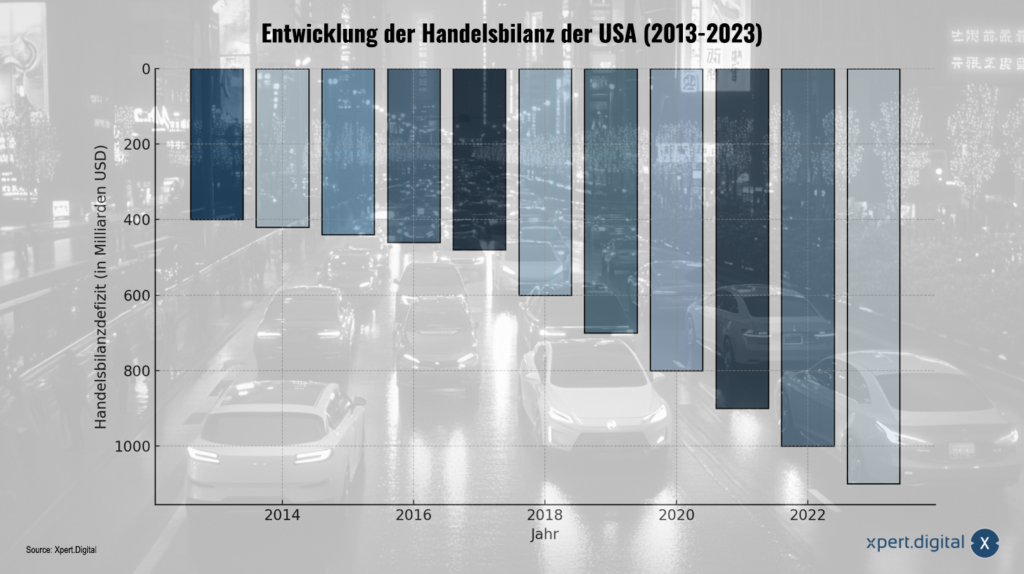
The changing development of the US trade balance (2013-2023) – Image: Xpert.Digital
🕰️ Overview: Historical development of the trade balance
1950s and 1960s: heyday of the trade surplus
After World War II, the USA experienced economic dominance on a global scale. Industrial production was strong, and demand for American goods was high in world markets. This era was characterized by trade surpluses, made possible by the export of manufactured goods such as automobiles, machinery, and chemical products. The postwar prosperity and the leading role of the USA in the global economy fostered this positive development.
1970s: A turn for the worse
The 1970s marked a turning point. A decisive factor was the oil crisis, which hit the US hard. The rise in oil imports led to a significant increase in trade deficits. At the same time, international competition, particularly from Japan and Europe, began to intensify. American products lost their price and quality competitiveness, which negatively impacted exports. The trade deficit took on a sustained form for the first time.
1990s: Beginning of a steady increase in deficits
In the 1990s, the trend toward growing deficits intensified. With increasing globalization and the expansion of international trade, the US imported more and more consumer goods, while exports did not increase at the same rate. The technology sector boomed, but many high-tech products were manufactured in Asian countries such as Japan and South Korea. On average, the trade deficit amounted to about $185 billion per year during this decade.
2000s: Record deficit levels
Globalization reached a new peak, and the US trade deficit grew dramatically. Averaging $675 billion annually, it reached record levels in the 2000s. A key factor was increased trade with China, which was becoming the "workshop of the world." The growing shift of manufacturing to Asian countries contributed to the US importing more and more while its exports remained comparatively low.
📊 Development of the trade balance from 2013 to 2023
Over the past decade, the US trade deficit has continued to worsen, reaching its lowest point in 2023. The following milestones provide an overview of this development:
2013–2016
During this period, the deficit remained relatively stable, fluctuating between -450 and -600 billion US dollars. A slight decline in commodity prices and moderate export demand kept the deficit at this level.
2017–2018
During these years, the trade deficit rose to -678 billion US dollars in 2018. The main reason was increased import demand, driven by strong economic growth and rising consumer spending.
2020
The COVID-19 pandemic led to a short-term decline in international trade, slightly reducing the deficit to -$626 billion. However, this was only a temporary development, as global demand for goods and services subsequently recovered rapidly.
2021–2023
The trade deficit reached new highs during these years. In particular, the deficit amounted to -1.15 trillion US dollars in 2023, a historic record. Driving forces included increased demand for imported goods such as electronics and consumer products, as well as weaker demand for American exports.
🔍 Causes of the growing trade deficit
The US trade deficit is the result of a multitude of factors, both structural and cyclical in nature. The main causes can be summarized as follows:
1. High import demand
American consumers often prefer imported goods because they are frequently cheaper or of higher quality. This is especially true for electronics, vehicles, and household appliances.
2. Dependence on foreign raw materials
Despite increased domestic energy production, the US remains a major importer of raw materials such as oil, rare earths, and metals. This dependence contributes significantly to the deficit.
3. International competitiveness
American products are often more expensive than their international competitors due to high production costs. The high labor cost structure and strict regulations negatively impact the competitiveness of the US economy.
4. China's role
Trade with China is a major contributor to the trade deficit. In 2022 alone, the bilateral deficit with China amounted to approximately $422 billion. China exports a wide range of products to the US, while American exports to China are limited.
5. Strong US dollar
The value of the US dollar against other currencies is another significant factor. A strong dollar makes American exports more expensive and imports cheaper, further exacerbating the deficit.
🌐 Economic and political consequences
The persistent trade deficit has far-reaching consequences for the US economy and its international relations:
Increase in foreign debt
The deficit is causing the US to become increasingly indebted to foreign creditors. This could lead to financial instability in the long term.
Relocation of jobs
Imports of foreign products have led to the closure of many manufacturing facilities in the USA. This has cost jobs, particularly in the manufacturing industry.
Tensions with trading partners
The trade deficit, particularly with China, has repeatedly led to political tensions. Measures such as tariffs and trade sanctions have been implemented to correct the imbalance.
Influence on monetary policy
The deficit also influences the Federal Reserve's monetary policy decisions. Persistently high import demand can generate inflationary pressure, which in turn affects interest rate policy.
💼 Possible solutions
To reduce the trade deficit, various strategies could be pursued:
1. Promotion of exports
Investments in innovative technologies and improvements in international competitiveness could boost exports. There is particularly great potential in sectors such as renewable energies and high-tech industries.
2. Reducing import dependency
Promoting domestic production and diversifying supply chains could reduce dependence on imports.
3. Trade policy measures
The US could create fair competitive conditions through trade agreements and thus improve access to foreign markets.
4. Investments in education and infrastructure
A well-trained workforce and modern infrastructure could increase the productivity and competitiveness of the US economy.
🌍📉 US trade balance: On the way to a global realignment?
The US trade balance remains a complex and multifaceted issue with both national and global implications. Sustainable improvement requires long-term reforms and a balanced interplay of economic policy, trade, and innovation. The future will show how the US meets this challenge and redefines its role in the global economy.
📣 Similar topics
- 📊 From surplus to deficit: The fluctuating trade balance of the USA
- 🌍 Global impact: How the US trade balance affects the world economy
- 🔍 A look back: The development of the US trade balance since 1950
- 📈 Record deficits and their causes: The US trade balance in 2023
- ⚖️ Between China and the USA: The bilateral trade deficit in focus
- 🚀 Future strategies: Ways to reduce the US trade deficit
- 💼 Political tensions and their economic consequences: An unsolvable dilemma?
- 🏭 Outsourced jobs: The downsides of the trade deficit
- 💡 Innovation as the key: Opportunities to boost US exports
- 🏛️ The role of trade and monetary policy in the US economy
#️⃣ Hashtags: #Economy #TradeBalance #USA #Globalization #Innovation
We are here for you - Consulting - Planning - Implementation - Project Management
☑️ SME support in strategy, consulting, planning and implementation
☑️ Creation or realignment of the digital strategy and digitization
☑️ Expansion and optimization of international sales processes
☑️ Global & Digital B2B trading platforms
☑️ Pioneer Business Development

Konrad Wolfenstein
I would be happy to serve as your personal advisor.
You can contact me by filling out the contact form below or simply call me on +49 7348 4088 965 .
I'm looking forward to our joint project.
Write to me



Xpert.Digital - Konrad Wolfenstein
Xpert.Digital is a hub for industry focusing on digitalization, mechanical engineering, logistics/intralogistics and photovoltaics.
With our 360° Business Development solution, we support renowned companies from new business to after-sales.
Market intelligence, smarketing, marketing automation, content development, PR, mail campaigns, personalized social media and lead nurturing are part of our digital tools.
You can find more information at: www.xpert.digital - www.xpert.solar - www.xpert.plus
Keep in touch