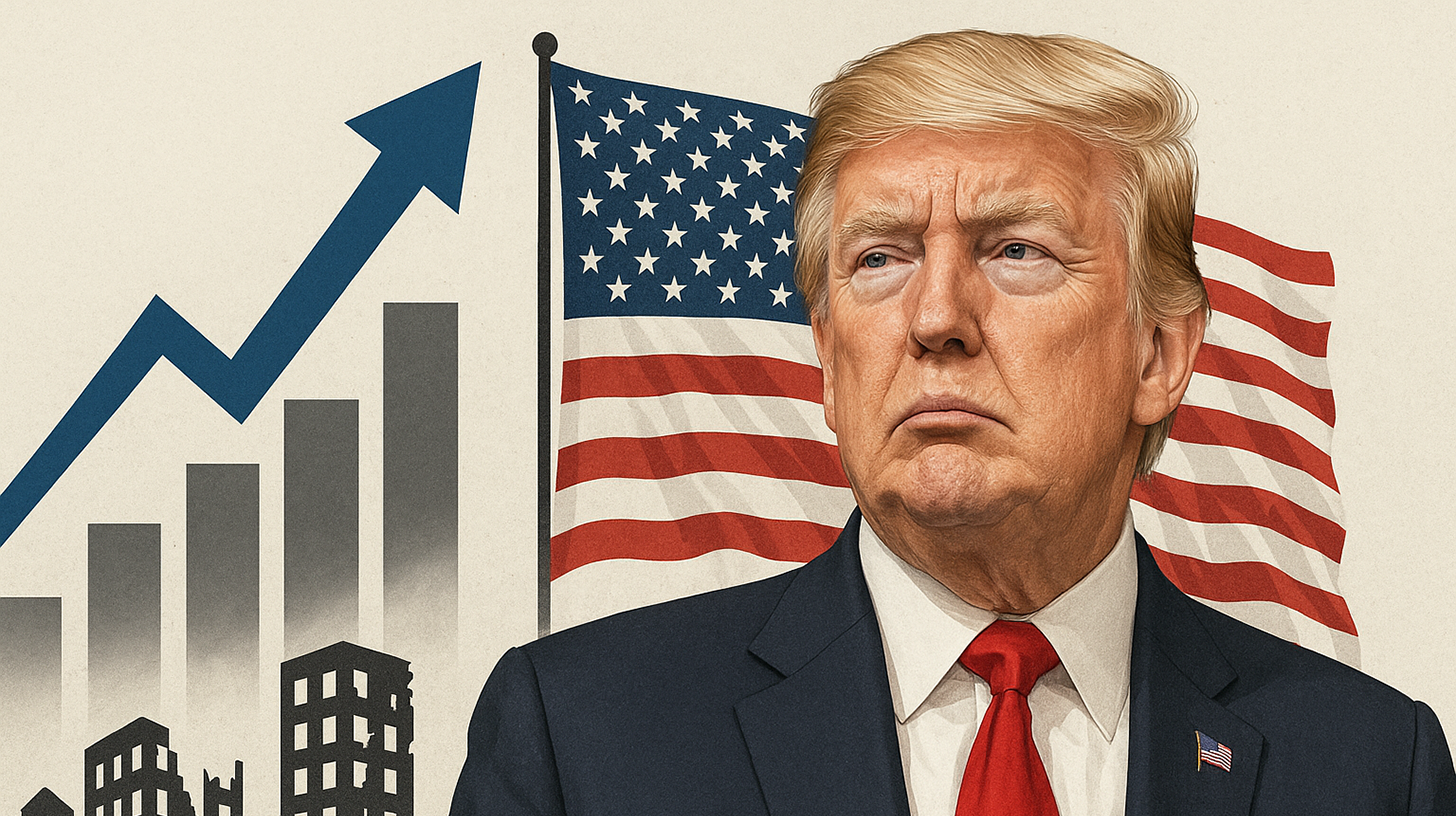
US economy grows stronger than expected – The Trump phenomenon between economic dynamics and structural challenges – Image: Xpert.Digital
The first warning sign: While the US economy is booming, a crucial sector is already collapsing
Miracle or madness? Trump's economy on the verge of collapse? More hype than substance? The $37 trillion time bomb
The American economy under Donald Trump's second term presents itself as a complex phenomenon full of contradictions. While economists predicted a severe recession at the beginning of the year, the US economy is showing remarkable resilience, which is simultaneously overshadowed by growing structural problems. The question of the sustainability of the so-called Trump phenomenon is becoming increasingly urgent.
Related to this:

The psychological dimension of economic policy
Ludwig Erhard's famous statement that economics is fifty percent psychology proves particularly apt when analyzing the current American economic situation. Trump's communication strategy acts as a powerful catalyst for economic expectations, creating a sense of optimism among large segments of the population and the business community, which translates into real economic activity.
This psychological component manifests itself in several dimensions. Trump's constant promises of economic recovery and the return of American jobs create a positive mindset, which, paradoxically, is also reinforced by his disruptive policies. While the constant announcements of new tariffs and policy reversals create uncertainty, they also generate a form of creative tension that forces companies and investors to react and adapt more quickly.
Particularly noteworthy is the discrepancy between sentiment and behavior. While the University of Michigan's consumer confidence index fell to 55.4 points in September 2025, actual consumer spending rose steadily throughout the second quarter. Americans talk pessimistically but continue to act optimistically—a classic example of how psychological factors are more complex than simple sentiment barometers suggest.
Related to this:

Economic reality contrary to forecasts
Contrary to the gloomy predictions of many experts at the beginning of the year, the US economy is showing remarkable resilience. Gross domestic product grew at an annualized rate of 3.3 percent in the second quarter of 2025, after having contracted by 0.5 percent in the first quarter. The Federal Reserve even revised its GDP growth forecast for 2025 upwards from 1.4 to 1.6 percent.
Growth was primarily driven by a dramatic 29.8 percent drop in imports, following a sharp rise in the first quarter as businesses and consumers stockpiled goods in anticipation of price increases following tariff announcements. At the same time, consumer spending rose by 1.6 percent, compared to 0.5 percent in the first quarter, underscoring the robustness of consumer demand.
Corporate profits also showed positive developments, rising from $3,203.60 billion to $3,266.20 billion in the second quarter of 2025. Particularly noteworthy is the development of corporate investment, which increased by an impressive 7.6 percent at the beginning of 2025 – the strongest pace since mid-2023.
The critical turning point in the labor market
While other economic indicators still show strength, the labor market is revealing the first clear signs of weakness, which can be interpreted as harbingers of a major economic turnaround. The unemployment rate rose to 4.3 percent in August 2025, the highest level since October 2021. The employment figures are even more dramatic: In August, only 22,000 new jobs were created, far fewer than the expected 75,000.
The developments in key sectors are particularly alarming. The manufacturing sector lost around 12,000 jobs, while the federal government cut 15,000 positions. Since the beginning of the year, almost 100,000 federal jobs have been eliminated, highlighting the impact of Trump's austerity measures in the public sector.
Analysts primarily blame the Trump administration's aggressive tariff policies for this weakening. High import tariffs increase material costs, disrupt supply chains, and create investment uncertainty, prompting companies to respond with hiring freezes, production relocations, or job cuts.
The debt crisis as a structural threat
Parallel to short-term economic indicators, American national debt is developing into an increasingly threatening structural challenge. In August 2025, the national debt reached a new record high of $37.27 trillion, which corresponds to a debt-to-GDP ratio of approximately 124 percent.
The development of interest costs is particularly dramatic. The US now has to spend over $1.1 trillion annually on interest payments alone, making interest payments the largest single expenditure item in the federal budget. This interest burden is growing exponentially, as the country must continuously take on new debt to refinance existing liabilities.
The budget proposal recently passed by the House of Representatives significantly exacerbates the situation. According to estimates by the Committee for a Responsible Federal Budget, the planned tax cuts and spending programs would increase the national debt by an additional $3.3 trillion over ten years. Harvard economist Kenneth Rogoff even predicts a severe debt crisis within the next five years.
Inflation as a growing threat
Inflation trends are causing increasing concern among experts and could trigger an economic downturn. The annual inflation rate accelerated to 2.9 percent in August 2025, the highest level since January. Particularly worrying is the fact that core inflation remained at 3.1 percent, significantly above the Fed's target of 2 percent.
The Federal Reserve raised its own estimate of core inflation for 2026 from 2.4 to 2.6 percent, reflecting growing concerns. Prices rose particularly sharply for food (3.2 percent), used cars (6 percent), and new vehicles (0.7 percent). For the first time in seven months, energy costs also rose again, by 0.2 percent.
Consumer inflation expectations rose for the third consecutive month, signaling a significant risk of future price increases. This presents the Federal Reserve with a complex dilemma between supporting the weakening labor market and containing rising inflation risks.
Monetary policy in a field of tension
Under Jerome Powell, the Federal Reserve skillfully navigated the challenges of a weakening labor market and the inflation risks posed by tariff policy. On September 17, 2025, the Fed lowered its key interest rate by 25 basis points to a range of 4.00 to 4.25 percent – the first rate cut since December 2024.
The Fed's new interest rate projections anticipate two further rate cuts by the end of 2025 and another easing step in 2026. This cautious easing signals to markets continued monetary policy support without ignoring inflation risks.
Powell emphasized that the Fed places greater emphasis on downside risks to the labor market than on upside risks to inflation. This prioritization makes the state of the labor market the primary reason for the upcoming monetary easing, but it also puts the central bank under enormous political pressure from Trump, who is demanding significantly more aggressive interest rate cuts.
Trade policy and international implications
Trump's protectionist trade policies are now having a clear impact on global trade flows. China's trade surplus with the US fell to $20.32 billion in August, down from $23.74 billion in July. Both Chinese exports to the US and American imports from China declined drastically, by 33.1 and 16.0 percent, respectively.
This development reflects the increasing fragmentation of the international trading system. The ongoing trade conflicts and protectionist measures could lead to a fragmented global market that generates costs everywhere and negatively impacts not only the American economy but global growth as a whole.
Our US expertise in business development, sales and marketing

Our US expertise in business development, sales and marketing - Image: Xpert.Digital
Industry focus areas: B2B, digitalization (from AI to XR), mechanical engineering, logistics, renewable energies and industry
More information here:
A thematic hub offering insights and expertise:
- Knowledge platform covering global and regional economies, innovation and industry-specific trends
- A collection of analyses, insights, and background information from our key areas of focus
- A place for expertise and information on current developments in business and technology
- A hub for companies seeking information on markets, digitalization, and industry innovations
Resilience or the calm before the storm? Tech as salvation? How long will Trump's psychological boost last for the economy?
Sectoral developments and structural strengths
Despite macroeconomic challenges, certain sectors of the American economy remain robust. The technology sector continues to act as a key growth driver. The US IT services market is projected to reach approximately $513.8 billion in 2025, with an expected annual growth rate of 3.73 percent through 2030.
Large technology companies like Alphabet, Amazon, Microsoft, and Meta are expected to increase their capital expenditures from $90 billion in 2020 to over $270 billion in 2025. These massive investments in artificial intelligence and digital infrastructure strengthen the long-term competitiveness of the American economy.
The structural strengths of the US economy—labor market flexibility, financial market depth, innovative capacity, and the size of the domestic market—continue to prove to be important buffers against external shocks. These institutional advantages can partially offset short-term political uncertainties and contribute to economic resilience.
Trump's dwindling approval ratings
Political support for Trump's economic policies is eroding, threatening the sustainability of the psychological impact of his presidency. His approval ratings have now fallen to just 40 to 41 percent, down from 50 percent when he took office. Particularly worrying for Trump is his especially poor performance on the economy, a key issue for him.
According to a YouGov poll, 54 percent of US citizens believe the economy is worsening, while only 31 percent give Trump high marks on the cost of living. This is particularly problematic, as Trump scored points on economic issues during his re-election campaign in November.
In September 2025, Trump has negative approval ratings in all major policy areas. His rating for inflation and prices is particularly dramatic at minus 30.45 percent. His approval ratings are also negative on foreign policy, migration, and the economy.
Medium-term risks and expert assessments
Economic experts' assessments of medium-term developments paint a mixed picture, reflecting both cautious optimism and justified concerns. While growth forecasts for the full year 2025 have stabilized, many analysts warn of increasing risks in the coming years.
Experts are particularly critical of the second half of Trump's term. Harvard economist Kenneth Rogoff predicts that the US economy will likely slow down and experience a downturn in the second half of the year. He sees the most probable scenario as a strong upswing followed by a slowdown leading to recession.
Immigration policy poses significant economic risks. According to estimates by the Peterson Institute, Trump's planned mass deportations could shrink the US economy by more than 7 percent by 2028. The sudden loss of workers would not only affect individual companies but could destabilize entire industries while simultaneously exacerbating inflationary pressures.
The limits of predictability
The performance of the US economy in the first months of the Trump presidency offers valuable insights into the complexity of economic forecasting and the resilience of modern economies. The discrepancy between the gloomy predictions of many economists and actual economic developments raises fundamental questions about the limits of economic forecasting.
Many experts focused too heavily on individual factors such as tariffs or immigration policy, without adequately considering the dynamic adjustment mechanisms of the American economy. The US economy proved to be more adaptable and dynamic than many models suggested. Furthermore, the strong US domestic market—characterized by a large consumer base, robust private consumption, developed financial markets, and flexible labor and production structures—received too little weight in many analyses. This domestic market dynamic often acts as a buffer against external shocks and can significantly mitigate the negative effects of trade conflicts or political uncertainty. This underscores the importance of a nuanced understanding of economic relationships beyond sweeping predictions.
Related to this:

International Perspectives and Trade Dynamics
The international dimension of Trump's economic policies is showing increasingly problematic consequences. The US is planning widespread import tariffs of 10 to 20 percent, and Trump has already threatened retaliatory tariffs of over 100 percent should the EU respond with its own trade barriers.
These escalating trade restrictions could trigger a devastating race to the bottom, ultimately harming the US as a business location. The fragmentation of the international trading system leads to higher costs for all participants and reduces the efficiency of global value chains.
The impact on strategically important trading partners is particularly problematic. German companies, which invested €15.7 billion in the US in 2023, face considerable uncertainty regarding their expansion plans and supply chains.
The future of the Trump phenomenon
The question of whether the Trump phenomenon will continue or reverse is not easily answered, as various factors are at play. On the one hand, the structural strengths of the American economy—flexibility, innovation, and the depth of capital markets—continue to have a stabilizing effect. The psychological component of Trump's economic policies still acts as a catalyst for entrepreneurial activity and consumer behavior.
On the other hand, warning signs are piling up alarmingly. The labor market, as a leading indicator, is showing clear signs of weakness, inflation is rising again, and national debt is reaching critical levels. Trump's dwindling approval ratings suggest that psychological support for his policies is beginning to crumble.
The crucial question is whether the psychological effects are strong enough to overcome the growing structural problems. Experience shows that economic psychology can quickly reverse course when real-world results deviate too much from expectations. As soon as unemployment rises noticeably or inflation significantly strains household budgets, psychological support for Trump's policies could rapidly evaporate.
US resilience vs. the real economy: When will economic psychology tip over?
The Trump phenomenon is likely at a critical turning point. The remarkable resilience of the American economy in the first months of his second term could prove to be the calm before the storm. The combination of growing structural problems, dwindling political support, and increasing macroeconomic imbalances suggests that a counter-trend may already be underway.
The next few months will be crucial. If the labor market weakness persists, inflation continues to rise, and the debt crisis intensifies, the psychological foundation of Trump's economic policies could quickly erode. The American economy has proven to possess considerable capacity for self-healing, but this capacity is not unlimited.
The international community and financial markets are watching this development with growing attention. A failure of Trumponomics would not only affect the US, but the entire global economy. The challenge for the future lies in preserving the strengths of the American economy while simultaneously addressing the structural problems that pose a long-term threat to economic stability.
The Trump phenomenon may not have completely disappeared, but there are increasing signs that his time is running out. The economy is too complex to be permanently controlled solely by psychology and political rhetoric. Sooner or later, economic fundamentals will prevail, and these are increasingly pointing in a worrying direction.
Your global marketing and business development partner
☑️ Our business language is English or German
☑️ NEW: Correspondence in your native language!

Konrad Wolfenstein
I and my team are happy to be available to you as your personal advisor.
You can contact me by filling out the contact form here wolfenstein@xpert.digital:or simply call me at +49 7348 4088 965. My email address is
I'm looking forward to our joint project.