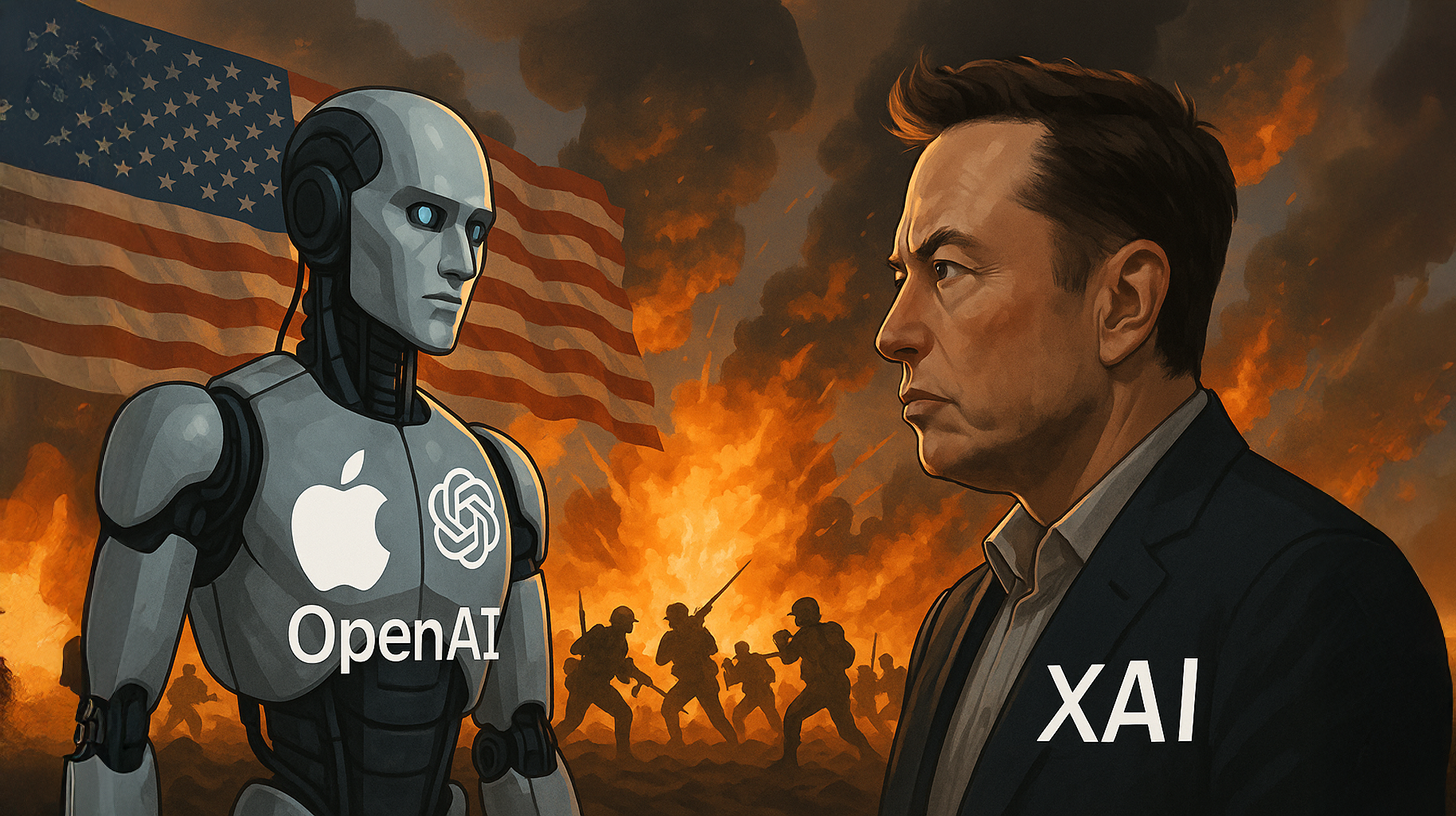
The US AI war over artificial intelligence is escalating: Why Musk (xAI/Grok) accuses Apple and OpenAI of an AI monopoly – Image: Xpert.Digital
Billion-dollar lawsuit rocks tech world: Why Musk (xAI/Grok) accuses Apple of an AI monopoly
### Grok sidelined? What's really behind Musk's furious lawsuit against Apple ### Your iPhone in the crosshairs: What Musk's lawsuit against Apple means for all users ### More than just business: Is Musk's lawsuit the culmination of his personal feud with OpenAI? ###
“Conspiracy to prevent competition”: The explosive allegations in Musk’s lawsuit against Apple and OpenAI
A legal earthquake is shaking Silicon Valley and threatens to reshape the power dynamics in the future market of artificial intelligence. Tech visionary Elon Musk and his company xAI have filed a sweeping lawsuit against two of the world's most powerful corporations: Apple and OpenAI. The accusations are serious: conspiracy to restrict competition and the abusive establishment of a monopolistic position.
At the heart of the conflict is the strategic partnership announced in June 2024, which deeply integrates OpenAI's ChatGPT into Apple's operating systems like iOS, giving the chatbot direct access to hundreds of millions of users—a potentially insurmountable advantage. For Musk, this is a direct attack on his own AI chatbot, Grok, which he claims is being systematically excluded from competition and hampered in its development. But the lawsuit is about more than just frustration over market share. It's a fundamental power struggle for control of a revolutionary technology, where personal feuds, multi-billion-dollar business interests, and the fundamental vision for the future of AI clash. This titanic battle could not only determine the fate of individual companies but also shape the technological landscape for years to come.
Background of the lawsuit
What leads a tech billionaire like Elon Musk to take two of the world's most powerful technology companies to court? The answer lies in the complex power structures of the artificial intelligence industry and Musk's frustration with the market position of his own AI chatbot, Grok.
In August 2025, Musk's company xAI filed a comprehensive lawsuit in a US federal court in Texas, targeting both Apple and OpenAI. The core allegation is "conspiracy to prevent competition in the field of artificial intelligence." Specifically, xAI claims that Apple systematically disadvantages other chatbots to give ChatGPT an unfair advantage.
The lawsuit accuses both companies of having "closed off markets" to "maintain their monopolies and prevent innovators like X and xAI from competing." These allegations go far beyond simple business practices and touch upon fundamental questions of market power in the rapidly evolving AI landscape.
The strategic partnership between Apple and OpenAI
Which collaboration is at the heart of the allegations? In June 2024, Apple and OpenAI announced a far-reaching partnership that integrates ChatGPT directly into Apple's operating systems iOS, iPadOS, and macOS. This collaboration, touted as "Apple Intelligence," allows iPhone users to send direct queries to ChatGPT without having to switch between different applications.
The partnership goes beyond simple app integration. ChatGPT is deeply embedded in Siri, allowing users to make more complex requests that exceed Apple's own AI capabilities. Additionally, ChatGPT is integrated into Apple's system-wide writing tools to assist users with content creation.
Apple emphasizes that this integration comes with strict data protection regulations. User requests are not stored by OpenAI, and IP addresses are masked. Despite these data protection measures, Musk sees the partnership as an existential threat to competing AI providers.
Musk's monopoly allegations in detail
On what legal grounds are Musk's accusations based? The lawsuit argues that Apple holds a monopolistic position with a 65 percent market share in the US smartphone market. At the same time, OpenAI is accused of controlling a monopoly with an 80 percent market share in AI chatbots.
According to xAI, this market dominance forms the basis for anti-competitive behavior. The lawsuit alleges that Apple, through its exclusive agreement with OpenAI, systematically excludes other AI chatbots from valuable user interactions. This exclusion makes it more difficult for competitors like Grok to improve their software through machine learning, while OpenAI profits from billions of user queries.
One particularly contentious point is Apple's alleged manipulation of App Store rankings. Musk claims that despite a million reviews with an average of 4.9 stars for Grok, Apple refuses to mention the app in relevant lists. This would suggest that Apple is actively suppressing the visibility of competing AI applications.
Grok's market position compared to ChatGPT
How does Grok actually compare to ChatGPT in the competition? The figures reveal a clear imbalance in market dominance. ChatGPT holds a commanding position with approximately 62.5 percent of the consumer AI market. In September 2024, ChatGPT recorded an astonishing 3 billion visits, surpassing even popular platforms like TikTok and Bing.
Grok, on the other hand, is struggling to gain market share despite having made remarkable progress. From 1.2 million users in September 2024, the platform grew to 25.82 million visitors in February 2025, representing an increase of over 24.6 million visits in just five months. By June 2025, the user base had stabilized at 18.8 million monthly active users.
Despite these growth rates, Grok remains far behind ChatGPT. While ChatGPT boasts over 200 million weekly active users, Grok has approximately 35.1 million monthly active users. This discrepancy underscores the challenges xAI faces in competing with the established market leader.
The financial dimensions of AI warfare
What economic interests lie behind this legal dispute? The financial stakes in the AI industry are enormous. xAI saw impressive revenue jumps: from approximately $100 million at the end of 2024 to an estimated $3.2 billion in annualized revenue in July 2025. Following the integration of xAI as the parent company of X in March 2025, revenue growth accelerated significantly.
xAI's revenue streams are diverse and include xAdvertising, xPremium Subscriptions, consumer Grok Subscriptions both on and off-platform, and xAI's usage-based API. The company also introduced expensive subscription plans, including SuperGrok Heavy at $300 per month, significantly more expensive than offerings from competitors like OpenAI, Google, and Anthropic.
OpenAI, for its part, has solidified its market leadership through massive investments. The company raised $40 billion in the first quarter of 2025, a sixfold increase compared to the previous quarter. This influx of capital enables OpenAI to outpace competitors in infrastructure investments, including the $50-100 billion Stargate data center project.
Apple's smartphone monopoly from a legal perspective
How valid are the monopoly allegations against Apple? The question of market definition is at the heart of the legal dispute. The US Department of Justice filed a comprehensive antitrust lawsuit against Apple back in 2024, arguing that the company controls over 70 percent of the US smartphone market, measured by revenue.
Apple disputes this assessment, arguing that the global smartphone market should be the relevant benchmark, where Apple's market share is only around 23 percent. This discrepancy between national and global market shares could be crucial to the outcome of the legal disputes.
A federal judge in New Jersey has already ruled that the allegations against Apple regarding monopolistic practices in the US smartphone market could be justified. The court found that Apple's alleged market share of 65 to 70 percent, combined with significant barriers to entry such as high switching costs and technical limitations, could support monopolistic power.
The historic feud between Musk and OpenAI
What personal and business conflicts underlie this dispute? The tensions between Musk and OpenAI date back to the company's beginnings. Musk co-founded OpenAI in 2015 but left the company in 2018 due to disagreements over its strategic direction.
The central point of contention was OpenAI's transformation from a non-profit organization to a for-profit company. Musk claims he invested under the assumption that OpenAI would remain a non-profit organization serving humanity. He viewed the subsequent partnership with Microsoft and the conversion to a for-profit company as a betrayal of its original mission.
These personal animosities have intensified over the years. Musk referred to OpenAI CEO Sam Altman as "Scam Altman," while Altman described Musk as "an unhappy person." The legal battles between the two have evolved into a complex web of lawsuits, countersuits, and public accusations.
Technological innovations and competitive dynamics
What technological differences characterize the competition between Grok and ChatGPT? Grok differs from ChatGPT through its direct access to real-time data from X (formerly Twitter) and its distinctive personality, which emphasizes humor and a "rebellious charm." These characteristics are intended to differentiate Grok from ChatGPT's more neutral and professional approach.
ChatGPT, on the other hand, scores points with its versatility, professional usability, and multimodal capabilities. The platform offers a wider range of use cases, from content creation to customer service and education. OpenAI has also continuously introduced new features, such as GPT-4 integration and multimodal capabilities, which keep ChatGPT at the forefront of technological innovation.
The latest version, Grok 4, launched in July 2025, led to a dramatic 279 percent increase in downloads and a 325 percent jump in revenue to $419,000. This demonstrates that innovative AI models can have a significant impact on consumer interest and spending.
EU/DE Data Security | Integration of an independent and cross-data-source AI platform for all business needs


Independent AI platforms as a strategic alternative for European companies - Image: Xpert.Digital
AI Game Changer: The most flexible AI platform - Tailor-made solutions that reduce costs, improve your decisions and increase efficiency
Independent AI platform: Integrates all relevant company data sources
- Rapid AI integration: Tailor-made AI solutions for businesses in hours or days, instead of months
- Flexible infrastructure: Cloud-based or hosting in your own data center (Germany, Europe, free choice of location)
- Maximum data security: its use in law firms is irrefutable proof
- Deployment across a wide variety of enterprise data sources
- Choice of own or different AI models (DE, EU, USA, CN)
More information here:
Between innovation and monopoly: The battle for AI supremacy
Antitrust challenges and market definition
How complex are the antitrust aspects of this case? Determining the relevant market is a central aspect of any antitrust case. Apple can argue that the relevant market is broader than the "performance smartphone" market claimed by the US Department of Justice, which excludes entry-level smartphones.
The government defines two specific markets: the general smartphone market in the US, in which Apple allegedly holds 65 percent, and the narrower "performance smartphone" submarket with 70 percent. These market definitions are crucial because they form the basis for the monopoly allegations.
Antitrust experts are closely monitoring the case, as it presents a significant opportunity for US courts to assess the existence of a defined market for AI and its potential parameters. Professor Christine Bartholomew of the Buffalo School of Law described the case as a "canary in the coal mine" regarding the judicial response to AI and the intersection of antitrust law and AI.
Impact on the future of the AI industry
What does this legal battle mean for the development of the AI industry? The lawsuit could have far-reaching consequences for how tech giants integrate and market AI technologies. Should Musk be successful, this could lead to stronger regulation of AI partnerships and a more even distribution of market opportunities.
This case could also set precedents for future antitrust proceedings in the AI industry. With the generative AI sector, valued at $3.88 billion in 2023, projected to grow to $38.6 billion by 2028, enormous economic interests are at stake.
The integration of AI into existing platforms will likely remain a contentious issue, as companies seek to strengthen their market position while regulators strive to ensure fair competition. The decision in this case could set the course for the entire industry.
Data protection and user rights in AI competition
What role do data privacy considerations play in this competition conflict? Apple has made considerable efforts to emphasize the privacy aspects of its ChatGPT integration. The company assures that user requests are not stored by OpenAI and that IP addresses are masked.
This privacy-focused approach could be seen as a competitive advantage over other AI providers who may have less stringent data protection measures. Apple also allows external parties to conduct regular and independent audits of its cloud systems to strengthen confidence in its data protection commitments.
For consumers, this means that the choice between different AI platforms is based not only on functionality and user-friendliness, but also on data privacy and transparency. These considerations could become increasingly important as AI technology is more deeply integrated into everyday applications.
Economic consequences and claims for damages
What financial consequences could this lawsuit have? xAI is demanding not only a ban on the current Apple-OpenAI collaboration but also billions of dollars in damages. The lawsuit claims that the exclusive agreement between Apple and OpenAI has caused billions of dollars in losses to xAI and other competitors.
The economic implications extend beyond direct damage claims. If the lawsuit is successful, it could force Apple to change its App Store practices and grant other AI chatbots equal access. This could have significant repercussions for Apple's business model and revenue streams.
For OpenAI, an unfavorable outcome of the lawsuit could mean that its valuable partnership with Apple is restricted or terminated. This would jeopardize access to hundreds of millions of iPhone users and significantly hinder ChatGPT's growth.
The defendant's answers
How are Apple and OpenAI responding to these serious allegations? Following Musk's initial threat of legal action, Apple stated that its App Store is designed to be fair and unbiased. The company emphasizes that it presents thousands of apps through charts, algorithmic recommendations, and curated lists selected by experts based on objective criteria.
Apple also argues that its partnership with OpenAI is not exclusive and that other AI chatbots could be integrated in a similar way over time. The company insists that users are not prevented from using other chatbots like Grok, and that nothing in Apple's operating system prevents iPhone users from using alternative AI services.
OpenAI has sharply criticized the lawsuit, calling it part of "Mr. Musk's ongoing pattern of harassment." The company argues that Musk is trying to win through legal tactics what he cannot achieve by developing better products.
Impact on the X platform and the "Everything App" concept
What role does Musk's vision of an "Everything App" play in this legal battle? The lawsuit reveals that Musk is not only fighting for downloads for Grok, but that he fears Apple and OpenAI have conspired to thwart his ambitions for an "Everything App," which motivated his acquisition of Twitter.
According to the lawsuit, Apple is allegedly so concerned that X could use Grok to develop a "super app" that could make advanced smartphones obsolete that it chose to cooperate with OpenAI to suppress innovation from X and xAI. This claim demonstrates how closely Musk's various business interests are intertwined.
The lawsuit also alleges that the damages to xAI and its generative AI chatbot Grok also harm X's "Everything App." Since Grok's functionality is a key feature of the X app, the better Grok performs, the more attractive the X app becomes. The defendant's alleged conduct makes Grok less competitive with ChatGPT, ultimately resulting in fewer customers, subscriptions, and revenue for X.
International Perspectives and Regulatory Approaches
How do international regulators view similar competition issues? The European Union has already taken steps to limit the market power of large technology companies. The European Commission fined Apple $1.95 million, demonstrating that international authorities also have concerns about Apple's business practices.
In other markets, such as China, where super apps like WeChat thrive, concerns about AI monopolies may carry less weight. The lawsuit refers to Apple executive Eddy Cue, who allegedly "expressed concerns that AI could threaten Apple's smartphone business" based on trends in international markets where super apps are successful.
This international dimension shows that the impact of the legal dispute could extend far beyond US borders and potentially influence global standards for AI integration and competition.
Technological innovation versus market power
What balance should exist between technological innovation and market power? This case raises fundamental questions about the role of market power in promoting or hindering technological innovation. Apple argues that its integration of AI technologies constitutes product differentiation and integration, not exclusion from competition.
Musk, on the other hand, claims that market power is used to stifle innovation and keep smaller competitors out of the market. This tension between the right of companies to integrate and differentiate their products and the need to maintain fair competition is at the heart of many modern antitrust debates.
The decision as to whether Apple's behavior constitutes a legitimate business strategy or anti-competitive conduct could set precedents for future technology integrations. This is particularly important as AI technologies are increasingly integrated into a wide range of products and services.
Long-term impact on the AI market
What could be the long-term consequences of this legal dispute for the AI industry? Regardless of the outcome of the lawsuit, it has already raised important questions about market structure and competition in the AI sector. The lawsuit could lead to regulators scrutinizing more closely how large technology companies enter into AI partnerships and treat smaller competitors.
For consumers, this could lead to more choice and potentially lower prices for AI services. If courts find that current practices are anti-competitive, companies could be forced to create more open platforms that grant equal access to different AI providers.
The development of the AI industry will likely continue to be characterized by a tension between innovation and regulation. While companies seek to gain a competitive edge through technological breakthroughs, regulators will try to ensure that these advantages do not come at the expense of fair competition.
The power struggle between Musk, Apple, and OpenAI is therefore more than just a business conflict – it could significantly influence the future of artificial intelligence and its integration into our daily lives. The court's decision will likely have far-reaching consequences for the entire technology industry and may set new standards for competition and innovation in the AI era.
We are here for you - Consulting - Planning - Implementation - Project Management
☑️ SME support in strategy, consulting, planning and implementation
☑️ Creation or realignment of the AI strategy
☑️ Pioneer Business Development

Konrad Wolfenstein
I would be happy to serve as your personal advisor.
You can contact me by filling out the contact form below or simply call me on +49 7348 4088 965 .
I'm looking forward to our joint project.
Write to me


Xpert.Digital - Konrad Wolfenstein
Xpert.Digital is a hub for industry focusing on digitalization, mechanical engineering, logistics/intralogistics and photovoltaics.
With our 360° Business Development solution, we support renowned companies from new business to after-sales.
Market intelligence, smarketing, marketing automation, content development, PR, mail campaigns, personalized social media and lead nurturing are part of our digital tools.
You can find more information at: www.xpert.digital - www.xpert.solar - www.xpert.plus
Keep in touch